Product Strategy and Order Quantity: How the Waterdeep Trading Company Aligns What It Sells With How It Orders
For the Waterdeep Trading Company, order quantity is not a clerical detail. It is a product strategy choice that shapes cash, risk, and service.
MOQ and EOQ only make sense when viewed through the lens of what a product is meant to do for the business. Some goods are built for volume. Others exist to deliver value, margin, or capability. When teams align product strategy with ordering behavior, decisions become more precise, and silent balance-sheet damage is avoided.
This article integrates the product strategy view, the MOQ-EOQ trade-off, and a worked example that makes the trade-off visible.
Two Product Strategies, Two Ordering Behaviors
Most products fall into one of two broad strategies. Bulk flow goods are designed to move. Value-sensitive goods are designed to protect margin and cash.

This classification should happen before any discussion of order size.
Bulk Flow Products
Bulk-flow products sell steadily, store cheaply, and rarely lose value over time.
For these goods, MOQ pressure is often acceptable. Excess stock turns quickly, and the business recovers its coin through normal sales.
EOQ still matters, but it often aligns closely with MOQ when holding costs and demand are well-balanced.
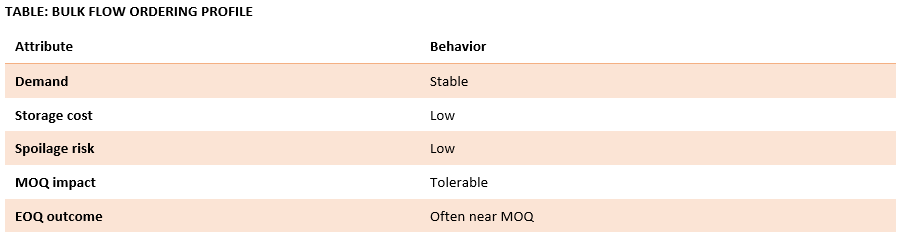
This is why buyers feel comfortable ordering by the crate or wagon.
Value Sensitive Products
Value-sensitive products behave very differently.
Demand is uneven. Storage is costly. Risk rises the longer goods sit idle. These products punish excess.
Here, EOQ is usually far lower than the supplier’s MOQ. Every unit above EOQ increases tied-up cash and write-off exposure.
Accepting MOQ without challenge becomes a structural risk, not a short-term inconvenience.
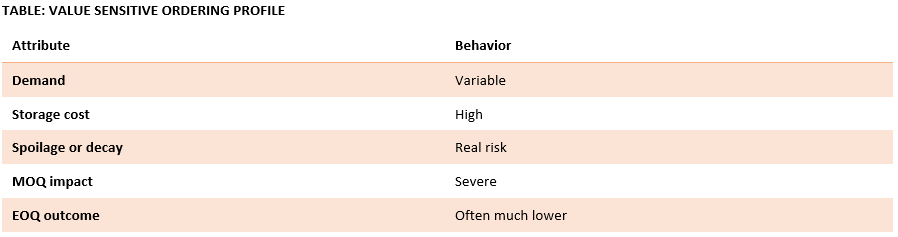
These products are where ordering discipline matters most.
MOQ and EOQ Within Product Strategy
MOQ and EOQ serve different masters.
The supplier sets the MOQ and reflects their cost structure. It is a constraint.
The business sets the EOQ and aligns it with total cost and working capital goals. It is a decision target.
The conflict arises when the MOQ exceeds the EOQ.
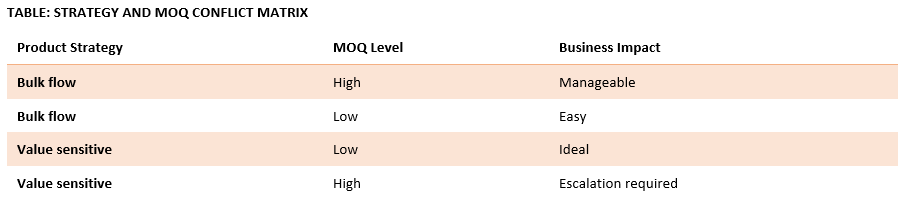
This matrix alone often explains why an order feels wrong before numbers are even reviewed.
Worked Example
Consider the case of a specialty alchemical ink, favored by scribes and guild clerks. Annual demand remains modest but consistent, while the supplier insists on large batch distillations. This setup creates a classic tension between what the business wants to order and what the supplier requires.
When MOQ Sits Above EOQ
Consider the case of a specialty alchemical ink, favored by scribes and guild clerks. Annual demand remains modest but consistent, while the supplier insists on large batch distillations. This setup creates a classic tension between what the business wants to order and what the supplier requires.
Scenario Setup: The company sells a specialty alchemical ink used by scribes and guild clerks. Annual demand is low but steady. The supplier only runs large batch distillations.
The following table summarizes the key assumptions for this scenario: annual demand is 50 vials, the supplier’s minimum order quantity (MOQ) is 500 vials, and the business’s calculated economic order quantity (EOQ) is 60 vials. Each vial costs 8 FSD, and the annual holding cost rate is 25%. By strategy, this ink is a value-sensitive product, making excess inventory a costly risk.
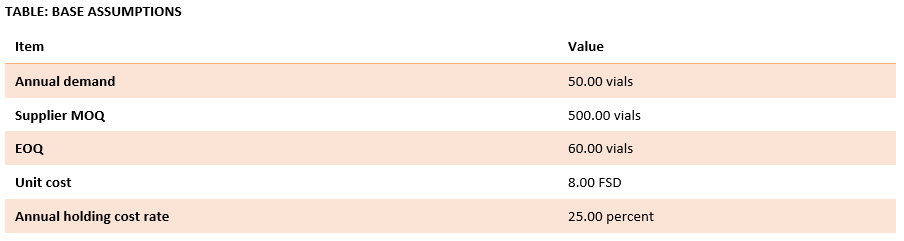
This is a value-sensitive product by strategy.
EOQ View: What the business would choose
If the business could order at its preferred EOQ, the numbers reflect a lean approach: 60 vials per order, a purchase value of 480 FSD, and an average inventory of 30 vials. Inventory value stays at 240 FSD, with an annual holding cost of just 60 FSD. Cash exposure is limited, and inventory turns efficiently.
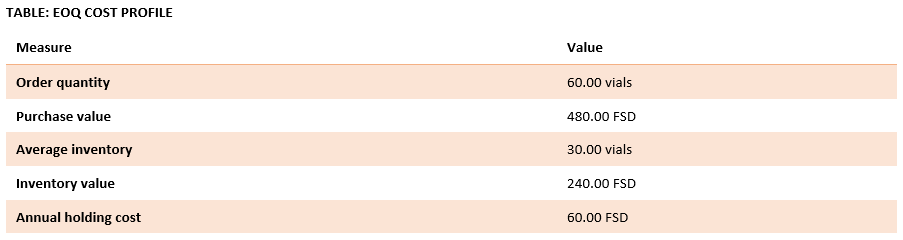
Cash exposure is limited, and inventory turns cleanly.
MOQ View: What the supplier requires
When the supplier’s MOQ dictates the order size, the impact is dramatic. The business must purchase 500 vials at once, tying up 4,000 FSD. Average inventory jumps to 250 vials, with a value of 2,000 FSD, and annual holding costs soar to 500 FSD. This approach locks up far more cash and increases the risk of unsold stock.
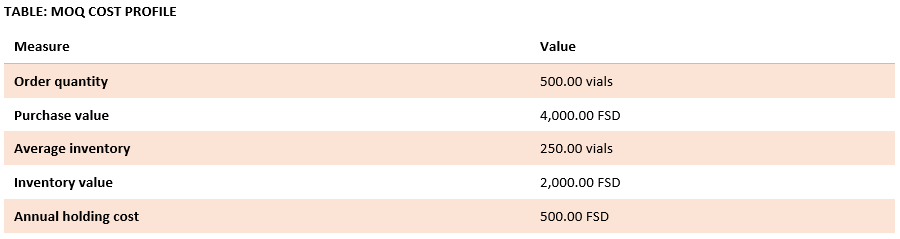
What Changed
Demand did not change. Unit cost did not change. Only the order quantity changed.
Cash tied up increased by 3,520.00 FSD. Annual holding cost increased by 440.00 FSD.
That difference lives entirely on the buyer’s balance sheet.
Making the Trade Off Visible: Buyer and Planner Checklist
Before placing an order that exceeds EOQ, teams should pause and answer the following.

Multiple No answers indicate that the order carries structural risk.
When This Becomes a Leadership Issue
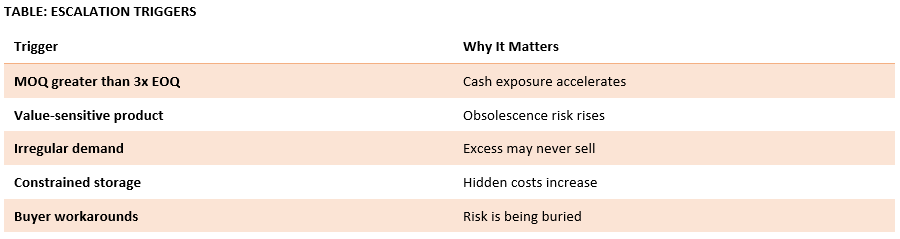
High MOQ on value-sensitive products should never be handled quietly.
These cases belong in sales and operations planning or integrated planning discussions, where demand, supplier strategy, and cash are reviewed together.
Negotiating With Strategy in Mind
Suppliers often defend MOQs on the grounds of unit price. That view ignores total cost.
Better discussions focus on shared value. Stable commitments, longer contracts, coordinated transport, or phased deliveries can lower MOQ pressure without harming supplier economics.
Strategy provides the leverage. Quantity follows.
Other Ordering Strategies to Consider Beyond MOQ and EOQ
MOQ and EOQ frame the core tension between supplier constraints and internal cost control. The company also uses additional ordering strategies to fit product behavior, demand visibility, and risk tolerance. These approaches complement MOQ and EOQ rather than replace them.
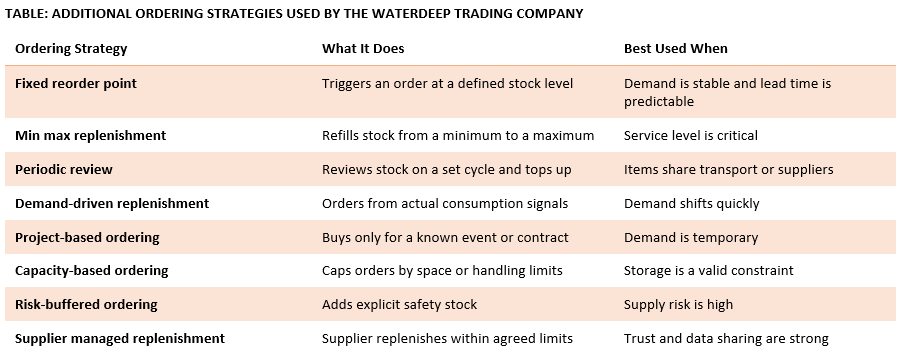
These strategies let planners express product intent clearly. A healing potion may use min-max replenishment to protect service, while festival banners use project-based ordering to avoid leftovers.
Final Thoughts
Order quantity is not neutral. It reflects how a product creates value.
Bulk flow goods reward scale. Value-sensitive goods punish excess. MOQ is a constraint imposed from outside. EOQ is a choice made within the business.
When teams connect product strategy to ordering behavior, trade-offs become visible, intentional, and easier to lead.
Support the AD&D365 Project on Patreon. To grow this world, we’ve launched an official Patreon page where supporters can access exclusive content, tools, and training labs, and even influence the project’s future. Your support fuels more than just development; it expands the guildhall, forges new scrolls, and empowers the next generation of configuration wizards. Begin your journey: https://www.patreon.com/adnd365/
A Grateful Salute to Our Patrons. To all those who stand behind the vision, thank you for helping bring this world to life. Our Benefactors, Andre Breillatt and Eryndor Fiscairn‡, your boundless generosity fuels the arcane core of this project. Without your magic, the weave would falter. Our Apprentices, the spell engines turn, and the training labs thrive thanks to our current Apprentices: Michael Ramirez and Andreth Bael’Rathyn‡. Special thanks to our past Apprentices, whose contributions helped us get here: Ralf Weber, Wendy Rijners, Shashi Mahesh, Julia Tejera, Ben Ekokobe, Tiago Xavier, Naveen Boyinapelli, Marcos Tadeu Wolf, Kathryn Greene, Jason Brown, Mark Christy, and Ashish Singh. Our Initiates, Jesper Livbjerg, Peter Lorre, Gregory Brigden, and Martin Grahm, your commitment marks the start of the deeper path, stepping beyond mere observation into the active shaping of this realm. Our Followers, your steady presence along the journey is a beacon of encouragement: Rusty Cavalier, Eric Shuss, Sunil Panchal, Sarah D. Morgan, Nick Ramchandani, Daniel Kjærsgaard, and Tomasz Pałys. And our Voyeurs, Harry Burgh, Abdelrahman Nabil, and Basil Quarrell, ever watching from the shadows, clearly intrigued… but not enough to part with a single gold piece. Your silent curiosity is noted and mildly judged.
Want to design your own economic models in Faerûn? Get your own AD&D365 Environment and guides at adnd365.com/start, and request access to the public view of the current database at https://public.adnd365.com – Login npc@adnd365.com, Password N0nPl@yC#822!
 A Tinkerers Notebook