Cut Optimization in Faerûn: How the Waterdeep Trading Company Protects Yield and Margin
Within Faerûn, waste is rarely loud. It slips away in thin shavings of wood, in excess trim from a carcass, or in ribbon lengths that never quite fit an order. For the Waterdeep Trading Company, cut optimization is the discipline that prevents this loss. It is the practice of deciding how raw material is divided before the blade ever touches it. When done well, yield is predictable, costs stay stable, and pricing remains fair across guild contracts and city markets.
This article explains cut optimization as it is practiced by the Waterdeep Trading Company, using meat, timber, and ribbon as working examples. Each section shows how planned cuts outperform improvised ones, and why this matters to cost, inventory, and trust.
What Cut Optimization Is
Cut optimization is the planning of cut orders, dimensions, and allocations to maximize the share of raw material that becomes sellable goods. It applies wherever material cannot be restored once cut. In Faerûn trade, this includes butcher work, sawmills, cloth halls, and packaging workshops.
The purpose is not speed. The purpose is to achieve yield, consistency, and unit-cost control.
Why It Matters to Trade
Markets pay for finished goods, not for raw weight. A carcass, a log, or a ribbon spool all carry a fixed purchase cost. The only way to improve margin after purchase is to increase the portion of that material that becomes saleable stock.
Poor cutting raises the cost per unit without increasing the price. That loss manifests later as thin margins, stock shortages, or measurement disputes.
Meat Cut Optimization
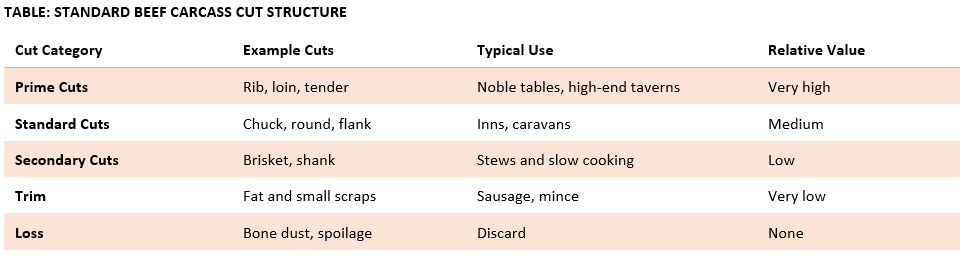
Meat cutting shows cut optimization at its clearest. A carcass has a fixed weight. Every cut choice shifts value between premium cuts, standard cuts, trim, and loss.
The following table shows how a standard beef carcass is divided for trade use. It is helpful for planners and butchers to share a standard structure.
The following table shows how yield varies with cutting quality. It highlights where discipline matters most.
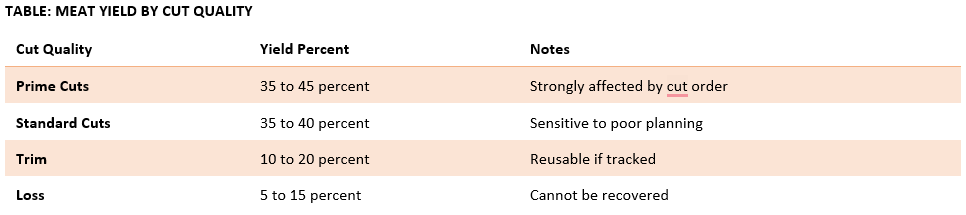
Cost impact follows directly from yield. This table explains why planners care about cutting standards.

Wood Cut Optimization
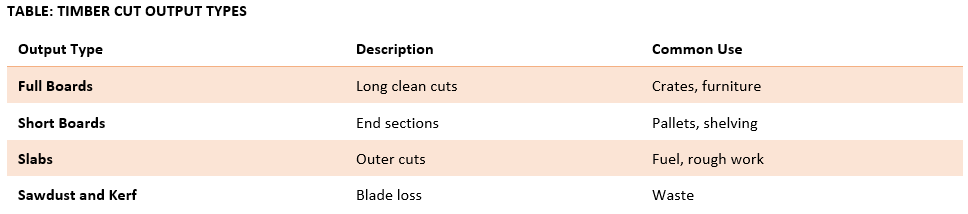
Timber behaves much like meat in economic terms. A log has a fixed volume. Waste hides in kerf loss, poor board layout, and random sizing.
The table below defines the main outputs from a log. It helps align sawyers, crate makers, and cost scribes.
Yield depends on planning. This comparison shows the difference.

Board size discipline also matters. The following table explains why standard lengths are favored.

Ribbon Cut Optimization
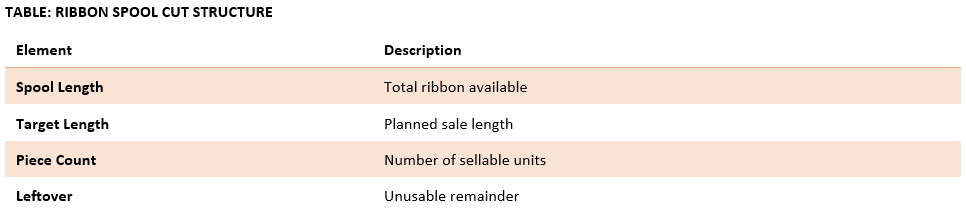
Ribbon and cloth are thin materials, but the same rules apply. Length planning determines whether value is realized or stranded.
This structure table defines how a spool is evaluated before cutting.
Cut outcomes vary sharply by planning discipline.

Cost follows the same pattern seen in meat and wood.

How the Company Applies These Rules
The Waterdeep Trading Company enforces cut plans before work begins. Primary cuts are reserved for known buyers. Secondary outputs are assigned to reuse streams. Trim is tracked rather than ignored. Actual yield is recorded and compared with the expected yield after each batch.
This turns cutting from a craft risk into a managed process.
Final Thoughts
Cut optimization is quite a lot of work, but it decides profit more often than price negotiation. Whether the blade meets meat, wood, or ribbon, the rule remains the same. Plan the cut, protect the yield, and never let waste hide inside the ledger.
Support the AD&D365 Project on Patreon. To grow this world, we’ve launched an official Patreon page where supporters can access exclusive content, tools, and training labs, and even influence the project’s future. Your support fuels more than just development; it expands the guildhall, forges new scrolls, and empowers the next generation of configuration wizards. Begin your journey: https://www.patreon.com/adnd365/
A Grateful Salute to Our Patrons. To all those who stand behind the vision, thank you for helping bring this world to life. Our Benefactors, Andre Breillatt and Eryndor Fiscairn‡, your boundless generosity fuels the arcane core of this project. Without your magic, the weave would falter. Our Apprentices, the spell engines turn, and the training labs thrive thanks to our current Apprentices: Michael Ramirez and Andreth Bael’Rathyn‡. Special thanks to our past Apprentices, whose contributions helped us get here: Ralf Weber, Wendy Rijners, Shashi Mahesh, Julia Tejera, Ben Ekokobe, Tiago Xavier, Naveen Boyinapelli, Marcos Tadeu Wolf, Kathryn Greene, Jason Brown, Mark Christy, and Ashish Singh. Our Initiates, Jesper Livbjerg, Peter Lorre, Gregory Brigden, and Martin Grahm, your commitment marks the start of the deeper path, stepping beyond mere observation into the active shaping of this realm. Our Followers, your steady presence along the journey is a beacon of encouragement: Rusty Cavalier, Eric Shuss, Sunil Panchal, Sarah D. Morgan, Nick Ramchandani, Daniel Kjærsgaard, and Tomasz Pałys. And our Voyeurs, Harry Burgh, Abdelrahman Nabil, and Basil Quarrell, ever watching from the shadows, clearly intrigued… but not enough to part with a single gold piece. Your silent curiosity is noted and mildly judged.
Want to design your own economic models in Faerûn? Get your own AD&D365 Environment and guides at adnd365.com/start, and request access to the public view of the current database at https://public.adnd365.com – Login npc@adnd365.com, Password N0nPl@yC#822!
 A Tinkerers Notebook