Archive

Monthly Archives: April 2025

When Greta Ironfist founded the Waterdeep Trading Company, she knew that managing the flow of goods across the Sword Coast would be just as critical as sourcing rare herbs or distilling the finest spirits. In Faerûn, transportation isn’t just about moving cargo — it’s about surviving treacherous roads, stormy seas, and even aerial piracy.

Today, the Waterdeep Trading Company powers its shipping operations with Dynamics 365 Supply Chain Management – Transportation Management. Let’s take a closer look at how they model freight rating and routing to thrive in a world of dragons, bandits, and booming trade.

Setting Up Rating Structures: Costing Freight the Faerûnian Way

In Dynamics 365 Transportation Management, Rate Masters and Rate Charges define how costs are calculated. Waterdeep Trading Company configures their freight rates using both weight and distance (leagues traveled) — just like a merchant caravan master would charge in the Realms.

Each of the company’s preferred carriers is modeled with custom rating rules:

Example Setup in D365:

  • Rate Base Type: Weight × Distance
  • Rating Method: Rate engine calculates total cost during load planning.
  • Freight Classes: Different categories for standard goods, perishables, and magical cargo (surcharge applied).

Route Planning: Choosing the Best Way to Move Goods Across Faerûn

Using Rate Route Plans in Dynamics 365, Waterdeep Trading Company defines how goods are routed:

Each route includes transit times, distance calculations, and alternate routing if a carrier is unavailable (for instance, if pirate attacks delay a sea convoy).

Example Setup in D365:

  • Hub Types: Seaport Hub (Waterdeep Dock Ward), Airship Port Hub (Sky Dock), Caravan Hub (Trade Gate)
  • Transit Distance Tables: Leagues between key hubs calculated to automate costing.
  • Route Guides: Preferences for low-cost (sea) vs. high-speed (air).

Freight Execution: Dynamic Mode Selection in Action

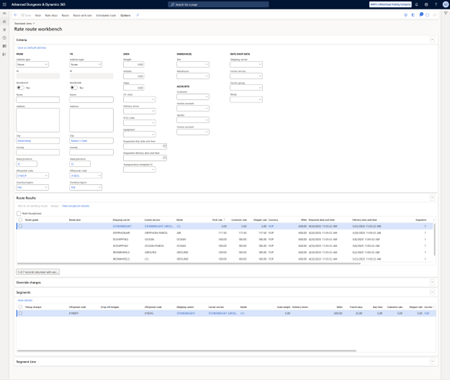
When a sales order is created (say, shipping 300 lbs of moonshine to Baldur’s Gate), D365 automatically:

  1. Calculates shipping cost for each mode:
    1. IronWheels: 300 lbs × 0.1 gp × 250 leagues = 7500 gp
    1. Gryphon Air: 300 lbs × 0.16 gp × 250 leagues = 12,000 gp
    1. Sword Coast Sea Freight: 300 lbs × 0.015 gp × 250 leagues = 1125 gp
  2. Suggests the best option based on customer priorities (cost vs. speed).
  3. Books the load, assigns the carrier, and generates a bill of lading — whether that’s by wagon, gryphon, or ship!
The Benefits to Waterdeep Trading Company

  • Lower Transportation Costs: Bulk shipments sail cheaply by Sword Coast Sea Freight.
  • Faster Customer Deliveries: Urgent magical scrolls or potions ship via Gryphon Air.
  • Optimized Resource Allocation: Caravans are filled smartly, reducing deadhead miles on the Trade Way.
  • Resilient Network: Dynamic route fallback keeps the business moving even during pirate attacks or magical storms.

Why Rating and Routing Matter in Faerûn and Beyond

Transportation Management in Dynamics 365 lets Waterdeep Trading Company navigate the complexities of Faerûn’s trade like seasoned merchant princes. By building smart rating structures and flexible routing plans, they can deliver anything, anywhere — whether it’s barrels of moonshine, crates of enchanted herbs, or bundles of rare textiles.

And the best part? Greta Ironfist always knows that no matter the obstacles, Waterdeep Trading Company will deliver.

Want to master Transportation Management for your own Faerûnian trading company (or your real-world supply chain)?

Download the Advanced Dungeons & Dynamics 365 Guides at adnd365.com/start and embark on your own logistics adventure!

In a world where regional identity matters as much in governance as in business, aligning your financial operations to the local calendar of record is more than a cultural gesture—it’s good operational practice. For companies trading across Faerûn, like the Waterdeep Trading Company, that means organizing time not by “January” or “March,” but by Hammer, Ches, and Eleint.

Within Dynamics 365 Finance & Operations, configuring and referencing financial periods by their Harptos names—complete with intercalary feast days like Greengrass and Midsummer—gives your teams, accountants, and auditors a shared language grounded in the world you operate in.

Why Use Harptos Period Names?

Cultural Alignment with Clients and Guilds: Referencing your closing books in Nightal or mid-year budgets during Kythorn aligns you with local practice. Guilds expect ledgers and contracts to reference these dates—not foreign imports like April or November.

Clarity in Communication: When reporting timelines, forecasting seasonal sales, or discussing period-based tariffs or tithes, consistency matters. Everyone from tax auditors in Cormyr to procurement officers in Baldur’s Gate understands “Greengrass” as a distinct operational moment.

Strategic Planning: Seasons in Faerûn impact trade, inventory, and production cycles. Planning harvest inventories for distribution in Marpenoth or prepping for port slowdowns during Midsummer isn’t just thematic—it’s operationally sound.

Compliance with Realm-Specific Regulations: Certain city-states or regions may require financial declarations or trade logs to be submitted by specific feast days or by end of periods like Uktar. Using Harptos periods directly supports these localized requirements.

What You See in the System

In the configuration shown, each Harptos month—including single-day intercalary periods like Midwinter, Greengrass, Midsummer, Highharvestide, and The Feast of the Moon—has been explicitly defined. This approach preserves the spirit of Faerûn’s calendar while maintaining accuracy for financial period tracking and quarterly reporting.

These aren’t just decorative names—they’re functional, reportable periods. A shipment booked on Midsummer, an invoice due by the end of Marpenoth, or profits reconciled during the Feast of the Moon—each now ties into a financial structure that matches your world.

Final Thoughts

By tracking time in Harptos periods, you’re doing more than localizing your finance module—you’re embedding your business into the daily rhythm of the world you operate in. In realms where tradition shapes law and law shapes trade, this choice isn’t just logical.

It’s essential.

 Want to implement this for your own fantasy or hybrid business setup? Download the Advanced Dungeons & Dynamics 365 Bare Bones Configuration Guides and start your journey at adnd365.com/start.

In the complex and often perilous world of Faerûn, overland trade remains one of the lifelines of regional commerce. Understanding the costs, risks, and logistics of transporting goods between cities is crucial for trading companies, merchant guilds, and caravan operators alike. This article examines the full cost breakdown of transporting goods via horse-drawn caravan from Waterdeep to Dagger Falls, following the more direct and strategic route through Secomber, Loudwater, Llorkh, and the Black Road through the Empire of Shadows.

Overview: Route Summary

The total journey from Waterdeep to Dagger Falls covers 155 leagues, approximately 465 miles, and takes about 15.5 days under average conditions. The route chosen offers a faster but riskier alternative to the northern passage through Silverymoon.

Route Segments

Daily Operational Costs

To estimate full journey expenses, we begin by calculating the daily baseline costs for one standard merchant wagon. These include wages, lodging, maintenance, and overhead.

Basic Daily Costs per Wagon

Hazard Pay and Risk Premiums

Traveling through the Empire of Shadows and the Black Road requires additional security and preparation. Shadowspawn, undead, and political hostilities can add risk-based costs.

Additional Risk-Based Costs

Total Transportation Cost Estimate

With both daily operational costs and risk premiums calculated, we can summarize the full cost for one wagon making the 15.5-day journey.

Final Journey Cost Summary (Per Wagon)

This cost is for one standard wagon. Larger caravans, or those transporting magical goods, should expect higher totals due to increased security needs.

Considerations for Merchants and Caravaneers

  • Insurance: Some merchant guilds offer limited insurance or replacement value for losses due to attack or theft.
  • Teleportation Circles: Licensed teleportation may be available from Silverymoon or Hillsfar, but costs begin at 500 gp one-way, plus registration fees.
  • Cargo Valuation: Goods like dwarven steel, moonshae wine, or spell components may justify the cost and risk of direct overland shipment.

Conclusion

Whether you are a small-scale trader or a major trading company like the Waterdeep Trading Company, understanding the cost structures of overland routes is vital for planning logistics and maximizing profit margins. The Waterdeep to Dagger Falls route via Secomber and the Black Road offers speed, but also risk—and cost. Proper planning, appropriate guard contingents, and clear expectations on tolls and bribes are essential.

To explore how you can set up full logistics operations, merchant trade networks, or configure route-based cost tracking inside Dynamics 365, get the Advanced Dungeons & Dynamics 365 Bare Bones Configuration Guides at:

adnd365.com/start

These guides provide the foundation for modeling travel, trade, inventory, and cost management within your fantasy economy—whether for business or adventuring campaigns.

The bustling wards of Waterdeep hum with trade, alchemy, and ambition. Among the city’s most respected guilds, the Waterdeep Trading Company (WDTC) stands out for blending economic savvy with magical expertise. To meet a surge in demand for enchanted elixirs and arcane reagents, WDTC is expanding its production capacity by building a second distillation wing in the North Ward.

But in a city governed as much by guild charters as it is by gravity, managing construction isn’t just a matter of bricks and beams—it’s about managing time, cost, and control. That’s where Dynamics 365 Project Management and Accounting proves invaluable.

Project Overview

Below is a snapshot of the expansion project managed within Dynamics 365:

Project NameArcane Distillery Expansion – North Ward
Project IDWDTC-PRJ-001
Project TypeInvestment
StatusIn Progress
Legal EntityWaterdeep Trading Company (WD)
LocationNorth Ward, Waterdeep
Project ManagerAva Thompson
Capital Asset GroupMagical Infrastructure

This expansion aims to double potion output and install leyline-powered extraction towers and rune-etched containment vaults for sensitive magical substances.

Work Breakdown Structure (WBS)

The WBS is configured in Dynamics 365 to plan and allocate tasks efficiently:

Task IDTask NameDurationResource Group
1.1Site Preparation10 daysConstruction Crew
1.2Alembic Tower Foundations15 daysElemental Engineering
1.3Rune Chamber Install12 daysArcane Masonry
1.4Essence Pipeline Extension8 daysMagical Infrastructure
1.5Vault of Essences Securing7 daysSecurity & Enchantments
1.6Final Testing & Certification5 daysAlchemy QA Team

By assigning work to both mundane and magical resource groups, the system ensures seamless coordination between artificers, masons, and administrators.

Budget and Forecasting

Dynamics 365 allows WDTC to monitor real-time variances and cost trends throughout the project:

Cost CategoryEstimated CostForecast Variance
Labor25,000 gp–1,000 gp
Materials (Mithral)12,000 gp+500 gp
Magical Components15,000 gp0
Subcontractors10,000 gp–750 gp
Overhead & Freight3,500 gp+200 gp
Total65,500 gp

Capitalization Details

Once the construction is complete and inspected, the assets are automatically capitalized using D365 rules:

Asset DetailValue
Asset GroupDistillery Machinery
Fixed Asset TypeInfrastructure – Magical
Capitalization TriggerProject Completion & Inspection
Depreciation Profile10-Year Straight Line

By mapping projects to fixed asset profiles, WDTC ensures the magical distillery is accounted for properly on the ledger.

Project Notes

The project includes dynamic conditions tracked through user-defined fields in Dynamics 365:

  • Inspection required by the Guild of Arcane Safety
  • Elementals bound into the heating array must be re-certified every 180 days
  • Experimental batches are flagged with special tracking statuses in inventory

The Value of Project-Based Construction in D365

This isn’t just a distillery expansion—it’s a model for how to run high-stakes, guild-regulated construction using modern ERP tools. The Waterdeep Trading Company uses Project Management and Accounting in Dynamics 365 to tame complexity, empower its project leads, and deliver results across timelines, budgets, and magical boundaries.

Whether you’re building a potion vault, an airship dockyard, or a golem factory, the Projects module in D365 offers structure, clarity, and complete control.

Begin Your Journey Toward Magical ERP Mastery

To learn how to configure WBS structures, investment project types, and fixed asset transitions for magical infrastructure, download the Advanced Dungeons & Dynamics 365 Bare Bones Configuration Guides.Get started now at adnd365.com/start and transform your fantasy enterprise—one ledger-bound leyline at a time.

In the cities and farmlands of Faerûn, trade flows like water through the continent—vital, ever-changing, and affected by forces both natural and magical. To help traders, governments, and guilds make sense of this dynamic economy, the Faerûnian Commodities Exchange (FCEX) and its regional partners maintain a set of Faerûn Price Indexes (FPIs)—standardized benchmarks that track the value of common goods across the continent.

Whether you’re a merchant prince in Calimport or a dwarven brewer in Citadel Adbar, understanding price indexes can help you make better decisions, hedge against regional volatility, and forecast your next profitable move.

What Is a Price Index?

A price index is a numerical value representing the average price level of a selected group of goods over time. In Faerûn, each index is tied to a commodity category and adjusts based on:

  • Supply and demand
  • Regional scarcity or abundance
  • Seasonal factors
  • Political or magical disruptions

Price indexes allow merchants and record-keepers in Dynamics 365 Finance to automate price adjustments, simulate market events, and guide inventory valuation.

The Core Faerûn Price Indexes

These indexes are recalculated monthly and regionally, using weighted average pricing from participating exchanges.

Here are the primary FPIs maintained by FCEX:

Example: Price Calculation Using FPI

Let’s say you’re trading wheat in Baldur’s Gate. The FPI-GRNS is currently at 108.0. The base price per bushel is 1.00 gp, and the current regional modifier is +5% (due to local demand).

Final Price = Base Price × (FPI / 100) × (1 + Regional Modifier)

Calculation:

1.00 × (108 / 100) × (1 + 0.05) = 1.134 gp per bushel

Thus, the trader should price wheat at 1.13 gp per bushel in current market conditions.

Magical & Seasonal Adjustments

Faerûnian indexes are also responsive to magical anomalies and seasonal trends. For example:

  • Winter: +10% to grain and livestock indexes
  • Festival Month (Mirtul): +15% to Moonshine Index
  • Arcane Drought in Thay: +20% to Alchemical Index

These modifiers can be simulated in Dynamics 365 using Price Adjustment Journals linked to market events or custom financial dimensions.

Dynamics 365 Integration Example

In Dynamics 365 Finance, FPIs can be integrated using:

  • Trade Agreements for commodity contracts
  • Inventory Revaluation Journals for cost layer updates
  • Price Simulation Models using seasonal and regional modifiers
  • Procurement Policies to enforce index-based pricing

You can even create a custom Price Index table to adjust costs across product hierarchies automatically.

Sample Commodity Index Table

Building a Resilient Economy with FPIs

Using Faerûn Price Indexes provides:

  • Transparency in trade
  • Fair valuation across regions
  • Simulation of economic events
  • Seamless integration into ERP systems

Whether you’re a guild accountant or a caravan master, understanding the FPIs is essential for navigating the financial landscape of the realms.

Want to Use FPIs in Your Game or Business?

Download the official Faerûnian Trader’s Handbook and FCEX Pricing Templates at: adnd365.com/start

You’ll gain access to:

  • Pre-built Excel pricing sheets
  • Trade agreement configuration files
  • Market simulation tools for Dynamics 365

In Faerûn, wealth isn’t just held in coin—it bleats, moos, and occasionally tries to escape from the back of a cart. While cities like Waterdeep rely heavily on minted currency, rural economies and frontier settlements often prefer bartering with livestock, especially sheep and cows, as their primary medium of exchange. In these markets, currency management goes far beyond decimal places and exchange rates—it’s measured in hooves and wool.

Trading Livestock: The Art of the Barter Deal

Sheep and cows are among the most commonly traded animals across Faerûn. Instead of fixed coin prices, their value is often expressed in livestock equivalents or agreed-upon barter deals. For example, a farmer in Daggerford might offer 3 sheep for 1 milk cow, while a merchant in Silverymoon agrees to trade 2 cows for a refurbished wagon and a barrel of smoked fish.

Barter agreements like these introduce valuation risks—a form of unrealized gain or loss if the agreed deal differs from market value at settlement.

Example:

If Greta Ironfist agrees to trade 1 cow (normally valued at 12 gp) for 10 sheep (normally valued at 1 gp each), she’s made a paper gain of 2 gp—but only if she manages to offload those sheep at market value. If the market crashes and sheep drop to 0.8 gp each, she’s suddenly facing a realized loss of 4 gp.

Tracking Unrealized Gains & Losses in Dynamics 365

Using Dynamics 365 Finance, organizations can manage livestock like any asset class, and track fluctuations through barter transactions:

 Configure posting profits to book gains/losses into:

  • 8150 – Unrealized Currency Gains
  • 8200 – Realized Currency Gains
  • 1400 – Livestock Inventory (customized by type)

 Sheep Equivalency Table

To help standardize barter pricing, many trading companies and farming cooperatives use equivalency tables. These values adjust seasonally, but the table below offers a standard baseline used by the Waterdeep Trading Company:

These equivalencies are often posted on chalkboards in guild halls and auction houses, with exchange rates adjusted based on region, season, and demand.

Livestock Valuation Strategy in Faerûn

Using barter pricing as the standard means the value of livestock acts like floating currency, influenced by:

  • War or Famine: Raises cow values, lowers sheep (if feed is short)
  • Seasonal Demand: High wool prices in winter increase sheep value
  • Regional Trade Routes: Supply constraints affect prices dramatically

In D365, livestock can be managed with inventory journals that reflect changes in expected barter value. These changes trigger unrealized gains or losses until settlement occurs—when those numbers become very real on the books.

Final Thoughts: Counting Sheep in the Ledger

Managing currency in Faerûn isn’t just a matter of coins—it’s about contracts and creatures. By treating livestock as movable wealth, Faerûnian traders and companies like the Waterdeep Trading Company bring agility and realism to their accounting.

When you track sheep like silver and cows like coin, the only limit is how fast your ledgers—and your livestock—can move.

Ready to track your herd and harvest your profits? Download the Advanced Dungeons & Dynamics 365 Bare Bones Configuration Guides at adnd365.com/start and bring order to your beasts.

In the bustling streets of Waterdeep, the steaming forges of Mithral Hall, and the drifting markets of Calimport, one universal truth binds all enterprises together: people problems.

Whether you’re managing a trade guild, a distillery, or an adventuring company, HR headaches in Faerûn are as abundant as kobolds in a cave. Disputes, misfiled contracts, guild violations, magical misconduct, and improper planar onboarding can bring even the most powerful organization to its knees.

Thankfully, Dynamics 365 Finance & Operations provides the structure needed to handle even the most dramatic workforce drama—without needing a Wish spell.

Common HR Problems Across the Realms

Let’s start with the reality of managing people in a world filled with swords, scrolls, and spellplague survivors.

“My shift partner’s undead!”

Some undead labor is technically legal in Thay and certain parts of Skullport. But in Baldur’s Gate? A huge violation of city ordinance 12-B.

Solution in Dynamics 365: Use employee classifications and location-based compliance rules to flag non-compliant workforce assignments. Assign undead entities to shadow shifts where legal—and restrict their presence in jurisdictions where complaints are likely.

“I was promised meditation leave and you gave me a bunk!”

Elves don’t sleep. Everyone knows this. But your procurement manager didn’t, and now your moon elf accountant is furious.

Solution in Dynamics 365: Custom leave types and work schedule templates can be configured by race or heritage group. You can assign “Trance Breaks” to elves, “Clan Assembly Days” to dwarves, or “Lunar Cycles” to lycanthropes.

“That artificer keeps casting Suggestion in team meetings.”

Workplace enchantment is a real problem. It leads to false agreements, charmed signoffs, and very confused payroll clerics.

Solution in Dynamics 365: Maintain disciplinary records tied to magical misconduct. Flag certain spell usage through custom compliance workflows. Even trigger auto-notifications when a meeting participant is on a “Magically Influenced” watchlist.

“My complaint scroll was never answered.”

Complaint scrolls tend to pile up—especially if your HR team is one scribe and a talking raven.

Solution in Dynamics 365: Implement a case management system within HR modules. Each grievance gets tracked by priority, type (harassment, safety, magical interference), and resolution timeline. You can assign investigators (clerics, HR officers, or neutral bards) and send automated updates to complainants.

“The Guild of Appraisers says we broke three oaths this quarter.”

Guild compliance isn’t optional. Violate the rules of the Guild of Alchemists and you might find your potions sour and your licenses revoked.

Solution in Dynamics 365: Use certification tracking and rule-based compliance engines. Link workers to guilds, set expiration dates on certifications, and receive alerts for renewal deadlines or breaches. You can even assign guild-specific workflows for disciplinary action.

Other Problem Areas Solved by D365

Tracking Grievances with Precision

The Employee Issue Log in Dynamics 365 allows you to:

·         Categorize issues by type, realm, or department.

·         Log witness accounts (including illusions, scryed recordings, or divine visions).

·         Track resolution steps, disciplinary measures, and restitution.

·         Assign arcane or divine investigators, if needed.

You can even use Power BI dashboards to visualize issues by source, region, or frequency—helpful when trying to reduce fireball-related workplace accidents.

Final Thoughts: From Complaint to Compliance

Faerûn is wild, wonderful, and wholly unpredictable. That’s what makes it so magical. But whether you’re running an airship company out of Lantan or a potion bottling plant in Rashemen, your workforce is your most volatile (and valuable) asset.

With Dynamics 365, you can tame the chaos—ensuring every worker, from kobold courier to celestial consultant, feels heard, respected, and governed by fair (and realm-appropriate) rules.

Want to know how to configure these systems step by step?

Check out the Advanced Dungeons & Dynamics 365 Bare Bones Configuration Guides—your spellbook for solving HR crises, building workforce workflows, and ensuring guild compliance across the Realms.

Buy your copy today at adnd365.com/start Master the magic of workforce management, one configuration scroll at a time.

When adventurers in Faerûn tally their loot, when merchants count their wares in the bustling streets of Waterdeep, or when a dwarven stillmaster measures out moonshine in the Underdark—there’s one thing they all rely on: units of measure. But unlike our modern world of liters, kilograms, and miles per hour, Faerûn’s systems are delightfully inconsistent, hyper-regional, and infused with centuries of tradition, trade, and even magic.

Let’s take a tour through the wonderfully eclectic system of measurement in the Forgotten Realms.

Quantity Units: From Pieces to Pallets

Faerûnian traders deal in discrete units when counting physical goods—especially when it comes to adventuring gear, weapons, fabric, or food.

Weight Units: Medieval Heft with Mystical Variance

Faerûn may lack precision scales in every village, but weight still matters—especially to caravan masters and tax collectors.

Different regions may also use local names (like “kiv” in Rashemen or “zenk” in Thay), each reflecting unique cultural needs.

Volume Units: Casks, Jars, and Magical Bottles

Alchemists, distillers, and apothecaries are fastidious about their liquids—whether it’s healing potion or dwarven ale.

Magical volumes may defy expectations—a decanter of endless water, for example, does not comply with any rational standard.

Length and Fabric: From Elves to Ells

Clothiers and mapmakers in Faerûn often measure in units both familiar and fantastical.

Some elven cultures use units like the “moonstep” (about 3.3 feet) or the “petal’s fall” (a subjective unit of time/distance).

Area and Agriculture: For Land, Fields, and Armies

Land grants, farming plots, and battlegrounds are measured in larger units.

Magic and Alchemical Units

The arcane arts introduced unique measurements for magical substances and energies:

  • “Casting” (cst): One complete spell effect, used in crafting and alchemy.
  • “Soul-shard”: A necromantic unit for capturing essence (not legally recognized in Waterdeep).
  • “Pinch,” “Smidgen,” “Dash”: Extremely small units often used in potion brewing and cooking—especially halfling kitchens.

Standardization… Or Not

Faerûn doesn’t have a single standards board—each city, guild, or kingdom may have their own versions of the same unit. Thankfully, major trade cities like Waterdeep, Baldur’s Gate, and Calimport have codified equivalents for inter-regional commerce. Some larger organizations—like the Lords’ Alliance—even issue measurement tokens to help travelers convert between standards.

Final Thoughts

Units of measure may seem mundane, but in a world of dragons, liches, and flying ships, they’re a grounding force. Whether you’re an adventurer dividing loot, a merchant measuring goods, or a mage crafting potions, understanding these units means operating safely and fairly in a realm where even the size of a spoonful could mean life or death.

And in case you’re setting up inventory in Dynamics 365 for the Waterdeep Trading Company—yes, we’ve mapped all these units into the Item Master for you in The Advanced Dungeons & Dynamics 365 book series takes you deeper into magical business systems with step-by-step setups, fantasy examples, and real ERP strategy.

Grab your copy today and contract with confidence at adnd365.com/start

In the vast and diverse realms of Faerûn, long-distance communication is as varied as its landscapes—from the bustling trade roads of Waterdeep to the planar corridors of Sigil. Unlike the predictable flow of email or phone calls in our world, sending a message across Faerûn could involve a raven, a wizard, or a mirror infused with ancient magic. This article explores the rich tapestry of communication methods used across the Forgotten Realms—and how these can be modeled within systems like Dynamics 365.

Mundane Means: The Backbone of Civil Messaging

For most citizens, long-distance communication is still a matter of roads, sails, and wings.

Messenger Services

Guild-backed or freelance couriers carry written letters and parcels between towns, often accompanied by wax-sealed documents or sigil-marked containers. Common in trade hubs and capitals.

  • Identification Format: CourierRouteID, DeliveryCode, or RecipientName

Carrier Birds

Ravens, pigeons, and magical avians are trained to deliver messages to fixed posts or homes. A small scroll tied to their leg may carry orders, love notes, or secret codes.

  • Identification Format: BirdTagID, AviaryCode, SealSymbol

Semaphore Towers & Signal Fires

Large cities and military outposts maintain visual signaling systems—towers equipped with rotating arms or flame signals that convey simple coded messages line-of-sight across great distances.

  • Identification Format: TowerID, SignalCode, FactionCipher

Magical Communication: Instantaneous and Expensive

Magic enables faster communication—but only for those with coin, connections, or spell slots to spare.

Sending (Spell)

With a mere 25 words, a caster can contact someone across planes. Used by adventurers, diplomats, and guildmasters alike.

  • Identification Format: TrueName, ArcaneSigilID, MentalLinkCode

Sending Stones

Enchanted pairs of stones allow once-per-day communication between bonded users. Common among merchant princes and noble houses.

  • Identification Format: StonePairID, RunicEngravingCode, MagicalSignature

Teleportation Messenger

For urgent and high-value communications, an entire person may be teleported to deliver the message directly.

  • Identification Format: TeleportationCircleID, MessengerBadgeID, ArcaneDestinationCode

Animal Messenger

A druid or ranger may whisper words into a squirrel’s ear and send it cross-country with a short verbal message.

  • Identification Format: DruidicMark, AnimalTrackingID, NaturalRouteCode

Mirror of Communication

Perhaps the most luxurious method, these enchanted mirrors provide visual two-way contact—essentially the FaceTime of Faerûn.

🪞 Mirror ID Format:

MIR-<RegionCode>-<UserCode>-<SeqNum>

Examples:

  • MIR-WD-GRI-001 → Mirror in Greta Ironfist’s Waterdeep office
  • MIR-SG-SIG-045 → Portal Chamber Mirror in Sigil
  • MIR-FA-MRK-003 → Merchant House Relay Mirror

Institutional Networks: Communication at Scale

Major organizations employ layered systems blending magic and muscle.

OrganizationCommunication MethodsID Format Examples
HarpersCiphered magical messages, shadow informantsShadowAlias, CipherName, HarpTokenID
Lords’ AllianceFormal letters, couriers, Sending, diplomatic envoysOfficialSealID, AllianceChannelCode
Thayan EnclavesArcane relay crystals and magical scrollsRedWizardSigil, EnclaveID, ThayanEyeID
Merchant GuildsMessage stones, ravens, private teleport networksTradeLinkID, GuildCipherCode, MarketRelayID

Optional System Fields in D365

Field NameFormat ExampleDescription
MirrorCommIDMIR-CO-LDR-001Used for mirror-linked contacts
SendingStoneIDSND-FAC-TR-02Tracks paired stones
CourierRouteCodeCR-ZAK-MKT-034Identifies courier logistics
PlanarChannelIDPLN-AST-TR-07For extraplanar messaging
GuildRelayCodeTRD-WD-WTC-001For commercial messaging and trade alerts

Bringing It Into Dynamics 365

Within Advanced Dungeons & Dynamics 365, these communication tools can be configured and tracked for business purposes:

  • Contact Info Fields:
    • Magical Communication ID, Courier Channel Code, Mirror ID
  • Custom Tables for Mirrors and Stones:
    • Mirror registry using MIR-WD-GRI-001 format
    • Sending Stone assignments with limited message quotas
  • Workflow Triggering:
    • A Sending spell could correspond to an automated alert or approval request
    • Mirror communications can be logged like Teams or Zoom sessions
    • Courier routes assigned to Purchase Orders in Trade & Logistics

Final Thoughts

Long-distance communication in Faerûn is not just a means to transmit information—it’s a reflection of class, access to magic, and guild infrastructure. By modeling these systems in Dynamics 365, your campaigns or simulations can reflect the strategic depth and immersive world-building Faerûn is known for.

So whether you’re dispatching a raven, dialing into a mirror, or casting your words across planes—just remember to include your Magical Signature.

Faerûn Communication ID Registry (Sample Entries)

Entity / IndividualCommunication TypeExample Communication IDNotes
Greta Ironfist (WDTC Owner)Mirror of CommunicationMIR-WD-GRI-001Primary mirror in Waterdeep HQ
Sending StoneSND-GRI-WD-02Stone linked to Cormyr trade partner
Courier IDCR-WD-GRI-TR-013Used for Trade Route 13 between Waterdeep & Rashemen
Lords’ AllianceDiplomatic Seal CodeALN-SWD-023Standard alliance cipher for Sword Coast emissaries
The HarpersCipher AliasHARP-SHADOW-W-59Assigned to Western Harp Cell operative
Sending Node IDSND-HRP-NW-77Used in Neverwinter Arcane Relay
Thayan Enclave – Baldur’s GateRelay Crystal IDRLY-THA-BG-001Arcane communication crystal bound to Thay HQ
Enclave CodeENC-BAL-RZ-34Enclave-specific encrypted address ID
Lara Arvensdottir (Lara’s Fabrics)Carrier Bird IDRAV-LAR-TR-11Routinely used for textile orders to Amn
Mirror of CommunicationMIR-WD-LAR-002Shared mirror with the Clothiers’ Guild
Archmage Khelben “Blackstaff”Arcane Channel IDARC-BLK-STAFF-001Secure planar comm ID to Mystra’s court
Mirror of CommunicationMIR-WD-KBS-999High-clearance mirror, sigil-locked
Zhentarim Central CommandSecure Sending RelaySND-ZHE-DARK-03Routed through Darkhold’s network
Black Network Courier CodeCR-ZHE-BLK-OP-117Used for high-value message runners
Elminster of ShadowdalePlanar Message ThreadTHR-ELM-SHAD-AST-1Cross-plane Astral transmission via Sigil Gate
Temple of Tyr (Neverwinter)Temple Courier SealTMP-TYR-NW-05Used for interfaith coordination
Merchant House of AmnGuild TradeLink IDTRD-AMN-GH-327For scheduling trade caravans and crystal shipments
The Red Wizards of ThayThayan Eye IDEYE-THA-ZUL-RED-02Eye-glyph identifier for telepathic override nodes
City of Sigil (Lady’s Ward)Planar Routing IDSIG-LADY-GATE-001Public mirror relay identifier for interplanar commerce
Druid Circle of the Moonshae IslesAnimal Messenger TagANM-MSH-DRU-17Trackable identifier for sea-eagle messengers
Captain Ralvyr of LuskanSemaphore Signal CodeSEM-LUS-NAVY-021Used for ship-to-coast signaling during black powder convoys

If you’ve ever tried to negotiate pricing with a Beholder, you know two things:

  1. They see everything, and
  2. They demand exact terms—preferably in writing and reinforced with anti-mind-control clauses.

That’s why, in the world of Advanced Dungeons & Dynamics 365, we rely on Trade Agreements and Price Management to tame the chaos of deals across Faerûn. Whether you’re bartering with the Arcane Brotherhood or setting bulk discounts for taverns in Neverwinter, Dynamics 365 gives you the tools to manage pricing without breaking a sweat—or getting disintegrated.

Let’s talk about how to structure trade deals that even a Beholder would sign off on.

What Are Trade Agreements in D365?

Trade Agreements in Dynamics 365 are flexible pricing rules you create to manage:

  • Customer and vendor pricing
  • Discounts (line, multiline, total)
  • Quantity-based pricing
  • Date-effective promotions
  • Tiered pricing structures

These agreements can apply broadly (e.g., all customers in Calimshan) or be surgically precise (e.g., “10% off for Bob the Druid if he orders 4 or more teleportation runes between Mirtul and Eleasis”).

Setting the Stage: The Beholder Deal

Let’s say the Waterdeep Trading Company is negotiating a high-volume potion deal with Xargolax the Insightful, a Beholder with a fondness for healing tonics. Here’s how we’d set it up:

Step 1: Choose the Type of Agreement

  • Sales Trade Agreement
  • Agreement applies to: Customer: XARGOLAX01
  • Validity dates: 1 Flamerule to 30 Eleint (that’s summer season, folks)

Step 2: Define the Pricing

  • Product: Healing Potion, Greater
  • Base Price: 100 GP
  • Agreed Price: 85 GP (Bulk discount due to Xargolax’s vast underground network)

You can also use price groups if you’re offering the same rate to multiple Underdark dwellers.

Adding Quantity Discounts and Breakpoints

Say you want to incentivize buying in bulk. D365 allows tiered pricing with quantity thresholds:

Qty OrderedPrice (GP)
1–9100
10–2490
25+85

This is done using a Price/Discount journal, selecting the correct relation and unit of measure. No magical contract needed—just a clean UI.

Supporting Multi-Dimensional Pricing

Let’s say the price differs depending on:

  • Region: Underdark shipments are higher due to magical hazard pay
  • Storage: Chilled potions (via Frost Runes) cost more
  • Delivery Mode: Teleportation incurs a premium

You can configure price dimensions to handle all of that, ensuring that your pricing logic accounts for every potential eyestalk.

Using Trade Agreements for Vendors

It works both ways! When buying rare ingredients—like basilisk bile or phoenix feathers—from exotic suppliers, you can use Purchase Trade Agreements to:

  • Lock in costs
  • Define lead times
  • Account for magical taxation or Guild import fees

This is vital when sourcing restricted or volatile materials. And yes, you can set a preferred vendor just to avoid… unpleasant negotiations.

Visibility and Control

All your trade agreements are:

  • Auditable
  • Date-controlled
  • Configurable by line or header
  • Easily adjusted in bulk using Excel or data entities

No more chasing scrolls or re-casting Zone of Truth every time someone questions pricing.

Final Thoughts: Why the Beholders Trust You

When your pricing is transparent, well-managed, and backed by trade agreements in Dynamics 365, even the most terrifying customer will respect your process. And if they don’t? Just remember—no discount is worth a disintegration ray.

Want to Learn All the Tricks of the Trade?

The Advanced Dungeons & Dynamics 365 book series takes you deeper into magical business systems with step-by-step setups, fantasy examples, and real ERP strategy.

Grab your copy today and contract with confidence:
Buy the AD&D365 Books
