Archive

Monthly Archives: May 2025

Mentorship in Faerûn is not a luxury. It is a necessity. From guild apprenticeships to arcane tutelage, structured knowledge sharing ensures the continuity of craft, character, and commerce. At the Waterdeep Trading Company, mentoring is formalized and tracked using Dynamics 365 Human Resources, transforming tradition into a measurable, strategic advantage.

Why Mentorship is Critical to the Company

In an operation as complex as the Waterdeep Trading Company, mentoring helps:

  • Reduce onboarding time for new hires
  • Prepare junior employees for leadership roles
  • Transfer critical knowledge from senior specialists
  • Reinforce guild-aligned values and conduct

Rather than rely on informal mentorships, the company uses Dynamics 365 to make these relationships visible and accountable.

Configuring Mentorships in Dynamics 365 Human Resources

Waterdeep’s HR team manages mentorships through the Employee Development workspace. The key components include:

Assigning Roles

Each participant is given a mentorship role, such as:

  • Mentor: Magical Goods Logistics
  • Protégé: Export Customs and Seafaring Law

These are linked to employee records for visibility in their development plans.

Creating Programs

Programs like Arcane Inventory Excellence or Trade Negotiation Bootcamp can group participants by focus area or department. Each program includes objectives, duration, and suggested mentor-protégé pairings.

Scheduling Sessions

Mentorship sessions are scheduled as recurring activities with dates, goals, and progress fields. They appear in each employee’s timeline and can be logged for compliance or reporting.

Real Examples from Employee Notes
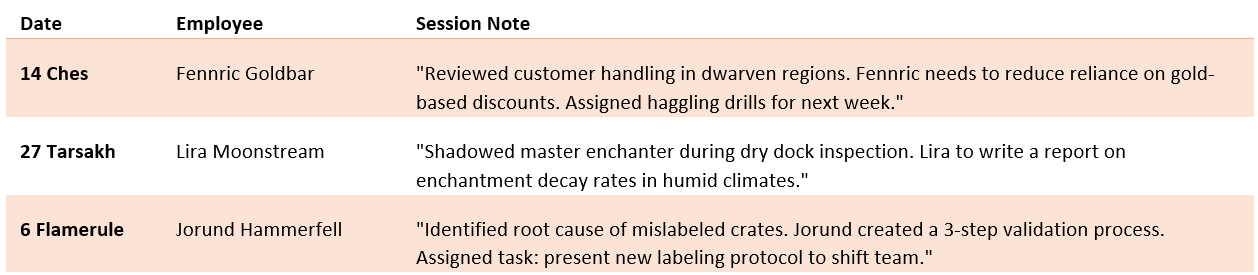
Performance Goals in Mentoring Programs

Every mentorship program includes a set of clearly defined performance goals, which are linked to the employee’s development plan and appraisal review. Examples include:

Measuring Success

Mentorship is not just about good intentions. Dynamics 365 helps turn qualitative progress into quantitative insight.

These measurements are tracked in the Performance and Development area, feeding directly into compensation review, succession planning, and certification tracking.

Conclusion

Mentoring in Faerûn is serious business. By integrating it into Dynamics 365 Human Resources, the Waterdeep Trading Company transforms mentorship from informal guidance to a structured development engine. Whether it is onboarding a new dockhand or preparing the next Director of Trade Routes, the system ensures every session is meaningful and measurable.

Start building your workforce of legends. Purchase the guides at adnd365.com/start, and request access to the public demo environment at https://public.adnd365.com

Login: npc@adnd365.com

Password: N0nPl@yC#822!

In a realm teeming with dragonfire hazards, magical regulations, and the occasional spontaneous planar rift, the idea of structured onboarding might seem like a low priority. But not for the Waterdeep Trading Company.

Whether you’re a seasoned mage joining the Arcane Logistics Division or a young dockworker hired by the Faerûn Dockworkers Federation to unload casks from Chult, starting a new job should never feel like being thrown into a gelatinous cube. That’s why Greta Ironfist, owner and visionary behind the Waterdeep Trading Company, implemented a comprehensive HR Onboarding Task Framework using Microsoft Dynamics 365 Human Resources.

Why Onboarding Matters in Faerûn

Onboarding in Faerûn isn’t just about setting up a workstation—it’s about surviving it. Misfile a wand shipment, and you might release a burst of wild magic. Confuse inventory from the Thayan Enclave with goods bound for Silverymoon? That’s not just a mistake, that’s a diplomatic incident.

At the Waterdeep Trading Company, onboarding serves three key purposes:

  1. Knowledge Transfer from veteran guild members to recruits.
  2. Compliance with guild and arcane trade laws.
  3. Role Readiness to ensure employees can handle enchanted inventory, volatile goods, and guild hierarchy expectations.

Structured Tasks = Faster Ramp-Up

Dynamics 365 Human Resources allows WDTC to predefine task sequences for each new hire. These are not just checkboxes—they’re embedded experiences.

Here’s a look at the onboarding task structure:

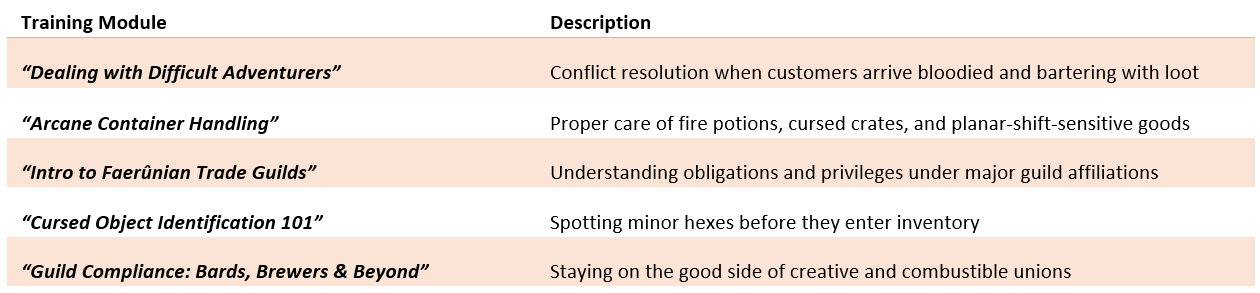
Faerûn-Style Training Modules

The onboarding experience reflects the company’s deep integration with the culture and industries of Faerûn. Employees don’t just learn about spreadsheets and supply chains—they learn how to navigate a magically active, politically sensitive, and guild-controlled economy.

Some examples include:

These aren’t optional. They’re required by Waterdeep City Law and audited regularly by the Watchful Order of Magists and Protectors.

Automated, Personalized, and Role-Aware

Using Dynamics 365’s Onboarding Templates, the HR team tailors onboarding for various job families:

  • Warehouse Operatives get put on directed training paths that include enchanted lockpick safety.
  • Potion Engineers start with regulatory training on labeling and transmutation safety.
  • Merchant Liaison Officers receive cultural sensitivity training for dealing with nobility and underworld contacts alike.

Automated reminders and approvals ensure no task slips through the cracks, and hiring managers can track progress with real-time dashboards—whether they’re at the Castle Ward HQ or visiting the Daggerford outpost.

Results That Scale with Adventure

Since implementing the onboarding task framework, the Waterdeep Trading Company has seen:

  • 32% faster ramp-up for new logistics recruits
  • Reduced guild violations and near elimination of compliance fines
  • Improved inter-departmental collaboration, especially between Procurement and Alchemy

More importantly, new employees feel like part of something epic from day one. And in a world where your next delivery might be to a necropolis or through an active war zone, that sense of purpose and preparedness makes all the difference.

Want to implement this in your own Faerûnian operation?

Pick up the guides at adnd365.com/start and access the public demo database at https://public.adnd365.com using:

Login: npc@adnd365.com

Password: N0nPl@yC#822!

Your next hire deserves more than a rusty scroll rack—they deserve a proper onboarding.

Waterdeep, the City of Splendors, is the crown jewel of trade along the Sword Coast. Its robust infrastructure, bustling markets, and magical commerce attract merchants from every corner of Faerûn. However, these opportunities come with significant responsibilities. Trade within the city is tightly regulated, and businesses must comply with a comprehensive and often complex system of taxes, tariffs, and guild fees.

For the Waterdeep Trading Company (WDTC), compliance with these financial obligations is not just about avoiding penalties. It is a fundamental part of how the company operates and thrives.

Understanding the Tax Landscape in Waterdeep

The economy of Waterdeep is shaped by policies enacted by the Lords of Waterdeep, enforced by trade guilds, and influenced by arcane regulators. Taxes cover everything from standard sales to magical services and imported goods. Below are the key types of taxes and fees businesses face:

How WDTC Manages Tax Compliance

The Waterdeep Trading Company uses Microsoft Dynamics 365 Finance to integrate tax compliance into every aspect of its financial operations. This ensures that taxes are accurately applied, transparently recorded, and automatically posted at the point of transaction.

Automated Tax Application

Each tax type is configured as a distinct code or group within the system. These are applied to sales orders, purchase orders, and inventory transactions based on product classification and trade channel. This reduces manual entry and improves audit readiness.

Smart Product Classification

WDTC assigns all items to tax groups that reflect their economic category. For example:

  • Enchanted items fall under the magic group
  • Jewelry and fine fabrics are categorized under luxury
  • General goods are classified under standard groups

This categorization ensures that the correct tax rates are applied automatically during sales and purchasing processes.

Landed Cost Tracking for Imports

Imported goods are subject to various tariffs and duties. WDTC utilizes the Landed Cost module in Dynamics 365 to accurately track and allocate these costs across the items being received. This ensures the company always has a clear picture of true inventory value and profitability.

Budgeting for Unofficial Overhead

While not recognized in formal tax records, certain transactions require what are diplomatically referred to as “negotiation fees.” These are handled with discretion and tracked within internal budgets to maintain operational agility in bureaucratic environments.

Tax Strategy as a Growth Enabler

Rather than treating tax as a burden, the Waterdeep Trading Company approaches it as a source of control and insight. Their tax configuration supports accurate reporting, supports pricing strategies, and ensures compliance across all trade activity.

This level of discipline allows the company to operate confidently within Waterdeep’s competitive and heavily regulated marketplace. It also lays the groundwork for expansion into other city-states with similarly complex trade policies.

If you are ready to elevate your Faerûnian business operations or want to model similar structures in your Dynamics 365 environment:

Visit adnd365.com/start for the full set of configuration guides.

Access the public demo environment at https://public.adnd365.com

Login: npc@adnd365.com

Password: N0nPl@yC#822!
At the Waterdeep Trading Company, efficiency is the difference between a satisfied customer and a fireball in the storeroom. One of the simplest but most powerful tools we’ve implemented in Dynamics 365 to streamline inventory lookup is the Search name field — and we’re not just typing in product names. We’ve turned it into a structured hierarchy system that lets us search smarter, not harder.

What Is the “Search Name”?

In Dynamics 365, the Search name is a simplified identifier that helps users quickly find products without needing to remember the exact item number or full description. It’s used in lookups across sales orders, purchase orders, inventory journals, and more. But by default, it’s just text.

We decided to turn that text into a strategy.

Hierarchy-Based Naming Convention

Instead of entering plain names, we use uppercase, hyphenated codes that follow a logical structure. Each segment represents a tier of product classification — from category to product type to material and variant.

Format

[CATEGORY]-[PRODUCT]-[MATERIAL]-[VARIANT]

This makes every search name:

  • Readable
  • Standardized
  • Filterable by segment

Segment Breakdown

Example Table

With this structure, a warehouse user typing STRG- can immediately filter to everything in the storage category. Type WPN-SWRD- and you’re only seeing swords. It’s as if your product list is pre-sorted by magic.

Why Uppercase?

We use uppercase exclusively for visual cleanliness and consistency. Mixed-case names slow down scanning and increase the chance of typos during data entry. When everyone follows the same uppercase-hyphenated structure, there’s less room for error — and a lot less shouting across the warehouse.

Benefits

  • Faster product lookups in order entry and warehouse activities
  • Simpler training for new users who only need to learn the hierarchy
  • Improved filtering during Excel exports, reports, and analytics
  • Consistency across environments, especially when syncing with e-commerce or external systems

Getting Started with Search Name Hierarchies

If you’re implementing or cleaning up your item master, now’s the time to adopt a structured search name strategy. Start by building a controlled vocabulary of category, product, material, and variant codes. Then roll it out in mass updates or via Excel templates.

Want to master more hidden inventory tricks like this? Grab the guides at adnd365.com/start and explore the public instance of our database at public.adnd365.com using

Login: npc@adnd365.com Password: N0nPl@yC#822!

Sharpen your lookup skills and become the inventory wizard Faerûn deserves.

The Waterdeep Trading Company, headquartered in the bustling Sword Coast metropolis of Waterdeep, offers everything an adventurer might need—from enchanted aprons to armor blessed by clerics of Lathander. But as their product lines expanded across Faerûn, their quill-and-scroll inventory system simply couldn’t keep up. That’s when they turned to Microsoft Dynamics 365—and specifically, product category hierarchies—to bring order to their magical chaos.

Why Category Hierarchies Matter

In Dynamics 365, category hierarchies are like the enchanted blueprints of your product catalog. They give structure, meaning, and power to how products are organized, priced, reported on, and sold.

Instead of listing all products in a single long scroll, Waterdeep Trading Company now classifies them into structured Sales Category Hierarchies that mirror their physical shelves and trading logic.

The Anatomy of Waterdeep’s Product Categories

Here’s a peek at their current Sales Category Hierarchy:

Each node isn’t just a label—it’s a functional container that drives how products behave in the system.

Magic Behind the Structure

Here’s why Waterdeep’s team, led by Greta Ironfist, built such a comprehensive structure:

  • Relevant Attributes Per Category: Different products need different data. A chainmail vest needs a defense rating, while a cook’s apron requires a heat resistance level. By assigning attribute groups to each category, they ensure each product has the right fields—no more, no less.
  • Faster Sales and Smarter Filtering: Sales agents no longer scroll endlessly through product lists. Using Released Products by Category, they can filter by Clothing > Aprons or Weapons > Daggers instantly—whether they’re taking an order in-store or via speaking stone.
  • Discount and Pricing Control: During the annual “Goblin Week” sale, the system automatically applies discounts to all Armor category items. There’s no need to tag each item—just one discount rule tied to the category node.
  • Clean Procurement Workflows: Vendor relationships are tied to procurement categories. This ensures the Baldur’s Gate Blacksmiths Guild doesn’t get accidental orders for bathrobes. Procurement policies guide buying by category, preventing mistakes and keeping supplier alignment sharp.
  • Crystal-Clear Reporting: Need to know which product family brought in the most gold last quarter? Category-based reports break down performance by line: Armor vs. Weapons vs. Clothing.

Real Example: Bells & Aprons

Using product codes like 10002-BELL and 10001-APRN, products are linked to the Bells and Aprons nodes under Clothing. This categorization powers everything from pricing to trade agreement journals to magical inventory counts.

A System Built for Growth

As new products are added—say Clothing > Cloaks or Weapons > Polearms—they simply extend the existing hierarchy. Each addition inherits the right behaviors, pricing rules, and attributes without manual duplication.

This system ensures that the Waterdeep Trading Company is prepared not just for tomorrow’s adventures, but for a full-scale expansion across the Western Heartlands and beyond.

Ready to organize your own product catalog with spellbinding efficiency? Grab the Advanced Dungeons & Dynamics 365 guides at adnd365.com/start.

Want to explore Waterdeep’s real system? Request access to the live demo environment at https://public.adnd365.com using:

Username: npc@adnd365.com

Password: N0nPl@yC#822!

Let category hierarchies be your Bag of Holding—clean, compartmentalized, and infinitely scalable.

In the heart of the Sword Coast, nestled within the bustling streets of Waterdeep, the Waterdeep Trading Company operates more than just a retail storefront. Beneath its merchant façade lies a complex web of manufacturing operations—each tailored to suit the diversity of products demanded by adventurers, nobles, and guilds alike. To meet this demand, the company has embraced Mixed Mode Manufacturing within Dynamics 365 Supply Chain Management, blending Discrete, Process, and Lean production models into a seamless hybrid.

Let’s delve into how these modes function and how the Trading Company uses them to maintain its place as the leading supplier in Faerûn.

Discrete Manufacturing: Crafting Blades and Baubles

Discrete manufacturing is used for distinct, countable items—think longswords, lanterns, and lockboxes. These items are produced in set quantities, with clearly defined bills of materials (BOMs) and routings.

Example:

The Silvered Shortsword is assembled in discrete batches of 25 using individual components like hilts, blades, and enchantment-infused pommels.

Usage:

  • Production orders are created per batch.
  • Components are reserved and consumed using standard picking lists.
  • Work centers and resources are allocated through routings.

Process Manufacturing: Brewing Potions and Alchemical Supplies

For concoctions, tonics, and other consumables, process manufacturing takes the lead. This model handles formulas instead of BOMs and uses co-products and by-products.

Example:

The Potion of Fire Resistance is brewed in vats, using fluid measures and concentration levels.

Usage:

  • Formula versions are set for various potency levels.
  • Batch attributes track things like concentration and expiration.
  • Co-products (like Weak Potion Residue) are tracked for repurposing or disposal.

Lean Manufacturing: Assembling Kits and Packs on Demand

Lean manufacturing supports made-to-order kits with minimal overhead and maximum efficiency—ideal for items assembled based on immediate customer demand.

Example:

The Dungeon Survival Pack is a configurable kit containing rope, torches, rations, and flint.

Usage:

  • Kanban rules trigger pack assembly when sales orders are placed.
  • No BOMs or traditional routings needed—assembly happens at packing stations.
  • Ideal for customization (e.g., swapping rations for vegetarian options).

Why Mixed Mode Matters

Mixed mode manufacturing allows the Waterdeep Trading Company to:

  • Scale across diverse product lines without reworking core setups.
  • Support both standard inventory and made-to-order goods.
  • Optimize material usage through formula balancing and by-product tracking.
  • Stay agile in a chaotic economy where customer needs change by the tenday.

And with Dynamics 365, these modes aren’t siloed—they coexist under one umbrella, sharing inventory, costing models, and quality control data. This synergy ensures the Company can serve blacksmiths, brewers, and bulk buyers without breaking stride.

Looking to master manufacturing in Dynamics 365 like a true Waterdhavian trade lord?  Pick up the complete guides at adnd365.com/start

Request access to the public database at https://public.adnd365.com

Login: npc@adnd365.com

Password: N0nPl@yC#822!

The Waterdeep Trading Company isn’t just a general store, it’s the central nerve of a supply empire that keeps adventurers, merchants, and mystics stocked from Luskan to Calimport. With customers as diverse as noble houses, guild outposts, and lone rangers, the company needed a way to structure its rapidly growing operations while maintaining financial precision and strategic agility.

Enter Business Units, Departments, Sales Channels, and Cost Centers, the quartet of operational clarity in Microsoft Dynamics 365 Finance.

Business Units: Territory and Purpose

The company organizes its operations by Business Unit to reflect both geographic footprint and strategic focus. Each Business Unit represents a distinct operational hub, responsible for local inventory, staffing, and margin targets.

Each Business Unit tracks its own revenue and costs, enabling financial reporting at both unit and consolidated levels.

Departments: Role and Function

Where Business Units define where things happen, Departments define who does the work. These are the roles and internal teams that perform the operations of the business, often cutting across units.

Departments help structure responsibilities for budgeting and workforce management within each Business Unit.

Sales Channels: Who They Serve

Sales Channels represent the customer-facing paths through which the Waterdeep Trading Company moves its goods. These span traditional commerce and some… less conventional routes.

Using sales channels allows for segmented revenue reporting, discounting strategies, and tailored marketing campaigns.

Cost Centers: Where Money Is Spent

To control expenses and improve budgeting accuracy, the company uses Cost Centers to group similar operational expenditures. These are typically aligned with departments but offer finer granularity, especially in joint projects or field operations.

This structure supports top-down and bottom-up budgeting, with financial dimensions tracking expenses per cost center across all Business Units.

Why It All Matters

By organizing the Waterdeep Trading Company with Business Units, Departments, Sales Channels, and Cost Centers, Greta Ironfist and her team achieve:

  • Granular reporting: See profit margins by branch, track department-level performance, or monitor sales channel velocity.
  • Smarter budgeting: Allocate funds where they’re needed and track actuals against plans with visibility by dimension.
  • Accountability: Department heads and business unit managers can be held responsible for outcomes.
  • Scalability: As the company expands (hello, Chult!), new units, departments, or sales paths can be added without disrupting the existing structure.

A Realm in Balance

The Waterdeep Trading Company didn’t become Faerûn’s top outfitter by accident. Through clever use of Dynamics 365’s organizational structures, it tames the chaos of commerce—even in a world of dragons, demons, and duty-bound auditors.

So whether you’re running potions to a necromancer or hempen rope to a ranger, remember: structure is the silent partner in every successful adventure.

Start your own implementation journey today.  Buy the full configuration guide at adnd365.com/start

🔍 Want to explore the live Faerûn demo environment?  Log in to the public read-only view at https://public.adnd365.com

Username: npc@adnd365.com Password: N0nPl@yC#822!

Discover how the realms are mapped inside Dynamics 365—because if you can build it in Faerûn, you can build it anywhere.

Running a business like the Waterdeep Trading Company involves more than sword sales and enchanted lockboxes. Every tenday, some things stay the same: rent needs paying, guild dues are owed, and inventory costs need logging.

If you find yourself retyping the same entries month after month, it’s time to bring in a little structure. That’s where Periodic Journals come in.

What Are Periodic Journals?

Periodic journals are used for recurring transactions — those repeating entries that don’t change often. Think monthly expenses, regular allocations, or standard entries for fees, salaries, or provisions. Once you’ve defined them, you can post the entries on a regular schedule without building them from scratch every time.

It’s like having a pre-written scroll that auto-fills your accounting spellbook.

Why the Waterdeep Trading Company Uses Them

Each month, the Waterdeep Trading Company pays maintenance fees to several local guilds for use of shared crafting halls and inspection services. Here’s how we structure one of those entries:

This journal can be reused every month with minimal adjustment, making it easy to keep the guilds happy and the books balanced.

Great Use Cases for Periodic Journals

When Not to Use Them

Not everything should be a periodic journal. They work best for entries that are consistent and scheduled. If the amounts vary significantly or require approvals, other journal types might be more appropriate.

Final Thoughts

If you’re repeating the same ledger entry more than once, it’s probably time to automate it. Periodic journals won’t solve every financial challenge, but they will make life easier and free up time for more important work, like negotiating with dwarves over mithral prices.

Want to see periodic journals in a real system?

Check out the walkthroughs in the Advanced Dungeons & Dynamics 365 guides at adnd365.com/start, or log into our public environment at https://public.adnd365.com

Login: npc@adnd365.com

Password: N0nPl@yC#822!

Budgeting doesn’t get the same attention as dragon-slaying or spell-slinging, but if you ask Greta Ironfist, it’s what keeps the doors open and the swords sharp. At the Waterdeep Trading Company, budgeting is how we make sure every gold piece has a job to do.

Let’s walk through how you can set up and use budgeting in Dynamics 365 Finance, with a few examples from our favorite trade hub on the Sword Coast.

Why Budgeting Is More Than Just Ledger Scrolls

Running a growing trading company means managing costs across different wards, cities, and sometimes even planes. Whether you’re buying spell ink in Waterdeep or renting a wagon in Elturel, you need a plan.

With Dynamics 365, budgeting helps you:

  • Forecast future expenses
  • Prevent overspending
  • Align your spend with goals like expansion or inventory restocking

Creating a Budget Register Entry

A budget register entry is where you define how much money you’re allocating and where it’s going. This can be done by department, cost center, or project.

Here’s what Greta’s FY25 budget register might look like:

You can create these manually or import from Excel. It’s especially helpful when you’re dealing with dozens of departments and hundreds of accounts.

Setting Up Budget Control Rules

Budget control lets you apply rules that prevent spending over budget. You can set this up to stop transactions or just warn the user.

Here’s how we’ve configured ours:

This makes sure field teams don’t accidentally order 10 crates of holy water when they only need two.

Allocating Budgets Over Time

Not all costs hit at once. Some budgets, like the one for magical research or training, might be spread across the year.

Equal Monthly Allocation Example

You can also do weighted allocations if you expect spikes during busy seasons, like Greengrass or the Day of Wonders.

Reporting and Variance Tracking

Now that your budget is in the system, it’s easy to track how you’re doing. With the help of Power BI or built-in reports, you can compare budget to actuals.

Sample Variance Report

This kind of visibility lets Greta make smarter decisions and redirect funds when needed.

Final Thoughts

Budgeting in Faerûn is not just about counting coins. It’s about making sure your resources are lined up with your ambitions. Whether you’re building a new warehouse in Baldur’s Gate or launching a supply run to Icewind Dale, having your budgets set in Dynamics 365 means you can move with confidence.

Want to do this yourself? Download the Advanced Dungeons & Dynamics 365 guides at adnd365.com/start. For hands-on access, explore the live demo environment at https://public.adnd365.com, logging in with npc@adnd365.com and password N0nPl@yC#822!.

Let me know if you want to create a follow-up post on budgeting approvals, forecast comparisons, or project-based budgeting.

In Faerûn, having inventory on hand when the next caravan arrives is the difference between a profitable month and a letter of apology written in infernal ink. At the Waterdeep Trading Company, we don’t rely on wishful thinking or divination spells to keep our shelves stocked. We use Forecasting and Demand Planning in Dynamics 365 to stay ahead of the curve.

Let’s break down what that looks like when you’re supplying everything from iron spikes to cursed mirror cases.

What Is Forecasting?

Forecasting is the process of predicting future demand based on historical data, market trends, upcoming events, and customer behavior. In Dynamics 365, this can be driven by:

  • Historical sales
  • Purchase trends
  • Manual adjustments
  • External factors (festivals, raids, wars, winter wolf migration patterns)

Forecasts can be entered manually or generated using built-in models, which project expected demand over a defined horizon. These forecasts can be set at various levels:

  • By item
  • By item group
  • By customer or sales channel
  • By warehouse or region

Example: Forecast for Health Potions

What Is Demand Planning?

Demand planning takes that forecast and aligns it with inventory, procurement, and production. It helps answer:

  • Do we have enough raw materials?
  • Should we increase safety stock?
  • Should we initiate new purchase orders or production runs?

In Dynamics 365, this process feeds into Master Planning, where forecasted demand is treated like confirmed orders, generating planned supply suggestions. These can include:

  • Planned purchase orders
  • Planned transfer orders
  • Planned production orders

Why It Matters for the Waterdeep Trading Company

Greta Ironfist, our fearless founder, once said:

“If you can predict the next spike in rope demand during troll season, you don’t need luck. You need a forecast.”

In the past, too many decisions were based on guesswork. Now, by using historical trends and adjusting for regional events (like the Annual Adventurers’ Expo in Silverymoon), we’re better prepared for demand fluctuations.

Best Practices in Dynamics 365 for Forecasting

Start with historical data: Use the Forecast planning workspace or Excel templates to analyze patterns.

Segment your products: Forecast high-volume items differently from rare or seasonal goods.

Involve stakeholders: Sales, warehouse managers, and even suppliers may have insights that raw numbers miss.

Adjust forecasts regularly: Update based on shifting trends, marketing events, or monster incursions.

Use forecast reduction: Let actual sales orders reduce the forecast so you don’t double-count demand.

Putting It Into Action

Let’s say you forecast a rise in demand for Frost Resistance Gear due to early winter reports from Icewind Dale. Dynamics 365 will recommend boosting production of frost cloaks and earmuffs, generating supply plans to meet the projected demand before it becomes a problem.

These forecasts then flow into:

  • Master Planning for automated supply suggestions
  • Warehouse stocking plans
  • Cash flow planning based on expected procurement

Final Thoughts

Forecasting and demand planning in Dynamics 365 give you something better than magical foresight — real-time, data-driven decisions that protect margins and customer satisfaction.

You no longer need to pray to Mystra for inventory clarity. With the right setup, you can plan your way to profitability and avoid the scroll of backorders altogether.

Ready to build your own forecasting models and master plans?

Start your journey today with the Advanced Dungeons & Dynamics 365 guides at adnd365.com/start

You can also test it yourself in a live environment at https://public.adnd365.com

Login: npc@adnd365.com

Password: N0nPl@yC#822!