Funding the Future of Faerûn: Guild-Based Budgeting at the Waterdeep Trading Company
In the thriving trade capital of Waterdeep, gold flows not only between merchants and markets but also into the hands of guilds, those vital engines of craftsmanship, protection, and prosperity. The Waterdeep Trading Company stands at the center of this economic orchestra, ensuring every mason’s hammer, every apothecary’s mortar, and every bard’s lute is backed by fair and structured funding.
The guilds of Faerûn don’t merely operate as trade organizations. They are public institutions, economic engines, and strategic partners in building a stable realm. But even the most revered guild cannot function without clear financial support, transparent oversight, and seasonal adaptability.
Budgeting by Guild and Region
Each guild chapter submits seasonal funding requests, tied to both civic needs and operational objectives. Some seek coin for tools or stockpiles; others require capital for events, apprenticeships, or fortification efforts. The Waterdeep Trading Company maintains a central allocation ledger that organizes these funds by region and purpose.
Winter Allocation Table – 1495 DR
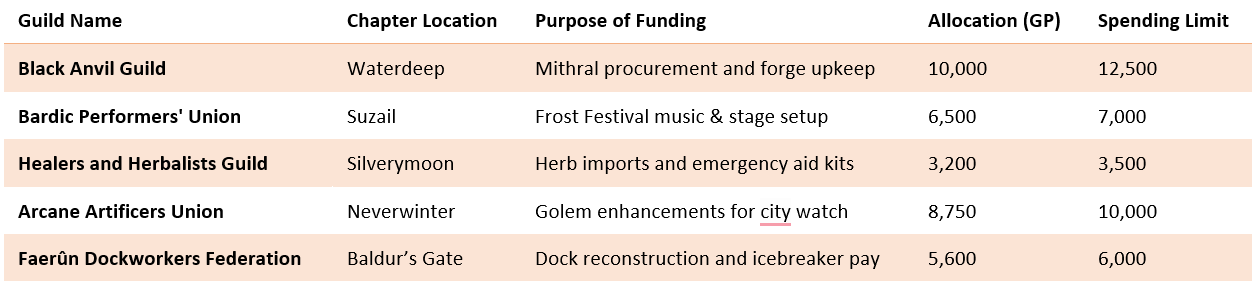
These allocations are not only about coin, but about trust. Higher thresholds are granted to guilds with consistent reporting and successful outcomes. Infractions, mismanagement, or delayed reporting can result in reduced limits for the following quarter.
Submitting and Approving Funding Requests
Guild stewards submit funding requests through formal scrolls, stamped with arcane validation sigils, including:
- Description of the project or seasonal need
- Proposed cost and required amount
- Guild rank and authorization
- Historical budget usage summary
- Supporting documents such as scribed contracts or crystal scrying validations
A multi-tiered approval process follows, often requiring consent from regional trade councils, merchant alliances, and in some cases, the Lady’s Council itself. Larger requests, particularly those exceeding seasonal baselines, must include performance metrics from the prior year.
Seasonal Adjustments and Emergency Allocations
Faerûn is ever-changing. Wild magic storms, winter floods, and sudden invasions shift priorities. Funding cannot be static. Mid-season reallocations are made during the Highgold Council’s monthly conclave. These decisions reflect both public sentiment and on-the-ground conditions reported by informants and guild marshals.
Spring Revision Example – 1495 DR

Funding is not political, it is logistical. But when emergencies strike, such as the Great Collapse in the Deepstone Ward or the blockade on Moonshae wool, the Company responds swiftly, prioritizing public need over protocol.
Evaluating Guild Performance
Once gold is granted, so too comes accountability. Guild chapters are expected to submit closing ledgers, summarizing their usage, milestones achieved, and any deviations. These are reviewed by both the Chief Trade Auditor and the Office of Resource Alignment.
Sample Performance Ledger Summary – 1495 DR

Performance feeds future funding. Those who show discipline and deliver measurable outcomes earn larger grants and greater autonomy in the following year.
Closing Thoughts
Guild funding in Faerûn is more than coin counted in ledgers. It is the trust between trade and crown, the collaboration between sword and scroll, and the foundation of a thriving realm.
With regional budgeting models, seasonal responsiveness, and reputation-based controls, the Waterdeep Trading Company ensures the right gold flows to the right hands, so that peace, progress, and prosperity continue to echo from the Sea of Swords to the jungles of Chult.
For more tales of trade and triumph, buy the guides at adnd365.com/start, and request access to the public database at https://public.adnd365.com with:
Login: npc@adnd365.com
Password: N0nPl@yC#822!
 A Tinkerers Notebook