Archive

Monthly Archives: June 2025

For over a century, the Waterdeep Trading Company has been the heartbeat of Faerûn’s trade. From the frost-kissed docks of Icewind Dale to the coastal bazaars of Calimport, the Company moves goods through every season with precision.

Success here is not based on speed alone. It depends on timing.

Seasonal demand planning is the art of predicting what will be needed, when it will be needed, and how to ensure it arrives just in time. It is how the Waterdeep Trading Company avoids stockpiling cloaks in the heat of Flamerule or running out of cider during the first toast of Highharvestide.

The Calendar of Commerce

Faerûn’s calendar tells more than time. It reflects culture, climate, and consumption. Every month carries specific market behaviors and patterns.

Waterdeep Trading Company studies these cycles carefully and layers them into every supply and logistics plan.

How the Company Forecasts Demand

Historical records are the backbone of the Company’s seasonal forecasting. Scribes maintain product movement scrolls dating back several generations.

Here are a few forecasting techniques in practice:

  1. Rolling multi-year averages to compare monthly and festival-based trends across regions
  2. Contracts and standing orders from temples, noble houses, and guilds which repeat annually
  3. Predictive adjustments based on current market activity, such as harbor delays or rising prices from core vendors
  4. Sentinel dispatches from field agents who report signs of early shifts in demand or local disruptions

The result is a structured forecast that balances tradition with the changing tides of trade.

Seasonal Labor and Staffing

The flow of goods depends on the flow of hands. The Waterdeep Trading Company plans its workforce as carefully as it does its inventory.

  • In Deepwinter, fewer shipments mean a heavier focus on warehouse security and internal audits
  • In Spring, hiring increases as couriers, carriers, and sorters are deployed to reopen stalled trade routes
  • In Summer, nearly every department grows. Market tents, brewery lines, and ship crews all need additional labor
  • In Autumn, specialized workers such as grain assessors and preservation technicians are deployed to lock in inventory before the freeze

Many workers are brought in on rotating seasonal contracts, often earning guild certifications for each successful campaign.

Managing Supplier Constraints

Not every vendor can scale with seasonal demand. Some are limited by harvest cycles, others by labor, and a few by magical interference.

To manage these risks, the Company maintains a supplier tier system:

  • Primary suppliers are those with strong delivery history and seasonal reliability
  • Secondary suppliers are used during peak demand or to fill gaps when primary vendors fall short
  • Specialist vendors are called upon for short seasonal bursts, such as rare spices during feast days or potion ingredients during cold snaps

Every procurement team tracks lead times and past performance to determine who to trust and when to switch.

Special Contracts and Priority Orders

Seasonal shifts also mean more contract-based orders. Some examples include:

  • Military garrisons requesting rations before planned campaigns
  • Temples ordering ceremonial garb and incense ahead of holy days
  • Mercenary companies securing bulk gear and potions in advance of expedition season
  • Nobles requiring finery and decor ahead of social functions

The Company sets aside protected inventory and often reserves wagon space or teleportation slots for these clients. They are built into seasonal forecasts as immovable pillars.

Transportation Planning by Season

Logistics can be the difference between profit and loss during seasonal transitions. Travel conditions change rapidly, and the Company prepares for these disruptions with dedicated planning ledgers.

Every route has a seasonal modifier and an action plan in place before the first sign of disruption appears.

What Happens After the Season Ends

The Waterdeep Trading Company reviews each season within ten days of its end.

  • Unused goods are either rotated to other regions or sold at a discount
  • Performance of forecasts is measured against actual sales
  • Surprises or anomalies are recorded in the forecasting grimoire for future adjustment
  • Lessons learned are shared across all Company locations

This cycle of planning, acting, and reviewing has been central to the Company’s growth and resilience.

Closing Thoughts

Seasons affect everything. Weather shifts harvests. Holidays shift demand. Travel restrictions shift logistics. But a business that plans for the seasons instead of reacting to them will always come out ahead.

Waterdeep Trading Company invites others to study how preparation drives prosperity.

To access trade records, planning templates, and regional demand data, visit adnd365.com/start and request access to the public trade network at https://public.adnd365.com.

Login: npc@adnd365.com

Password: N0nPl@yC#822!

Prepare before the winds change. Trade like the season depends on it.

In Faerûn, no successful merchant operates alone. Behind every cartload of enchanted textiles or barrel of trollwine stands a guild – documenting, inspecting, regulating, and, when necessary, demanding compensation. These are not advisory councils or informal collectives. They are the law in most cities when it comes to tradecraft, labor, pricing, and apprenticeships.

At the Waterdeep Trading Company, guilds form the foundation of our entire supply network. From the warehouses of Silverymoon to the docks of Calimport, our ability to do business depends on how well we manage, track, and respect these institutions.

What Is a Guild in Faerûn?

To an outsider, a guild may look like a club of craftsmen. To a merchant, it is a governing body. Guilds in Faerûn:

  • Regulate Pricing: They set base prices and forbid undercutting or overpricing.
  • Enforce Quality Standards: Products bearing the guild seal meet standards of safety, craftsmanship, and purity.
  • Manage Apprenticeships: Only members of a guild can legally train new workers in a trade.
  • Control Certification: From spell-tuned brewing to adamantine shaping, guilds determine who is licensed to work in a craft.
  • Settle Disputes: Guild arbitration often supersedes civil courts in trade matters.
  • Oversee Regional Chapters: Each major city has a chapter following the central charter while adjusting for local needs.

Organizing Guild Information in Your Company

To manage guilds effectively, companies like ours treat each one like a partner, with structured records and established procedures.

Guild Directory Examples

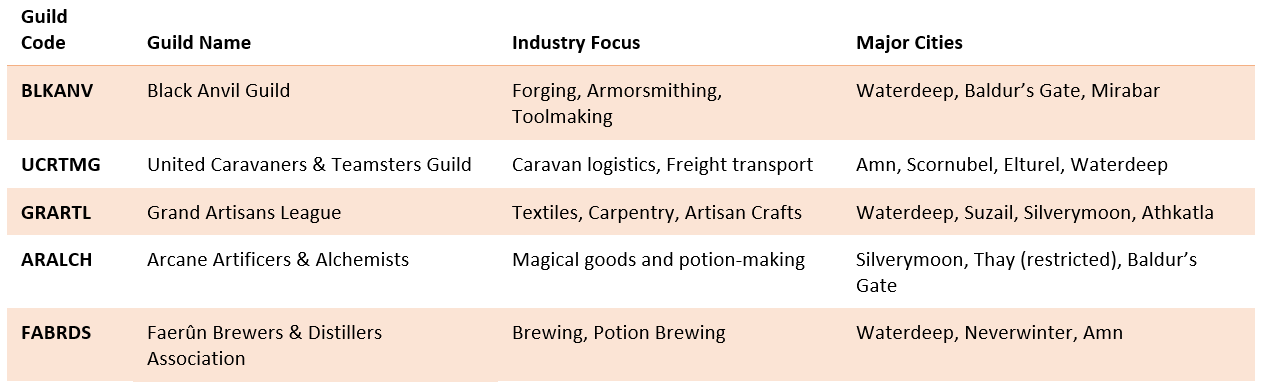
Here are a few of the more prominent guilds the Waterdeep Trading Company works with:

Guilds govern not just trade but talent. If you want to hire a certified loommaster, a leyline-calibrated enchanter, or a crystal alchemist with reliability, guild records are your best friend.

Merchants should track:

  • Certification Validity (including expiration and issuing chapter)
  • Completed Apprenticeship Logs (trainer, craft, rating)
  • Advancement Requests (for promotion to master rank or guild chair)
  • Guild Exams (success rates and focus areas)

By doing this, you can ensure you’re always working with approved craftsmen and that your wares pass muster when they reach port inspectors.

Managing Guild Contracts

Contracts with guilds are not one-size-fits-all. A shipping agreement with the Teamsters may include:

  • Volume quotas
  • Minimum wage requirements
  • Safety and magical seal inspections
  • Contingency routes for high-risk regions
  • A procurement agreement with the Black Anvil Guild might include:
  • Fixed pricing tiers for steel or mithral goods
  • Priority supply in wartime
  • Enchantment inspection clauses

Track these by guild, chapter, and effective date—and always be aware of when a renegotiation period is due.

Dispute Resolution and Compliance

Most cities allow guilds to enforce their own rulings within their domain. When a dispute arises:

  • Arbitration is often mandatory
  • Guild fines may be binding on the merchant
  • Disciplinary actions (such as blacklisting) can affect all affiliated trade

Maintain detailed logs of:

  • Complaints filed
  • Guild responses
  • Resolution terms
  • Any modifications to contracts or certifications following the ruling

This protects your company and helps build a reputation as a guild-respecting trading house.

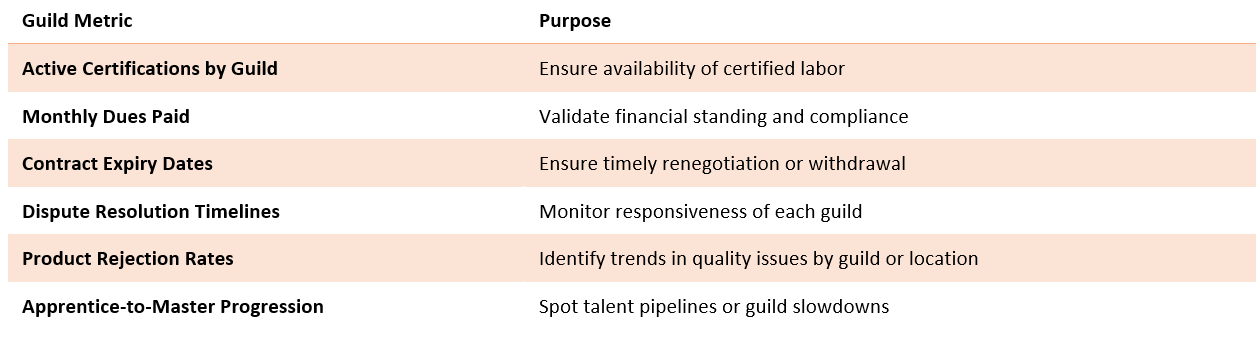
Guild Reporting and Oversight

Larger operations should develop guild reporting practices. Here are a few metrics we track:

Final Thoughts: Why Guilds Deserve Respect

Guilds don’t just protect craftsmen—they protect the economy. They ensure that products move fairly, workers are trained properly, and that bad actors can’t flood the market with cursed tankards and half-finished crossbows.

For a trading company, building strong, respectful, well-documented relationships with every guild you work with isn’t just a best practice—it’s the key to staying in business.

Want to start managing your guild partnerships better? Check out the guides at adnd365.com/start and explore the public demo environment at https://public.adnd365.com, using:

Login: npc@adnd365.com

Password: N0nPl@yC#822!

In the cities and strongholds of Faerûn, coin doesn’t just flow through markets and mead halls, it flows through payroll ledgers. Whether you’re an apprentice scribe in Candlekeep or a battle-hardened inventory porter in Waterdeep’s lower docks, your pay is determined by a system that’s as structured as a dwarven fortress: step-based compensation.

This isn’t just a civilized form of gold distribution. It’s how guilds and trading companies standardize pay, encourage career growth, and keep labor disputes from devolving into fireball-flinging protests.

What Is Step-Based Compensation?

Step-based compensation is a tiered wage system where workers earn more as they progress through defined roles. Most guilds structure this into five steps, with each level tied to experience, certifications, or sometimes just surviving long enough to tell the tale.

These ranges aren’t static. In cities like Luskan, where danger clings to every crate, hazard pay bonuses may boost compensation by up to 50%. Some occupations also carry premiums depending on magical risk, rarity of skill, or guild scarcity.

Why the Steps Matter

In a continent bound together by trade routes and teleportation circles, consistency in compensation helps prevent chaos. Guilds enforce minimums, reward growth, and create expectations across the Sword Coast and beyond.

Step-based models also:

  • Support career progression that’s visible and motivating.
  • Enable structured training programs and certifications.
  • Allow for easy workforce budgeting in tools like Dynamics 365.
  • Prevent the “random NPC wage” effect from breaking immersion.

Common Faerûnian Pay Ranges

Here’s a sample from across guilds and corker classes:

These roles often reflect local conditions. A Potion Sampler in Amn may fetch higher rates due to alchemical guild demand, while an Inventory Porter in Mirabar might earn less thanks to automation by enchanted pulley systems.

Moving Up the Ranks

Progressing through compensation steps usually involves:

  • Time served in a guild or under contract
  • Performance evaluations from senior corkers
  • Certifications and formal skill tests
  • Survival, especially in hazardous roles like wild magic waste disposal

Guilds like the Grand Artisans League and the Arcane Artificers Union publish detailed advancement criteria, while others—like the Free Mercenaries League—prefer the “prove it or perish” method.

Standardizing Pay in Dynamics 365

For trading companies like the Waterdeep Trading Company, these steps are modeled directly in Dynamics 365 Human Resources:

  • Job levels and skill requirements mapped to compensation bands
  • Automated progression workflows tied to review periods
  • Reports and dashboards showing wage distribution across sites
  • Integration with guild dues and hazard premiums

This ensures your compensation structure reflects both fantasy logic and enterprise accountability.

Final Thoughts

Whether you’re enchanting potion bottles in Baldur’s Gate or hauling siege ballistae in Scornubel, step-based pay ensures that work in Faerûn is as structured as it is storied. It builds morale, supports retention, and ensures that even the lowliest apprentice has a path forward—ideally, one with fewer explosions.

Looking to implement your step-based compensation strategy (with or without beholder hazard pay)? Start your journey at adnd365.com/start and request access to the public demo of our Faerûn Dynamics 365 setup at https://public.adnd365.com, logging in with

Username: npc@adnd365.com

Password: N0nPl@yC#822!

The realm pays well—if you level up right.

When most adventurers think of critical gear, their minds turn to enchanted weapons, shimmering cloaks, or potent healing draughts. But there’s one unsung hero in every rucksack, every military crate, and every ship’s galley: the Hardtack Loaf.

Built for Survival, Not for Taste

The hardtack loaf is a dense, triple-baked, long-lasting bread—flavorless, tough, and enduring. It’s not trying to win any culinary contests. Its purpose is singular: sustain life. With a shelf life measured in decades (or longer), it resists mold, insects, and even the occasional siege.

Breakable only with a pommel or boot heel, it’s more weapon than snack. But softened in stew or ale, and paired with a chunk of salted pork or cheese, it becomes a nostalgic reminder of hearths far from the battlefield.

Cost to Produce

Let’s break down the economics behind this survival essential. Here’s what it costs to produce 100 loaves:

That’s right—less than half a Faerûnian Silver Dragon per loaf. And with a retail markup of 0.69 FSD and wholesale options starting at 0.60 FSD, hardtack brings in profit margins that even a Zhentarim quartermaster would respect.

Regional Price Variation

Not all economies treat hardtack equally. By applying regional Economy Type Modifiers, you get price realism across Faerûn:

Imagine the profit potential when buying low in Daggerford and selling high in Port Nyanzaru.

Crate-Level Supply & Demand

Crates of hardtack (100 loaves each) are shipped across the continent to organizations like:

That’s over 13,000 loaves monthly to named buyers alone, with more forecasted based on regional campaign seasons and winter stockpiling.

Capital Investment & Workforce

To get a hardtack operation running, you’ll need:

And a team of six cross-trained workers producing up to 100 loaves per batch/day, including an ovenmaster, bakers, and haulers.

Planning for the Future

A monthly demand forecast shows strategic consumption spikes:

Using this data, supply chain managers at the Waterdeep Trading Company can optimize procurement, scale batches, and even model profitability across trade routes using margin-based forecasting.

Final Thoughts

The hardtack loaf may be simple, but it sits at the center of some of the most complex logistical webs in Faerûn. It powers armies, fuels adventurers, and ensures caravans survive long hauls. If you’re not selling hardtack, you’re leaving money on the table—and possibly your crew hungry in the field.

Start modeling your Faerûnian business today. Get the full Advanced Dungeons & Dynamics 365 guides at adnd365.com/start, and see the public view of the current database by logging in at https://public.adnd365.com using:

Login: npc@adnd365.com

Password: N0nPl@yC#822!

At the Waterdeep Trading Company, production efficiency is more than just a number on a ledger. It is the difference between an on-time delivery of potions to Silverymoon or a chaotic recall because a batch of fire resistance potions fizzled out mid-adventure. Whether we are bottling enchanted tonics or stitching high-grade leather satchels, the core of our operational success lies in the structure of our manufacturing routes.

And yes, routes are not just maps or travel paths. In manufacturing, a route is the formal recipe for how a product gets built, who does the work, in what order, using which tools, and for how long.

What Happens When Efficiency Drops?

Let us say you are running the Potionworks team, and you notice that the standard time to produce a batch of Potion of Giant Strength has slowly crept up by fifteen percent over the last quarter. It does not mean your alchemists are lazy. More likely, something in the route no longer reflects reality.

You might see results like this:

Where Route Adjustments Make the Difference

Adjusting a manufacturing route is not just about changing a number. It is about recognizing the evolving nature of work and making sure your systems reflect reality.

Update Task Durations

Add Alternate Operations

Reassign Resource Groups

Efficiency Tracking With Employee Profiles

Each worker has their own rhythm. Instead of a one-size-fits-all metric, track efficiency by skill, task type, and improvement over time.

Breaking Out Composite Steps

Some operations hide their inefficiencies inside multi-part steps. Separating them helps pinpoint exactly where slowdowns occur.

Quality Inspections Add Predictability

A well-placed inspection prevents rework, improves customer satisfaction, and gives employees more confidence in their work.

The Bigger Picture

Every route is a living system. Ingredients change. Regulations shift. Staff learn and grow. If the Waterdeep Trading Company kept its manufacturing routes static, we would be unable to handle product innovation, seasonal demand spikes, or guild audits.

By updating task durations, reassigning talent, building flexible alternatives, and embedding inspections, we create a production system that adapts with us. We do not just run a business, we run a guild-backed, customer-loved, efficiency-honed enterprise that runs like a dwarven clockwork engine.

Want to boost your own manufacturing efficiency and avoid magical misfires? Download the full Advanced Dungeons and Dynamics 365 guide at adnd365.com/start, and see it live in the public database at https://public.adnd365.com using:

Login: npc@adnd365.com

Password N0nPl@yC#822!

The Waterdeep Trading Company employs a wide range of talent—from guild-trained accountants in Baldur’s Gate to teleportation-circle custodians in Elturel. With such a diverse and magically-inclined workforce, offering the right benefits isn’t just important—it’s essential for survival, morale, and long-term productivity (especially in a realm where “occupational hazard” may include basilisk encounters).

But how do we track benefits, manage eligibility periods, and enable self-enrollment in a setting where both arcane scrolls and labor contracts exist side-by-side?

The answer lies in our adoption of Advanced Dungeons & Dynamics 365.

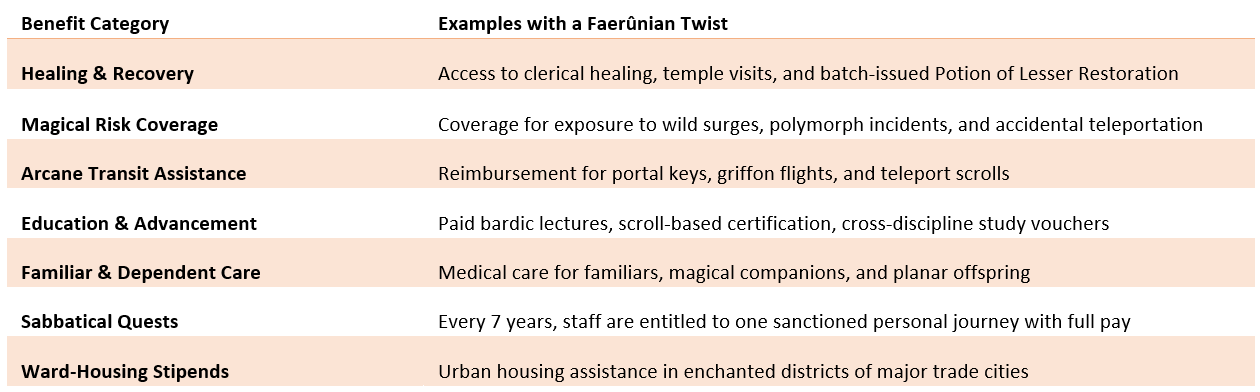
What Counts as a Benefit in Faerûn?

Employee benefits in Faerûn go well beyond the mundane. Here’s a breakdown of what we manage at WDTC:

Let the Adventurers Choose: Self-Service Enrollment

In the spirit of decentralization (and to avoid overworking our HR scribes), employee self-enrollment is a cornerstone of our benefit tracking system. Whether you’re a dwarven accountant working nights in Mithral Hall or a half-elf procurement officer stationed in Thay, you can manage your own benefits via the Employee Self-Service Portal in Dynamics 365 Human Resources.

Here’s how it works:

  1. Eligibility Flags: When a new employee is added, their race, class, guild affiliation, and role type automatically configure their base eligibility.
  2. Enrollment Periods: Two major periods are open annually — Greengrass (early spring) and Highharvestide (autumn harvest). A third “emergency re-enrollment” is available during Time of Troubles declarations.
  3. Benefit Elections: Employees can opt into available plans through an intuitive, portal-based interface. Each option includes a description, value in GP, duration, and special magical considerations.
  4. Familiar Enrollment: Employees with bonded companions can select add-on options for Familiar Healthcare, Companion Shadow Training, or Planar Travel Liability Coverage.

“I signed up for the Arcane Accidents Protection plan just in time—our wizard sneezed during inventory and turned me into a stool. That’s at least a Tier 2 incident,” — Nharra Feldspar, Junior Enchanter, Skullport Branch

Controlling Enrollment with Periods and Rules

Just like any good system of laws in Waterdeep, benefits come with timelines and compliance windows. Dynamics 365 allows us to define benefit periods, event-based eligibility, and waiting periods for risk-heavy roles.

Standard Enrollment Periods

Eligibility Conditions

  • Waiting Periods: Employees classified as “Adventurer Class II or higher” must wait 30 days before Magical Risk plans are active.
  • Guild Membership Dependencies: Benefits for potion-makers, for instance, require active status in the Healers & Herbalists Guild.
  • Location-Based Restrictions: Some plans (like “Underdark Relocation Stipends”) are only available to employees based in subterranean postings.

Automation with a Magical Touch

Here’s what makes the WDTC system so efficient:

  • Automated Alerts for enrollment deadlines sent via Sending Stones or enchanted scrollmail
  • Approval Workflows using customizable rules (e.g., benefits for a druid require Druid Circle co-signature)
  • Reporting and Audit Trails to track who enrolled, when, and how the benefits align with compensation benchmarks
  • Benefit Forecasting with Power BI to estimate potions consumed per department, scroll usage by guild, and familiars vaccinated

Final Thoughts

Managing benefits across Faerûn isn’t just about compliance—it’s about culture. By empowering our employees to enroll themselves, timing those decisions with meaningful in-world events, and tracking magical and mundane needs alike, the Waterdeep Trading Company sets a new standard in workforce support.

Whether you run a guild, a keep, or a kraken-hunting charter, there’s a lesson here: Magic might make anything possible—but good HR practices make it sustainable.

 Want to build your own portal for Faerûnian benefits management? Download the full implementation guides at adnd365.com/start and explore our working demo at https://public.adnd365.com

Login: npc@adnd365.com

Password: N0nPl@yC#822!

Your next sabbatical quest awaits—track it properly.

In Faerûn, the line between a laborer and a legend is paper-thin. One day, you’re lifting crates of trollbone whiskey in Baldur’s Gate, and the next, you’re rerouting magical freight through a planar junction beneath Waterdeep. The Waterdeep Trading Company has learned the hard way that tracking skills, certs, and classes are not optional; it is vital.

Using Microsoft Dynamics 365 Finance and Operations, the company now maintains a guild-standard record of worker classes, certifications, and performance history. This ensures the right person is sent to the right job, even if that job involves a magically unstable ale cask or a cursed batch of moonbeams.

The Corker Class System: A New Model for Faerûnian Labor

Just like adventurers level up, so do logistics workers, alchemists, enchanters, and dockhands. WDTC’s HR system uses corker classes to define key labor archetypes.

Sample Corker Classes and Skill Requirements

Each class includes promotion logic. For example, a Cratebound Initiate who earns CrateStacker II, completes three hazard reports, and passes a Strength challenge might ascend to Hauler Vanguard status.

Skill Matrix Management in Dynamics 365

With the Human Resources module, WDTC tracks each employee’s skill level in key domains using a custom matrix.

Example Skill Matrix for Employee Profile (Alyndra Swiftcart)

All skills are linked to a Learning Path, offering required training courses, cert renewals, or on-the-job challenges that grant advancement.

Certifications as Regulatory Keys

Certifications are not just trophies in Faerûn; they are legal permissions to perform work. A worker handling magical alcohol in Waterdeep must be certified by the Faerûn Brewers and Distillers Association and approved by the Watchful Order of Magists and Protectors.

Sample Certification Registry in D365

Certs are configured with expiration reminders, required recertifications, and workflow rules to prevent uncertified workers from being assigned to dangerous duties.

Self-Assessments and Performance Ratings

WDTC encourages self-awareness and growth through self-assessments. Workers evaluate their readiness for advancement, with ratings used by managers in promotion evaluations.

Managers respond with their own evaluations, stored in the same record using Dynamics 365 Performance Journals.

Advancement Paths with Built-In Leveling

Classes and certifications tie into a leveling system. Advancement happens when all conditions are met.

Advancement Conditions (Arcane Containment Tech to Lead Enchanter)

These conditions are stored in a Progression Tracker, with automated triggers once all requirements are fulfilled.

Closing Thoughts: More Than Just Labor

In a world where one miscast levitation spell can demolish a dockyard, the stakes of proper training are high. Tracking classes and certifications ensures that only the right hands touch volatile crates or negotiate with extraplanar customs officers.

With Dynamics 365, Faerûn’s leading trade companies can operate with safety, precision, and a surprising amount of class-based character progression.

Take the Next Step

Start building your skill and certification tracking system today by using the Bare Bones Configuration Guides at adnd365.com/start

You can also explore a live environment at https://public.adnd365.com

Log in with: npc@adnd365.com

Password: “N0nPl@yC#822!”

The Waterdeep Trading Company (WDTC) doesn’t just traffic in grain sacks and crossbow bolts. From spell-scrolls to silks, it handles a sprawling catalog of goods that straddle two very different economic planes: the mundane and the magical. And if there’s one thing Greta Ironfist has learned over the years, it’s this: you cannot value a crate of pickles the same way you value a Potion of Invisibility.

In this post, we explore how WDTC uses multi-ledger inventory valuation in Microsoft Dynamics 365 to accurately represent the true cost and value of its wildly diverse product lines.

The Problem: Two Economies, One Ledger?

Most trading companies operate within a single economic model. Standard costing methods like FIFO or Weighted Average are enough when you’re just shipping barrels of oil or bundles of lumber.

But for WDTC, the reality is more complex:

  • Mundane goods like iron nails or flour operate on predictable market logic.
  • Magical goods fluctuate based on arcane scarcity, planar trade politics, or adventuring trends.

Using a single valuation method across both types would either overstate the value of cheap goods or understate the risk in magical inventory.

The Solution: Valuation by Product Class in Dynamics 365

Using item model groups and inventory valuation methods, WDTC configured Dynamics 365 to assign different costing logic based on product category:

Example: Cloak vs Crate

Let’s break down two sales scenarios:

Cloak of the Emberward (Magical Item)

  • Purchase Cost (initial): 250 gp
  • Market spike after a regional fire elemental outbreak
  • Revaluation: 300 gp
  • Selling Price: 450 gp
  • Costing Method: Moving Average
  • Margin: 150 gp

Crate of Iron Nails (Mundane Item)

  • Purchase Cost: 10 gp
  • Stable demand across regions
  • Selling Price: 15 gp
  • Costing Method: FIFO
  • Margin: 5 gp

This separation ensures that magical price volatility does not distort the margin reports of common products, and vice versa.

Why It Matters to WDTC

  • Accurate financial reporting by product class
  • Better guild compliance when reporting to trade unions and arcane oversight bodies
  • Risk visibility for magical goods with erratic supply chains
  • Profit segmentation that separates stable trade income from speculative arcane revenue

Regional Valuation Adjustments

Faerûn isn’t one economy. It’s dozens. Prices vary by city, faction, and even by time of year.

For instance, Elixir of Haste sells at:

  • 200 gp in Waterdeep
  • 300 gp in Icewind Dale
  • 150 gp in Calimport

WDTC uses financial dimensions tied to region to track where margins are highest. This allows Greta to reroute magical inventory dynamically and ensure magical surplus in saturated markets is reallocated before losses hit the books.

Final Thoughts

Managing two economies under one roof is no easy task. But with the right inventory valuation configuration in Dynamics 365, the Waterdeep Trading Company turns complexity into clarity.

So next time you’re weighing whether to ship a box of rope or a case of scrolls, ask yourself: do you know what it’s really worth, and how it affects your ledger?


For more Faerûn-based business wisdom, get your copy of the guides at adnd365.com/start. You can also request access to our current demo database and see how it’s all set up. Just log in to https://public.adnd365.com using:

Email: npc@adnd365.com

Password: N0nPl@yC#822!

At first glance, commodity codes in Dynamics 365 might seem like a bureaucratic remnant of real-world customs offices. But within the fantastical framework of the Waterdeep Trading Company, they offer something far more powerful: order in a world of organized chaos.

Whether you’re dealing in fine dwarven ale, potion reagents, backpack bundles, or the occasional siege weapon, Waterdeep’s broad inventory poses a challenge that most companies never face. That’s where commodity codes come in.

Why Commodity Codes Matter (Even in Faerûn)

Commodity codes are structured classification tools used across Procurement, Inventory, Sales, and Regulatory Compliance in Dynamics 365. They’re often dismissed as optional metadata, but for the Waterdeep Trading Company, they serve as a universal language of trade.

Here’s why:

Real Magic: How Codes Function in Dynamics 365

Commodity codes live in the Product Information Management and Procurement and Sourcing modules. Their power emerges when you assign them to your released products and use them across:

  • Purchase order policies
  • Vendor agreements
  • Sales categories
  • Regulatory compliance (like Guild Law or Arcane Council mandates)

You can link commodity codes to categories like:

You can also customize these codes to reflect Faerûnian-specific classifications like:

  • COM-UNDR-DWVF: Dwarven-forged underdark tools
  • COM-PLAN-PORT: Planar transportation services
  • COM-FCEX-GRAIN: Commodity-traded grains on the Faerûn Commodities Exchange

Alignment with the Guilds and the Arcane Council

As seen in the ADND365 Business Administrator’s Guide, the economic powerhouses of Faerûn such as the Black Anvil Guild and Arcane Artificers & Alchemists Union impose strict guidelines on product sales, tariffs, and magical regulation.

Commodity codes make it easier for Waterdeep Trading Company to comply with:

  • Guild-specific trade reporting
  • Magical export laws (Thayan scroll compliance, for example)
  • Watchful Order requisition approvals

A Lesser-Known Feature, A Greater Advantage

Why don’t more Faerûnian businesses use commodity codes?

Because they’re hidden, buried in the configuration areas of Product Information Management, many overlook them in favor of simpler product categories or item groups. But for any organization dealing with high-mix, high-regulation inventory, they’re not optional—they’re foundational.

Let’s Get Nerdy: Automating with Code-Based Policies

Here’s a simple example. Say you sell both regular camping tents and magical tents that unfold into pocket dimensions. You don’t want the pocket-dimension ones sold unless the customer has a “Planar Goods License.”

Assign commodity codes like this:

  • COM-CAMP-TENT (mundane)
  • COM-PLNR-TENT (planar, regulated)

Then in your Sales order workflow policy, add logic:

If Commodity Code = COM-PLNR-TENT, require Customer Attribute = Planar Licensed.

Boom. Controlled sales. Reduced compliance risk. All with commodity code metadata.

Final Thoughts

At Waterdeep Trading Company, aligning the arcane and the mundane is part of the job. Commodity codes let you do just that, blending the sorcery of inventory complexity with the logic of digital systems.

Whether you’re classifying troll-skin rugs, enchanted carpets, or crates of vintage elven mead, commodity codes bring order to your catalog and power to your business rules.

Ready to build a system where even the Blackstaff could find your audit trail impressive?

Start building your Faerûnian back office now at adnd365.com/start

And request access to the public view of our current database at https://public.adnd365.com, logging in with

Username: npc@adnd365.com

Password: N0nPl@yC#822!