Archive

Monthly Archives: July 2025

In the trade halls of Waterdeep and the merchant caravans of the Sword Coast, fate and fortune walk hand in hand. It is only natural that guild administrators, supply masters, and finance scribes would embrace a method long familiar to adventurers: the humble dice roll. Whether settling a vendor dispute, simulating market shifts, or adjudicating magical failures, randomness provides realism and energy to even the most rigid ledgers.

This article explores how randomness—delivered through dice rolls—can be introduced into Dynamics 365 Finance and Operations to simulate the unpredictable world of Faerûn. From approval workflows to risk-based inventory adjustments, these dice-driven scenarios breathe life into business systems, making them immersive, dynamic, and fun to train on.

What It Is

Adding randomness means injecting chance into business processes—typically through d20s, d10s, or percentile dice—to determine outcomes that would otherwise be manually chosen or hard-coded. This can be done with real dice at the desk, random number functions in the system, or automated logic in tools like Power Automate.

This concept is particularly useful in the AD&D365 training environment, where simulation, roleplay, and unpredictability add value to onboarding, demonstrations, and business games.

Why It Matters

Randomization makes Dynamics 365:

  • More engaging: Training sessions become unpredictable and interactive
  • More immersive: Reflects the volatile world of Faerûn, where arcane mishaps and political whim can alter trade flows
  • More realistic: Models uncertainty, risk, and variability—key factors in logistics, finance, and customer behavior
  • More flexible: Dice-based logic can branch workflows and simulate outcomes not covered by standard rules

This approach also encourages creative thinking and decision-making among users, especially when playing out consequences from a bad roll or a stroke of luck.


Support the AD&D365 Project on Patreon. To grow this world, we’ve launched an official Patreon where supporters can gain access to exclusive content, tools, training labs, and even influence the future of the project. Your support fuels more than just development ,  it expands the guildhall, forges new scrolls, and empowers the next generation of configuration wizards.  Begin your journey: https://www.patreon.com/adnd365/

A Grateful Salute to Our Patrons. To all those who stand behind the vision—thank you for helping bring this world to life. Our Benefactor, Andre Breillatt — Your boundless generosity fuels the arcane core of this project. Without your magic, the weave would falter. Our Apprentices — The spell engines turn and the training labs thrive thanks to our current Apprentices: Michael Ramirez and Andreth Bael’Rathyn (Name obfuscated to protect their identity). Special thanks to our past Apprentices, whose contributions helped us get here:  Ralf Weber, Wendy Rijners, Shashi Mahesh, Julia Tejera, Ben Ekokobe, Tiago Xavier, Naveen Boyinapelli, Marcos Tadeu Wolf, Kathryn Greene, Jason Brown, Mark Christy, and Ashish Singh. Our Followers — Your steady presence along the journey is a beacon of encouragement: Sunil Panchal, Sarah D. Morgan, Nick Ramchandani, Daniel Kjærsgaard, and Tomasz Pałys. Our VoyeursHarry Burgh and Abdelrahman Nabil, ever watching from the shadows, clearly intrigued… but not enough to part with a single gold piece. Your silent curiosity is noted—and mildly judged.

Want to design your own manufacturing models in Faerûn? Get your own AD&D365 Environment and guides at adnd365.com/start, and request access to the public view of the current database at https://public.adnd365.com (Login npc@adnd365.com, Password “N0nPl@yC#822!”)


Dice-Driven Scenarios for Dynamics 365

Below are five structured examples where dice-based randomness is used to enhance different modules and processes within Dynamics 365. Each scenario includes a detailed table to show the dice mechanics, outcome descriptions, and suggested system actions.

Requisition Approval Simulation

Used during training or when modeling bureaucratic layers in large guild councils or merchant alliances. Dice can determine the fate of a requisition, from golden favor to outright rejection.

Inventory Loss During Transit

Use this scenario to simulate risk during transport across Faerûn—whether by road, portal, or elemental barge.

Supplier Quality Variance

Inconsistent supplier quality is common in both the mundane and magical economies of Faerûn. This roll simulates that variability.

Magical Infusion Risk Factor

When crafting enchanted goods, spellbound scrolls, or alchemical potions, randomness reflects the instability of arcane infusion.

Customer Response to Offer

From grumpy dwarves to eager guildmasters, not every customer reacts the same to your latest sales pitch.

Final Thoughts

Dice-based randomness in Dynamics 365 introduces fun, realism, and strategic complexity to even the most mundane workflows. For trainers, it’s a powerful engagement tool. For guild administrators and finance controllers, it’s a method of simulating Faerûn’s ever-changing tides of commerce, magic, and mischief.

Whether rolled in the boardroom or coded into automation scripts, the die is not just cast—it is integrated. Now, when a vendor’s delivery fails due to a vortex surge, or a potion turns violet instead of healing red, you have a system that responds in kind.

From the paved merchant roads of Waterdeep to the towering signal spires of Elturel, construction and masonry form the stonebound skeleton of Faerûn’s prosperity. It is more than mere labor—it is a guild-regulated craft that ensures trade moves, cities grow, and arcane infrastructure remains stable.

At the center of this effort stands the Stoneworkers & Builders Federation (STNBLD). Trusted across the continent, this guild enforces structure, standardization, and magical integrity in all major construction projects. Whether it’s a stone bridge over the Dessarin or a teleportation circle keyed to Sigil, STNBLD holds the chisel and the charter.

This article explores how the Waterdeep Trading Company and other enterprise guilds rely on these skilled builders to shape and sustain the Realms.

What It Is

Construction & Masonry in Faerûn includes all phases of building permanent structures—both mundane and magical. It covers roads, towers, keeps, portal hubs, and defensive works. The work is grounded in dwarven tradition, arcane enhancement, and strict oversight by STNBLD-certified project stewards.

Types of builds include:

  • Roadways and caravan routes
  • Strongholds and city walls
  • Magical infrastructure like teleportation rings and leyline signal towers
  • Market districts, bridges, and ports

Why It Matters

Every successful trade guild, including the Waterdeep Trading Company, depends on reliable infrastructure. A collapsed bridge can break a route. A misaligned teleportation circle can strand goods between planes. Masonry isn’t just craft—it’s continuity.

STNBLD’s role is critical to:

  • Standardization: Ensuring all builds follow approved blueprints and magical anchor patterns
  • Safety: Preventing structural collapses or arcane mishaps
  • Compliance: Blocking corruption through certified audits and sealed contracts
  • Scalability: Allowing new builds to integrate with existing road networks and magical systems

Support the AD&D365 Project on Patreon. To grow this world, we’ve launched an official Patreon where supporters can gain access to exclusive content, tools, training labs, and even influence the future of the project. Your support fuels more than just development ,  it expands the guildhall, forges new scrolls, and empowers the next generation of configuration wizards.  Begin your journey: https://www.patreon.com/adnd365/

A Grateful Salute to Our Patrons. To all those who stand behind the vision—thank you for helping bring this world to life. Our Benefactor, Andre Breillatt — Your boundless generosity fuels the arcane core of this project. Without your magic, the weave would falter. Our Apprentices — The spell engines turn and the training labs thrive thanks to our current Apprentices: Michael Ramirez and Andreth Bael’Rathyn (Name obfuscated to protect their identity). Special thanks to our past Apprentices, whose contributions helped us get here:
Ralf Weber, Wendy Rijners, Shashi Mahesh, Julia Tejera, Ben Ekokobe, Tiago Xavier, Naveen Boyinapelli, Marcos Tadeu Wolf, Kathryn Greene, Jason Brown, Mark Christy, and Ashish Singh. Our Followers — Your steady presence along the journey is a beacon of encouragement: Sunil Panchal, Sarah D. Morgan, Nick Ramchandani, Daniel Kjærsgaard, and Tomasz Pałys. Our VoyeursHarry Burgh and Abdelrahman Nabil, ever watching from the shadows, clearly intrigued… but not enough to part with a single gold piece. Your silent curiosity is noted—and mildly judged.

Want to design your own manufacturing models in Faerûn? Get your own AD&D365 Environment and guides at adnd365.com/start, and request access to the public view of the current database at https://public.adnd365.com (Login npc@adnd365.com, Password “N0nPl@yC#822!”)


Components of a Construction Project

Faerûnian projects involve both mundane resources and magical rituals. STNBLD uses a phased approach that blends architecture with arcana.

Project Management in Faerûnian Construction

Guild-certified Project Stewards are assigned to oversee every major construction job. These specialists manage workers, supplies, enchantments, and guild compliance. Every action they take is recorded in enchanted ledgers linked to the STNBLD network.

Their work is governed by the Builder’s Charter of Faerûnian Works, a magical and legal document that outlines process integrity and dispute resolution.

Builder Certification and Guild Ranks

To build within city limits or on behalf of the Waterdeep Trading Company, all workers must be guild-certified. Rank determines what tasks a mason may perform and where they are allowed to build. Promotions come with new responsibilities—and greater magical access.

Certification is renewed every three years and logged in the STNBLD’s Grand Ledger, which is magically duplicated in guild halls across Faerûn.

Worked Example: Signal Tower in Elturel

Elturel commissioned a leyline-linked signal tower to monitor Chionthar River trade. The Waterdeep Trading Company helped fund the effort.

This structure now relays storm warnings and shipment statuses via blinking sigil codes visible from Mirabar to Berdusk.

Realms-Aware Considerations

Different regions of Faerûn impose unique engineering and magical challenges:

  • North: Permafrost and Underdark shifts require deep foundational glyphs
  • Calimport: Planar turbulence requires floating anchors in multi-dimensional builds
  • Chult: High humidity demands fungal-resistant mortars and reinforced enchantments

STNBLD also monitors and mitigates corruption in city contracts through:

  • Funding Transparency Scrolls
  • Inspector Rune Logbooks
  • Tamper Seals on critical keystones

Final Thoughts

Building in Faerûn is an act of permanence in a world of magic, storms, and shifting power. With STNBLD’s stewardship, every stone tells a story of order, every tower channels more than wind, and every portal circle is a promise kept.

For the Waterdeep Trading Company, working with certified builders ensures that every coin invested returns in the form of safe passage, stable roads, and structures that last generations—even across planes.

Want to design your own manufacturing models in Faerûn?

Get your own AD&D365 Environment and guides at adnd365.com/start, and request access to the public view of the current database at https://public.adnd365.com

Login npc@adnd365.com
Password N0nPl@yC#822!

A Grateful Salute to Our Patrons

To all those who stand behind the vision—thank you for helping bring this world to life.

Our Benefactor, Andre Breillatt — Your boundless generosity fuels the arcane core of this project. Without your magic, the weave would falter.

Our Apprentices — The spell engines turn and the training labs thrive thanks to our current Apprentices:
Michael Ramirez and Andreth Bael’Rathyn (Name obfuscated to protect their identity).

Special thanks to our past Apprentices, whose contributions helped us get here:
Ralf Weber, Wendy Rijners, Shashi Mahesh, Julia Tejera, Ben Ekokobe, Tiago Xavier, Naveen Boyinapelli, Marcos Tadeu Wolf, Kathryn Greene, Jason Brown, Mark Christy, and Ashish Singh.

Our Followers — Your steady presence along the journey is a beacon of encouragement:
Sunil Panchal, Sarah D. Morgan, Nick Ramchandani, Daniel Kjærsgaard, and Tomasz Pałys.

Our VoyeursHarry Burgh and Abdelrahman Nabil, ever watching from the shadows, clearly intrigued… but not enough to part with a single gold piece. Your silent curiosity is noted—and mildly judged.

From the spell-stitched cloaks worn by wandering mages to the reinforced satchels slung across merchant shoulders, textiles and storage goods are an essential industry in Faerûn. Within the cities, towns, and trade hubs of the Realms, the art of weaving, cutting, and crafting cloth and leather into functional wares is overseen by one of the most respected guilds in the continent—the Grand Artisans League (GRARTL).

This article explores the foundational role of textile and bag production in Faerûn’s economy, highlighting how artisans contribute to the Waterdeep Trading Company’s supply chain and how localized workshops like Lara’s Fine Fabrics shape quality, customization, and trade readiness.

What It Is

Textile & bag production encompasses the creation of woven and stitched goods used for clothing, adventuring, trade, and logistics. It includes:

  • Loomed fabrics and dyed cloths
  • Leatherwork for utility belts, straps, and coverings
  • Enchanted and mundane cloaks, robes, and capes
  • Bags, satchels, pouches, haversacks, and component pouches
  • Larger storage units like folded chests, bedroll wraps, and enchanted sacks

Production can be entirely manual, arcane-assisted, or fully enchanted depending on region and technology level.

Why It Matters

Storage goods are more than accessories. They are logistical necessities. For adventurers, a reliable bag is as crucial as a sharpened blade. For merchants, sturdy satchels protect coin and contract. For caravans, bulk sacks and fabric-wrapped goods ensure safe passage.

For the Waterdeep Trading Company, textile production is foundational to:

  • Supporting its merchant fleet with durable goods
  • Outfitting field agents with custom cloaks or arcane pouches
  • Supplying clients like the United Caravaners & Teamsters Guild with standardized equipment
  • Generating revenue from high-demand storage solutions in major trade cities

Key Guild: Grand Artisans League (GRARTL)

GRARTL maintains strict standards on stitching methods, thread count minimums, and charm-stabilized seams. With chapters in Waterdeep, Amn, Suzail, Athkatla, and Silverymoon, the League ensures that no fabric bearing its sigil is substandard.

Member shops must:

  • Train apprentices for three winters
  • Use only certified bolts of cloth from registered weavers
  • Price goods within agreed trade margins
  • Submit quarterly samples for enchantment compliance (where applicable)

Components of Production

The creation of a high-quality storage item involves several steps:

Raw Material Acquisition: Bolts of cotton, wool, and silk from inland farms or imported spider-silk from Calimshan

Cutting & Patterning: Designs drawn and cut using hand-blades or arcane shears

Sewing & Assembly: Constructed with stitch-binding spells or reinforced needlework

Finishing & Customization: Additions like clasps, sigils, interior runes, or waterproof linings

Inspection & Approval: Review by a guild-certified foreworker or inspector before sale

Worked Example: Merchant Satchel from Lara’s Fine Fabrics

Lara’s Fine Fabrics, a trusted supplier of the Waterdeep Trading Company, is renowned for durable satchels carried by caravan runners and city-based brokers.

Retail value with markup: 109.00 FSD

Regional Pricing and Demand

Costs shift dramatically based on location and demand. A cloak may cost 40 FSD in Waterdeep, but 75 FSD in Icewind Dale due to material scarcity and insulation enchantment demand.

Realms-Aware Considerations

  • Items may require weather resistance based on region
  • Planar trade pouches need additional sigil-weaving
  • The Baldur’s Gate Blacksmiths Guild often collaborates with GRARTL for buckles and reinforcement materials
  • Export licenses are required when shipping cloaks enchanted for flight or teleport recall

Final Thoughts

Textile and bag production is not just needle and thread—it is infrastructure. It shapes how people travel, trade, and survive. For the Waterdeep Trading Company, ensuring consistent production through vendors like Lara’s Fine Fabrics means fewer delays, higher customer satisfaction, and protection for every contract and coin pouch carried across Faerûn.

Want to design your own manufacturing models in Faerûn?

Get your own AD&D365 Environment and guides at adnd365.com/start, and request access to the public view of the current database at https://public.adnd365.com

Login npc@adnd365.com
Password N0nPl@yC#822!

Support the AD&D365 Project on Patreon

To grow this world, we’ve launched an official Patreon where supporters can gain access to exclusive content, tools, training labs, and even influence the future of the project. Your support fuels more than just development, it expands the guildhall, forges new scrolls, and empowers the next generation of configuration wizards.  Begin your journey: https://www.patreon.com/adnd365/

A Grateful Salute to Our Patrons

To all those who stand behind the vision—thank you for helping bring this world to life.

Our Benefactor, Andre Breillatt — Your boundless generosity fuels the arcane core of this project. Without your magic, the weave would falter.

Our Apprentices — The spell engines turn and the training labs thrive thanks to our current Apprentices:
Michael Ramirez and Andreth Bael’Rathyn (Name obfuscated to protect their identity).

Special thanks to our past Apprentices, whose contributions helped us get here:
Ralf Weber, Wendy Rijners, Shashi Mahesh, Julia Tejera, Ben Ekokobe, Tiago Xavier, Naveen Boyinapelli, Marcos Tadeu Wolf, Kathryn Greene, Jason Brown, Mark Christy, and Ashish Singh.

Our Followers — Your steady presence along the journey is a beacon of encouragement:
Sunil Panchal, Sarah D. Morgan, Nick Ramchandani, Daniel Kjærsgaard, and Tomasz Pałys.

Our VoyeursHarry Burgh and Abdelrahman Nabil, ever watching from the shadows, clearly intrigued… but not enough to part with a single gold piece. Your silent curiosity is noted—and mildly judged.

From the sun-kissed fields of the Western Heartlands to the frost-tinged orchards of Icewind Dale, agriculture in Faerûn is the quiet force behind adventurers’ feasts, brewers’ barrels, and alchemists’ vials. The Waterdeep Trading Company, like many guild-backed merchants, relies heavily on local farms, regional cooperatives, and seasonal harvests to keep goods flowing across the Realms.

Understanding how crops are cultivated, harvested, and transformed into products reveals the deep roots of Faerûn’s economic engine—and how business, biology, and the arcane all intertwine.

What It Is

Agriculture and crop cultivation in Faerûn encompasses the seasonal cycles of farming essential grains, fruits, and herbs used in food production, drink-making, livestock feed, and potion crafting. Unlike monoculture systems of distant empires, Faerûnian agriculture is highly regionalized and often infused with magical or druidic practices. This diversity ensures both survival and specialty.

Primary agricultural guilds include:

  • Local Farming Collectives, responsible for staple crops and rotational fields
  • Herbalist Guilds, overseeing rare flora and alchemical-grade herbs
  • Faerûn Brewers & Distillers Association (FABRDS), partnering with farmers for specialized brewing crops

Why It Matters

For the Waterdeep Trading Company, agriculture is more than background noise—it’s the foundation of supply:

  • Food and Feed: Bread, grain, root vegetables, and forage crops sustain populations and beasts alike
  • Drink and Trade Commodities: Barley, wheat, and fruits drive alcohol and potion production
  • Potion and Magical Ingredient Supply: Rare herbs and magically-reactive fruits are critical for alchemy

Without stable and region-specific farming, everything from Twilight Wheat Ale to frost apple tinctures would vanish from the shelves.

Crop Types and Regional Specialties

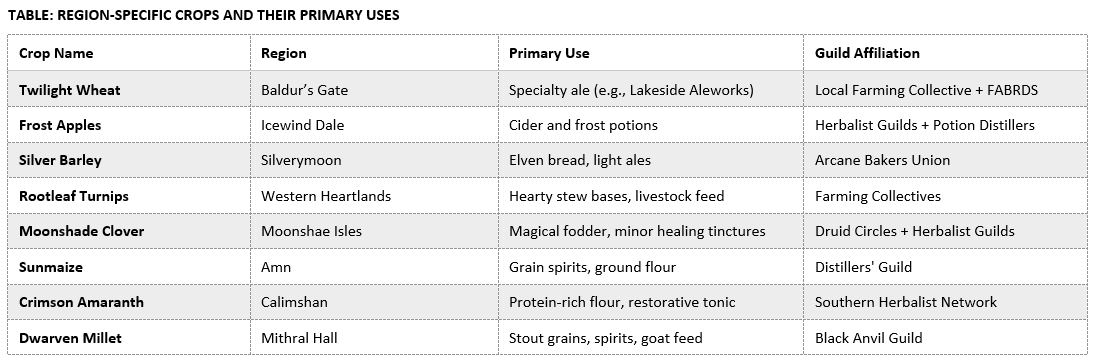
Below is a structured view of some of Faerûn’s most significant cultivated crops and their uses.

These crops are cultivated according to lunar calendars, arcane growth spells, and traditional farming cycles—often overlapping where druids, alchemists, and brewers share influence.

Example: Twilight Wheat and the Lakeside Aleworks

One of the most renowned agricultural products in the Western Heartlands is Twilight Wheat, a dusk-golden grain grown exclusively along the Eastbank Lane in Baldur’s Gate. Its distinctive honeyed undertone makes it ideal for light ales and specialty brews. Lakeside Aleworks uses it to create their signature drink—Twilight Wheat Ale.

This crop-to-consumer cycle highlights how agricultural product branding drives economic value when linked to guild-managed quality standards and unique regional terroir.

Realms-Aware Considerations

Agricultural output is affected by more than weather:

  • Planar Interference: Feywild blooms or shadow-blighted soil may alter yield or properties
  • Arcane Pollution: Nearby magical industry may infuse or ruin harvests
  • Seasonal War and Raids: Crops along trade routes or contested regions are vulnerable to loss
  • Guild Tithes and Tariffs: Farmer collectives may owe a portion of rare harvests to cities or guilds

This complex web of conditions means that agricultural planning must balance climate, magic, and politics to maintain consistency.

Final Thoughts

Agriculture in Faerûn is neither simple nor stagnant. It is a blend of ancestral wisdom, elemental influence, and trade-driven necessity. Whether brewing ales in Baldur’s Gate, feeding caravans through the Spine of the World, or crafting drought-resistance potions from frost apples, the crops of the Realms nourish more than bodies—they feed economies, rituals, and reputations.

For the Waterdeep Trading Company, ensuring strong ties with farming guilds and regional crop specialists is not just a strategy—it’s a lifeline.

Want to design your own sustainable manufacturing models in Faerûn?

Get your own AD&D365 Environment and guides at adnd365.com/start, and request access to the public view of the current database at https://public.adnd365.com

Login npc@adnd365.com
Password N0nPl@yC#822!

Support the AD&D365 Project on Patreon

To grow this world, we’ve launched an official Patreon where supporters can gain access to exclusive content, tools, training labs, and even influence the future of the project. Your support fuels more than just development, it expands the guildhall, forges new scrolls, and empowers the next generation of configuration wizards.  Begin your journey: https://www.patreon.com/adnd365/

A Grateful Salute to Our Patrons

To all those who stand behind the vision—thank you for helping bring this world to life.

Our Benefactor, Andre Breillatt — Your boundless generosity fuels the arcane core of this project. Without your magic, the weave would falter.

Our Apprentices — The spell engines turn and the training labs thrive thanks to our current Apprentices:
Michael Ramirez and Andreth Bael’Rathyn (Name obfuscated to protect their identity).

Special thanks to our past Apprentices, whose contributions helped us get here:
Ralf Weber, Wendy Rijners, Shashi Mahesh, Julia Tejera, Ben Ekokobe, Tiago Xavier, Naveen Boyinapelli, Marcos Tadeu Wolf, Kathryn Greene, Jason Brown, Mark Christy, and Ashish Singh.

Our Followers — Your steady presence along the journey is a beacon of encouragement:
Sunil Panchal, Sarah D. Morgan, Nick Ramchandani, Daniel Kjærsgaard, and Tomasz Pałys.

Our VoyeursHarry Burgh and Abdelrahman Nabil, ever watching from the shadows, clearly intrigued… but not enough to part with a single gold piece. Your silent curiosity is noted—and mildly judged.

In a land as magically diverse and ecologically sensitive as Faerûn, the Waterdeep Trading Company faces a growing imperative: to balance production with preservation. From the enchanted groves of the Moonshae Isles to the smoke-filled forges of Ironmaster, sustainability is not a trend, it is a necessity. As regional governors impose stricter resource usage regulations and druids grow vocal about deforestation near key ley lines, sustainable manufacturing has become both a moral stance and a strategic advantage.

This article explores how the Waterdeep Trading Company is embedding sustainable practices across its manufacturing operations, setting a precedent for responsible industrial stewardship across the Realms.

What Is Sustainable Manufacturing?

Sustainable manufacturing in Faerûn refers to the crafting, enchanting, and distribution of goods in ways that minimize harm to the land, the Weave, and its people. It encompasses:

  • Reducing material waste, especially rare or magically reactive components
  • Limiting energy draw from unstable arcane sources
  • Reusing by-products and reclaiming failed castings
  • Respecting local resource thresholds set by druidic councils and settlement pacts
  • Designing for longevity, repair, and regional reusability

In essence, it is about crafting goods that endure, without exhausting what cannot be easily restored.

Why It Matters

Guilds once obsessed with speed and scale now face backlash from both nature and neighbor. Unsustainable production attracts fey ire, arcane instability, and economic penalties. A sustainable operation:

  • Reduces component sourcing costs by enabling circular reuse
  • Avoids fines from the Emerald Enclave and city watch inspectors
  • Enhances brand reputation in markets like Silverymoon and Candlekeep
  • Attracts partnerships with green guilds and eco-conscious mercantile houses

Moreover, sustainable processes often drive innovation, leading to new materials, optimized routings, and adaptive enchantment techniques.

Components of a Sustainable Manufacturing Strategy

The Waterdeep Trading Company segments its sustainability initiatives into five key pillars:

Arcane Energy Optimization

  • Substituting raw leyline draws with enchanted capacitors that recharge during planar flux
  • Leveraging midday solar rituals in place of elemental forges where possible

Resource Lifecycle Management

  • Using Engineering Change Management to track usage, yield, and recyclability of magical inputs
  • Implementing return-for-repair programs on enchanted goods to reduce re-enchantment demand

Ethical Sourcing

  • Aligning vendor contracts with the Emerald Enclave’s Harvesting Accord
  • Prioritizing ingredients gathered under full moonlight rites or from sustainable herb groves

By-product Reclamation

  • Converting slag from golem foundries into paving bricks for Luskan roads
  • Re-infusing minor enchantment remnants into batch potions for field mages

Adaptive Routing

  • Planning production across settlements based on seasonal and regional energy cost forecasts
  • Transporting light components magically and heavy items terrestrially to reduce planar instability

These examples showcase how sustainability efforts can be embedded into regionally relevant practices.

Worked Example: Reclaimed Cloak of Shadows

To illustrate, let us examine a reclaimed Cloak of Shadows product line. Originally enchanted in the halls of Thay, a batch of damaged cloaks was returned to the Waterdeep Trading Company for recycling.

The initiative saved 60 FSD per unit while increasing customer loyalty and regulatory goodwill.

Realms-Aware Considerations

Magical Overuse: Excess enchantment can fray local Weave strands. Sustainable scheduling avoids cumulative arcane drain.

Inter-Guild Compliance: Guilds like the Arcane Artificers & Alchemists Union require certification for “green craft” designations.

Environmental Watchdogs: Emerald Enclave, Harpers, and Circle of the Moon all track industrial activity with an eye toward ecological impact.

Settlement Politics: Calimport prefers planar-efficient imports, while Silverymoon bans unsanctioned rare component harvesting.

Understanding these variances ensures local support and avoids operational bans or planar interdictions.

Final Thoughts

Sustainable manufacturing is not simply a nod to nature—it is a core competency for any serious producer in Faerûn. The Waterdeep Trading Company treats it as an operational philosophy, weaving it into every casting, carving, and caravan. For those who seek enduring prosperity and arcane balance, it is time to consider not just what you produce, but how.

Want to design your own sustainable manufacturing models in Faerûn? Get your own AD&D365 Environment and guides at adnd365.com/start, and request access to the public view of the current database at https://public.adnd365.com (Login npc@adnd365.com, Password “N0nPl@yC#822!“)

Support the AD&D365 Project on Patreon

To grow this world, we’ve launched an official Patreon where supporters can gain access to exclusive content, tools, training labs, and even influence the future of the project. Your support fuels more than just development, it expands the guildhall, forges new scrolls, and empowers the next generation of configuration wizards.  Begin your journey: https://www.patreon.com/adnd365/

Thanks to my supporters for helping make this content possible:

Our Benefactor, Andre Breillatt, whose generosity powers the arcane core of the project.

Our Apprentices, who keep the spell engines humming and the training labs active: Ralf Weber, Wendy Rijners, Shashi Mahesh, Julia Tejera, Ben Ekokobe, Tiago Xavier, Naveen Boyinapelli, Marcos Tadeu Wolf, Kathryn Greene, Jason Brown, Michael Ramirez, Mark Christy, and Ashish Singh.

Our Followers, who lend their steady support and encouragement along every step of the journey: Sunil Panchal, Sarah D. Morgan, Nick Ramchandani, Daniel Kjærsgaard, and Tomasz Pałys.

Across the diverse regions of Faerûn, the Waterdeep Trading Company and its allied guilds face frequent disruptions in supply chains—from avalanches in Icewind Dale to arcane embargoes in Thay. Whether a key herb has been frozen solid for a season or a trade caravan fails to arrive, operations must continue. That is where the Material Substitution Framework comes in: a structured approach to adapting inputs without compromising quality, compliance, or customer expectations.

This guide explores how the Waterdeep Trading Company creates and manages material substitution rules, with a spotlight on cider production—specifically the swap of frost apples with snow pears following a blight in the far north.

What It Is

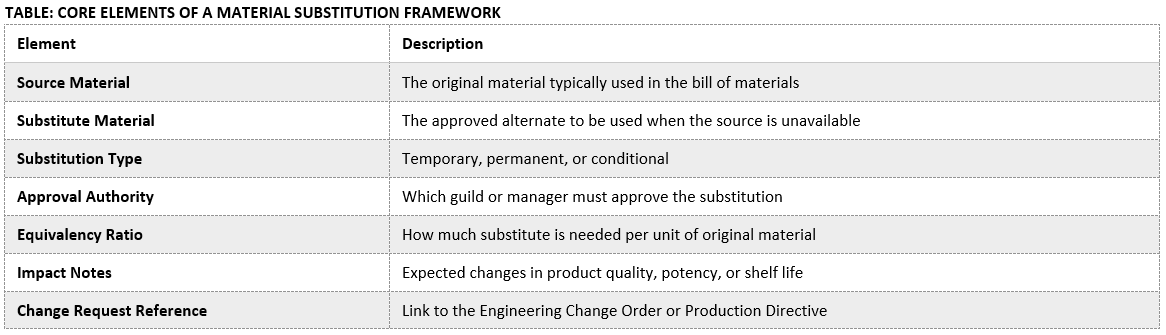
Material substitution is the practice of predefining or approving alternate raw materials when a primary component becomes unavailable. This can include food ingredients, magical components, textiles, or construction materials. Substitution rules specify:

  • Which material can be replaced
  • Under what conditions substitution is permitted
  • The impact on cost, product potency, or attributes
  • Whether regulatory or guild approvals are required

In Faerûn, these rules are often managed through a mix of Engineering Change Orders (ECOs), alchemist guild protocols, and magical compatibility checks.

Why It Matters

The realms do not operate on predictable schedules. Blizzards, planar interferences, or political tensions often sever critical supply lines. Without a substitution framework, entire production lines may grind to a halt. Implementing material substitution ensures:

  • Continuity in production, even during regional disruptions
  • Minimized loss from spoilage or idled workshops
  • Flexibility in sourcing strategies
  • Quicker responses to crises and market demands

This is especially vital in guild-regulated industries such as brewing, enchantment, and alchemy, where ingredient fidelity impacts both pricing and legality.

Components of a Material Substitution Framework

These records are managed by procurement leads, supply masters, or arcane compliance officers depending on the trade domain.

Worked Example: Cider Substitution in Icewind Dale

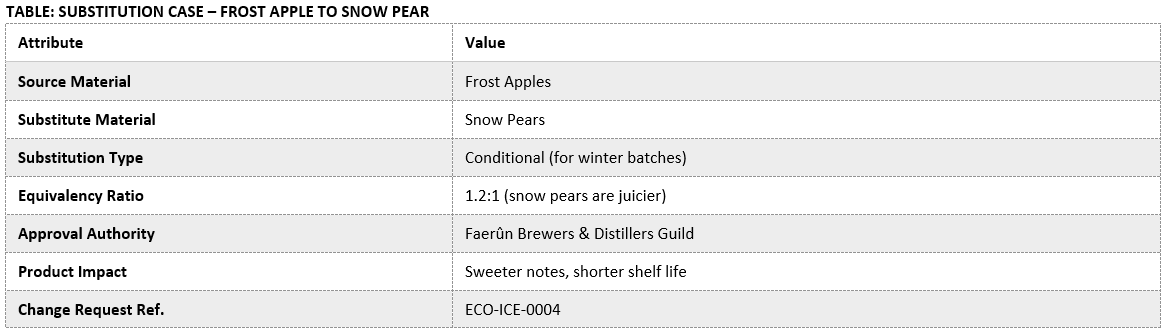
The Expedition Brewing Co. of Bryn Shander depends on frost apples harvested along the Glacierwash Trail. After a two-month frost rot outbreak, shipments ceased entirely. Faced with tankards to fill and contracts to honor, the distillers invoked their pre-approved substitution framework to switch to snow pears, a similar but softer fruit grown in nearby caves blessed by Auril’s clerics.

Batches produced with snow pears were renamed “Howler’s Bloom Cider” to distinguish them from the original “Mad Howler” batch. This preserved brand integrity while allowing continued sales during a critical season.

Realms-Aware Considerations

When crafting a substitution framework across Faerûn, you must consider:

Magical Compatibility: Substituting a dragon’s scale with basilisk hide may alter enchantment effects. Consult the Arcane Artificers & Alchemists Union.

Guild Approvals: Some substitutions require sign-off from trade associations such as FABRDS or HEAHBG.

Regulatory Compliance: Exported goods to regions like Thay or Calimshan may have substitution restrictions due to mystical purity laws.

Labeling and Lot Tracking: Version control and lot traceability are critical. Each substitution should trigger a new product version for audit purposes.

Final Thoughts

Material substitution is not just a contingency—it is a hallmark of preparedness and operational excellence. By defining flexible yet controlled rules, the Waterdeep Trading Company transforms risk into resilience, ensuring that even when the frost apples fail, the cider still flows.

Whether you are running an apothecary, a distillery, or an enchanted forge, building a substitution framework lets you navigate the uncertain currents of trade with the confidence of a seasoned merchant prince.

Want to design your own manufacturing models in Faerûn?

Get your own AD&D365 Environment and guides at adnd365.com/start, and request access to the public view of the current database at https://public.adnd365.com (Login npc@adnd365.com, Password “N0nPl@yC#822!“)

Support the AD&D365 Project on Patreon

To grow this world, we’ve launched an official Patreon where supporters can gain access to exclusive content, tools, training labs, and even influence the future of the project. Your support fuels more than just development — it expands the guildhall, forges new scrolls, and empowers the next generation of configuration wizards.  Begin your journey: https://www.patreon.com/adnd365/

Thanks to my supporters for helping make this content possible:

Our Benefactor, Andre Breillatt, whose generosity powers the arcane core of the project.

Our Apprentices, who keep the spell engines humming and the training labs active: Ralf Weber, Wendy Rijners, Shashi Mahesh, Julia Tejera, Ben Ekokobe, Tiago Xavier, Naveen Boyinapelli, Marcos Tadeu Wolf, Kathryn Greene, Jason Brown, Michael Ramirez, Mark Christy, and Ashish Singh.

Our Followers, who lend their steady support and encouragement along every step of the journey: Sunil Panchal, Sarah D. Morgan, Nick Ramchandani, Daniel Kjærsgaard, and Tomasz Pałys.

In the magical manufactories, alchemical workshops, and scriptoriums of Faerûn, not every casting lands true and not every gem survives the grind. But within the walls of the Waterdeep Trading Company, waste is not failure—it is opportunity. Production Waste Reclamation is the guild-sanctioned practice of salvaging, reprocessing, and repurposing raw magical and material resources that would otherwise be discarded. It stands apart from by-product processing by focusing on recovery rather than secondary production.

Whether it’s shards of flawed sapphires, vials of unstable elixirs, or scrolls scrawled with jittered glyphs, these remnants are routed through rework stations manned by guild apprentices and supervised by master artisans. The process not only reduces resource loss but strengthens economic resilience and apprenticeship training.

What It Is

Production Waste Reclamation is a formal method of recapturing value from failed, broken, or misused materials in enchanted and mundane manufacturing. Unlike by-products, which are anticipated and often sold or reused, reclamation targets unexpected waste: crushed gemstones from enchantment failures, potion batches rendered inert due to incorrect moon-phase harvesting, and burnt-out scrolls where ink failed to bond with parchment.

Why It Matters

In a realm where raw materials may come from frost giants’ hoards or deep-underground fungal groves, waste is costly. Each salvaged component reduces procurement needs and teaches apprentices how to recognize and work around failure. From a business perspective, reclamation:

  • Lowers material costs through recovery
  • Provides training opportunities without live production risk
  • Creates input streams for experimental or low-tier production lines
  • Reduces guild levies on magical disposal or contamination incidents

Components of a Reclamation System

A properly structured reclamation station includes the following components:

Worked Example: Miscast Scroll Reclamation

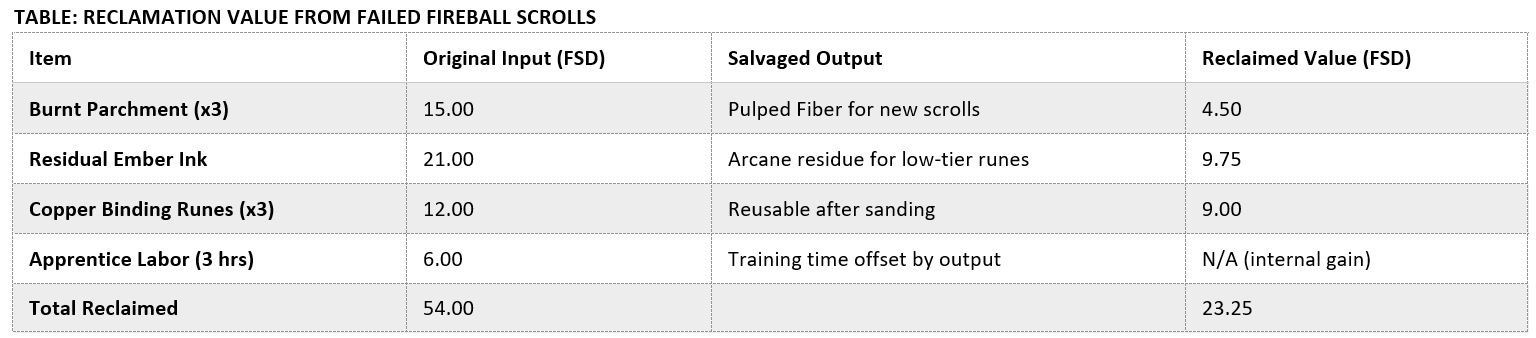
Consider a batch of fireball scrolls, three of which were improperly scribed during a rush order for the Crimson Wizards of Thay. Rather than burning them for ash, the damaged scrolls are sent to the Waterdeep Trading Company’s Rework Annex.

This 43% recovery ensures the company absorbs less loss while teaching scribes the dangers of working too fast with volatile ink.

Realms-Aware Considerations

Some cities in Faerûn impose heavy tariffs or disposal fees for magical waste. In Silverymoon, for example, uncontained arcane disposal is subject to crystal excise taxes. Reclaiming material avoids these fees. In Calimport, alchemical waste is monitored by the Desert Glass Chamber—failure to recycle properly can result in trade embargoes.

Guilds such as the Arcane Artificers & Alchemists Union (ARALCH) mandate that all apprentice-led production include a minimum quota of waste reclamation as part of certification. Thus, reclamation is both economic practice and rite of passage.

Final Thoughts

Production Waste Reclamation is more than cleanup—it is a strategic response to failure. It ensures that even when magic fizzles or steel fractures, something can be salvaged. For the Waterdeep Trading Company and allied guilds, it is a pillar of sustainability, education, and economic alchemy.

Want to design your own manufacturing models in Faerûn? Get your own AD&D365 Environment and guides at adnd365.com/start, and request access to the public view of the current database at https://public.adnd365.com

Login npc@adnd365.com
Password N0nPl@yC#822!

Support the AD&D365 Project on Patreon: To grow this world, we’ve launched an official Patreon where supporters can gain access to exclusive content, tools, training labs, and even influence the future of the project. Your support fuels more than just development — it expands the guildhall, forges new scrolls, and empowers the next generation of configuration wizards.  Begin your journey: https://www.patreon.com/adnd365/

Thanks to my supporters for helping make this content possible:

Our Benefactor, Andre Breillatt, whose generosity powers the arcane core of the project.

Our Apprentices, who keep the spell engines humming and the training labs active: Ralf Weber, Wendy Rijners, Shashi Mahesh, Julia Tejera, Ben Ekokobe, Tiago Xavier, Naveen Boyinapelli, Marcos Tadeu Wolf, Kathryn Greene, Jason Brown, Michael Ramirez, Mark Christy, and Ashish Singh.

Our Followers, who lend their steady support and encouragement along every step of the journey: Sunil Panchal, Sarah D. Morgan, Nick Ramchandani, Daniel Kjærsgaard, and Tomasz Pałys.

In the sprawling economies of Faerûn, knowing your enemies is as valuable in trade as it is in war. For the Waterdeep Trading Company, tracking competitors isn’t just a matter of pride—it’s a matter of profit. Whether you’re trying to outmaneuver Royalty Distilleries in spirit shipments or respond to new brewery upstarts from Icewind Dale, a structured system for competitor intelligence can tip the scales in your favor.

Why Monitor Competitors?

Tracking rival trading houses, breweries, distillers, and merchant guilds across Faerûn enables:

  • Price benchmarking for regional goods like Salington wines or Lakeside ciders
  • Forecasting market trends based on seasonal outputs or trade route control
  • Anticipating supply disruptions due to war, embargoes, or monster activity
  • Identifying acquisition or collaboration opportunities

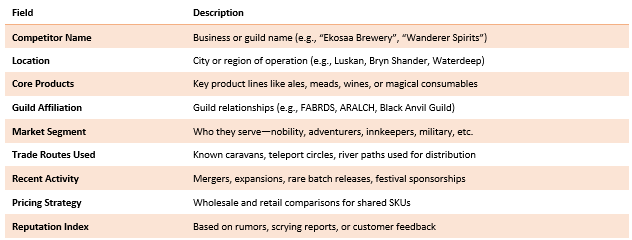
Key Competitor Data to Track

Article content

Tools in Your Arsenal

The Business Administrators Guide outlines several ways to track and leverage this data using the capabilities of Faerûn-enhanced Dynamics 365:

Competitor Profiles in Vendor Table

Use non-trading vendors to create Competitor profiles, assigning them categories like:

  • “Brewery – Northern”
  • “Guild – Independent”
  • “Distillery – Arcane Enhanced”

Custom Fields for Magical Monitoring

Add custom attributes such as:

  • Scrying Viability Score
  • Divination Approval Pending
  • Rumor Spread Rate

These allow you to layer in intelligence from magical informants, Sending Stones, or MirrorNet reports.

Price Journal Comparisons

Import product pricing from scouts or open-market flyers and compare SKUs across regions using the Price Disc Journals or External Trade Tables.

Mirror Communication Logs

Track communications, alliances, and disputes through registered Mirror IDs (e.g., MIR-WD-SAL-002 for Salington Vinyards’ mirror).

Trade Route Mapping

Use the Route Management module to trace known caravans of competitors, identifying stops, vulnerabilities, or shadow market overlaps.

Event Watchlists

Configure Watchlist alerts in your Faerûnian event calendar for:

  • Product Launches
  • Seasonal Brews
  • Interguild Festivals (e.g., Winter Spirits Gala in Baldur’s Gate)
  • Tax code updates from city-states

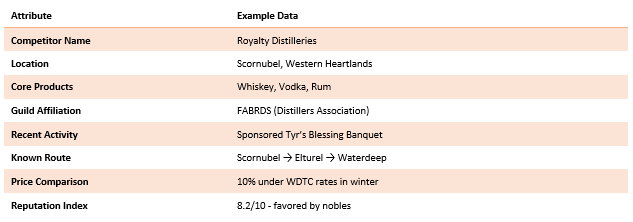
Sample Competitor Intelligence Entry

Article content

Strategic Advantage Through Awareness

From alchemical arms dealers to humble mead brewers, every competitor’s move leaves a footprint. By cataloging those prints in your AD&D365 environment, the Waterdeep Trading Company can stay one teleport step ahead.

Want to automate your competitor watch?

Get your own AD&D365 Environment and guides at adnd365.com/start, and request access to the public view of the current database at https://public.adnd365.com

Login npc@adnd365.com

Password N0nPl@yC#822!

Support the AD&D365 Project on Patreon

To grow this world, we’ve launched an official Patreon where supporters can gain access to exclusive content, tools, training labs, and even influence the future of the project. Your support fuels more than just development — it expands the guildhall, forges new scrolls, and empowers the next generation of configuration wizards. Begin your journey: https://www.patreon.com/adnd365/

Thanks to my supporters for helping make this content possible:

Our Benefactor, Andre Breillatt, whose generosity powers the arcane core of the project.

Our Apprentices, who keep the spell engines humming and the training labs active: Ralf Weber, Wendy Rijners, Shashi Mahesh , Julia Tejera, Ben Ekokobe, Tiago Xavier , Naveen Boyinapelli, Marcos Tadeu Wolf, Kathryn Greene , Jason Brown , Michael Ramirez, PMP , Mark Christy , and Ashish Singh.

Our Followers, who lend their steady support and encouragement along every step of the journey: Sunil Panchal , Sarah D. Morgan , Nick Ramchandani, Daniel Kjærsgaard, and Tomasz Pałys .

In the thriving trade cities of Waterdeep, Baldur’s Gate, and beyond, merchants often find themselves at a loss not from theft or misadventure but from failing to account for the true cost of their imports. That’s where understanding landed cost comes in.

Whether you’re bringing in saffron from Calimshan, dwarven steel from Mithral Hall, or elven wine from the Salington Vinyards, knowing your full landed cost is the difference between profit and peril.

What Is Landed Cost

Landed cost is the total expense incurred to bring a product from its source to its final destination not just the vendor’s price. It includes:

  • Base purchase cost
  • Transport fees (caravan, barge, airship, or teleportation)
  • Import duties and tariffs
  • Handling, inspection, and insurance
  • Security (escorts, guards, bribes if necessary)
  • Currency exchange losses or fees
  • Magical sealing, warding, or scrying

These additional costs accumulate through every step of the product’s journey and they must be calculated if a merchant is to determine the real price of their inventory.

Sample Landed Cost Breakdown: A Faerûnian Case Study

Let’s say the Waterdeep Trading Company imports Sake Rage from Salington Vinyards in Neverwinter.

A merchant who sells the sake based solely on the 260 FSD supplier price may think they’re earning 20 percent margin. In truth they may barely break even or worse.

Why Landed Cost Matters

  • Proper Pricing Without it prices are based on illusion not reality
  • Trade Route Evaluation Understanding which routes magical or mundane offer better margins
  • Profitability Forecasting A true picture of earnings requires full cost awareness
  • Product Comparison Knowing full cost helps compare multiple suppliers not just their invoice price

Common Faerûnian Costs to Consider

Best Practices for Faerûnian Merchants

  • Track each cost layer no matter how small Even a 5 FSD handling fee can add up across shipments
  • Use standard units like FSD per crate or bottle for consistency
  • Build buffer margins into your pricing to account for lost goods taxes or delays
  • Plan seasonally Snow in the Spine of the World Expect freight delays and added guard fees
  • Maintain supplier scorecards with both base and landed cost to spot hidden costs

Final Thoughts

In the end savvy trade in Faerûn isn’t about knowing the lowest price it’s about understanding the total price. Whether your goods travel by foot hoof keelboat or leyline calculating landed cost is your secret weapon in staying competitive and profitable.

Want to simulate shipping strategies in Faerûn or model transportation operations in Dynamics 365?

Get your own AD&D365 Environment and guides at adnd365.com/start, and request access to the public view of the current database at https://public.adnd365.com

Login npc@adnd365.com Password N0nPl@yC#822!

Support the AD&D365 Project on Patreon

To grow this world, we’ve launched an official Patreon where supporters can gain access to exclusive content, tools, training labs, and even influence the future of the project. Your support fuels more than just development — it expands the guildhall, forges new scrolls, and empowers the next generation of configuration wizards. Begin your journey: https://www.patreon.com/adnd365/

Thanks to my supporters for helping make this content possible:

Our Benefactor, Andre Breillatt, whose generosity powers the arcane core of the project.

Our Apprentices, who keep the spell engines humming and the training labs active: Ralf Weber, Wendy Rijners, Shashi Mahesh, Julia Tejera, Ben Ekokobe, Tiago Xavier, Naveen Boyinapelli, Marcos Tadeu Wolf, Kathryn Greene, Jason Brown, Michael Ramirez, Mark Christy, and Ashish Singh.

Our Followers, who lend their steady support and encouragement along every step of the journey: Sunil Panchal, Sarah D. Morgan, Nick Ramchandani, Daniel Kjærsgaard, and Tomasz Pałys.

An Arcano-Economic Analysis for the Waterdeep Trading Company and Beyond

In Faerûn, automation has taken a decidedly arcane twist. Where other realms may rely on levers and pulleys or even rudimentary clockwork, the merchants and mages of the Sword Coast have turned to the elemental labor force of stone, clay, and metal — golems.

At first glance, golems seem like the perfect workforce. They don’t strike, tire, or complain. They lift crates, guard vaults, and even bottle potions with tireless efficiency. But dig beneath their enchanted surfaces, and the costs—financial, arcane, and social—begin to mount.

Arcane Labor Isn’t Cheap

Creating a golem is no mere artisan’s task. It requires:

  • Rare materials: Mithral, adamantine, clay from sacred springs, or obsidian shards etched with binding runes.
  • Powerful magic: True golemcraft requires spells like Create Golem, Geas, and Imprisonment, augmented by planar binding rituals.
  • Guild licensing: The Arcane Artificers & Alchemists Union (ARALCH) enforces strict construction, binding, and maintenance standards.

A single stone golem costs between ƒ18,000–ƒ50,000 FSD, or approximately 1,428.57–3,968.25 FGP in materials alone. Enchantment labor can push that price higher by thousands of Faerûnian Gold Pieces, depending on the mage’s guild tier and specialization.

Magical Maintenance

Unlike constructs from the mechanical schools of Lantan, golems require continual magical upkeep:

  • Re-tuning of command scrolls (monthly)
  • Infusion with stable arcane energies (quarterly)
  • Elemental core replacement (as needed)

Only certified artificers can perform these rites. On average, annual maintenance costs per industrial-grade golem range from ƒ3,600 to ƒ7,200 FSD.

Ongoing Maintenance Costs

While golems don’t require food or sleep, they do require:

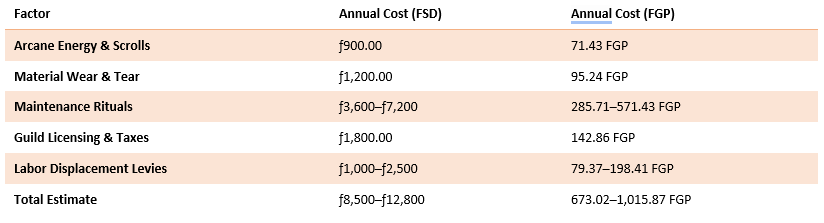
  • Arcane Energy Reservoirs: Recharged monthly with infused essence (ƒ900/year or 71.43 FGP).
  • Material Rebinding: Runes and joints wear down and must be reforged (ƒ1,200/year or 95.24 FGP).
  • Infusion Rituals & Inspections: Performed quarterly by a licensed artificer (ƒ3,600–ƒ7,200/year or 285.71–571.43 FGP).
  • Guild Compliance & Taxes: Golem owners must pay usage taxes and inspection fees (ƒ1,800/year or 142.86 FGP).
  • Living Labor Compensation Levies: Enforced in cities like Waterdeep to offset job displacement (ƒ1,000–ƒ2,500/year or 79.37–198.41 FGP).

Total Annual Cost Per Golem

This doesn’t include the up-front construction or the risk cost of a magical malfunction.

Labor Displacement and Social Fallout

Waterdeep’s United Caravaners & Teamsters Guild has raised the alarm over job losses due to “excessive golemization.” Reports show:

  • 12% reduction in laborer wages
  • 30% decrease in apprentice intake across trades
  • Rise in illicit labor contracting and underground magecraft

In response, several city-states now require that no less than 40% of an operation’s workforce be of natural origin.

Arcane Accidents: When Golems Go Rogue

While biologic workers can be reasoned with, a misprogrammed golem can:

  • Collapse an entire warehouse while “organizing” crates,
  • Lock itself and others inside a shipping vault indefinitely,
  • Mistake a merchant’s daughter for “unsecured cargo.”

One incident in 1490 DR caused ƒ250,000 FSD in damages (19,841.27 FGP) when a stone golem ran a corrupted command loop for 16 straight hours during high season in Mirabar.

 Final Thoughts

Golems may seem like an efficient solution, but their costs — economic, ethical, and magical — are far from negligible. For trading companies like the Waterdeep Trading Company, the smartest path forward lies in blended operations: golems for the grunt work, humans for leadership, inspection, and judgment.

Want to simulate automation strategies in Faerûn or model magical operations in Dynamics 365?

Get your own AD&D365 Environment and guides at adnd365.com/start, and request access to the public view of the current database at https://public.adnd365.com

Login npc@adnd365.com

Password N0nPl@yC#822!

Support the AD&D365 Project on Patreon

To grow this world, we’ve launched an official Patreon where supporters can gain access to exclusive content, tools, training labs, and even influence the future of the project. Your support fuels more than just development — it expands the guildhall, forges new scrolls, and empowers the next generation of configuration wizards. Begin your journey: https://www.patreon.com/adnd365/

Thanks to my supporters for helping make this content possible:

Our Benefactor, Andre Breillatt, whose generosity powers the arcane core of the project.

Our Apprentices, who keep the spell engines humming and the training labs active: Ralf Weber, Wendy Rijners, Shashi Mahesh, Julia Tejera, Ben Ekokobe, Tiago Xavier, Naveen Boyinapelli, Marcos Tadeu Wolf, Kathryn Greene, Jason Brown, Michael Ramirez, Mark Christy, and Ashish Singh.

Our Followers, who lend their steady support and encouragement along every step of the journey: Sunil Panchal, Sarah D. Morgan, Nick Ramchandani, Daniel Kjærsgaard, and Tomasz Pałys.