Reclaiming the Arcane: Production Waste Reclamation in Faerûn
In the magical manufactories, alchemical workshops, and scriptoriums of Faerûn, not every casting lands true and not every gem survives the grind. But within the walls of the Waterdeep Trading Company, waste is not failure—it is opportunity. Production Waste Reclamation is the guild-sanctioned practice of salvaging, reprocessing, and repurposing raw magical and material resources that would otherwise be discarded. It stands apart from by-product processing by focusing on recovery rather than secondary production.
Whether it’s shards of flawed sapphires, vials of unstable elixirs, or scrolls scrawled with jittered glyphs, these remnants are routed through rework stations manned by guild apprentices and supervised by master artisans. The process not only reduces resource loss but strengthens economic resilience and apprenticeship training.
What It Is
Production Waste Reclamation is a formal method of recapturing value from failed, broken, or misused materials in enchanted and mundane manufacturing. Unlike by-products, which are anticipated and often sold or reused, reclamation targets unexpected waste: crushed gemstones from enchantment failures, potion batches rendered inert due to incorrect moon-phase harvesting, and burnt-out scrolls where ink failed to bond with parchment.
Why It Matters
In a realm where raw materials may come from frost giants’ hoards or deep-underground fungal groves, waste is costly. Each salvaged component reduces procurement needs and teaches apprentices how to recognize and work around failure. From a business perspective, reclamation:
- Lowers material costs through recovery
- Provides training opportunities without live production risk
- Creates input streams for experimental or low-tier production lines
- Reduces guild levies on magical disposal or contamination incidents
Components of a Reclamation System
A properly structured reclamation station includes the following components:

Worked Example: Miscast Scroll Reclamation
Consider a batch of fireball scrolls, three of which were improperly scribed during a rush order for the Crimson Wizards of Thay. Rather than burning them for ash, the damaged scrolls are sent to the Waterdeep Trading Company’s Rework Annex.
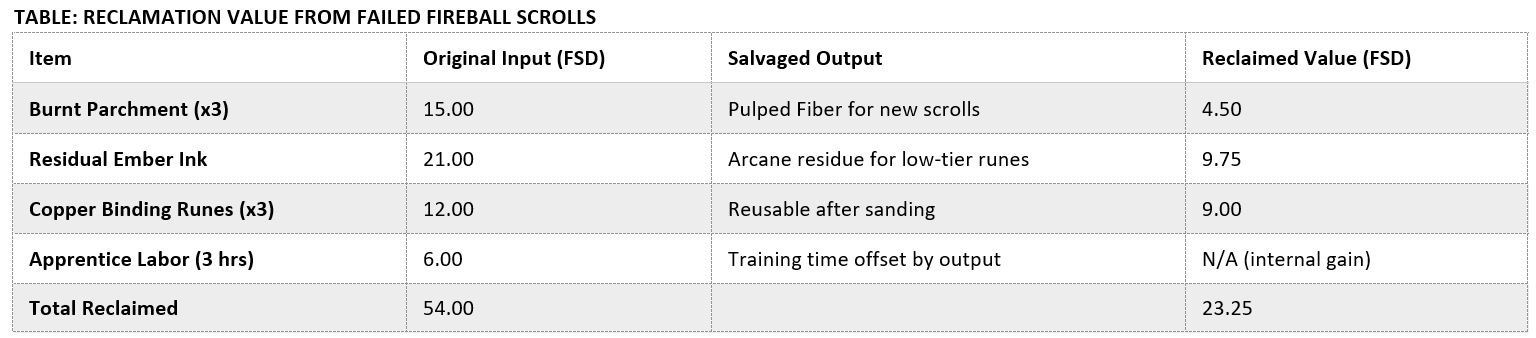
This 43% recovery ensures the company absorbs less loss while teaching scribes the dangers of working too fast with volatile ink.
Realms-Aware Considerations
Some cities in Faerûn impose heavy tariffs or disposal fees for magical waste. In Silverymoon, for example, uncontained arcane disposal is subject to crystal excise taxes. Reclaiming material avoids these fees. In Calimport, alchemical waste is monitored by the Desert Glass Chamber—failure to recycle properly can result in trade embargoes.
Guilds such as the Arcane Artificers & Alchemists Union (ARALCH) mandate that all apprentice-led production include a minimum quota of waste reclamation as part of certification. Thus, reclamation is both economic practice and rite of passage.
Final Thoughts
Production Waste Reclamation is more than cleanup—it is a strategic response to failure. It ensures that even when magic fizzles or steel fractures, something can be salvaged. For the Waterdeep Trading Company and allied guilds, it is a pillar of sustainability, education, and economic alchemy.
Want to design your own manufacturing models in Faerûn? Get your own AD&D365 Environment and guides at adnd365.com/start, and request access to the public view of the current database at https://public.adnd365.com
Login npc@adnd365.com
Password N0nPl@yC#822!
Support the AD&D365 Project on Patreon: To grow this world, we’ve launched an official Patreon where supporters can gain access to exclusive content, tools, training labs, and even influence the future of the project. Your support fuels more than just development — it expands the guildhall, forges new scrolls, and empowers the next generation of configuration wizards. Begin your journey: https://www.patreon.com/adnd365/
Thanks to my supporters for helping make this content possible:
Our Benefactor, Andre Breillatt, whose generosity powers the arcane core of the project.
Our Apprentices, who keep the spell engines humming and the training labs active: Ralf Weber, Wendy Rijners, Shashi Mahesh, Julia Tejera, Ben Ekokobe, Tiago Xavier, Naveen Boyinapelli, Marcos Tadeu Wolf, Kathryn Greene, Jason Brown, Michael Ramirez, Mark Christy, and Ashish Singh.
Our Followers, who lend their steady support and encouragement along every step of the journey: Sunil Panchal, Sarah D. Morgan, Nick Ramchandani, Daniel Kjærsgaard, and Tomasz Pałys.
 A Tinkerers Notebook