Material Substitution Framework in Faerûn: Adapting Recipes and Routes When Supplies Run Dry
Across the diverse regions of Faerûn, the Waterdeep Trading Company and its allied guilds face frequent disruptions in supply chains—from avalanches in Icewind Dale to arcane embargoes in Thay. Whether a key herb has been frozen solid for a season or a trade caravan fails to arrive, operations must continue. That is where the Material Substitution Framework comes in: a structured approach to adapting inputs without compromising quality, compliance, or customer expectations.
This guide explores how the Waterdeep Trading Company creates and manages material substitution rules, with a spotlight on cider production—specifically the swap of frost apples with snow pears following a blight in the far north.
What It Is
Material substitution is the practice of predefining or approving alternate raw materials when a primary component becomes unavailable. This can include food ingredients, magical components, textiles, or construction materials. Substitution rules specify:
- Which material can be replaced
- Under what conditions substitution is permitted
- The impact on cost, product potency, or attributes
- Whether regulatory or guild approvals are required
In Faerûn, these rules are often managed through a mix of Engineering Change Orders (ECOs), alchemist guild protocols, and magical compatibility checks.
Why It Matters
The realms do not operate on predictable schedules. Blizzards, planar interferences, or political tensions often sever critical supply lines. Without a substitution framework, entire production lines may grind to a halt. Implementing material substitution ensures:
- Continuity in production, even during regional disruptions
- Minimized loss from spoilage or idled workshops
- Flexibility in sourcing strategies
- Quicker responses to crises and market demands
This is especially vital in guild-regulated industries such as brewing, enchantment, and alchemy, where ingredient fidelity impacts both pricing and legality.
Components of a Material Substitution Framework
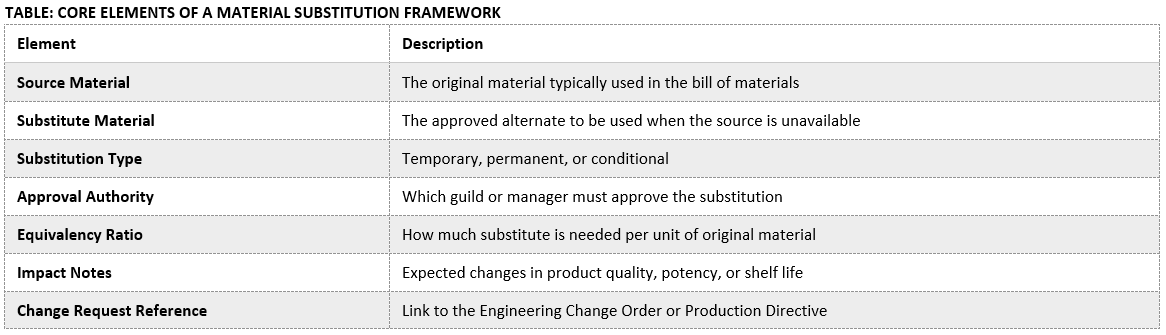
These records are managed by procurement leads, supply masters, or arcane compliance officers depending on the trade domain.
Worked Example: Cider Substitution in Icewind Dale
The Expedition Brewing Co. of Bryn Shander depends on frost apples harvested along the Glacierwash Trail. After a two-month frost rot outbreak, shipments ceased entirely. Faced with tankards to fill and contracts to honor, the distillers invoked their pre-approved substitution framework to switch to snow pears, a similar but softer fruit grown in nearby caves blessed by Auril’s clerics.
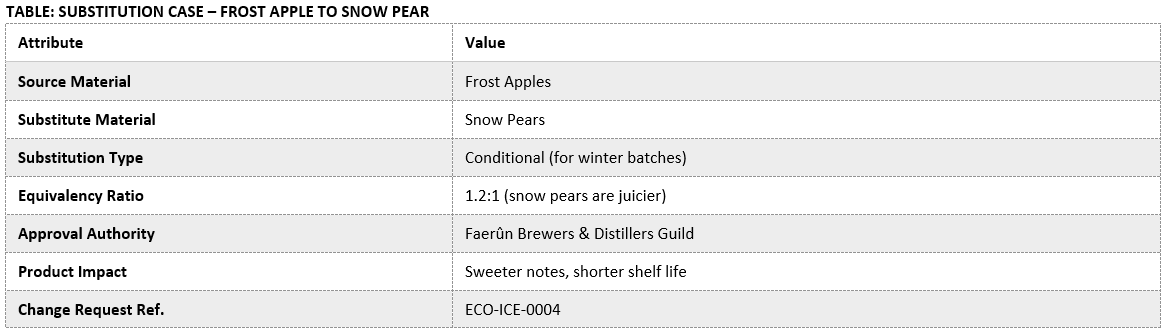
Batches produced with snow pears were renamed “Howler’s Bloom Cider” to distinguish them from the original “Mad Howler” batch. This preserved brand integrity while allowing continued sales during a critical season.
Realms-Aware Considerations
When crafting a substitution framework across Faerûn, you must consider:
Magical Compatibility: Substituting a dragon’s scale with basilisk hide may alter enchantment effects. Consult the Arcane Artificers & Alchemists Union.
Guild Approvals: Some substitutions require sign-off from trade associations such as FABRDS or HEAHBG.
Regulatory Compliance: Exported goods to regions like Thay or Calimshan may have substitution restrictions due to mystical purity laws.
Labeling and Lot Tracking: Version control and lot traceability are critical. Each substitution should trigger a new product version for audit purposes.
Final Thoughts
Material substitution is not just a contingency—it is a hallmark of preparedness and operational excellence. By defining flexible yet controlled rules, the Waterdeep Trading Company transforms risk into resilience, ensuring that even when the frost apples fail, the cider still flows.
Whether you are running an apothecary, a distillery, or an enchanted forge, building a substitution framework lets you navigate the uncertain currents of trade with the confidence of a seasoned merchant prince.
Want to design your own manufacturing models in Faerûn?
Get your own AD&D365 Environment and guides at adnd365.com/start, and request access to the public view of the current database at https://public.adnd365.com (Login npc@adnd365.com, Password “N0nPl@yC#822!“)
Support the AD&D365 Project on Patreon
To grow this world, we’ve launched an official Patreon where supporters can gain access to exclusive content, tools, training labs, and even influence the future of the project. Your support fuels more than just development — it expands the guildhall, forges new scrolls, and empowers the next generation of configuration wizards. Begin your journey: https://www.patreon.com/adnd365/
Thanks to my supporters for helping make this content possible:
Our Benefactor, Andre Breillatt, whose generosity powers the arcane core of the project.
Our Apprentices, who keep the spell engines humming and the training labs active: Ralf Weber, Wendy Rijners, Shashi Mahesh, Julia Tejera, Ben Ekokobe, Tiago Xavier, Naveen Boyinapelli, Marcos Tadeu Wolf, Kathryn Greene, Jason Brown, Michael Ramirez, Mark Christy, and Ashish Singh.
Our Followers, who lend their steady support and encouragement along every step of the journey: Sunil Panchal, Sarah D. Morgan, Nick Ramchandani, Daniel Kjærsgaard, and Tomasz Pałys.
 A Tinkerers Notebook