Sowing the Future: Agriculture & Crop Cultivation in Faerûn
From the sun-kissed fields of the Western Heartlands to the frost-tinged orchards of Icewind Dale, agriculture in Faerûn is the quiet force behind adventurers’ feasts, brewers’ barrels, and alchemists’ vials. The Waterdeep Trading Company, like many guild-backed merchants, relies heavily on local farms, regional cooperatives, and seasonal harvests to keep goods flowing across the Realms.
Understanding how crops are cultivated, harvested, and transformed into products reveals the deep roots of Faerûn’s economic engine—and how business, biology, and the arcane all intertwine.
What It Is
Agriculture and crop cultivation in Faerûn encompasses the seasonal cycles of farming essential grains, fruits, and herbs used in food production, drink-making, livestock feed, and potion crafting. Unlike monoculture systems of distant empires, Faerûnian agriculture is highly regionalized and often infused with magical or druidic practices. This diversity ensures both survival and specialty.
Primary agricultural guilds include:
- Local Farming Collectives, responsible for staple crops and rotational fields
- Herbalist Guilds, overseeing rare flora and alchemical-grade herbs
- Faerûn Brewers & Distillers Association (FABRDS), partnering with farmers for specialized brewing crops
Why It Matters
For the Waterdeep Trading Company, agriculture is more than background noise—it’s the foundation of supply:
- Food and Feed: Bread, grain, root vegetables, and forage crops sustain populations and beasts alike
- Drink and Trade Commodities: Barley, wheat, and fruits drive alcohol and potion production
- Potion and Magical Ingredient Supply: Rare herbs and magically-reactive fruits are critical for alchemy
Without stable and region-specific farming, everything from Twilight Wheat Ale to frost apple tinctures would vanish from the shelves.
Crop Types and Regional Specialties
Below is a structured view of some of Faerûn’s most significant cultivated crops and their uses.
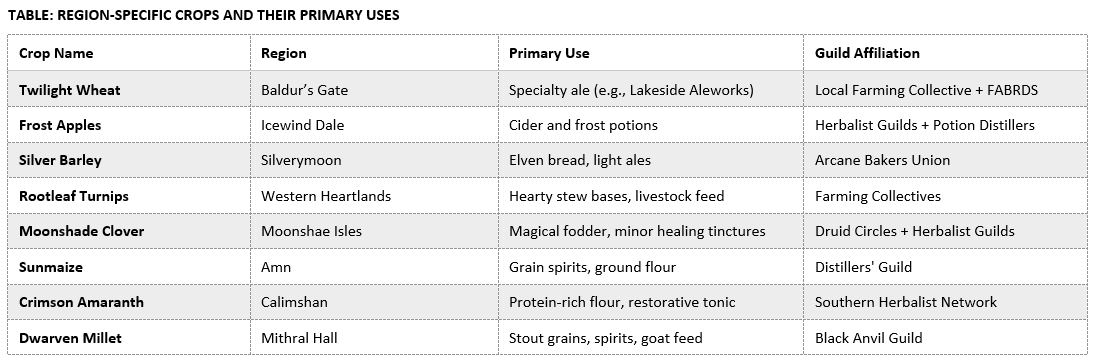
These crops are cultivated according to lunar calendars, arcane growth spells, and traditional farming cycles—often overlapping where druids, alchemists, and brewers share influence.
Example: Twilight Wheat and the Lakeside Aleworks
One of the most renowned agricultural products in the Western Heartlands is Twilight Wheat, a dusk-golden grain grown exclusively along the Eastbank Lane in Baldur’s Gate. Its distinctive honeyed undertone makes it ideal for light ales and specialty brews. Lakeside Aleworks uses it to create their signature drink—Twilight Wheat Ale.

This crop-to-consumer cycle highlights how agricultural product branding drives economic value when linked to guild-managed quality standards and unique regional terroir.
Realms-Aware Considerations
Agricultural output is affected by more than weather:
- Planar Interference: Feywild blooms or shadow-blighted soil may alter yield or properties
- Arcane Pollution: Nearby magical industry may infuse or ruin harvests
- Seasonal War and Raids: Crops along trade routes or contested regions are vulnerable to loss
- Guild Tithes and Tariffs: Farmer collectives may owe a portion of rare harvests to cities or guilds
This complex web of conditions means that agricultural planning must balance climate, magic, and politics to maintain consistency.
Final Thoughts
Agriculture in Faerûn is neither simple nor stagnant. It is a blend of ancestral wisdom, elemental influence, and trade-driven necessity. Whether brewing ales in Baldur’s Gate, feeding caravans through the Spine of the World, or crafting drought-resistance potions from frost apples, the crops of the Realms nourish more than bodies—they feed economies, rituals, and reputations.
For the Waterdeep Trading Company, ensuring strong ties with farming guilds and regional crop specialists is not just a strategy—it’s a lifeline.
Want to design your own sustainable manufacturing models in Faerûn?
Get your own AD&D365 Environment and guides at adnd365.com/start, and request access to the public view of the current database at https://public.adnd365.com
Login npc@adnd365.com
Password N0nPl@yC#822!
Support the AD&D365 Project on Patreon
To grow this world, we’ve launched an official Patreon where supporters can gain access to exclusive content, tools, training labs, and even influence the future of the project. Your support fuels more than just development, it expands the guildhall, forges new scrolls, and empowers the next generation of configuration wizards. Begin your journey: https://www.patreon.com/adnd365/
A Grateful Salute to Our Patrons
To all those who stand behind the vision—thank you for helping bring this world to life.
Our Benefactor, Andre Breillatt — Your boundless generosity fuels the arcane core of this project. Without your magic, the weave would falter.
Our Apprentices — The spell engines turn and the training labs thrive thanks to our current Apprentices:
Michael Ramirez and Andreth Bael’Rathyn (Name obfuscated to protect their identity).
Special thanks to our past Apprentices, whose contributions helped us get here:
Ralf Weber, Wendy Rijners, Shashi Mahesh, Julia Tejera, Ben Ekokobe, Tiago Xavier, Naveen Boyinapelli, Marcos Tadeu Wolf, Kathryn Greene, Jason Brown, Mark Christy, and Ashish Singh.
Our Followers — Your steady presence along the journey is a beacon of encouragement:
Sunil Panchal, Sarah D. Morgan, Nick Ramchandani, Daniel Kjærsgaard, and Tomasz Pałys.
Our Voyeurs — Harry Burgh and Abdelrahman Nabil, ever watching from the shadows, clearly intrigued… but not enough to part with a single gold piece. Your silent curiosity is noted—and mildly judged.
 A Tinkerers Notebook