Archive

Monthly Archives: July 2025

In Faerûn, where trade routes are protected by arcane glyphs and castles glow with perpetual wards, it’s easy to overlook that even magic has limits. While a +1 sword might stay sharp indefinitely, enchantments placed on buildings, gates, infrastructure, and tools often degrade, expire, or require periodic recharging. For the wise merchant or quartermaster, these enhancements aren’t one-time costs—they’re capital assets with lifespans and diminishing value.

This article explores how to financially track and depreciate long-term magical enhancements as part of responsible accounting and resource planning.

What Qualifies as a Long-Term Magical Enhancement?

These enhancements share common traits:

  • They improve the utility, protection, or efficiency of a structure, facility, or system.
  • They last for more than a year but eventually degrade.
  • They require significant upfront investment in labor, materials, or guild services.

Examples of Enhancements:

Depreciation Methods for Magical Assets

Straight-Line Depreciation (Most Common)

  • Equal value lost each year.
  • Works well for enchantments with stable energy decay or maintained potency.

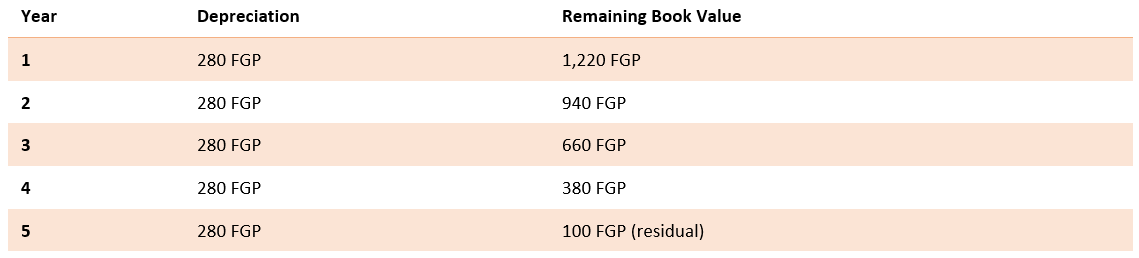
Example: A Sending Circle costing 1,500 FGP with a 100 FGP residual rune value after 5 years:

Annual Depreciation = (1,500 – 100) / 5 = 280 FGP per year
Magical Half-Life Depreciation

  • Ideal for enchantments that fade with time, like illusions, camouflage fields, or aura-based effects.
  • Value decreases by half each year or by magical potency intervals.

Example: Illusory Ward (600 FGP)

Ritual-Driven Declining Balance

  • Some magical investments lose value faster early on (e.g., temporary blessings or planar-tuned wards).
  • Use a declining balance method with a fixed percentage (e.g., 40% per year).

Accounting for Residual Magic

When enchantments fade, residual components (e.g., carved runestones, infused crystals, or blessed architecture) may retain scrap value:

  • Residual Value: Kept for repurposing or sale.
  • Re-enchantment Credit: Used to offset future enhancement costs.
  • Magical Salvage: Claimed by guilds like ARALCH if the enchantment was subsidized.

Triggering Revaluations

Some enchantments require mid-life reassessment, such as:

  • Leyline shifts that reduce potency.
  • Guild policy changes affecting regulatory compliance.
  • Damage or misfires reducing duration or effectiveness.

In such cases, a revaluation or impairment adjustment may be applied to reflect the true market or magical value of the asset.

When to Expense Instead of Depreciate

Not all enchantments qualify for depreciation. Short-duration effects, consumable spell contracts, or one-time arcane services (e.g., teleportation, weather summoning) are typically expensed immediately.

Expensed Examples:

  • Alarm spell cast on a single delivery (15 FGP, one day)
  • Sending scroll rental for a merchant’s urgent message (50 FGP, one use)
  • Hallowing a tent before a diplomatic negotiation (100 FGP, single event)

Conclusion

Even in a world saturated with wonder, magic must bow to the ledger. By tracking long-term magical enhancements as depreciable assets, organizations ensure more accurate valuations, realistic budgeting, and better forecasting for re-enchantment cycles.

Whether you’re protecting your warehouse with dragon wards or tuning a lighthouse to repel banshees, accounting for the slow fade of magic is a critical part of surviving in a realm where commerce is every bit as arcane as the spells that fuel it.

Get your own AD&D365 Environment

For more enchanted finance, get your guide at adnd365.com/start, and explore the public accounting samples at https://public.adnd365.com

Login npc@adnd365.com

Password N0nPl@yC#822!

Support the AD&D365 Project on Patreon

To grow this world, we’ve launched an official Patreon where supporters can gain access to exclusive content, tools, training labs, and even influence the future of the project. Your support fuels more than just development, it expands the guildhall, forges new scrolls, and empowers the next generation of configuration wizards.

Begin your journey: https://www.patreon.com/adnd365/

Thanks to my supporters (past and present) for helping make this content possible:

Sunil Panchal , Michael Ramirez, PMP , Sarah D. Morgan , Nick Ramchandani , Daniel Kjærsgaard and Tomasz Pałys.

When Faerûnians hear “batch control,” their thoughts often drift to the rich scent of mead barrels aging beneath Baldur’s Gate, or to the tightly tracked crates of vintage wine headed for noble feasts in Waterdeep. But there’s another trade where batch control has become essential, not for taste, but for trust.

The Herbalists Guild of Faerûn (HRBL) has quietly adopted one of the most advanced forms of traceability across the continent. No longer just guardians of ancient remedies and hedge-grown wisdom, the herbalists are becoming stewards of supply chain integrity in a world where reputation can wilt faster than a summer thistle.

The Trouble With Loose Leaves

A few years ago, no one questioned where their feverfew sprigs came from. You bought them from a guild-certified apothecary, assumed they were properly harvested, dried, and dosed, and hoped for the best. But as Faerûn’s trade expanded and demand for rare potions exploded, the risks multiplied:

  • Spoiled wild yarrow from the Chondalwood weakened recovery potions across multiple outposts.
  • A black-market ring in Tethyr swapped skybloom petals with painted leaves from roadside weeds.
  • A corrupted batch of bitter nettle led to hallucinatory side effects in Luskan’s mercenary district.

Without traceability, the blame scattered like dandelion fluff in the wind. With traceability, the HRBL could trace the problem right back to the glade, the gatherer, and the moment of misharvest.

What Does Batch Control Look Like for Herbalists?

Under HRBL regulation, all registered ingredients now include the following details:

Every finished salve, tincture, or potion includes encoded batch marks readable by guild auditors and arcane inspection devices.

From Grove to Vial: How the Guild Tracks Flow

A simplified example:

  1. Frostroot is harvested outside Daggerford by a certified gatherer. It is assigned a batch code, bagged, tagged, and sealed with a guild rune.
  2. It enters a local guild node, where potency is tested and quality is validated. If the results fall below standard, it’s discarded or redirected to minor uses.
  3. A potion brewer in Elturel uses the frostroot batch to craft a batch of Resilience Draught. The potion is labeled with its own production code and linked back to every ingredient used.
  4. A recall alert is issued two weeks later due to a contamination issue upstream. The HRBL issues an order: all Resilience Draughts linked to that frostroot batch must be removed from shelves and adventuring packs by the next full moon.
  5. Compensation and sanctions are processed based on documentation. The brewer is cleared. The gatherer is retrained. The forest site is closed for inspection.

Why the Guild Cares Deeply About This

The HRBL isn’t driven by bureaucracy—they’re driven by the weight of responsibility. Herbalists aren’t just craftspeople; they’re caretakers of health, memory, and survival. When something goes wrong in a potion, people get hurt.

With batch tracking:

  • Safety becomes provable, not just promised.
  • Fraud becomes traceable.
  • Reputation becomes protectable.

And for guild members, it ensures that their skills are never devalued by counterfeiters or careless hands.

Looking Ahead

The Herbalists Guild of Faerûn is now experimenting with layered seals and arcane batch runes that react to climate, time, or tampering. Some regions are piloting seasonal certification marks, allowing rare spring blossoms to be certified separately from late bloomers.

In an age of magical volatility and global trade, traceability isn’t optional, it’s an ingredient in the potion itself.

If you work with ingredients, sell potions, or run an apothecary, now is the time to ask: Do you know where your herbs came from—and where they’ll go next?

To learn more about how the HRBL operates across Faerûn, grab the free public guild records at https://public.adnd365.com

Login: npc@adnd365.com

Password: “N0nPl@yC#822!”

Or start your own trade simulation with the full guides at adnd365.com/start.

In the intricate world of Faerûn’s botanical trade, few processes are as important (or as carefully regulated) as the cultivation and transfer of magical herbs. Within the Herbalists Guild (HRBL), transitioning delicate plants like Nightroot from arcane greenhouses to open fields is a ritualized, multi-phase operation. Using a combination of formulation logic and routing in Dynamics 365, the HRBL models this process to ensure product quality, consistency, and magical integrity.

A Two-Phase Growing Strategy

Herbs such as Nightroot cannot be grown directly in outdoor soil without early magical stabilization. Their properties are sensitive to light cycles, soil composition, and even astral interference. To solve this, the HRBL uses a greenhouse-to-field cultivation model, which breaks production into two primary stages:

  1. Controlled germination in magically-enhanced greenhouses
  2. Transplant and field integration under druidic supervision

This phased process is fully tracked and managed using the Bill of Materials (Formulation) and Production Route features within Dynamics 365.

Formulation: Modeling the Cultivation Inputs

The Bill of Materials (BOM) for Nightroot includes both tangible and magical components, alongside guild-certified services.

This formulation ensures the correct ingredients and labor are planned for the greenhouse stage and the transition ritual. Items like moonlight water and arcane soil are regionally sourced through guild-managed supply chains, and their availability is monitored by the Bloomworks Archive.

Route: Modeling the Operational Steps

The production route defines the specific stages and resources needed to grow and transition Nightroot.

This route models both time and magical complexity, including queue times for ritual stabilization and post-transplant inspection. The Druidic Transfer Platform is a shared resource among regional guild chapters, and must be scheduled in advance to align with lunar phases and leyline pulses.

Planning and Execution in Dynamics 365

Using Master Planning in Dynamics 365, HRBL chapters can:

  • Forecast Nightroot production based on seasonal demand and moon-phase calendars
  • Automatically generate planting and transfer orders with lead times
  • Schedule druidic resources and greenhouse time
  • Monitor herb maturity and trigger harvesting workflows

By leveraging these tools, the HRBL Guild ensures that even the most fragile magical herbs are cultivated under optimal conditions, without sacrificing traceability or guild-standard compliance.

Why It Matters

Nightroot is just one example, but the same model applies to hundreds of herbs managed across Faerûn by HRBL. From frostleaf to dreambloom, each plant has its own growth path, magical behavior, and environmental needs. Properly modeling those workflows ensures that adventurers, healers, and alchemists receive standardized, potent, and ethically-grown ingredients every time.

This is where the fantasy world meets practical operations—and why HRBL leads the continent in agricultural alchemy.

To learn how to build and track growing operations in Dynamics 365 like this one, buy the full guides at adnd365.com/start. You can also explore working examples and test data by accessing the public database at https://public.adnd365.com

Login npc@adnd365.com

Password N0nPl@yC#822.

In the complex tapestry of Faerûnian commerce, no sector is more regulated, interwoven, and arcane-infused than the herbal trade. Anchoring this ecosystem are four pivotal players: the Herbalist Guild, Guild Members (herbal producers and alchemists), the Waterdeep Trading Company (WDTC), and the Faerûn Board of Trade. Together, they orchestrate a symphony of standardized pricing, controlled distribution, and protected formulation practices.

This article unpacks how each entity contributes to market stability, governs production and pricing, and supports distribution across the Sword Coast and beyond.

The Economic Structure of Herbal Trade

Price Governance

  • Guild-Controlled Pricing: The Herbalist Guild centrally publishes and enforces standardized prices for common remedies and herbal ingredients. These prices serve as the benchmark for both wholesale and retail transactions across member shops and WDTC channels.
  • Recipe Ownership: Standard accepted formulas (such as Healing Draughts or Sleep Balms) are governed by the guild, ensuring consistency in formulation, labeling, and quality control. Proprietary recipes (e.g., a fire-resistant salve unique to a Calimport alchemist) remain with individual guild members unless submitted and accepted into the standard catalog.
  • Markup Logic at WDTC: WDTC applies market-driven markups to standardized guild pricing. For instance, high-demand urban areas like Waterdeep may carry a 15–25% increase depending on rarity and availability.

Drop Ship Distribution Model

A key innovation of this ecosystem is its drop-ship fulfillment model, orchestrated by the Herbalist Guild:

Step-by-Step Flow:

  1. WDTC Purchase Request: WDTC places an order through the Herbalist Guild specifying desired products and quantities.
  2. Guild Matching: The Guild reviews its member registry and matches the request to producers with certified inventory and proximity to the buyer.
  3. Drop Ship Execution: A selected Guild Member ships directly to the WDTC warehouse or end customer.
  4. Guild Oversight: The Herbalist Guild ensures compliance with packaging, pricing, and delivery timelines.

This model reduces friction for the WDTC, allows small-scale producers to access large markets, and ensures traceability and quality assurance across shipments.

Engineering Change Management (ECM) for Formulas

While ECM is not used to manage pricing, it plays a crucial role in formula governance:

  • When Used: Anytime a standard formula is updated (e.g., replacing wyvern leaf with moonblossom), an Engineering Change Order (ECO) is logged within the Guild’s records.
  • Approval Bodies: Changes are reviewed by arcane regulators and master herbalists for potency, safety, and efficacy.
  • Product Versions: WDTC uses product versioning and BOM control features to ensure that all versions of an alchemical product remain traceable in inventory and sales.

RFQ Process

A Request for Quote (RFQ) is rarely used in traditional pricing scenarios, as the Guild enforces standard prices. However, there are exceptions:

  • Volume Commitments: WDTC may use RFQs to secure bulk contracts with select members.
  • Custom Orders: Specialized remedies based on proprietary recipes may be quoted separately.
  • Seasonal Contracts: For high-demand periods (e.g., Festival of the Moon), RFQs may lock in supply ahead of harvest.

 Summary of Trade Dynamics

Conclusion

The Faerûnian herbal trade operates not as a chaotic marketplace, but as a well-regulated ecosystem—each entity fulfilling a role to ensure fair compensation, product integrity, and supply chain efficiency. From recipe enforcement to drop shipping logistics, the Herbalist Guild and its members form a powerful guild-centric supply model that seamlessly integrates with commercial giants like WDTC and regulatory bodies like the Faerûn Board of Trade.

If you’re ready to simulate this structure in your own Dynamics 365 implementation, grab the full Bare Bones Configuration Guide at adnd365.com/start, and request access to the shared database at public.adnd365.com

Login: npc@adnd365.com

Password: N0nPl@yC#822!