Archive

Monthly Archives: August 2025

In the bustling trade heart of Faerûn, the Waterdeep Trading Company has built its reputation on reliability. From enchanted cauldrons sold in Candlekeep to barrels of Twilight Wheat Ale bound for Baldur’s Gate, adventurers and nobles alike trust the Company to deliver safe, dependable, and high-quality goods. Yet, not every shipment is flawless. Potions may destabilize, enchantments may fade, or items may cause unintended magical surges. When these issues occur, the guild cannot rely on coin refunds alone, it must ensure that the problem never happens again.

This is where Corrective and Preventive Actions (CAPA) take root. CAPA is the discipline that ensures magical and mundane products alike meet standards of safety, quality, and trust. In a land where a faulty potion can mean life or death in a dungeon, CAPA is more than process, it is survival.

What Is CAPA?

Corrective and Preventive Actions (CAPA) is a structured process used to resolve product defects, investigate causes, and prevent recurrence. In the context of magical commerce, CAPA is not only about repairing goods but also about safeguarding reputation, protecting customers, and complying with guild regulations.

In Faerûn, a single failed batch of healing potions could tarnish the reputation of a trading company for seasons. CAPA provides the framework to identify the issue, correct the defect, and design safeguards against future failure. It is an arcane-tempered system of accountability that ensures consistency, safety, and trust across the entire supply chain.

Why CAPA Matters for Magical Products

Magical items are far more volatile than their mundane counterparts. Where a cracked leather satchel may inconvenience an adventurer, a mis-brewed potion can burn flesh, explode in transit, or cause unintended enchantments. A sword with a fading rune might break mid-battle. An amulet mis-scribed with unstable sigils might corrupt its wearer.

For the Waterdeep Trading Company, the risks of such failures include:

  • Loss of trust among adventurers, nobles, and guilds.
  • Financial penalties from regulatory guilds such as the Arcane Artificers & Alchemists Union.
  • Legal repercussions from nobles, merchants, or mercenaries harmed by defective items.
  • Operational disruption, as caravans must be recalled and goods remade.

CAPA ensures that these risks are mitigated. It is a defensive shield protecting both the Company’s coin and its honor.

The CAPA Components in Faerûn

Every CAPA process in the Waterdeep Trading Company follows four main stages.

Detection:  Issues are identified through customer complaints, guild inspections, or magical monitoring runes embedded in goods.

Root Cause Analysis:  Investigations determine the cause. Methods may include mundane inspection or divination spells to retrace the enchantment sequence.

Corrective Action:  Immediate steps taken to address defective stock, such as recalls, refunds, or re-enchantments.

Preventive Action:  Long-term measures to ensure the issue does not recur, such as changing suppliers, adjusting workshop wards, or updating process instructions.

CAPA Workflow in Dynamics 365 for Magical Goods

The Waterdeep Trading Company manages CAPA cases directly in its enchanted ledgers, structured within Dynamics 365. A CAPA case links directly to returns, inventory adjustments, or quality incidents, ensuring traceability.

  1. Initiate CAPA Case:  A clerk opens a CAPA case when a non-conformance is reported.
  2. Assign Responsibilities:  Arcane Treasurers manage cost analysis, Sage Archivists record root cause findings, and Lorewright Cartographers adjust routing and storage data.
  3. Investigate and Document:  Records include customer accounts, supplier contracts, magical readings, and inspection reports.
  4. Implement Actions:  Corrective steps (replacements, recalls) and preventive measures (new suppliers, modified enchantments) are executed.
  5. Close and Archive:  The case is closed only once the Guild Council confirms resolution and preventive safeguards are embedded.

Worked Example: Faulty Potion Batch CAPA

In 1382 DR, the Waterdeep Trading Company faced a crisis. A full caravan of Elixirs of Flame Resistance was returned after adventurers in Calimport reported that the potions had evaporated before use.

Step 1: Detection

The issue was reported by the Faerûn Brewers & Distillers Association after several adventuring parties returned the faulty potions. Enchanted tracking runes confirmed product evaporation during transit.

Step 2: Root Cause Analysis

  • Investigation revealed that the potion vials had been sourced from a Rashemi supplier.
  • The glass was mundane and lacked the arcane reinforcement required to contain volatile essences.
  • Divination spells confirmed leyline interference during distillation had further weakened vial integrity.

Step 3: Corrective Action

  • All distributed vials were recalled from Calimshan and the Sword Coast.
  • Customers were refunded in Faerûn Standard Dollars (FSD).
  • A new batch was brewed, this time infused into reinforced glass vials supplied by the Baldur’s Gate Blacksmiths Guild.

Step 4: Preventive Action

  • The Rashemi supplier was blacklisted.
  • Procurement contracts were updated to specify “arcane-reinforced containment required.”
  • New QA wards were installed in the Alchemical Distillery to monitor vial resilience before shipment.

The case was closed only after the preventive measures were verified across three new production runs.

Realms-Aware Considerations

While the principles of CAPA are universal, applying them across Faerûn requires sensitivity to the unique conditions of the Realms. Each city, guild, and arcane market brings its own challenges, from strict regulations in Waterdeep to the unpredictable flows of leyline magic in Rashemen. A potion brewed under one moon may behave differently under another, and a sword enchanted in Baldur’s Gate may be subject to entirely different guild standards in Calimport.

For the Waterdeep Trading Company, this means that CAPA cannot exist as a static system—it must flex and adapt to regional, magical, and political realities. Regulatory compliance, ingredient variability, guild collaboration, and the protection of reputation are all crucial considerations when designing preventive safeguards for magical products.

  • Regulatory Compliance: Cities like Waterdeep impose stricter guild regulations, while Luskan offers more leniency. CAPA must adapt accordingly.
  • Magical Variability: Ingredients fluctuate with moon cycles and leyline strength, demanding flexible but reliable safeguards.
  • Multi-Guild Oversight: Alchemists, Artificers, and Brewers all influence CAPA, requiring careful coordination.
  • Reputation Management: A single defective magical batch can ripple across markets, doubling the importance of preventive measures.

Final Thoughts

Corrective and Preventive Actions in Faerûn are more than clerical processes, they are protective wards for commerce. For the Waterdeep Trading Company, CAPA ensures that a single failure does not cascade into systemic collapse. By blending arcane oversight with disciplined process, the Company safeguards both adventurers’ lives and its own long-standing reputation across Faerûn.


Support the AD&D365 Project on Patreon.

To grow this world, we’ve launched an official Patreon where supporters can gain access to exclusive content, tools, training labs, and even influence the future of the project. Your support fuels more than just development ,  it expands the guildhall, forges new scrolls, and empowers the next generation of configuration wizards.  Begin your journey: https://www.patreon.com/adnd365/

A Grateful Salute to Our Patrons

To all those who stand behind the vision, thank you for helping bring this world to life. Our Benefactor, Andre Breillatt, your boundless generosity fuels the arcane core of this project. Without your magic, the weave would falter. Our Apprentices, the spell engines turn and the training labs thrive thanks to our current Apprentices: Michael Ramirez and Andreth Bael’Rathyn (Name obfuscated to protect their identity). Special thanks to our past Apprentices, whose contributions helped us get here:  Ralf Weber, Wendy Rijners, Shashi Mahesh, Julia Tejera, Ben Ekokobe, Tiago Xavier, Naveen Boyinapelli, Marcos Tadeu Wolf, Kathryn Greene, Jason Brown, Mark Christy, and Ashish Singh. Our Initiates, Peter Lorre, your commitment marks the start of the deeper path, stepping beyond mere observation into the active shaping of this realm. Our Followers, your steady presence along the journey is a beacon of

Want to design your own economic models in Faerûn?

Get your own AD&D365 Environment and guides at adnd365.com/start, and request access to the public view of the current database at https://public.adnd365.com – Login npc@adnd365.com, Password N0nPl@yC#822!

Class TypeSpecialist (Arcano-Industrial Hybrid)
Guild AffiliationArtificer’s Consortium, Tinkerers’ League, Foundry of Gond
Work TierLevel 1 to 10 (Apprentice Inventor to Master Artifice-Savant)
Primary RoleDesigns, builds, and maintains magical-mechanical constructs, tools, and production devices across Faerûn  
Typical WorksiteWorkshops, guild foundries, arcane laboratories, shipyards, and battlefield forges.

The Artificer is the backbone of technological-magic integration in Faerûn. Equal parts inventor, mage, and craftsman, they merge arcane runes with gears, pulleys, and cogs to produce devices that extend beyond mere magic or engineering. In urban centers like Waterdeep, Baldur’s Gate, and Lantan, Artificers are essential to sustaining trade automation, security wards, and war-time engineering.

Their work bridges multiple guilds and industries, providing enchanted constructs, defensive turrets, automated supply networks, and even living golems. With each level of mastery, Artificers climb from simple tinkerers to planar engineers, influencing everything from the postal systems of cities to the engines of skyships and war machines.

Worker Proficiency

As Artificers progress, their proficiency bonus reflects not only technical skill but also guild-granted authority to construct increasingly dangerous or valuable devices. At lower levels, proficiency ensures accurate rune-work and stable mechanisms. At higher levels, it signifies the ability to handle planar alloys, volatile reagents, and enchanted blueprints too complex for ordinary guildsmen.

Their growing proficiency also governs licensing rights within the Artificer’s Consortium. A Guildwright at level 4 might be licensed to build mechanical mounts, while a Forge-Savant at level 7 could oversee entire shipyard automation projects. By level 10, the Artificer wields unmatched authority, shaping devices that alter economies, warfronts, and even planar barriers.

Skill Set Summary

The Artificer’s skill set merges arcane theory with industrial craftsmanship. Their talents are vital to guild economies, diplomacy, and warfare. A Master Artificer is not merely a tinkerer but a strategic resource capable of shifting entire economies or battles. Their skillset shapes city defenses, accelerates production pipelines, and ensures standardization across mechanical and magical systems.

In political spheres, Artificers hold sway as advisors on infrastructure and war-councils. Within trade networks, their constructs support logistics, transportation, and security. Their artistry represents the intersection of craft, arcane power, and state control.

Core Skills

  • Tinkering & Repair – Building and maintaining minor devices.
  • Runic Integration – Applying glyphs to machinery for magical augmentation.
  • Construct Animation – Crafting golems, familiars, and mechanical guardians.
  • Magical Metallurgy – Forging alloys resistant to enchantments and planar forces.
  • Arcane Blueprinting – Designing enchanted schematics and prototypes.
  • Industrial Automation – Scaling devices for guild-wide production.
  • Defensive Engineering – Creating turrets, wards, and siege devices.
  • Planar Material Handling – Working with exotic reagents and otherworldly metals.
  • Reality Anchoring – Building devices that stabilize planar rifts.
  • Guild Codex Maintenance – Cataloguing inventions for guild archives.
  • Transport Enchantment – Designing magical propulsion and logistics devices.

Efficiency Metrics

Artificers are measured by output stability, device reliability, and construct resilience. Efficiency grows with each level, marked not just by how much they can produce, but by how long their inventions last and how safe they are for guild deployment.

Class Role in Guild and Economy

Artificers are tracked in guild systems such as Dynamics 365 for Faerûn under innovation registries and construct certification logs. They align magical-industrial processes with master data governance, ensuring their inventions are standardized, recorded, and properly licensed.

System Responsibilities:

  • Maintain device registries for constructs and prototypes.
  • Standardize enchantment metadata across inventions.
  • Track patents and certifications via guild registries.
  • Integrate with supply chain modules for construct upkeep.
  • Align construct performance metrics with financial reporting.

Image Prompts

Visual representation conveys both the aesthetic of invention and the hierarchy of expertise. Lower-level Artificers appear as soot-covered tinkerers, while high-level ones manifest as near-arcane industrialists whose creations reshape reality.

General Prompt:

An artificer in Faerûn, surrounded by gears, glowing runes, and half-finished constructs. Their attire blends leather aprons with arcane glyphwork, goggles, and enchanted tools. Their workspace is a chaotic mix of glowing crystals, steam engines, and magical blueprints.


Support the AD&D365 Project on Patreon.

To grow this world, we’ve launched an official Patreon where supporters can gain access to exclusive content, tools, training labs, and even influence the future of the project. Your support fuels more than just development ,  it expands the guildhall, forges new scrolls, and empowers the next generation of configuration wizards.  Begin your journey: https://www.patreon.com/adnd365/

A Grateful Salute to Our Patrons

To all those who stand behind the vision, thank you for helping bring this world to life. Our Benefactor, Andre Breillatt, your boundless generosity fuels the arcane core of this project. Without your magic, the weave would falter. Our Apprentices, the spell engines turn and the training labs thrive thanks to our current Apprentices: Michael Ramirez and Andreth Bael’Rathyn (Name obfuscated to protect their identity). Special thanks to our past Apprentices, whose contributions helped us get here:  Ralf Weber, Wendy Rijners, Shashi Mahesh, Julia Tejera, Ben Ekokobe, Tiago Xavier, Naveen Boyinapelli, Marcos Tadeu Wolf, Kathryn Greene, Jason Brown, Mark Christy, and Ashish Singh. Our Initiates, Peter Lorre, your commitment marks the start of the deeper path, stepping beyond mere observation into the active shaping of this realm. Our Followers, your steady presence along the journey is a beacon of

Want to design your own economic models in Faerûn?

Get your own AD&D365 Environment and guides at adnd365.com/start, and request access to the public view of the current database at https://public.adnd365.com – Login npc@adnd365.com, Password N0nPl@yC#822!

In the bustling arcane districts of Faerûn—where scrolls are scribed by moonlight and potions bubble through the night—magical workshops are the beating heart of innovation. From the runeforges of Silverymoon to the cauldron yards of Baldur’s Gate, spellcasters labor tirelessly to meet the demands of nobles, adventurers, and merchant guilds alike. Yet even magic has its limits.

At the Waterdeep Trading Company, understanding workshop overload and capacity planning is essential to avoiding catastrophic failures—from potion evaporation to leyline destabilization. This article explores how magical production capacity is tracked, the factors that cause overload, and how workshop managers across the Realms plan their way out of arcane bottlenecks.

What It Is

Capacity planning in Faerûnian workshops refers to the systematic measurement and management of a magical site’s ability to produce enchanted goods, alchemical concoctions, or spell-infused items. Overload occurs when the demands placed upon the workshop exceed its magical, physical, or labor-based thresholds.

Why It Matters

Unlike mundane smithies, arcane workshops face risks beyond smoke and heat. Mismanaged capacity can lead to:

  • Leyline interference, disrupting the flow of planar energies and corrupting spell matrices.
  • Spellcaster fatigue, a hazardous state that reduces precision and increases the odds of failure or injury.
  • Resource spoilage, such as potion evaporation or unstable reagents igniting during overproduction cycles.

When capacity is exceeded without proper planning, entire batches may fail, enchanted tools may become cursed, and planar regulators may impose fines or shut down production facilities.

Components of Magical Capacity

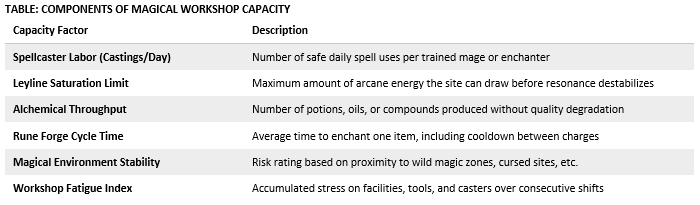
To effectively manage workload across workshops, the Waterdeep Trading Company tracks the following capacity components:

Common Sources of Overload

Seasonal demand spikes, such as mass orders of fire-resistant cloaks during dragon migration season

Guild pressure, when orders from the Arcane Artificers Union demand unrealistic lead times

Planar anomalies, which may cause sudden surges or dropouts in leyline energy availability

Inexperienced apprentices, whose miscasts may jam infusion chambers or destabilize reagents

Worked Example: Potion Workshop at Capacity

Imagine the Alchemical Infusion Wing in Waterdeep is rated for:

  • 12 castings/day per spellcaster (3 casters on staff)
  • 60 potion vials infused per day
  • Leyline draw of 300 ArcUnits

One urgent guild contract demands:

  • 90 Healing Potions in 2 days
  • Each potion requires 1 casting and draws 5 ArcUnits

Assessment:

  • Total Castings Needed: 90
  • Castings Capacity: 3 casters × 12/day × 2 days = 72 → Overload by 18 castings
  • Leyline Draw: 90 × 5 = 450 ArcUnits → Overload by 150 ArcUnits

Mitigation strategies would include shifting work to a secondary site, staggering production over four days, or hiring freelance mages on hazard pay.

Realms-Aware Considerations

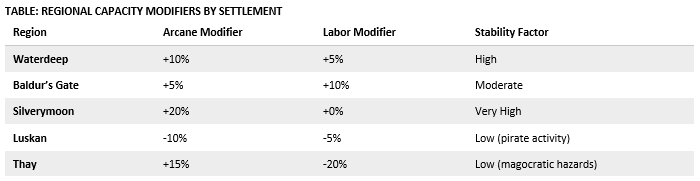
Capacity planning cannot ignore local conditions. Cities near leyline convergence zones, like Myth Drannor, may support higher arcane throughput. Conversely, areas like Thay or the Underdark may suffer from planar contamination, reducing safe operational thresholds.

Final Thoughts

In Faerûn, even the most skilled spellwright or potion master must respect the limits of magic and labor. Workshop overload is more than a logistical inconvenience—it is a threat to safety, reputation, and the very fabric of the Realms.

By tracking spellcasting loads, leyline usage, environmental factors, and fatigue, the Waterdeep Trading Company ensures that its enchanted goods meet the highest standards—without melting the floor or summoning a hungry elemental.


Support the AD&D365 Project on Patreon.

To grow this world, we’ve launched an official Patreon where supporters can gain access to exclusive content, tools, training labs, and even influence the future of the project. Your support fuels more than just development ,  it expands the guildhall, forges new scrolls, and empowers the next generation of configuration wizards.  Begin your journey: https://www.patreon.com/adnd365/

A Grateful Salute to Our Patrons

To all those who stand behind the vision, thank you for helping bring this world to life. Our Benefactor, Andre Breillatt, your boundless generosity fuels the arcane core of this project. Without your magic, the weave would falter. Our Apprentices, the spell engines turn and the training labs thrive thanks to our current Apprentices: Michael Ramirez and Andreth Bael’Rathyn (Name obfuscated to protect their identity). Special thanks to our past Apprentices, whose contributions helped us get here:  Ralf Weber, Wendy Rijners, Shashi Mahesh, Julia Tejera, Ben Ekokobe, Tiago Xavier, Naveen Boyinapelli, Marcos Tadeu Wolf, Kathryn Greene, Jason Brown, Mark Christy, and Ashish Singh. Our Initiates, Peter Lorre, your commitment marks the start of the deeper path, stepping beyond mere observation into the active shaping of this realm. Our Followers, your steady presence along the journey is a beacon of

Want to design your own economic models in Faerûn?

Get your own AD&D365 Environment and guides at adnd365.com/start, and request access to the public view of the current database at https://public.adnd365.com – Login npc@adnd365.com, Password N0nPl@yC#822!

In Waterdeep, trade does not flow on coin alone. Promises, contracts, and notarized scrolls hold nearly as much weight as gold in a coffer. Merchants, guilds, and noble houses depend upon creditworthiness to determine whether they will extend terms, demand payment in advance, or deny a contract altogether. To safeguard these arrangements, two powerful institutions manage the city’s trust and reputation economy: the Scriveners’, Scribes’, & Clerks’ Guild (SSCG) and the Waterdeep Mercantile League (WML).

Together, these organizations act as the credit bureaus of Faerûn. Their scrolls and seals decide whether a trader prospers or falters in the Realms’ most competitive market.

The Scriveners’, Scribes’, & Clerks’ Guild (SSCG)

The SSCG is the bureaucratic heart of Waterdeep. Scribes maintain enchanted ledgers that track every notarized debt, repayment, and dispute. Its Credit Scrolls are respected across Faerûn for impartiality, backed by city law.

  • Method: Evaluates payment punctuality, legal disputes, and trade license history.
  • Symbol: A scroll sealed with blue wax.
  • Motto: “The ink remembers longer than coin.”

SSCG Credit Rating Levels

The SSCG issues ratings in five tiers, each represented by a symbolic title and scroll. These levels reflect how reliably a merchant or guild fulfills its obligations.

The Waterdeep Mercantile League (WML)

Where the SSCG embodies order, the WML represents the pragmatic power of the guilds. This consortium of trading houses and lenders pools knowledge of defaults and reputations across Faerûn.

  • Method: Reviews market reputation, guild endorsements, and repayment history.
  • Symbol: A coin stamped with a seal.
  • Motto: “Your debts echo across the North, and our seal makes sure no one forgets.”

WML Credit Rating Levels

The WML grants seals to merchants and guilds based on reputation within its networks. These seals often influence contracts more than law itself, as guildmasters rely heavily on them when extending terms.

Contact Information and Offices

Both agencies maintain official halls in Waterdeep, where scribes and clerks receive visitors. The table below lists their addresses, hours, and primary means of communication.

Membership and Annual Fees

Annual fees sustain the agencies’ clerks, enchanted ledgers, and registries. Membership grants faster service, wider recognition, and discounts, while non-members must pay higher one-time rates. The table below shows the available membership tiers and their benefits.

How to Use the Agencies

Using the SSCG

  1. Submit merchant name, guild affiliation, and license.
  2. Pay the fee (scaled to contract size).
  3. Receive a Credit Scroll valid for 30 days.
  4. Present the scroll in negotiations to secure terms or tariffs.

Using the WML

  1. Join or partner with a member guild.
  2. Apply for a Credence Seal based on trade reputation.
  3. Display the seal directly on contracts or caravan documents.
  4. Monitor standing, as seals may be revoked for defaults.

Why Merchants Use Both

The SSCG provides legality and impartiality, while the WML offers guild-backed influence. A trader holding both an Aegis Silver scroll and a Gold Seal will command far more trust than one bearing only one mark.

Why Credit Ratings Matter

For the Waterdeep Trading Company and others across Faerûn, these ratings influence payment terms, credit limits, and contract approvals. A merchant with Aegis Gold or Platinum Seal may obtain a large shipment on partial down payment, while one marked Black Quill or Broken Seal will be refused entirely or forced to pay double tariffs.

In essence, credit ratings shape the very lifeblood of commerce.

Final Thoughts

In Waterdeep, reputation is worth more than coin. The SSCG and WML act as arbiters of that reputation, turning promises into enforceable trust. Whether sealed in ink or stamped by guilds, their ratings determine who thrives in Faerûn’s most competitive markets.


Support the AD&D365 Project on Patreon.

To grow this world, we’ve launched an official Patreon where supporters can gain access to exclusive content, tools, training labs, and even influence the future of the project. Your support fuels more than just development ,  it expands the guildhall, forges new scrolls, and empowers the next generation of configuration wizards.  Begin your journey: https://www.patreon.com/adnd365/

A Grateful Salute to Our Patrons

To all those who stand behind the vision, thank you for helping bring this world to life. Our Benefactor, Andre Breillatt, your boundless generosity fuels the arcane core of this project. Without your magic, the weave would falter. Our Apprentices, the spell engines turn and the training labs thrive thanks to our current Apprentices: Michael Ramirez and Andreth Bael’Rathyn (Name obfuscated to protect their identity). Special thanks to our past Apprentices, whose contributions helped us get here:  Ralf Weber, Wendy Rijners, Shashi Mahesh, Julia Tejera, Ben Ekokobe, Tiago Xavier, Naveen Boyinapelli, Marcos Tadeu Wolf, Kathryn Greene, Jason Brown, Mark Christy, and Ashish Singh. Our Initiates, Peter Lorre, your commitment marks the start of the deeper path, stepping beyond mere observation into the active shaping of this realm. Our Followers, your steady presence along the journey is a beacon of

Want to design your own economic models in Faerûn?

Get your own AD&D365 Environment and guides at adnd365.com/start, and request access to the public view of the current database at https://public.adnd365.com – Login npc@adnd365.com, Password N0nPl@yC#822!

In the bustling trade halls and guarded workshops of Faerûn, precision is not a luxury but a necessity. Whether brewing a potion of vitality, forging enchanted armor, or binding spells into scrolls, the smallest mismeasure can bring disaster. The Waterdeep Trading Company has learned through long practice that true success rests upon a foundation of precision. Every grain of diamond dust, every drop of basilisk bile, and every thread of silver filament must be weighed, measured, dispensed, and calibrated under strict guild oversight.

This discipline is more than arithmetic. It is a covenant of trust — between guilds, merchants, artisans, and customers — ensuring that value, safety, and reputation are preserved across the Realms.

What It Is

Weighing, measuring, dispensing, and calibration are the four pillars of controlled ingredient management. Together, they ensure that materials are handled safely and consistently while meeting the standards of the Arcane Artificers & Alchemists Union and other trade guilds.

  • Weighing: Determining exact weight of powders, filings, and solids.
  • Measuring: Ensuring accurate volume of liquids, extracts, and slurries.
  • Dispensing: Controlled withdrawal of restricted ingredients from secured storage.
  • Calibration: Regular adjustment and verification of devices to ensure lasting accuracy.

Why It Matters

  • Product Quality: Consistency of goods across batches and regions.
  • Safety: Prevents dangerous overuse of volatile reagents.
  • Compliance: Meets guild mandates and city-state trade regulations.
  • Security: Restricts access to rare, expensive, or dangerous components.
  • Cost Control: Reduces waste and protects margins on high-value inputs.
  • Reputation: Builds trust with customers, guild auditors, and adventurers alike.

Key Components of Controlled Ingredient Management

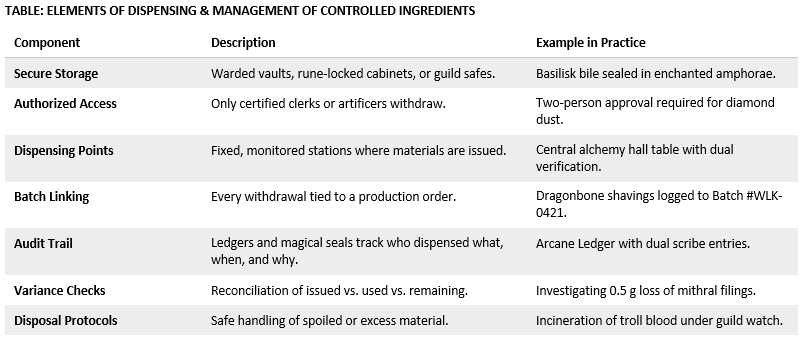
The dispensing and management of controlled ingredients requires multiple safeguards. Secure storage, authorization protocols, and reconciliation practices all work together to prevent misuse and loss. The following table outlines the critical components of this process as observed by the Waterdeep Trading Company.

Weighing & Measuring

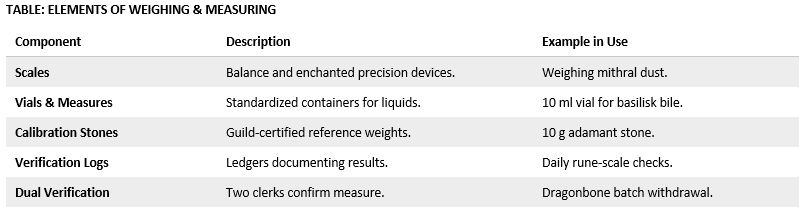
Precision in weighing and measuring is the heart of controlled ingredient management. Every scale, vial, and calibration stone must function correctly to prevent dangerous variances. The table below highlights the elements that make accurate measurement possible.

Worked Example – Potion of Hero’s Vitality:

  • Basilisk bile: 15.00 ml (±0.05 ml)
  • Diamond dust: 2.50 g (±0.01 g)
  • Silver filament: 3 strands (visual master spool check)
  • Twilight wheat extract: 25.00 ml (±0.1 ml)

Calibration Process

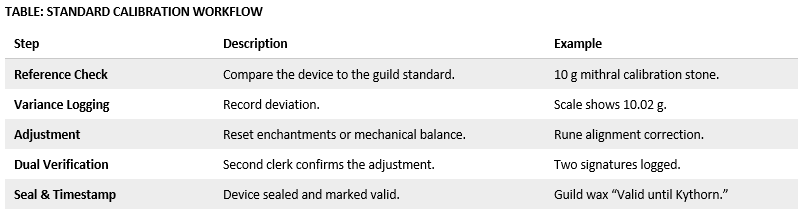
Once calibration standards are set, they must be applied in daily practice. The following workflow shows how a measuring device is tested, corrected if necessary, and sealed for continued use under guild standards.

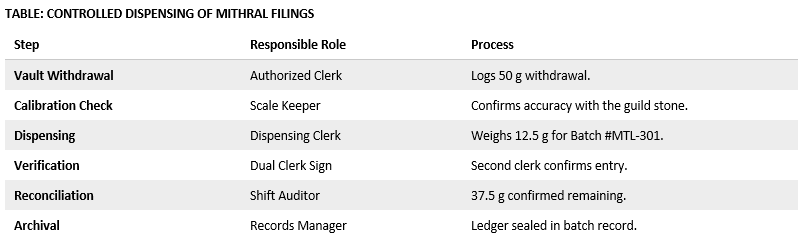
Worked Example: Controlled Dispensing of Mithral Filings

To illustrate how controlled dispensing operates in practice, the table below outlines each step taken when mithral filings are withdrawn from storage, measured for production, and reconciled at the end of the shift.

Realm-Aware Considerations

Across Faerûn, no two cities practice dispensing and calibration alike. Each region adapts its standards to its environment, culture, and guild oversight. The Waterdeep Trading Company must account for these variations when managing far-reaching trade routes. The following list describes how regional practices differ across the Realms.

  • Waterdeep (Sword Coast Standard):
    The benchmark city where rune-locked vaults, arcane scales, and guild-sealed calibration stones define best practice. All regional calibrations are compared against Waterdeep’s records.
  • Baldur’s Gate (Pragmatic Oversight):
    Less dependent on arcane devices, Baldur’s Gate relies heavily on mercantile guild oversight and mercenary enforcement. Devices are calibrated often by third-party scale keepers, and ledgers are checked against city notaries.
  • Silverymoon (Arcane Resonance):
    Within its mythal, Silverymoon employs harmonic resonance calibration. Devices are tuned by frequency rather than weight, ensuring that crystalline reagents and magical powders are measured with unmatched precision.
  • Calimport (Desert Flux):
    Heat distortion and expansion require daily recalibration of flasks and vials. Apprentices often perform verifications under the watchful eye of multiple masters, since even small mismeasures can spoil expensive desert-sourced reagents.
  • Icewind Dale (Harsh Adaptations):
    Rugged conditions and scarce access to guild stones result in wider tolerances. Variances are accepted but offset by strict reconciliation protocols: double batching, cross-measurement, and heavy reliance on trust between small mining camps and trading posts.

Final Thoughts

Managing controlled ingredients is a discipline of balance: weighing, measuring, dispensing, and calibration working as one. The Waterdeep Trading Company treats these practices as a guild-standard covenant, ensuring safety, compliance, and profitability. Every vial, strand, and stone is accounted for, measured true, and reconciled to the last drop.

Calibration is not a uniform process but a tapestry woven from mechanical, arcane, and environmental strands. Each realm of Faerûn colors the practice with its own conditions, yet the goal remains the same: to safeguard accuracy and uphold trust. For the Waterdeep Trading Company, mastering these nuances means that whether trading in the warmth of Calimport, the frost of Icewind Dale, or the arcane shimmer of Silverymoon, its word is its weight.

Through precision comes stability. Through calibration comes trust. Through trust comes trade.


Support the AD&D365 Project on Patreon.

To grow this world, we’ve launched an official Patreon where supporters can gain access to exclusive content, tools, training labs, and even influence the future of the project. Your support fuels more than just development ,  it expands the guildhall, forges new scrolls, and empowers the next generation of configuration wizards.  Begin your journey: https://www.patreon.com/adnd365/

A Grateful Salute to Our Patrons

To all those who stand behind the vision, thank you for helping bring this world to life. Our Benefactor, Andre Breillatt, your boundless generosity fuels the arcane core of this project. Without your magic, the weave would falter. Our Apprentices, the spell engines turn and the training labs thrive thanks to our current Apprentices: Michael Ramirez and Andreth Bael’Rathyn (Name obfuscated to protect their identity). Special thanks to our past Apprentices, whose contributions helped us get here:  Ralf Weber, Wendy Rijners, Shashi Mahesh, Julia Tejera, Ben Ekokobe, Tiago Xavier, Naveen Boyinapelli, Marcos Tadeu Wolf, Kathryn Greene, Jason Brown, Mark Christy, and Ashish Singh. Our Initiates, Peter Lorre, your commitment marks the start of the deeper path, stepping beyond mere observation into the active shaping of this realm. Our Followers, your steady presence along the journey is a beacon of

Want to design your own economic models in Faerûn?

Get your own AD&D365 Environment and guides at adnd365.com/start, and request access to the public view of the current database at https://public.adnd365.com – Login npc@adnd365.com, Password N0nPl@yC#822!

In the sprawling markets of Faerûn, sweetness is never just sugar, it is craft, alchemy, and trade. The Waterdeep Trading Company stands at the forefront of this art, transforming raw ingredients from across the Realms into syrups that enrich daily life. From the common taverns of Baldur’s Gate to the noble estates of Silverymoon and the enchanted courts of the Moonshae Isles, our syrups find their way into mugs, goblets, and ritual chalices.

Sweeteners carry not only taste but also identity. They bring forward the land they hail from, the guilds who refine them, and the merchants who carry them along caravan and sea routes. Some are familiar, like cane sugar or honey, while others are rare luxuries, moonflower nectar harvested under enchanted blossoms, or celestial dew condensed from the very light of the heavens.

This article reveals how the Waterdeep Trading Company manufactures, refines, and distributes syrups. It explores both traditional and exotic sweeteners, provides tables for conversion and usage, and presents worked examples to show the difference between common goods and rare luxuries.


Support the AD&D365 Project on Patreon.

To grow this world, we’ve launched an official Patreon where supporters can gain access to exclusive content, tools, training labs, and even influence the future of the project. Your support fuels more than just development ,  it expands the guildhall, forges new scrolls, and empowers the next generation of configuration wizards.  Begin your journey: https://www.patreon.com/adnd365/

A Grateful Salute to Our Patrons

To all those who stand behind the vision, thank you for helping bring this world to life. Our Benefactor, Andre Breillatt, your boundless generosity fuels the arcane core of this project. Without your magic, the weave would falter. Our Apprentices, the spell engines turn and the training labs thrive thanks to our current Apprentices: Michael Ramirez and Andreth Bael’Rathyn (Name obfuscated to protect their identity). Special thanks to our past Apprentices, whose contributions helped us get here:  Ralf Weber, Wendy Rijners, Shashi Mahesh, Julia Tejera, Ben Ekokobe, Tiago Xavier, Naveen Boyinapelli, Marcos Tadeu Wolf, Kathryn Greene, Jason Brown, Mark Christy, and Ashish Singh. Our Initiates, Peter Lorre, your commitment marks the start of the deeper path, stepping beyond mere observation into the active shaping of this realm. Our Followers, your steady presence along the journey is a beacon of

Want to design your own economic models in Faerûn?

Get your own AD&D365 Environment and guides at adnd365.com/start, and request access to the public view of the current database at https://public.adnd365.com – Login npc@adnd365.com, Password N0nPl@yC#822!


Classic Sugars: The Foundation of Syrupcraft

The backbone of most syrups rests upon tried-and-true sugars. These provide stability and consistency, easily dissolved into both hot and cold beverages.

  • Cane Sugar – Imported from the cane fields of Amn, pressed and crystallized, then dissolved into syrup. Clean, sweet, and versatile.
  • Brown Sugar – A Waterdeep specialty created by adding molasses back into refined sugar, giving depth and a toasted warmth.
  • Honey – Harvested by Rashemi druids and apiarists, honey carries floral notes and golden sweetness, a luxury long beloved in Faerûn.
  • Maple Syrup – Drawn from enchanted northern groves, reduced by fire and filtered to retain its earthy, woodsy caramel tones.

Manufacturing Process: Raw sugar or honey is delivered to Waterdeep workshops. Syrup-makers dissolve it in large copper cauldrons, strain it through linen cloth, add stabilizing herbs, and bottle it for trade.

Alternative Natural Sweeteners: Syrups with Character

Adventurers and nobles often seek tastes that go beyond tradition. These syrups bring distinctive flavors tied to their regions of origin.

  • Agave Syrup – Extracted from the cactus heart in Calimshan, light, smooth, and excellent for cold drinks.
  • Coconut Sugar Syrup – From Chultan coconuts, boiled down into a caramel-rich syrup.
  • Date Syrup – A Thayan enclave specialty, dark, fruity, and reminiscent of toffee and dried fruit.

Manufacturing Process: These sweeteners are boiled in sealed kettles at low heat to preserve flavor, then aged briefly in oak casks for consistency.

Plant-Based Zero-Calorie Sweeteners: Nature Refined by Alchemy

These extracts appeal to health-conscious customers without sacrificing sweetness.

  • Stevia – Leaves harvested from eastern plantations are dried, powdered, and magically steeped to yield sweetness 200× stronger than sugar.
  • Monk Fruit Extract – Rare fruits imported from Kara-Tur, carefully processed to create concentrated sweetness.

Manufacturing Process: Extracts are stabilized with herbs and cooled by enchanted stones, preventing bitterness and ensuring clarity.

Sugar Alcohols: Sweet with a Cool Finish

These lie between natural and refined, offering milder sweetness and a refreshing aftertaste.

  • Erythritol – Created from fermented fruits in Icewind Dale, nearly calorie-free, with a cooling effect.
  • Xylitol – Extracted from northern birchwood, equal in sweetness to sugar, providing body to syrups.

Manufacturing Process: Fermentation and crystallization cycles ensure purity before blending into syrups.

Artificial Sweeteners: The Arcane Alternatives

Though some prefer natural sources, the Company also crafts syrups from wizard-forged ingredients.

  • Aspartame – Alchemically bound proteins, strong but heat-sensitive, suited to cold syrups.
  • Acesulfame K – A stable, arcane creation that can withstand boiling and large-scale brewing.

Manufacturing Process: Arcane treasurers oversee the sigil-sealed laboratories where these sweeteners are made, ensuring purity.

Faerûn-Exclusive Sweeteners

Beyond the known Realms, exotic ingredients provide syrups unique to Waterdeep’s trade networks.

  • Moonflower Nectar – Blossoms from the Moonshae Isles, glowing under starlight, yielding intense sweetness.
  • Evermead Sap – A floral nectar from Evereskan vines, prized for noble teas and vintages.
  • Shadowroot Molasses – Thick syrup drawn from Underdark fungal roots, bitter-sweet and favored by dwarves.
  • Celestial Dew – Distilled from condensed starlight, requiring mage-sealed containers, nearly priceless.

Conversion Rates for Sweeteners

To assist guilds and taverns, we provide guidance on how each sweetener compares to standard cane sugar.

Usage Guidance for Sweeteners

To guide merchants and artisans, here are suggested applications for each syrup type.

Worked Example: Syrup Production

To illustrate how manufacturing differs between a common and a luxury syrup, here are two complete costing sheets.

Final Thoughts

Sweeteners in Faerûn are more than just ingredients. They are a symbol of connection between regions, guilds, and cultures. Cane sugar syrup sustains the daily trade of inns and taverns, while moonflower nectar syrup binds noble courts and elven feasts to the Waterdeep Trading Company’s reputation.

By maintaining both steady common production and rare luxury offerings, the Company ensures that no cup, mug, or chalice goes without the right touch of sweetness.

The Morning of the Three Bottles
The bells of the Waterdeep Trading Company’s counting house chimed the eighth hour as Greta Ironfist strode into the pricing hall. Ledger-keepers were already at their desks, quills scratching in neat columns while the scent of parchment, ink, and faintly sweet syrup filled the air. On the great oak table in the center of the room sat three glass bottles, each gleaming under the morning light—one plain but sturdy, one etched with seasonal motifs, and one crowned with gold filigree.
Greta stopped beside them, resting her calloused hand on the S3 bottle as though it were a treasured relic. “These,” she said to the gathered clerks, “are more than syrup. They are the proof of our craft, the measure of our discipline, and the promise we make to every customer who walks through our doors. Whether you sell to a dockside inn or the High Lord’s feast, the price must be right, fair to them, fair to us.”
She nodded to the head scribe, who unrolled a parchment marked with the familiar S1–S3 tiers. Numbers and attributes danced across the page like runes of commerce, each line telling the story of a product’s value: its flavor, its rarity, its place in the market. This was the Company’s way, turning traits into tariffs, attributes into coin, and it had kept their coffers full for decades.

In the labyrinthine alleys of Waterdeep’s Trade Ward, merchants haggle over crates of goods while scribes tally weights and measures in ink-stained ledgers. For the Waterdeep Trading Company (WDTC), pricing is not left to the chaos of the marketplace. Instead, it is governed by a structured system that transforms a product’s attributes into precise, repeatable pricing rules.

By defining product attributes, rarity tier, size, seasonal status, and enhancement type, the Company ensures every sale is consistent, fair, and profitable. The foundation of this method is the tier system, known internally as S1–S3, which assigns products into structured pricing categories.

What It Is

Before we can apply structured pricing, we must understand the foundation of the approach. This section introduces the concept of product attribute–based pricing, how characteristics like flavor type, rarity, and size become the framework for determining base prices and modifiers. By replacing guesswork with defined attributes, WDTC ensures consistency across its entire product catalog.

Product attribute–based pricing is a strategy that uses the characteristics of an item to determine its base price and any modifiers. Attributes may be purely physical (size, weight), tied to rarity (common vs seasonal), or value-enhancing (arcane infusion, sugar-free variants).

In WDTC’s syrup trade, this approach avoids setting prices individually for each SKU. Instead, a tiered pricing table and attribute multipliers generate the correct price for every product variation automatically.

Why It Matters

The value of an attribute-based pricing system lies in its ability to serve both operational efficiency and commercial advantage. Here we explain why WDTC invests in this method, covering the benefits of consistency, scalability, and speed, as well as how the approach safeguards margins while encouraging customer loyalty.

  • Consistency: All merchants pay prices grounded in defined rules, not guesswork.
  • Scalability: New products can be slotted into existing tiers without rewriting the entire price list.
  • Speed: Price updates are applied instantly across all products sharing the same attribute set.
  • Margin Protection: Rare and high-cost items maintain premium pricing even during seasonal promotions.

Support the AD&D365 Project on Patreon.

To grow this world, we’ve launched an official Patreon where supporters can gain access to exclusive content, tools, training labs, and even influence the future of the project. Your support fuels more than just development ,  it expands the guildhall, forges new scrolls, and empowers the next generation of configuration wizards.  Begin your journey: https://www.patreon.com/adnd365/

A Grateful Salute to Our Patrons

To all those who stand behind the vision, thank you for helping bring this world to life. Our Benefactor, Andre Breillatt, your boundless generosity fuels the arcane core of this project. Without your magic, the weave would falter. Our Apprentices, the spell engines turn and the training labs thrive thanks to our current Apprentices: Michael Ramirez and Andreth Bael’Rathyn (Name obfuscated to protect their identity). Special thanks to our past Apprentices, whose contributions helped us get here:  Ralf Weber, Wendy Rijners, Shashi Mahesh, Julia Tejera, Ben Ekokobe, Tiago Xavier, Naveen Boyinapelli, Marcos Tadeu Wolf, Kathryn Greene, Jason Brown, Mark Christy, and Ashish Singh. Our Initiates, Peter Lorre, your commitment marks the start of the deeper path, stepping beyond mere observation into the active shaping of this realm. Our Followers, your steady presence along the journey is a beacon of

Want to design your own economic models in Faerûn?

Get your own AD&D365 Environment and guides at adnd365.com/start, and request access to the public view of the current database at https://public.adnd365.com

Login npc@adnd365.com
Password N0nPl@yC#822!


The S1–S3 Tier System

To make attribute-based pricing work in practice, WDTC needed a simple, universal classification. This section presents the S1–S3 tier framework, showing how products are grouped into Common, Seasonal, and Specialty categories. Each tier reflects availability, production cost, and buyer segment, forming the base layer for all pricing calculations.

Attribute Modifiers

The tier sets the foundation, but the real power comes from fine-tuning. This section details the modifiers that adjust base prices within a tier: size multipliers, sweetener premiums, seasonal adjustments, and packaging upgrades. By layering these rules, WDTC tailors each product’s price to its exact combination of attributes.

Once a tier is set, additional attributes adjust the base price:

  • Size: Larger bottles (24oz) use a multiplier (e.g., 1.75× S1 base price).
  • Sweetener Type: Sugar-free variants add a flat premium (e.g., +0.25 FSD).
  • Seasonal Status: Pre-season discounts encourage early stocking; post-season discounts clear inventory.
  • Packaging Prestige: Ornate or magical packaging can double retail value for noble clients.

Worked Example: Pumpkin Spice Syrup (S2 Seasonal)

Theory is valuable, but nothing drives home a process like a real example. In this section, we walk through the pricing calculation for a seasonal favorite, Pumpkin Spice Syrup. Each step shows how attributes, modifiers, and customer discounts flow into a final price per bottle, demonstrating how repeatable and transparent the process can be.

Attributes:

  • Tier: S2 (Seasonal)
  • Size: 12oz
  • Sweetener: Classic sugar
  • Season: In-Season (Fall)

Pricing Calculation Flow:

  1. Base Price (Tier S2, 12oz): 6.85 FSD
  2. Seasonal Modifier: None (In-Season)
  3. Customer Group Discount: Preferred customer → –15% = 5.82 FSD
  4. Volume Discount: Order of 24 bottles → –10% = 5.25 FSD
  5. Final Price per Bottle: 5.25 FSD

This structured calculation ensures that whether the syrup is sold in Dock Ward’s guildhouses or shipped to a noble estate in Silverymoon, the pricing is consistent and predictable.

Realms-Aware Considerations

Pricing in Faerûn is never just about numbers, it’s about context. This section addresses the factors outside the core calculation that WDTC must account for: guild tariffs, regional availability, magical enhancements, and festival demand spikes. These realities influence how attribute-based pricing is applied in practice across the Realms.

  • Guild Tariffs: The Confectioners’ Guild levies additional fees on S3 products to maintain exclusivity.
  • Regional Availability: Certain flavors are only viable in specific climates (e.g., Frostsap from Icewind Dale).
  • Magical Enhancements: Arcane infusion extends shelf life but adds to cost.
  • Festivals: Flavors linked to major holidays (Shieldmeet, Midwinter) may shift from S1 to S2 during high demand.

Final Thoughts

An attribute-based pricing system is not simply a mechanical exercise in number-crunching—it is a discipline that shapes the way the Waterdeep Trading Company engages with every facet of its trade. By using the S1–S3 tier framework as a foundation, the Company ensures that each product is valued not by whim, but by the tangible qualities and market realities that define it.

This approach allows the Company to navigate the diverse economies of Faerûn with confidence. In the same week, a merchant caravan may carry S1 common syrups to rural taverns along the Trade Way, S2 seasonal syrups to bustling city markets, and S3 specialty syrups to the banquet halls of noble estates. Each sale, whether modest or grand, follows the same transparent structure—reinforcing fairness and predictability for customers while protecting margins.

Beyond immediate profit, this method strengthens WDTC’s long-term position. Consistency builds trust, and trust becomes loyalty. Preferred customers can rely on their tier-based advantages without the uncertainty of shifting prices, while non-preferred customers are presented with clear incentives to deepen their relationship with the Company. Seasonal surges and rare ingredient shortages may influence pricing, but they do so within a framework that is understood by all parties.

In a realm where the price of goods can be swayed by guild politics, sudden resource scarcity, or even the whims of magic, WDTC’s attribute-driven pricing system serves as both a shield and a sword. It shields the Company from market instability by applying calculated safeguards, and it acts as a sword by giving WDTC a competitive edge over less disciplined rivals.

Ultimately, the practice transforms pricing from a reactive task into a proactive strategy—one that aligns perfectly with the Company’s broader mission: to conduct trade across Faerûn with precision, foresight, and an unyielding commitment to fair dealing. The sweet profits of the syrup trade are merely one example of how this philosophy plays out in the everyday business of the Waterdeep Trading Company.

A Dynamics Master’s Guide to Rewarding Loyalty in the Markets of Faerûn

Scenario Introduction

As the Dynamics Master, you control more than just the dice, you oversee the very economic systems that power the Waterdeep Trading Company’s operations in AD&D365. Greta Ironfist has tasked you with crafting a rebate structure that not only rewards customer loyalty but also strategically boosts profit margins, clears surplus stock, and strengthens alliances across Faerûn.

Your players aren’t adventurers with swords, they’re trade agents, procurement specialists, and sales negotiators working inside the system you run. Their battlefield is the Rebate Management workspace.

Part I – Setting the Stage in AD&D365

From the WDTC Headquarters in Waterdeep, trade flows across caravans, airships, and planar portals. The competition is fierce, Baldur’s Gate’s spice consortium, Calimport’s jewel traders, Neverwinter’s timber merchants, all offering tempting prices.

Your mission as Dynamics Master is to create a rebate program in AD&D365 that makes your customers think twice before taking their coin elsewhere.


Support the AD&D365 Project on Patreon.

To grow this world, we’ve launched an official Patreon where supporters can gain access to exclusive content, tools, training labs, and even influence the future of the project. Your support fuels more than just development ,  it expands the guildhall, forges new scrolls, and empowers the next generation of configuration wizards.  Begin your journey: https://www.patreon.com/adnd365/

A Grateful Salute to Our Patrons

To all those who stand behind the vision, thank you for helping bring this world to life. Our Benefactor, Andre Breillatt, your boundless generosity fuels the arcane core of this project. Without your magic, the weave would falter. Our Apprentices, the spell engines turn and the training labs thrive thanks to our current Apprentices: Michael Ramirez and Andreth Bael’Rathyn (Name obfuscated to protect their identity). Special thanks to our past Apprentices, whose contributions helped us get here:  Ralf Weber, Wendy Rijners, Shashi Mahesh, Julia Tejera, Ben Ekokobe, Tiago Xavier, Naveen Boyinapelli, Marcos Tadeu Wolf, Kathryn Greene, Jason Brown, Mark Christy, and Ashish Singh. Our Initiates, Peter Lorre, your commitment marks the start of the deeper path, stepping beyond mere observation into the active shaping of this realm. Our Followers, your steady presence along the journey is a beacon of

Want to design your own economic models in Faerûn?

Get your own AD&D365 Environment and guides at adnd365.com/start, and request access to the public view of the current database at https://public.adnd365.com

Login npc@adnd365.com
Password N0nPl@yC#822!


Part II – Configuring the Rebate Accord

Rebate Types

In your Customer Rebates configuration, you may define:

Roll when introducing a new rebate agreement to simulate market and customer sentiment:

Part III – Advanced Dynamics Master Tactics

Tiered & Hybrid Agreements in AD&D365

In the arsenal of a skilled Dynamics Master, few tools are as versatile as tiered and hybrid agreements. These configurations allow the Waterdeep Trading Company to move beyond one-size-fits-all offers, tailoring incentives that adapt to customer behavior and seasonal rhythms. By layering spend or volume thresholds, combining different rebate triggers, and aligning offers with festivals or market events, you can guide purchasing patterns with precision. The result is a rebate program that not only rewards loyalty but also shapes the very flow of trade across Faerûn.

  • Tiered: Set multiple spend/volume bands in the agreement to encourage progressive purchasing
  • Hybrid: Combine volume thresholds with targeted product incentives
  • Seasonal: Apply rebate lines with effective dates matching festivals or market events

Use at the start of a rebate period to determine external influences on sales:

(For 2–19, use the full “Rebate Trigger Events” table from the core guide.)

Use at rebate cycle close to determine payout style in AD&D365:

Part IV – Victory Conditions in the Dynamics Master Campaign

Success Conditions

In the realm of the Dynamics Master, success is not won with swords, but with spreadsheets and strategic foresight. Each rebate cycle is a campaign in its own right, with profit margins as your battlefield, customer satisfaction as your supply lines, and market share as your captured territory. To claim victory, you must balance generosity with discipline, rewarding loyalty while keeping the Waterdeep Trading Company’s coffers secure. The following conditions define what triumph looks like when the final ledger is closed and the cycle’s story is told.

  • Maintain profitability while funding rebate payouts
  • Increase customer retention rate by at least 15%
  • Build exclusive rebate-linked supply contracts with guilds

Failure Conditions

Even the most seasoned Dynamics Master knows that a misjudged rebate program can unravel faster than a frayed caravan rope. Overcommit to payouts, misread the market, or let rivals turn your own tactics against you, and the Waterdeep Trading Company’s advantage can vanish overnight. Failure in this campaign is not simply a loss of coin, it is a loss of influence, trust, and strategic standing in the bustling trade halls of Faerûn. The following conditions mark the signs that the rebate accord has tipped from asset to liability.

  • Overextended rebate liabilities trigger negative cash flow
  • Rivals adopt and improve on your rebate model
  • Merchant council fines for unfair competition or improper accounting

Dynamics Master Tips

As the Dynamics Master, you hold the quill that writes the fate of every rebate cycle. Your role is equal parts strategist, storyteller, and system architect. Just as a dungeon master weaves encounters to challenge and reward adventurers, you must design rebate programs that entice customers, withstand market turbulence, and align with the Waterdeep Trading Company’s grand strategy. The tips below are your toolkit, practical levers and narrative devices to keep the campaign balanced, profitable, and engaging from the first signed agreement to the final coin counted.

  1. Tie game events to AD&D365 automation – let the system track progress toward thresholds in real time
  2. Leverage trade agreements for flexibility – seasonal clauses, product-specific terms, and dynamic start/end dates
  3. Use analytics to adjust mid-cycle – prevent loss by revising thresholds before end-of-period settlements

Epilogue: The Dynamics Master’s Reward

If your rebate program thrives, the Waterdeep Trading Company solidifies its position as the trade power of the Sword Coast, with Greta Ironfist granting you a seat on the Merchant Council and a share of quarterly profits. Fail, and your name will be whispered in the halls of rival traders as the one who tried to buy loyalty but paid too dear a price.

In the diverse and often fractious realms of Faerûn, trade flows not only through rivers and roadways, but also through the tangled webs of regulation spun by each city-state, province, and guild-dominated territory. These authorities often impose tariffs—whether to protect local industries, fund defensive walls, or simply fill coffers—which impact the final cost of goods traded across borders.

For the Waterdeep Trading Company and its peers, applying these surcharges manually is a recipe for inefficiency and inconsistency. Instead, the company relies on the pricing engine to automatically apply margin-based pricing adjustments. These adjustments ensure that tariff costs are accounted for transparently and fairly at the time of sale or quotation.

This article explains how margin pricing works, how to configure it, and why it is essential for maintaining profitability when tariffs are involved.

What Are Margin-Based Pricing Adjustments?

Margin pricing adjusts the final sales price of a product by applying a target profit margin over a known cost. In the case of tariffs, these adjustments often include:

  • A fixed markup to cover expected border fees or import duties
  • A percentage-based increase over the base cost of the product
  • Location-specific surcharges tied to trade routes, zones, or cities

Tariff-aware pricing is especially critical in cities like Zhentil Keep, Calimport, or Amn, where merchant councils or rulers impose steep levies on foreign goods.

Why Margin Pricing Matters in a Tariffed Economy

Using the pricing engine for tariff-aware adjustments provides several benefits:

  • Automation: Prices adjust automatically based on the destination, customer group, or delivery warehouse.
  • Compliance: Ensures that tariffs are passed on to customers rather than absorbed as margin erosion.
  • Transparency: Sales agents and customers alike can see that pricing varies by region due to legal and logistical reasons.
  • Competitiveness: Adjusting margins dynamically enables the company to remain profitable while still offering competitive prices in less regulated markets.

Support the AD&D365 Project on Patreon.

To grow this world, we’ve launched an official Patreon where supporters can gain access to exclusive content, tools, training labs, and even influence the future of the project. Your support fuels more than just development ,  it expands the guildhall, forges new scrolls, and empowers the next generation of configuration wizards.  Begin your journey: https://www.patreon.com/adnd365/

A Grateful Salute to Our Patrons

To all those who stand behind the vision, thank you for helping bring this world to life. Our Benefactor, Andre Breillatt, your boundless generosity fuels the arcane core of this project. Without your magic, the weave would falter. Our Apprentices, the spell engines turn and the training labs thrive thanks to our current Apprentices: Michael Ramirez and Andreth Bael’Rathyn (Name obfuscated to protect their identity). Special thanks to our past Apprentices, whose contributions helped us get here:  Ralf Weber, Wendy Rijners, Shashi Mahesh, Julia Tejera, Ben Ekokobe, Tiago Xavier, Naveen Boyinapelli, Marcos Tadeu Wolf, Kathryn Greene, Jason Brown, Mark Christy, and Ashish Singh. Our Followers, your steady presence along the journey is a beacon of encouragement:  Sunil Panchal, Sarah D. Morgan, Nick Ramchandani, Daniel Kjærsgaard, and Tomasz Pałys. Our Voyeurs, Harry Burgh, Abdelrahman Nabil, and Basil Quarrell, ever watching from the shadows, clearly intrigued… but not enough to part with a single gold piece. Your silent curiosity is noted, and mildly judged.


Components of a Tariff-Aware Pricing Setup

To implement tariff-based margin pricing, the Waterdeep Trading Company configures the following:

Cost Price Setup

  • This includes the landed cost of goods, including freight, handling, and vendor cost.
  • For imports from Baldur’s Gate into Calimshan, this may also include bribes and “unofficial entry fees.”

Margin Pricing Rules

  • Set at the item, item group, or category level.
  • Vary based on the customer’s location, tariff group, or shipping method.

Tariff Groups

  • Created to group cities or provinces with similar duties.
  • Assigned to delivery locations or sales territories.

Sales Price Adjustments

  • Configured in the pricing engine using trade agreements or price simulations.
  • Include tiered pricing based on cost plus margin.

Worked Example: Selling Cloaks into Calimport

Let’s assume the Waterdeep Trading Company is selling enchanted cloaks from its Silverymoon workshop. The base cost per cloak is 45.00 FSD. The company aims to maintain a 25% margin in normal cities, but must apply an additional 15% to account for Calimport’s magical goods import tariff.

Tariff groups in this case are applied to determine the final price through the margin pricing policy tied to destination city-states.

Realms-Aware Considerations

Different regions in Faerûn may use tariffs for wildly different purposes. In some cities, tariffs fund sanitation and roads. In others, they line the pockets of merchant princes or enforce protectionism.

Notable Examples:

  • Amn uses tariffs to fund their merchant navy.
  • Thay applies tariffs based on magical aura ratings of enchanted goods.
  • Luskan offers tariff waivers in exchange for smuggling contracts.

Using the pricing engine allows you to adapt your pricing strategy to the political and economic landscape of each territory.

Navigating the Unpredictable World of Tariff Pricing

Even the most finely-tuned pricing engine cannot account for the whims of Faerûn’s merchant lords, border guards, or arcane auditors. Tariffs are living creatures—shifting with the seasons, manipulated by guild politics, or waived on a noble’s drunken promise. To bring this unpredictability into your simulations, the Waterdeep Trading Company employs random roll tables.

These tables introduce chaos, challenge, and realism to trade scenarios by simulating tariff fluctuations, bribe opportunities, and pricing engine anomalies. Whether used during training exercises, economic simulations, or tabletop commerce campaigns, these rolls provide rich variability to any margin pricing strategy.

This table adds dynamic fluctuation to tariffs based on the current mood of the city-state, economic need, or political climate.

If the trader attempts to negotiate or bypass tariffs through “other means.”

When using automation, mishaps can occur. Use this to simulate pricing miscalculations due to magical interference or bureaucratic error.

Adding dice tables to tariff-aware pricing creates an immersive and unpredictable element for trade campaigns or test scenarios. Whether used in a Faerûnian pricing simulation or during a tabletop logistics challenge, these random events challenge even the most seasoned merchant clerks and pricing wizards.

Final Thoughts

In a realm where trade is taxed as much by swords as by scrolls, margin-based pricing adjustments ensure that your business remains profitable and adaptable. With the pricing engine configured to account for tariffs, the Waterdeep Trading Company not only meets local compliance but maintains a strategic edge in every market.


Want to design your own economic models in Faerûn?

Get your own AD&D365 Environment and guides at adnd365.com/start, and request access to the public view of the current database at https://public.adnd365.com

Login npc@adnd365.com
Password N0nPl@yC#822!