NPC Worker Class: Lorewright Cartographer
| Class Type | Specialist (Linguistic-Geographic Hybrid) |
| Guild Affiliation | Cartographer’s Circle, Scribemaster’s League, Heralds of Candlekeep |
| Work Tier | Level 1 to 10 (Apprentice to Master Scholar of Toponymy) |
| Primary Role | Standardizes regional place names, dialect variants, and localization metadata across Faerûn |
| Typical Worksite | Map halls, royal archives, translation chambers, guild dispatch rooms, and border posts |
Lorewright Cartographers are the unseen hands behind every place name, map legend, dialect table, and regional postal schema in Faerûn. Where adventurers traverse wild lands and traders carry goods across borders, Lorewrights ensure the signs, scrolls, and systems agree on where and what those places are called. Working in tandem with scribes, heralds, and guildmasters, they record region-specific spellings, track renamings and political shifts, and maintain accurate language variants for translation and governance.
From setting province codes for merchant ledgers to registering new settlement names with Candlekeep’s Great Lexicon, these specialists are vital in maintaining geographic and linguistic integrity across the realm’s increasingly globalized trade routes. Their work ties directly into recordkeeping, contract law, supply chain documentation, and even magical travel anchoring.
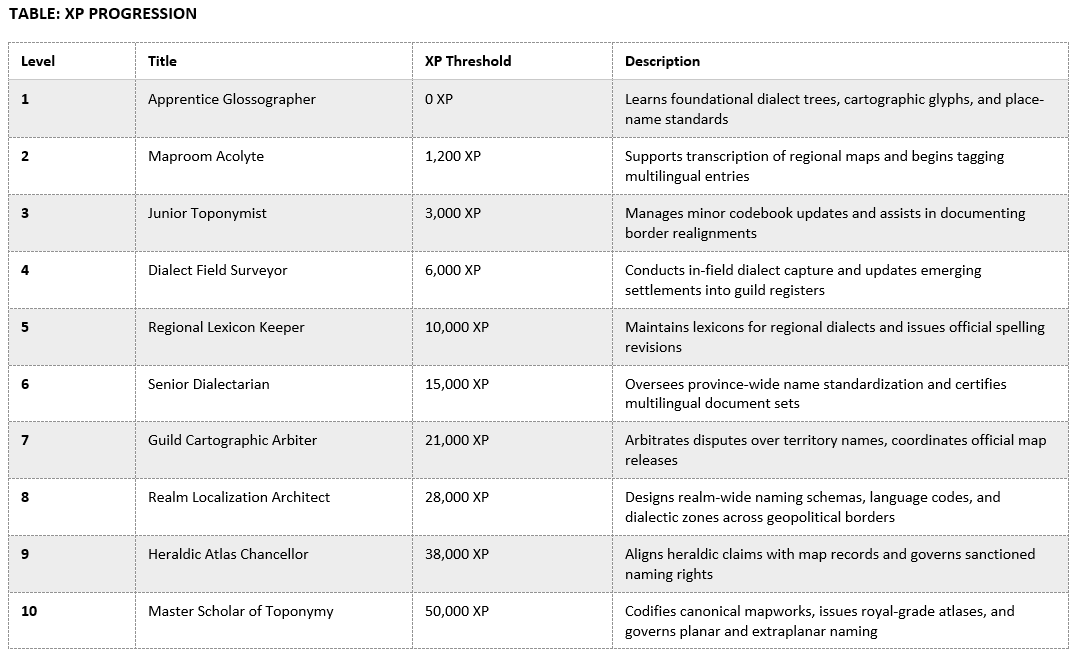
Worker Proficiency
The Lorewright Cartographer follows a structured progression of geographic literacy, dialectal authority, and map governance. From apprentice scribes documenting minor settlements to mythic lexicographers designing planar codification trees, each rank in this class represents a deeper bond with the linguistic fabric of Faerûn.
Proficiency bonuses reflect expertise in toponymic research, cultural cartography, diplomatic translation, and standardized localization. Higher-tier Lorewrights are authorized to enforce naming standards across trade records, guild ledgers, and even royal edicts.
This system is essential to the operations of guilds like the Waterdeep Trading Company, where accurate names, codes, and dialect mappings are tied directly to taxation, delivery accuracy, teleportation scrolls, and cultural compliance.
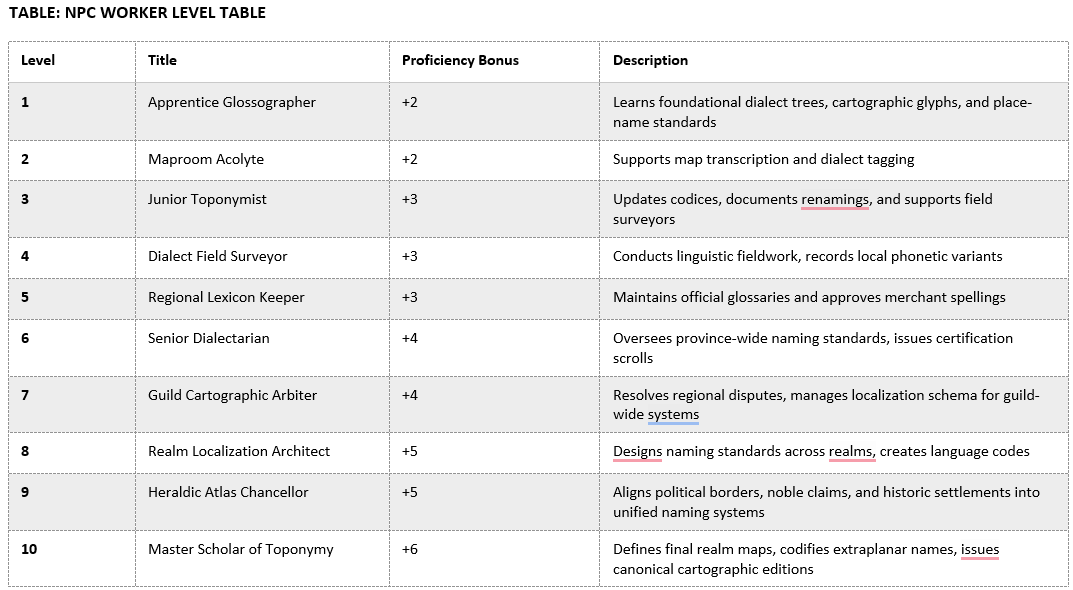
Skill Set Summary
By the time one rises to the rank of Master Scholar of Toponymy, a map is no longer just a tool of navigation, it is a declaration of truth, authority, and sovereign memory. The skill set of a Lorewright Cartographer transcends inked borders and place names; it is the careful art of codifying identity, resolving territorial claims, and preserving the linguistic soul of Faerûn across centuries and realms.
Each of the following proficiencies reflects decades of guild schooling, regional immersion, and arcane-codex study. Whether transcribing a newly founded hamlet, resolving a border dispute between duchies, or formalizing the planar names of extraplanar colonies, these skills are essential to the cultural infrastructure of the Realms. From dialectal calibration to glyph alignment, the Lorewright’s craft ensures that every map tells a story with precision, purpose, and political weight.
Dialect Tree Mapping: Understands regional linguistic evolution, enabling accurate rendering of names in context.
Province Codex Maintenance: Updates official names, borders, and language data for trade, governance, and travel.
Translation Standardization: Applies approved grammatical structures and naming suffixes across official documents.
Postal Schema Integration: Assigns postal region codes (e.g., 01-WDP) for use in commerce and delivery systems.
Heraldic Coordination: Links place names with noble houses, historical holdings, and title claims.
Glyph Legend Control: Ensures all maps use correct cartographic symbols and sigils per guild standard.
Multiplanar Localization: Creates naming structures for extraplanar settlements and coordinates realm-aligned equivalency.
Map Script Calligraphy: Crafts maps with approved scriptwork, guild insignia, and readable symbols for replication.
Cultural Sensitivity Protocols: Avoids offense or diplomatic incident by applying naming conventions with historical respect.
Scroll Duplication: Produces faithful duplicates of map scrolls with preserved glyph integrity and legend clarity.
Cross-Language Lexeme Resolution: Resolves multiple translations of the same place into a unified codex entry.
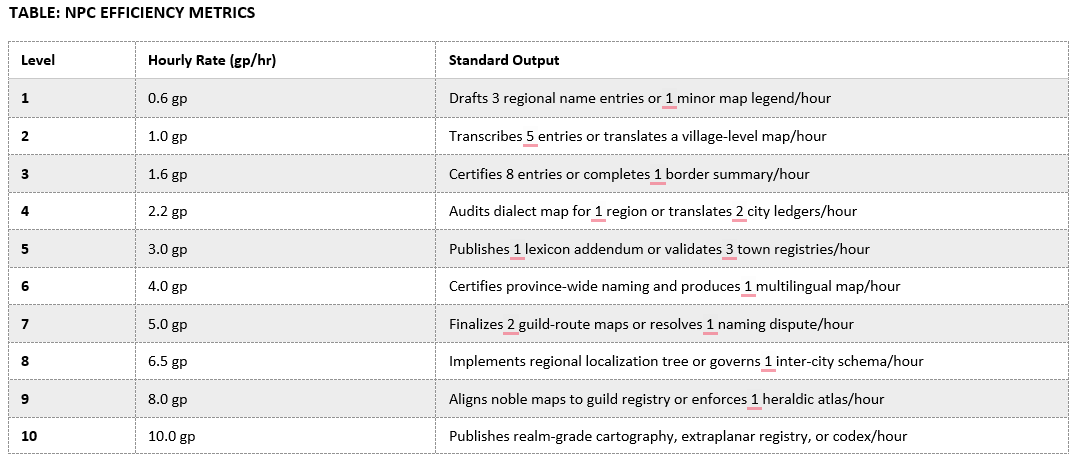
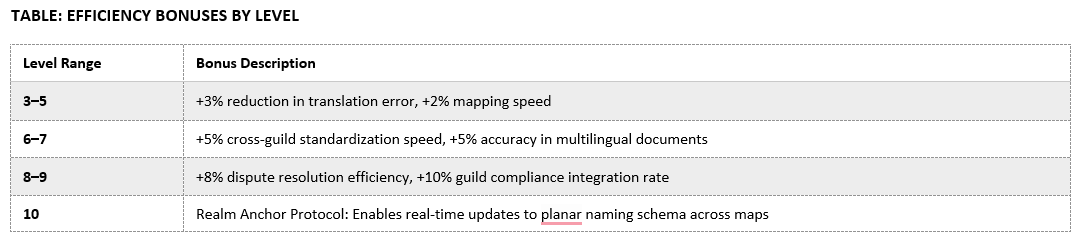
Efficiency Metrics
Lorewright Cartographers are not only guardians of linguistic and geographic fidelity, but also disciplined professionals whose productivity can be measured, evaluated, and optimized. The Efficiency Metrics below provide a structured view of expected output at each level of proficiency, allowing guilds, merchant consortiums, and royal archives to align the right talent to the right localization or cartographic task.
As Lorewrights advance in rank, their responsibilities grow from simple transcription and dialect tagging to the publication of realm-sanctioned atlases and the design of interplanar naming systems. These benchmarks ensure that a Junior Toponymist isn’t assigned a planar naming schema, just as a Master Scholar isn’t burdened with minor settlement updates.
Starting at Level 3, Lorewrights gain cumulative efficiency bonuses, ranging from reduced transcription error to increased speed in dispute resolution and cross-cultural compliance. These gains reflect their mastery of complex dialect webs, glyph-legends, and mapping protocols across cultural boundaries.
By using these metrics, institutions like the Waterdeep Trading Company can make informed decisions on localization staffing, resource allocation, and operational scalability, ensuring every name, border, and legend is crafted with precision and purpose.
Class Role in Guild and Economy
Within systems like Dynamics 365 or guild-led administrative platforms, the Lorewright Cartographer class manages localization master data. This includes:
- Defining and enforcing regional naming hierarchies
- Maintaining the province-to-postal-code schema
- Auditing linguistic consistency across customer records and contracts
- Managing translation layers in multilingual environments
Their training is tracked in the Cartographer’s Circle Registry, and their certifications determine access to regional lexicons and naming databases. Promotions are tied to successful publication of codified maps, dispute arbitration, and dialectic preservation initiatives.
Image Prompts
Visual representation plays a vital role in bringing the Lorewright Cartographer to life, especially within lore-driven campaigns, simulation modules, or guild-based training guides like those in AD&D365. As the architects of geographic identity and the standard-bearers of linguistic precision, these figures should be portrayed as dignified scholars, respected not for their combat prowess, but for their unwavering authority over borders, names, and cultural memory.
The following image prompt captures the Lorewright Cartographer in full regalia, offering a compelling visual reference suitable for NPC tokens, class handouts, worldbuilding documentation, or character art. Whether illustrated as a traveling dialectarian or a royal codex editor, the prompt reflects the balance between academic mastery, arcane tradition, and bureaucratic power that defines the class.
Use this prompt with your preferred image generation tool to create immersive visuals for campaigns, worldbooks, or training simulations set within Faerûn’s interconnected realms.
General Prompt
A full-body portrait of a Lorewright Cartographer in a candlelit archival chamber surrounded by maps, scrolls, and glowing glyphs. The figure wears indigo and bronze robes embroidered with cartographic lines, runes, and compass roses. They hold a map quill and a floating projection of Faerûn’s regional divisions. Background includes hanging scroll racks, province sigils, and magical map globes.
Style: High-fantasy illustration, rich lighting with arcane blue glow
Mood: Scholarly, precise, diplomatically powerful
No modern elements.
NPC Level Image Prompts
| Level | Title | Image Prompt Description |
| 1 | Apprentice Glossographer | A young scribe seated at a shared guild desk, practicing regional script forms by candlelight. Simple tan robes, ink-stained hands, scrolls open to dialect trees. Background: dusty maproom corner. Style: warm, painterly realism. |
| 2 | Maproom Acolyte | A junior cartographer filing region tags and pinning parchment to a large guild map board. Wearing a navy vest over robes, surrounded by measuring tools and labeling glyphs. Style: training-hall interior, medieval fantasy. |
| 3 | Junior Toponymist | A confident figure reviewing a border codex with a quill in hand, tagging a location on a floating map orb. Robes include silver-threaded provincial badges. Style: crisp, scholastic lighting with magical accents. |
| 4 | Dialect Field Surveyor | A robed traveler standing at a village crossroad, interviewing locals while jotting in a language journal. Gear includes a surveyor’s staff, dialect wheel, and map case. Background: rustic settlement with waystones. |
| 5 | Regional Lexicon Keeper | An experienced scholar cataloging names in a guild lexicon chamber. Dozens of scroll tubes, labeled by dialect, encircle the space. Robe bears the sigil of a regional linguistic order. Style: archival realism with warm glows. |
| 6 | Senior Dialectarian | A high-ranking cartographer adjusting a projection map showing shifting borders and multilingual overlays. Complex robes with translation glyphs stitched in gold. Style: arcane academic interior, glowing scrying runes. |
| 7 | Guild Cartographic Arbiter | A stern official presiding over a dispute between guild envoys, displaying a regional map with contested labels. Robes trimmed in red and bronze, wielding a rod of lexicon judgment. Style: courtroom diplomacy scene. |
| 8 | Realm Localization Architect | A master planner orchestrating a magical display of Faerûn’s realms, each zone glowing with different dialect overlays. Robes shimmer with realm-wide code rings. Style: mystical strategy chamber with globe-sized map illusion. |
| 9 | Heraldic Atlas Chancellor | A dignified elder presenting a gilded atlas before a royal court, with sigils of noble houses behind them. Golden cartographic robe, heraldic chain across chest. Style: regal, ceremonial atmosphere with high contrast lighting. |
| 10 | Master Scholar of Toponymy | A mythic figure in a floating map observatory, surrounded by constellations of place-names across realms and planes. Robes appear to flow like parchment, embroidered with runes. Style: celestial high-fantasy epic, divine authority. |
 A Tinkerers Notebook