In the markets of Waterdeep and beyond, a sword is never just steel. It is ore, labor, enchantment, guild sanction, and risk bundled into an item that must survive battle and audit alike. The Waterdeep Trading Company prices longswords according to their total cost of creation, adding premiums for scarcity, magical risk, and service guarantees. A mundane blade carries the costs of metal and craft. A +3 blade carries all of that plus rare reagents, arcane labor, failed attempts, and planar licenses.
What It Is
A Bill of Materials, or BOM, is the structured ledger of inputs required to produce an item. For the Waterdeep Trading Company, a BOM separates base materials, manual craft, arcane work, overhead, levies, and logistics. This lets our clerks forecast costs, post variances, and set prices that reflect both the forge and the spell circle.
Why Prices Differ
Prices rise with each enchantment tier for five reasons.
Scarcity of arcane labor, senior enchanters are limited and booked.
Rare reagents, residuum, mithral filaments, and diamond dust scale up sharply by tier.
Failure rate and rework, higher tier work has more spoiled stock and scrap.
Guild, city, and planar fees, seals, audits, and licenses add fixed and variable costs.
Warranty and risk premium, stronger items carry longer guarantees and liability reserves.
Below are full BOMs with example standard costs in FGP. Use them as a baseline, then apply your local regional and guild modifiers as needed.
This table lists all inputs to forge a nonmagical longsword, useful for blacksmith contracts, shop pricing, and cost audits.
This table adds first tier arcane work and reagents to the mundane base, useful for uncommon enchantment contracts and guild review.
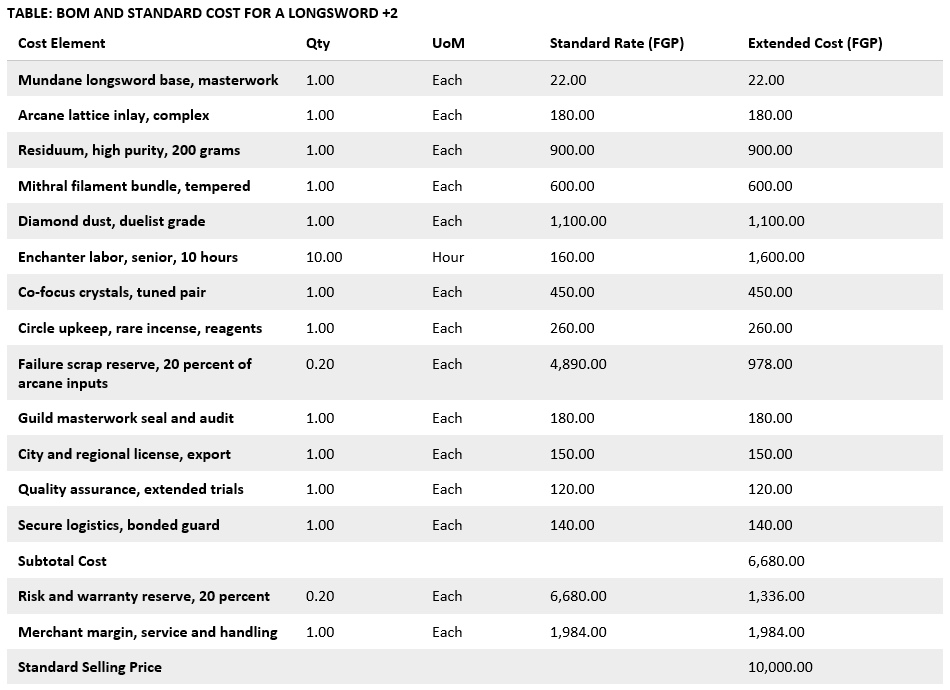
This table reflects rarer reagents, senior labor, and higher failure reserves. Use for rare items and contract bids.
Note. The selling price shown is a conservative mid rare figure. In high demand markets this often lists between 8,000.00 and 20,000.00 FGP.
This table covers very rare work. Costs include planar licenses and heavy failure reserves. Use for elite clients and quest collateral.
Final Thoughts
Acres, leagues, rods, and fathoms are more than quaint measures of the past. They are the scaffolding of Faerûn’s commerce, the unseen standards that let merchants, nobles, and adventurers trade fairly and travel safely. For the Waterdeep Trading Company, understanding these units is not antiquarian trivia: it is the foundation of every contract, shipment, and ledger line.
Support the AD&D365 Project on Patreon.
To grow this world, we’ve launched an official Patreon where supporters can gain access to exclusive content, tools, training labs, and even influence the future of the project. Your support fuels more than just development , it expands the guildhall, forges new scrolls, and empowers the next generation of configuration wizards. Begin your journey: https://www.patreon.com/adnd365/
A Grateful Salute to Our Patrons
To all those who stand behind the vision, thank you for helping bring this world to life. Our Benefactors, Andre Breillatt, and Eryndor Fiscairn‡, your boundless generosity fuels the arcane core of this project. Without your magic, the weave would falter. Our Apprentices, the spell engines turn and the training labs thrive thanks to our current Apprentices: Michael Ramirez and Andreth Bael’Rathyn‡. Special thanks to our past Apprentices, whose contributions helped us get here: Ralf Weber, Wendy Rijners, Shashi Mahesh, Julia Tejera, Ben Ekokobe, Tiago Xavier, Naveen Boyinapelli, Marcos Tadeu Wolf, Kathryn Greene, Jason Brown, Mark Christy, and Ashish Singh.Our Initiates, Gregory Brigden, and Martin Grahm, your commitment marks the start of the deeperFpath, stepping beyond mere observation into the active shaping of this realm. Our Followers, your steady presence along the journey is a beacon of encouragement: Eric Shuss, Sunil Panchal, Sarah D. Morgan, Nick Ramchandani, Daniel Kjærsgaard, and Tomasz Pałys. And our Voyeurs, Harry Burgh, Abdelrahman Nabil, and Basil Quarrell, ever watching from the shadows, clearly intrigued… but not enough to part with a single gold piece. Your silent curiosity is noted, and mildly judged.
Want to design your own economic models in Faerûn?
Get your own AD&D365 Environment and guides at adnd365.com/start, and request access to the public view of the current database at https://public.adnd365.com – Login npc@adnd365.com, Password N0nPl@yC#822!
The Waterdeep Trading Company knows that profit is not only what is carried, but how, when, and in what quantity it is delivered. Perishable goods demand speed, luxury goods reward distance, and transportation—whether caravan, ship, or portal—carries its own costs. Scale, the merchant’s hidden lever, can turn a marginal route into a fortune.
Perishables: Fighting Spoilage
Perishable goods—food, drink, herbs, potions, and livestock—lose value with time. Every week of travel cuts into margin unless preserved by salt, ice, or enchantment.
Caravans: slow, cheaper per unit, but high spoilage.
Ships: faster, large loads, but weather-sensitive.
Portals: instantaneous, preserve freshness, but costs scale poorly.
Luxuries: Gaining with Distance
Luxury goods—spices, silks, jewelry, perfumes, planar reagents—gain value with distance. Buyers pay for scarcity, prestige, and the risks endured to bring them.
Caravans: increase value with each league, but invite theft.
Ships: move bulk luxuries at moderate cost, maximizing margin.
Portals: flatten distance premiums, but allow nobles to secure rare goods instantly.
The Role of Transportation & Scale
Transportation cost is not fixed. Moving one crate by teleportation circle may equal the cost of an entire caravan. Merchants calculate economy of scale before deciding the method.
Caravan Freight
Cost: Low per unit when wagons are full.
Scale Advantage: Larger caravans reduce per-unit guard and wagon costs.
Limitation: Spoilage eats margin for perishables.
Maritime Shipping
Cost: Moderate per unit, with large holds reducing cost further.
Scale Advantage: Best for bulk grain, silks, and ore.
Limitation: Risk of storms and piracy.
Arcane Portals
Cost: Extremely high base (e.g., 500 FSD per casting).
Scale Advantage: Costs spread across more goods if the portal is fully loaded.
Limitation: Not suited to bulk, but invaluable for high-value perishables and urgent luxuries.
Comparative Economics Table
To bring these principles together, it is helpful to compare how different goods behave under varying methods of transport and scale. The following table illustrates the practical economics of moving both perishables and luxuries by caravan, ship, or portal, showing not only the base cost of each method but also how per-unit expenses shift when moving small loads versus bulk consignments. By examining both spoilage and appreciation alongside transportation cost, merchants can see where profit is gained, where coin is lost, and why the Waterdeep Trading Company selects routes with such care.
Realms-Aware Considerations
While ledgers and tables reveal the numbers, true trade in Faerûn is shaped by the lands, climates, and powers that goods must cross. A caravan moving through the frozen North faces different challenges than a ship sailing to Calimshan, just as planar imports demand rules unlike any mortal route. These local and magical conditions shape spoilage, scarcity, and demand in ways no simple calculation can capture. The following considerations highlight the realities that every Waterdeep Trading Company factor must weigh before sending a wagon, ship, or spell across the Realms.
Bulk vs. Urgency: Grain caravans thrive on scale; healing potions justify portal expense.
Climate: Hot regions make portal transport more attractive for perishables.
Noble Demands: Aristocrats often pay for instant luxury, ignoring efficiency.
Planar Imports: Exotic reagents justify high costs because no local substitute exists.
Final Thoughts
Economy of scale separates thriving merchants from failed ones. Perishables belong to wagons and ships unless urgency demands portals. Luxuries grow more valuable with distance, but risk premiums and transport costs must be measured carefully. The Waterdeep Trading Company prospers by balancing spoilage, scarcity, transportation, and scale to turn every journey into profit.
Support the AD&D365 Project on Patreon.
To grow this world, we’ve launched an official Patreon where supporters can gain access to exclusive content, tools, training labs, and even influence the future of the project. Your support fuels more than just development , it expands the guildhall, forges new scrolls, and empowers the next generation of configuration wizards. Begin your journey: https://www.patreon.com/adnd365/
A Grateful Salute to Our Patrons
To all those who stand behind the vision, thank you for helping bring this world to life. Our Benefactors, Andre Breillatt, and Eryndor Fiscairn‡, your boundless generosity fuels the arcane core of this project. Without your magic, the weave would falter. Our Apprentices, the spell engines turn and the training labs thrive thanks to our current Apprentices: Michael Ramirez and Andreth Bael’Rathyn‡. Special thanks to our past Apprentices, whose contributions helped us get here: Ralf Weber, Wendy Rijners, Shashi Mahesh, Julia Tejera, Ben Ekokobe, Tiago Xavier, Naveen Boyinapelli, Marcos Tadeu Wolf, Kathryn Greene, Jason Brown, Mark Christy, and Ashish Singh.Our Initiates, Gregory Brigden, and Martin Grahm, your commitment marks the start of the deeperFpath, stepping beyond mere observation into the active shaping of this realm. Our Followers, your steady presence along the journey is a beacon of encouragement: Eric Shuss, Sunil Panchal, Sarah D. Morgan, Nick Ramchandani, Daniel Kjærsgaard, and Tomasz Pałys. And our Voyeurs, Harry Burgh, Abdelrahman Nabil, and Basil Quarrell, ever watching from the shadows, clearly intrigued… but not enough to part with a single gold piece. Your silent curiosity is noted, and mildly judged.
Want to design your own economic models in Faerûn?
Get your own AD&D365 Environment and guides at adnd365.com/start, and request access to the public view of the current database at https://public.adnd365.com – Login npc@adnd365.com, Password N0nPl@yC#822!
In Faerûn, wealth flows in two forms: the clean decimals of the guildhall and the jangling coins of the marketplace. The Waterdeep Trading Company unites both under a dual system of Financial Currency (FSD) and Coinage Currency. To better support large-scale trade, a new instrument has been added to the ledger , the Faerûn Pound Note, bridging noble contracts and inter-kingdom finance with trust and paper.
Financial Currency: The Faerûn Standard Dollar and Pound
The Faerûn Standard Dollar (FSD) remains the base reporting unit for all accounts. It is now joined by the Faerûn Pound Note (FPN), a high-value financial denomination equal to 20 FSD. The Pound Note is not minted but scribed, sealed, and backed by vaults , a symbol of trust between guilds and noble houses.
Usage:
FPN: Treasury bonds, noble house contracts, cross-border financing
FSD: Guild ledgers, ERP, taxation
Shillings, Pence, Farthings: Decimal fractions for books, not minted
Coinage Currency: Minted for the People
Coins remain the lifeblood of Faerûn’s markets. Here, shillings follow the traditional rule of 12 pence to the shilling, a standard that predates the decimal ledger.
Reconciling Ledger and Market
The Waterdeep Trading Company enforces a clear reconciliation between the ledger and the purse:
1 Pound Note = 20 FSD
1 FSD = 10 Ledger Shillings = 100 Pence
1 Market Shilling = 12 Pence ≈ 0.12 FSD
1 Penny = 4 Farthings = 0.01 FSD
Thus, a merchant may sign a contract for 5 Pound Notes, while the tavern still demands a shilling for ale.
Time-As-Money
The currency also mirrors labor:
1 Pound Note ≈ 20 days of work
1 FSD ≈ 1 day of work
1 Ledger Shilling ≈ 1 hour (decimalized)
1 Market Shilling ≈ 1¼ hours (traditional)
1 Penny = 15 minutes
1 Farthing = 3–4 minutes
Guild proverbs reflect both sides: “Count pounds in the ledger, but shillings in the street.” “Never waste a farthing’s time.”
Final Thoughts
The introduction of the Faerûn Pound Note marks a turning point in the Realms’ finance. Ledgers now have a high-value denomination for great contracts, while coins remain unchanged for daily trade. The FSD keeps decimals neat for ERP, the Pound Note enables treasury-scale trust, and the shilling-penny-farthing chain preserves cultural authenticity.
The Waterdeep Trading Company thrives because it honors both: the ink of the ledger and the weight of the coin.
Support the AD&D365 Project on Patreon.
To grow this world, we’ve launched an official Patreon where supporters can gain access to exclusive content, tools, training labs, and even influence the future of the project. Your support fuels more than just development , it expands the guildhall, forges new scrolls, and empowers the next generation of configuration wizards. Begin your journey: https://www.patreon.com/adnd365/
A Grateful Salute to Our Patrons
To all those who stand behind the vision, thank you for helping bring this world to life. Our Benefactors, Andre Breillatt, and Eryndor Fiscairn‡, your boundless generosity fuels the arcane core of this project. Without your magic, the weave would falter. Our Apprentices, the spell engines turn and the training labs thrive thanks to our current Apprentices: Michael Ramirez and Andreth Bael’Rathyn‡. Special thanks to our past Apprentices, whose contributions helped us get here: Ralf Weber, Wendy Rijners, Shashi Mahesh, Julia Tejera, Ben Ekokobe, Tiago Xavier, Naveen Boyinapelli, Marcos Tadeu Wolf, Kathryn Greene, Jason Brown, Mark Christy, and Ashish Singh.Our Initiates, Gregory Brigden, and Martin Grahm, your commitment marks the start of the deeperFpath, stepping beyond mere observation into the active shaping of this realm. Our Followers, your steady presence along the journey is a beacon of encouragement: Eric Shuss, Sunil Panchal, Sarah D. Morgan, Nick Ramchandani, Daniel Kjærsgaard, and Tomasz Pałys. And our Voyeurs, Harry Burgh, Abdelrahman Nabil, and Basil Quarrell, ever watching from the shadows, clearly intrigued… but not enough to part with a single gold piece. Your silent curiosity is noted, and mildly judged.
Want to design your own economic models in Faerûn?
Fantasy worlds demand more than simple copper-silver-gold progressions. As campaigns evolve beyond dungeon crawling into politics, trade, and nation-building, game masters need sophisticated monetary systems that can handle everything from a tavern meal to financing a war. The challenge lies in creating currencies that feel both authentically medieval and practically usable at the gaming table.
The Dual Currency Solution
Modern fantasy economics benefit from dual currency systems that separate high-level financial instruments from everyday coinage. This approach mirrors historical practices where merchants used letters of credit for major transactions while common folk relied on physical coins.
Consider a system with two parallel tracks:
Financial Currency serves the ledger books of guilds, noble houses, and kingdoms. These are standardized, decimal-friendly units perfect for contracts, taxation, and large-scale trade. Think of them as the “banking system” of your world.
Street Currency represents the physical coins jangling in purses and strongboxes. These follow older, more traditional systems that evolved organically—often with irregular ratios that reflect historical accident rather than mathematical convenience.
Building Value Hierarchies
Effective fantasy currency needs clear value relationships that players can internalize quickly. The most successful approach ties monetary value directly to labor time:
Sovereign Note: 20 days of skilled work
Standard Unit: 1 day of skilled work
Hour Piece: 1 hour of work (for precise ledger keeping)
Trade Coin: ~1.2 hours of work (traditional street currency)
Common Copper: 15 minutes of work
Token: 3-4 minutes of work
This creates intuitive pricing where players immediately understand that a sword costing “three days’ work” represents significant expense, while “fifteen minutes’ worth” clearly indicates pocket change.
The Trust Economy
High-value financial instruments depend on institutional backing rather than precious metal content. Pound notes, treasury bonds, and guild certificates derive value from the reputation and guarantees of their issuers. This creates fascinating opportunities for economic storytelling:
What happens when a major guild’s credibility collapses?
How do forgeries affect market confidence?
Which institutions can nations trust for international trade?
The physical form of these instruments matters too. Hand-scribed notes with personal seals feel more authentic than printed currency, while magical authentication (enchanted inks, divination-resistant papers) adds fantasy flavor to financial security.
Regional Variations and Exchange
No fantasy continent should have uniform currency. Different regions, cultures, and historical periods demand distinct monetary approaches:
The Northern Kingdoms might favor heavy silver pieces reflecting their mining heritage, with exchange rates fluctuating based on seasonal trade routes.
Desert Trading Cities could emphasize portable, high-value instruments—gem-backed certificates and spice futures that travel well across caravan routes.
Island Nations often develop sophisticated credit systems since physical transport of bulk coinage proves impractical across dangerous waters.
Magical Realms might integrate arcane elements directly into their currency—coins that verify their own authenticity through minor enchantments, or notes that can only be read by their intended recipients.
Practical Gaming Implementation
The key to successful currency systems lies in selective complexity. Players need simple rules for common transactions but rich detail for economic adventures. Consider implementing:
Quick Reference Cards showing common prices in both currency types, allowing smooth transitions between street-level purchases and major negotiations.
Exchange Rate Dynamics that shift based on political events, seasonal changes, or magical catastrophes. A dragon’s hoard flooding the market with gold creates very different economic pressures than a plague disrupting trade routes.
Cultural Proverbs that embed the currency system into world lore. “Count crowns in the ledger, but coppers in the street” tells players immediately how different social classes think about money.
The Social Layer
Currency reflects social structure. Who appears on coins and notes? What symbols convey authority? How do different classes handle money?
Noble houses might never touch physical currency, conducting all business through signed instruments and trusted intermediaries. Merchants could maintain complex ledgers tracking dozens of different regional currencies and exchange rates. Common folk might view anything beyond physical coins with deep suspicion.
Religious organizations often issue their own internal currencies—temple tokens for services, pilgrimage certificates, or charity notes that can be redeemed across a faith’s network of institutions.
Magic and Money
Fantasy settings offer unique opportunities to integrate supernatural elements into economic systems:
Magically Authenticated Currency prevents counterfeiting but requires trained mages to verify, creating bottlenecks and specialized professions.
Elemental Backing ties currency value to magical resources—fire crystals from volcanic regions, bottled storm essence from sky cities, or crystallized life force from druidic enclaves.
Temporal Currency allows for fascinating economic stories where coins from different eras carry different values, or where time magic creates inflation by flooding markets with currency from alternate timelines.
Economic Storytelling
Rich currency systems enable compelling narratives beyond traditional adventure hooks:
The Confidence Crisis: When rumors spread about a kingdom’s financial stability, can the party prevent economic collapse through investigation, diplomacy, or direct action?
The Exchange War: Competing guilds manipulate currency rates to gain advantage, turning economic espionage into adventure material.
The Lost Treasury: Discovering ancient currency hoards requires understanding historical exchange rates and defunct monetary systems.
The Counterfeiting Ring: Players must navigate complex financial investigation while learning about authentication methods and market psychology.
Balancing Complexity and Playability
The ultimate test of any currency system is whether it enhances rather than hinders gameplay. Start simple with clear conversion rates and familiar denominations. Add complexity gradually as players become comfortable with basic mechanics and show interest in economic elements.
Remember that currency systems serve the story, not the other way around. A perfectly realistic monetary system that slows down gameplay or confuses players has failed its primary purpose. The best fantasy currencies feel both authentic and invisible—players use them naturally without stopping to calculate exchange rates or argue about historical precedent.
Implementation Guidelines
When designing your world’s monetary system:
Start with labor value as your baseline—what does a day’s work buy?
Create clear hierarchies that players can memorize quickly
Distinguish between institutional and street currencies for different transaction types
Embed social and cultural meaning into monetary design and usage
Plan for regional variation without overwhelming complexity
Consider magical integration that enhances rather than complicates the system
Test with actual gameplay before committing to complex mechanics
The most successful fantasy currencies feel like natural extensions of their worlds—systems that grew organically from the needs, values, and capabilities of their societies. When players instinctively understand that “a sovereign’s ransom” represents enormous wealth while “copper for your thoughts” suggests casual conversation, you’ve created more than a monetary system. You’ve built a living piece of culture that enriches every interaction with your fantasy world.
Whether your players are negotiating with dragon hoards, financing military campaigns, or simply buying supplies for the next adventure, a well-designed currency system transforms economic interactions from mechanical necessities into meaningful elements of worldbuilding and storytelling.
Across Faerûn, not every product can or should be made within one’s own walls. The Waterdeep Trading Company often partners with allied guilds, artisan workshops, and subcontracted enchanters to meet demand. This practice—outsourced manufacturing—allows the company to expand capacity, gain access to specialized skills, and fulfill orders more swiftly across regions.
Outsourcing is not a matter of trust alone. It is a structured process, involving contracts, service postings, inspections, and settlements. When done correctly, it aligns multiple guilds into one seamless chain of value creation.
What It Is
Outsourced manufacturing is the practice of sending goods or raw materials to an external guild, house, or artisan who completes specific production steps on behalf of the Waterdeep Trading Company. This may include weaving, enchanting, engraving, or bottling. The company retains ownership of the base goods and pays a service fee to the subcontractor for labor and expertise.
Why It Matters
The practice of outsourcing goes beyond convenience. It safeguards the company against bottlenecks, preserves coin by paying only for needed services, and strengthens ties with partner guilds across the Sword Coast and beyond. In a realm where trade is subject to feast, famine, and shifting demand, outsourced production offers resilience and adaptability that no single workshop can guarantee.
Specialization: Tap into rare skills, such as gem-runed etching or planar glass forging.
Cost Control: Pay only for the service provided, while maintaining ownership of inputs.
Flexibility: Respond quickly to surges in demand or region-specific product variants.
Service Steps Breakdown
To manage outsourced work effectively, the Waterdeep Trading Company follows a structured path that ensures accountability at each stage. These steps balance administrative rigor with guild cooperation, covering everything from the first handshake to the final ledger posting.
Below is the standard service flow used by the Waterdeep Trading Company when contracting outsourced manufacturing:
Guild Selection & Contract Drafting Choose an approved vendor from guild rosters (e.g., Arcane Artificers & Alchemists Union). Draft a service contract with terms, scope, and FSD service fee.
Materials Supply Issue a transfer order to send raw materials or semi-finished goods to the subcontractor. Ownership remains with the company.
Service Work Order Create a purchase order for the manufacturing service, linked to the production order. This defines labor, enchantment, or crafting steps to be performed.
Production & Crafting The subcontractor completes the work, following specifications. Progress may be tracked through posted service confirmations.
Inspection & Quality Assurance On receipt of finished goods, the Waterdeep Trading Company inspects quality. Failures trigger rework or claim against the service vendor.
Settlement & Ledger Posting Post the purchase order invoice for the service fee. Costs are absorbed into the production order, while payments are settled against Accounts Payable.
Inventory Update Finished goods are returned to stock. The inventory value now reflects both material costs and outsourced service charges.
Worked Example: Enchanted Steel Cauldrons in Silverymoon
To meet a surge of orders for enchanted cauldrons, the Waterdeep Trading Company ships 200 steel bases to a Silverymoon workshop under the Arcane Artificers & Alchemists Union.
Materials: 200 steel cauldron bases (valued at 90.00 FSD each).
Service: Rune engraving and enchantment at 85.00 FSD per unit.
Process:
Transfer cauldrons to subcontractor.
Raise service purchase order for rune engraving.
Receive cauldrons back, enchanted and certified.
Post invoice for 17,000.00 FSD service fee.
Result: Inventory updated to show cauldrons at full cost (90.00 + 85.00 = 175.00 FSD each).
Realms-Aware Considerations
Not all outsourcing arrangements are equal. A contract in Silverymoon will differ from one in Calimport, and planar subcontracting introduces its own hazards. This section brings awareness to the special conditions of Faerûn, ensuring that no guildmaster or treasurer is caught unprepared by regional quirks, planar costs, or credit disputes.
Guild Approvals: Outsourced work must comply with guild regulations and licenses.
Regional Variance: Prices differ by settlement type—services in Silverymoon may be 20% higher than in Waterdeep due to arcane premiums.
Planar Outsourcing: If contracted across planes, factor in teleportation tolls, time distortion, and hazard insurance.
Credit Ratings: Check subcontractor’s standing with the Scriveners’ Guild or Mercantile League before issuing advance payments.
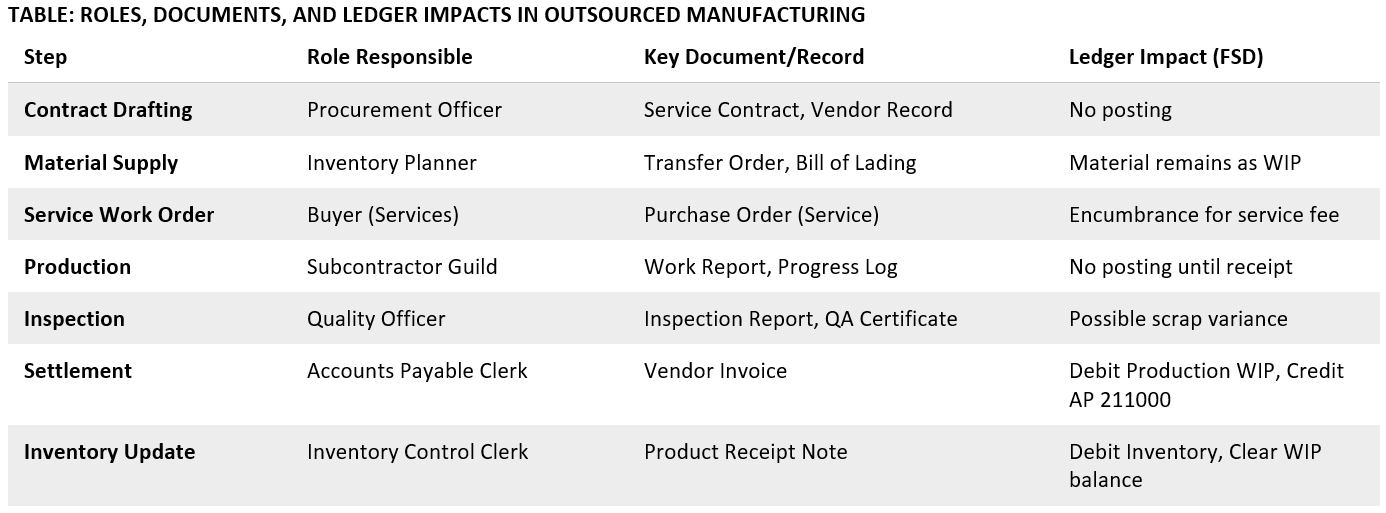
This table outlines the key roles, required documents, and ledger effects for outsourced manufacturing within the Waterdeep Trading Company.
Final Thoughts
Outsourced manufacturing in Faerûn is more than a convenience. It is a strategic method of extending reach, ensuring quality, and balancing resources. For the Waterdeep Trading Company, it turns guild rivals into partners and transforms distance into opportunity. With structured steps, clear contracts, and vigilant inspection, outsourced production becomes a powerful tool in the company’s arsenal.
Support the AD&D365 Project on Patreon.
To grow this world, we’ve launched an official Patreon where supporters can gain access to exclusive content, tools, training labs, and even influence the future of the project. Your support fuels more than just development , it expands the guildhall, forges new scrolls, and empowers the next generation of configuration wizards. Begin your journey: https://www.patreon.com/adnd365/
A Grateful Salute to Our Patrons
To all those who stand behind the vision, thank you for helping bring this world to life. Our Benefactors, Andre Breillatt, and Eryndor Fiscairn‡, your boundless generosity fuels the arcane core of this project. Without your magic, the weave would falter. Our Apprentices, the spell engines turn and the training labs thrive thanks to our current Apprentices: Michael Ramirez and Andreth Bael’Rathyn‡. Special thanks to our past Apprentices, whose contributions helped us get here: Ralf Weber, Wendy Rijners, Shashi Mahesh, Julia Tejera, Ben Ekokobe, Tiago Xavier, Naveen Boyinapelli, Marcos Tadeu Wolf, Kathryn Greene, Jason Brown, Mark Christy, and Ashish Singh.Our Initiates, Gregory Brigden, and Martin Grahm, your commitment marks the start of the deeperFpath, stepping beyond mere observation into the active shaping of this realm. Our Followers, your steady presence along the journey is a beacon of encouragement: Eric Shuss, Sunil Panchal, Sarah D. Morgan, Nick Ramchandani, Daniel Kjærsgaard, and Tomasz Pałys. And our Voyeurs, Harry Burgh, Abdelrahman Nabil, and Basil Quarrell, ever watching from the shadows, clearly intrigued… but not enough to part with a single gold piece. Your silent curiosity is noted, and mildly judged.
Want to design your own economic models in Faerûn?
Get your own AD&D365 Environment and guides at adnd365.com/start, and request access to the public view of the current database at https://public.adnd365.com – Login npc@adnd365.com, Password N0nPl@yC#822!
In the bustling workshops and enchanted forges of Faerûn, the reputation of the Waterdeep Trading Company rests on the quality of its goods. From rune-etched cauldrons to barrels of ale, consistency is key. To maintain that standard, the company employs structured methods of inline and continuous item sampling during production. These practices ensure that defects are caught early, magical anomalies are corrected, and customers across the Sword Coast receive only the finest merchandise.
What It Is
Production is not simply the act of crafting an item—it is the weaving together of material, labor, and enchantment into something worthy of trade. At every step, flaws may appear: impurities in ore, unstable runes, mismeasured herbs, or even disruption from ambient magic. Inline sampling and continuous sampling are the two chief practices for safeguarding against such failures. Inline sampling takes precise snapshots of quality at chosen points in the line, while continuous sampling acts as an ever-vigilant sentinel, monitoring the flow without pause. Together, they form a shield against defects and unreliability in the production halls of Faerûn.
Inline sampling refers to taking quality samples at defined checkpoints within the production line. This could be after the shaping of a steel blade, midway through a potion distillation, or upon the weaving of an enchanted fabric.
Continuous sampling involves monitoring product quality throughout the entire production flow. Instead of relying on static checkpoints, it constantly draws information—through inspection, testing, or even arcane sensors—to flag issues as soon as they arise.
Both methods are integral parts of a quality control system within Faerûn’s manufacturing houses and are supported by enchanted ledgers that track results automatically.
Why It Matters
Every caravan that departs Waterdeep bears the reputation of the Company with it. A cracked cauldron in Baldur’s Gate or a spoiled potion in Calimport can tarnish not just a shipment but the very trust of an entire guild or city. By embedding sampling practices into production, the Company ensures that goods arriving in far-off markets meet the highest standards. More than a technical necessity, these practices fulfill guild contracts, appease inspectors, and honor the confidence of customers who expect perfection from every crate, cask, and casting.
Inline and continuous sampling matter because they:
Reduce waste by catching defects before they reach final assembly
Protect brand reputation by ensuring goods are consistent
Meet guild regulations, such as those set by the Brewers & Distillers or Arcane Artificers’ Union
Provide traceability for compliance with magical safety standards
Support continuous improvement of both mundane and arcane production processes
Components of Inline Sampling
Inline sampling is deliberate and structured, demanding that checkpoints be chosen wisely. A single overlooked step can allow imperfections to slip downstream. By establishing these checkpoints—whether at the forge, the loom, or the distillery—workers carve moments of certainty out of an otherwise complex flow. Each checkpoint becomes a watchtower along the supply route, guarding the line against creeping errors. The Company records not just results, but the very methods of inspection, so that apprentices learn, guilds are reassured, and auditors find confidence in the paper and rune trails alike.
Inline sampling typically includes:
Checkpoint Definition: Identifying critical stages in the production route where a sample must be taken.
Sample Size: Deciding how many items to test from each batch or flow.
Inspection Method: Visual, mechanical, or magical checks depending on the item.
Documentation: Recording results in production journals, often supported by enchanted runes or Dynamics 365 ledgers.
Components of Continuous Sampling
Continuous sampling carries this watchfulness further, embedding quality vigilance into the very heartbeat of production. Instead of stopping to examine at intervals, it uses enchanted crystals, mechanical gauges, or even bound elementals to watch every item as it moves. No forge can produce endlessly flawless goods, but continuous monitoring ensures that the moment cracks form, or magical energy fluctuates, the line is alerted. This constant oversight is akin to a cleric’s ward, shielding not through occasional ritual but through ceaseless guardianship.
Continuous sampling builds on these by:
Using real-time detection tools, such as crystal sensors for potion stability or weight-runes for milling consistency.
Applying statistical or arcane process control to spot trends.
Ensuring ongoing compliance, with alerts that automatically halt a production line if thresholds are breached.
Worked Example: Enchanted Steel Cauldron
The enchanted steel cauldron is one of the Waterdeep Trading Company’s most popular items, sold to merchants, alchemists, and inns across the Sword Coast. Its strength lies not only in its steel but in the delicate balance of enchantments that allow it to withstand flame, frost, and magical reactions. To maintain this reputation, both inline and continuous sampling are employed throughout its production cycle.
Step 1: Smelting and Pouring
As dwarven smelters pour molten steel into molds, inline sampling occurs every twentieth ladle. A portion of the steel is cooled, tested for purity, and checked for proper alloy balance. If traces of brittle slag are found, the entire melt is flagged for rework. At the same stage, continuous sampling is achieved by placing rune-marked weights at the base of the molds. These weights glow red if the density shifts outside acceptable limits, alerting workers instantly.
Step 2: Shaping and Hammering
When the cauldron halves are hammered into form, inline sampling involves removing one cauldron per shift and testing rim thickness with enchanted calipers. Results are logged into the quality ledger for guild review. Continuous sampling here is subtler: rune-etched anvils hum and glow whenever force distribution strays, catching uneven strikes that could cause long-term weakness.
Step 3: Enchanting
Perhaps the most critical stage, enchantments must bind evenly across the steel. Inline sampling includes channeling a simple flame spell into every fiftieth cauldron, verifying that the enchantment disperses heat without distortion. Meanwhile, continuous sampling is carried out by crystals embedded above the enchanting circle. These crystals pulse whenever magical resonance falters, allowing enchanters to halt the ritual before an unstable cauldron is finalized.
Step 4: Cooling and Finishing
During cooling, inline sampling involves pulling random cauldrons and filling them with boiling water to test for sudden cracks. The tests are witnessed by both smiths and guild auditors. Continuous sampling comes through rune-bands laid along the cooling racks, which hum in harmony when the cauldrons contract evenly. A discordant note warns of hidden fractures invisible to the naked eye.
Step 5: Packing and Dispatch
Before the cauldrons are crated and sealed for caravan, the sampling process continues. Inline checks inspect branding marks and serial runes on selected cauldrons to ensure traceability. Continuous oversight comes from arcane sigils painted on the storage pallets that glow if any item deviates from the recorded sample standard.
By employing both sampling methods, the Waterdeep Trading Company ensures that not a single enchanted cauldron leaves the forge untested. Customers in Calimport can set them over dragon-fire stoves, alchemists in Baldur’s Gate can brew volatile mixtures within them, and nobles in Silverymoon can serve feasts with pride—all without fear of failure.
Realms-Aware Considerations
Unlike purely mundane factories, Faerûn’s production halls contend with shifting magical fields, guild regulations, and planar oddities. Inline and continuous sampling must be adapted for each region and product. A brewer in Silverymoon might emphasize sensory sampling to detect subtleties of taste enchanted by moonlight, while a smith in Luskan must focus on structural checks to prevent flaws in steel. When trade stretches across planes, additional layers of stability and safety are imposed, ensuring that what survives a planar forge remains safe once carried back to Waterdeep. In the Realms, quality control is as much an art of adaptation as it is of procedure.
In Faerûn, these methods must adapt to local conditions:
Arcane Influence: Magical surges may distort results; continuous wards are often required.
Regional Guild Standards: Brewers in Silverymoon use stricter taste tests than smiths in Baldur’s Gate.
Inline and continuous item sampling are more than mundane quality tools—they are safeguards of trust in a realm where goods may carry both physical and magical consequences. For the Waterdeep Trading Company, they ensure that every cauldron, potion, and enchanted saddle leaving its gates strengthens its reputation as the Sword Coast’s most reliable trading house.
Support the AD&D365 Project on Patreon.
To grow this world, we’ve launched an official Patreon where supporters can gain access to exclusive content, tools, training labs, and even influence the future of the project. Your support fuels more than just development , it expands the guildhall, forges new scrolls, and empowers the next generation of configuration wizards. Begin your journey: https://www.patreon.com/adnd365/
A Grateful Salute to Our Patrons
To all those who stand behind the vision, thank you for helping bring this world to life. Our Benefactors, Andre Breillatt, and Eryndor Fiscairn‡, your boundless generosity fuels the arcane core of this project. Without your magic, the weave would falter. Our Apprentices, the spell engines turn and the training labs thrive thanks to our current Apprentices: Michael Ramirez and Andreth Bael’Rathyn‡. Special thanks to our past Apprentices, whose contributions helped us get here: Ralf Weber, Wendy Rijners, Shashi Mahesh, Julia Tejera, Ben Ekokobe, Tiago Xavier, Naveen Boyinapelli, Marcos Tadeu Wolf, Kathryn Greene, Jason Brown, Mark Christy, and Ashish Singh.Our Initiates, Gregory Brigden, and Martin Grahm, your commitment marks the start of the deeperFpath, stepping beyond mere observation into the active shaping of this realm. Our Followers, your steady presence along the journey is a beacon of encouragement: Eric Shuss, Sunil Panchal, Sarah D. Morgan, Nick Ramchandani, Daniel Kjærsgaard, and Tomasz Pałys. And our Voyeurs, Harry Burgh, Abdelrahman Nabil, and Basil Quarrell, ever watching from the shadows, clearly intrigued… but not enough to part with a single gold piece. Your silent curiosity is noted, and mildly judged.
Want to design your own economic models in Faerûn?
Get your own AD&D365 Environment and guides at adnd365.com/start, and request access to the public view of the current database at https://public.adnd365.com – Login npc@adnd365.com, Password N0nPl@yC#822!
In Faerûn, knowledge is coin, and foresight is power. The Waterdeep Trading Company does not rely solely on ledgers, contracts, or merchant intuition. It has embraced Arcane Intelligence (AI), a realm of enchanted constructs, bound spirits, and predictive augury that performs the same role as artificial intelligence in other lands.
Arcane Intelligence transforms raw scrolls of data into living insight. From enchanted ledgers that predict shortages to runic dashboards that expose inefficiencies, the Waterdeep Trading Company’s mastery of AI ensures it remains one of the most formidable trading houses across the Sword Coast and beyond.
What Arcane Intelligence Is
Arcane Intelligence combines spellwork, enchanted runes, and planar bindings to replicate decision-making, prediction, and pattern recognition. Instead of circuits and code, the Waterdeep Trading Company uses:
Divination Scripts: Spells inscribed on ledgers to forecast trends and pricing shifts.
Bound Logicians: Minor elementals of knowledge bound to archives, comparing trade histories across centuries.
Runic Engines: Arcane arrays that evaluate transport costs, caravan risks, and leyline stability.
Augury Dashboards: Illusory panels projecting real-time financial, operational, and magical health indicators.
Echo Crystals: Scrying stones that capture customer behavior and feed it into predictive enchantments.
Together, these enchanted systems form a lattice of intelligence that advises clerks, treasurers, and even Guildmaster Greta Ironfist herself.
Why It Matters
Faerûnian commerce is fast, dangerous, and complex. Caravans must dodge bandits, spell components must be priced against volatile demand, and enchanted goods must be tracked for misuse or fraud. Without Arcane Intelligence, these problems would overwhelm even the most disciplined guild.
For the Waterdeep Trading Company, Arcane Intelligence delivers:
Resilient trade networks by anticipating risks before they become crises.
Reduced waste and overstock by forecasting demand with uncanny accuracy.
Financial vigilance through credit scrolls and collection auguries.
Operational efficiency that frees apprentices and scribes from repetitive tasks.
Strategic growth through predictive modeling of new franchise or planar expansions.
Components of Arcane Intelligence in the Waterdeep Trading Company
Arcane Intelligence is not a single spell or artifact, but a constellation of interconnected enchantments and bound systems. Each one is designed to observe, predict, and advise, giving the Waterdeep Trading Company an edge in a market where timing and precision determine profit. From enchanted ledgers that whisper forecasts to runic engines that plot the safest caravan paths, every component plays a role in turning raw trade data into actionable strategy. These tools allow the Company to anticipate needs, prevent losses, and seize opportunities across Faerûn’s ever-shifting landscape of commerce.
Mapping Arcane Tools to Modern Equivalents
To outsiders, the workings of Arcane Intelligence may seem otherworldly, crystals humming with unseen power, ledgers alive with shifting ink, and spectral logicians whispering counsel in the archives. Yet beneath the layers of spellcraft lies a logic familiar to any merchant or scribe of numbers. Each enchanted tool mirrors a discipline recognized in other realms: forecasting demand, optimizing routes, or rating the trustworthiness of a debtor. By mapping these arcane devices to their modern equivalents, we can better understand how the Waterdeep Trading Company uses magic not only as spectacle, but as structured intelligence that drives commerce with precision.
This mapping shows how familiar business concepts are mirrored in Faerûn’s enchanted economy.
Worked Example 1: Shipping a Crate of Enchanted Cauldrons
A customer in Calimport requests a shipment of enchanted cauldrons. Traditionally, this would require scribes, cost estimates, and messenger ravens. Instead, the Waterdeep Trading Company’s Arcane Intelligence manages the flow:
Inventory Ledger: Divination scripts confirm stock of 50 cauldrons and predict the rate of sale in Waterdeep.
Route Engine: Evaluates caravan overland vs. gryphon flight vs. sea transport, factoring in tariffs, storms, and risk of sahuagin raids.
Augury Dashboard: Projects profit margin after all costs and displays recommended markup.
Credit Scrolls: Automatically check the buyer’s standing with the Scriveners’ Guild and Waterdeep Mercantile League.
Execution: The order is approved, scheduled, and tracked, with illusory updates visible to both clerks and couriers.
The shipment is routed by sea with elemental protections, saving 15 percent over caravan costs while ensuring delivery before the Calimport festival.
Worked Example 2: Preventing Wand Fraud
A surge of wand sales in Baldur’s Gate triggers concern. The Waterdeep Trading Company activates its Arcane Intelligence system:
Enchanted ledgers flag that several wands are being re-enchanted unusually often.
Bound logicians compare this activity against three centuries of wand trade records.
Augury dashboards alert clerks to a likely fraud attempt, where defective wands are being returned and resold.
Action: The company halts the shipments, recovers the wands, and prevents a 5,000 FSD loss.
This is not just efficiency, it is protection against schemes that could undermine trust in the Company.
Realms-Aware Considerations
Arcane Intelligence in Faerûn faces unique constraints:
Planar Interference: Predictions fail when portals destabilize or when scrying wards block vision.
Guild Regulation: Unions and guilds may ban certain augury tools to protect worker roles.
Cultural Variance: Rural areas mistrust enchanted constructs, preferring traditional scribes.
Arcane Expense: Maintaining bound logicians and rune arrays requires rare inks, crystals, and planar contracts.
Ethical Quandaries: Binding knowledge elementals raises debates about consent and exploitation.
Despite these, the Waterdeep Trading Company continues to refine its enchantments, balancing human judgment with magical calculation.
Final Thoughts
The Waterdeep Trading Company demonstrates that Arcane Intelligence is not merely a luxury but a necessity. By blending spellcraft with tradecraft, the Waterdeep Trading Company has transformed how goods move, how risks are assessed, and how prosperity is maintained across Faerûn.
The future of commerce in the Realms will not be guided by guesswork but by the illuminated wisdom of enchanted systems. Those who resist this change may find themselves left behind, while those who embrace it stand to thrive.
Support the AD&D365 Project on Patreon.
To grow this world, we’ve launched an official Patreon where supporters can gain access to exclusive content, tools, training labs, and even influence the future of the project. Your support fuels more than just development , it expands the guildhall, forges new scrolls, and empowers the next generation of configuration wizards. Begin your journey: https://www.patreon.com/adnd365/
A Grateful Salute to Our Patrons
To all those who stand behind the vision, thank you for helping bring this world to life. Our Benefactors, Andre Breillatt, and Eryndor Fiscairn‡, your boundless generosity fuels the arcane core of this project. Without your magic, the weave would falter. Our Apprentices, the spell engines turn and the training labs thrive thanks to our current Apprentices: Michael Ramirez and Andreth Bael’Rathyn‡. Special thanks to our past Apprentices, whose contributions helped us get here: Ralf Weber, Wendy Rijners, Shashi Mahesh, Julia Tejera, Ben Ekokobe, Tiago Xavier, Naveen Boyinapelli, Marcos Tadeu Wolf, Kathryn Greene, Jason Brown, Mark Christy, and Ashish Singh.Our Initiates, Gregory Brigden, and Martin Grahm, your commitment marks the start of the deeperFpath, stepping beyond mere observation into the active shaping of this realm. Our Followers, your steady presence along the journey is a beacon of encouragement: Eric Shuss, Sunil Panchal, Sarah D. Morgan, Nick Ramchandani, Daniel Kjærsgaard, and Tomasz Pałys. And our Voyeurs, Harry Burgh, Abdelrahman Nabil, and Basil Quarrell, ever watching from the shadows, clearly intrigued… but not enough to part with a single gold piece. Your silent curiosity is noted, and mildly judged.
Want to design your own economic models in Faerûn?
Get your own AD&D365 Environment and guides at adnd365.com/start, and request access to the public view of the current database at https://public.adnd365.com – Login npc@adnd365.com, Password N0nPl@yC#822!
In the bustling markets of Waterdeep, Baldur’s Gate, and Calimport, merchants haggle over spices, steel, and spellscrolls. Yet a new frontier of commerce has emerged, one that stretches far beyond caravans and cargo ships. This is the realm of cross-planar manufacturing, the bold attempt to establish supply chains, workshops, and resource hubs across planes of existence.
The City of Brass, Mechanus, Feywild, and even the Shadowfell beckon with their rare resources and unique production conditions. Fire-infused alloys, time-defying fabrics, and law-bound constructs can only be sourced or manufactured in these realms. For ambitious guilds like the Waterdeep Trading Company, extraplanar operations offer riches beyond imagining.
But such ventures also expose traders to hazards unseen in the Prime. Unstable portals, erratic timelines, and alien jurisdictions can cripple an unprepared supply chain. What follows is an expanded examination of the risks, frameworks, and mitigation practices for those daring enough to conduct business beyond Faerûn.
What Cross-Planar Manufacturing Is
Cross-planar manufacturing is the extension of production, sourcing, or assembly operations into non-Prime Material planes. This might involve:
Building smelting operations in the City of Brass to infuse metals with elemental fire.
Cultivating chronoweave silks in the Feywild, where temporal anomalies create fabrics that resist decay.
Forging golem-cores within Mechanus, where the clockwork plane enforces precision beyond mortal craft.
Harvesting gloom-iron in the Shadowfell, imbued with decay-resistant properties.
Brewing potions in the Positive Energy Plane, where vitality saturates all matter.
Each location offers unique advantages, yet demands arcane expertise, legal treaties, and supply safeguards.
Why It Matters
The Waterdeep Trading Company and similar enterprises pursue extraplanar ventures for several reasons:
Competitive Advantage: Access to goods and enchantments no Faerûnian rival can duplicate.
Strategic Alliances: Partnering with extraplanar guilds strengthens political and economic influence.
But the same opportunities carry profound risks that can erode profit, reputation, and even existential stability.
The Risks of Cross-Planar Operations
Operating across planes is not as simple as opening a portal and setting up shop. Each realm imposes its own rules of time, matter, and governance, and even the most carefully laid plans can unravel under forces mortals barely comprehend. While the potential profits of extraplanar manufacturing are vast, the hazards are equally formidable. From unstable gateways to temporal anomalies, from elemental surges to legal decrees enforced by planar sovereigns, the risks are as varied as the planes themselves. Understanding these dangers is essential for any company seeking to expand beyond the Prime Material Plane.
Mitigation Strategies
The dangers of extraplanar trade may seem insurmountable, but the Waterdeep Trading Company and other bold guilds have developed an arsenal of countermeasures to balance profit with survival. Mitigation in cross-planar manufacturing is not a single spell or policy, it is a layered defense of arcane wards, contractual protections, logistical redundancies, and guild-certified oversight. Just as a caravan relies on both armored wagons and trusted guards, extraplanar ventures require safeguards at every stage: stabilizing portals, anchoring time, preserving goods in hostile environments, and securing legal recognition from the powers that rule beyond Faerûn. Only by weaving these protections together can a merchant transform extraplanar chaos into a manageable, if still perilous, source of wealth.
Temporal Anchors: Magical chronometers align planar workshops with Prime Material time.
Redundant Gateways: Secondary portals provide fallback supply routes.
Planar Risk Assessments: Guild-certified assessors survey sites for hazards before production begins.
Legal Charters: Treaties with planar rulers, enforced by neutral brokers like the Sigil Trade Consortium, provide legitimacy.
Rotational Staffing: Workers are cycled out to prevent long-term planar corruption.
Insurance Contracts: Backed by the Scriveners’, Scribes’, & Clerks’ Guild or the Mercantile League, insuring against planar loss.
Worked Example: Fireglass Forge in the City of Brass
Theoretical risks and safeguards become far clearer when viewed through the lens of a real-world venture. To illustrate how cross-planar operations unfold in practice, we turn to one of the Waterdeep Trading Company’s boldest endeavors: establishing a forge in the fabled City of Brass. This extraplanar metropolis, built upon the endless seas of elemental fire, offers unparalleled access to flame-touched alloys and ember-born reagents. Yet it also embodies the full spectrum of dangers, arcane tariffs, volatile environments, and the ever-shifting politics of the efreeti courts. The following example demonstrates both the hardships and the rewards of conducting business in such a place, showing how strategy and preparation transform peril into profit.
Scenario: The Waterdeep Trading Company opens a forge in the City of Brass to produce Fireglass Lenses, used in enchanted lanterns.
Challenges Encountered:
Portal tolls demanded by efreeti gatekeepers.
Temporal misalignment causing shipments to arrive two weeks late in Waterdeep.
A firestorm destroying half of a smelting workshop.
Mitigation Applied:
Purchased a Planar Compliance Seal from the Arcane Artificers Guild, reducing tariffs.
Installed temporal anchoring runes to keep production aligned with Prime.
Split production across two forges to prevent total loss from localized hazards.
Outcome: Costs increased by 30%, but the retail value of Fireglass Lenses soared, yielding a 70% net margin.
Realms-Aware Considerations
Cross-planar ventures cannot be managed with Prime Material practices alone. Each realm comes with its own currencies, legal codes, and metaphysical conditions that demand adjustments to both trade policy and recordkeeping. Success depends not only on mitigating hazards within the workshop but also on aligning operations with the realities of planar governance, guild recognition, and financial reporting across dimensions. By accounting for these unique factors, whether in contracts, ledgers, or logistics, the Waterdeep Trading Company ensures its extraplanar dealings remain profitable, legitimate, and sustainable.
Guild Oversight: Many planar lords will only permit trade through recognized guilds, failure to comply may result in confiscation or exile.
Planar Currency: Transactions may require extraplanar tender (ember-coins, fate-marks, chronostamps) rather than FSD. Exchange rates fluctuate wildly.
Faerûnian Ledgering: All extraplanar transactions must be recorded under specialized ledger accounts, often using “Planar Adjustment” categories in the chart of accounts.
Interplanar Communication: Sending Stones and Planar Mirrors should be registered with planar channel IDs for continuity.
Final Thoughts
Cross-planar manufacturing offers unmatched opportunities for wealth, innovation, and influence. But unlike trade along the Sword Coast, the risks are not merely political or environmental, they are existential. Time itself may betray you, portals may scatter goods across the multiverse, and guild contracts may carry divine enforcement.
For those who prepare with anchors, treaties, and enchanted safeguards, the rewards are staggering. For those who do not, ruin awaits.
Support the AD&D365 Project on Patreon.
To grow this world, we’ve launched an official Patreon where supporters can gain access to exclusive content, tools, training labs, and even influence the future of the project. Your support fuels more than just development , it expands the guildhall, forges new scrolls, and empowers the next generation of configuration wizards. Begin your journey: https://www.patreon.com/adnd365/
A Grateful Salute to Our Patrons
To all those who stand behind the vision, thank you for helping bring this world to life. Our Benefactors, Andre Breillatt, and Eryndor Fiscairn‡, your boundless generosity fuels the arcane core of this project. Without your magic, the weave would falter. Our Apprentices, the spell engines turn and the training labs thrive thanks to our current Apprentices: Michael Ramirez and Andreth Bael’Rathyn‡. Special thanks to our past Apprentices, whose contributions helped us get here: Ralf Weber, Wendy Rijners, Shashi Mahesh, Julia Tejera, Ben Ekokobe, Tiago Xavier, Naveen Boyinapelli, Marcos Tadeu Wolf, Kathryn Greene, Jason Brown, Mark Christy, and Ashish Singh.Our Initiates, Gregory Brigden, and Martin Grahm, your commitment marks the start of the deeperFpath, stepping beyond mere observation into the active shaping of this realm. Our Followers, your steady presence along the journey is a beacon of encouragement: Eric Shuss, Sunil Panchal, Sarah D. Morgan, Nick Ramchandani, Daniel Kjærsgaard, and Tomasz Pałys. And our Voyeurs, Harry Burgh, Abdelrahman Nabil, and Basil Quarrell, ever watching from the shadows, clearly intrigued… but not enough to part with a single gold piece. Your silent curiosity is noted, and mildly judged.
Want to design your own economic models in Faerûn?
Get your own AD&D365 Environment and guides at adnd365.com/start, and request access to the public view of the current database at https://public.adnd365.com – Login npc@adnd365.com, Password N0nPl@yC#822!
In the wards of Waterdeep, work begins before dawn and ends when the last cart clears the gate. Foremen count crates, baristas tune grindstones, and clerks balance ledgers by lantern light. The Waterdeep Trading Company thrives when each role is measured with clarity and coached with purpose. This article gathers the company rating models, anchors, and prompts into one reusable guide. It turns scattered checklists into a single practice that is fair, fast, and ready for audit in every city of the Sword Coast.
What It Is
This is a complete evaluation framework for crews and stewards across shops, warehouses, caravans, and labs. It defines rating scales with pass rules, gives behavior anchors for everyday tasks, and packages a clean question set for reviews. It also includes targeted follow-ups for training exceptions and a worked example that shows the scoring pattern.
Why It Matters
Consistent ratings reduce disputes and speed coaching. Anchors cut guesswork between shifts and locations. Pass rules support auditors and guild inspectors. Together, these practices improve service, limit rework, and raise throughput without risking safety or compliance.
Rating Models at a Glance
This section introduces the scales used across the company. Each model has a factor used in scoring, a pass rule, and a plain description. Use this overview to pick the right model before you rate a task.
The following table summarizes every model the Waterdeep Trading Company uses for performance and compliance. Keep this close at hand when preparing reviews or building dashboards. It doubles as a quick reference so stewards can choose the correct scale without searching through scrolls.
BARS5, Behavior Anchors for Common Roles
This section explains the behavior scale with concrete anchors for three common duties. Use these anchors to keep ratings consistent between wards and shifts, especially when crews rotate between lanes.
The next table turns the BARS5 scale into specific, observable behaviors across three role families. These anchors reduce rater drift, help new stewards calibrate quickly, and give employees clear targets for advancement.
Training Status and Follow Through
This section covers training completion states and the actions that keep the roster compliant. Use the status table for scoring and the follow up table to close gaps without delay.
The next table shows every completion state along with factor and pass rule. It is the single source of truth for auditors and guild inspectors. Pair it with the follow up table that follows to convert exceptions into dated action.
Use the next table whenever a training item is failed or exempt. These prompts create a corrective path with ownership and due dates. This prevents repeat exceptions and keeps the ledger of learning clean.
Skill Proficiency
This section records how strong a skill is in daily work. Use the five level table for detailed roles, and the three level table for quick snapshots during ladder reviews.
The table below defines five proficiency levels with factors and pass rules. Use it for hands on roles like brewing, picking, and station work. It is also helpful when proposing cross training or merit increases.
Use the next table when a quick snapshot is needed for role mapping. It supports talent reviews, crew assignments, and leadership identification with minimal overhead.
Compliance and Observation
This section captures policy status and live task checks. Use it to certify safe practice on the floor and to keep inspection scrolls in order.
The following compliance table aligns policy status to clear outcomes. It is designed for quick sign off during monthly reviews and for guild inspections. It ensures that remediation steps are tracked when gaps appear.
Use the observation table that follows to document what was seen at the station. It is the evidence trail for sign off and prevents disputes about readiness.
Frequency, Security, License, and Audit
This section covers measures that guide training plans and risk posture, including frequency of use, security drills, credentials, and audits.
The next table is informational. It captures how often a skill is used. This helps planners time refreshers and rotate crews to maintain muscle memory without wasting tuition.
Security incidents in Faerûn include trapped parchments and false sending stones. The table below records the latest outcome for drills or real events. It pairs well with refresher coaching notes.
Credentials keep dangerous work safe, from forklifts to alchemical vessels. Use the next table to track standing, schedule renewals, and satisfy inspectors.
Audits keep shops and warehouses honest. The next table provides a simple four level record for findings. Use it with CAPA logs to close issues before the next inspection.
Attendance matters for classroom and on the job sessions. Use the table below to record presence and to trigger make up training when needed.
Short UI Tooltips
This section gives single line hints for forms and dashboards. Use them as hover text or small print under field labels when building review scrolls or crystals.
The table below condenses each model into a one line helper. It improves speed during entry and reduces confusion for new stewards.
The Question Set, Ready to Use
This section presents the evaluation prompts in a single checklist. Use the right model beside each prompt, and add notes when the prompt calls for narrative detail.
The next table maps every prompt to the correct model. Take it onto the floor for mid-period checks, and keep a copy in the steward’s office for end-of-period reviews. It allows one pass from behavior through growth planning.
When a completion exception appears, use the prompts below without delay. This keeps the training ledger current and prevents repeat findings at the next inspection.
Worked Example, Mid-Period Snapshot
This section shows a filled example for a picker barista in the Dock Ward. Use it as a model for scoring and notes during mid period coaching.
The next table presents a complete snapshot with selections, factors, pass results, and short notes. It demonstrates how to convert observations into clear scores and actions that carry into the next moon.
Quick Capture Sheet for Field Use
This section gives a one-page capture layout for clipboards and tablets in loud stations. Copy it into a form and keep it near the time board so stewards can complete reviews between rushes.
The next table lists the capture fields in the order a steward will encounter them during a review. It keeps the process fast, traceable, and consistent with the scales above.
Realms Aware Considerations
Travel time varies by ward and season, so judge behaviors first and adjust expectations only when evidence shows outside forces at play. Arcane devices require extra care, so apply compliance with attention to sanitation charms and containment runes. Security awareness includes trapped parchments and false sending stones, treat them like suspicious links, report, isolate, purge. For roaming caravans, pin observations to the city and day to keep context clear for audits.
Final Thoughts
Post the scales in steward stations, add the tooltips to forms, and keep the capture sheet close at hand. Rate the behavior you see most, write brief notes, and close every exception with an owner and a date. End each review with two strengths, one development area, and two or three goals that can be verified on the floor. In this way the Waterdeep Trading Company keeps its promise to crews and clients across Faerûn.
Support the AD&D365 Project on Patreon.
To grow this world, we’ve launched an official Patreon where supporters can gain access to exclusive content, tools, training labs, and even influence the future of the project. Your support fuels more than just development, it expands the guildhall, forges new scrolls, and empowers the next generation of configuration wizards. Begin your journey: https://www.patreon.com/adnd365/
A Grateful Salute to Our Patrons
To all those who stand behind the vision, thank you for helping bring this world to life. Our Benefactors, Andre Breillatt, and Eryndor Fiscairn‡, your boundless generosity fuels the arcane core of this project. Without your magic, the weave would falter. Our Apprentices, the spell engines turn and the training labs thrive thanks to our current Apprentices: Michael Ramirez and Andreth Bael’Rathyn‡. Special thanks to our past Apprentices, whose contributions helped us get here: Ralf Weber, Wendy Rijners, Shashi Mahesh, Julia Tejera, Ben Ekokobe, Tiago Xavier, Naveen Boyinapelli, Marcos Tadeu Wolf, Kathryn Greene, Jason Brown, Mark Christy, and Ashish Singh.Our Initiates, Gregory Brigden, and Martin Grahm, your commitment marks the start of the deeper path, stepping beyond mere observation into the active shaping of this realm. Our Followers, your steady presence along the journey is a beacon of encouragement: Eric Shuss, Sunil Panchal, Sarah D. Morgan, Nick Ramchandani, Daniel Kjærsgaard, and Tomasz Pałys. And our Voyeurs, Harry Burgh, Abdelrahman Nabil, and Basil Quarrell, ever watching from the shadows, clearly intrigued… but not enough to part with a single gold piece. Your silent curiosity is noted, and mildly judged.
Want to design your own economic models in Faerûn?
Get your own AD&D365 Environment and guides at adnd365.com/start, and request access to the public view of the current database at https://public.adnd365.com – Login npc@adnd365.com, Password N0nPl@yC#822!
In the streets and halls of Waterdeep, learning is a living contract. The Waterdeep Trading Company binds its craft to standards that outlast seasons, caravans, and councils. A clear academy structure ensures that every stallkeeper, caravaner, artificer, and ledger scribe gains the right knowledge at the right time. This article sets out the learning management model used by the company, the types of classes, and the master course catalog adapted for the Realms. It also marks which trainings are required for all hands and which are required by role.
What It Is
Learning management is the guild function that designs, delivers, and verifies training across the company. It sets pathways by role, issues certificates and badges, and records completions in the company ledger. It aligns skills to duties using clear curricula and repeatable assessments.
Why It Matters
Training keeps patrons safe, keeps workers confident, and keeps the company in good standing with guild charters and the Lords of Waterdeep. It reduces loss, improves margins, and shortens time to proficiency. It also supports promotions and apprenticeships across guild chapters.
Class Types and Delivery Modes
Below are the formats the company uses to teach and verify skill. Each format has a place in the journey from novice to master.
This table explains each class type so managers can build balanced learning paths.
Company-Wide Required Trainings
All workers complete these within the first tenday, then refresh as scheduled.
This table lists the mandatory courses for every employee, regardless of role.
Role based mandatory courses are listed in the catalog overview below.
Catalog Overview by Guild Path
The full catalog has been realm tuned. Codes remain short for easy ledger entry, titles reflect Faerûn practices, and required audiences are noted.
This table helps leaders see which groups own which requirements.
Worked Example, A Path for a New Market Stall Attendant
A novice begins with Orientation, Conduct, Anti Harassment, CX Basics, Data Privacy, and Timekeeping. In the first tenday they complete Countinghouse and Chit Payments, Cash Handling, Cleaning by Watch, and De escalation. In the second tenday they take Brewcraft 101 and Equipment Care, then pass an On The Job checklist under a senior. Their Mastery Trial is a service simulation using role play and a short ledger reconciliation.
Realms Aware Considerations
Festivals in the city drive seasonality for staffing and refreshers, guild inspections require records on demand, cross city transfers must honor chapter specific rules and seals, caravaners need watch rotation training when routes cross dangerous roads, and arcane workshops require special emergency procedures for vapors and unstable brews.
Final Thoughts
A guild grows only as fast as it teaches. With a clear academy, the Waterdeep Trading Company trains faster, safer, and smarter, and keeps its sigil bright in every ward and on every road.
Support the AD&D365 Project on Patreon.
To grow this world, we’ve launched an official Patreon where supporters can gain access to exclusive content, tools, training labs, and even influence the future of the project. Your support fuels more than just development , it expands the guildhall, forges new scrolls, and empowers the next generation of configuration wizards. Begin your journey: https://www.patreon.com/adnd365/
A Grateful Salute to Our Patrons
To all those who stand behind the vision, thank you for helping bring this world to life. Our Benefactors, Andre Breillatt, and Eryndor Fiscairn‡, your boundless generosity fuels the arcane core of this project. Without your magic, the weave would falter. Our Apprentices, the spell engines turn and the training labs thrive thanks to our current Apprentices: Michael Ramirez and Andreth Bael’Rathyn‡. Special thanks to our past Apprentices, whose contributions helped us get here: Ralf Weber, Wendy Rijners, Shashi Mahesh, Julia Tejera, Ben Ekokobe, Tiago Xavier, Naveen Boyinapelli, Marcos Tadeu Wolf, Kathryn Greene, Jason Brown, Mark Christy, and Ashish Singh.Our Initiates, Gregory Brigden, and Martin Grahm, your commitment marks the start of the deeperFpath, stepping beyond mere observation into the active shaping of this realm. Our Followers, your steady presence along the journey is a beacon of encouragement: Eric Shuss, Sunil Panchal, Sarah D. Morgan, Nick Ramchandani, Daniel Kjærsgaard, and Tomasz Pałys. And our Voyeurs, Harry Burgh, Abdelrahman Nabil, and Basil Quarrell, ever watching from the shadows, clearly intrigued… but not enough to part with a single gold piece. Your silent curiosity is noted, and mildly judged.
Want to design your own economic models in Faerûn?
Get your own AD&D365 Environment and guides at adnd365.com/start, and request access to the public view of the current database at https://public.adnd365.com – Login npc@adnd365.com, Password N0nPl@yC#822!






 A Tinkerers Notebook