Archive

Monthly Archives: September 2025

From the marble halls of Waterdeep to the windswept ports of Luskan, the Waterdeep Trading Company has long stood as a trusted name in commerce. Greta Ironfist’s banner is recognized for quality adventuring supplies, enchanted goods, and fair contracts. Yet one city alone cannot carry the weight of Faerûn’s demand. To meet the growing needs of guilds, nobles, and adventurers alike, the Company has turned to a powerful method of growth: franchising.

Franchising allows the company to scale without building and managing every store directly. By licensing the Waterdeep Trading Company name and operating model to local merchants, the brand can flourish across provinces while ensuring quality, consistency, and profitability.

What Franchising Means in Faerûn

In the shifting markets of Faerûn, every city carries its own rules, guild pressures, and merchant traditions. A single company cannot hope to master all of these without help. Franchising bridges that gap by pairing the Waterdeep Trading Company’s established brand with the knowledge of local merchants. Each franchise becomes an outpost of trust, delivering familiar goods and services under a shared banner while adapting to the unique demands of its province.

A franchise is an agreement between the Waterdeep Trading Company and a local operator. The operator gains the right to sell under the Company’s banner, access its supply chains, and stock approved products. In return, they pay licensing fees, share profits, and uphold guild and company standards.

This model thrives in Faerûn where:

  • Regional economies differ wildly from Amn to Calimshan
  • Guild approvals govern trade in every major city
  • Adventurers seek recognizable suppliers they can trust wherever their quests lead

Why Franchises Matter

Expansion across Faerûn is not simply about opening more doors. It is about weaving the Waterdeep Trading Company’s banner into the daily life of adventurers, nobles, and merchants no matter where they travel. A franchise network ensures that a warrior in Baldur’s Gate can rely on the same trusted gear as a bard in Calimport, strengthening loyalty to the brand while spreading its influence.

For the Waterdeep Trading Company, franchising creates three distinct advantages:

  1. Scalability – Expansion into Amn, Cormyr, or the Moonshae Isles without building warehouses from scratch.
  2. Local Expertise – Franchisees navigate local guild laws, noble taxes, and regional tastes better than outsiders.
  3. Brand Consistency – Enchanted seals, trade agreements, and centralized procurement ensure every franchise carries authentic, approved goods.

Components of a Franchise Model

Franchising is not simply a matter of handing over a banner and wishing a merchant luck. It requires structure, safeguards, and systems that protect the Waterdeep Trading Company’s reputation while giving franchisees the tools to succeed. Each component of the model defines how the relationship works, from the first signed parchment to the enchanted seal of compliance that hangs above the shop door.

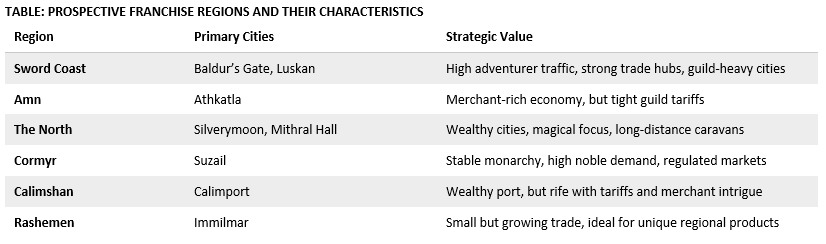
Regional Expansion Strategy

Not every province of Faerûn is equally suited for immediate expansion. Some regions boast thriving ports and bustling guildhouses, while others are bound by tariffs, noble decrees, or simple distance from major trade routes. The Waterdeep Trading Company approaches expansion like a seasoned general planning a campaign, choosing battlefields wisely, weighing local risks, and aligning with regional strengths. By focusing on high-value cities and trade corridors first, the Company ensures its franchises take root where demand is strongest.
Tracking Franchises Across the Realms

Expansion without oversight is folly. The griffon crest of the Waterdeep Trading Company is more than a symbol, it is a promise of quality and trust. To uphold that promise, every franchise across Faerûn must be carefully tracked, monitored, and supported. From enchanted compliance seals in Suzail to mirror councils with Calimport, the Company ensures that no matter where a banner flies, the standards of Waterdeep are upheld.

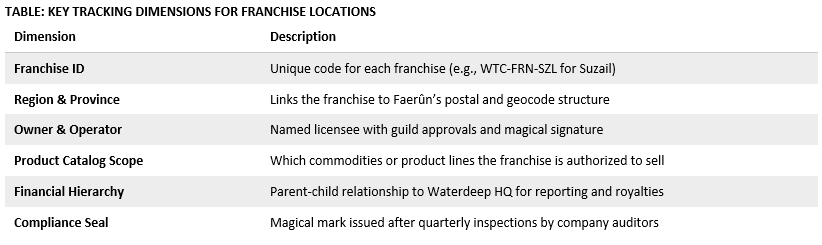
Core Tracking Dimensions

Franchises are tracked using structured identifiers, regional codes, and hierarchical reporting.
Methods of Oversight

The Waterdeep Trading Company combines enchanted oversight with structured accounting to maintain control:

  • Arcane Seals of Compliance glow gold if reports are accurate, crimson if falsified or late.
  • Guild Chapter Reports file compliance scrolls directly into WDTC archives.
  • Mirror of Communication Logs (MIR-WD-FRN-###) provide weekly visual councils with HQ.
  • Inventory Scrying lets HQ clerks verify stock levels remotely.
  • Customer Feedback Charms tally enchanted praise or complaint tokens into central ledgers.

Franchise Ledger Integration

Managing a franchise network across Faerûn requires more than guild inspections and enchanted seals, it requires numbers that tell the truth. The Waterdeep Trading Company treats each franchise as its own legal entity, but links them all back to the parent account in Waterdeep. This approach ensures clear accountability while allowing consolidated reporting across the entire Realms-spanning operation.

Each franchise ledger records its own revenue, costs, and local taxes, while royalties and fees flow back to HQ through recurring journals. Inventory is supplied through intercompany trade agreements, and every transaction is visible to both the franchise operator and the Company’s central treasurers. This creates transparency, prevents fraud, and allows swift decision-making when markets shift.

Realms-Aware Considerations

No two provinces of Faerûn operate alike. Each region carries its own guild politics, magical restrictions, and logistical challenges. What works seamlessly in Waterdeep may be impossible in Calimport, while practices in Suzail are bound by royal decree. For the Waterdeep Trading Company, successful franchising depends on adapting oversight and operations to the realities of each market without compromising the integrity of the brand.

  • Suzail requires joint audits with the Crown’s inspectors, adding layers of noble oversight.
  • Calimport demands strict anti-smuggling measures to prevent contraband from flowing through franchise docks.
  • Silverymoon enforces separate monitoring for magical commodities under the Arcane Artificers & Alchemists Union.
  • Icewind Dale relies heavily on Sending Stones and enchanted couriers during winter, when caravans cannot pass.

By acknowledging these regional variances, the Company ensures that each franchise thrives under local law while remaining tied to the central griffon crest.

Worked Example: Suzail Franchise

Examples speak louder than ledgers. To show how the franchise model operates in practice, let us look at a single case in the heart of Cormyr. Suzail, the capital, offers a stable monarchy, wealthy nobles, and steady demand for high-quality goods. It is an ideal proving ground for the Waterdeep Trading Company’s franchising approach.

A merchant in Suzail opens a franchise with an initial fee of 2,500 FSD. They receive training from Waterdeep, stock approved goods, and sign intercompany trade agreements. In the first quarter, revenue reaches 15,000 FSD, with 2,250 FSD remitted as royalty to HQ. Quarterly reports are transmitted via enchanted mirrors and verified with compliance seals, ensuring trust between Suzail and Waterdeep.

This example shows how a single franchise can uphold brand standards while adapting to local demand, building both local prosperity and company-wide growth.

Final Thoughts

Franchising is more than an expansion tactic, it is a covenant between the Waterdeep Trading Company and the people of Faerûn. Each franchise must not only turn a profit but also uphold the reputation of the griffon crest, ensuring that adventurers and nobles alike know they can trust the goods within. By balancing local autonomy with central oversight, the Company transforms regional shops into a continental network of reliability.

Franchising transforms the Waterdeep Trading Company from a regional guildhouse into a continental brand. Expansion brings reach; tracking ensures discipline. With enchanted oversight, robust ledgers, and strong guild partnerships, the griffon crest becomes a symbol of trust and consistency across the Realms, from the noble courts of Cormyr to the caravan routes of Amn.


Support the AD&D365 Project on Patreon.

To grow this world, we’ve launched an official Patreon where supporters can gain access to exclusive content, tools, training labs, and even influence the future of the project. Your support fuels more than just development ,  it expands the guildhall, forges new scrolls, and empowers the next generation of configuration wizards.  Begin your journey: https://www.patreon.com/adnd365/

A Grateful Salute to Our Patrons

To all those who stand behind the vision, thank you for helping bring this world to life. Our Benefactors, Andre Breillatt, and Eryndor Fiscairn, your boundless generosity fuels the arcane core of this project. Without your magic, the weave would falter. Our Apprentices, the spell engines turn and the training labs thrive thanks to our current Apprentices: Michael Ramirez and Andreth Bael’Rathyn. Special thanks to our past Apprentices, whose contributions helped us get here:  Ralf Weber, Wendy Rijners, Shashi Mahesh, Julia Tejera, Ben Ekokobe, Tiago Xavier, Naveen Boyinapelli, Marcos Tadeu Wolf, Kathryn Greene, Jason Brown, Mark Christy, and Ashish Singh. Our Initiates, Peter Lorre, your commitment marks the start of the deeper path, stepping beyond mere observation into the active shaping of this realm. Our Followers, your steady presence along the journey is a beacon of encouragement:  Eric Shuss, Sunil Panchal, Sarah D. Morgan, Nick Ramchandani, Daniel Kjærsgaard, and Tomasz Pałys. And our Voyeurs, Harry Burgh, Abdelrahman Nabil, and Basil Quarrell, ever watching from the shadows, clearly intrigued… but not enough to part with a single gold piece. Your silent curiosity is noted, and mildly judged.

Want to design your own economic models in Faerûn?

Get your own AD&D365 Environment and guides at adnd365.com/start, and request access to the public view of the current database at https://public.adnd365.com – Login npc@adnd365.com, Password N0nPl@yC#822!
The economy of Faerûn is not defined by coin alone. Its true strength lies in the industries that sustain livelihoods, uphold guild traditions, and bridge the gap between the mundane and the magical. From the vast wheat fields of Goldenfields to the enchanted workshops of Silverymoon, industries act as the pulse of the Realms, feeding cities, outfitting adventurers, empowering temples, and ensuring that trade routes remain alive with goods both practical and arcane.

For merchants and adventurers alike, industries are more than suppliers of goods, they are the engines of culture, politics, and survival. Guilds wield enormous influence, dictating not only quality and pricing but also shaping the destinies of apprentices, artisans, and even kingdoms. Magical integration further sets Faerûn apart from other economies: brewers enchant their mead for longevity, smiths forge blades with runes of protection, and scribes craft parchments immune to rot. Each craft carries with it centuries of tradition, technical mastery, and at times, divine blessing.

The Waterdeep Trading Company views industries not as abstract markets but as living ecosystems. Understanding how each vertical operates is essential for anticipating shortages, negotiating contracts, and leveraging guild alliances. A failure in one industry, a poor harvest, a guild strike, a broken leyline, can ripple outward, threatening supply chains, destabilizing tariffs, or sparking political unrest. Conversely, mastery of industry knowledge can unlock opportunities: positioning goods where scarcity drives demand, investing in verticals aligned with magical trends, and safeguarding contracts through compliance with guild regulations.

Industries of Faerûn also mirror the unique geography and cultures of the continent. Luskan’s shipwrights thrive because of their harsh northern seas. Amn’s merchants dominate coffee and tea through coastal access and southern trade routes. Thay’s arcane workshops flourish under Red Wizard oversight, while Goldenfields ensures that the breadbasket of the Sword Coast never runs dry. Each region specializes, adapts, and innovates, creating a patchwork economy where survival depends on both local resilience and continental trade flows.

By exploring these industries in detail, we uncover not only their typical products and craft requirements but also the business capabilities needed to manage them effectively within a system like Dynamics 365. From batch traceability in brewing to serialized artifact registries for enchanted items, each vertical demands specialized processes that reflect its magical and cultural realities.

The following sections will examine the major industries of Faerûn, their guild structures, and their operational needs. Together, they form a blueprint for understanding the engines of commerce and craft, industries that do not simply sustain the Realms but define them.

Why Faerûnian Industries Matter

Industries in Faerûn are more than lines of trade, they are the pillars that uphold the Realms’ prosperity and stability. Each vertical binds together tradition, innovation, and survival, ensuring that both great cities and rural hamlets remain supplied and sustained. Their significance rests on four interwoven principles:

  • Guild Regulation: Powerful guilds safeguard every craft, enforcing standards of quality, setting fair wages, and guiding apprenticeships. Their oversight prevents chaos in the marketplace and ensures continuity of skill across generations.
  • Regional Specialization: Geography shapes mastery. Goldenfields thrives as the breadbasket of the North, while Luskan’s icy docks produce ships that endure the harshest seas. Each region’s strengths define its contribution to the greater economy.
  • Magical Integration: Arcane practice and mundane craft are inseparable. Brewers weave enchantments into mead for longevity, smiths etch protective runes into armor, and scribes enchant parchment against decay. Magic amplifies what craftsmanship alone could not achieve.
  • Economic Stability: Industries are the lifeblood of tariffs, taxes, and trade flows. They generate wealth for cities, sustenance for villages, and resilience for kingdoms, anchoring both everyday survival and grand commerce.

Together, these principles explain why industries are not merely sectors of labor, they are the engines that drive Faerûn’s culture, politics, and prosperity.

Key Industries of Faerûn and Their Unique Requirements

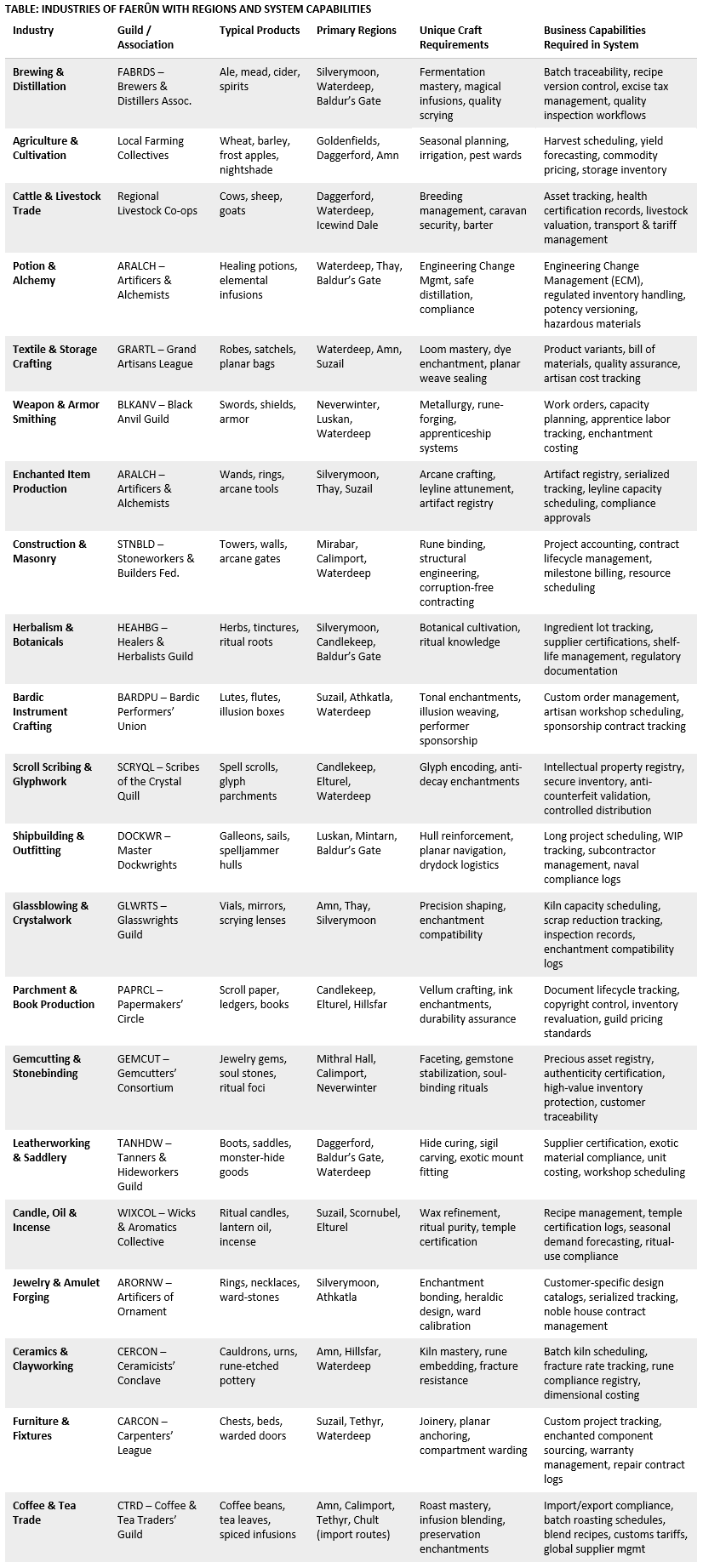
From the bustling dockyards of Luskan to the fertile fields of Goldenfields and the enchanted workshops of Silverymoon, each industry in Faerûn has its own rhythms, strengths, and challenges. These verticals not only supply goods but also shape the character of their regions, reflecting centuries of guild tradition and magical practice. For the Waterdeep Trading Company, understanding the unique requirements of each industry is vital to managing supply chains, negotiating contracts, and forecasting demand. What follows is a closer look at the industries that power the Realms and the specialized capabilities that make them thrive.

Brewing & Distillation: Ale, cider, and spirits flow across taverns and courts alike. Brewers require fermentation mastery, magical infusions for aging, and scrying spells for quality control. Their guild, FABRDS, ensures authenticity and fair pricing.

Agriculture & Crop Cultivation: Goldenfields and Amn dominate grain and produce, feeding cities and supplying potion ingredients. Farmers must master seasonal planning, irrigation, and pest-warding rituals, while balancing both mundane crop yields and druidic blessings.

Cattle & Livestock Trade: From Daggerford pastures to Calimport markets, livestock fuels diets and barter economies. Herdsmen must focus on breeding management, disease prevention, and caravan protection, especially in regions where a cow may be worth 30 gold or more.

Potion & Alchemy Manufacturing: Alchemists and artificers in Waterdeep, Baldur’s Gate, and Thay rely on Engineering Change Management to regulate volatile recipes. Requirements include safe distillation, version tracking, and strict guild compliance to avoid catastrophic failures.

Textile & Storage Crafting: The Grand Artisans League oversees fabrics, satchels, and planar bags. Craftsfolk require loom mastery, dye enchantment, and planar weave sealing, ensuring robes resist flames and bags hold more than their size would suggest.

Weapon & Armor Smithing: The Black Anvil Guild unites smiths from Waterdeep and Neverwinter. Beyond metallurgy, rune-forging and rigorous apprenticeship systems are essential. Every blade and breastplate is tested both by hammer and enchantment.

Enchanted Item Production: Concentrated in Silverymoon and Thay, enchanted item production requires leyline attunement, artifact registries, and enchantment safety practices. Wands, rings, and arcane tools must be carefully catalogued to prevent misuse.

Construction & Masonry: The Stoneworkers & Builders Federation oversees towers, fortresses, and arcane gates. Requirements include rune binding, corruption-free contracting, and structural engineering fit for both mundane strongholds and planar gateways.

Herbalism & Botanical Goods: Herbalists in Candlekeep and Silverymoon must balance cultivation, drying techniques, and ritual knowledge. Their trade supplies both healers and alchemists, with guilds ensuring rare herbs are protected from exploitation.

Bardic & Instrument Crafting: The Bardic Performers’ Union protects the crafters of lutes, flutes, and illusion boxes. Their work requires tonal enchantments, illusion weaving, and performer sponsorship to keep bardic schools supplied.

Shipbuilding & Outfitting: Luskan’s dockyards and Mintarn’s drydocks specialize in galleons and spelljammer-ready hulls. Dockwrights require hull reinforcement expertise, planar navigation glyphs, and logistical control of drydock resources.

Glassblowing & Crystalworks: Glasswrights shape vials, mirrors, and scrying lenses in Amn and Silverymoon. Precision crystal alignment and enchantment compatibility are paramount to prevent flaws in alchemical or divinatory tools.

Parchment & Book Production: Papermakers and scribes produce ledgers and spell scrolls. They require vellum crafting, ink enchantments, and anti-decay spells to safeguard libraries such as Candlekeep.

Gemcutting & Stonebinding: The Gemcutters’ Consortium ensures stability in jewelry and soul stones. Skills include faceting, soul-binding rituals, and gemstone stabilization, work that often balances commerce with spiritual trust.

Leatherworking & Saddlery: Tanners in Daggerford and Baldur’s Gate craft boots, saddles, and monster-hide goods. Requirements include toxin neutralization, hide curing, and sigil carving, particularly for exotic mounts.

Candle, Oil & Incense Making: Temples rely heavily on WIXCOL guild-certified products. Craftsfolk refine wax, infuse scents, and maintain ritual purity, ensuring candles and incense meet religious standards.

Jewelry & Amulet Forging: Artificers of Ornament specialize in protective amulets and noble house sigils. They must blend heraldic design with enchantment bonding, ensuring both prestige and function.

Ceramics & Clayworking: Potters in Amn and Waterdeep produce urns, cauldrons, and rune-etched vessels. Their requirements include kiln mastery, rune embedding, and fracture resistance for ritual reliability.

Furniture & Fixtures: Carpenters craft chests, beds, and warded doors. Joinery, planar anchoring, and compartment warding are required to create fixtures that protect against scrying or intrusion.

The following table highlights all the industries of Faerûn, their guilds, typical goods, craft requirements, business system needs, and the regions where they are most active. A new row has been added for the Coffee & Tea trade, a growing vertical in southern Faerûn.

Realms-Aware Considerations

Industries in Faerûn do not exist in isolation, they are shaped by forces as varied as guild politics, magical tides, geography, and the turning of the seasons. A process that runs flawlessly in Waterdeep may falter in Luskan’s harsher climate, while Goldenfields’ abundant harvests may wither under Calimport’s arid skies. For the Waterdeep Trading Company, true mastery comes not only from understanding the craft of each industry but also from recognizing the wider forces that influence production, trade, and demand across the continent.

  • Seasonality – Many trades, particularly agriculture, brewing, and candle-making, are bound to ritual calendars and harvest cycles, creating periods of abundance and scarcity that drive pricing and supply.
  • Magic vs. Mundane Balance – Some industries, such as alchemy and potion-making, operate under strict arcane regulation, while others, like blacksmithing, face shifting pressures from tariffs, wartime requisitions, or local politics.
  • Guild Oversight – Apprenticeships, certifications, and price controls are enforced through powerful guild networks, ensuring consistency but also limiting flexibility for independent traders.
  • Regional Scarcity – Goods plentiful in one region may be rare luxuries in another. Cattle may roam freely in Goldenfields, yet in Icewind Dale they command extraordinary value, shaping trade routes and bargaining power.

Taken together, these considerations remind us that Faerûn’s industries are never static. They are living systems, influenced by culture, magic, and environment. For traders and guilds alike, success lies in adapting to these shifting currents while maintaining trust, quality, and resilience.

Final Thoughts

The industries of Faerûn create more than goods, they weave the very fabric of the Realms. Where tradition meets magic, each vertical carries its own disciplines, safeguards, and cultural significance, shaping not only commerce but also identity and survival. Brewing, smithing, enchanting, and cultivation are not isolated trades; together they sustain cities, empower adventurers, and anchor the flow of wealth across kingdoms.

For the Waterdeep Trading Company, understanding these industries is not simply a matter of market awareness, it is a strategic imperative. Success depends on anticipating the rhythms of harvests, respecting guild governance, leveraging magical innovation, and adapting to shifting regional demands. By mastering the unique requirements of each vertical, the Company secures its place at the heart of Faerûn’s economy, ensuring resilience, influence, and prosperity in an ever-changing world.


Support the AD&D365 Project on Patreon.

To grow this world, we’ve launched an official Patreon where supporters can gain access to exclusive content, tools, training labs, and even influence the future of the project. Your support fuels more than just development ,  it expands the guildhall, forges new scrolls, and empowers the next generation of configuration wizards.  Begin your journey: https://www.patreon.com/adnd365/

A Grateful Salute to Our Patrons

To all those who stand behind the vision, thank you for helping bring this world to life. Our Benefactors, Andre Breillatt, and Eryndor Fiscairn,, your boundless generosity fuels the arcane core of this project. Without your magic, the weave would falter. Our Apprentices, the spell engines turn and the training labs thrive thanks to our current Apprentices: Michael Ramirez and Andreth Bael’Rathyn. Special thanks to our past Apprentices, whose contributions helped us get here:  Ralf Weber, Wendy Rijners, Shashi Mahesh, Julia Tejera, Ben Ekokobe, Tiago Xavier, Naveen Boyinapelli, Marcos Tadeu Wolf, Kathryn Greene, Jason Brown, Mark Christy, and Ashish Singh. Our Initiates, Peter Lorre, your commitment marks the start of the deeper path, stepping beyond mere observation into the active shaping of this realm. Our Followers, your steady presence along the journey is a beacon of encouragement:  Eric Shuss, Sunil Panchal, Sarah D. Morgan, Nick Ramchandani, Daniel Kjærsgaard, and Tomasz Pałys. And our Voyeurs, Harry Burgh, Abdelrahman Nabil, and Basil Quarrell, ever watching from the shadows, clearly intrigued… but not enough to part with a single gold piece. Your silent curiosity is noted, and mildly judged.

Want to design your own economic models in Faerûn?

Get your own AD&D365 Environment and guides at adnd365.com/start, and request access to the public view of the current database at https://public.adnd365.com – Login npc@adnd365.com, Password N0nPl@yC#822!
From the anvil halls of the Black Anvil Guild to the silk-threaded studios of the Grand Artisans League, apprenticeships are the lifeblood of skilled labor across Faerûn. For the Waterdeep Trading Company and affiliated guilds, integrating apprentices into active production environments ensures not only continuity of craft but also operational resilience. However, such integration requires careful structuring, balancing training, certification, and workplace safety.

This article outlines how Faerûnian guilds manage apprentice participation on the production floor, detailing learning outcomes, certification paths, and the governance necessary to mitigate risk and uphold standards.

What It Is

Apprenticeship Integration is the structured onboarding of novice guild members into real-world production activities. Unlike classroom instruction or simulation-based learning, this model places apprentices directly on workshop floors, caravan logistics teams, or alchemical lines, under the guidance of journeymen and masters.

Why It Matters

For the Waterdeep Trading Company and its guild partners, apprentices are not mere students, they are future masters, capable of carrying on the art and trade. Integration allows:

  • Accelerated skill acquisition through practical experience
  • Early detection of talent and specialization pathways
  • Reduced training costs through in-situ instruction
  • Strengthening of guild labor pipelines during peak demand

Components of the Integration Framework

The successful inclusion of apprentices on live workstations or production environments requires structure. The table below outlines the key components:

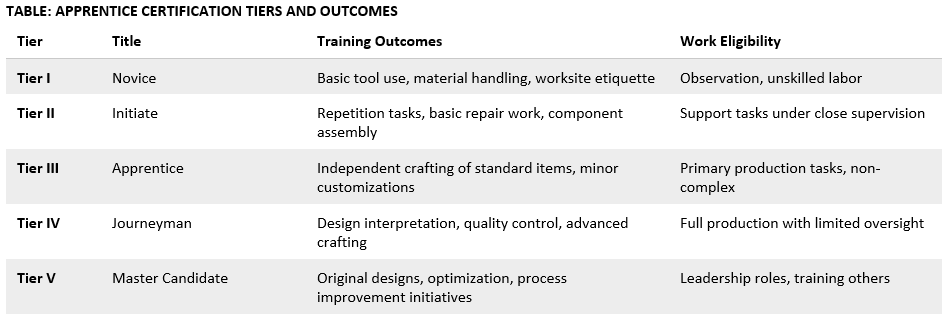
Training Outcomes by Certification Tier

Each certification level within a guild defines the scope of permissible work and the expected outcomes. Below is a model used by the Grand Artisans League:

Risk Mitigation When Working with Apprentices

Letting apprentices on the shop floor is not without risk. The Waterdeep Trading Company applies the following strategies to minimize disruptions and dangers:

  • Magical Safeguards: Enchanted aprons, emergency dispel zones, and auto-warded tools reduce arcane mishaps
  • Task Gating: Each task is linked to a minimum certification tier, preventing unqualified access
  • Shadow Assignments: New apprentices must shadow a senior member for a defined period before solo work
  • Rotational Learning: Apprentices rotate across stations to prevent overuse injuries and broaden exposure
  • Incident Review Panels: Any apprentice-caused incident triggers a panel review and learning cycle

Worked Example: Integration at the Elturel Leatherworks Guild

At the Elturel chapter of the Grand Artisans League, apprentices from Tier II onward are placed on the production floor during peak order seasons. A sample schedule might look like:

  • Morning: Tool sharpening, leather cutting under journeyman review
  • Midday: Stitching standard satchels on the apprentice line
  • Afternoon: Supervisory feedback, skill assessments, and lore studies

Every completed product is logged against the apprentice’s guild ledger. Errors beyond tolerance lead to either rework drills or temporary reassignment to basic tasks.

Realms-Aware Considerations

Different cities and guilds apply unique filters:

  • Baldur’s Gate Blacksmiths Guild mandates all apprentices pass a Magical Resistance Fitness check due to high enchanted forge use
  • Arcane Artificers Union forbids planar material handling until Tier IV due to safety and containment risks
  • Faerûn Dockworkers Federation trains apprentices on dummy loads before allowing real cargo interaction

Final Thoughts

Apprenticeship integration in Faerûn is more than filling labor gaps, it is an investment in continuity, quality, and craft preservation. For the Waterdeep Trading Company, ensuring apprentices are nurtured, certified, and safeguarded is key to a sustainable workforce and to the legacies each guild seeks to build.


Support the AD&D365 Project on Patreon.

To grow this world, we’ve launched an official Patreon where supporters can gain access to exclusive content, tools, training labs, and even influence the future of the project. Your support fuels more than just development ,  it expands the guildhall, forges new scrolls, and empowers the next generation of configuration wizards.  Begin your journey: https://www.patreon.com/adnd365/

A Grateful Salute to Our Patrons

To all those who stand behind the vision, thank you for helping bring this world to life. Our Benefactors, Andre Breillatt, and Eryndor Fiscairn,, your boundless generosity fuels the arcane core of this project. Without your magic, the weave would falter. Our Apprentices, the spell engines turn and the training labs thrive thanks to our current Apprentices: Michael Ramirez and Andreth Bael’Rathyn. Special thanks to our past Apprentices, whose contributions helped us get here:  Ralf Weber, Wendy Rijners, Shashi Mahesh, Julia Tejera, Ben Ekokobe, Tiago Xavier, Naveen Boyinapelli, Marcos Tadeu Wolf, Kathryn Greene, Jason Brown, Mark Christy, and Ashish Singh. Our Initiates, Peter Lorre, your commitment marks the start of the deeper path, stepping beyond mere observation into the active shaping of this realm. Our Followers, your steady presence along the journey is a beacon of encouragement:  Eric Shuss, Sunil Panchal, Sarah D. Morgan, Nick Ramchandani, Daniel Kjærsgaard, and Tomasz Pałys. And our Voyeurs, Harry Burgh, Abdelrahman Nabil, and Basil Quarrell, ever watching from the shadows, clearly intrigued… but not enough to part with a single gold piece. Your silent curiosity is noted, and mildly judged.

Want to design your own economic models in Faerûn?

Get your own AD&D365 Environment and guides at adnd365.com/start, and request access to the public view of the current database at https://public.adnd365.com – Login npc@adnd365.com, Password N0nPl@yC#822!

In the industrious world of Faerûn, spellcasting is more than art or warfare, it is labor. From enchanting blades to illuminating hearths, arcane effort underpins much of the continent’s production economy. At the Waterdeep Trading Company, understanding when and how to treat spellcasting as a cost of production versus a service expense is essential for accurate costing, fair guild compensation, and sound decision-making.

This article explores the accounting treatment of spellcasting within the production cycle, with a special focus on cases like Continual Flame, where the same spell might be used either as a production input or an after-market service.

What It Is

Spellcasting as labor refers to the classification and costing of magical efforts performed by qualified casters, whether wizards, clerics, artificers, or sorcerers, within the production of goods. This includes:

  • Enchantments during manufacturing
  • Temporary transmutations
  • Alchemical infusions
  • Ritual augmentations or bindings
  • Permanent magical installations

Why It Matters

Accounting for spellcasting properly ensures that products reflect their true cost. Misclassifying spellcasting labor can lead to underpriced goods, incorrect margin calculations, or regulatory infractions with the Arcane Artificers & Alchemists Union (ARALCH).

Moreover, some spells blur the line between a production input and a service. For instance, Continual Flame might be cast:

  • During manufacturing to produce a lightstone sold as part of a lamp (production cost)
  • Afterward, upon installation at a client’s location (service expense)

Getting this distinction right is essential for inventory valuation, tax treatment, and guild compliance.

Components of Spellcasting Labor

Not all spells are cast alike, nor should they be costed alike. Within the production cycle of the Waterdeep Trading Company, spellcasting manifests in a variety of forms: some spells permanently bind enchantments to goods, while others are temporary enhancements used during bottling, inspection, or safety control. Understanding the types of spellcasting involved allows the company to apply the correct cost category, assign the right account behavior, and uphold transparency across its enchanted operations.

The following table breaks down the most common types of spellcasting labor observed in Faerûnian production and how each should be classified within the accounting framework. This ensures every flick of a wand or uttered incantation finds its rightful place in the ledger.

Worked Example: Continual Flame Use in Production vs. Service

Consider a series of enchanted lanterns sold by the Waterdeep Trading Company.

Scenario A: Production Phase

  • Continual Flame is cast at the forge.
  • The lantern is shipped with the light already embedded.
  • The labor cost of the spell is added to the production BOM.

Scenario B: Post-Sale Service

  • A lantern is sold empty.
  • A licensed enchanter is dispatched to cast Continual Flame on-site.
  • This is treated as a service expense, not capitalized into the product’s inventory value.

Realms-Aware Considerations

Across Faerûn, the cost and treatment of spellcasting labor can vary widely based on local laws, guild regulations, and magical resource availability. What applies in Waterdeep may not hold in Calimport or Silverymoon. The following considerations help ensure compliance and accurate costing in every region where the Waterdeep Trading Company operates.

Guild Approval: Only certified ARALCH members may perform production-stage enchantments.

Spell Component Costing: Some spells require expensive components (e.g., rubies for Continual Flame). These should be tracked as separate material lines.

Location Matters: In Silverymoon, arcane labor is cheaper and more common. In Calimport, magical licenses inflate costs by 15 to 30 percent.

Final Thoughts

Spellcasting is labor, and labor has value. Whether burned into steel or summoned into the sky, each casting must be measured, valued, and attributed with precision. For the Waterdeep Trading Company, this clarity ensures not only financial control but compliance with realmwide trade guild expectations.


Support the AD&D365 Project on Patreon.

To grow this world, we’ve launched an official Patreon where supporters can gain access to exclusive content, tools, training labs, and even influence the future of the project. Your support fuels more than just development ,  it expands the guildhall, forges new scrolls, and empowers the next generation of configuration wizards.  Begin your journey: https://www.patreon.com/adnd365/

A Grateful Salute to Our Patrons

To all those who stand behind the vision, thank you for helping bring this world to life. Our Benefactor, Andre Breillatt, your boundless generosity fuels the arcane core of this project. Without your magic, the weave would falter. Our Apprentices, the spell engines turn and the training labs thrive thanks to our current Apprentices: Michael Ramirez and Andreth Bael’Rathyn (Name obfuscated to protect their identity). Special thanks to our past Apprentices, whose contributions helped us get here:  Ralf Weber, Wendy Rijners, Shashi Mahesh, Julia Tejera, Ben Ekokobe, Tiago Xavier, Naveen Boyinapelli, Marcos Tadeu Wolf, Kathryn Greene, Jason Brown, Mark Christy, and Ashish Singh. Our Initiates, Peter Lorre, your commitment marks the start of the deeper path, stepping beyond mere observation into the active shaping of this realm. Our Followers, your steady presence along the journey is a beacon of encouragement:  Eric Shuss, Sunil Panchal, Sarah D. Morgan, Nick Ramchandani, Daniel Kjærsgaard, and Tomasz Pałys. And our Voyeurs, Harry Burgh, Abdelrahman Nabil, and Basil Quarrell, ever watching from the shadows, clearly intrigued… but not enough to part with a single gold piece. Your silent curiosity is noted, and mildly judged.

Want to design your own economic models in Faerûn?

Get your own AD&D365 Environment and guides at adnd365.com/start, and request access to the public view of the current database at https://public.adnd365.com – Login npc@adnd365.com, Password N0nPl@yC#822!

From the ember-lit forges of Neverwinter to the mist-cloaked alchemy halls of Thay, the production facilities of Faerûn hum with magical activity. But when spells misfire, potions backfire, or extraplanar residue leaks into the material plane, the consequences can be dire. For the Waterdeep Trading Company and other guild-operated workshops, such events demand swift, structured action, lest a single miscast alter a year’s worth of inventory or spawn something best left undescribed.

This article outlines the key protocols used by responsible enterprises to isolate production lines following arcane incidents. Whether managing potion bottling lines or enchanted fabric looms, understanding and deploying magical contamination control procedures is essential to safeguarding workers, goods, and realms.

What It Is

Magical contamination control refers to the standardized set of responses enacted when production environments are compromised due to:

  • Alchemical Failures: Unstable mixtures or expired ingredients causing explosive or mutagenic reactions.
  • Arcane Feedback: Resonant energy loops from misaligned enchantment channels.
  • Planar Anomalies: Unexpected breaches to or influences from elemental, fey, or infernal planes.

Why It Matters

Unchecked contamination does more than damage product. It risks:

  • Cross-contamination of inventory
  • Arcane drift corrupting enchantment runes
  • Worker injury or polymorphic exposure
  • Violations of guild regulatory standards
  • Reputation loss due to cursed or unstable shipments

For guilds operating under the Arcane Artificers & Alchemists Union or exporting under planar trade compacts, containment compliance is legally and ethically mandated.

Components of a Magical Contamination Protocol

The Waterdeep Trading Company employs a tiered response system known as the Aetherlock Sequence. This model scales with severity and includes personnel, magical wards, and procedural safeguards.

Isolation and Neutralization Techniques

When contamination occurs, the first principle is always containment before cure. Methods vary by trade but commonly include:

  • Arcane Lock and Ward Circles: Prevent spread of animated objects or malicious enchantments
  • Material Sequestration Fields: Isolate ingredients or products suspected of instability
  • Spellflame Purge: A controlled cleansing fire that neutralizes enchantments (used only in Tier III or IV events)
  • Planar Anchors: Restore equilibrium when foreign energy leaks are detected

Worked Example: Fabric Infusion Collapse

At Lara’s Fine Fabrics and More, a batch of invisibility-thread cloaks became unstable after a moonstone filament from the Feywild proved incompatible with standard weave matrices. Within moments, the visibility of workers and materials began fluctuating wildly.

Response Summary:

  • Tier II initiated
  • Loom Room sealed with a triple-layer ward
  • Cloaks marked with non-visual sigils and relocated
  • All affected workers underwent charm reversal and planar detox

Total downtime: 6 hours. Inventory loss: 4 cloaks. Lives lost: 0. Reputation: Preserved.

Realms-Aware Considerations

Contamination protocols differ by location and infrastructure:

Final Thoughts

Magical contamination is not a matter of “if” but “when” for any serious producer in Faerûn. By embedding strong protocols, both mundane and magical, into daily operations, guilds like the Waterdeep Trading Company not only protect their profit but honor their oath to the safety of the Realms.

The arcane may be volatile, but through discipline and ritual, even the most unstable magic can be managed.

Across the bustling Sword Coast, caravans flow like rivers of commerce. Yet even the Waterdeep Trading Company, with its sprawling storefronts and enchanted vaults, cannot hold every crate, barrel, or cask within its own walls. To meet demand, the guild has turned to third-party logistics (3PL) warehouses, outsourced storage partners who manage inventory on behalf of the company.

This practice is not without precedent in Faerûn. Merchant guilds in Calimport have centuries of experience with contracted warehousing, while Mirabar has long offered stone-hewn vaults as neutral trade hubs. What is new, however, is how the Waterdeep Trading Company uses modern ledgercraft within Dynamics 365 to track, reconcile, and optimize these outsourced operations.

What Is a 3PL Warehouse in Faerûn?

A 3PL (third-party logistics) warehouse is an independent storage hall or vault managed by a specialist provider. The Waterdeep Trading Company contracts these halls to store adventuring gear, foodstuffs, or raw materials closer to markets and trade routes.

Unlike company-owned warehouses, 3PLs operate under a strict contract. They manage inbound deliveries, secure stock within their wards, and often handle outbound shipments as well.

Why Outsource Storage?

For a company as ambitious as the Waterdeep Trading Company, not every crate can remain under its own vaulted roof. Demand for adventuring gear, trade goods, and raw materials often outpaces the limits of in-house warehouses. Expanding physical infrastructure is costly, risky, and time-consuming. Outsourcing storage offers an alternative path, one that leverages specialized partners who already possess the halls, vaults, and labor to safeguard goods across Faerûn.

By turning to these 3PL providers, the company can respond swiftly to market shifts, expand its footprint into distant provinces, and weather seasonal surges without overburdening its own facilities.

  • Proximity to Markets: A hall in Baldur’s Gate or Calimport means faster delivery to southern clients.
  • Risk Diversification: Splitting stock across regions protects against raids, magical mishaps, or local tariffs.
  • Scalability: During festival seasons like Shieldmeet, temporary space can be rented rather than building new warehouses.
  • Cost Efficiency: Avoiding the upkeep of additional vaults and guards lowers capital investment.

Leading 3PL Providers in Faerûn

Not all providers are equal. The Waterdeep Trading Company selects its partners carefully, favoring those with reputations for security, accuracy, and reliability.

By matching the type of goods to the provider, the Waterdeep Trading Company ensures the right balance of cost, security, and responsiveness.

Components of 3PL Tracking in Dynamics 365

Within the enchanted framework of Dynamics 365, outsourced warehouses are modeled and tracked just like internal ones, but with special considerations.

The Journey of a Sack of Grain: A 3PL Transaction Flow in Faerûn

The Waterdeep Trading Company, ever watchful of its growing markets, decides to provision Baldur’s Gate with adventurer rations ahead of the spring caravans. Greta Ironfist herself signs the parchment order for 500 sacks of grain to be placed not in the company’s own vaults, but in the care of a contracted 3PL provider: the Dwarven Vault Guild of Baldur’s Gate.

  1. The Purchase Order
    The process begins with a purchase order inscribed in both ink and rune. This binding agreement links the supplier of the grain to the dwarven warehouse, ensuring that goods flow directly into outsourced custody.
  2. The Arrival at the 3PL Vault
    Wagon after wagon rolls into Baldur’s Gate, the sacks offloaded beneath the watchful eyes of dwarven clerks. With a clang of iron keys and a murmur of enchantments, the goods are sealed within Warehouse WH-BDG-03. At this moment, the company records the product receipt, and the inventory appears in the enchanted Dynamics 365 ledgers.
  3. Consigned Custody
    Although the grain now rests safely in the stone vault, ownership remains in a twilight state. The dwarves hold the stock under consignment—present in on-hand reports, yet not invoiced to the company until required. This balance of visibility without immediate liability is the very heart of outsourced storage.
  4. The Call to Ship
    Weeks later, a request arrives from Calimport. Two hundred sacks are needed for caravans bound across Amn. A parchment sales order triggers the issue from the dwarven hall. The clerks chalk the vault stones, unlock the wards, and release the grain. In Dynamics 365, the transaction reduces stock from WH-BDG-03, aligning the enchanted ledger with physical movement.
  5. The Storage Fee
    At month’s end, the Dwarven Vault Guild presents its invoice: a neatly itemized tally of space, labor, and magical warding. The Waterdeep Trading Company pays in full, posting the fee to account 612200, Outsourced Storage Expenses.

Thus the circle closes. Goods once merely a line in a purchase order have journeyed through receipt, storage, and outbound issue, each step faithfully tracked within system and scroll. Even though the sacks lay far from Waterdeep’s own storehouses, Greta Ironfist’s treasurers can account for every kernel.

Realms-Aware Considerations

Even with the strongest contracts and the most trusted 3PL providers, doing business across Faerûn is never without complexity. Each region, guild, and city enforces its own laws, tariffs, and cultural practices that can shape the way outsourced warehouses operate. Magical protections, local politics, and even planar interference can all influence the cost and reliability of third-party storage.

To ensure smooth operations, the Waterdeep Trading Company must weigh these realities carefully. What works in the rune-sealed vaults of Mirabar may not hold true in the spice-scented warehouses of Calimport, and what is acceptable in Amn might conflict with Waterdeep’s mercantile codes. Understanding these realms-aware factors is essential to safeguarding both goods and profit.

  • Magical Safeguards: Some providers offer wards against fireballs or extraplanar theft, adding premium fees.
  • Cultural Practices: Contract terms vary, Mirabar dwarves favor multi-year agreements, while Amnian houses emphasize flexible tariffs.
  • Tariffs and Guild Law: Certain cities levy extra duties on outsourced warehouses, making location choice strategic.
  • Auditability: Rune-inscribed ledgers or guild seals double as legally binding documents under Waterdeep’s Mercantile Code.

Final Thoughts

By outsourcing to trusted 3PL providers across Faerûn, the Waterdeep Trading Company secures both reach and resilience. With Dynamics 365 providing the enchanted ledger backbone, Greta Ironfist and her treasurers maintain control over stock that lies far beyond the walls of Waterdeep.

The lesson is clear: in Faerûn, no company thrives alone. Partnership with specialized providers, properly tracked and accounted for, is the key to enduring prosperity.


Support the AD&D365 Project on Patreon.

To grow this world, we’ve launched an official Patreon where supporters can gain access to exclusive content, tools, training labs, and even influence the future of the project. Your support fuels more than just development ,  it expands the guildhall, forges new scrolls, and empowers the next generation of configuration wizards.  Begin your journey: https://www.patreon.com/adnd365/

A Grateful Salute to Our Patrons

To all those who stand behind the vision, thank you for helping bring this world to life. Our Benefactor, Andre Breillatt, your boundless generosity fuels the arcane core of this project. Without your magic, the weave would falter. Our Apprentices, the spell engines turn and the training labs thrive thanks to our current Apprentices: Michael Ramirez and Andreth Bael’Rathyn (Name obfuscated to protect their identity). Special thanks to our past Apprentices, whose contributions helped us get here:  Ralf Weber, Wendy Rijners, Shashi Mahesh, Julia Tejera, Ben Ekokobe, Tiago Xavier, Naveen Boyinapelli, Marcos Tadeu Wolf, Kathryn Greene, Jason Brown, Mark Christy, and Ashish Singh. Our Initiates, Peter Lorre, your commitment marks the start of the deeper path, stepping beyond mere observation into the active shaping of this realm. Our Followers, your steady presence along the journey is a beacon of

Want to design your own economic models in Faerûn?

Get your own AD&D365 Environment and guides at adnd365.com/start, and request access to the public view of the current database at https://public.adnd365.com – Login npc@adnd365.com, Password N0nPl@yC#822!