Orders of Operation in Math and Magic: A Shared Logic of Numbers and Potions
In the great halls of Candlekeep, scholars often debate the structure of thought. Some argue that mathematics is the purest language, while others claim alchemy and spellcraft hold the deeper truth. Yet both disciplines share a single, crucial principle: order matters. Just as the Waterdeep Trading Company must post its ledgers in the right sequence to keep its coffers balanced, so too must wizards, merchants, and potion-brewers follow a strict order of operations, lest their results turn to chaos.
The Order of Numbers: From Scrolls to Schools
Modern arithmetic across Faerûn mirrors the conventions of our age: Parentheses, Exponents, Multiplication and Division, Addition and Subtraction, all working left to right. An apprentice scribe in Baldur’s Gate, faced with the sum 6 + 7 × 2, is taught to find 20, not 26.
Yet this has not always been so. In early ages, mathematicians wrote their problems in words, not symbols, and most reckoning was done from left to right. Early mechanical calculators, gnomish clockworks from Lantan in the 1600s DR, also marched one step at a time, yielding 26 in the example above.
By the 1800s DR, however, standardized teaching from Silverymoon to Waterdeep had settled on the modern sequence. Schools, guilds, and later even enchanted calculators adopted the familiar PEMDAS rule. Order brought certainty to trade, engineering, and spellcraft alike.
Alternate Conventions: When Rules Shift
Different traditions still echo through history:
- Strict left-to-right: Found in early scrolls and basic counting tools.
- Forced grouping: With parentheses or magical brackets, results vary by design.
- Reverse Polish Notation: Favored by gnomish artificers, where symbols follow numbers (6 7 2 × + = 20).
These alternate rules remind us that clarity in notation prevents costly mistakes, whether in a sum of coins or in a contract for planar trade.
The Order of Potions: A Magical Precedence
Alchemy and potion-making mirror mathematics in their need for sequence. A healing draught brewed without structure will curdle into poison or burst into flame. Master apothecaries agree on six stages of precedence:
- Containment – vessels, seals, and wards to hold volatile energy.
- Catalyst – application of heat, moonlight, or ley energy.
- Primary Ingredients – herbs, minerals, monster parts.
- Stabilizers – salts, oils, or arcane binders.
- Essences & Distillates – phoenix tears, celestial extracts, rare alchemical spirits.
- Final Enchantments – chants, sigils, or breathwork to bind the brew.
Skipping a step is like ignoring parentheses in mathematics: it invites disaster. The glow of a proper healing potion depends entirely on faithful order.
The “Magical PEMDAS” Mnemonic
To guide apprentices, the guilds of Waterdeep teach the mnemonic:
C-C-P-S-E-F Order
“Careful Cauldrons Prevent Sudden Explosions, Fool.”
- Careful = Containment
- Cauldrons = Catalyst
- Prevent = Primary
- Sudden = Stabilizers
- Explosions = Essences
- Fool = Final Enchantments
Much as a scribe remembers PEMDAS for sums, an alchemist recalls C-C-P-S-E-F for potions. Both disciplines demand rigor.
Worked Example: Formulation and Route of a Healing Draught
Just as an accountant breaks down a ledger entry into debits and credits, an alchemist or apothecary breaks down a potion into its formulation (ingredients and costs) and route (the ordered sequence of preparation).
Below is how the Waterdeep Trading Company would record the production of a standard Healing Draught in both detail and sequence.

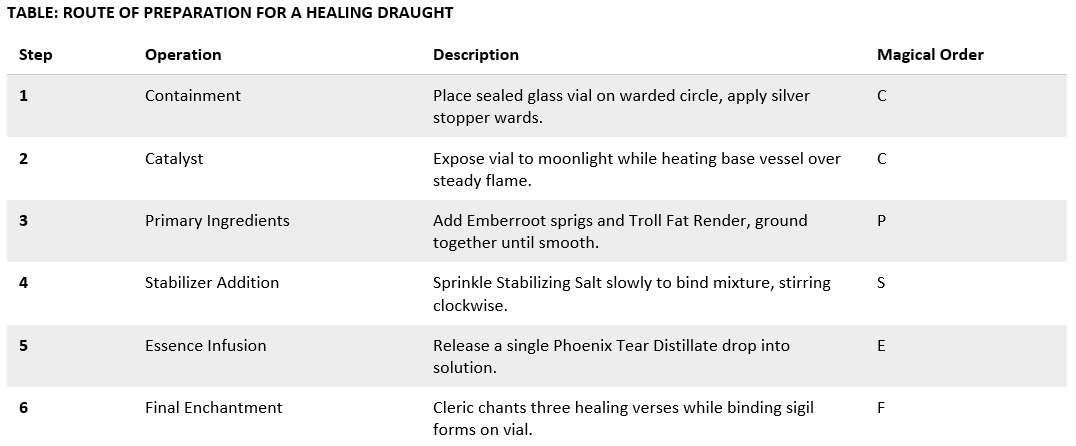
Result: A properly prepared Healing Draught that restores vitality and knits minor wounds when consumed.
A Shared Lesson for Trade and Craft
The lesson is plain: numbers and magic alike require structure. The Waterdeep Trading Company, having abandoned quill-and-scroll accounts for the precise ledgers of Dynamics 365, knows this truth well. Just as its clerks follow accounting rules when recording coins, so too must potion-brewers follow the order of their craft.
An error in one yields a wrong answer on parchment; an error in the other may yield an explosion in the apothecary. In both cases, order is everything.
Final Thoughts
Mathematics and magic are not separate languages, but dialects of order. To disregard precedence is to invite chaos, whether in a failed equation, a broken ledger, or a firebomb masquerading as a healing potion. For students, merchants, and alchemists alike, the rule remains eternal: follow the sequence, or face the consequences.
Support the AD&D365 Project on Patreon. To grow this world, we’ve launched an official Patreon where supporters can gain access to exclusive content, tools, training labs, and even influence the future of the project. Your support fuels more than just development , it expands the guildhall, forges new scrolls, and empowers the next generation of configuration wizards. Begin your journey: https://www.patreon.com/adnd365/
A Grateful Salute to Our Patrons. To all those who stand behind the vision, thank you for helping bring this world to life. Our Benefactors, Andre Breillatt, and Eryndor Fiscairn‡, your boundless generosity fuels the arcane core of this project. Without your magic, the weave would falter. Our Apprentices, the spell engines turn and the training labs thrive thanks to our current Apprentices: Michael Ramirez and Andreth Bael’Rathyn‡. Special thanks to our past Apprentices, whose contributions helped us get here: Ralf Weber, Wendy Rijners, Shashi Mahesh, Julia Tejera, Ben Ekokobe, Tiago Xavier, Naveen Boyinapelli, Marcos Tadeu Wolf, Kathryn Greene, Jason Brown, Mark Christy, and Ashish Singh. Our Initiates, Gregory Brigden, and Martin Grahm, your commitment marks the start of the deeperFpath, stepping beyond mere observation into the active shaping of this realm. Our Followers, your steady presence along the journey is a beacon of encouragement: Eric Shuss, Sunil Panchal, Sarah D. Morgan, Nick Ramchandani, Daniel Kjærsgaard, and Tomasz Pałys. And our Voyeurs, Harry Burgh, Abdelrahman Nabil, and Basil Quarrell, ever watching from the shadows, clearly intrigued… but not enough to part with a single gold piece. Your silent curiosity is noted, and mildly judged.
Want to design your own economic models in Faerûn? Get your own AD&D365 Environment and guides at adnd365.com/start, and request access to the public view of the current database at https://public.adnd365.com – Login npc@adnd365.com, Password N0nPl@yC#822!
 A Tinkerers Notebook