Slightly Cursed Product Lines: Managing the Unpredictable in Faerûnian
In the bustling markets of Faerûn, not all goods behave as expected. Some resist enchantment, others attract misfortune, and a few seem to take a perverse delight in failing at the worst possible moment. These items, known within the Waterdeep Trading Company as Slightly Cursed Product Lines, occupy a unique niche in the supply chain. They blur the line between profitable inventory and potential liability, demanding careful financial tracking, specialized routing, and a sense of humor among the accounting staff.
What It Is
A Slightly Cursed Product Line refers to a category of goods that carry residual magical interference, inconsistent behavior, or minor hexes. They are not dangerous enough to be banned, yet not reliable enough for standard sale without disclaimers. Examples include swords that hum off-key, cloaks that occasionally vanish their wearers’ heads, and wagons that refuse to travel north on certain days.
These items often originate from botched enchantments, reclaimed relics, or surplus stock from apprentice artificers. While such products can still be sold at discount or repurposed for “adventurer-grade” markets, they require special handling within both logistics and finance.
Why It Matters
From an accounting perspective, slightly cursed items challenge the conventional model of inventory valuation. Their defects are inconsistent, and their resale value depends on perceived severity of the curse and local superstitions.
For the Waterdeep Trading Company, managing these lines allows the organization to reclaim sunk costs from failed enchantment batches and transform potential waste into a secondary revenue stream.
Each cursed product line is evaluated on three axes:
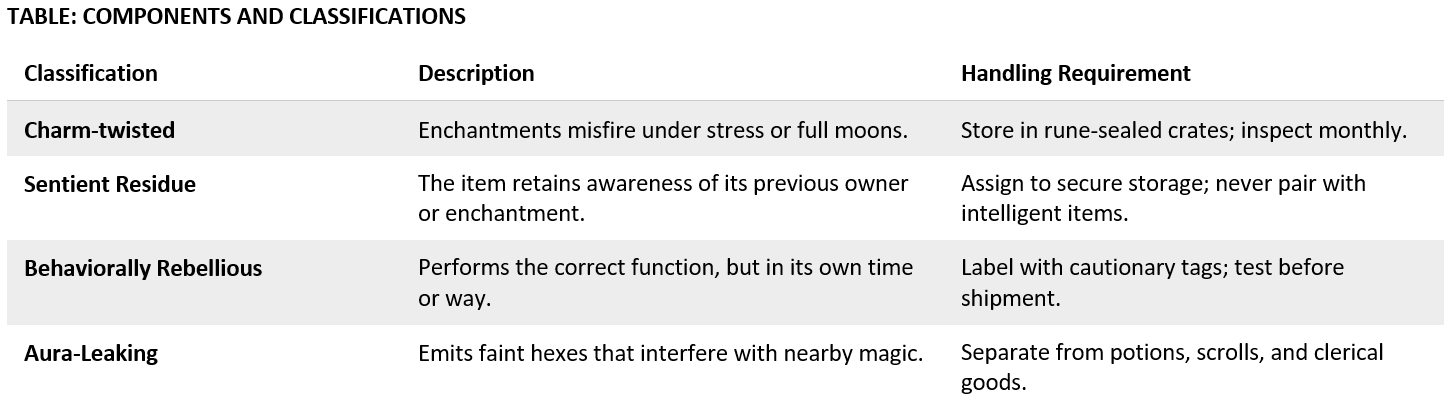
The following table illustrates how the Waterdeep Trading Company accounts for the uncertainty surrounding slightly cursed goods.
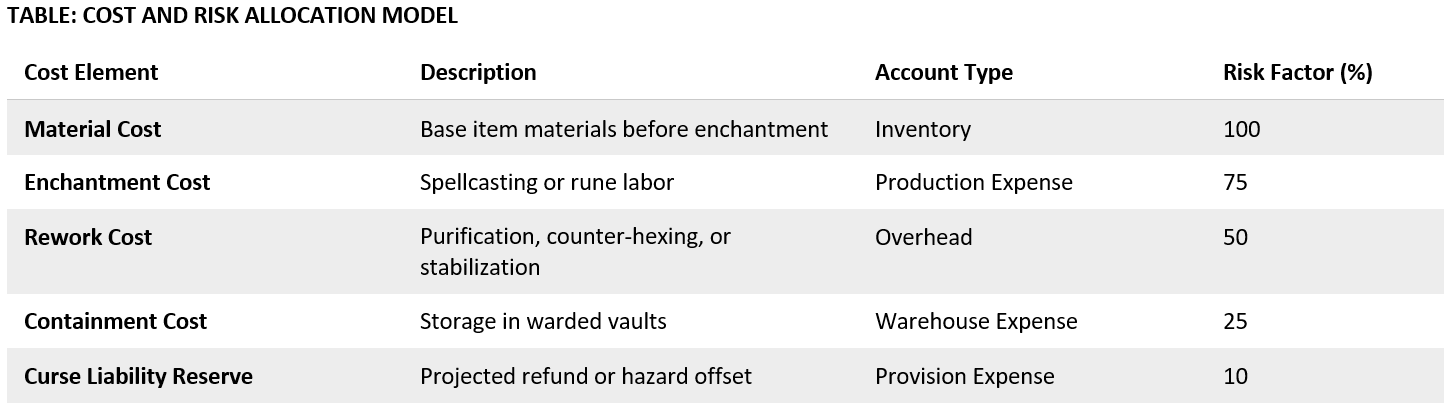
These percentages are applied within the costing sheet to balance financial exposure and enable selective insurance with the Temple of Waukeen’s trade underwriters.
Worked Example: Wand of Minor Misfires
The Wand of Minor Misfires was produced in a batch of fifty by the Baldur’s Gate Blacksmiths Guild in partnership with an overzealous artificer. While forty function perfectly, ten occasionally produce sparks, illusory frogs, or temporary hair loss.

Although the company records a nominal loss of 15 FSD per wand, the reclamation process recovers materials, the apprentice gains experience, and the novelty market sustains limited demand.
Realms-Aware Considerations
Cursed goods move differently through Faerûn’s economy. In Amn, merchants avoid them entirely due to superstition, while in Calimport, they are marketed as “luck-touched curiosities.” The Waterdeep Trading Company maintains a specialized product ledger, CURS-LITE, to isolate postings and track warranty claims.
Guild regulations require quarterly audits from the Scriveners’, Scribes’, & Clerks’ Guild to ensure that no “curses of consequence” are distributed without proper disclosure seals.
Final Thoughts
Slightly cursed product lines remind traders that profit and peril often walk hand in hand. By categorizing, valuing, and managing these goods systematically, the Waterdeep Trading Company turns minor misfortune into steady revenue. It is a fine example of Faerûnian pragmatism, where even a miscast spell can still balance the books.
Support the AD&D365 Project on Patreon. To grow this world, we’ve launched an official Patreon where supporters can gain access to exclusive content, tools, training labs, and even influence the future of the project. Your support fuels more than just development , it expands the guildhall, forges new scrolls, and empowers the next generation of configuration wizards. Begin your journey: https://www.patreon.com/adnd365/
A Grateful Salute to Our Patrons. To all those who stand behind the vision, thank you for helping bring this world to life. Our Benefactors, Andre Breillatt, and Eryndor Fiscairn‡, your boundless generosity fuels the arcane core of this project. Without your magic, the weave would falter. Our Apprentices, the spell engines turn and the training labs thrive thanks to our current Apprentices: Michael Ramirez and Andreth Bael’Rathyn‡. Special thanks to our past Apprentices, whose contributions helped us get here: Ralf Weber, Wendy Rijners, Shashi Mahesh, Julia Tejera, Ben Ekokobe, Tiago Xavier, Naveen Boyinapelli, Marcos Tadeu Wolf, Kathryn Greene, Jason Brown, Mark Christy, and Ashish Singh. Our Initiates, Gregory Brigden, and Martin Grahm, your commitment marks the start of the deeper path, stepping beyond mere observation into the active shaping of this realm. Our Followers, your steady presence along the journey is a beacon of encouragement: Eric Shuss, Sunil Panchal, Sarah D. Morgan, Nick Ramchandani, Daniel Kjærsgaard, and Tomasz Pałys. And our Voyeurs, Harry Burgh, Abdelrahman Nabil, and Basil Quarrell, ever watching from the shadows, clearly intrigued… but not enough to part with a single gold piece. Your silent curiosity is noted, and mildly judged.
Want to design your own economic models in Faerûn? Get your own AD&D365 Environment and guides at adnd365.com/start, and request access to the public view of the current database at https://public.adnd365.com – Login npc@adnd365.com, Password N0nPl@yC#822!
 A Tinkerers Notebook