Archive

Monthly Archives: October 2025

In the great halls of Candlekeep, scholars often debate the structure of thought. Some argue that mathematics is the purest language, while others claim alchemy and spellcraft hold the deeper truth. Yet both disciplines share a single, crucial principle: order matters. Just as the Waterdeep Trading Company must post its ledgers in the right sequence to keep its coffers balanced, so too must wizards, merchants, and potion-brewers follow a strict order of operations, lest their results turn to chaos.

The Order of Numbers: From Scrolls to Schools

Modern arithmetic across Faerûn mirrors the conventions of our age: Parentheses, Exponents, Multiplication and Division, Addition and Subtraction, all working left to right. An apprentice scribe in Baldur’s Gate, faced with the sum 6 + 7 × 2, is taught to find 20, not 26.

Yet this has not always been so. In early ages, mathematicians wrote their problems in words, not symbols, and most reckoning was done from left to right. Early mechanical calculators, gnomish clockworks from Lantan in the 1600s DR, also marched one step at a time, yielding 26 in the example above.

By the 1800s DR, however, standardized teaching from Silverymoon to Waterdeep had settled on the modern sequence. Schools, guilds, and later even enchanted calculators adopted the familiar PEMDAS rule. Order brought certainty to trade, engineering, and spellcraft alike.

Alternate Conventions: When Rules Shift

Different traditions still echo through history:

  • Strict left-to-right: Found in early scrolls and basic counting tools.
  • Forced grouping: With parentheses or magical brackets, results vary by design.
  • Reverse Polish Notation: Favored by gnomish artificers, where symbols follow numbers (6 7 2 × + = 20).

These alternate rules remind us that clarity in notation prevents costly mistakes, whether in a sum of coins or in a contract for planar trade.

The Order of Potions: A Magical Precedence

Alchemy and potion-making mirror mathematics in their need for sequence. A healing draught brewed without structure will curdle into poison or burst into flame. Master apothecaries agree on six stages of precedence:

  • Containment – vessels, seals, and wards to hold volatile energy.
  • Catalyst – application of heat, moonlight, or ley energy.
  • Primary Ingredients – herbs, minerals, monster parts.
  • Stabilizers – salts, oils, or arcane binders.
  • Essences & Distillates – phoenix tears, celestial extracts, rare alchemical spirits.
  • Final Enchantments – chants, sigils, or breathwork to bind the brew.

Skipping a step is like ignoring parentheses in mathematics: it invites disaster. The glow of a proper healing potion depends entirely on faithful order.

The “Magical PEMDAS” Mnemonic

To guide apprentices, the guilds of Waterdeep teach the mnemonic:

C-C-P-S-E-F Order
“Careful Cauldrons Prevent Sudden Explosions, Fool.”

  • Careful = Containment
  • Cauldrons = Catalyst
  • Prevent = Primary
  • Sudden = Stabilizers
  • Explosions = Essences
  • Fool = Final Enchantments

Much as a scribe remembers PEMDAS for sums, an alchemist recalls C-C-P-S-E-F for potions. Both disciplines demand rigor.

Worked Example: Formulation and Route of a Healing Draught

Just as an accountant breaks down a ledger entry into debits and credits, an alchemist or apothecary breaks down a potion into its formulation (ingredients and costs) and route (the ordered sequence of preparation).

Below is how the Waterdeep Trading Company would record the production of a standard Healing Draught in both detail and sequence.

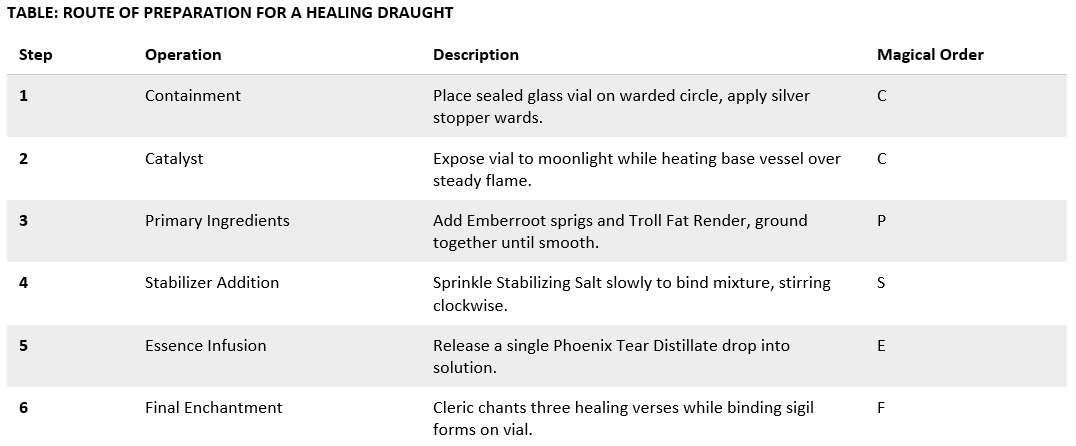
Result: A properly prepared Healing Draught that restores vitality and knits minor wounds when consumed.

A Shared Lesson for Trade and Craft

The lesson is plain: numbers and magic alike require structure. The Waterdeep Trading Company, having abandoned quill-and-scroll accounts for the precise ledgers of Dynamics 365, knows this truth well. Just as its clerks follow accounting rules when recording coins, so too must potion-brewers follow the order of their craft.

An error in one yields a wrong answer on parchment; an error in the other may yield an explosion in the apothecary. In both cases, order is everything.

Final Thoughts

Mathematics and magic are not separate languages, but dialects of order. To disregard precedence is to invite chaos, whether in a failed equation, a broken ledger, or a firebomb masquerading as a healing potion. For students, merchants, and alchemists alike, the rule remains eternal: follow the sequence, or face the consequences.


Support the AD&D365 Project on Patreon. To grow this world, we’ve launched an official Patreon where supporters can gain access to exclusive content, tools, training labs, and even influence the future of the project. Your support fuels more than just development ,  it expands the guildhall, forges new scrolls, and empowers the next generation of configuration wizards.  Begin your journey: https://www.patreon.com/adnd365/

A Grateful Salute to Our Patrons. To all those who stand behind the vision, thank you for helping bring this world to life. Our Benefactors, Andre Breillatt, and Eryndor Fiscairn, your boundless generosity fuels the arcane core of this project. Without your magic, the weave would falter. Our Apprentices, the spell engines turn and the training labs thrive thanks to our current Apprentices: Michael Ramirez and Andreth Bael’Rathyn. Special thanks to our past Apprentices, whose contributions helped us get here:  Ralf Weber, Wendy Rijners, Shashi Mahesh, Julia Tejera, Ben Ekokobe, Tiago Xavier, Naveen Boyinapelli, Marcos Tadeu Wolf, Kathryn Greene, Jason Brown, Mark Christy, and Ashish Singh. Our Initiates, Gregory Brigden, and Martin Grahm, your commitment marks the start of the deeperFpath, stepping beyond mere observation into the active shaping of this realm. Our Followers, your steady presence along the journey is a beacon of encouragement:  Eric Shuss, Sunil Panchal, Sarah D. Morgan, Nick Ramchandani, Daniel Kjærsgaard, and Tomasz Pałys. And our Voyeurs, Harry Burgh, Abdelrahman Nabil, and Basil Quarrell, ever watching from the shadows, clearly intrigued… but not enough to part with a single gold piece. Your silent curiosity is noted, and mildly judged.

Want to design your own economic models in Faerûn? Get your own AD&D365 Environment and guides at adnd365.com/start, and request access to the public view of the current database at https://public.adnd365.com – Login npc@adnd365.com, Password N0nPl@yC#822!

In the bustling markets of Faerûn, coin is not the only currency of trust, measurement is. From the wheat fields of the Dalelands to the shipyards of Luskan, merchants, nobles, and adventurers depend upon a shared language of land, distance, weight, and volume. Without these measures, contracts could not be enforced, caravans would falter, and harvests would be sold with suspicion rather than certainty.

The common measures of Faerûn, acres, leagues, rods, fathoms, and more, did not arise from the halls of scholars or the quills of scribes. They were born of toil and necessity. The acre was carved into existence by the plowshare, its length dictated by how far oxen could pull in a day. The league was paced out by weary travelers and sailors who needed to reckon their way across dangerous roads and seas. The fathom stretched from fingertip to fingertip on the decks of storm-tossed ships, ensuring rope and sail were measured quickly and reliably.

Over centuries, these measures moved from custom to standard. Guilds and councils enforced their use, stamping rods and ell-sticks with marks of authority to prevent fraud. City-states and kingdoms codified them into law, aligning trade across provinces and ports. Though elves, dwarves, and men each had their own traditional systems, commerce demanded reconciliation, and the Lords’ Alliance together with the great mercantile guilds brought uniformity to the common measures we still know today.

For the Waterdeep Trading Company, mastery of these measures is no mere academic curiosity. It is the framework of every contract, shipment, and tax record. When land is leased in acres, when a caravan’s journey is reckoned in leagues, when a grain harvest is sold in bushels, or when a barrel of ale is promised to a tavern in Baldur’s Gate, the company depends on these measures to guarantee fairness and profitability.

This article explores the origins, definitions, and cultural context of these common measures of Faerûn, showing not only where they came from but why they endure.

The Acre: A Farmer’s Day of Work

The acre is perhaps the most familiar unit of land. Its name and value are born of the field itself. An acre represents the strip of land a yoke of oxen could plough in a single day, moving in long furrows from dawn to dusk.

Over time, the acre was fixed as 43,560 square feet, though this number hides its agrarian roots. Larger holdings were measured by hides, a noble unit of about 120 acres. A hide was often the size of an estate sufficient to sustain a household and supply taxes or feudal levies.

For tax collectors in Baldur’s Gate or Waterdeep, the acre provided a consistent way to levy dues, ensuring farmers of one province were not unfairly burdened compared to those in another.

The League: The Traveler’s Measure

Where the acre was shaped by plow and ox, the league came from weary feet. Defined loosely as three miles, a league was the distance a person could travel on foot in an hour.

Caravan masters used it to calculate journeys. Mariners extended its use, adopting the league to chart coastlines and sea voyages. Tales of adventurers often measure danger in leagues: “The goblin camp lies three leagues east of Daggerford.”

Cultural lore reinforced its use. To dwarves, a league was the comfortable distance between waystations in mountain halls. To elves, leagues marked the length of a moonlit march. The human kingdoms standardized it in contracts and treaties, ensuring every captain and caravaner could plan with confidence.

The Rod and the Chain: Tools of the Surveyor

The rod, equal to 16.5 feet, was the surveyor’s companion. Its length matched the poles carried by land measurers, who stretched them end to end across fields to mark boundaries.

When linked, four rods formed a chain of 66 feet. Ten square chains made one acre, tying land measurement to the very tools of survey. Thus, the rod and chain were the bridge between abstract units and physical markers hammered into soil.

For the Waterdeep Trading Company, these measures still matter when laying out warehouses or mapping caravan yards.

The Fathom: Born of Sailor’s Arms

The fathom, equal to six feet, comes from the span of a sailor’s outstretched arms. Mariners measured rope, sailcloth, and most importantly depth with this unit.

Casting a weighted line into the sea, a sailor could call out “ten fathoms deep,” a phrase that carried life-or-death importance in shallow waters or near reefs. The fathom also became a measure for fishing nets and anchor lines, embedding itself in the language of seafaring guilds.

The Mile: Soldier’s March and Royal Road

The mile derives from the distance of a thousand paces taken by marching soldiers. Fixed at 5,280 feet, the mile became the backbone of royal road systems across Faerûn.

Standardizing miles allowed kingdoms to build milestones, calculate travel times for couriers, and measure supply routes for armies. Even today, contracts for caravan guards often specify journeys in miles, while noble proclamations grant rights to “all the land within ten miles of the keep.”

The Ell and the Cubit: Measures of the Body

Before metal rods and chains, the body itself was the measure.

  • Cubit: The length from elbow to fingertip, about 18 inches. Used for building temples, crafting coffins, and setting brick.
  • Ell: Roughly 45 inches, drawn from the length of a man’s arm to the opposite shoulder. Tailors used it to measure bolts of cloth.

These body-based units varied from person to person, but guilds eventually enforced standard lengths. In Waterdeep’s Clothiers Guild, every ell-stick was cut to the same master pattern, stamped with the guild’s seal to prevent cheating.

Barrels, Bushels, and Stones: Weight and Volume

Imperial measures extended beyond land and distance. Farmers and merchants also needed common standards for grain, ale, and trade goods.

  • Bushel: A volume measure for grain, about 8 gallons. Four pecks made one bushel.
  • Barrel: Used for ale, wine, or oil, though the exact gallon count varied by region and commodity.
  • Stone: Equal to 14 pounds, used for wool, cheese, and occasionally dwarven ore.

These measures tied directly into commerce. A brewer in Waterdeep promised a “barrel of ale,” while a Rashemi trader offered “three stones of cheese.”

Realms-Aware Variations

Not all regions of Faerûn agreed on the same values.

  • Elves favored poetic units, such as the moonstep, a distance marked by the shadows of silver trees.
  • Dwarves used the hold, a subterranean land measure linked to the reach of their halls.
  • Calishite merchants measured in cubits and palms, reflecting older traditions.

Yet trade demanded standardization. Over centuries, the Lords’ Alliance and merchant guilds codified these units into contracts and tariffs, ensuring that an acre in Waterdeep was the same as one in Calimport.

Worked Example

Imagine the Waterdeep Trading Company leasing farmland outside Daggerford. The agreement calls for 60 acres, an expanse easily measured in rods and chains. The harvest, promised in bushels, will fill wagons measured in cubic feet, bound for Baldur’s Gate. The distance to market is 15 leagues, or about 45 miles, requiring three days’ march by caravan.

Every stage of the contract, from field to road to market, depends on imperial units, without them, the deal would collapse into uncertainty.

Final Thoughts

Acres, leagues, rods, and fathoms are more than quaint measures of the past. They are the scaffolding of Faerûn’s commerce, the unseen standards that let merchants, nobles, and adventurers trade fairly and travel safely. For the Waterdeep Trading Company, understanding these units is not antiquarian trivia: it is the foundation of every contract, shipment, and ledger line.


Support the AD&D365 Project on Patreon.

To grow this world, we’ve launched an official Patreon where supporters can gain access to exclusive content, tools, training labs, and even influence the future of the project. Your support fuels more than just development ,  it expands the guildhall, forges new scrolls, and empowers the next generation of configuration wizards.  Begin your journey: https://www.patreon.com/adnd365/

A Grateful Salute to Our Patrons

To all those who stand behind the vision, thank you for helping bring this world to life. Our Benefactors, Andre Breillatt, and Eryndor Fiscairn, your boundless generosity fuels the arcane core of this project. Without your magic, the weave would falter. Our Apprentices, the spell engines turn and the training labs thrive thanks to our current Apprentices: Michael Ramirez and Andreth Bael’Rathyn. Special thanks to our past Apprentices, whose contributions helped us get here:  Ralf Weber, Wendy Rijners, Shashi Mahesh, Julia Tejera, Ben Ekokobe, Tiago Xavier, Naveen Boyinapelli, Marcos Tadeu Wolf, Kathryn Greene, Jason Brown, Mark Christy, and Ashish Singh. Our Initiates, Gregory Brigden, and Martin Grahm, your commitment marks the start of the deeperFpath, stepping beyond mere observation into the active shaping of this realm. Our Followers, your steady presence along the journey is a beacon of encouragement:  Eric Shuss, Sunil Panchal, Sarah D. Morgan, Nick Ramchandani, Daniel Kjærsgaard, and Tomasz Pałys. And our Voyeurs, Harry Burgh, Abdelrahman Nabil, and Basil Quarrell, ever watching from the shadows, clearly intrigued… but not enough to part with a single gold piece. Your silent curiosity is noted, and mildly judged.

Want to design your own economic models in Faerûn?

Get your own AD&D365 Environment and guides at adnd365.com/start, and request access to the public view of the current database at https://public.adnd365.com – Login npc@adnd365.com, Password N0nPl@yC#822!