The guild halls of Faerûn are filled with merchants, couriers, artificers, and adventurers who spend half their lives on the road. The Waterdeep Trading Company relies on these workers to keep trade routes open and contracts moving. This means travel costs and merchant expenses must be tracked with care. Quill ledgers alone cannot support the pace of modern trade.
Expense Management within the company gives workers a clear way to record their spend. It helps the arcane treasurers separate personal costs from company approved expenses. It also helps with corporate cards and P-Cards that are issued to high-trust members of the guild. By keeping each expense type clear, the company protects its accounts, shortens reimbursement time, and keeps the books balanced.
What It Is
Expense Management is the guild system that captures all spend created while workers perform their duties. It stores receipts for caravan inns, griffon passage, ferry crossings, guild meals, magical components, and more. It also manages company issued cards such as corporate cards and P-Cards.
Within the Waterdeep Trading Company this system is watched over by the Arcane Treasurer’s office. Each expense record moves through review, approval, posting, and payment.
Why It Matters
Expense Management matters to the guild because it ensures fair reimbursement. It also protects the company from fraud by making sure receipts and spend types are closely reviewed. The company gains better control of travel budgets as well as insight into which routes and tasks cost the most coin.
Types of Expenses
Workers at the Waterdeep Trading Company use three main methods to record their spend.
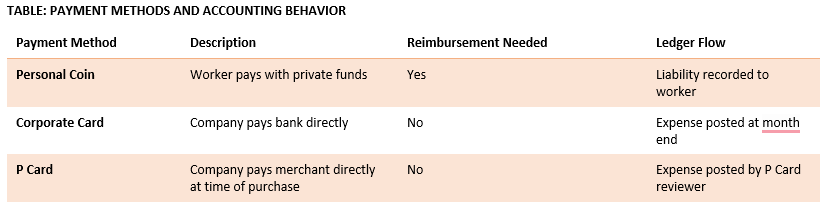
Personal Spend: The worker pays out of pocket using their own coin or pouch token. These expenses are submitted for later reimbursement.
Corporate Card Spend: The guild issues a card that is linked to a central company account. The company pays the bank directly. The worker assigns each transaction to an expense type. No reimbursement is needed.
P-Card Spend: A P-Card is issued to workers in roles such as Procurement Officer, Route Captain, or Workshop Master. These cards allow direct purchase of goods and materials without requiring a formal purchase order. P-Card spend is reviewed by the Arcane Treasurer’s office after the transaction is posted.
Components of the Expense Record
Each expense has several parts that feed into the guild ledger.
- Receipt details
- Expense category
- Worker assignment
- Payment method
- Tax rules
- Currency and exchange rate
- Approval path
- Posting profile
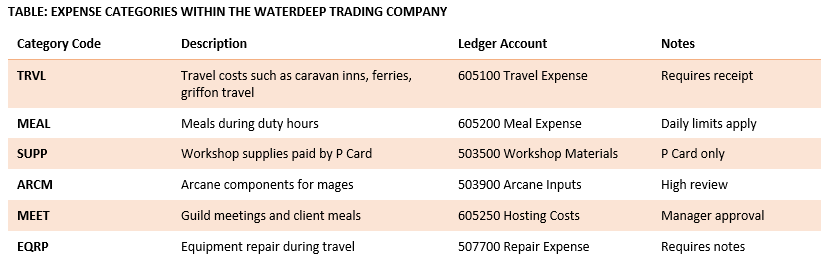
These details ensure that each record flows correctly into the accounts for travel, meals, materials, or magical components.
Key Structures
Below is an introduction to the first summary of the structures that the Waterdeep Trading Company uses to classify expense spend. This view helps workers understand which spend types are allowed for each guild task.
How Expense Methods Flow into the Ledger
Here is an introduction to how different payment methods are handled and why they matter to the guild treasurers.
Worked Examples
Below is an introduction to three examples that show how workers record different spend types and how the ledger reflects them.
Example 1: Personal Travel Expense
Elira Moonshadow, Special Courier, pays 18.00 FSD for a caravan bunk on the Sword Coast route.
She submits a travel expense with a receipt.

The worker receives 18.00 FSD in the next payment run.
Example 2: Corporate Card Expense
Tovak Ironscroll, Inventory Planner, uses his corporate card to buy a 14.00 FSD meal during a late inventory shift.

No reimbursement is created.
Example 3: P-Card Purchase
Veyra Greenmantle, Procurement Officer, buys 120.00 FSD of herbal distillate for a production batch.

Realms Aware Considerations
The Waterdeep Trading Company operates across many regions. Expense policies change based on the location. Griffon travel in Silverymoon is cheap. Caravan beds in Calimport are costly. Tax rules shift when entering Thayan enclaves. Some components such as rune ink or blessed herbs require special guild permits.
Spell components purchased by mages must follow arcane trade law. Inn lodging bought in regions with high magical activity may carry additional tariffs. These differences are handled through the expense categories and approval workflows.
Final Thoughts
Expense Management keeps the Waterdeep Trading Company honest, efficient, and well informed. By tracking all spend with care, the guild protects its coffers and keeps routes funded. Workers are paid back quickly and the treasurers maintain accurate accounts for every journey.
Support the AD&D365 Project on Patreon. To grow this world, we’ve launched an official Patreon where supporters can gain access to exclusive content, tools, training labs, and even influence the future of the project. Your support fuels more than just development , it expands the guildhall, forges new scrolls, and empowers the next generation of configuration wizards. Begin your journey: https://www.patreon.com/adnd365/
A Grateful Salute to Our Patrons. To all those who stand behind the vision, thank you for helping bring this world to life. Our Benefactors, Andre Breillatt, and Eryndor Fiscairn‡, your boundless generosity fuels the arcane core of this project. Without your magic, the weave would falter. Our Apprentices, the spell engines turn, and the training labs thrive thanks to our current Apprentices: Michael Ramirez and Andreth Bael’Rathyn‡. Special thanks to our past Apprentices, whose contributions helped us get here: Ralf Weber, Wendy Rijners, Shashi Mahesh, Julia Tejera, Ben Ekokobe, Tiago Xavier, Naveen Boyinapelli, Marcos Tadeu Wolf, Kathryn Greene, Jason Brown, Mark Christy, and Ashish Singh. Our Initiates, Jesper Livbjerg, Peter Lorre, Gregory Brigden, and Martin Grahm, your commitment marks the start of the deeper path, stepping beyond mere observation into the active shaping of this realm. Our Followers, your steady presence along the journey is a beacon of encouragement: Eric Shuss, Sunil Panchal, Sarah D. Morgan, Nick Ramchandani, Daniel Kjærsgaard, and Tomasz Pałys. And our Voyeurs, Harry Burgh, Abdelrahman Nabil, and Basil Quarrell, ever watching from the shadows, clearly intrigued… but not enough to part with a single gold piece. Your silent curiosity is noted, and mildly judged.
Want to design your own economic models in Faerûn? Get your own AD&D365 Environment and guides at adnd365.com/start, and request access to the public view of the current database at https://public.adnd365.com – Login npc@adnd365.com, Password N0nPl@yC#822!







 A Tinkerers Notebook