Project Fabrication in Faerûn for the Waterdeep Trading Company, Crafting Complex Commissions through Integrated Manufacturing and Project Control
The Waterdeep Trading Company has grown into one of the most respected builders of crafted goods across the Sword Coast. Many requests are small enough to be filled with stocked items, yet the most valuable work comes from large commissions. These include reinforced wagons for mercenary companies, enchanted devices for mage guilds, and custom tools for noble households. These builds require planning, steady coordination between workshop and finance, and careful tracing of every coin. Project fabrication brings structure to these builds by joining project accounting with manufacturing.
What It Is
Project fabrication treats each commission as a controlled project while using manufacturing to perform the physical crafting. This keeps the build organized and allows both the workshop master and the finance scribe to follow the same plan from start to finish.
A project holds the financial structure. A production order holds the physical process. The two flow together through shared postings.
- The project stores budgets and estimated costs
- Production orders consume materials and record labor
- Actual postings feed directly into the project ledger
- Final cost is compared to initial expectations
- Customers receive clear costed invoices backed by project records
Why It Matters
Custom builds in Faerûn often involve rare materials, high labor skill, and strict guild expectations. Without a firm structure, these builds risk cost overruns, missing components, or disputes with customers.
Project fabrication supports the Waterdeep Trading Company by allowing the team to:
- Plan every major step of a build before work starts
- Estimate raw materials, manual labor, and arcane labor with accuracy
- Track real usage and compare it to the original budget
- Maintain compliance with guild rules for enchantments and hazardous materials
- Produce clear cost reports for customers, nobles, and guild auditors
- Identify which commissions bring profit and which ones drain resources
Components of a Project Fabrication Build
This approach includes several connected steps, each essential for building complex work with clarity.
- A project record in the ledger
- A set of cost categories that define how coin is tracked
- Estimates for planned materials and labor
- Production orders that carry out the physical crafting
- Postings of real materials, labor, overhead, and freight
- A final cost review
- Invoicing tied to actual cost with markup applied
Each part supports the others, giving the company a full view of cost from the first steel bar picked to the last sigil carved.
Key Data Structures
This section explains the main cost categories used for any project fabrication job. These categories serve as the backbone for all postings. When materials, labor, or services are consumed, they are assigned to a category.
This ensures consistency across all builds, whether the team is crafting a simple reinforced chest or a fully enchanted wagon.
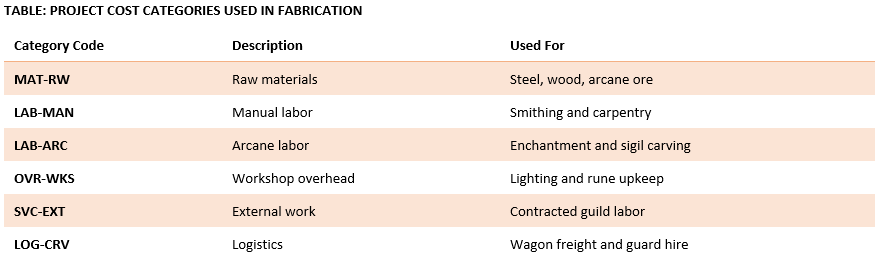
Crafting large items requires a steady supply of reliable components. The materials listed below form the foundation of most major builds. Some are mundane, such as hardwood beams, while others are rare and sensitive, such as mithral thread or arcane shards. Their cost and reliability directly influence final project cost.

Project Setup
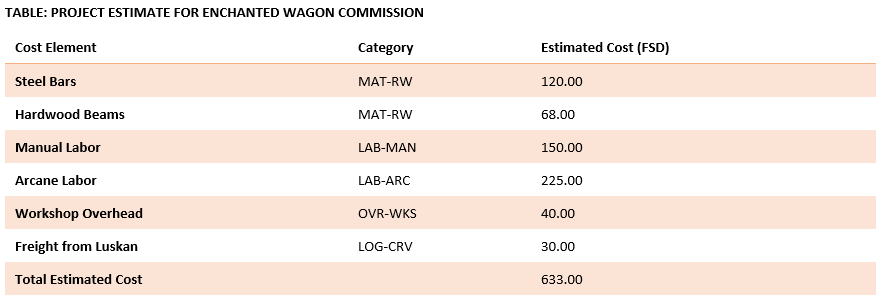
Before the workshop begins its first cut, strike, or engraving, the finance team sets up a structured project in the ledger. This project forms the financial shell that will collect all costs. The project includes expected materials, estimated labor hours, and overhead plans. Once the estimate is recorded, the workshop master can release the build to the production floor.
Below is an example of the kind of estimate recorded before work begins. It represents the best understanding of required effort at the time of planning.
Linking Manufacturing to the Project
Manufacturing carries out the physical work, yet every action taken there must connect back to the project. By tying a production order to the project record, the company ensures that:
Material pick lists send cost directly into the project
- Labor recorded through job cards posts to the project ledger
- Overhead and machine time follow the same path
- Report as finished updates both inventory and the project
This connection prevents lost cost and ensures that every hour and item used can be traced.
Worked Example: Enchanted Wagon Commission
A noble from the North Ward requests a frost resistant wagon with reinforced panels and runic protection. This build requires steel shaping, carpentry, resin application, and two layers of arcane engraving. The following examples show the postings captured during the build.
Step 1. Material Consumption
All materials pulled from inventory must be posted against the project. This not only records consumption but also updates the project cost in real time. Variances often begin here, especially when additional steel or rare materials are used.

Step 2. Labor Recording
Labor is the heart of fabrication. It reflects both the time and the skill needed to complete a build. Manual labor covers shaping and construction, while arcane labor involves sigil carving, magical reinforcement, and binding spells. Both must be tracked with precision.

Step 3. Overhead and Logistics
Every project requires the workshop itself, from lamp oil to rune plates that keep the forge steady. Freight costs also appear often, especially when raw materials must travel from Luskan, Mirabar, or even Baldur’s Gate. These costs must be added to the project to give a complete picture of the build.

Step 4. Final Project Cost
The final cost summary brings all elements together. This allows the finance scribe and the workshop master to compare the estimate with the actual build. Any gap is reviewed to improve future planning.

The original estimate was 633.00 FSD. The real cost was 840.00 FSD. Most of the difference came from higher labor effort and additional material consumption. These findings help refine future estimates for similar enchanted wagons.
Realms Aware Considerations
Faerûn is a land shaped by guilds, trade routes, and regional laws. These factors must be considered during project fabrication.
- Some provinces require special permits for arcane labor
- Transporting mithral, cold iron, and arcane cores requires guarded freight
- Frost seasons in the North raise demand for insulated builds
- Mage guilds often require logs of spellwork hours and sigil layers
- Coastal cities have higher workshop overhead due to saltstone protection rituals
These factors influence cost, planning, and scheduling.
Final Thoughts
Project fabrication allows the Waterdeep Trading Company to maintain clarity from the first planned cost to the final enchanted seal. By linking project accounting to manufacturing, the company ensures every coin, every nail, and every rune is tracked with care. This system brings order to complex work and strengthens customer trust in every commission.
Support the AD&D365 Project on Patreon. To grow this world, we’ve launched an official Patreon where supporters can gain access to exclusive content, tools, training labs, and even influence the future of the project. Your support fuels more than just development , it expands the guildhall, forges new scrolls, and empowers the next generation of configuration wizards. Begin your journey: https://www.patreon.com/adnd365/
A Grateful Salute to Our Patrons. To all those who stand behind the vision, thank you for helping bring this world to life. Our Benefactors, Andre Breillatt, and Eryndor Fiscairn‡, your boundless generosity fuels the arcane core of this project. Without your magic, the weave would falter. Our Apprentices, the spell engines turn, and the training labs thrive thanks to our current Apprentices: Michael Ramirez and Andreth Bael’Rathyn‡. Special thanks to our past Apprentices, whose contributions helped us get here: Ralf Weber, Wendy Rijners, Shashi Mahesh, Julia Tejera, Ben Ekokobe, Tiago Xavier, Naveen Boyinapelli, Marcos Tadeu Wolf, Kathryn Greene, Jason Brown, Mark Christy, and Ashish Singh. Our Initiates, Jesper Livbjerg, Peter Lorre, Gregory Brigden, and Martin Grahm, your commitment marks the start of the deeper path, stepping beyond mere observation into the active shaping of this realm. Our Followers, your steady presence along the journey is a beacon of encouragement: Eric Shuss, Sunil Panchal, Sarah D. Morgan, Nick Ramchandani, Daniel Kjærsgaard, and Tomasz Pałys. And our Voyeurs, Harry Burgh, Abdelrahman Nabil, and Basil Quarrell, ever watching from the shadows, clearly intrigued… but not enough to part with a single gold piece. Your silent curiosity is noted, and mildly judged.
Want to design your own economic models in Faerûn? Get your own AD&D365 Environment and guides at adnd365.com/start, and request access to the public view of the current database at https://public.adnd365.com – Login npc@adnd365.com, Password N0nPl@yC#822!
 A Tinkerers Notebook