Input-Driven vs Output-Driven Manufacturing in Faerûn: Understanding How the Waterdeep Trading Company Plans Its Production Flow
The Waterdeep Trading Company oversees forges, breweries, tanneries, butcher halls, and alchemical works from the Sword Coast to the Moonsea. Each site produces goods needed by guilds, caravans, and settlements. To control these flows, the company relies on two core production models: input-driven manufacturing and output-driven manufacturing.
Choosing the correct method shapes cost, supply, and worker activity across the company. It is a key skill for any planner or foreman in Faerûn.
What Is Input-Driven Manufacturing
Input-driven manufacturing begins when materials arrive. The trigger is the availability of raw goods, not a customer request. Production cycles are set by supply rhythm, which may depend on weather, caravans, or seasonal harvests.
This method suits operations that must consume materials before spoilage or where bulk goods are expected to flow in steady waves.
Examples include:
- Breweries working with incoming grain.
- Tanneries receiving hides after large hunts.
- Butcher halls where livestock arrives from nearby farms.
What Is Output-Driven Manufacturing
Output-driven manufacturing begins when a customer asks for something. A work order is created only when demand is confirmed. Goods are produced with accuracy, often following custom instructions or strict material controls.
This method suits operations where materials are rare or high cost, or where final goods require specialized work by artificers or master smiths.
Examples include:
- Enchanted gear production.
- Noble house commissions.
- Custom alchemical batches.
Why These Approaches Matter
Both approaches determine how goods and coins move across the company.
They influence:
- Inventory levels.
- Cash flow.
- Labor planning.
- Resource allocation.
Selecting the right method ensures smooth trade across regions such as Waterdeep, Baldur’s Gate, and Calimport.
Worked Example One: Input Driven Example: Frostroot Ale in Silverymoon
When Frostroot Barley arrives from Icewind Dale, the Copperleaf Brewery begins a new brewing cycle. Barley cannot remain in storage for long, so production is triggered by shipments.
The table below shows how incoming material drives production volume.
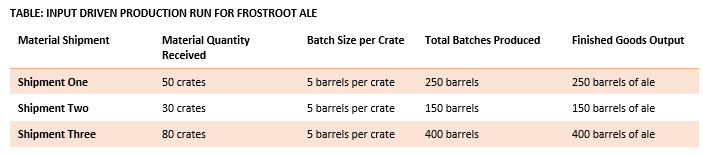
This method keeps taverns supplied but increases storage during heavy harvest seasons.
Worked Example Two: Output Driven Example: Enchanted Shields in Waterdeep
The Arcane Smiths Hall starts production only when a signed order arrives. Mithral Dust and Phoenix Plume are tracked tightly by the Artificers Union, which makes this method ideal.
The table shows how materials are allocated only after orders are logged.

This approach protects rare resources and ensures predictable delivery.
Worked Example Three: Input Driven Example with Variable Outputs: Whole Animal Disassembly in Daggerford
When local farmers bring cattle to the Daggerford Butcher Hall, production begins immediately. This is input-driven because the animal itself is the trigger. One animal, however, can be broken into multiple cut profiles, each requested by nearby markets.
The final output varies because cutters choose different profiles based on condition, size, and planned sales.
The table below shows how three animals can produce different cut mixes. Each cut type has a standard yield range, but the actual yield depends on the animal’s size and the chosen breakdown pattern.

How This Works in Practice
The Butcher Hall begins work as soon as animals arrive. The cutters select the breakdown style based on:
- Market demand in Waterdeep or Baldur’s Gate
- Condition and age of the animal
- Local festival needs
- Storage space and salt levels
- Order patterns from nearby taverns
This produces variable outputs and makes production unpredictable.
It is a classic input-driven scenario because cutters respond to the arrival of livestock rather than to a fixed customer order.
This method is standard across Faerûn, where livestock flows depend on weather, harvesting, grazing conditions, and the health of nearby herds.
Realms Aware Considerations
Faerûn’s regions shape the choice of method.
- Livestock production in Daggerford follows input cycles tied to farm supply.
- Wandering herds in Amn cause irregular arrivals for local butcher halls.
- Enchanted workshops in Waterdeep use output cycles to protect rare essence materials.
- Coastal trade houses in Calimport favor output cycles for high-value seafood that must be allocated by order.
Final Thoughts
Input-driven manufacturing converts available goods into stock as soon as materials arrive. Output-driven manufacturing produces only when the market demands it. The Waterdeep Trading Company uses both across Faerûn to keep trade stable, predictable, and profitable.
Animal disassembly adds an extra layer of complexity, since a single input can yield many different outputs. This makes the method valuable for regions with active livestock markets and diverse customer needs.
Support the AD&D365 Project on Patreon. To grow this world, we’ve launched an official Patreon where supporters can gain access to exclusive content, tools, training labs, and even influence the future of the project. Your support fuels more than just development , it expands the guildhall, forges new scrolls, and empowers the next generation of configuration wizards. Begin your journey: https://www.patreon.com/adnd365/
A Grateful Salute to Our Patrons. To all those who stand behind the vision, thank you for helping bring this world to life. Our Benefactors, Andre Breillatt, and Eryndor Fiscairn‡, your boundless generosity fuels the arcane core of this project. Without your magic, the weave would falter. Our Apprentices, the spell engines turn and the training labs thrive thanks to our current Apprentices: Michael Ramirez and Andreth Bael’Rathyn‡. Special thanks to our past Apprentices, whose contributions helped us get here: Ralf Weber, Wendy Rijners, Shashi Mahesh, Julia Tejera, Ben Ekokobe, Tiago Xavier, Naveen Boyinapelli, Marcos Tadeu Wolf, Kathryn Greene, Jason Brown, Mark Christy, and Ashish Singh. Our Initiates, Gregory Brigden, and Martin Grahm, your commitment marks the start of the deeper path, stepping beyond mere observation into the active shaping of this realm. Our Followers, your steady presence along the journey is a beacon of encouragement: Eric Shuss, Sunil Panchal, Sarah D. Morgan, Nick Ramchandani, Daniel Kjærsgaard, and Tomasz Pałys. And our Voyeurs, Harry Burgh, Abdelrahman Nabil, and Basil Quarrell, ever watching from the shadows, clearly intrigued… but not enough to part with a single gold piece. Your silent curiosity is noted, and mildly judged.
Want to design your own economic models in Faerûn? Get your own AD&D365 Environment and guides at adnd365.com/start, and request access to the public view of the current database at https://public.adnd365.com – Login npc@adnd365.com, Password N0nPl@yC#822!
 A Tinkerers Notebook