Catchweight and Variable Measure in Faerûn: How the Waterdeep Trading Company Distinguishes Two Similar but Separate Tracking Methods
Across Faerûn, merchants and guilds work with goods that rarely behave in uniform ways. Some arrive with uneven cuts, some stretch or shrink when handled, and others flow or coil into shapes that defy standard form. Two tracking methods address these challenges within the Waterdeep Trading Company. These are catchweight and variable measures. The two are often confused, yet each follows a distinct tradition rooted in long-standing trade customs from the Sword Coast to the inland markets.
This expanded article explores how each method works, why they diverge, and how the company applies them to tangible goods.
What Catchweight Is
Catchweight is used when an item is traded and inventoried as a single unit, yet its value depends on its actual weight. The piece is counted as one, but no two pieces weigh the same. The ledger must therefore carry both the count and the weight for every item received. This method applies to goods shaped by hand, harvested in uneven portions, or carved from natural materials.
Boar meat from farms near Daggerford offers a clear example. Hunters deliver each haunch as a single piece, but the weight of each cut varies. The company must accept the count as a whole unit and price the cut based on its recorded weight. The same applies to the stone blocks quarried in the Western Heartlands. Each block is counted as a single unit, yet the density of the stone and the irregularity of its cut make the accurate measure of value. Even cheese wheels brought in from Amn follow this rule. Farmers shape them by hand, and each wheel comes out slightly different. Merchants rely on weight to ensure fair payment between buyers and suppliers.
In all these cases, the company treats each item as one object, one unit in stock, yet uses weight as the companion measure for valuation. This duality is central to catchweight.
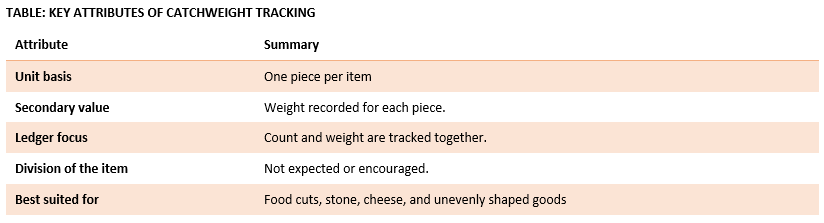
This table highlights the essential traits of catchweight and why it is applied to certain goods.
What Variable Measure Is
Variable measure is used when an item has no practical piece count at all. Instead, its measure is the only value that matters. These goods are destined to be cut, poured, stretched, or shaped during use. A piece means nothing. Only the remaining measure matters.
Cloth from the Waterdeep Weaver’s Guild is a perfect example. A bolt may arrive with forty-five yards, and tailors may cut ten yards for a robe, two yards for a sash, or a fraction for lining. The bolt does not shrink as a piece. It simply loses length. The ledger tracks the remaining yards until the entire bolt is consumed. Rope coils behave the same way. A sailor may cut a short length for a rig, and the ledger only needs to record how many yards remain in the coil. Timber beams brought from the Western Heartlands also fall under this method. A carpenter trims a beam to fit a frame, yet there is no expectation that the leftover sections be counted as separate pieces—only the remaining length or volume matters.
Variable measure places complete focus on the unit of measure. It assumes goods will change form and size through regular use. No count is required, and no record of pieces is ever created.
This table outlines the essential traits of variable measure and why it differs from catchweight.

Why These Methods Are Not the Same
Catchweight and variable measure appear similar because both acknowledge irregular goods. Yet their rules diverge sharply.
In catchweight, the piece is the item’s core identity. A smoked boar cut is one cut. A cheese wheel is one wheel. A quarry stone is one block. The weight varies, and this variation affects the cost and selling price. The ledger, therefore, carries two values at all times: the count and the weight. Workers know that the item cannot be freely divided without changing its identity. A cheese wheel cut in two is no longer a single wheel, and the tracking method fails. The item must remain whole.
Variable measure takes the opposite approach. The item has no identity as a piece. A bolt of cloth is not one object in the same sense as a cheese wheel. It is simply forty-five yards of fabric. Cutting it into sections does not change its identity. A rope coil does not become two pieces in the ledger when a length is cut. It becomes a smaller total measure. Pieces do not matter because pieces do not exist.
This fundamental difference shapes how the company handles stock, cost, and issue.
Expanded Examples
The Cheese Wheel: When a caravan from Amn arrives with six cheese wheels, the ledger records six units, each with its individual weight. One wheel may weigh twelve pounds, another thirteen, and a third eleven and a half. The workers stack all six wheels together, yet the enchanted scales beneath the receiving table track each weight precisely. Later, when the cheese is sold to taverns in the Dock Ward or noble kitchens in the Sea Ward, the invoice reflects the recorded weight, not a fixed price per wheel. The identity of each wheel remains whole. Cutting the wheel would force it out of its tracking method, so the guild sells wheels intact unless a special arrangement is made.
The Cloth Bolt: A bolt arriving from the Weaver’s Guild is handled quite differently. A forty-five-yard bolt is logged simply as forty-five yards. When tailors request fabric for company uniforms or mage robes, they draw the exact length required. After cutting, the ledger updates the remaining measure. No one records the number of cuts taken from the bolt. When it is finally used up, there is no history of pieces, only a record of how many yards were issued and to which workshop. The bolt’s design allows division, so the tracking method supports it without penalty.
The Stone Block: Stone quarried in the Western Heartlands is carried to Waterdeep as single blocks. Each block is heavy and irregular. Workers measure its weight upon receipt, then use that value in both cost and freight calculations. A mason could reshape the block later, yet the original count and weight must be preserved for audit purposes. This reinforces the rule that the block is a single-tracked unit, and the ledger will not follow every future chip removed by masons. It cares only about the original block.
The Rope Coil: A coil of rope behaves in the exact opposite way. A sailor or warehouse worker needs only a length sufficient to secure a load or repair a harness. Cutting the rope is expected, repeated, and unremarkable. The remaining coil remains unchanged. The ledger reflects only the new measured total. No worker needs to track how many pieces the rope becomes divided into.
Side-by-Side Comparison
This table compares how the ledger treats the two methods and why they are not interchangeable.

Why the Company Keeps Them Separate
Each method influences freight rules, vendor contracts, customer pricing, and internal cost control. Catchweight affects transport fees because heavier items cost more to haul. Variable measures affect workshop planning because cuts must be tracked precisely during production runs.
The Waterdeep Trading Company separates these methods to avoid confusion in mixed cargo shipments, ensure fair valuation when trading with coastal guilds, and maintain clarity when issuing goods across its workshops. The distinction also prevents disputes when merchants, adventurers, or craftsmen question why prices differ even when goods look similar.
Final Thoughts
Understanding the difference between catchweight and variable measure is essential for any merchant working with goods that do not conform to standard forms. In Waterdeep, this knowledge keeps ledgers clean, contracts clear, and trade flowing without delay. Across Faerûn, it marks a merchant as trained, careful, and ready to stand behind every recorded measure.
Support the AD&D365 Project on Patreon. To grow this world, we’ve launched an official Patreon page where supporters can access exclusive content, tools, and training labs, and even influence the project’s future. Your support fuels more than just development; it expands the guildhall, forges new scrolls, and empowers the next generation of configuration wizards. Begin your journey: https://www.patreon.com/adnd365/
A Grateful Salute to Our Patrons. To all those who stand behind the vision, thank you for helping bring this world to life. Our Benefactors, Andre Breillatt and Eryndor Fiscairn‡, your boundless generosity fuels the arcane core of this project. Without your magic, the weave would falter. Our Apprentices, the spell engines turn, and the training labs thrive thanks to our current Apprentices: Michael Ramirez and Andreth Bael’Rathyn‡. Special thanks to our past Apprentices, whose contributions helped us get here: Ralf Weber, Wendy Rijners, Shashi Mahesh, Julia Tejera, Ben Ekokobe, Tiago Xavier, Naveen Boyinapelli, Marcos Tadeu Wolf, Kathryn Greene, Jason Brown, Mark Christy, and Ashish Singh. Our Initiates, Jesper Livbjerg, Peter Lorre, Gregory Brigden, and Martin Grahm, your commitment marks the start of the deeper path, stepping beyond mere observation into the active shaping of this realm. Our Followers, your steady presence along the journey is a beacon of encouragement: Rusty Cavalier, Eric Shuss, Sunil Panchal, Sarah D. Morgan, Nick Ramchandani, Daniel Kjærsgaard, and Tomasz Pałys. And our Voyeurs, Harry Burgh, Abdelrahman Nabil, and Basil Quarrell, ever watching from the shadows, clearly intrigued… but not enough to part with a single gold piece. Your silent curiosity is noted and mildly judged.
Want to design your own economic models in Faerûn? Get your own AD&D365 Environment and guides at adnd365.com/start, and request access to the public view of the current database at https://public.adnd365.com – Login npc@adnd365.com, Password N0nPl@yC#822!
 A Tinkerers Notebook