Route Types in Faerûn: How the Waterdeep Trading Company Moves Goods Across Faerûn
Trade in Faerûn is governed by cost control, timing discipline, and careful handling of risk, both mundane and arcane. From the docks of Waterdeep to the long caravan roads leading to Baldur’s Gate and the portal halls of Silverymoon, the Waterdeep Trading Company succeeds because it plans routes with precision. Each route type reflects a specific trade pattern, chosen to balance distance, volume, urgency, and security.
This article explains the most common route types used by the Waterdeep Trading Company and provides worked examples for each. Each example breaks the route into legs, showing distance, pickup and drop-off quantities, and cost per leg. This level of detail supports both logistics planning and ledger review.
What Route Types Are
A route type defines the movement pattern used to transfer goods between locations. It determines whether a caravan travels directly to a single destination, visits several locations in sequence, loops back to its origin, or passes through a central hub. Selecting the correct route type reduces wasted travel, improves delivery timing, and protects valuable or sensitive goods.
Why Route Details Matter
Breaking routes down to the leg level enables the Waterdeep Trading Company to manage operations and finances in tandem. This structure enables caravan masters and Arcane Treasurers to calculate accurate cost-per-segment, track inventory movement by location, allocate expenses for profitability review, and improve loading and unloading control at intermediate stops.
Common Route Types in Faerûn
The table below lists the primary route types used by the Waterdeep Trading Company and the situations in which each is applied.

Worked Examples with Route Legs
Each example below begins with a short scenario, followed by a level-by-level table. Fixed fees are applied after travel costs to show the full route impact.
Direct Route Example
Enchanted swords are shipped from Waterdeep to Baldur’s Gate with no delay permitted. The table below shows how travel costs accumulate along the route.

Additional costs include a guard fee of 50.00 FSD and a magical stabilizer cost of 25.00 FSD.
The total route cost is 150.00 FSD.
Milk Run Example
A single caravan departs Waterdeep, serves Amphail, Rassalantar, and Secomber, then returns. This route combines delivery and pickup activity across several stops.

Fixed costs include a guard fee of 60.00 FSD and loading and unloading charges of 30.00 FSD per stop.
The total route cost is 120.00 FSD.
Circular Route Example
A regional loop runs from Waterdeep to Daggerford, onward to Baldur’s Gate, then back to Waterdeep. This route supports steady regional demand.
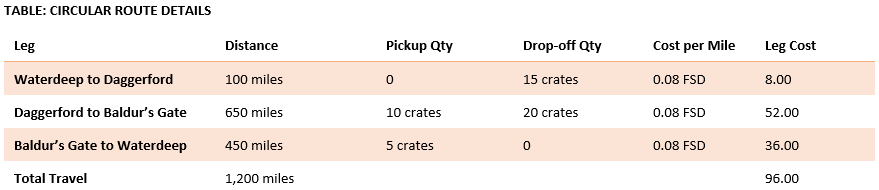
Additional costs include guard fees of 100.00 FSD and lodging costs of 40.00 FSD.
The total route cost is 236.00 FSD.
Hub and Spoke Example
Goods move from Waterdeep to a hub in Daggerford, then outward to Amphail, Secomber, Rassalantar, and Goldenfields.
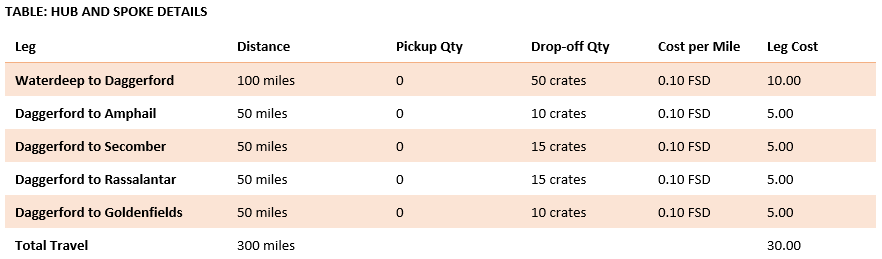
A hub handling fee of 50.00 FSD is applied.
The total route cost is 80.00 FSD.
Portal Route Example
Rare spell kits are transferred from Waterdeep to Silverymoon using an arcane portal.

A portal toll of 200.00 FSD and a magical stabilizer cost of 50.00 FSD are applied.
The total route cost is 250.00 FSD.
Route Comparison Summary
The table below provides a single view of all route options using total distance and total cost. This view is used during planning councils and budget reviews.

This summary highlights how different routing strategies trade distance for fixed fees, consolidation, or speed.
Final Thoughts
Detailed route planning gives the Waterdeep Trading Company complete visibility into how goods and coin move together. By tracking distance, quantities, and cost at the leg level, the company improves control, reduces waste, and supports reliable trade across Faerûn. Milk runs serve small settlements, hub routes scale distribution, direct routes protect valuable cargo, and portal routes support urgent needs. Each route type has a clear place when applied with discipline.
Support the AD&D365 Project on Patreon. To grow this world, we’ve launched an official Patreon page where supporters can access exclusive content, tools, and training labs, and even influence the project’s future. Your support fuels more than just development; it expands the guildhall, forges new scrolls, and empowers the next generation of configuration wizards. Begin your journey: https://www.patreon.com/adnd365/
A Grateful Salute to Our Patrons. To all those who stand behind the vision, thank you for helping bring this world to life. Our Benefactors, Andre Breillatt and Eryndor Fiscairn‡, your boundless generosity fuels the arcane core of this project. Without your magic, the weave would falter. Our Apprentices, the spell engines turn, and the training labs thrive thanks to our current Apprentices: Michael Ramirez and Andreth Bael’Rathyn‡. Special thanks to our past Apprentices, whose contributions helped us get here: Ralf Weber, Wendy Rijners, Shashi Mahesh, Julia Tejera, Ben Ekokobe, Tiago Xavier, Naveen Boyinapelli, Marcos Tadeu Wolf, Kathryn Greene, Jason Brown, Mark Christy, and Ashish Singh. Our Initiates, Jesper Livbjerg, Peter Lorre, Gregory Brigden, and Martin Grahm, your commitment marks the start of the deeper path, stepping beyond mere observation into the active shaping of this realm. Our Followers, your steady presence along the journey is a beacon of encouragement: Rusty Cavalier, Eric Shuss, Sunil Panchal, Sarah D. Morgan, Nick Ramchandani, Daniel Kjærsgaard, and Tomasz Pałys. And our Voyeurs, Harry Burgh, Abdelrahman Nabil, and Basil Quarrell, ever watching from the shadows, clearly intrigued… but not enough to part with a single gold piece. Your silent curiosity is noted and mildly judged.
Want to design your own economic models in Faerûn? Get your own AD&D365 Environment and guides at adnd365.com/start, and request access to the public view of the current database at https://public.adnd365.com – Login npc@adnd365.com, Password N0nPl@yC#822!
 A Tinkerers Notebook