Choosing the Ideal Length for Fixed Length Codes: How Long Is Long Enough Without Becoming a Burden
Once an organization decides that a code should be fixed-length, the next question is unavoidable.
How long should it be?
Too short, and the code runs out of room or loses clarity.
Too long; it becomes slow to read, hard to type, and error-prone.
The Waterdeep Trading Company treats code length as a design decision, not a guess. This article explains how to select the appropriate length for fixed codes using practical customer-group examples.
What Fixed Length Is Solving
Fixed-length codes exist to create predictability.
They allow
- Clean sorting
- Consistent reports
- Easy scanning
- Stable training materials
Length determines how much meaning and growth can be packed into that predictability.
Common Fixed Length Options with Examples
Two Characters
Two character codes are rarely sufficient for business classifications.
They only work when
- The list is extremely small
- The values will never grow
- Meaning is obvious without explanation
For customer groups, this breaks almost immediately.
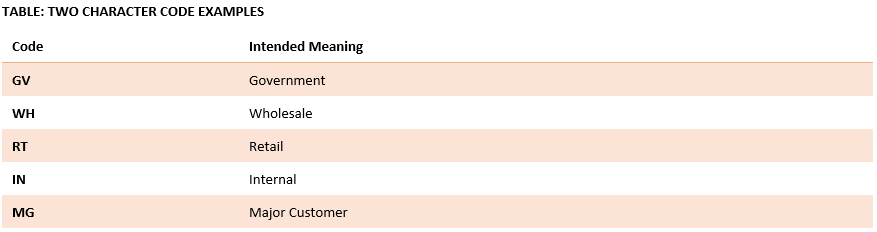
These become ambiguous as soon as the business needs subcategories.
Four Characters
Four-character codes work for small, controlled domains.
They are often used for
- Region codes
- Short site identifiers
- Very limited category lists
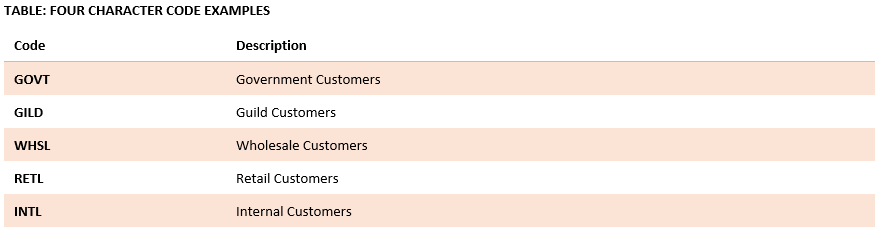
Expansion pressure becomes apparent as the list grows.
Six Characters
Six characters are the most common reference data balance points.
They allow
- Clear abbreviations
- Visual consistency
- Room for moderate growth
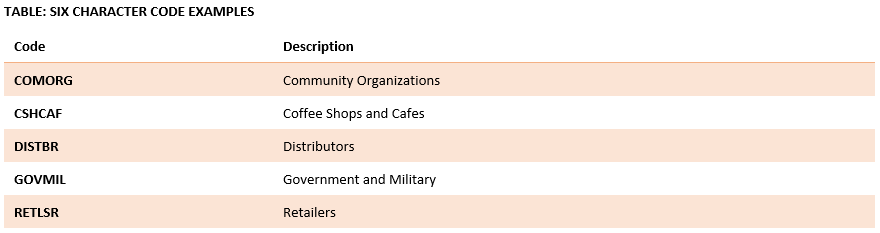
This length supports scalability while remaining readable and easy to train on.
Eight Characters
Eight characters favor longevity over speed.
They work well when
- The domain is large
- Growth is expected
- More clarity is required
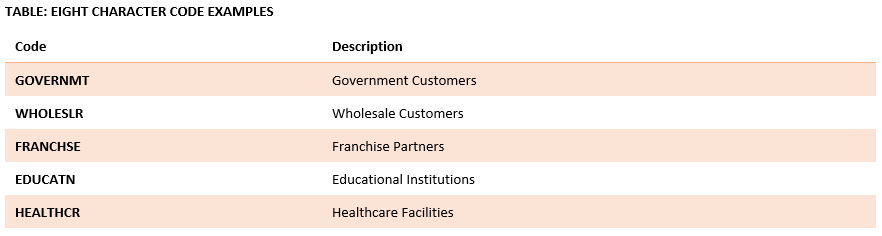
This reduces abbreviation pressure at the cost of slightly slower scanning.
Ten Characters or More
Ten-character fixed codes should be used cautiously.
They only make sense when
- The code must be fully readable
- Structure is minimal
- The list is stable
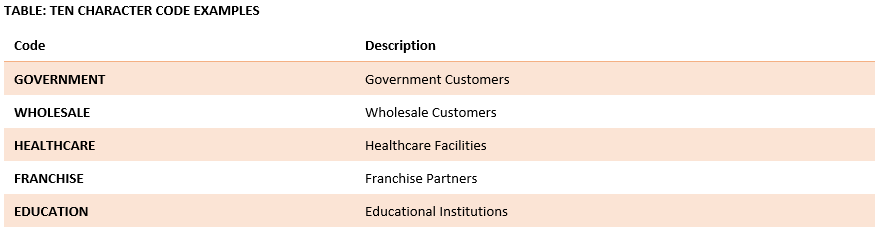
At this point, variable-length codes often provide better flexibility.
Human Factors Matter
The Waterdeep Trading Company places a heavy weight on how often people interact with a code.
Key questions are always asked
- Will this appear in daily work
- Will clerks type it manually
- Will it be spoken aloud
The more human interaction involved, the shorter and cleaner the code should be.
Growth Pressure Over Time
A fixed-length code must survive future use, not just current needs.
Short codes fail when
- New categories appear
- The business expands into new markets
- Special cases multiply
Longer codes fail when
- Users avoid them
- Entry errors increase
- People invent unofficial shortcuts
The ideal length balances both pressures.
Practical Recommendation
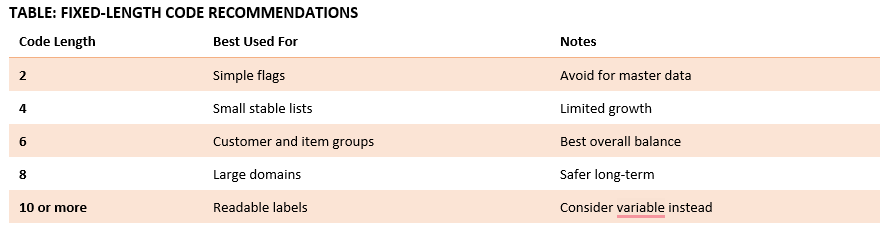
Why Six Characters Often Win
Six characters succeed because they sit in the middle.
They are
- Short enough to scan
- Long enough to grow
- Clear enough to teach
- Stable enough to trust
This is why many well-run systems standardize on six for customer groups and posting groups.
Final Thoughts
There is no universal correct length. There is only the correct fit.
Fixed-length codes should be
- Long enough to survive growth
- Short enough to support people
- Consistent enough to train
Choosing the length early and documenting the rationale avoids costly redesign later.
Support the AD&D365 Project on Patreon. To grow this world, we’ve launched an official Patreon page where supporters can access exclusive content, tools, and training labs, and even influence the project’s future. Your support fuels more than just development; it expands the guildhall, forges new scrolls, and empowers the next generation of configuration wizards. Begin your journey: https://www.patreon.com/adnd365/
A Grateful Salute to Our Patrons. To all those who stand behind the vision, thank you for helping bring this world to life. Our Benefactors, Andre Breillatt and Eryndor Fiscairn‡, your boundless generosity fuels the arcane core of this project. Without your magic, the weave would falter. Our Apprentices, the spell engines turn, and the training labs thrive thanks to our current Apprentices: Michael Ramirez and Andreth Bael’Rathyn‡. Special thanks to our past Apprentices, whose contributions helped us get here: Ralf Weber, Wendy Rijners, Shashi Mahesh, Julia Tejera, Ben Ekokobe, Tiago Xavier, Naveen Boyinapelli, Marcos Tadeu Wolf, Kathryn Greene, Jason Brown, Mark Christy, and Ashish Singh. Our Initiates, Jesper Livbjerg, Peter Lorre, Gregory Brigden, and Martin Grahm, your commitment marks the start of the deeper path, stepping beyond mere observation into the active shaping of this realm. Our Followers, your steady presence along the journey is a beacon of encouragement: Rusty Cavalier, Eric Shuss, Sunil Panchal, Sarah D. Morgan, Nick Ramchandani, Daniel Kjærsgaard, and Tomasz Pałys. And our Voyeurs, Harry Burgh, Abdelrahman Nabil, and Basil Quarrell, ever watching from the shadows, clearly intrigued… but not enough to part with a single gold piece. Your silent curiosity is noted and mildly judged.
Want to design your own economic models in Faerûn? Get your own AD&D365 Environment and guides at adnd365.com/start, and request access to the public view of the current database at https://public.adnd365.com – Login npc@adnd365.com, Password N0nPl@yC#822!
 A Tinkerers Notebook