Archive

Monthly Archives: December 2025

Across Faerûn, merchants and guilds work with goods that rarely behave in uniform ways. Some arrive with uneven cuts, some stretch or shrink when handled, and others flow or coil into shapes that defy standard form. Two tracking methods address these challenges within the Waterdeep Trading Company. These are catchweight and variable measures. The two are often confused, yet each follows a distinct tradition rooted in long-standing trade customs from the Sword Coast to the inland markets.

This expanded article explores how each method works, why they diverge, and how the company applies them to tangible goods.

What Catchweight Is

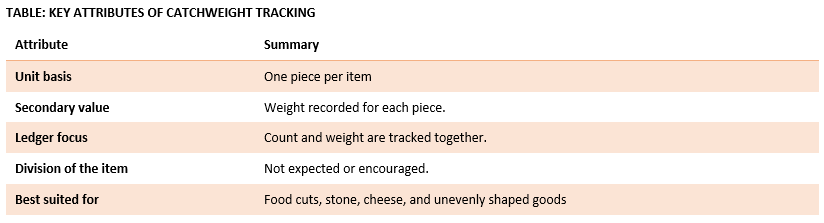
Catchweight is used when an item is traded and inventoried as a single unit, yet its value depends on its actual weight. The piece is counted as one, but no two pieces weigh the same. The ledger must therefore carry both the count and the weight for every item received. This method applies to goods shaped by hand, harvested in uneven portions, or carved from natural materials.

Boar meat from farms near Daggerford offers a clear example. Hunters deliver each haunch as a single piece, but the weight of each cut varies. The company must accept the count as a whole unit and price the cut based on its recorded weight. The same applies to the stone blocks quarried in the Western Heartlands. Each block is counted as a single unit, yet the density of the stone and the irregularity of its cut make the accurate measure of value. Even cheese wheels brought in from Amn follow this rule. Farmers shape them by hand, and each wheel comes out slightly different. Merchants rely on weight to ensure fair payment between buyers and suppliers.

In all these cases, the company treats each item as one object, one unit in stock, yet uses weight as the companion measure for valuation. This duality is central to catchweight.

This table highlights the essential traits of catchweight and why it is applied to certain goods.
What Variable Measure Is

Variable measure is used when an item has no practical piece count at all. Instead, its measure is the only value that matters. These goods are destined to be cut, poured, stretched, or shaped during use. A piece means nothing. Only the remaining measure matters.

Cloth from the Waterdeep Weaver’s Guild is a perfect example. A bolt may arrive with forty-five yards, and tailors may cut ten yards for a robe, two yards for a sash, or a fraction for lining. The bolt does not shrink as a piece. It simply loses length. The ledger tracks the remaining yards until the entire bolt is consumed. Rope coils behave the same way. A sailor may cut a short length for a rig, and the ledger only needs to record how many yards remain in the coil. Timber beams brought from the Western Heartlands also fall under this method. A carpenter trims a beam to fit a frame, yet there is no expectation that the leftover sections be counted as separate pieces—only the remaining length or volume matters.

Variable measure places complete focus on the unit of measure. It assumes goods will change form and size through regular use. No count is required, and no record of pieces is ever created.

This table outlines the essential traits of variable measure and why it differs from catchweight.

Why These Methods Are Not the Same

Catchweight and variable measure appear similar because both acknowledge irregular goods. Yet their rules diverge sharply.

In catchweight, the piece is the item’s core identity. A smoked boar cut is one cut. A cheese wheel is one wheel. A quarry stone is one block. The weight varies, and this variation affects the cost and selling price. The ledger, therefore, carries two values at all times: the count and the weight. Workers know that the item cannot be freely divided without changing its identity. A cheese wheel cut in two is no longer a single wheel, and the tracking method fails. The item must remain whole.

Variable measure takes the opposite approach. The item has no identity as a piece. A bolt of cloth is not one object in the same sense as a cheese wheel. It is simply forty-five yards of fabric. Cutting it into sections does not change its identity. A rope coil does not become two pieces in the ledger when a length is cut. It becomes a smaller total measure. Pieces do not matter because pieces do not exist.

This fundamental difference shapes how the company handles stock, cost, and issue.

Expanded Examples

The Cheese Wheel: When a caravan from Amn arrives with six cheese wheels, the ledger records six units, each with its individual weight. One wheel may weigh twelve pounds, another thirteen, and a third eleven and a half. The workers stack all six wheels together, yet the enchanted scales beneath the receiving table track each weight precisely. Later, when the cheese is sold to taverns in the Dock Ward or noble kitchens in the Sea Ward, the invoice reflects the recorded weight, not a fixed price per wheel. The identity of each wheel remains whole. Cutting the wheel would force it out of its tracking method, so the guild sells wheels intact unless a special arrangement is made.

The Cloth Bolt:  A bolt arriving from the Weaver’s Guild is handled quite differently. A forty-five-yard bolt is logged simply as forty-five yards. When tailors request fabric for company uniforms or mage robes, they draw the exact length required. After cutting, the ledger updates the remaining measure. No one records the number of cuts taken from the bolt. When it is finally used up, there is no history of pieces, only a record of how many yards were issued and to which workshop. The bolt’s design allows division, so the tracking method supports it without penalty.

The Stone Block:  Stone quarried in the Western Heartlands is carried to Waterdeep as single blocks. Each block is heavy and irregular. Workers measure its weight upon receipt, then use that value in both cost and freight calculations. A mason could reshape the block later, yet the original count and weight must be preserved for audit purposes. This reinforces the rule that the block is a single-tracked unit, and the ledger will not follow every future chip removed by masons. It cares only about the original block.

The Rope Coil:  A coil of rope behaves in the exact opposite way. A sailor or warehouse worker needs only a length sufficient to secure a load or repair a harness. Cutting the rope is expected, repeated, and unremarkable. The remaining coil remains unchanged. The ledger reflects only the new measured total. No worker needs to track how many pieces the rope becomes divided into.

Side-by-Side Comparison

This table compares how the ledger treats the two methods and why they are not interchangeable.

Why the Company Keeps Them Separate

Each method influences freight rules, vendor contracts, customer pricing, and internal cost control. Catchweight affects transport fees because heavier items cost more to haul. Variable measures affect workshop planning because cuts must be tracked precisely during production runs.

The Waterdeep Trading Company separates these methods to avoid confusion in mixed cargo shipments, ensure fair valuation when trading with coastal guilds, and maintain clarity when issuing goods across its workshops. The distinction also prevents disputes when merchants, adventurers, or craftsmen question why prices differ even when goods look similar.

Final Thoughts

Understanding the difference between catchweight and variable measure is essential for any merchant working with goods that do not conform to standard forms. In Waterdeep, this knowledge keeps ledgers clean, contracts clear, and trade flowing without delay. Across Faerûn, it marks a merchant as trained, careful, and ready to stand behind every recorded measure.


Support the AD&D365 Project on Patreon.  To grow this world, we’ve launched an official Patreon page where supporters can access exclusive content, tools, and training labs, and even influence the project’s future. Your support fuels more than just development; it expands the guildhall, forges new scrolls, and empowers the next generation of configuration wizards.  Begin your journey: https://www.patreon.com/adnd365/

A Grateful Salute to Our Patrons.  To all those who stand behind the vision, thank you for helping bring this world to life. Our Benefactors, Andre Breillatt and Eryndor Fiscairn, your boundless generosity fuels the arcane core of this project. Without your magic, the weave would falter. Our Apprentices, the spell engines turn, and the training labs thrive thanks to our current Apprentices: Michael Ramirez and Andreth Bael’Rathyn. Special thanks to our past Apprentices, whose contributions helped us get here: Ralf Weber, Wendy Rijners, Shashi Mahesh, Julia Tejera, Ben Ekokobe, Tiago Xavier, Naveen Boyinapelli, Marcos Tadeu Wolf, Kathryn Greene, Jason Brown, Mark Christy, and Ashish Singh. Our Initiates, Jesper Livbjerg, Peter Lorre, Gregory Brigden, and Martin Grahm, your commitment marks the start of the deeper path, stepping beyond mere observation into the active shaping of this realm. Our Followers, your steady presence along the journey is a beacon of encouragement: Rusty Cavalier, Eric Shuss, Sunil Panchal, Sarah D. Morgan, Nick Ramchandani, Daniel Kjærsgaard, and Tomasz Pałys. And our Voyeurs, Harry Burgh, Abdelrahman Nabil, and Basil Quarrell, ever watching from the shadows, clearly intrigued… but not enough to part with a single gold piece. Your silent curiosity is noted and mildly judged.

Want to design your own economic models in Faerûn?  Get your own AD&D365 Environment and guides at adnd365.com/start, and request access to the public view of the current database at https://public.adnd365.com – Login npc@adnd365.com, Password N0nPl@yC#822!

Across Faerûn, gambling brings life to fairs, taverns, trade routes, and festival grounds. Chance games draw crowds, and well-managed wagers support guild events across the Sword Coast. While the Waterdeep Trading Company typically limits gambling to keep workers safe, there are sanctioned moments when the company itself serves as the Gaming Accountant. These events pose risks to the company, so every wager must follow strict accounting controls.

When the Waterdeep Trading Company accepts wagers, it does not act as a private gambler. It serves as the Gaming Accountant with full responsibility for posting odds, collecting stakes, paying winners, and recording the final surplus. This creates temporary liabilities, short-term obligations, and controlled revenue flows that must be tracked with the same care as inventory, tenders, and contractual work across the organization.

What It Means to Serve as the Gaming Accountant

Serving as the Gaming Accountant means the company places itself at the center of the wager cycle. All bets run through the company records. All odds are fixed before the contest begins. All coin is held in trust until the event ends. Workers involved in record-keeping are not permitted to participate in the games. These rules preserve fairness and create a clean ledger trail for later review.

The company uses the same record discipline already present across its system setup. This includes clear account codes, tracking of obligations, accurate closing of liabilities, and a structured posting flow that mirrors the treatment of other deferred revenue.

Why This Matters

Gambling events can generate revenue, but their real value lies in building guild relations and community presence. When the Waterdeep Trading Company serves as the Gaming Accountant, its reputation depends on accuracy, fairness, and follow-through. Poorly tracked wagers erode trust. Strong accounting strengthens the company’s standing far beyond the contest grounds.

Treasury manages wagers and exposure. Records logs all entries. Security ensures there is no coercion or unauthorized collection. Each group works together to create a clear, controlled cycle.

The Accounting Structure Behind Gaming Accounting

The model follows four steps.

First, wagers are collected and posted as deferred revenue.

Second, the company’s odds create a payout liability equal to the maximum possible winnings.

Third, actual payouts are issued after the event.

Fourth, any remaining coin becomes gambling revenue.

This prevents early revenue recognition and allows each step to be reviewed in isolation during audits or guild inspections.

The key accounts include Cash on Hand, Gaming Deferred Revenue, Gaming Payout Liability, Gaming Odds Exposure Expense, and Gambling Revenue. Together, they create a complete and straightforward flow.

Worked Example One: Highharvestide Foot Race in Waterdeep

The following table presents the complete set of ledger entries from a significant event held during the Highharvestide Fair.

This event drew a large crowd and produced clear patterns useful for training and review.

This cycle ensures that wagers remain obligations until all outcomes are settled.

Only then may the surplus be treated as income.

Worked Example Two: Dock Ward Dice Event

The following table shows a smaller event held inside the Dock Ward warehouse.

Such events are ideal for training treasury clerks, since the stakes are lower but the accounting flow remains the same.

These two examples show the same rhythm.

Hold coin, track exposure, settle obligations, then recognize income.

This pattern protects the company and preserves trust among workers and patrons.

Realms Aware Considerations

Gaming practices vary across the Realms. Luskan games can change without warning. Calimport wagers mix coins with favors that require careful valuation. Silverymoon contests often involve magical audits, which reduce uncertainty. The Waterdeep Trading Company adapts to each region while maintaining a consistent core accounting structure.

  • Every wager must be logged.
  • Every payout must be confirmed.
  • Every surplus must be recognized only after liabilities reach zero.

This approach enables the company to operate as a stable, respected Gaming Accountant across the Sword Coast.

Final Thoughts

When the Waterdeep Trading Company serves as the Gaming Accountant, it holds the confidence of the crowd and the guilds. Its duty is not only to manage coin, but also to preserve fairness in every sanctioned contest. With clean accounting and careful oversight, the company maintains honor in chance and coin alike.


Support the AD&D365 Project on Patreon.  To grow this world, we’ve launched an official Patreon page where supporters can access exclusive content, tools, and training labs, and even influence the project’s future. Your support fuels more than just development; it expands the guildhall, forges new scrolls, and empowers the next generation of configuration wizards.  Begin your journey: https://www.patreon.com/adnd365/

A Grateful Salute to Our Patrons.  To all those who stand behind the vision, thank you for helping bring this world to life. Our Benefactors, Andre Breillatt and Eryndor Fiscairn, your boundless generosity fuels the arcane core of this project. Without your magic, the weave would falter. Our Apprentices, the spell engines turn, and the training labs thrive thanks to our current Apprentices: Michael Ramirez and Andreth Bael’Rathyn. Special thanks to our past Apprentices, whose contributions helped us get here: Ralf Weber, Wendy Rijners, Shashi Mahesh, Julia Tejera, Ben Ekokobe, Tiago Xavier, Naveen Boyinapelli, Marcos Tadeu Wolf, Kathryn Greene, Jason Brown, Mark Christy, and Ashish Singh. Our Initiates, Jesper Livbjerg, Peter Lorre, Gregory Brigden, and Martin Grahm, your commitment marks the start of the deeper path, stepping beyond mere observation into the active shaping of this realm. Our Followers, your steady presence along the journey is a beacon of encouragement: Rusty Cavalier, Eric Shuss, Sunil Panchal, Sarah D. Morgan, Nick Ramchandani, Daniel Kjærsgaard, and Tomasz Pałys. And our Voyeurs, Harry Burgh, Abdelrahman Nabil, and Basil Quarrell, ever watching from the shadows, clearly intrigued… but not enough to part with a single gold piece. Your silent curiosity is noted and mildly judged.

Want to design your own economic models in Faerûn?  Get your own AD&D365 Environment and guides at adnd365.com/start, and request access to the public view of the current database at https://public.adnd365.com – Login npc@adnd365.com, Password N0nPl@yC#822!

Facility maintenance across Faerûn is a constant effort. Weather from the Sea of Swords wears down roofs and stonework. Workshops hum with arcane devices that need careful inspection. Storehouses carry goods from every coast, and their upkeep protects both inventory and reputation. The Waterdeep Trading Company depends on steady maintenance to keep its halls safe, its warehouses efficient, and its trading operations uninterrupted.

This article explains how facility maintenance works within the company, why it matters to both accounting and logistics teams, and how the company structures its routine and long-term upkeep across the Sword Coast.

What Facility Maintenance Is

Facility maintenance covers all tasks that keep property, structures, and equipment in proper condition. In Waterdeep, that means stone repairs, timber replacement, arcane ward checks, chimney sweeps, roof inspection after storms, and routine upkeep of forges and loading areas.

These tasks fall into three main groups.

  • Planned maintenance occurs on a schedule.
  • Reactive maintenance corrects failures or damage.
  • Capital improvements enhance the property’s long-term value.

The Waterdeep Trading Company treats each group differently through its ledgers, work orders, and supply planning.

Why Facility Maintenance Matters

Strong buildings keep workers safe and goods protected.

Predictable upkeep prevents costly failures during peak trade seasons.

Precise financial tracking allows the company to separate expenses, investments, and losses.

Accurate records help the guild justify labor costs for city inspections.

Maintenance also supports merchants’ trust in secure storage facilities.

Location and Asset Hierarchy

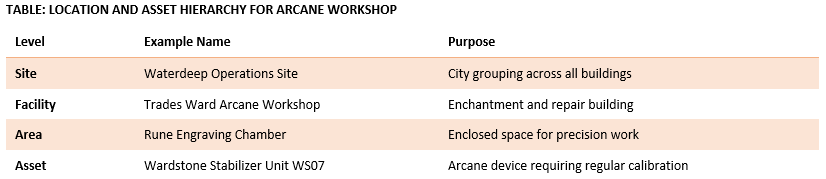
The Waterdeep Trading Company maintains a structured hierarchy to manage every facility, room, and piece of equipment. This hierarchy helps clerks assign work orders, track maintenance history, and record costs at the correct property level.

The hierarchy is built in four levels.

  • The Site represents the city location, such as Waterdeep or Baldur’s Gate.
  • The Facility represents each central operational building.
  • The Area groups rooms or working spaces.
  • The Asset represents the specific item requiring upkeep.

Below is a view of the hierarchy used across the Sword Coast.

This table shows an example hierarchy for the Waterdeep primary operations area.

A second example of arcane equipment follows.

This table shows how magical assets are grouped within the Trades Ward workshop.

These structures ensure maintenance orders are always posted against the correct area and asset. They also enable the company to generate reports that show where failures recur or where investment is needed.

Components of Facility Maintenance

The company organizes upkeep into four areas.

  • Structural upkeep includes walls, floors, beams, doors, and roofs.
  • Utility systems include lantern lines, water pumps, heating runes, and ventilation.
  • Operational equipment includes hoists, lifts, carts, loading arches, and warded vault doors.
  • Grounds upkeep includes yard areas, stable maintenance, and perimeter inspection.

This table lists common cost types used in planning and reviewing maintenance.

Maintenance Types and Their Use

This table helps overseers select the proper work classification for each job.

Worked Example

Below is a sample roof repair at the Dock Ward storehouse.

Realms Aware Considerations

Faerûn presents special conditions that influence upkeep.

  • Salt air from the Sea of Swords causes fast corrosion.
  • Arcane flux near magical districts requires routine stabilizer checks.
  • Forest settlements face creature interference.
  • Seasonal storms strain roofs and drainage.

These conditions guide the company’s maintenance calendar and supply plans.

Final Thoughts

Facility maintenance keeps the Waterdeep Trading Company steady through every trade season. Strong buildings support safe storage, stable operations, and predictable financial results. A clear hierarchy, proper classification, and careful planning help the company control costs while protecting the value of its assets.


Support the AD&D365 Project on Patreon.  To grow this world, we’ve launched an official Patreon page where supporters can access exclusive content, tools, and training labs, and even influence the project’s future. Your support fuels more than just development; it expands the guildhall, forges new scrolls, and empowers the next generation of configuration wizards.  Begin your journey: https://www.patreon.com/adnd365/

A Grateful Salute to Our Patrons.  To all those who stand behind the vision, thank you for helping bring this world to life. Our Benefactors, Andre Breillatt and Eryndor Fiscairn, your boundless generosity fuels the arcane core of this project. Without your magic, the weave would falter. Our Apprentices, the spell engines turn, and the training labs thrive thanks to our current Apprentices: Michael Ramirez and Andreth Bael’Rathyn. Special thanks to our past Apprentices, whose contributions helped us get here: Ralf Weber, Wendy Rijners, Shashi Mahesh, Julia Tejera, Ben Ekokobe, Tiago Xavier, Naveen Boyinapelli, Marcos Tadeu Wolf, Kathryn Greene, Jason Brown, Mark Christy, and Ashish Singh. Our Initiates, Jesper Livbjerg, Peter Lorre, Gregory Brigden, and Martin Grahm, your commitment marks the start of the deeper path, stepping beyond mere observation into the active shaping of this realm. Our Followers, your steady presence along the journey is a beacon of encouragement: Rusty Cavalier, Eric Shuss, Sunil Panchal, Sarah D. Morgan, Nick Ramchandani, Daniel Kjærsgaard, and Tomasz Pałys. And our Voyeurs, Harry Burgh, Abdelrahman Nabil, and Basil Quarrell, ever watching from the shadows, clearly intrigued… but not enough to part with a single gold piece. Your silent curiosity is noted and mildly judged.

Want to design your own economic models in Faerûn?  Get your own AD&D365 Environment and guides at adnd365.com/start, and request access to the public view of the current database at https://public.adnd365.com – Login npc@adnd365.com, Password N0nPl@yC#822!
Equity shares explain how ownership is recorded in the Waterdeep Trading Company. Stock-based compensation extends this structure by granting workers who guide the company each season a future claim to ownership. Greta Ironfist uses these awards to reward commitment, attract skilled treasurers, and maintain stable long-term plans.

This follow-up article explains how these awards work, how they connect to the existing equity accounts, and how the ledger captures the cost of service through clear accruals.

What Stock-Based Compensation Represents

A stock-based award grants a worker the right to receive shares at a later date. Some vest with time. Some require completing a trade route or a season of substantial surplus. All create an obligation for the company. As the worker provides service, a portion of that award becomes earned. This earned portion is recognized as an expense.

Because these awards settle in shares rather than coins, the accounting flows through equity. The Waterdeep Mercantile League provides fair value scrolls to help treasurers measure each grant at the moment it is offered.

Why These Awards Matter

Workers who hold a chance at future ownership feel a stronger bond to the company. They take care of the ledgers, caravans, and contracts as if they already have a place in the long history of the guild. Stock-based compensation supports worker retention and encourages a stable culture across the company.

For the ledger, these awards must be handled with precision. The service cost must be recognized each season. The equity obligation must be increased over the vesting period. When the award vests, the reserve converts into the appropriate share class.

Equity Accounts Used for Stock-Based Awards

Stock-based compensation builds on the existing share accounts. Two new reserve accounts are added to track the accrual during the vesting period.

This table shows the core accounts used when awards are granted, accrued, and vested.

These accounts integrate fully with the chart of accounts used in the prior article.

How the Company Measures Fair Value

At the grant date, the arcane treasurers rely on Waterdeep Mercantile League valuation scrolls. These scrolls consider guild reputation, seasonal surplus, trade route strength, supply conditions, and historical demand for company shares. This value becomes fixed for accounting purposes and does not change with later events.

The fair value is then spread evenly across the vesting period, unless service terms require a different pattern.

Worked Example: Four-Year Vesting Award

A senior archivist is awarded a fair value of 2,400.00 FSD. The award lasts for over four years.

Annual expense equals 2,400.00 divided by 4. This is 600.00 FSD per year.

Below is the progression of expense and reserve growth.

Journal Entries During the Vesting Period

The following entries repeat each year until vesting is complete.

This records the cost of service and increases the equity obligation.

Journal Entry Upon Vesting

When the award vests, the reserve is transferred to the appropriate equity account.

If the award settles into common shares:

If the nominal share value is less than the award value, a portion may be posted to Share Premium instead.

Special Faerûn Notes

Some provinces classify stock-based awards as guild benefits and require scroll filings before vesting. The Scriveners’, Scribes’, and Clerks’ Guild must seal the grant scroll for the award to be recognized. Magical contracts tied to planar trade may require performance conditions rather than time-based vesting.

The Waterdeep Trading Company stores all award terms in the Arcane Ledger to ensure that each accrual aligns with the service provided.

Final Thoughts

Stock-based compensation links the strength of the Waterdeep Trading Company to the dedication of its workers. These awards are both a reward and a responsibility. When recorded with care, they present a clear story of service, growth, and shared ownership. The seasonal expense and the growing reserve keep the ledger accurate. The final conversion into shares marks the worker’s lasting place in the company.


Support the AD&D365 Project on Patreon.  To grow this world, we’ve launched an official Patreon page where supporters can access exclusive content, tools, and training labs, and even influence the project’s future. Your support fuels more than just development; it expands the guildhall, forges new scrolls, and empowers the next generation of configuration wizards.  Begin your journey: https://www.patreon.com/adnd365/

A Grateful Salute to Our Patrons.  To all those who stand behind the vision, thank you for helping bring this world to life. Our Benefactors, Andre Breillatt and Eryndor Fiscairn, your boundless generosity fuels the arcane core of this project. Without your magic, the weave would falter. Our Apprentices, the spell engines turn, and the training labs thrive thanks to our current Apprentices: Michael Ramirez and Andreth Bael’Rathyn. Special thanks to our past Apprentices, whose contributions helped us get here: Ralf Weber, Wendy Rijners, Shashi Mahesh, Julia Tejera, Ben Ekokobe, Tiago Xavier, Naveen Boyinapelli, Marcos Tadeu Wolf, Kathryn Greene, Jason Brown, Mark Christy, and Ashish Singh. Our Initiates, Jesper Livbjerg, Peter Lorre, Gregory Brigden, and Martin Grahm, your commitment marks the start of the deeper path, stepping beyond mere observation into the active shaping of this realm. Our Followers, your steady presence along the journey is a beacon of encouragement: Rusty Cavalier, Eric Shuss, Sunil Panchal, Sarah D. Morgan, Nick Ramchandani, Daniel Kjærsgaard, and Tomasz Pałys. And our Voyeurs, Harry Burgh, Abdelrahman Nabil, and Basil Quarrell, ever watching from the shadows, clearly intrigued… but not enough to part with a single gold piece. Your silent curiosity is noted and mildly judged.

Want to design your own economic models in Faerûn?  Get your own AD&D365 Environment and guides at adnd365.com/start, and request access to the public view of the current database at https://public.adnd365.com – Login npc@adnd365.com, Password N0nPl@yC#822!

Ownership in Faerûn carries weight in both coin and standing. A share in the Waterdeep Trading Company grants a vote in council meetings, a portion of seasonal surplus, and a clear place within the guild’s long history. Greta Ironfist relies on equity shares to invite investment while keeping the company’s direction firm and stable.

This article explains how shares work within the company, how they support expansion across the Sword Coast, and how equity accounts in the Faerûn Standard Chart of Accounts record every change in ownership.

What Equity Shares Are

An equity share represents a unit of ownership. Common shares grant one vote and a portion of surplus. Preferred shares grant early surplus rights but no vote. Guildmaster shares belong only to Greta Ironfist and carry weighted voting strength.

Shares allow the company to raise funds for new routes, enchanted storage, and protection contracts. They also create a path for dedicated workers to share in long-term success.

Why Equity Shares Matter

Shares determine who guides the company. They allow outside investors to support major plans while keeping authority in the hands of confirmed shareholders. They help fund caravan lines, warehouse expansions, and arcane upgrades without drawing on moneylenders.

The share ledger maintained by the arcane treasurers keeps every transfer clear. The Scriveners’, Scribes’, and Clerks’ Guild verifies each scroll before it enters the official record.

Share Classes Used in the Company

The Waterdeep Trading Company uses three classes of shares.

This table shows how each class participates in votes and surplus.

This structure encourages investment without weakening leadership.

Equity Accounts Used for Share Management

Ownership activity is recorded in a series of equity and liability accounts. These accounts come from the Faerûn Standard Chart of Accounts and include both existing accounts and new ones created to support preferred shares, guildmaster shares, surplus tracking, and treasury share activity.

This combined table brings all share-related accounts together, making the overall structure clear.

This structure supports transparent reporting in both regular seasons and expansion periods.

Worked Example: Preferred Share Issue

The council votes to open a new trade route to Calimport. To fund the enchanted crates, caravan guards, and advance payments to Rashemi traders, the company issues 500 preferred shares at 100.00 FSD each. The nominal value is 80.00 FSD, and the remaining 20.00 FSD per share becomes share premium.

This strengthens the company’s position without altering council control.

Worked Example: Surplus Declaration

At season’s end, the council declares a surplus distribution of 12,000.00 FSD.

Payment later clears the liability.

Realms Aware Notes

Share values may rise or fall with supply routes, arcane costs, seasonal demand, or shifting regional tariffs. Trade lines in Luskan or the North may require preferred share structures to attract outside backing.

The Scriveners’, Scribes’, and Clerks’ Guild must seal every transfer scroll before it becomes valid. This keeps the ledger clean and reduces disputes in high-value share exchanges.

Final Thoughts

A strong share structure supports the Waterdeep Trading Company as it grows. These accounts keep every change in ownership clear, protect decision-making rights, and ensure that surplus is shared fairly. With a unified ledger and well-defined share classes, the company stands ready to expand across Faerûn with confidence.


Support the AD&D365 Project on Patreon.  To grow this world, we’ve launched an official Patreon page where supporters can access exclusive content, tools, and training labs, and even influence the project’s future. Your support fuels more than just development; it expands the guildhall, forges new scrolls, and empowers the next generation of configuration wizards.  Begin your journey: https://www.patreon.com/adnd365/

A Grateful Salute to Our Patrons.  To all those who stand behind the vision, thank you for helping bring this world to life. Our Benefactors, Andre Breillatt and Eryndor Fiscairn, your boundless generosity fuels the arcane core of this project. Without your magic, the weave would falter. Our Apprentices, the spell engines turn, and the training labs thrive thanks to our current Apprentices: Michael Ramirez and Andreth Bael’Rathyn. Special thanks to our past Apprentices, whose contributions helped us get here: Ralf Weber, Wendy Rijners, Shashi Mahesh, Julia Tejera, Ben Ekokobe, Tiago Xavier, Naveen Boyinapelli, Marcos Tadeu Wolf, Kathryn Greene, Jason Brown, Mark Christy, and Ashish Singh. Our Initiates, Jesper Livbjerg, Peter Lorre, Gregory Brigden, and Martin Grahm, your commitment marks the start of the deeper path, stepping beyond mere observation into the active shaping of this realm. Our Followers, your steady presence along the journey is a beacon of encouragement: Rusty Cavalier, Eric Shuss, Sunil Panchal, Sarah D. Morgan, Nick Ramchandani, Daniel Kjærsgaard, and Tomasz Pałys. And our Voyeurs, Harry Burgh, Abdelrahman Nabil, and Basil Quarrell, ever watching from the shadows, clearly intrigued… but not enough to part with a single gold piece. Your silent curiosity is noted and mildly judged.

Want to design your own economic models in Faerûn?  Get your own AD&D365 Environment and guides at adnd365.com/start, and request access to the public view of the current database at https://public.adnd365.com – Login npc@adnd365.com, Password N0nPl@yC#822!

In Faerûn, some of the most valuable work done by the Waterdeep Trading Company is not tied to stocked goods or caravan shipments. Instead, it comes from clients who need unique work planned, tracked, and completed on their behalf. These are customer-funded projects, a standard part of trade across the Sword Coast, where noble houses, guilds, and adventuring parties require crafted items, research, or services beyond a regular order.

For the Waterdeep Trading Company, these projects allow the guild to grow coin reserves without taking on risk from unsold stock. Each project is financed by the customer who requests it, and Dynamics 365 helps track cost, time, revenue, and progress through structured project accounting, ledger controls, and milestone billing.

This article explores how customer-funded projects function in Faerûn, why they matter, and how they are managed through the company’s accounting practices.

What Customer Funded Projects Are

A customer-funded project is work that is paid for by the customer either in advance or throughout the life of the activity. The Waterdeep Trading Company treats these as formal undertakings, usually tied to a contract scroll signed and sealed by the Scriveners Guild. Common examples include commissions for enchanted goods, production runs for noble households, research tasks for arcanists, or repairs for merchant fleets.

Unlike internal projects, these efforts do not draw on the company’s own coin at the outset. Instead, funds provided by the customer become the resource pool used to carry out the work. This requires precise accounting to separate the client’s coin from internal budgets.

Why These Projects Matter

Customer-funded projects support the company’s financial stability in several ways.

  • They remove inventory risk, since the client covers all costs.
  • They allow the company to expand its capabilities, since rare materials or specialist labor can be procured with client funds.
  • They offer steady and predictable revenue, since contracts lay out how milestones and progress payments are invoiced.

In a land where supply lines stretch across wild terrain and arcane markets shift day by day, having stable client-backed work ensures dependable profit for Greta Ironfist and her planners.

Core Components of a Customer Funded Project

Below are the significant elements the Waterdeep Trading Company tracks within Dynamics 365.

First, Contract Setup. Every project begins with a customer record linked to a project contract. The contract defines funding rules, billing type, currency, and expected milestones. The base setup for customers and billing models follows the same ledger framework taught in the Bare Bones Configuration Guides.

Second, Funding Allocation. Funds supplied by the customer are mapped to the project so that labor, materials, and overhead settle against the customer’s balance rather than internal accounts.

Third, Work Breakdown. Tasks, phases, and activities are created to organize the work effort. This may include forging stages, enchantment sessions, transport planning, or research steps.

Fourth, Cost Accumulation. All project expenses are routed through dedicated ledger accounts. This includes raw material purchases, hourly craft labor, magical services, and overhead charges.

Fifth, Revenue Recognition. Invoicing may be based on milestones, time-and-materials, or fixed-price agreements. Milestone billing is most common, with seals applied at major completion points.

Sixth, Project Closure. The ledger is settled, any unused customer funds are returned or credited, and Seraphina Quillspire and Maelor the Quill archive all documentation.

Worked Example: Commissioned Arcane Beacon for the Lords of Everlund

To show how customer-funded projects operate, here is a complete example of a commission.

Scenario: The Lords of Everlund request a defensive arcane beacon built by the Waterdeep Trading Company. They provide full funding up front.

Below is a table that captures the planned cost structure.

Before the table, here is an explanation. This table lists the major cost items required to produce the arcane beacon and shows how each cost is drawn from the customer’s funded pool. It helps planners keep spending aligned with the contract.

Because the customer funds the entire amount at contract signing, the ledger holds their deposit as a liability until revenue is recognized through milestone completion.

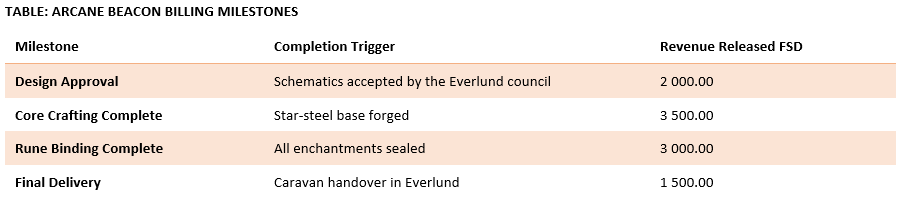
A second table shows how revenue is released.

This table outlines the billing milestones and explains when the customer’s deposit converts to earned revenue. This helps the Accounts Receivable clerks track progress and apply the proper postings.

Once the final milestone is posted, the deposit liability is cleared and converted into project revenue, and the project is closed.

Realms-Aware Considerations

Faerûn introduces unique factors that must be considered with customer-funded projects.

  • Arcane inputs may require permits from mage guilds, adding additional lead times.
  • Regions outside the Sword Coast may impose trade tariffs or require special papers.
  • Some clients provide materials directly, such as gemstones or ancient relics, which must be handled as non-monetary contributions.
  • Guild labor unions control rates for smiths, engravers, and arcane specialists.
  • Projects involving planar materials may require Essence Credit tracking for sustainability purposes.

These factors make structured project accounting vital for the Waterdeep Trading Company.

Final Thoughts

Customer-funded projects allow the Waterdeep Trading Company to serve nobles, adventurers, and trade houses with custom work while keeping internal risk low. When managed well, they offer steady coin, predictable workloads, and precise financial control.

For teams using Dynamics 365, the structure provided in the Bare Bones Configuration Guides supports proper ledger setup, customer controls, and project workflows that keep each commission profitable and compliant.


Support the AD&D365 Project on Patreon.  To grow this world, we’ve launched an official Patreon where supporters can gain access to exclusive content, tools, training labs, and even influence the future of the project. Your support fuels more than just development ,  it expands the guildhall, forges new scrolls, and empowers the next generation of configuration wizards.  Begin your journey: https://www.patreon.com/adnd365/

A Grateful Salute to Our Patrons.  To all those who stand behind the vision, thank you for helping bring this world to life. Our Benefactors, Andre Breillatt, and Eryndor Fiscairn, your boundless generosity fuels the arcane core of this project. Without your magic, the weave would falter. Our Apprentices, the spell engines turn, and the training labs thrive thanks to our current Apprentices: Michael Ramirez and Andreth Bael’Rathyn. Special thanks to our past Apprentices, whose contributions helped us get here: Ralf Weber, Wendy Rijners, Shashi Mahesh, Julia Tejera, Ben Ekokobe, Tiago Xavier, Naveen Boyinapelli, Marcos Tadeu Wolf, Kathryn Greene, Jason Brown, Mark Christy, and Ashish Singh. Our Initiates, Jesper Livbjerg, Peter Lorre, Gregory Brigden, and Martin Grahm, your commitment marks the start of the deeper path, stepping beyond mere observation into the active shaping of this realm. Our Followers, your steady presence along the journey is a beacon of encouragement:  Eric Shuss, Sunil Panchal, Sarah D. Morgan, Nick Ramchandani, Daniel Kjærsgaard, and Tomasz Pałys. And our Voyeurs, Harry Burgh, Abdelrahman Nabil, and Basil Quarrell, ever watching from the shadows, clearly intrigued… but not enough to part with a single gold piece. Your silent curiosity is noted, and mildly judged.

Want to design your own economic models in Faerûn?  Get your own AD&D365 Environment and guides at adnd365.com/start, and request access to the public view of the current database at https://public.adnd365.com – Login npc@adnd365.com, Password N0nPl@yC#822!

In Faerûn, guilds rise and fall on the strength of their name. Some have deep histories, while others seek a broader presence across the Sword Coast markets. Many do not own the workshops or caravans needed to support steady trade. This gap is filled by the Waterdeep Trading Company, which offers both white label and private-label production.

These services allow guilds, noble houses, and merchant companies to place their own seal upon goods crafted by the company. Through these partnerships, Waterdeep Trading Company becomes the quiet force behind many brands without ever setting foot in their halls.

What White Label and Private Label Mean in Faerûn

White label items are standard goods produced in bulk. Any client may purchase them and apply their own seal. The goods themselves do not change across buyers.
Private label items are exclusive commissions. The client directs the product design, and the company produces it exclusively for that client.

White label favors scale. Private label favors identity.

Why These Practices Matter in the Sword Coast

Commerce moves quickly along the coast. Caravans pass through Waterdeep every day, bringing requests from far-off cities like Silverymoon and Calimport. Many organizations cannot afford to manage supply chains or maintain staff of enchanters and skilled workers. White label and private-label production turn these gaps into opportunities.

Clients gain:

  • Reliable supply of goods
  • Stable cost structure
  • Access to the company’s procurement network
  • Protection against market shifts or magical shortages
  • Fast entry into new regions without building local workshops

Waterdeep Trading Company gains:

  • Steady volume across seasons
  • Long-term agreements with influential houses
  • Exclusive contracts for rare material sourcing
  • Increased reach without changing its own brand

The arrangement strengthens the guild and the region.

How the Waterdeep Trading Company Manages White Label Trade

White label goods must remain consistent. They are produced with the same recipe, materials, and routing for all clients. The customer applies branding after delivery.

The Waterdeep Trading Company controls:

  • Material quality
  • Production routing
  • Arcane safety
  • Bulk transport

This keeps costs low and efficiency high.

White label items often include:

  • Common healing potions
  • Basic satchels
  • Travel pouches
  • Unmarked alchemical supplies
  • Simple foods and dried rations
  • Unenchanted scroll cases

How Private Label Production Works

Private label goods require a deeper partnership. Buyers may specify materials, freshness windows, embellishments, or even the workers permitted to handle the product. These items are tied to a single client and cannot be sold to others without permission.

Private label goods often include:

  • Noble house satchels with protective runes
  • Exclusive alchemical brews
  • Magical inks with secret compositions
  • House banners made with custom dyes
  • Luxury trade goods for high-end markets

Expanded Worked Example

A noble house in Silverymoon requests an enchanted satchel for its officers. The item must hold more than its size suggests. The crest must appear on the clasp in silver thread and must glow faintly when exposed to moonlight.

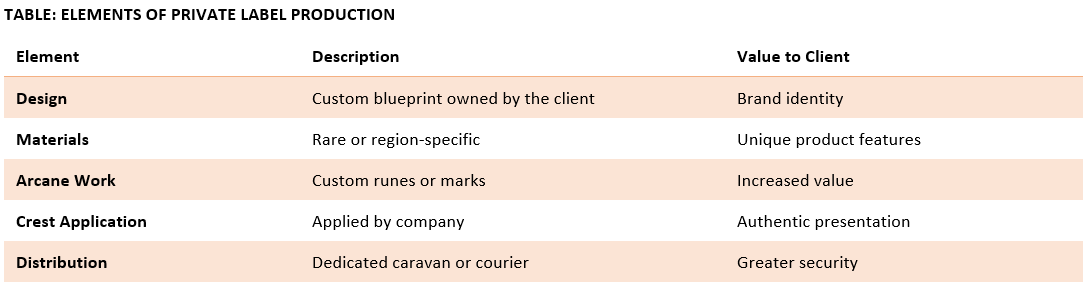
The Waterdeep Trading Company prepares the costing sheet shown below.

The noble house pays a private-label margin of 25%, bringing the final contract price to 255.00 FSD.

Contract Models in Faerûn

White label and private-label agreements follow distinct patterns.

Regional and Material Considerations

Faerûn is large and diverse. Production quality must adjust to regional realities.

Sword Coast: Strong supply lines and fast arcane courier routes

The North: Cold weather slows caravans so that insulation materials may be needed

Amn: Strict tax checks on imported goods

Calimshan: High interest in luxury items with rare scents or spices

Thay: Arcane compliance is strict and requires extensive proof of origin

Rare material sourcing also affects agreements. Items such as rainbow quills, moonlight dyes, and stormglass shards require planning, as they can only be harvested during specific sky turns.

Branding and Secrecy

Brand identity is vital in Faerûn. For private-label goods, Waterdeep Trading Company maintains strict confidentiality. Workrooms that produce exclusive items are closed to general staff.

Seals and crests are applied in a controlled room overseen by the Sage Archivists and the Mage Guild liaison.
Arcane Treasurers record each production batch to prevent counterfeit goods.

Expanding Distribution Through Cooperative Labeling

Some guilds choose a cooperative model in which several allied houses commission white label goods but agree to share a unified brand for a season. Waterdeep Trading Company manages the production and ensures every shipment matches the shared mark.

This approach is common during:

  • Merchant festivals
  • Trade fairs
  • Regional harvest weeks
  • Diplomatic gatherings

It strengthens alliances and creates temporary product lines that build interest across provinces.

Final Thoughts

White label and private-label production turn craftsmanship into a shared advantage across Faerûn. Through these agreements, the Waterdeep Trading Company becomes a steady hand behind many banners while clients gain access to scale, skill, and arcane safety that few could maintain alone.

These partnerships strengthen trade routes, stabilize supply, and deepen the ties between guilds and houses across the realms.


Support the AD&D365 Project on Patreon.  To grow this world, we’ve launched an official Patreon where supporters can gain access to exclusive content, tools, training labs, and even influence the future of the project. Your support fuels more than just development ,  it expands the guildhall, forges new scrolls, and empowers the next generation of configuration wizards.  Begin your journey: https://www.patreon.com/adnd365/

A Grateful Salute to Our Patrons.  To all those who stand behind the vision, thank you for helping bring this world to life. Our Benefactors, Andre Breillatt, and Eryndor Fiscairn, your boundless generosity fuels the arcane core of this project. Without your magic, the weave would falter. Our Apprentices, the spell engines turn, and the training labs thrive thanks to our current Apprentices: Michael Ramirez and Andreth Bael’Rathyn. Special thanks to our past Apprentices, whose contributions helped us get here: Ralf Weber, Wendy Rijners, Shashi Mahesh, Julia Tejera, Ben Ekokobe, Tiago Xavier, Naveen Boyinapelli, Marcos Tadeu Wolf, Kathryn Greene, Jason Brown, Mark Christy, and Ashish Singh. Our Initiates, Jesper Livbjerg, Peter Lorre, Gregory Brigden, and Martin Grahm, your commitment marks the start of the deeper path, stepping beyond mere observation into the active shaping of this realm. Our Followers, your steady presence along the journey is a beacon of encouragement:  Eric Shuss, Sunil Panchal, Sarah D. Morgan, Nick Ramchandani, Daniel Kjærsgaard, and Tomasz Pałys. And our Voyeurs, Harry Burgh, Abdelrahman Nabil, and Basil Quarrell, ever watching from the shadows, clearly intrigued… but not enough to part with a single gold piece. Your silent curiosity is noted, and mildly judged.

Want to design your own economic models in Faerûn?  Get your own AD&D365 Environment and guides at adnd365.com/start, and request access to the public view of the current database at https://public.adnd365.com – Login npc@adnd365.com, Password N0nPl@yC#822!

Commerce in Faerûn is shaped by shifting seasons, magical markets, and the endless flow of raw goods that move between provinces. From ores pulled from the deep halls of the North to the spice caravans of Calimshan and the enchanted herbs gathered in Rashemen, every region carries its own strengths. The Waterdeep Trading Company relies on these differences to operate a steady and profitable commodity network. This trade network links ports, roads, and arcane corridors to balance supply and demand across the Sword Coast and beyond.

The goal of commodity trading at the Waterdeep Trading Company is simple. Buy where goods are plentiful and priced low, transport them with care, and deliver them into markets hungry for those same goods. This article looks at how those trades work, how region based supply patterns shape prices, and how the company chooses the best routes to move goods safely.

What Commodity Trading Is

Commodity trading is the movement of raw or lightly processed materials from one region to another in response to changes in supply, climate, harvest cycles, or magical conditions. Within Faerûn, this includes materials such as iron ore, timber, grain, herbs, spell components, hides, salt, incense, and planar infused substances. Each province offers something unique because of terrain, culture, or magical tradition.

For the Waterdeep Trading Company, commodity trading supports three key aims. First, meeting the needs of Waterdeep’s dense urban markets. Second, maintaining trade influence across border cities. Third, strengthening relations with guilds, harvest clans, and miners’ lodges in distant lands.

Why This Matters to the Waterdeep Trading Company

The company’s influence depends on steady deliveries. Inns need grain, smiths need ore, and apothecaries need herbs. When the company can buy in regions with surplus and sell in cities with active demand, profits rise and relationships strengthen. Knowing when to send caravans, when to hold stock in bonded warehouses, and when to shift to sea routes is what keeps the trade ledgers in balance.

Regional differences also shape margins. Some provinces offer low cost extraction, while others impose tariffs, guild dues, or arcane proofing fees. These variables must be understood before any caravan or ship leaves Waterdeep’s gates.

Commodity Patterns Across the Provinces

Each region of Faerûn produces its own set of traded resources. The following section outlines the typical goods that flow from province to province.

Here is an introduction to the first summary grid. This grid lists the major commodities produced in each province and why these regions matter to the company.

How the Waterdeep Trading Company Trades These Goods

The approach is based on buying in bulk at the source, forming contracts with regional guilds, and assigning caravans or ships based on route risk. When goods require enchantment, such as planar dust or spirit soaked herbs, the company uses mage sealed containers prepared in Waterdeep before departure.

Route planning accounts for weather, borders, bandit risk, guild rules, and tolls. The company uses coastal ships for dense cargo and slow caravans for fragile stock. Magical couriers move small high value items. All routes feed into depots in Baldur’s Gate, Daggerford, and Waterdeep.

Below is an introduction to the trade pattern grid. This grid shows how the company typically moves goods between provinces, the chosen transport method, and the pricing strategy.

Worked Example: Trading a Load of Iron Ore

Here is an introduction to the first example. This example shows how the company buys ore in the North, moves it to Waterdeep, and posts the expected profit once sold to the smiths.

Worked Example: Southern Salt Route from Calimshan

Here is an introduction to a second example that shows how exotic goods travel north and how margins rise as distance grows.

Route Considerations Across Faerûn

Trading depends on safe and predictable movement. The Waterdeep Trading Company uses known waypoints, seasonal shifts, and guild agreements to reduce risk. Sea routes are chosen when storms recede. Arcane shortcuts are used for urgent items. Desert crossings require extra water barrels and hired outriders. Winter freezes open river routes but close mountain passes.

The company keeps merchant scribes in each province to track regional changes. If Rashemen produces less herb than normal, buying shifts toward Dalelands grain until the herb cycle returns.

Final Thoughts

Commodity trading gives shape to the company’s finances. Stable routes bring stable coin. Knowing when to expand, when to pause shipments, and when to store goods for later is the mark of a true trader. This system of regional buying, careful transport, and managed selling is what keeps the Waterdeep Trading Company ahead across the Realms.


Support the AD&D365 Project on Patreon.  To grow this world, we’ve launched an official Patreon where supporters can gain access to exclusive content, tools, training labs, and even influence the future of the project. Your support fuels more than just development ,  it expands the guildhall, forges new scrolls, and empowers the next generation of configuration wizards.  Begin your journey: https://www.patreon.com/adnd365/

A Grateful Salute to Our Patrons.  To all those who stand behind the vision, thank you for helping bring this world to life. Our Benefactors, Andre Breillatt, and Eryndor Fiscairn, your boundless generosity fuels the arcane core of this project. Without your magic, the weave would falter. Our Apprentices, the spell engines turn, and the training labs thrive thanks to our current Apprentices: Michael Ramirez and Andreth Bael’Rathyn. Special thanks to our past Apprentices, whose contributions helped us get here: Ralf Weber, Wendy Rijners, Shashi Mahesh, Julia Tejera, Ben Ekokobe, Tiago Xavier, Naveen Boyinapelli, Marcos Tadeu Wolf, Kathryn Greene, Jason Brown, Mark Christy, and Ashish Singh. Our Initiates, Jesper Livbjerg, Peter Lorre, Gregory Brigden, and Martin Grahm, your commitment marks the start of the deeper path, stepping beyond mere observation into the active shaping of this realm. Our Followers, your steady presence along the journey is a beacon of encouragement:  Eric Shuss, Sunil Panchal, Sarah D. Morgan, Nick Ramchandani, Daniel Kjærsgaard, and Tomasz Pałys. And our Voyeurs, Harry Burgh, Abdelrahman Nabil, and Basil Quarrell, ever watching from the shadows, clearly intrigued… but not enough to part with a single gold piece. Your silent curiosity is noted, and mildly judged.

Want to design your own economic models in Faerûn?  Get your own AD&D365 Environment and guides at adnd365.com/start, and request access to the public view of the current database at https://public.adnd365.com – Login npc@adnd365.com, Password N0nPl@yC#822!

The Waterdeep Trading Company oversees forges, breweries, tanneries, butcher halls, and alchemical works from the Sword Coast to the Moonsea. Each site produces goods needed by guilds, caravans, and settlements. To control these flows, the company relies on two core production models: input-driven manufacturing and output-driven manufacturing.

Choosing the correct method shapes cost, supply, and worker activity across the company. It is a key skill for any planner or foreman in Faerûn.

What Is Input-Driven Manufacturing

Input-driven manufacturing begins when materials arrive. The trigger is the availability of raw goods, not a customer request. Production cycles are set by supply rhythm, which may depend on weather, caravans, or seasonal harvests.

This method suits operations that must consume materials before spoilage or where bulk goods are expected to flow in steady waves.

Examples include:

  • Breweries working with incoming grain.
  • Tanneries receiving hides after large hunts.
  • Butcher halls where livestock arrives from nearby farms.

What Is Output-Driven Manufacturing

Output-driven manufacturing begins when a customer asks for something. A work order is created only when demand is confirmed. Goods are produced with accuracy, often following custom instructions or strict material controls.

This method suits operations where materials are rare or high cost, or where final goods require specialized work by artificers or master smiths.

Examples include:

  • Enchanted gear production.
  • Noble house commissions.
  • Custom alchemical batches.

Why These Approaches Matter

Both approaches determine how goods and coins move across the company.

They influence:

  • Inventory levels.
  • Cash flow.
  • Labor planning.
  • Resource allocation.

Selecting the right method ensures smooth trade across regions such as Waterdeep, Baldur’s Gate, and Calimport.

Worked Example One: Input Driven Example: Frostroot Ale in Silverymoon

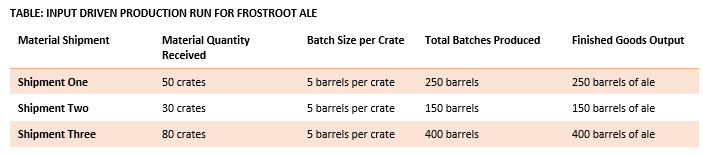
When Frostroot Barley arrives from Icewind Dale, the Copperleaf Brewery begins a new brewing cycle. Barley cannot remain in storage for long, so production is triggered by shipments.

The table below shows how incoming material drives production volume.

This method keeps taverns supplied but increases storage during heavy harvest seasons.

Worked Example Two: Output Driven Example: Enchanted Shields in Waterdeep

The Arcane Smiths Hall starts production only when a signed order arrives. Mithral Dust and Phoenix Plume are tracked tightly by the Artificers Union, which makes this method ideal.

The table shows how materials are allocated only after orders are logged.

This approach protects rare resources and ensures predictable delivery.

Worked Example Three: Input Driven Example with Variable Outputs: Whole Animal Disassembly in Daggerford

When local farmers bring cattle to the Daggerford Butcher Hall, production begins immediately. This is input-driven because the animal itself is the trigger. One animal, however, can be broken into multiple cut profiles, each requested by nearby markets.

The final output varies because cutters choose different profiles based on condition, size, and planned sales.

The table below shows how three animals can produce different cut mixes.  Each cut type has a standard yield range, but the actual yield depends on the animal’s size and the chosen breakdown pattern.

How This Works in Practice

The Butcher Hall begins work as soon as animals arrive. The cutters select the breakdown style based on:

  • Market demand in Waterdeep or Baldur’s Gate
  • Condition and age of the animal
  • Local festival needs
  • Storage space and salt levels
  • Order patterns from nearby taverns

This produces variable outputs and makes production unpredictable.
It is a classic input-driven scenario because cutters respond to the arrival of livestock rather than to a fixed customer order.

This method is standard across Faerûn, where livestock flows depend on weather, harvesting, grazing conditions, and the health of nearby herds.

Realms Aware Considerations

Faerûn’s regions shape the choice of method.

  • Livestock production in Daggerford follows input cycles tied to farm supply.
  • Wandering herds in Amn cause irregular arrivals for local butcher halls.
  • Enchanted workshops in Waterdeep use output cycles to protect rare essence materials.
  • Coastal trade houses in Calimport favor output cycles for high-value seafood that must be allocated by order.

Final Thoughts

Input-driven manufacturing converts available goods into stock as soon as materials arrive. Output-driven manufacturing produces only when the market demands it. The Waterdeep Trading Company uses both across Faerûn to keep trade stable, predictable, and profitable.

Animal disassembly adds an extra layer of complexity, since a single input can yield many different outputs. This makes the method valuable for regions with active livestock markets and diverse customer needs.


Support the AD&D365 Project on Patreon.  To grow this world, we’ve launched an official Patreon where supporters can gain access to exclusive content, tools, training labs, and even influence the future of the project. Your support fuels more than just development ,  it expands the guildhall, forges new scrolls, and empowers the next generation of configuration wizards.  Begin your journey: https://www.patreon.com/adnd365/

A Grateful Salute to Our Patrons.  To all those who stand behind the vision, thank you for helping bring this world to life. Our Benefactors, Andre Breillatt, and Eryndor Fiscairn, your boundless generosity fuels the arcane core of this project. Without your magic, the weave would falter. Our Apprentices, the spell engines turn and the training labs thrive thanks to our current Apprentices: Michael Ramirez and Andreth Bael’Rathyn. Special thanks to our past Apprentices, whose contributions helped us get here:  Ralf Weber, Wendy Rijners, Shashi Mahesh, Julia Tejera, Ben Ekokobe, Tiago Xavier, Naveen Boyinapelli, Marcos Tadeu Wolf, Kathryn Greene, Jason Brown, Mark Christy, and Ashish Singh. Our Initiates, Gregory Brigden, and Martin Grahm, your commitment marks the start of the deeper path, stepping beyond mere observation into the active shaping of this realm. Our Followers, your steady presence along the journey is a beacon of encouragement:  Eric Shuss, Sunil Panchal, Sarah D. Morgan, Nick Ramchandani, Daniel Kjærsgaard, and Tomasz Pałys. And our Voyeurs, Harry Burgh, Abdelrahman Nabil, and Basil Quarrell, ever watching from the shadows, clearly intrigued… but not enough to part with a single gold piece. Your silent curiosity is noted, and mildly judged.

Want to design your own economic models in Faerûn?  Get your own AD&D365 Environment and guides at adnd365.com/start, and request access to the public view of the current database at https://public.adnd365.com – Login npc@adnd365.com, Password N0nPl@yC#822!