Manufacturing Event Rolls in Faerûn: The Complete Guide to Shop Floor Uncertainty: Dice Tables for What Happens on the Shop Floor
Inside the workshops, forges, distilleries, and alchemical halls of Faerûn, production is never fully calm. Heat, magic, labor, weather, and supply all press against the work at once. The Waterdeep Trading Company accepts that no day of manufacturing is ever routine, even when the process is well known.
Every batch forged, every potion brewed, every enchantment laid carries the weight of a hundred small variables. A blacksmith’s fatigue. A sudden chill in the stone. A rune drawn half a degree off true. These moments, small as they are, compound into delays, waste, rework, or triumph.
This article provides comprehensive dice-rolling tables that model manufacturing events. These tables introduce risk, delay, loss, gain, and insight into production runs. They serve as narrative, training, and simulation tools to explain why strong controls, buffers, and records matter in the workshops of the Realms.
Each table is rolled at a defined point in the manufacturing cycle. Results should be logged as production notes, variances, or incident records. Over time, these records reveal patterns that inform better planning, stronger controls, and smarter resource allocation.
The Waterdeep Trading Company does not fear these problems. It embraces them. Because understanding variance is the first step toward mastering it.
When to Roll: Timing and Frequency
Use these tables at clear moments in the production flow. Not every table must be rolled every time. The goal is pressure, not chaos. The following guidelines help determine when rolling is appropriate.
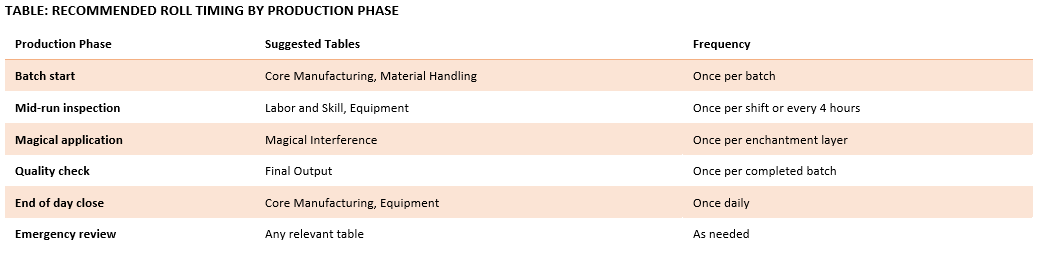
For high value items such as enchanted weapons, magical scrolls, or alchemical elixirs, roll more frequently. For bulk goods like rope, nails, or simple cloth, roll once per day or once per large batch.
Core Manufacturing Event Roll
This table represents the general state of the shop floor during a production run. Roll once per batch using a d20. This is the foundational role that sets the tone for all other checks.
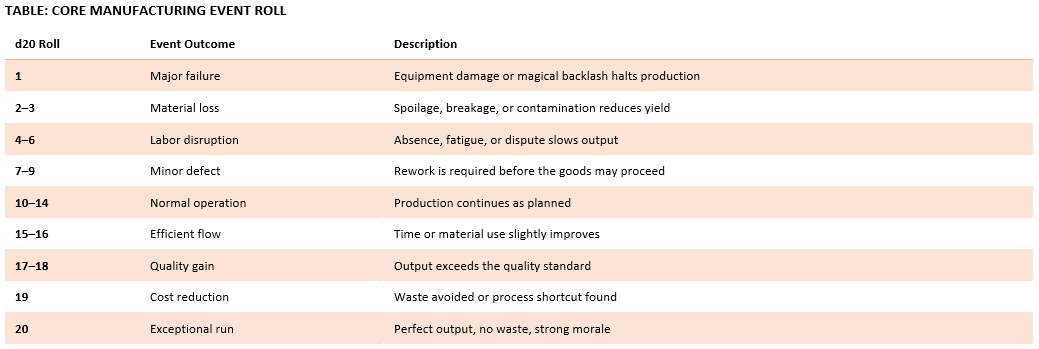
This table sets the batch tone and indicates which deeper tables should be rolled next. A major failure on this roll means you should roll on the Equipment table to determine what broke. Material loss triggers a Material Handling roll to understand the source.
Material Handling Events
This table shows how raw goods are issued, stored, or staged. Roll a d12 when materials are drawn into production. Material events often explain inventory discrepancies identified during cycle counts or month-end reconciliations.
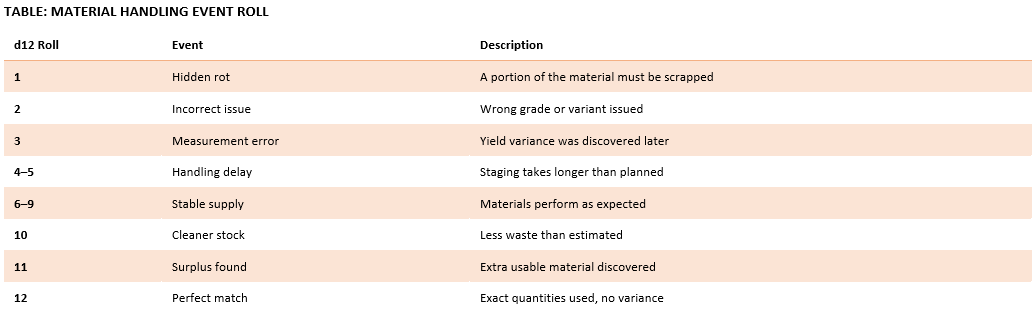
When a material event occurs, the production scribe must record it on the batch traveler. Hidden rot may result in an immediate shortage that requires additional requisitions. Measurement errors often appear during final reconciliation when expected versus actual usage is compared.
Labor and Skill Events
This table reflects the people doing the work. Roll a d12 during mid-run inspection. Labor is the most variable component in any workshop, and these events capture the human element behind every forged blade and stitched boot.
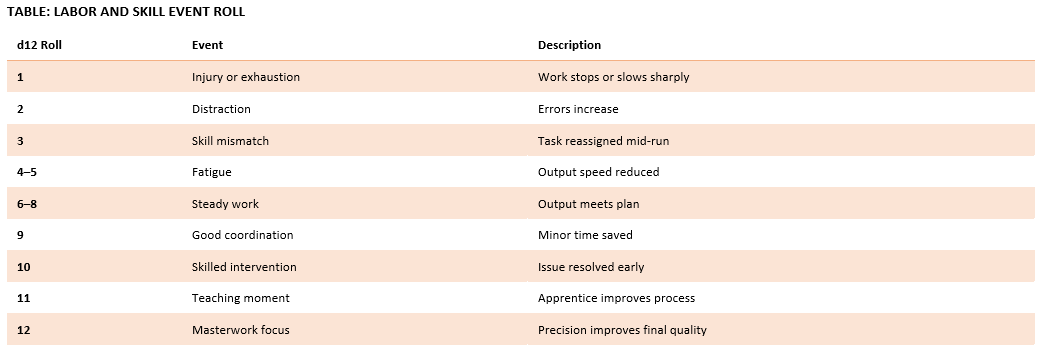
Labor events often affect both speed and quality at once. An injury may halt work for hours while a replacement is found. A teaching moment may slow the current batch but improve future runs. These outcomes should be recorded in the labor log and reviewed during weekly production meetings.
Equipment and Tool Events
This table represents tools, furnaces, presses, stills, or arcane devices. Roll a d10 when equipment is heavily used. Equipment is the backbone of consistent output, and failures here cascade into cost overruns and schedule delays.
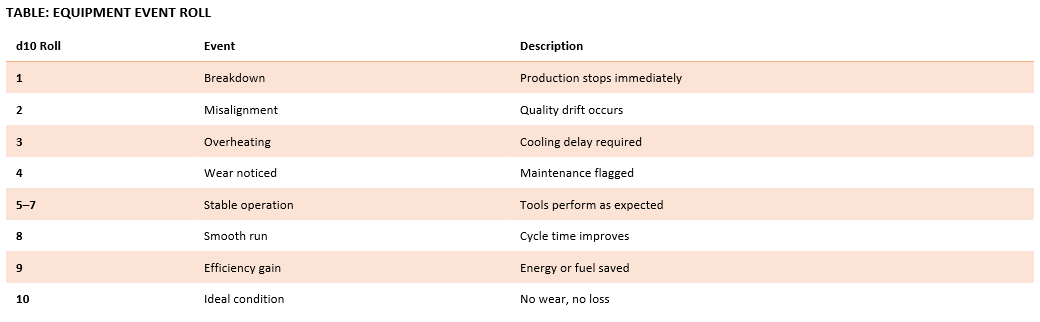
Equipment events explain maintenance backlogs and unplanned downtime. A breakdown on roll 1 requires an immediate repair work order and may delay shipments by days. Efficiency gains on roll 9 should be documented so the workshop master can replicate the conditions in future runs.
Magical Interference Events
If magic is involved, roll this table once per batch using a d8. Magical production introduces unique risks tied to ambient arcane energy, rune stability, and spell containment. Even experienced enchanters cannot fully control every variable.
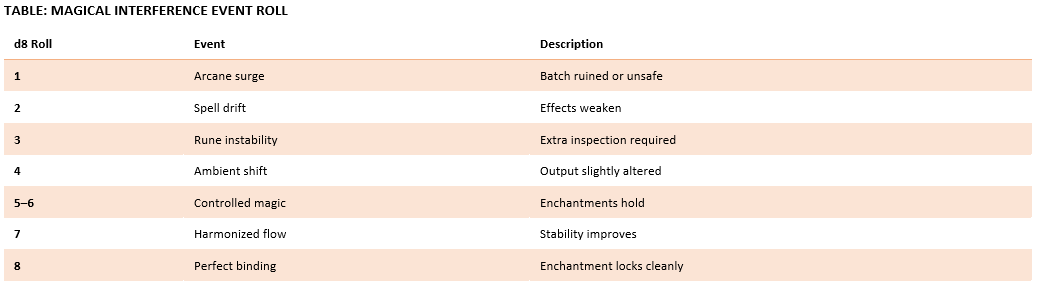
Magical events often justify extra inspection steps or batch holds. An arcane surge on roll 1 may require the entire batch to be destroyed and disposed of safely. Perfect binding on roll 8 means the enchantment is exceptionally stable and may command a premium price.
Final Output and Packaging Events
This table reflects what happens after production finishes. Roll a d12 at batch close. Final output events determine whether goods are ready for shipment, need rework, or exceed expectations.
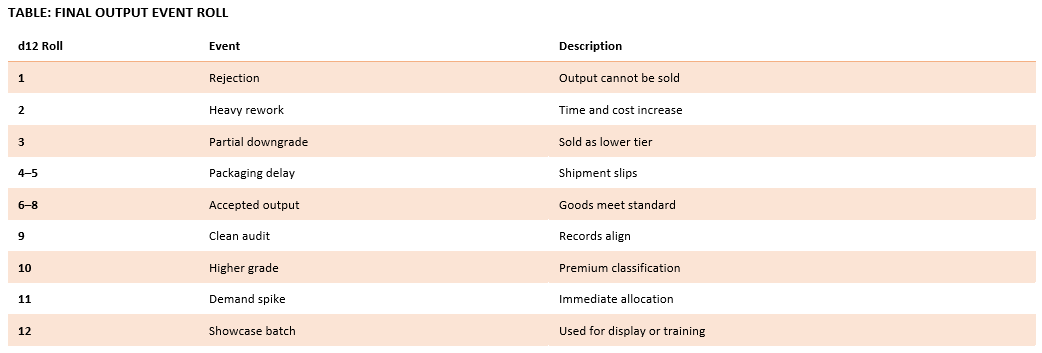
This table often feeds pricing and allocation decisions. A rejection on roll 1 results in total loss: the batch must be scrapped or salvaged. A showcase batch on roll 12 may be sent to the Waterdeep showroom or used in negotiations with high-value clients.
Additional Event Tables for Complex Operations
Weather and Environmental Events
Weather affects outdoor work, drying times, and material stability. Roll a d10 when production is exposed to the elements or relies on natural conditions.
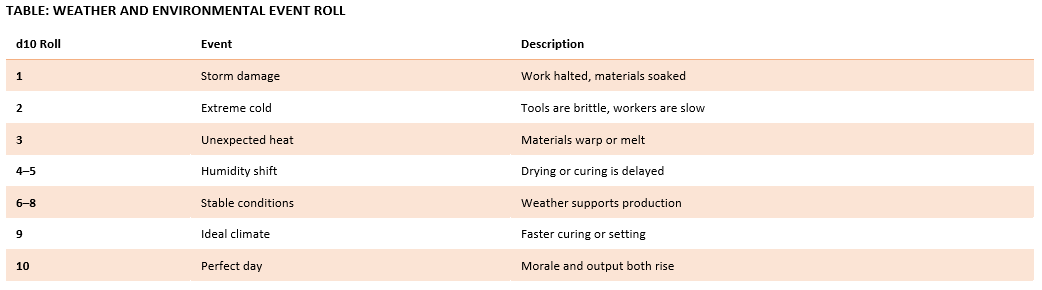
Weather events are common in shipyards, tanneries, dye houses, and potion gardens. A storm on roll 1 may ruin an entire week’s worth of drying hides. Perfect weather on roll 10 accelerates schedules and reduces cost.
Supply Chain Disruption Events
This table represents issues beyond the workshop walls. Roll a d8 when waiting on critical materials, subcontractor deliveries, or guild approvals.
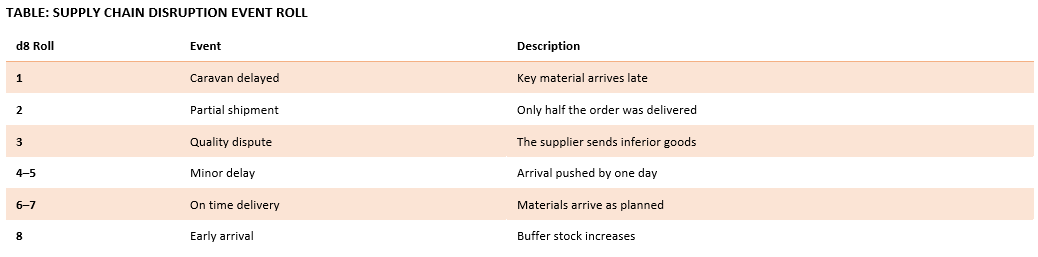
Supply chain events cascade into manufacturing schedules. A delayed caravan on roll 1 may force the workshop to halt or switch to a different product. Early arrival on roll 8 enables work to begin ahead of schedule.
Inspection and Compliance Events
Quality inspectors, guild auditors, and arcane regulators all visit workshops. Roll a d10 when an inspection is scheduled or occurs randomly.
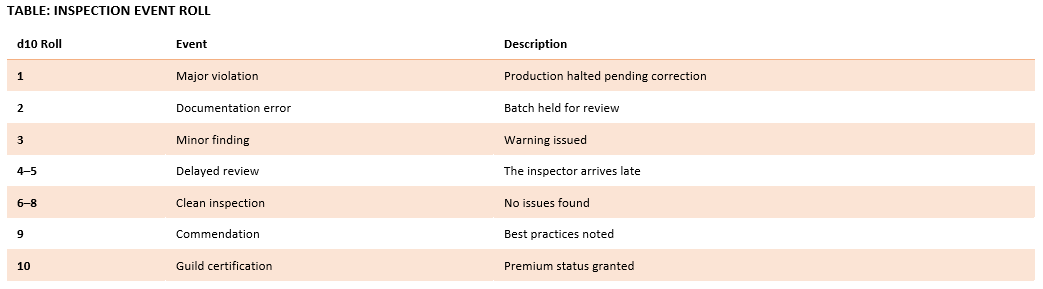
Inspection events affect reputation and market access. A major violation on roll 1 may result in fines and lost sales. Guild certification on roll 10 opens doors to exclusive contracts and higher pricing.
Interpreting Results and Taking Action
When an event is rolled, the production scribe must record the outcome and determine the response. Every roll has financial and operational consequences.
Response Framework by Event Severity
The following table provides guidance on how to respond to different events. Each response type includes suggested documentation and escalation paths.
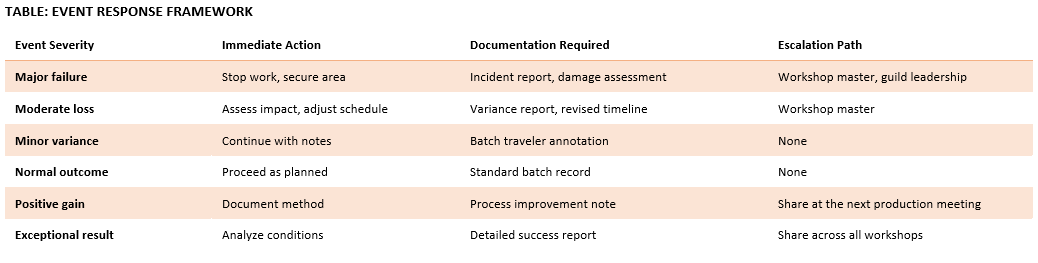
This framework ensures that events are handled consistently and that knowledge is captured for future improvement.
Recording Events: The Production Log
Every event should be logged in the production journal. This creates a historical record that can be analyzed for patterns, trends, and root causes. The log format should include the following fields.
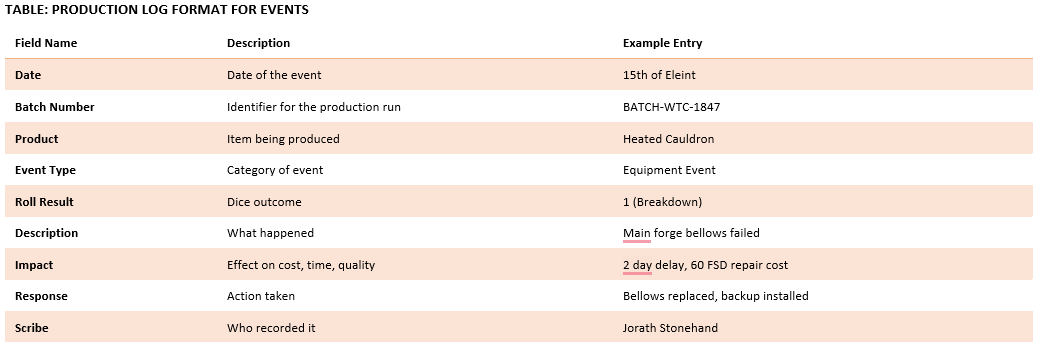
Over time, this log reveals which events are most common, which products are most vulnerable, and which workshops need additional support.
Worked Example: A Heated Cauldron Production Run
To demonstrate how these tables work together, here is a complete production scenario for a batch of five heated cauldrons. The Waterdeep Trading Company produces these in its Dock Ward foundry.
Batch Details
Product: Heated Cauldron
Batch Size: 5 units
Standard Cost per Unit: 285.00 FSD
Expected Total Cost: 1,425.00 FSD
Production Duration: 3 days
Day 1: Batch Start
Core Manufacturing Event Roll: d20 = 7 (Minor defect)
Material Handling Roll: d12 = 9 (Stable supply)
The batch begins with materials issued correctly. However, during the first day of forging, a minor defect was detected in the iron shaping. The rims are slightly uneven. This requires an additional hour of grinding and refinishing.
Cost Impact: +15.00 FSD labor (1 hour at 15 FSD per hour)
Schedule Impact: None (absorbed within shift)
Day 2: Mid Run Inspection
Labor and Skill Roll: d12 = 10 (Skilled intervention)
Equipment Roll: d10 = 8 (Smooth run)
The master smith notices the issue from Day 1 and adjusts the forming technique mid-run. This prevents further defects and slightly reduces cycle time. The forge operates smoothly throughout the shift.
Cost Impact: -10.00 FSD (time saved reduces labor cost)
Schedule Impact: 2 hours ahead of plan
Day 3: Magical Enchantment
Magical Interference Roll: d8 = 3 (Rune instability)
During enchantment, the heating runes show minor instability. The enchanter detects this during testing and re-inscribes two of the five cauldrons. This takes an additional three hours.
Cost Impact: +45.00 FSD arcane labor (3 hours at 15 FSD per hour)
Schedule Impact: 3 hours behind plan (net 1 hour behind overall)
Day 3: Final Output
Final Output Roll: d12 = 9 (Clean audit)
All five cauldrons pass final inspection with records fully aligned. The batch is approved for packaging and shipment.
Cost Impact: None
Schedule Impact: None
Final Batch Cost Summary
The following table shows how the event rolls impacted the total cost for this batch of five heated cauldrons.

The batch finished with a total variance of 50.00 FSD, or 3.5 percent over standard cost. This is within acceptable tolerance and can be absorbed into normal pricing. The production log notes that skilled intervention is the best practice for future runs.
How the Waterdeep Trading Company Uses These Rolls
These tables are not about chance alone. They create repeatable pressure that mirrors real operations. The company uses them in several ways.
Training and Simulation
New production scribes and workshop apprentices roll through simulated batches to learn how variance affects cost, time, and quality. They practice writing incident reports, calculating cost impacts, and deciding when to escalate issues.
Planning and Buffering
Historical event data informs planning assumptions. If Equipment Events show a 15 percent breakdown rate over six months, the company schedules preventive maintenance more frequently and keeps backup tools on hand.
Variance Analysis
Event rolls provide a structured way to explain why actual costs differ from standard costs. Instead of vague entries like “production issues,” the ledger shows “Equipment breakdown on Day 2, repair cost 60 FSD.”
Process Improvement
Positive events, such as skilled interventions or efficiency gains, are studied and replicated. The company documents the conditions that led to success and trains other workers in the technique.
A good company does not avoid events. It prepares for them, learns from them, and becomes stronger because of them.
Event Frequency by Product Type
Not all products face the same level of risk. The following table provides guidance on how often to roll based on product complexity and value.
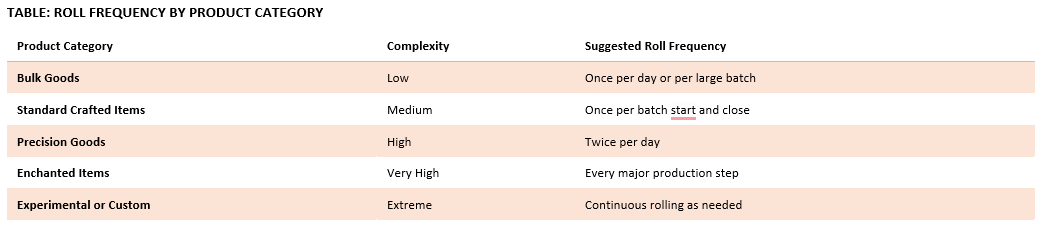
Bulk goods like nails, rope, or simple pottery have fewer variables. Enchanted weapons, alchemical compounds, and magical scrolls demand constant attention and more frequent checks.
Compound Event Scenarios
Sometimes multiple events occur in sequence or concurrently. These compound scenarios test the workshop’s resilience and the production team’s skill.
Example Compound Event: Storm During Enchantment
Scenario: A storm strikes (Weather Event roll = 1) while enchanting cauldrons (Magical Interference roll = 2). The storm disrupts ambient arcane energy, causing spell drift.
Response:
- Halt enchantment immediately to prevent arcane surge.
- Secure materials and equipment.
- Resume enchantment after the storm passes, re-inscribing affected runes.
- Log both events with a full impact assessment.
Cost Impact: 80.00 FSD (lost time, rework, materials ruined by moisture)
Schedule Impact: 1 full day delay
Compound events reveal weak points in process design and highlight the need for contingency plans.
Final Thoughts
Manufacturing in Faerûn is shaped by hands, heat, tools, and magic. Dice tables give structure to uncertainty and help explain why strong systems matter even on good days.
These rolls do not replace good management. They enhance it. They teach scribes to expect variance, record it clearly, and respond with skill rather than panic. Over time, a workshop that uses these tables will build a deeper understanding of its own rhythm, strengths, and fragilities.
The Waterdeep Trading Company knows that mastery comes not from avoiding trouble, but from meeting it with prepared hands and clear minds.
Use these tables to teach, to simulate, and to tell better operational stories inside the workshops of Faerûn.
This interplay of principles produces financial statements that outside parties can trust, management can use to make decisions, and auditors can verify. The result is a shared language of commerce understood throughout Faerûn.
Support the AD&D365 Project on Patreon. To grow this world, we’ve launched an official Patreon page where supporters can access exclusive content, tools, and training labs, and even influence the project’s future. Your support fuels more than just development; it expands the guildhall, forges new scrolls, and empowers the next generation of configuration wizards. Begin your journey: https://www.patreon.com/adnd365/
A Grateful Salute to Our Patrons. To all those who stand behind the vision, thank you for helping bring this world to life. Our Benefactors, Andre Breillatt and Eryndor Fiscairn‡, your boundless generosity fuels the arcane core of this project. Without your magic, the weave would falter. Our Apprentices, the spell engines turn, and the training labs thrive thanks to our current Apprentices: Michael Ramirez and Andreth Bael’Rathyn‡. Special thanks to our past Apprentices, whose contributions helped us get here: Ralf Weber, Wendy Rijners, Shashi Mahesh, Julia Tejera, Ben Ekokobe, Tiago Xavier, Naveen Boyinapelli, Marcos Tadeu Wolf, Kathryn Greene, Jason Brown, Mark Christy, and Ashish Singh. Our Initiates, Jesper Livbjerg, Peter Lorre, Gregory Brigden, and Martin Grahm, your commitment marks the start of the deeper path, stepping beyond mere observation into the active shaping of this realm. Our Followers, your steady presence along the journey is a beacon of encouragement: Rusty Cavalier, Eric Shuss, Sunil Panchal, Sarah D. Morgan, Nick Ramchandani, Daniel Kjærsgaard, and Tomasz Pałys. And our Voyeurs, Harry Burgh, Abdelrahman Nabil, and Basil Quarrell, ever watching from the shadows, clearly intrigued… but not enough to part with a single gold piece. Your silent curiosity is noted and mildly judged.
Want to design your own economic models in Faerûn? Get your own AD&D365 Environment and guides at adnd365.com/start, and request access to the public view of the current database at https://public.adnd365.com – Login npc@adnd365.com, Password N0nPl@yC#822!
 A Tinkerers Notebook