Researching the Unbuildable: How the Waterdeep Trading Company Evaluates Restricted Materials Without Ever Making Them
For the Waterdeep Trading Company, some ideas are valuable because they should never move beyond parchment. Restricted and volatile materials sit in that space. They promise force, speed, and leverage, yet they also carry risk that can harm workers, cities, and the balance sheet.
Research in this context is not about mixing, testing, or producing. It is about deciding early, clearly, and defensibly whether an idea should stop before any contract, caravan, or vault door is opened.
This article outlines how feasibility research is conducted for restricted materials. It integrates mining reality, custody discipline, routing analysis, and full risk costing into a single go/no-go decision.
Restricted Materials as a Research Category
Restricted materials are regulated inputs that remain stable when sealed and separated, yet become dangerous when mishandled or combined. Cities permit the extraction and movement of materials only for licensed civic, mining, or construction purposes.
The research question is simple.
Can the company source, store, move, insure, and account for these materials without crossing legal, ethical, or public safety lines?
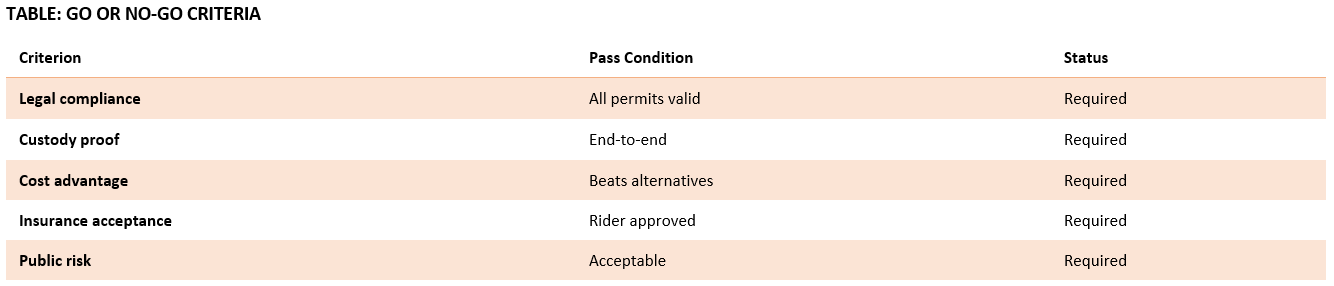
If that answer is not a clear yes, research ends.
Why Feasibility Comes Before Trade
Feasibility research exists to stop bad ideas cheaply.
Before any agreement is signed, three questions must be answered.
- Is the supply real across seasons and regions?
- Is custody defensible from the point of extraction to the final handover?
- Does total cost still make sense once risk replaces optimism?
Failure on any point is a stop, not a delay.
Mining Reality and Supply Truth
Mining defines availability long before pricing or routing is discussed. This table shows the sources of restricted inputs and the verification procedures employed in the research.

Research records historical output, shutdowns, and disruptions by region code. Forest closures, flooded caverns, and failed roads are treated as expected events rather than surprises.
Custody as a Feasibility Gate
If custody cannot be proven on paper, the feasibility fails immediately. This table lists the controls that must be in place before approval.

Custody is not an operational detail. It is a research filter.
Routing Without Handling
Routes are evaluated as paper exercises using prior caravan logs, guard rosters, and weather records. No trial movement occurs. This table shows why routing is a research activity.

If a route cannot be defended in writing, it does not advance.
Costing Research Before Orders Exist
Research costing is intended to reveal hidden weight early. This table presents a conservative cost view in FSD that includes compliance and risk considerations.
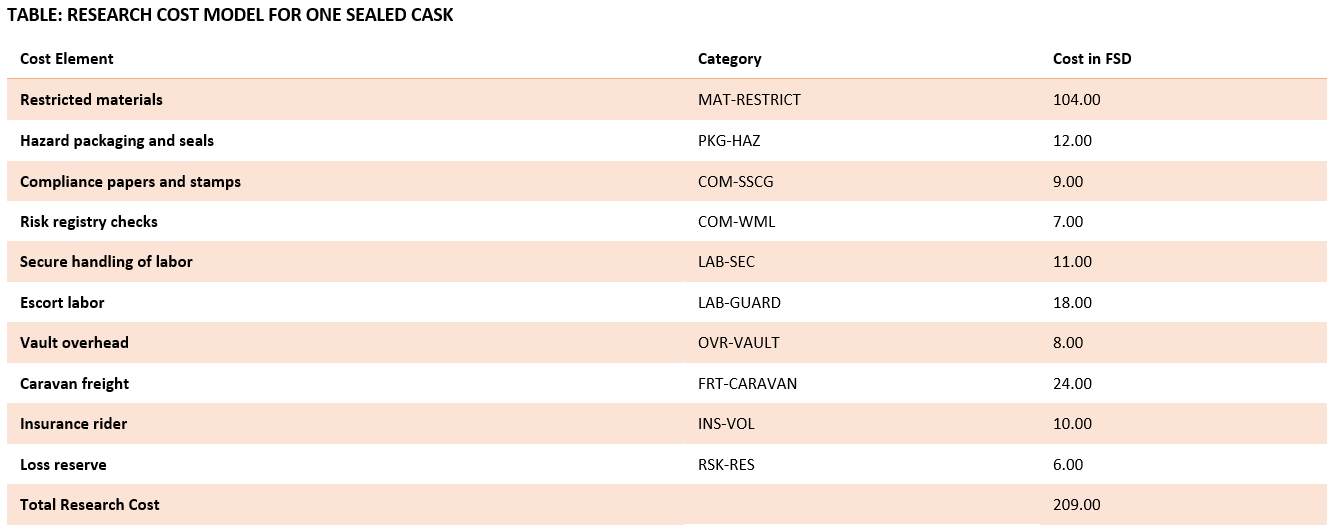
This total is then compared to non-restricted alternatives. In many cities, spellwork or mechanical methods cost less once risk is priced honestly.
Alternatives as Part of Feasibility
A feasibility study is incomplete without substitutes. This table supports risk-aware decision-making.

Alternatives often end the discussion.
Governance and the Final Gate
Research closes with a joint review. City law, temple guidance, and guild policy are considered together. One objection is sufficient to stop the effort.
Final Thoughts
Most ideas should remain unbuilt. Feasibility research proves that restraint is a core business skill. When mining limits, custody exposure, routing risk, and full cost are placed side by side, many proposals end prematurely.
That outcome protects workers, cities, and the coin. That is success.
Support the AD&D365 Project on Patreon. To grow this world, we’ve launched an official Patreon page where supporters can access exclusive content, tools, and training labs, and even influence the project’s future. Your support fuels more than just development; it expands the guildhall, forges new scrolls, and empowers the next generation of configuration wizards. Begin your journey: https://www.patreon.com/adnd365/
A Grateful Salute to our Patrons. To all those who stand behind the vision, thank you for helping bring this world to life. Our Benefactors, Andre Breillatt and Eryndor Fiscairn‡, your boundless generosity fuels the arcane core of this project. Without your magic, the weave would falter.
Our Apprentices, the spell engines turn, and the training labs thrive thanks to our current Apprentices: Michael Ramirez and Andreth Bael’Rathyn‡. Special thanks to our past Apprentices, whose contributions helped us get here: Ralf Weber, Wendy Rijners, Shashi Mahesh, Julia Tejera, Ben Ekokobe, Tiago Xavier, Naveen Boyinapelli, Marcos Tadeu Wolf, Kathryn Greene, Jason Brown, Mark Christy, and Ashish Singh.
Our Initiates, Jeff Stiles, Harry Burgh, Jesper Livbjerg, Peter Lorre, Gregory Brigden, and Martin Grahm, your commitment marks the start of the deeper path, stepping beyond mere observation into the active shaping of this realm.Our Followers, your steady presence along the journey is a beacon of encouragement: Rusty Cavalier, Eric Shuss, Sunil Panchal, Sarah D. Morgan, Nick Ramchandani, Daniel Kjærsgaard, and Tomasz Pałys.
And our Voyeurs, ever watching from the shadows, clearly intrigued… but not enough to part with a single gold piece. Your silent curiosity is noted and mildly judged.
Want to design your own economic models in Faerûn? Get your own AD&D365 Environment and guides at adnd365.com/start, and request access to the public view of the current database at https://public.adnd365.com – Login npc@adnd365.com, Password N0nPl@yC#822!
 A Tinkerers Notebook