Rolling Cart Inventory Management in Faerûn: Managing Materials, Par Levels, and Restocking for the Waterdeep Trading Company
Abstract
Rolling cart inventory management is the practice of treating mobile material carts as formal, governed sub-locations within a warehouse structure. This article explains how the Waterdeep Trading Company assigns items to carts, sets par levels to prevent stockouts, and follows a disciplined restocking cycle across its forge halls, enchanting workshops, and dispatch stations. Operations managers, materials planners, and guild inventory stewards will find this guide useful for establishing or improving cart-level controls at any site across Faerûn.
Introduction
Across the markets of Waterdeep, within the forge halls of Baldur’s Gate, and along the trade routes stretching toward Silverymoon, the Waterdeep Trading Company relies not only on grand warehouses and guarded vaults, but on something far humbler: the rolling cart.
Whether stationed beside an enchanter’s bench, a blacksmith’s anvil, or a packing table in the dispatch hall, rolling carts act as mobile inventory nodes. When managed well, they reduce wasted motion, prevent stockouts, and protect margins. When neglected, they become silent drains on coin and productivity.
In a formal inventory structure, a rolling cart is treated as a sub-location within a warehouse. Each cart carries its own assigned site, warehouse code, location identifier, storage dimension group, and default replenishment policy. Rather than forcing artisans to retrieve materials from a distant rack or vault, carts position high-usage items within arm’s reach. This increases throughput and reduces idle labor, and, from a materials management standpoint, the cart serves as a controlled buffer between bulk storage and production consumption.
What Is Rolling Cart Inventory Management?
Rolling cart inventory management is the structured control of materials stored in mobile carts that support production, repair, enchantment, or packing operations. It includes defining which items belong on each cart, setting minimum and maximum quantities, tracking consumption against production orders, replenishing from central warehouse stock, and counting inventory on a scheduled basis.
Unlike primary warehouse inventory, cart inventory turns quickly and is at a higher risk of shrinkage, misplacement, or undocumented use. For that reason, governance must be tighter, not looser.
Why It Matters
Poorly managed carts lead to hidden shrinkage, duplicate purchases, production delays, and the need for emergency procurement at premium prices. Across multiple sites and product lines, these losses compound quickly and erode the margins that keep a trading company competitive.
Well-managed carts produce measurable gains: reduced idle labor time, lower overall warehouse movement, predictable consumption trends, and improved gross margin control. Rolling carts may seem modest in isolation, but across the full network of Waterdeep Trading Company operations, their collective financial impact is anything but minor.
Materials Management at the Cart Level
Rolling carts typically hold fast-moving raw materials, small components and fittings, consumables such as oil, flux, ink, or arcane dust, and frequently used enchanted parts. The Waterdeep Trading Company assigns each cart to a functional area aligned with production routing.
The table below lists the standard cart types used across Waterdeep Trading Company operations, along with their assigned areas and typical contents.
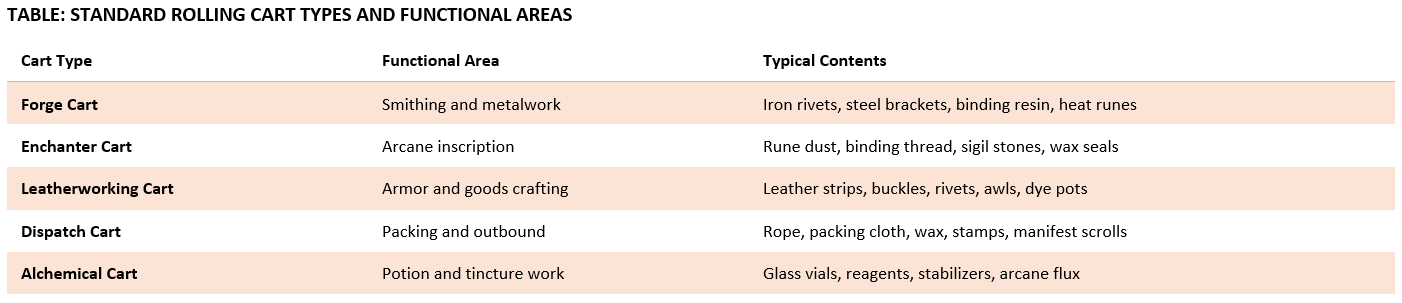
Each cart has a predefined item list that aligns with its production routing. Only approved items may be stocked; no bulk reserve inventory is held on carts. Every withdrawal must be posted to a production or service order, and each cart is assigned to a named, responsible guild member. This transforms the cart from a loose supply tray into a managed micro-warehouse.
Establishing Par Levels
Par levels define how much of each item must remain on the cart to support uninterrupted operations. The Waterdeep Trading Company uses a straightforward but disciplined formula:
Daily Usage multiplied by Lead Time, plus Safety Buffer, equals Par Level.
The safety buffer accounts for demand spikes, delivery delays, and seasonal variation. Without it, even a single missed replenishment can halt production run and trigger costly emergency procurement.
The table below shows a sample par configuration for a Forge Cart, including the maximum working quantity, the replenishment trigger point, and the required buffer to prevent disruption.

Par levels are reviewed quarterly or whenever demand patterns shift significantly. Sites operating in remote or high-risk locations should increase safety buffers to account for longer, less predictable lead times.
The table below shows how par level adjustments might apply across different regions of Faerûn for the same item.

This comparison illustrates why a single company-wide par level is insufficient. Each site must be assessed on its own supply conditions.
Restocking Process and Governance
Restocking is not a casual refill. It follows a defined workflow that ensures every movement of materials is recorded and verified. The five steps below represent the standard restocking cycle used by the Waterdeep Trading Company.
Step 1. Consumption Posting. Materials issued from the cart must be tied to a production order, sales order, or internal job before they leave the cart location. Unposted withdrawals are a primary source of inventory shrinkage and must be treated as a control failure.
Step 2. Reorder Trigger. When the on-hand quantity reaches the reorder point, a replenishment request is generated automatically or flagged to the cart steward. The trigger should be monitored daily in high-volume environments.
Step 3. Internal Transfer. Warehouse staff transfer the required materials from bulk storage to the cart location using a formal transfer journal. No materials should move without a corresponding document, even for internal movements.
Step 4. Verification Count. The cart steward confirms that quantities match the transfer journal before providing sign-off. Discrepancies must be investigated before the transfer is closed.
Step 5. Audit Cycle Count. Due to high turnover, carts are counted weekly as part of the standard inventory audit cycle. Surprise counts should also be performed at least monthly to identify unrecorded withdrawals and assess compliance.
Replenishment Models
The Waterdeep Trading Company applies three replenishment models depending on material type, volume, and supply conditions. Selecting the wrong model for a given item can result in either chronic shortages or wasteful overstocking.
Fixed Par Replenishment refills the cart back to its full par level each time a reorder is triggered. This model works best for high-volume standard components consumed consistently across production runs. It is simple to manage and easy for cart stewards to verify at a glance.
Minimum Trigger Replenishment initiates a restock only when the reorder point is reached. This suits mid-volume materials where demand is predictable but not constant. It reduces unnecessary material movement and keeps warehouse labor costs lower than with a fixed-par approach.
Demand-Based Replenishment ties restocking to scheduled production orders rather than fixed thresholds. This model is best for rare arcane components or controlled substances where over-ordering carries risk, whether due to cost, storage restrictions, or guild regulations. Restocking quantities are calculated from confirmed order requirements rather than standing par targets.
The table below summarizes when each model is most appropriate.

Risk Areas and Control Measures
Rolling carts introduce risk due to their mobility and accessibility. Unlike fixed rack locations, carts can be moved, shared between work areas, or accessed by personnel outside their assigned team. The table below identifies the most common risk categories and the controls the Waterdeep Trading Company applies to address them.
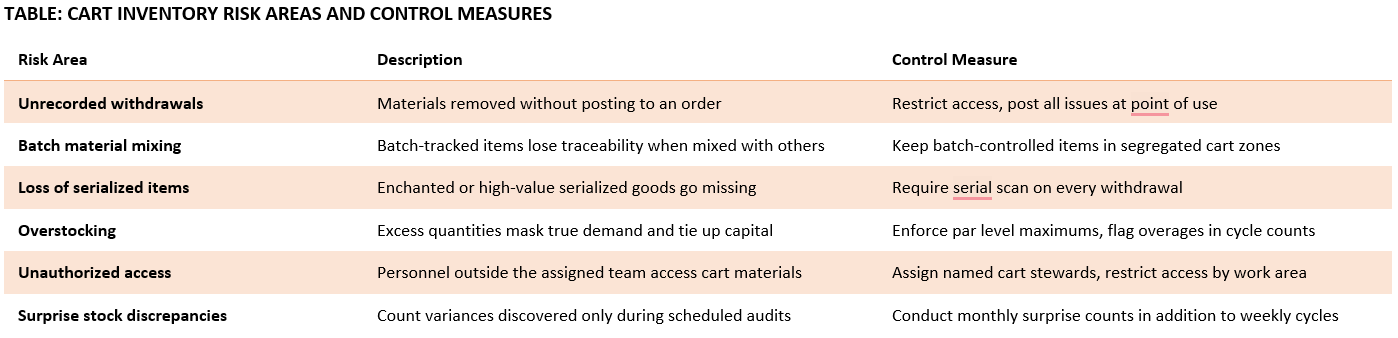
Proper tracking dimensions prevent traceability failures and protect the integrity of production records. Any control gap at the cart level can propagate through costing, batch tracking, and financial reporting, making what appears to be a minor operational issue into a significant audit concern.
Realms-Aware Considerations
The geography and infrastructure of Faerûn introduce variables that a simple par formula cannot always capture. In cities like Waterdeep, lead times are short, and replenishment can occur daily. In frontier settlements near the High Forest or along extended caravan routes, restocking delays may span several tendays, requiring par levels to be increased accordingly.
Arcane materials also require special storage conditions, which can restrict which carts are permitted to carry them. Guild regulations may further define handling protocols, particularly for enchanted or alchemical components. Operations managers should review cart configurations whenever a new site is established or when trade route conditions change significantly.
Final Thoughts
Rolling carts are not minor conveniences. They are controlled inventory nodes that support production efficiency across Faerûn. When governed through disciplined materials management, defined par levels, and structured restocking, they strengthen operational reliability and protect the coin of the Waterdeep Trading Company. Even the smallest mobile shelf, when managed with care, contributes to stable margins and uninterrupted trade.
Support the AD&D365 Project on Patreon.
To grow this world, we’ve launched an official Patreon page where supporters can access exclusive content, tools, and training labs, and even influence the project’s future. Your support fuels more than just development; it expands the guildhall, forges new scrolls, and empowers the next generation of configuration wizards. Begin your journey: https://www.patreon.com/adnd365/
A Grateful Salute to Our Patrons
To everyone who supports this world, thank you for helping keep it alive and growing.
Our Benefactor: Andre Breillatt. Your generosity powers the heart of this project. Because of you, everything continues to grow and move forward.
Our Apprentices: Michael Ramirez and Andreth Bael’Rathyn‡. The engines keep turning, and the training halls stay alive because of you.
With special thanks to our past Apprentices, whose early support built the foundation: Ralf Weber, Wendy Rijners, Shashi Mahesh, Julia Tejera, Ben Ekokobe, Tiago Xavier, Naveen Boyinapelli, Marcos Tadeu Wolf, Kathryn Greene, Jason Brown, Mark Christy, and Ashish Singh.
Our Initiates: Sarah D. Morgan, Jesper Livbjerg, Harry Burgh, Martin Frahm, Gregory Brigden, and Peter Lorre. You’ve stepped beyond watching and into shaping what this becomes.
Our Followers: Rusty Cavalier, Eric Shuss, and Michael Ramirez. Your steady backing keeps progress steady.
Our Voyeurs (Free Members): Deborah, Zarana, Daniel Tchakounte, Will Morrison, Danuelle Geldenhuys, Stuart, JoeNorthMan, Kshitiz Sinha, Michael A., Danijel Vucic, Damio, Zamir Gori, LK, Reza Al, Amith Prasanna, Suprit Naregal, Monika Duplessis, Brianna Otto, PW, Laura J, Alan Megahy, Carsten, Carri, Marcel Barrow, Greg, Ahmet, Franky, Abdullah, Basil Quarrell, Abdelrahman Nabil, NPC, Manimaran Shanmugam, and Shoaib Rafi. Ever watching from the shadows, curious but not yet parting with a single gold piece. Your quiet interest is noticed and lightly judged.
Want to design your own economic models in Faerûn? Get your own AD&D365 Environment and guides at adnd365.com/start, and request access to the public view of the current database at https://public.adnd365.com – Login npc@adnd365.com, Password N0nPl@yC#822!
 A Tinkerers Notebook