Archive

Author Archives: B-List Microsoft Celebrity, Available for Weddings and Bar Mitzvahs

At the Waterdeep Trading Company, production efficiency is more than just a number on a ledger. It is the difference between an on-time delivery of potions to Silverymoon or a chaotic recall because a batch of fire resistance potions fizzled out mid-adventure. Whether we are bottling enchanted tonics or stitching high-grade leather satchels, the core of our operational success lies in the structure of our manufacturing routes.

And yes, routes are not just maps or travel paths. In manufacturing, a route is the formal recipe for how a product gets built, who does the work, in what order, using which tools, and for how long.

What Happens When Efficiency Drops?

Let us say you are running the Potionworks team, and you notice that the standard time to produce a batch of Potion of Giant Strength has slowly crept up by fifteen percent over the last quarter. It does not mean your alchemists are lazy. More likely, something in the route no longer reflects reality.

You might see results like this:

Where Route Adjustments Make the Difference

Adjusting a manufacturing route is not just about changing a number. It is about recognizing the evolving nature of work and making sure your systems reflect reality.

Update Task Durations

Add Alternate Operations

Reassign Resource Groups

Efficiency Tracking With Employee Profiles

Each worker has their own rhythm. Instead of a one-size-fits-all metric, track efficiency by skill, task type, and improvement over time.

Breaking Out Composite Steps

Some operations hide their inefficiencies inside multi-part steps. Separating them helps pinpoint exactly where slowdowns occur.

Quality Inspections Add Predictability

A well-placed inspection prevents rework, improves customer satisfaction, and gives employees more confidence in their work.

The Bigger Picture

Every route is a living system. Ingredients change. Regulations shift. Staff learn and grow. If the Waterdeep Trading Company kept its manufacturing routes static, we would be unable to handle product innovation, seasonal demand spikes, or guild audits.

By updating task durations, reassigning talent, building flexible alternatives, and embedding inspections, we create a production system that adapts with us. We do not just run a business, we run a guild-backed, customer-loved, efficiency-honed enterprise that runs like a dwarven clockwork engine.

Want to boost your own manufacturing efficiency and avoid magical misfires? Download the full Advanced Dungeons and Dynamics 365 guide at adnd365.com/start, and see it live in the public database at https://public.adnd365.com using:

Login: npc@adnd365.com

Password N0nPl@yC#822!
The Waterdeep Trading Company employs a wide range of talent—from guild-trained accountants in Baldur’s Gate to teleportation-circle custodians in Elturel. With such a diverse and magically-inclined workforce, offering the right benefits isn’t just important—it’s essential for survival, morale, and long-term productivity (especially in a realm where “occupational hazard” may include basilisk encounters).

But how do we track benefits, manage eligibility periods, and enable self-enrollment in a setting where both arcane scrolls and labor contracts exist side-by-side?

The answer lies in our adoption of Advanced Dungeons & Dynamics 365.

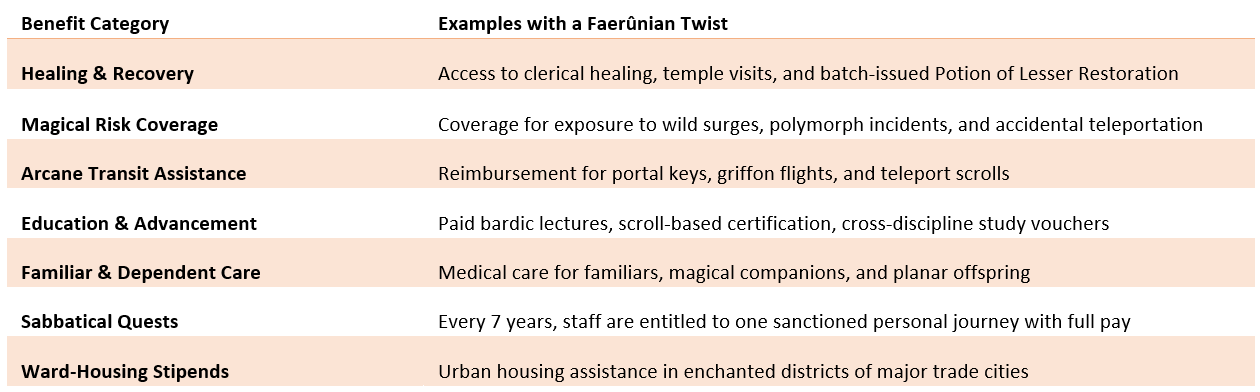
What Counts as a Benefit in Faerûn?

Employee benefits in Faerûn go well beyond the mundane. Here’s a breakdown of what we manage at WDTC:

Let the Adventurers Choose: Self-Service Enrollment

In the spirit of decentralization (and to avoid overworking our HR scribes), employee self-enrollment is a cornerstone of our benefit tracking system. Whether you’re a dwarven accountant working nights in Mithral Hall or a half-elf procurement officer stationed in Thay, you can manage your own benefits via the Employee Self-Service Portal in Dynamics 365 Human Resources.

Here’s how it works:

  1. Eligibility Flags: When a new employee is added, their race, class, guild affiliation, and role type automatically configure their base eligibility.
  2. Enrollment Periods: Two major periods are open annually — Greengrass (early spring) and Highharvestide (autumn harvest). A third “emergency re-enrollment” is available during Time of Troubles declarations.
  3. Benefit Elections: Employees can opt into available plans through an intuitive, portal-based interface. Each option includes a description, value in GP, duration, and special magical considerations.
  4. Familiar Enrollment: Employees with bonded companions can select add-on options for Familiar Healthcare, Companion Shadow Training, or Planar Travel Liability Coverage.

“I signed up for the Arcane Accidents Protection plan just in time—our wizard sneezed during inventory and turned me into a stool. That’s at least a Tier 2 incident,” — Nharra Feldspar, Junior Enchanter, Skullport Branch

Controlling Enrollment with Periods and Rules

Just like any good system of laws in Waterdeep, benefits come with timelines and compliance windows. Dynamics 365 allows us to define benefit periods, event-based eligibility, and waiting periods for risk-heavy roles.

Standard Enrollment Periods

Eligibility Conditions

  • Waiting Periods: Employees classified as “Adventurer Class II or higher” must wait 30 days before Magical Risk plans are active.
  • Guild Membership Dependencies: Benefits for potion-makers, for instance, require active status in the Healers & Herbalists Guild.
  • Location-Based Restrictions: Some plans (like “Underdark Relocation Stipends”) are only available to employees based in subterranean postings.

Automation with a Magical Touch

Here’s what makes the WDTC system so efficient:

  • Automated Alerts for enrollment deadlines sent via Sending Stones or enchanted scrollmail
  • Approval Workflows using customizable rules (e.g., benefits for a druid require Druid Circle co-signature)
  • Reporting and Audit Trails to track who enrolled, when, and how the benefits align with compensation benchmarks
  • Benefit Forecasting with Power BI to estimate potions consumed per department, scroll usage by guild, and familiars vaccinated

Final Thoughts

Managing benefits across Faerûn isn’t just about compliance—it’s about culture. By empowering our employees to enroll themselves, timing those decisions with meaningful in-world events, and tracking magical and mundane needs alike, the Waterdeep Trading Company sets a new standard in workforce support.

Whether you run a guild, a keep, or a kraken-hunting charter, there’s a lesson here: Magic might make anything possible—but good HR practices make it sustainable.

 Want to build your own portal for Faerûnian benefits management? Download the full implementation guides at adnd365.com/start and explore our working demo at https://public.adnd365.com

Login: npc@adnd365.com

Password: N0nPl@yC#822!

Your next sabbatical quest awaits—track it properly.

In Faerûn, the line between a laborer and a legend is paper-thin. One day, you’re lifting crates of trollbone whiskey in Baldur’s Gate, and the next, you’re rerouting magical freight through a planar junction beneath Waterdeep. The Waterdeep Trading Company has learned the hard way that tracking skills, certs, and classes are not optional; it is vital.

Using Microsoft Dynamics 365 Finance and Operations, the company now maintains a guild-standard record of worker classes, certifications, and performance history. This ensures the right person is sent to the right job, even if that job involves a magically unstable ale cask or a cursed batch of moonbeams.

The Corker Class System: A New Model for Faerûnian Labor

Just like adventurers level up, so do logistics workers, alchemists, enchanters, and dockhands. WDTC’s HR system uses corker classes to define key labor archetypes.

Sample Corker Classes and Skill Requirements

Each class includes promotion logic. For example, a Cratebound Initiate who earns CrateStacker II, completes three hazard reports, and passes a Strength challenge might ascend to Hauler Vanguard status.

Skill Matrix Management in Dynamics 365

With the Human Resources module, WDTC tracks each employee’s skill level in key domains using a custom matrix.

Example Skill Matrix for Employee Profile (Alyndra Swiftcart)

All skills are linked to a Learning Path, offering required training courses, cert renewals, or on-the-job challenges that grant advancement.

Certifications as Regulatory Keys

Certifications are not just trophies in Faerûn; they are legal permissions to perform work. A worker handling magical alcohol in Waterdeep must be certified by the Faerûn Brewers and Distillers Association and approved by the Watchful Order of Magists and Protectors.

Sample Certification Registry in D365

Certs are configured with expiration reminders, required recertifications, and workflow rules to prevent uncertified workers from being assigned to dangerous duties.

Self-Assessments and Performance Ratings

WDTC encourages self-awareness and growth through self-assessments. Workers evaluate their readiness for advancement, with ratings used by managers in promotion evaluations.

Managers respond with their own evaluations, stored in the same record using Dynamics 365 Performance Journals.

Advancement Paths with Built-In Leveling

Classes and certifications tie into a leveling system. Advancement happens when all conditions are met.

Advancement Conditions (Arcane Containment Tech to Lead Enchanter)

These conditions are stored in a Progression Tracker, with automated triggers once all requirements are fulfilled.

Closing Thoughts: More Than Just Labor

In a world where one miscast levitation spell can demolish a dockyard, the stakes of proper training are high. Tracking classes and certifications ensures that only the right hands touch volatile crates or negotiate with extraplanar customs officers.

With Dynamics 365, Faerûn’s leading trade companies can operate with safety, precision, and a surprising amount of class-based character progression.

Take the Next Step

Start building your skill and certification tracking system today by using the Bare Bones Configuration Guides at adnd365.com/start

You can also explore a live environment at https://public.adnd365.com

Log in with: npc@adnd365.com

Password: “N0nPl@yC#822!”

The Waterdeep Trading Company (WDTC) doesn’t just traffic in grain sacks and crossbow bolts. From spell-scrolls to silks, it handles a sprawling catalog of goods that straddle two very different economic planes: the mundane and the magical. And if there’s one thing Greta Ironfist has learned over the years, it’s this: you cannot value a crate of pickles the same way you value a Potion of Invisibility.

In this post, we explore how WDTC uses multi-ledger inventory valuation in Microsoft Dynamics 365 to accurately represent the true cost and value of its wildly diverse product lines.

The Problem: Two Economies, One Ledger?

Most trading companies operate within a single economic model. Standard costing methods like FIFO or Weighted Average are enough when you’re just shipping barrels of oil or bundles of lumber.

But for WDTC, the reality is more complex:

  • Mundane goods like iron nails or flour operate on predictable market logic.
  • Magical goods fluctuate based on arcane scarcity, planar trade politics, or adventuring trends.

Using a single valuation method across both types would either overstate the value of cheap goods or understate the risk in magical inventory.

The Solution: Valuation by Product Class in Dynamics 365

Using item model groups and inventory valuation methods, WDTC configured Dynamics 365 to assign different costing logic based on product category:

Example: Cloak vs Crate

Let’s break down two sales scenarios:

Cloak of the Emberward (Magical Item)

  • Purchase Cost (initial): 250 gp
  • Market spike after a regional fire elemental outbreak
  • Revaluation: 300 gp
  • Selling Price: 450 gp
  • Costing Method: Moving Average
  • Margin: 150 gp

Crate of Iron Nails (Mundane Item)

  • Purchase Cost: 10 gp
  • Stable demand across regions
  • Selling Price: 15 gp
  • Costing Method: FIFO
  • Margin: 5 gp

This separation ensures that magical price volatility does not distort the margin reports of common products, and vice versa.

Why It Matters to WDTC

  • Accurate financial reporting by product class
  • Better guild compliance when reporting to trade unions and arcane oversight bodies
  • Risk visibility for magical goods with erratic supply chains
  • Profit segmentation that separates stable trade income from speculative arcane revenue

Regional Valuation Adjustments

Faerûn isn’t one economy. It’s dozens. Prices vary by city, faction, and even by time of year.

For instance, Elixir of Haste sells at:

  • 200 gp in Waterdeep
  • 300 gp in Icewind Dale
  • 150 gp in Calimport

WDTC uses financial dimensions tied to region to track where margins are highest. This allows Greta to reroute magical inventory dynamically and ensure magical surplus in saturated markets is reallocated before losses hit the books.

Final Thoughts

Managing two economies under one roof is no easy task. But with the right inventory valuation configuration in Dynamics 365, the Waterdeep Trading Company turns complexity into clarity.

So next time you’re weighing whether to ship a box of rope or a case of scrolls, ask yourself: do you know what it’s really worth, and how it affects your ledger?


For more Faerûn-based business wisdom, get your copy of the guides at adnd365.com/start. You can also request access to our current demo database and see how it’s all set up. Just log in to https://public.adnd365.com using:

Email: npc@adnd365.com

Password: N0nPl@yC#822!

At first glance, commodity codes in Dynamics 365 might seem like a bureaucratic remnant of real-world customs offices. But within the fantastical framework of the Waterdeep Trading Company, they offer something far more powerful: order in a world of organized chaos.

Whether you’re dealing in fine dwarven ale, potion reagents, backpack bundles, or the occasional siege weapon, Waterdeep’s broad inventory poses a challenge that most companies never face. That’s where commodity codes come in.

Why Commodity Codes Matter (Even in Faerûn)

Commodity codes are structured classification tools used across Procurement, Inventory, Sales, and Regulatory Compliance in Dynamics 365. They’re often dismissed as optional metadata, but for the Waterdeep Trading Company, they serve as a universal language of trade.

Here’s why:

Real Magic: How Codes Function in Dynamics 365

Commodity codes live in the Product Information Management and Procurement and Sourcing modules. Their power emerges when you assign them to your released products and use them across:

  • Purchase order policies
  • Vendor agreements
  • Sales categories
  • Regulatory compliance (like Guild Law or Arcane Council mandates)

You can link commodity codes to categories like:

You can also customize these codes to reflect Faerûnian-specific classifications like:

  • COM-UNDR-DWVF: Dwarven-forged underdark tools
  • COM-PLAN-PORT: Planar transportation services
  • COM-FCEX-GRAIN: Commodity-traded grains on the Faerûn Commodities Exchange

Alignment with the Guilds and the Arcane Council

As seen in the ADND365 Business Administrator’s Guide, the economic powerhouses of Faerûn such as the Black Anvil Guild and Arcane Artificers & Alchemists Union impose strict guidelines on product sales, tariffs, and magical regulation.

Commodity codes make it easier for Waterdeep Trading Company to comply with:

  • Guild-specific trade reporting
  • Magical export laws (Thayan scroll compliance, for example)
  • Watchful Order requisition approvals

A Lesser-Known Feature, A Greater Advantage

Why don’t more Faerûnian businesses use commodity codes?

Because they’re hidden, buried in the configuration areas of Product Information Management, many overlook them in favor of simpler product categories or item groups. But for any organization dealing with high-mix, high-regulation inventory, they’re not optional—they’re foundational.

Let’s Get Nerdy: Automating with Code-Based Policies

Here’s a simple example. Say you sell both regular camping tents and magical tents that unfold into pocket dimensions. You don’t want the pocket-dimension ones sold unless the customer has a “Planar Goods License.”

Assign commodity codes like this:

  • COM-CAMP-TENT (mundane)
  • COM-PLNR-TENT (planar, regulated)

Then in your Sales order workflow policy, add logic:

If Commodity Code = COM-PLNR-TENT, require Customer Attribute = Planar Licensed.

Boom. Controlled sales. Reduced compliance risk. All with commodity code metadata.

Final Thoughts

At Waterdeep Trading Company, aligning the arcane and the mundane is part of the job. Commodity codes let you do just that, blending the sorcery of inventory complexity with the logic of digital systems.

Whether you’re classifying troll-skin rugs, enchanted carpets, or crates of vintage elven mead, commodity codes bring order to your catalog and power to your business rules.

Ready to build a system where even the Blackstaff could find your audit trail impressive?

Start building your Faerûnian back office now at adnd365.com/start

And request access to the public view of our current database at https://public.adnd365.com, logging in with

Username: npc@adnd365.com

Password: N0nPl@yC#822!

Mentorship in Faerûn is not a luxury. It is a necessity. From guild apprenticeships to arcane tutelage, structured knowledge sharing ensures the continuity of craft, character, and commerce. At the Waterdeep Trading Company, mentoring is formalized and tracked using Dynamics 365 Human Resources, transforming tradition into a measurable, strategic advantage.

Why Mentorship is Critical to the Company

In an operation as complex as the Waterdeep Trading Company, mentoring helps:

  • Reduce onboarding time for new hires
  • Prepare junior employees for leadership roles
  • Transfer critical knowledge from senior specialists
  • Reinforce guild-aligned values and conduct

Rather than rely on informal mentorships, the company uses Dynamics 365 to make these relationships visible and accountable.

Configuring Mentorships in Dynamics 365 Human Resources

Waterdeep’s HR team manages mentorships through the Employee Development workspace. The key components include:

Assigning Roles

Each participant is given a mentorship role, such as:

  • Mentor: Magical Goods Logistics
  • Protégé: Export Customs and Seafaring Law

These are linked to employee records for visibility in their development plans.

Creating Programs

Programs like Arcane Inventory Excellence or Trade Negotiation Bootcamp can group participants by focus area or department. Each program includes objectives, duration, and suggested mentor-protégé pairings.

Scheduling Sessions

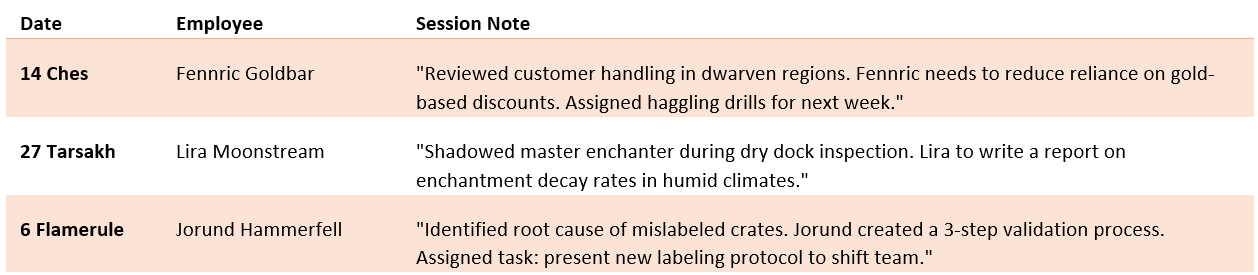
Mentorship sessions are scheduled as recurring activities with dates, goals, and progress fields. They appear in each employee’s timeline and can be logged for compliance or reporting.

Real Examples from Employee Notes

Performance Goals in Mentoring Programs

Every mentorship program includes a set of clearly defined performance goals, which are linked to the employee’s development plan and appraisal review. Examples include:

Measuring Success

Mentorship is not just about good intentions. Dynamics 365 helps turn qualitative progress into quantitative insight.

These measurements are tracked in the Performance and Development area, feeding directly into compensation review, succession planning, and certification tracking.

Conclusion

Mentoring in Faerûn is serious business. By integrating it into Dynamics 365 Human Resources, the Waterdeep Trading Company transforms mentorship from informal guidance to a structured development engine. Whether it is onboarding a new dockhand or preparing the next Director of Trade Routes, the system ensures every session is meaningful and measurable.

Start building your workforce of legends. Purchase the guides at adnd365.com/start, and request access to the public demo environment at https://public.adnd365.com

Login: npc@adnd365.com

Password: N0nPl@yC#822!

In a realm teeming with dragonfire hazards, magical regulations, and the occasional spontaneous planar rift, the idea of structured onboarding might seem like a low priority. But not for the Waterdeep Trading Company.

Whether you’re a seasoned mage joining the Arcane Logistics Division or a young dockworker hired by the Faerûn Dockworkers Federation to unload casks from Chult, starting a new job should never feel like being thrown into a gelatinous cube. That’s why Greta Ironfist, owner and visionary behind the Waterdeep Trading Company, implemented a comprehensive HR Onboarding Task Framework using Microsoft Dynamics 365 Human Resources.

Why Onboarding Matters in Faerûn

Onboarding in Faerûn isn’t just about setting up a workstation—it’s about surviving it. Misfile a wand shipment, and you might release a burst of wild magic. Confuse inventory from the Thayan Enclave with goods bound for Silverymoon? That’s not just a mistake, that’s a diplomatic incident.

At the Waterdeep Trading Company, onboarding serves three key purposes:

  1. Knowledge Transfer from veteran guild members to recruits.
  2. Compliance with guild and arcane trade laws.
  3. Role Readiness to ensure employees can handle enchanted inventory, volatile goods, and guild hierarchy expectations.

Structured Tasks = Faster Ramp-Up

Dynamics 365 Human Resources allows WDTC to predefine task sequences for each new hire. These are not just checkboxes—they’re embedded experiences.

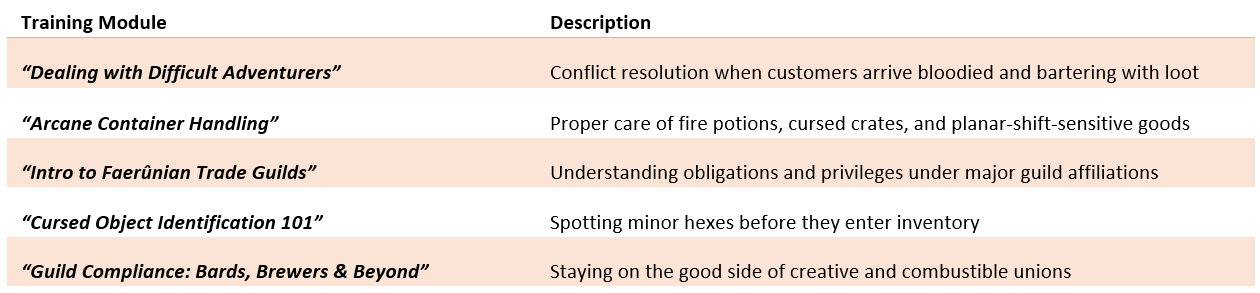
Here’s a look at the onboarding task structure:

Faerûn-Style Training Modules

The onboarding experience reflects the company’s deep integration with the culture and industries of Faerûn. Employees don’t just learn about spreadsheets and supply chains—they learn how to navigate a magically active, politically sensitive, and guild-controlled economy.

Some examples include:

These aren’t optional. They’re required by Waterdeep City Law and audited regularly by the Watchful Order of Magists and Protectors.

Automated, Personalized, and Role-Aware

Using Dynamics 365’s Onboarding Templates, the HR team tailors onboarding for various job families:

  • Warehouse Operatives get put on directed training paths that include enchanted lockpick safety.
  • Potion Engineers start with regulatory training on labeling and transmutation safety.
  • Merchant Liaison Officers receive cultural sensitivity training for dealing with nobility and underworld contacts alike.

Automated reminders and approvals ensure no task slips through the cracks, and hiring managers can track progress with real-time dashboards—whether they’re at the Castle Ward HQ or visiting the Daggerford outpost.

Results That Scale with Adventure

Since implementing the onboarding task framework, the Waterdeep Trading Company has seen:

  • 32% faster ramp-up for new logistics recruits
  • Reduced guild violations and near elimination of compliance fines
  • Improved inter-departmental collaboration, especially between Procurement and Alchemy

More importantly, new employees feel like part of something epic from day one. And in a world where your next delivery might be to a necropolis or through an active war zone, that sense of purpose and preparedness makes all the difference.

Want to implement this in your own Faerûnian operation?

Pick up the guides at adnd365.com/start and access the public demo database at https://public.adnd365.com using:

Login: npc@adnd365.com

Password: N0nPl@yC#822!

Your next hire deserves more than a rusty scroll rack—they deserve a proper onboarding.

Waterdeep, the City of Splendors, is the crown jewel of trade along the Sword Coast. Its robust infrastructure, bustling markets, and magical commerce attract merchants from every corner of Faerûn. However, these opportunities come with significant responsibilities. Trade within the city is tightly regulated, and businesses must comply with a comprehensive and often complex system of taxes, tariffs, and guild fees.

For the Waterdeep Trading Company (WDTC), compliance with these financial obligations is not just about avoiding penalties. It is a fundamental part of how the company operates and thrives.

Understanding the Tax Landscape in Waterdeep

The economy of Waterdeep is shaped by policies enacted by the Lords of Waterdeep, enforced by trade guilds, and influenced by arcane regulators. Taxes cover everything from standard sales to magical services and imported goods. Below are the key types of taxes and fees businesses face:

How WDTC Manages Tax Compliance

The Waterdeep Trading Company uses Microsoft Dynamics 365 Finance to integrate tax compliance into every aspect of its financial operations. This ensures that taxes are accurately applied, transparently recorded, and automatically posted at the point of transaction.

Automated Tax Application

Each tax type is configured as a distinct code or group within the system. These are applied to sales orders, purchase orders, and inventory transactions based on product classification and trade channel. This reduces manual entry and improves audit readiness.

Smart Product Classification

WDTC assigns all items to tax groups that reflect their economic category. For example:

  • Enchanted items fall under the magic group
  • Jewelry and fine fabrics are categorized under luxury
  • General goods are classified under standard groups

This categorization ensures that the correct tax rates are applied automatically during sales and purchasing processes.

Landed Cost Tracking for Imports

Imported goods are subject to various tariffs and duties. WDTC utilizes the Landed Cost module in Dynamics 365 to accurately track and allocate these costs across the items being received. This ensures the company always has a clear picture of true inventory value and profitability.

Budgeting for Unofficial Overhead

While not recognized in formal tax records, certain transactions require what are diplomatically referred to as “negotiation fees.” These are handled with discretion and tracked within internal budgets to maintain operational agility in bureaucratic environments.

Tax Strategy as a Growth Enabler

Rather than treating tax as a burden, the Waterdeep Trading Company approaches it as a source of control and insight. Their tax configuration supports accurate reporting, supports pricing strategies, and ensures compliance across all trade activity.

This level of discipline allows the company to operate confidently within Waterdeep’s competitive and heavily regulated marketplace. It also lays the groundwork for expansion into other city-states with similarly complex trade policies.

If you are ready to elevate your Faerûnian business operations or want to model similar structures in your Dynamics 365 environment:

Visit adnd365.com/start for the full set of configuration guides.

Access the public demo environment at https://public.adnd365.com

Login: npc@adnd365.com

Password: N0nPl@yC#822!

At the Waterdeep Trading Company, efficiency is the difference between a satisfied customer and a fireball in the storeroom. One of the simplest but most powerful tools we’ve implemented in Dynamics 365 to streamline inventory lookup is the Search name field — and we’re not just typing in product names. We’ve turned it into a structured hierarchy system that lets us search smarter, not harder.

What Is the “Search Name”?

In Dynamics 365, the Search name is a simplified identifier that helps users quickly find products without needing to remember the exact item number or full description. It’s used in lookups across sales orders, purchase orders, inventory journals, and more. But by default, it’s just text.

We decided to turn that text into a strategy.

Hierarchy-Based Naming Convention

Instead of entering plain names, we use uppercase, hyphenated codes that follow a logical structure. Each segment represents a tier of product classification — from category to product type to material and variant.

Format

[CATEGORY]-[PRODUCT]-[MATERIAL]-[VARIANT]

This makes every search name:

  • Readable
  • Standardized
  • Filterable by segment

Segment Breakdown

Example Table

With this structure, a warehouse user typing STRG- can immediately filter to everything in the storage category. Type WPN-SWRD- and you’re only seeing swords. It’s as if your product list is pre-sorted by magic.

Why Uppercase?

We use uppercase exclusively for visual cleanliness and consistency. Mixed-case names slow down scanning and increase the chance of typos during data entry. When everyone follows the same uppercase-hyphenated structure, there’s less room for error — and a lot less shouting across the warehouse.

Benefits

  • Faster product lookups in order entry and warehouse activities
  • Simpler training for new users who only need to learn the hierarchy
  • Improved filtering during Excel exports, reports, and analytics
  • Consistency across environments, especially when syncing with e-commerce or external systems

Getting Started with Search Name Hierarchies

If you’re implementing or cleaning up your item master, now’s the time to adopt a structured search name strategy. Start by building a controlled vocabulary of category, product, material, and variant codes. Then roll it out in mass updates or via Excel templates.

Want to master more hidden inventory tricks like this? Grab the guides at adnd365.com/start and explore the public instance of our database at public.adnd365.com using

Login: npc@adnd365.com Password: N0nPl@yC#822!

Sharpen your lookup skills and become the inventory wizard Faerûn deserves.

The Waterdeep Trading Company, headquartered in the bustling Sword Coast metropolis of Waterdeep, offers everything an adventurer might need—from enchanted aprons to armor blessed by clerics of Lathander. But as their product lines expanded across Faerûn, their quill-and-scroll inventory system simply couldn’t keep up. That’s when they turned to Microsoft Dynamics 365—and specifically, product category hierarchies—to bring order to their magical chaos.

Why Category Hierarchies Matter

In Dynamics 365, category hierarchies are like the enchanted blueprints of your product catalog. They give structure, meaning, and power to how products are organized, priced, reported on, and sold.

Instead of listing all products in a single long scroll, Waterdeep Trading Company now classifies them into structured Sales Category Hierarchies that mirror their physical shelves and trading logic.

The Anatomy of Waterdeep’s Product Categories

Here’s a peek at their current Sales Category Hierarchy:

Each node isn’t just a label—it’s a functional container that drives how products behave in the system.

Magic Behind the Structure

Here’s why Waterdeep’s team, led by Greta Ironfist, built such a comprehensive structure:

  • Relevant Attributes Per Category: Different products need different data. A chainmail vest needs a defense rating, while a cook’s apron requires a heat resistance level. By assigning attribute groups to each category, they ensure each product has the right fields—no more, no less.
  • Faster Sales and Smarter Filtering: Sales agents no longer scroll endlessly through product lists. Using Released Products by Category, they can filter by Clothing > Aprons or Weapons > Daggers instantly—whether they’re taking an order in-store or via speaking stone.
  • Discount and Pricing Control: During the annual “Goblin Week” sale, the system automatically applies discounts to all Armor category items. There’s no need to tag each item—just one discount rule tied to the category node.
  • Clean Procurement Workflows: Vendor relationships are tied to procurement categories. This ensures the Baldur’s Gate Blacksmiths Guild doesn’t get accidental orders for bathrobes. Procurement policies guide buying by category, preventing mistakes and keeping supplier alignment sharp.
  • Crystal-Clear Reporting: Need to know which product family brought in the most gold last quarter? Category-based reports break down performance by line: Armor vs. Weapons vs. Clothing.

Real Example: Bells & Aprons

Using product codes like 10002-BELL and 10001-APRN, products are linked to the Bells and Aprons nodes under Clothing. This categorization powers everything from pricing to trade agreement journals to magical inventory counts.

A System Built for Growth

As new products are added—say Clothing > Cloaks or Weapons > Polearms—they simply extend the existing hierarchy. Each addition inherits the right behaviors, pricing rules, and attributes without manual duplication.

This system ensures that the Waterdeep Trading Company is prepared not just for tomorrow’s adventures, but for a full-scale expansion across the Western Heartlands and beyond.

Ready to organize your own product catalog with spellbinding efficiency? Grab the Advanced Dungeons & Dynamics 365 guides at adnd365.com/start.

Want to explore Waterdeep’s real system? Request access to the live demo environment at https://public.adnd365.com using:

Username: npc@adnd365.com

Password: N0nPl@yC#822!

Let category hierarchies be your Bag of Holding—clean, compartmentalized, and infinitely scalable.