Archive

Author Archives: B-List Microsoft Celebrity, Available for Weddings and Bar Mitzvahs

In the heart of the Sword Coast, nestled within the bustling streets of Waterdeep, the Waterdeep Trading Company operates more than just a retail storefront. Beneath its merchant façade lies a complex web of manufacturing operations—each tailored to suit the diversity of products demanded by adventurers, nobles, and guilds alike. To meet this demand, the company has embraced Mixed Mode Manufacturing within Dynamics 365 Supply Chain Management, blending Discrete, Process, and Lean production models into a seamless hybrid.

Let’s delve into how these modes function and how the Trading Company uses them to maintain its place as the leading supplier in Faerûn.

Discrete Manufacturing: Crafting Blades and Baubles

Discrete manufacturing is used for distinct, countable items—think longswords, lanterns, and lockboxes. These items are produced in set quantities, with clearly defined bills of materials (BOMs) and routings.

Example:

The Silvered Shortsword is assembled in discrete batches of 25 using individual components like hilts, blades, and enchantment-infused pommels.

Usage:

  • Production orders are created per batch.
  • Components are reserved and consumed using standard picking lists.
  • Work centers and resources are allocated through routings.

Process Manufacturing: Brewing Potions and Alchemical Supplies

For concoctions, tonics, and other consumables, process manufacturing takes the lead. This model handles formulas instead of BOMs and uses co-products and by-products.

Example:

The Potion of Fire Resistance is brewed in vats, using fluid measures and concentration levels.

Usage:

  • Formula versions are set for various potency levels.
  • Batch attributes track things like concentration and expiration.
  • Co-products (like Weak Potion Residue) are tracked for repurposing or disposal.

Lean Manufacturing: Assembling Kits and Packs on Demand

Lean manufacturing supports made-to-order kits with minimal overhead and maximum efficiency—ideal for items assembled based on immediate customer demand.

Example:

The Dungeon Survival Pack is a configurable kit containing rope, torches, rations, and flint.

Usage:

  • Kanban rules trigger pack assembly when sales orders are placed.
  • No BOMs or traditional routings needed—assembly happens at packing stations.
  • Ideal for customization (e.g., swapping rations for vegetarian options).

Why Mixed Mode Matters

Mixed mode manufacturing allows the Waterdeep Trading Company to:

  • Scale across diverse product lines without reworking core setups.
  • Support both standard inventory and made-to-order goods.
  • Optimize material usage through formula balancing and by-product tracking.
  • Stay agile in a chaotic economy where customer needs change by the tenday.

And with Dynamics 365, these modes aren’t siloed—they coexist under one umbrella, sharing inventory, costing models, and quality control data. This synergy ensures the Company can serve blacksmiths, brewers, and bulk buyers without breaking stride.

Looking to master manufacturing in Dynamics 365 like a true Waterdhavian trade lord?  Pick up the complete guides at adnd365.com/start

Request access to the public database at https://public.adnd365.com

Login: npc@adnd365.com

Password: N0nPl@yC#822!
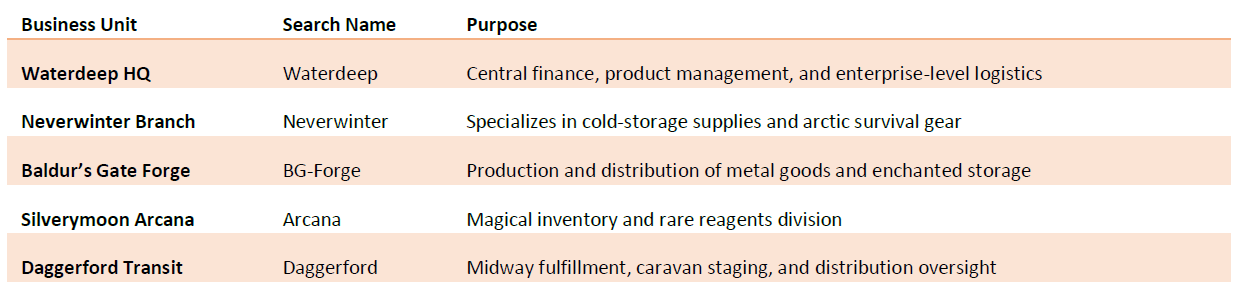
The Waterdeep Trading Company isn’t just a general store, it’s the central nerve of a supply empire that keeps adventurers, merchants, and mystics stocked from Luskan to Calimport. With customers as diverse as noble houses, guild outposts, and lone rangers, the company needed a way to structure its rapidly growing operations while maintaining financial precision and strategic agility.

Enter Business Units, Departments, Sales Channels, and Cost Centers, the quartet of operational clarity in Microsoft Dynamics 365 Finance.

Business Units: Territory and Purpose

The company organizes its operations by Business Unit to reflect both geographic footprint and strategic focus. Each Business Unit represents a distinct operational hub, responsible for local inventory, staffing, and margin targets.

Each Business Unit tracks its own revenue and costs, enabling financial reporting at both unit and consolidated levels.

Departments: Role and Function

Where Business Units define where things happen, Departments define who does the work. These are the roles and internal teams that perform the operations of the business, often cutting across units.

Departments help structure responsibilities for budgeting and workforce management within each Business Unit.

Sales Channels: Who They Serve

Sales Channels represent the customer-facing paths through which the Waterdeep Trading Company moves its goods. These span traditional commerce and some… less conventional routes.

Using sales channels allows for segmented revenue reporting, discounting strategies, and tailored marketing campaigns.

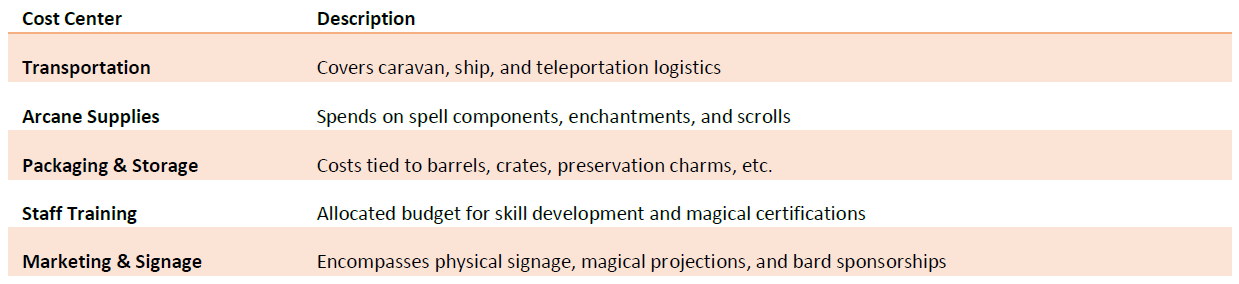
Cost Centers: Where Money Is Spent

To control expenses and improve budgeting accuracy, the company uses Cost Centers to group similar operational expenditures. These are typically aligned with departments but offer finer granularity, especially in joint projects or field operations.

This structure supports top-down and bottom-up budgeting, with financial dimensions tracking expenses per cost center across all Business Units.

Why It All Matters

By organizing the Waterdeep Trading Company with Business Units, Departments, Sales Channels, and Cost Centers, Greta Ironfist and her team achieve:

  • Granular reporting: See profit margins by branch, track department-level performance, or monitor sales channel velocity.
  • Smarter budgeting: Allocate funds where they’re needed and track actuals against plans with visibility by dimension.
  • Accountability: Department heads and business unit managers can be held responsible for outcomes.
  • Scalability: As the company expands (hello, Chult!), new units, departments, or sales paths can be added without disrupting the existing structure.

A Realm in Balance

The Waterdeep Trading Company didn’t become Faerûn’s top outfitter by accident. Through clever use of Dynamics 365’s organizational structures, it tames the chaos of commerce—even in a world of dragons, demons, and duty-bound auditors.

So whether you’re running potions to a necromancer or hempen rope to a ranger, remember: structure is the silent partner in every successful adventure.

Start your own implementation journey today.  Buy the full configuration guide at adnd365.com/start

🔍 Want to explore the live Faerûn demo environment?  Log in to the public read-only view at https://public.adnd365.com

Username: npc@adnd365.com Password: N0nPl@yC#822!

Discover how the realms are mapped inside Dynamics 365—because if you can build it in Faerûn, you can build it anywhere.

Running a business like the Waterdeep Trading Company involves more than sword sales and enchanted lockboxes. Every tenday, some things stay the same: rent needs paying, guild dues are owed, and inventory costs need logging.

If you find yourself retyping the same entries month after month, it’s time to bring in a little structure. That’s where Periodic Journals come in.

What Are Periodic Journals?

Periodic journals are used for recurring transactions — those repeating entries that don’t change often. Think monthly expenses, regular allocations, or standard entries for fees, salaries, or provisions. Once you’ve defined them, you can post the entries on a regular schedule without building them from scratch every time.

It’s like having a pre-written scroll that auto-fills your accounting spellbook.

Why the Waterdeep Trading Company Uses Them

Each month, the Waterdeep Trading Company pays maintenance fees to several local guilds for use of shared crafting halls and inspection services. Here’s how we structure one of those entries:

This journal can be reused every month with minimal adjustment, making it easy to keep the guilds happy and the books balanced.

Great Use Cases for Periodic Journals

When Not to Use Them

Not everything should be a periodic journal. They work best for entries that are consistent and scheduled. If the amounts vary significantly or require approvals, other journal types might be more appropriate.

Final Thoughts

If you’re repeating the same ledger entry more than once, it’s probably time to automate it. Periodic journals won’t solve every financial challenge, but they will make life easier and free up time for more important work, like negotiating with dwarves over mithral prices.

Want to see periodic journals in a real system?

Check out the walkthroughs in the Advanced Dungeons & Dynamics 365 guides at adnd365.com/start, or log into our public environment at https://public.adnd365.com

Login: npc@adnd365.com

Password: N0nPl@yC#822!

Budgeting doesn’t get the same attention as dragon-slaying or spell-slinging, but if you ask Greta Ironfist, it’s what keeps the doors open and the swords sharp. At the Waterdeep Trading Company, budgeting is how we make sure every gold piece has a job to do.

Let’s walk through how you can set up and use budgeting in Dynamics 365 Finance, with a few examples from our favorite trade hub on the Sword Coast.

Why Budgeting Is More Than Just Ledger Scrolls

Running a growing trading company means managing costs across different wards, cities, and sometimes even planes. Whether you’re buying spell ink in Waterdeep or renting a wagon in Elturel, you need a plan.

With Dynamics 365, budgeting helps you:

  • Forecast future expenses
  • Prevent overspending
  • Align your spend with goals like expansion or inventory restocking

Creating a Budget Register Entry

A budget register entry is where you define how much money you’re allocating and where it’s going. This can be done by department, cost center, or project.

Here’s what Greta’s FY25 budget register might look like:

You can create these manually or import from Excel. It’s especially helpful when you’re dealing with dozens of departments and hundreds of accounts.

Setting Up Budget Control Rules

Budget control lets you apply rules that prevent spending over budget. You can set this up to stop transactions or just warn the user.

Here’s how we’ve configured ours:

This makes sure field teams don’t accidentally order 10 crates of holy water when they only need two.

Allocating Budgets Over Time

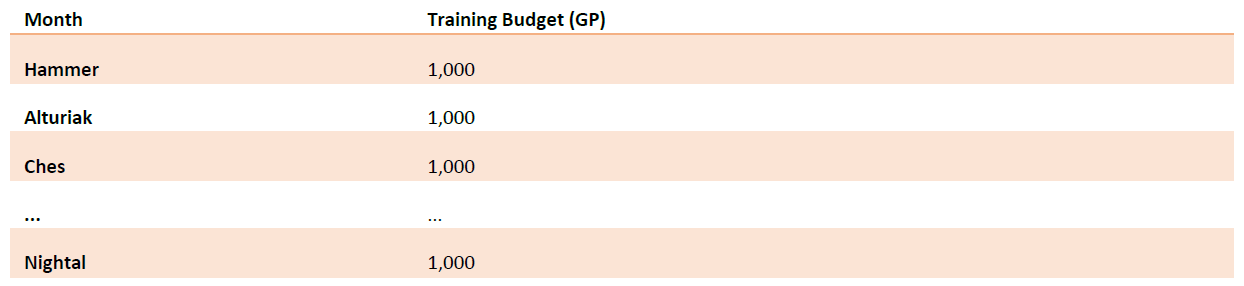
Not all costs hit at once. Some budgets, like the one for magical research or training, might be spread across the year.

Equal Monthly Allocation Example

You can also do weighted allocations if you expect spikes during busy seasons, like Greengrass or the Day of Wonders.

Reporting and Variance Tracking

Now that your budget is in the system, it’s easy to track how you’re doing. With the help of Power BI or built-in reports, you can compare budget to actuals.

Sample Variance Report

This kind of visibility lets Greta make smarter decisions and redirect funds when needed.

Final Thoughts

Budgeting in Faerûn is not just about counting coins. It’s about making sure your resources are lined up with your ambitions. Whether you’re building a new warehouse in Baldur’s Gate or launching a supply run to Icewind Dale, having your budgets set in Dynamics 365 means you can move with confidence.

Want to do this yourself? Download the Advanced Dungeons & Dynamics 365 guides at adnd365.com/start. For hands-on access, explore the live demo environment at https://public.adnd365.com, logging in with npc@adnd365.com and password N0nPl@yC#822!.

Let me know if you want to create a follow-up post on budgeting approvals, forecast comparisons, or project-based budgeting.

In Faerûn, having inventory on hand when the next caravan arrives is the difference between a profitable month and a letter of apology written in infernal ink. At the Waterdeep Trading Company, we don’t rely on wishful thinking or divination spells to keep our shelves stocked. We use Forecasting and Demand Planning in Dynamics 365 to stay ahead of the curve.

Let’s break down what that looks like when you’re supplying everything from iron spikes to cursed mirror cases.

What Is Forecasting?

Forecasting is the process of predicting future demand based on historical data, market trends, upcoming events, and customer behavior. In Dynamics 365, this can be driven by:

  • Historical sales
  • Purchase trends
  • Manual adjustments
  • External factors (festivals, raids, wars, winter wolf migration patterns)

Forecasts can be entered manually or generated using built-in models, which project expected demand over a defined horizon. These forecasts can be set at various levels:

  • By item
  • By item group
  • By customer or sales channel
  • By warehouse or region

Example: Forecast for Health Potions

What Is Demand Planning?

Demand planning takes that forecast and aligns it with inventory, procurement, and production. It helps answer:

  • Do we have enough raw materials?
  • Should we increase safety stock?
  • Should we initiate new purchase orders or production runs?

In Dynamics 365, this process feeds into Master Planning, where forecasted demand is treated like confirmed orders, generating planned supply suggestions. These can include:

  • Planned purchase orders
  • Planned transfer orders
  • Planned production orders

Why It Matters for the Waterdeep Trading Company

Greta Ironfist, our fearless founder, once said:

“If you can predict the next spike in rope demand during troll season, you don’t need luck. You need a forecast.”

In the past, too many decisions were based on guesswork. Now, by using historical trends and adjusting for regional events (like the Annual Adventurers’ Expo in Silverymoon), we’re better prepared for demand fluctuations.

Best Practices in Dynamics 365 for Forecasting

Start with historical data: Use the Forecast planning workspace or Excel templates to analyze patterns.

Segment your products: Forecast high-volume items differently from rare or seasonal goods.

Involve stakeholders: Sales, warehouse managers, and even suppliers may have insights that raw numbers miss.

Adjust forecasts regularly: Update based on shifting trends, marketing events, or monster incursions.

Use forecast reduction: Let actual sales orders reduce the forecast so you don’t double-count demand.

Putting It Into Action

Let’s say you forecast a rise in demand for Frost Resistance Gear due to early winter reports from Icewind Dale. Dynamics 365 will recommend boosting production of frost cloaks and earmuffs, generating supply plans to meet the projected demand before it becomes a problem.

These forecasts then flow into:

  • Master Planning for automated supply suggestions
  • Warehouse stocking plans
  • Cash flow planning based on expected procurement

Final Thoughts

Forecasting and demand planning in Dynamics 365 give you something better than magical foresight — real-time, data-driven decisions that protect margins and customer satisfaction.

You no longer need to pray to Mystra for inventory clarity. With the right setup, you can plan your way to profitability and avoid the scroll of backorders altogether.

Ready to build your own forecasting models and master plans?

Start your journey today with the Advanced Dungeons & Dynamics 365 guides at adnd365.com/start

You can also test it yourself in a live environment at https://public.adnd365.com

Login: npc@adnd365.com

Password: N0nPl@yC#822!
How Dynamics 365 keeps your business (and your soul) out of trouble

Let’s say you’re running a successful trading company in Waterdeep. You’ve got customers from Neverwinter to Calimport, moving everything from grain to griffon tack. Then one day, an order comes in:

Ten pounds of powdered mummy dust, two cursed grimoires, and a case of soulstones. Shipping destination? Thay. Buyer? The Red Wizards.

You pause. Not because you don’t have the inventory—oh, you do—but because you know these items come with strings, contracts, and possibly spectral audits. And this is where Dynamics 365 Finance and Operations becomes your most powerful (and lawful) ally.

So What Is a Restricted Product in the Realms?

In the real world, restricted items might include pharmaceuticals or firearms. In Faerûn? It’s enchanted reagents, cursed objects, or anything that screams “necromancer starter kit.”

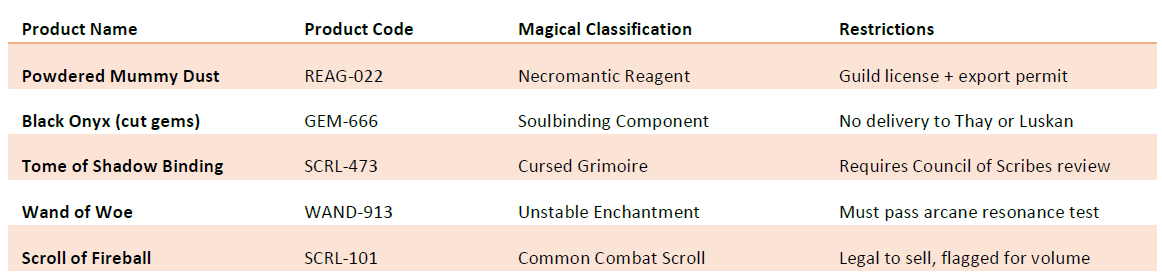
Let’s look at a few examples from the Waterdeep Trading Company catalog:

These are all configured as stocked products in D365, but flagged with restriction attributes like “Requires Permit,” “Region Lock,” or “Magical Risk Level: High.”

Selling Carefully, Not Fearfully

When a restricted item gets added to a sales order, Dynamics 365 can trigger rules to help keep your business from going down in flames (figuratively or literally). You might configure it so that:

  • The system automatically places the order on hold until reviewed
  • A compliance officer (or High Enchanter of Procurement) is notified
  • Documentation, like guild approvals or trade licenses, must be attached before posting

The cool part? You don’t have to do this manually every time. The workflow engine handles it. For instance, an order for five Scrolls of Fireball to a mage college? Approved instantly. But that shady buyer from Luskan who just ordered three crates of “Moonlight Bleeding Daggers”? Yeah, that one gets routed straight to legal.

Managing by Region (Because Thay Happens)

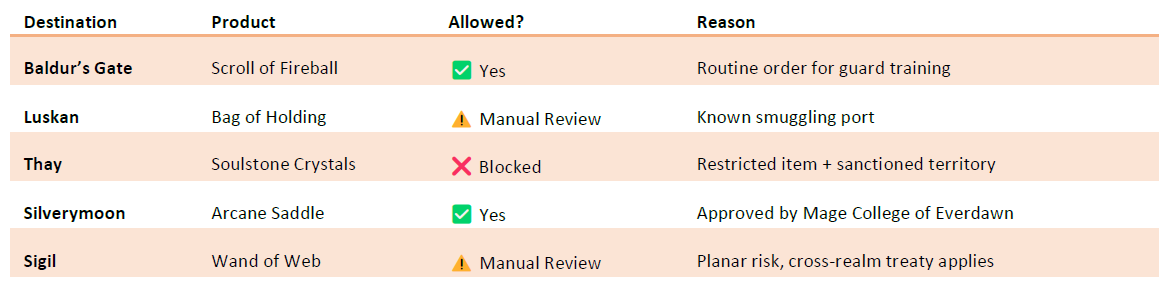
You can also enforce restrictions based on where the item is going. Here’s how that might look:

This lets your sales team focus on closing deals, while the system takes care of enforcing magical compliance, legal obligations, and common sense.

Auditable, Traceable, and Totally Not Illegal

Restricted product sales require documentation. You’ll need export permits, proof of guild membership, and in some cases, divine clearance from a temple. D365 lets you attach all of that right to the customer or order record.

So if the Lord’s Alliance knocks on your warehouse door asking why you sold thirteen shadow-bound daggers to a “Mr. X” from Skullport, you’ll have an audit trail longer than a paladin’s oath.

Why Bother?

Because when you’re moving dangerous goods in Faerûn, one wrong order can summon more than just a lawsuit. With Dynamics 365, you’re not just managing your inventory—you’re managing reputation, regulation, and risk.

You can sell exotic goods safely, smartly, and within the laws of magic and men.

Final Thought: The Scroll Doesn’t Sell Itself

Restricted products don’t mean restricted profits. They mean responsible handling, proper approvals, and a system that knows the rules—even if your customer doesn’t.

So go ahead. List that grimoire. Just be ready to click “Hold Order” if the buyer signs their name in blood.

Ready to Master Magical Compliance?

If you’re building a demo, teaching a course, or just trying to keep your trading company from being incinerated by bad procurement policy, the Advanced Dungeons and Dynamics 365 guides are for you.

Get step-by-step configurations, fantasy-themed templates, and prebuilt demo environments that bring Faerûn to life in Dynamics 365.

🎒 Grab your copy now at 👉 adnd365.com/start Because even restricted items need unrestricted control.

“One wand, five charges. One careless wizard, zero left.” — Greta Ironfist, COO, Waterdeep Trading Company

In the bustling arcane economy of Faerûn, inventory isn’t just about counting barrels of ale or bolts of cloth — it’s about precision tracking of the power inside the product. At the Waterdeep Trading Company (WDTC), that includes magical items like wands, staves, and devices that are finite in function, possessing a specific number of charges.

This is where Catchweight Inventory Management within Dynamics 365 Supply Chain Management comes into play — blending the tangible and the magical to enable better control, traceability, and profitability in the sales and management of charge-limited magical goods.

What Is Catchweight Inventory?

Catchweight inventory allows a product to be managed using two different units of measure simultaneously. It’s commonly used in food and beverage industries (like meat sold by the piece and weight), but at WDTC, we use it for something more… spellbinding:

  • Inventory Unit: 1 Wand of Fireballs
  • Catchweight Unit: 5 Castings

This means we can stock, ship, and invoice the wand by the piece, but track its actual usable magical value — its remaining charges — through a catchweight unit of measure: castings.

Why Use Catchweight for Magic Items?

Magical devices are powerful and pricey. But what happens when a wand is only half full? Or a device has just one charge left?

Using Catchweight, WDTC can:

Implementation Example: Wand of Magic Missiles

Here’s how WDTC configures the Wand of Magic Missiles in Dynamics 365:

When a wand is sold with only 3 of its original 7 charges remaining, Dynamics 365 recognizes both:

  • 1 wand shipped
  • 3 castings recorded for invoicing, pricing, or valuation

Integration with Inventory Dimensions

To further improve management, WDTC associates batch and serial numbers with each magical item. The serial number tracks:

  • Enchantment origin
  • Recharge history
  • Usage logs (via integration with spellcasting records)

This lets us prevent “wand fraud” — shady vendors selling depleted items with illusory packaging.

Reporting and Finance Magic

Using Power BI and native D365 reporting, managers can view:

  • Remaining casting capacity per warehouse
  • Average cost per casting
  • Most depleted items in circulation
  • Projected restock dates based on usage rates

This ensures Greta Ironfist and her enchanters make wise procurement decisions before the next dragon-slaying boom wipes out wand inventory.

Final Thoughts

In a world where a wand’s worth is measured not just by what it is, but how much it can do, Catchweight Inventory Management in Dynamics 365 gives WDTC the tools to balance commerce and chaos. From enchanted bolts to spell-laced scrolls, it’s the key to spellbook-accurate inventory and adventurer-grade profitability.

Want help configuring your own magical inventory system in D365? The arcane consultants at Waterdeep Trading Company are only a sending spell away.

Ready to level up your D365 implementation with a little magic?

Download the full Advanced Dungeons & Dynamics 365 guides and start your quest today at adnd365.com/start.Whether you’re managing inventory in Waterdeep or configuring workflows in Cormyr, these step-by-step tomes will equip you for legendary ERP success.

In the bustling cities of the Sword Coast—from Waterdeep’s merchant squares to the shady alleys of Luskan—one thing is clear: magic sells. Whether you’re a potion purveyor, an arcane gear supplier, or an enchanted scroll distributor, knowing which magical products bring the highest margins is critical for growth.

In this post, we’re using Dynamics 365’s Product Profitability Reports, Item Sales Margins, and Sales by Product Category to reveal the top 10 most profitable magical items currently moving through the Faerûnian economy.

How We Calculated Profitability

We pulled data from the Waterdeep Trading Company’s Dynamics 365 environment, combining:

  • Sales revenue from the Order to Cash module
  • Cost of Goods Sold (COGS) via Inventory Valuation
  • Gross Margin % based on item group (Magical Items, Potions, Scrolls, etc.)

Profit = (Sales – COGS) × Volume Sold

Top 10 Magical Products by Profit

Key Insights for Inventory & Trade Managers

  1. Healing Potions dominate—they’re cheap to produce, high in volume, and in constant demand. Set reorder thresholds in your Item Coverage settings.
  2. Arcane Saddles are low-volume, high-margin—ideal candidates for Trade Agreements with aerial suppliers and custom production runs.
  3. Scrolls offer recurring revenue—track parchment, ink, and scribing labor as bundled production cost drivers.
  4. Teleportation services represent a unique product-as-a-service model—handled as a non-stock item but linked to high-value invoicing and permit records.

Dynamics 365 Tips to Track Magical Profitability

  • Use Item Groups and Product Categories to segment magical vs. mundane goods.
  • Enable Standard Costing or FIFO for better margin clarity on alchemical and enchanted items.
  • Run the “Gross Margin by Product” report in Cost Management > Inquiries and Reports.
  • Tag products with attributes like Arcane Level, Guild Certification, or Spell School to enable dimensional profitability analysis.

What’s Next?

If you’re a trading company operating across Faerûn, your profit isn’t just about what you sell—it’s about knowing what sells best, to whom, and how consistently. With Dynamics 365, you have the tools to track product-level performance across every district, ward, and plane.

Curious what the margins are on a Flask of Faerie Fire or a Golem Core? Start building your magical profitability matrix today with our Bare Bones Templates and Fantasy Item Master demo packs at adnd365.com/start.

In the realms of Faerûn, even the most mundane items can carry rich cultural meaning. Take, for instance, the humble backpack—a staple in every adventurer’s kit. While it may seem like a simple sack to the untrained eye, its significance, design, and even name differ across the races and regions of the Forgotten Realms.

As part of the Advanced Dungeons & Dynamics 365 initiative, we’re exploring how everyday items are interpreted across languages and how they could be localized in a multilingual, multicultural D365 setup. Let’s dive into what an adventurer’s backpack might look—and sound—like across Orcish, Dwarven, Elven, and Common tongues.

The Common Tongue (Faerûnian Common)

In Common, it’s just “backpack”—a rugged leather sack with straps and compartments. Functional, practical, and devoid of poetic flourishes. It’s what you’ll find listed in most adventuring kits and inventories. But dig deeper, and you’ll find other cultures give it more evocative names.

A rugged leather backpack used by adventurers to carry supplies, tools, and personal gear. It has sturdy straps, multiple pouches, and enough room for a bedroll, rations, and a few secrets.

Dwarven: Thuldak-veth

The Dwarves, ever practical and fond of linguistic precision, call their backpacks Thuldak-veth—“burden harness.” Constructed of heavy leather, reinforced with metal rivets, and often rune-marked for durability, these are more than sacks—they’re tools of survival.

Thuldak-veth durzarn khuldûm, tharnok balgûn zarnûm. Kazad-barûk, tharnûn dulgan, azgal thuldath râg rûm, tharin, an durgûn dôr.

Translation:

Burden harness of strong leather, used by journeyers underground. Stout-strapped, pouch-bearing, with space for bedroll, supplies, and old secrets.

Orcish: Grumshpak

To the orcs, it is the Grumshpak—“Gruumsh’s burden.” Everything an orc owns, they carry on their back. These war-packs are stitched from thick hide, marked with clan glyphs, and smell faintly of blood and smoke.

Grumshpak kragh-leth, zagh kul rûgûl ob urûk. Zurn-grath, snaga-bolgs, agh mokûrz-latûrz ob nargûl, grub, agh bagûrz-ob.

Translation:

War-pack of hardened hide, used by warriors. Strong-bound, with slave-pockets, and space for bedroll, meat, and hidden-things.

Elven: Lóthanwë

The elves refer to theirs as Lóthanwë, the “bearer of burdens.” Even a utility item like a backpack is expressed poetically in Elvish. Made of supple leather, light and water-resistant, it flows as gracefully as its wearer. Elves do not simply carry their belongings—they travel with them.

Lóthanwë en’quessir, nórui’raug ar’lasselanta. Lintë-lassa, penna nárë, mi sírë a’lómelindi.

Translation:

The bearer of burdens of the People, graceful and enduring. Swift-strapped, opens with warmth, for path and twilight songs.

Translating Product Data in Dynamics 365: “Display Product Info in User’s Language”

In a global implementation—or in our case, a multiregional fantasy economy—it’s not enough to just name the product differently. You also want every user to see product names and descriptions in their own language.

Dynamics 365 Supply Chain Management includes a feature called Display product info in user’s language, which ensures that when users log into the system, product names, search terms, descriptions, and attributes are automatically displayed in their preferred language. This includes:

  • Product name translations
  • Search name translations
  • Product description translations
  • Translated attribute values and metadata

You can enable this feature by visiting the Feature management workspace and turning on “Display product info in user’s language”. Once enabled, it respects the user’s language preferences throughout the Product Information Management module.

This is particularly useful when supporting diverse regional audiences (or multilingual Faerûnian guilds) and dramatically improves usability, consistency, and user satisfaction.

For more details on configuring this, visit the official documentation at learn.microsoft.com.

Localizing Items with Meaning

When building product records in Dynamics 365, consider more than just item numbers. For immersive or narrative-rich systems like Advanced Dungeons & Dynamics 365, enrich the data model with translations and lore-informed descriptions. Here’s an example:

Final Thoughts

Language is more than words—it’s worldview. By considering how a simple item like a backpack might differ across cultures, we unlock opportunities to build systems that don’t just translate, but communicate. Whether you’re configuring inventory in Dynamics 365 or scripting a multilingual NPC interaction, cultural flavor adds depth.

So next time you equip a backpack, remember: it may be more than just a sack on your back—it could be a Grumshpak, a Thuldak-veth, or a Lóthanwë… depending on who you ask.

Want to bring Faerûn to life in Dynamics 365? Set up your own instance using the Advanced Dungeons & Dynamics 365 guides at adndD365.com/start, and explore a fully configured public version of the environment live at public.adnd365.com. Whether you’re adventuring through supply chain management or enchanting customer experiences, your journey begins there.

From the sky patrols of Waterdeep to the noble riders of Silverymoon, airborne units depend on highly specialized gear—Griffon Tack and Arcane Saddles that can withstand battle, weather, and the raw magical forces of the Realms. These aren’t items you pick up at the local market; they’re sourced through formal procurement strategies, powered by Request for Quotation (RFQ) and Vendor Scoring capabilities in Dynamics 365.

Why RFQs Matter in a Magical Economy

In a traditional D&D setting, most trading happens face-to-face—often over a tankard. But for larger organizations like the Waterdeep Trading Company (WDTC), bulk procurement must be structured, especially for gear involving magical enchantments or rare components.

Example:

The City Watch of Waterdeep needs 20 arcane saddles for a newly commissioned unit of griffon riders. Each saddle must support:

  • Up to 300 lbs of armored weight
  • A built-in Feather Fall enchantment
  • Compatibility with Griffon Tack forged from mithral-reinforced leather

Rather than asking each vendor individually, WDTC uses the RFQ system in Dynamics 365 to issue a formal request to certified suppliers.

Vendor Scoring: Objectivity Over Tradition

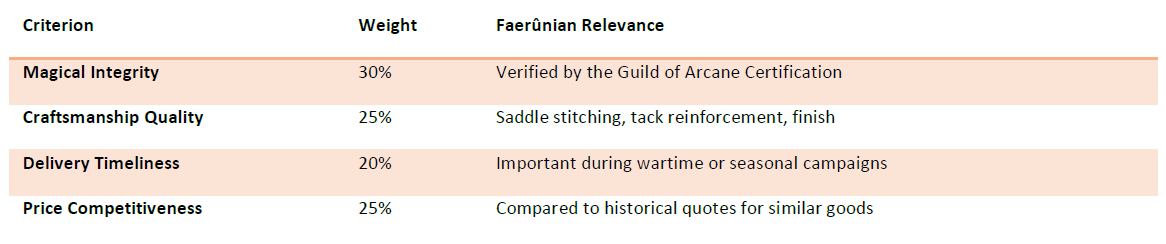
Craftsmanship and enchantment vary wildly between Faerûnian vendors. By using vendor scoring models, the trading company can evaluate vendors using criteria beyond price—ensuring quality and safety remain paramount.

Example Scorecard Weights:

Vendor Examples:

  • Baldur’s Gate Blacksmiths Guild: High in craftsmanship, but slower due to unionized processes
  • Luskan Flight Outfitters: Cheaper, but known for occasional magical instability
  • Neverwinter Skywrights Consortium: Moderate cost, consistent arcane compliance

Dynamics 365 applies these weights automatically to submitted RFQ responses, giving procurement officers an instant comparison across all key factors.

The Griffon Gear Commodity Category

In the WDTC product catalog, Griffon gear falls under structured commodity codes like:

These categories help align products to procurement hierarchies, trade agreements, and vendor capabilities.

Strategic Procurement Outcomes

Implementing RFQ and vendor evaluation processes provides tangible advantages in the Faerûnian economy:

  1. Better Risk Mitigation: Buying from the wrong enchanter can literally be fatal. RFQ processes flag unqualified vendors before the deal is struck.
  2. Improved Guild Compliance: Vendor scoring ensures only members of certified guilds (e.g., the Enchanters’ Hall or Leatherworkers’ Syndicate) win bids—limiting counterfeit products.
  3. Data-Driven Supply Decisions: Should you pay more for reliability, or risk a lower-cost vendor with a poor delivery record? The answer lies in the scoring history, available instantly in Dynamics 365.

 Real-World Fantasy Use Case: The Autumn Campaign Order

In the lead-up to the Autumn Griffon Campaign of 1495 DR, WDTC receives a bulk order from the Lords’ Alliance:

  • 50 Arcane Saddles
  • 100 Reinforced Griffon Tacks
  • Delivery deadline: Marpenoth 15

Using Dynamics 365:

  • RFQs are issued to five certified vendors across Baldur’s Gate, Silverymoon, and Yartar
  • Responses are scored, evaluated, and logged
  • Final purchase orders are generated and linked to trade agreements for future replenishments

Outcome: The entire contract is awarded to Skywrights Consortium of Neverwinter, who delivered ahead of schedule, scoring 92/100 in the vendor evaluation matrix.

Final Thoughts

In a realm of dragons, danger, and divine audits, your procurement process should be as fortified as your defenses. With RFQs and vendor scoring in Dynamics 365, even the most magical acquisitions can be approached with logic, structure, and transparency.

Explore More Procurement Templates and Demo Content at adnd365.com/start

Because in Faerûn, even saddles deserve a little enchantment—and a lot of due diligence.