Archive

Author Archives: B-List Microsoft Celebrity, Available for Weddings and Bar Mitzvahs

The New Dynamics AX is a big change from the previous releases. The majority of the changes are around the new web based user interface, the new way that you navigate around in the application and also new sets of tools that have come along for the ride.

For those of you that are familiar with the older user interfaces then you may have to learn a couple of new tricks to get around the system like the pro that you are, and for new users of the New Dynamics AX environments then you will probably want as many tips on all the cool things that you are hidden away within the application so that you can quickly become a power user of the system.

I have scoured all of the resources that I have to compile the most useful tips and tricks for the New Dynamics AX and that will be useful to everyone, regardless of if you are a novice to Dynamics AX just trying to get around in the application, or have worked with the previous versions of the system, and are just want to learn the nuances of the new user interface.

Undocking forms

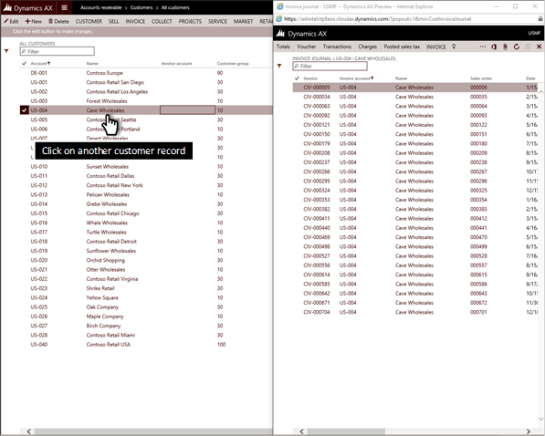
When you open up a new form, in order to manage the screens within the browser, the New Dynamics AX will open up as an overlay form. Sometimes though you may want to see this form, and the form below it. You can do this by undocking the form and it will open up as a new HTML window.

How it works…

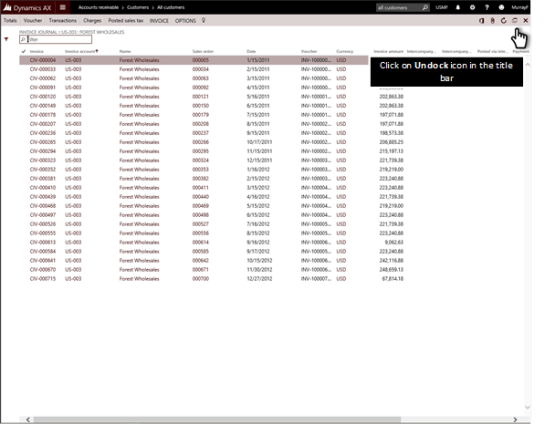
To do this, just click on the Undock icon in the top right hand corner of the form.

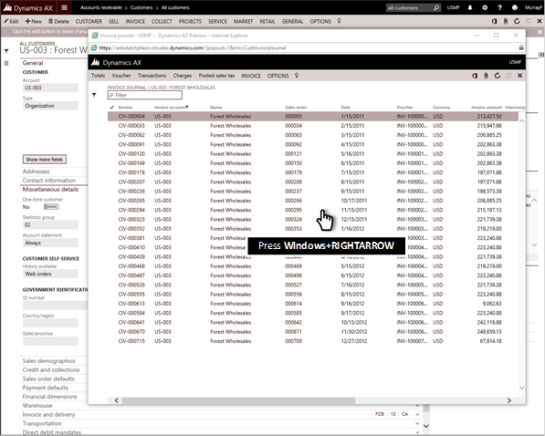
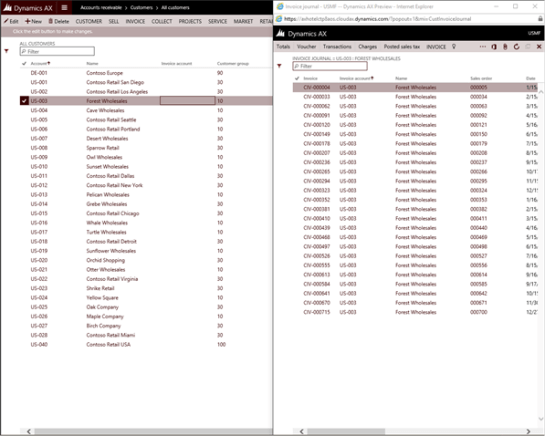
This will open up the top window as a new browser window and the original window will change back to the child form.

You can then show the data side by side, or move to other monitors if you have multiple screens.

Even though the window has been opened, this does not mean that the windows are disconnected. If you change the record within the parent form then this will also update the child form.

Want more?

If you liked this post and want to see more tips and tricks for the New Dynamics AX then I have compiled the 50 initial tips and tricks into a new guide for you all. If you want to get all of the tips and tricks in one place, then just follow the link: http://bit.ly/1mAzKf6

Also, if you are looking for more resources on Dynamics AX in general, then make sure you check out the Dynamics AX Companions site at www.dynamicsaxcompanions.com and also the Blind Squirrel Publishing site at www.blindsquirrelpublishing.com for more articles and books.

About the Author

Murray Fife is an Author of over 25 books on Microsoft Dynamics AX including the Bare Bones Configuration Guide series of over 15 books which step the user through the setup of initial Dynamics AX instance, then through the Financial modules and then through the configuration of the more specialized modules like production, service management, and project accounting. You can find all of his books on Amazon (www.amazon.com/author/murrayfife) and also even more on the BSP (www.blindsquirrelpublishing.com) site.

Murray is also the curator of the Dynamics AX Companions (www.dynamicsaxcompanions.com) site which he built from the ground up as a resource for all of the Dynamics AX community where you can find walkthroughs and blueprints that he created since first being introduced to the Dynamics AX product.

Throughout his 25+ years of experience in the software industry he has worked in many different roles during his career, including as a developer, an implementation consultant, a trainer and a demo guy within the partner channel which gives him a great understanding of the requirements for both customers and partner’s perspective.

For more information on Murray, here is his contact information:

Email:         mcf@blindsquirrelpublishing.com
Twitter:    @murrayfife
Facebook:    facebook.com/murraycfife
Google:        google.com/+murrayfife
LinkedIn:    linkedin.com/in/murrayfife
Blog:        atinkerersnotebook.com
Docs:        docs.com/mufife
Amazon:    amazon.com/author/murrayfife

The New Dynamics AX is a big change from the previous releases. The majority of the changes are around the new web based user interface, the new way that you navigate around in the application and also new sets of tools that have come along for the ride.

For those of you that are familiar with the older user interfaces then you may have to learn a couple of new tricks to get around the system like the pro that you are, and for new users of the New Dynamics AX environments then you will probably want as many tips on all the cool things that you are hidden away within the application so that you can quickly become a power user of the system.

I have scoured all of the resources that I have to compile the most useful tips and tricks for the New Dynamics AX and that will be useful to everyone, regardless of if you are a novice to Dynamics AX just trying to get around in the application, or have worked with the previous versions of the system, and are just want to learn the nuances of the new user interface.

Accessing the ribbon bar commands

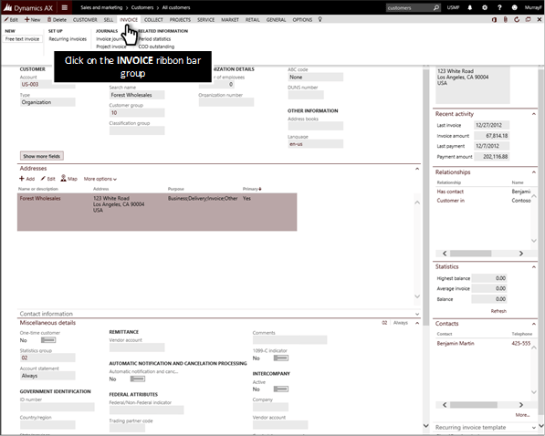
When you are on either the list page view or the details pane you can access additional functions related to the record from the ribbon menu bar at the top of the form.

How it works…

For example, while on the Customers record you can access all of the functions that are related to the invoicing by clicking on the INVOICE ribbon bar tab.

This will open up the invoice functions and then you can click on the Invoice Journal button.

This will open up the Invoice Journals list page.

Want more?

If you liked this post and want to see more tips and tricks for the New Dynamics AX then I have compiled the 50 initial tips and tricks into a new guide for you all. If you want to get all of the tips and tricks in one place, then just follow the link: http://bit.ly/1mAzKf6

Also, if you are looking for more resources on Dynamics AX in general, then make sure you check out the Dynamics AX Companions site at www.dynamicsaxcompanions.com and also the Blind Squirrel Publishing site at www.blindsquirrelpublishing.com for more articles and books.

About the Author

Murray Fife is an Author of over 25 books on Microsoft Dynamics AX including the Bare Bones Configuration Guide series of over 15 books which step the user through the setup of initial Dynamics AX instance, then through the Financial modules and then through the configuration of the more specialized modules like production, service management, and project accounting. You can find all of his books on Amazon (www.amazon.com/author/murrayfife) and also even more on the BSP (www.blindsquirrelpublishing.com) site.

Murray is also the curator of the Dynamics AX Companions (www.dynamicsaxcompanions.com) site which he built from the ground up as a resource for all of the Dynamics AX community where you can find walkthroughs and blueprints that he created since first being introduced to the Dynamics AX product.

Throughout his 25+ years of experience in the software industry he has worked in many different roles during his career, including as a developer, an implementation consultant, a trainer and a demo guy within the partner channel which gives him a great understanding of the requirements for both customers and partner’s perspective.

For more information on Murray, here is his contact information:

Email:         mcf@blindsquirrelpublishing.com
Twitter:    @murrayfife
Facebook:    facebook.com/murraycfife
Google:        google.com/+murrayfife
LinkedIn:    linkedin.com/in/murrayfife
Blog:        atinkerersnotebook.com
Docs:        docs.com/mufife
Amazon:    amazon.com/author/murrayfife

The New Dynamics AX is a big change from the previous releases. The majority of the changes are around the new web based user interface, the new way that you navigate around in the application and also new sets of tools that have come along for the ride.

For those of you that are familiar with the older user interfaces then you may have to learn a couple of new tricks to get around the system like the pro that you are, and for new users of the New Dynamics AX environments then you will probably want as many tips on all the cool things that you are hidden away within the application so that you can quickly become a power user of the system.

I have scoured all of the resources that I have to compile the most useful tips and tricks for the New Dynamics AX and that will be useful to everyone, regardless of if you are a novice to Dynamics AX just trying to get around in the application, or have worked with the previous versions of the system, and are just want to learn the nuances of the new user interface.

Accessing detail forms

From the list pages, you can also drill into the detailed information related to the record that you are looking at.

How it works…

To do this, just click on the customer name or the customer account number.

This will open up the detailed view where you can see a lot more of the fields that are related to the record.

Want more?

If you liked this post and want to see more tips and tricks for the New Dynamics AX then I have compiled the 50 initial tips and tricks into a new guide for you all. If you want to get all of the tips and tricks in one place, then just follow the link: http://bit.ly/1mAzKf6

Also, if you are looking for more resources on Dynamics AX in general, then make sure you check out the Dynamics AX Companions site at www.dynamicsaxcompanions.com and also the Blind Squirrel Publishing site at www.blindsquirrelpublishing.com for more articles and books.

About the Author

Murray Fife is an Author of over 25 books on Microsoft Dynamics AX including the Bare Bones Configuration Guide series of over 15 books which step the user through the setup of initial Dynamics AX instance, then through the Financial modules and then through the configuration of the more specialized modules like production, service management, and project accounting. You can find all of his books on Amazon (www.amazon.com/author/murrayfife) and also even more on the BSP (www.blindsquirrelpublishing.com) site.

Murray is also the curator of the Dynamics AX Companions (www.dynamicsaxcompanions.com) site which he built from the ground up as a resource for all of the Dynamics AX community where you can find walkthroughs and blueprints that he created since first being introduced to the Dynamics AX product.

Throughout his 25+ years of experience in the software industry he has worked in many different roles during his career, including as a developer, an implementation consultant, a trainer and a demo guy within the partner channel which gives him a great understanding of the requirements for both customers and partner’s perspective.

For more information on Murray, here is his contact information:

Email:         mcf@blindsquirrelpublishing.com
Twitter:    @murrayfife
Facebook:    facebook.com/murraycfife
Google:        google.com/+murrayfife
LinkedIn:    linkedin.com/in/murrayfife
Blog:        atinkerersnotebook.com
Docs:        docs.com/mufife
Amazon:    amazon.com/author/murrayfife

The New Dynamics AX is a big change from the previous releases. The majority of the changes are around the new web based user interface, the new way that you navigate around in the application and also new sets of tools that have come along for the ride.

For those of you that are familiar with the older user interfaces then you may have to learn a couple of new tricks to get around the system like the pro that you are, and for new users of the New Dynamics AX environments then you will probably want as many tips on all the cool things that you are hidden away within the application so that you can quickly become a power user of the system.

I have scoured all of the resources that I have to compile the most useful tips and tricks for the New Dynamics AX and that will be useful to everyone, regardless of if you are a novice to Dynamics AX just trying to get around in the application, or have worked with the previous versions of the system, and are just want to learn the nuances of the new user interface.

Showing the fact boxes

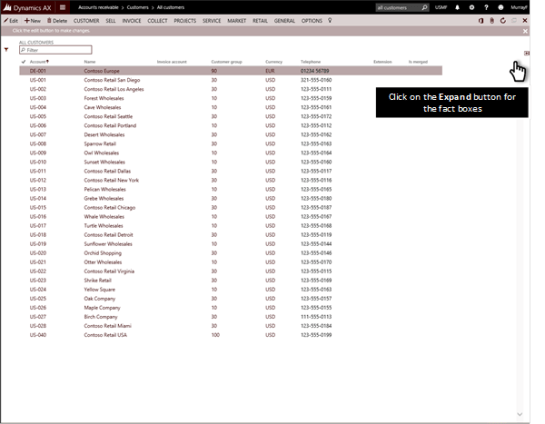
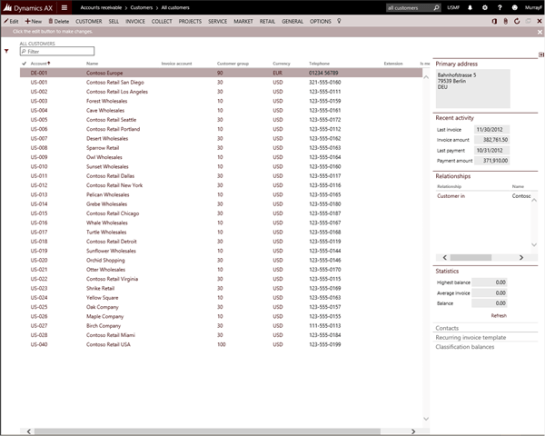
The first thing that we will show are the Fact Boxes. These give you summary information about the record that you are in without having to open up the detail form.

How it works…

By default these are collapsed on the right hand side of the form, but to see them all you need to do is click on the expand icon.

This will open up the Fact box panel and you will be able to see information specific to the record that you are on.

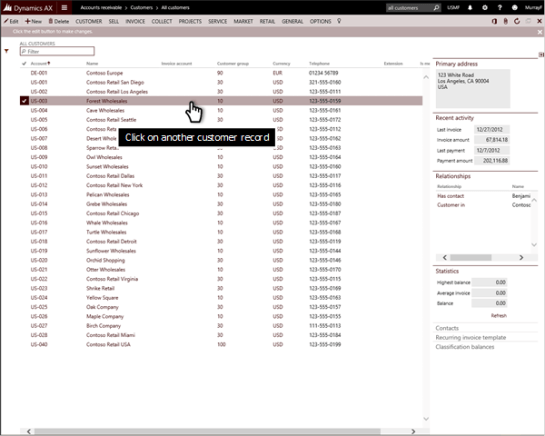
If you click on any of the other customer records then you will see that the fact boxed change to show you the details for that record.

Want more?

If you liked this post and want to see more tips and tricks for the New Dynamics AX then I have compiled the 50 initial tips and tricks into a new guide for you all. If you want to get all of the tips and tricks in one place, then just follow the link: http://bit.ly/1mAzKf6

Also, if you are looking for more resources on Dynamics AX in general, then make sure you check out the Dynamics AX Companions site at www.dynamicsaxcompanions.com and also the Blind Squirrel Publishing site at www.blindsquirrelpublishing.com for more articles and books.

About the Author

Murray Fife is an Author of over 25 books on Microsoft Dynamics AX including the Bare Bones Configuration Guide series of over 15 books which step the user through the setup of initial Dynamics AX instance, then through the Financial modules and then through the configuration of the more specialized modules like production, service management, and project accounting. You can find all of his books on Amazon (www.amazon.com/author/murrayfife) and also even more on the BSP (www.blindsquirrelpublishing.com) site.

Murray is also the curator of the Dynamics AX Companions (www.dynamicsaxcompanions.com) site which he built from the ground up as a resource for all of the Dynamics AX community where you can find walkthroughs and blueprints that he created since first being introduced to the Dynamics AX product.

Throughout his 25+ years of experience in the software industry he has worked in many different roles during his career, including as a developer, an implementation consultant, a trainer and a demo guy within the partner channel which gives him a great understanding of the requirements for both customers and partner’s perspective.

For more information on Murray, here is his contact information:

Email:         mcf@blindsquirrelpublishing.com
Twitter:    @murrayfife
Facebook:    facebook.com/murraycfife
Google:        google.com/+murrayfife
LinkedIn:    linkedin.com/in/murrayfife
Blog:        atinkerersnotebook.com
Docs:        docs.com/mufife
Amazon:    amazon.com/author/murrayfife

The New Dynamics AX is a big change from the previous releases. The majority of the changes are around the new web based user interface, the new way that you navigate around in the application and also new sets of tools that have come along for the ride.

For those of you that are familiar with the older user interfaces then you may have to learn a couple of new tricks to get around the system like the pro that you are, and for new users of the New Dynamics AX environments then you will probably want as many tips on all the cool things that you are hidden away within the application so that you can quickly become a power user of the system.

I have scoured all of the resources that I have to compile the most useful tips and tricks for the New Dynamics AX and that will be useful to everyone, regardless of if you are a novice to Dynamics AX just trying to get around in the application, or have worked with the previous versions of the system, and are just want to learn the nuances of the new user interface.

Using the search feature to find functions

If you are looking for a specific form or function within Dynamics AX then you don’t always need to search for it through the menu like we have been doing so far. If you know the general function that you want then you can use the search function to find it for you.

How it works…

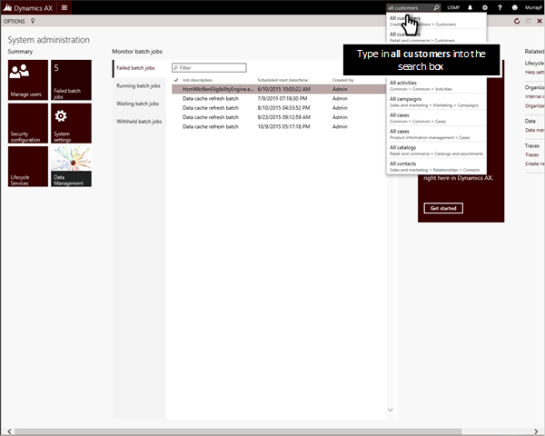
For example, if you wanted to find the Customers maintenance form then you can just type in all customers into the search box in the header of the application.

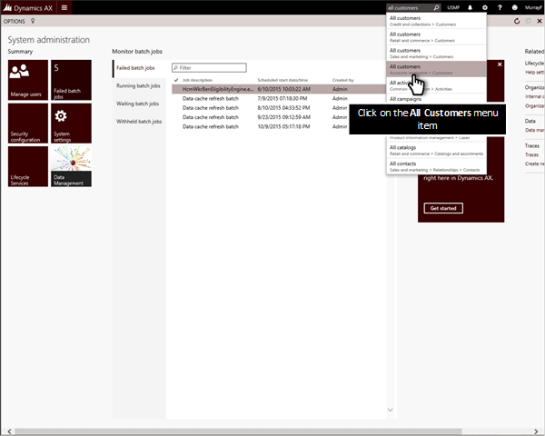
This will show you a list of all the functions that match your search. In this case there are a number of different ways that you can get to the Customers maintenance form, we just need to select one.

Want more?

If you liked this post and want to see more tips and tricks for the New Dynamics AX then I have compiled the 50 initial tips and tricks into a new guide for you all. If you want to get all of the tips and tricks in one place, then just follow the link: http://bit.ly/1mAzKf6

Also, if you are looking for more resources on Dynamics AX in general, then make sure you check out the Dynamics AX Companions site at www.dynamicsaxcompanions.com and also the Blind Squirrel Publishing site at www.blindsquirrelpublishing.com for more articles and books.

About the Author

Murray Fife is an Author of over 25 books on Microsoft Dynamics AX including the Bare Bones Configuration Guide series of over 15 books which step the user through the setup of initial Dynamics AX instance, then through the Financial modules and then through the configuration of the more specialized modules like production, service management, and project accounting. You can find all of his books on Amazon (www.amazon.com/author/murrayfife) and also even more on the BSP (www.blindsquirrelpublishing.com) site.

Murray is also the curator of the Dynamics AX Companions (www.dynamicsaxcompanions.com) site which he built from the ground up as a resource for all of the Dynamics AX community where you can find walkthroughs and blueprints that he created since first being introduced to the Dynamics AX product.

Throughout his 25+ years of experience in the software industry he has worked in many different roles during his career, including as a developer, an implementation consultant, a trainer and a demo guy within the partner channel which gives him a great understanding of the requirements for both customers and partner’s perspective.

For more information on Murray, here is his contact information:

Email:         mcf@blindsquirrelpublishing.com
Twitter:    @murrayfife
Facebook:    facebook.com/murraycfife
Google:        google.com/+murrayfife
LinkedIn:    linkedin.com/in/murrayfife
Blog:        atinkerersnotebook.com
Docs:        docs.com/mufife
Amazon:    amazon.com/author/murrayfife

The New Dynamics AX is a big change from the previous releases. The majority of the changes are around the new web based user interface, the new way that you navigate around in the application and also new sets of tools that have come along for the ride.

For those of you that are familiar with the older user interfaces then you may have to learn a couple of new tricks to get around the system like the pro that you are, and for new users of the New Dynamics AX environments then you will probably want as many tips on all the cool things that you are hidden away within the application so that you can quickly become a power user of the system.

I have scoured all of the resources that I have to compile the most useful tips and tricks for the New Dynamics AX and that will be useful to everyone, regardless of if you are a novice to Dynamics AX just trying to get around in the application, or have worked with the previous versions of the system, and are just want to learn the nuances of the new user interface.

The system administrator workspace

Another workspace that is interesting to look at is the System administrators workspace. This is a secure workspace that allows the administrators of the application to see all of the processes that have ran, and also access other tools like Data Management, and also Lifecycle Services.

How it works…

To access the System administrators workspace from the dropdown menu, just click on the System administration link from the All Workspaces submenu.

This will open up the System administration workspace where you will be able to access some of the key tools that the System Administrator would need to use. For example, if you need to access Lifecycle Services then you can just click on the Lifecycle Services tile.

This will take you right to the Lifecycle Services project page that is associated with your Dynamics AX environment.

If you wanted to access the Business process models that you are creating throughout the project then just scroll over to the right a little and click on the Business process modeler tile.

From here you will see all of the different business process models associated with the project, and you can just click on the one that you want to browse to.

Here you will see all of the different process steps that you may have business process models associated with. You can drill into the lower levels.

You will notice that there are multiple levels here and as you drill down you will get to more and more granular business processes.

When you open up any of the business processes that have been documented then you will see all of the business flows and also the text narrative that describes how the process works.

Want more?

If you liked this post and want to see more tips and tricks for the New Dynamics AX then I have compiled the 50 initial tips and tricks into a new guide for you all. If you want to get all of the tips and tricks in one place, then just follow the link: http://bit.ly/1mAzKf6

Also, if you are looking for more resources on Dynamics AX in general, then make sure you check out the Dynamics AX Companions site at www.dynamicsaxcompanions.com and also the Blind Squirrel Publishing site at www.blindsquirrelpublishing.com for more articles and books.

About the Author

Murray Fife is an Author of over 25 books on Microsoft Dynamics AX including the Bare Bones Configuration Guide series of over 15 books which step the user through the setup of initial Dynamics AX instance, then through the Financial modules and then through the configuration of the more specialized modules like production, service management, and project accounting. You can find all of his books on Amazon (www.amazon.com/author/murrayfife) and also even more on the BSP (www.blindsquirrelpublishing.com) site.

Murray is also the curator of the Dynamics AX Companions (www.dynamicsaxcompanions.com) site which he built from the ground up as a resource for all of the Dynamics AX community where you can find walkthroughs and blueprints that he created since first being introduced to the Dynamics AX product.

Throughout his 25+ years of experience in the software industry he has worked in many different roles during his career, including as a developer, an implementation consultant, a trainer and a demo guy within the partner channel which gives him a great understanding of the requirements for both customers and partner’s perspective.

For more information on Murray, here is his contact information:

Email:         mcf@blindsquirrelpublishing.com
Twitter:    @murrayfife
Facebook:    facebook.com/murraycfife
Google:        google.com/+murrayfife
LinkedIn:    linkedin.com/in/murrayfife
Blog:        atinkerersnotebook.com
Docs:        docs.com/mufife
Amazon:    amazon.com/author/murrayfife

The New Dynamics AX is a big change from the previous releases. The majority of the changes are around the new web based user interface, the new way that you navigate around in the application and also new sets of tools that have come along for the ride.

For those of you that are familiar with the older user interfaces then you may have to learn a couple of new tricks to get around the system like the pro that you are, and for new users of the New Dynamics AX environments then you will probably want as many tips on all the cool things that you are hidden away within the application so that you can quickly become a power user of the system.

I have scoured all of the resources that I have to compile the most useful tips and tricks for the New Dynamics AX and that will be useful to everyone, regardless of if you are a novice to Dynamics AX just trying to get around in the application, or have worked with the previous versions of the system, and are just want to learn the nuances of the new user interface.

Using the employee self-service workspace

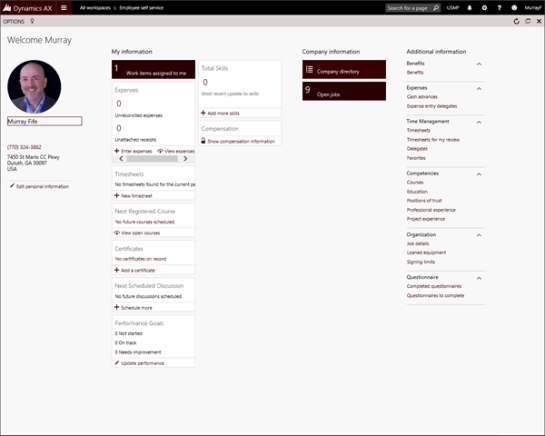
The Employee Self Service workspace is an example another of the new and improved portals within the New Dynamics AX. This portal shows the employees all of their HR information which they can maintain, and also allows them to track all of their skills and competencies.

How it works…

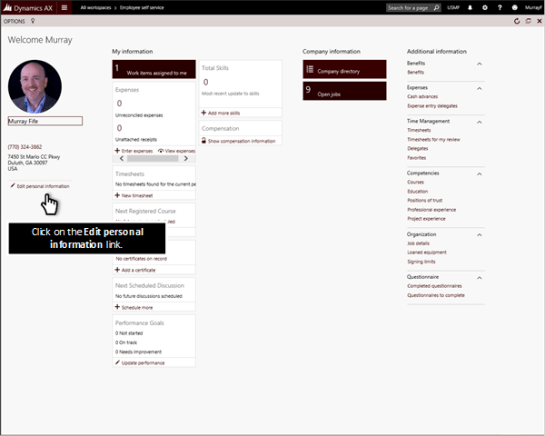
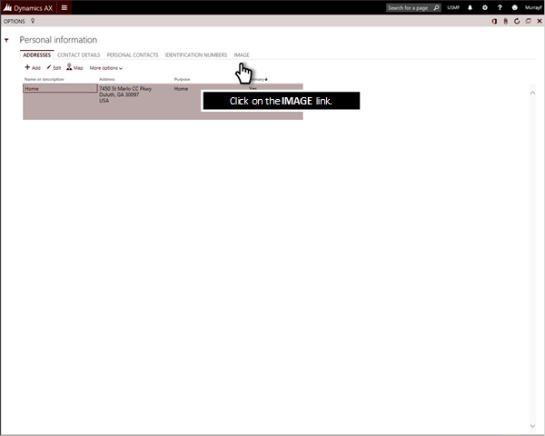
For example, if we wanted to edit any of our personal details from here then you just have to click on the Edit personal information link.

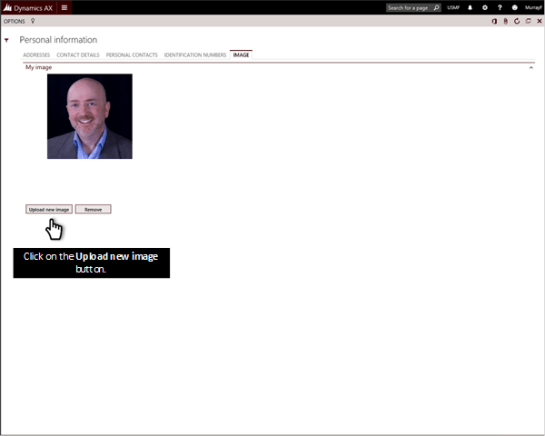
This will open up a form that shows all of the personal and contact information that is maintained within the application. Here you can update your address, phone number, email address, and even your own personal image that will show within the application

If you want to change the image, then it’s as simple as clicking on the Upload new image button.

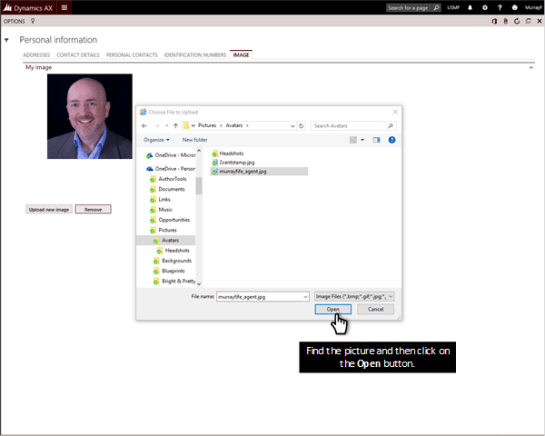
This will allow you to find the image that you want to use within Dynamics AX and then click on the Open button to upload it.

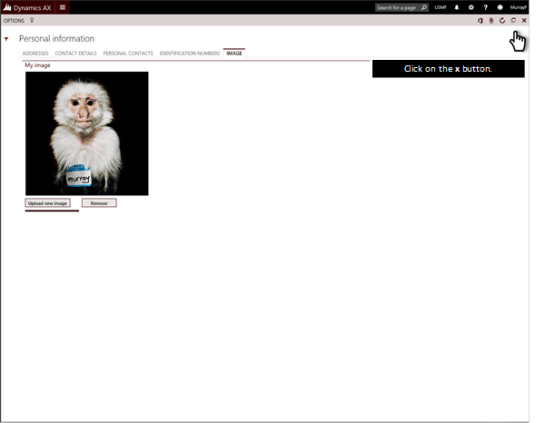
Once you have done that, click on the x button in the top right hand corner to close out of the Personal Information form.

When you return back to the Employee self-service workspace and refresh the page you will now have a new employee picture.

Want more?

If you liked this post and want to see more tips and tricks for the New Dynamics AX then I have compiled the 50 initial tips and tricks into a new guide for you all. If you want to get all of the tips and tricks in one place, then just follow the link: http://bit.ly/1mAzKf6

Also, if you are looking for more resources on Dynamics AX in general, then make sure you check out the Dynamics AX Companions site at www.dynamicsaxcompanions.com and also the Blind Squirrel Publishing site at www.blindsquirrelpublishing.com for more articles and books.

About the Author

Murray Fife is an Author of over 25 books on Microsoft Dynamics AX including the Bare Bones Configuration Guide series of over 15 books which step the user through the setup of initial Dynamics AX instance, then through the Financial modules and then through the configuration of the more specialized modules like production, service management, and project accounting. You can find all of his books on Amazon (www.amazon.com/author/murrayfife) and also even more on the BSP (www.blindsquirrelpublishing.com) site.

Murray is also the curator of the Dynamics AX Companions (www.dynamicsaxcompanions.com) site which he built from the ground up as a resource for all of the Dynamics AX community where you can find walkthroughs and blueprints that he created since first being introduced to the Dynamics AX product.

Throughout his 25+ years of experience in the software industry he has worked in many different roles during his career, including as a developer, an implementation consultant, a trainer and a demo guy within the partner channel which gives him a great understanding of the requirements for both customers and partner’s perspective.

For more information on Murray, here is his contact information:

Email:         mcf@blindsquirrelpublishing.com
Twitter:    @murrayfife
Facebook:    facebook.com/murraycfife
Google:        google.com/+murrayfife
LinkedIn:    linkedin.com/in/murrayfife
Blog:        atinkerersnotebook.com
Docs:        docs.com/mufife
Amazon:    amazon.com/author/murrayfife
The New Dynamics AX is a big change from the previous releases. The majority of the changes are around the new web based user interface, the new way that you navigate around in the application and also new sets of tools that have come along for the ride.

For those of you that are familiar with the older user interfaces then you may have to learn a couple of new tricks to get around the system like the pro that you are, and for new users of the New Dynamics AX environments then you will probably want as many tips on all the cool things that you are hidden away within the application so that you can quickly become a power user of the system.

I have scoured all of the resources that I have to compile the most useful tips and tricks for the New Dynamics AX and that will be useful to everyone, regardless of if you are a novice to Dynamics AX just trying to get around in the application, or have worked with the previous versions of the system, and are just want to learn the nuances of the new user interface.

Using the dropdown menus

Another way that you can navigate through the system is through the dropdown menus. These menus allow you to access all of the different functions within the New Dynamics AX and for those that have used previous versions of AX, these are very similar in structure to the old menu pages.

Additionally, you can see all of the workspaces within the default dashboard that we started on, if you need to quickly open up another workspace then you can see them all through the dropdown menu.

How it works…

To access the menus then just click on the hamburger icon in the top left hand corner of the application.

If you wanted to open up the Employee Self Service workspace then you can find it within the workspaces sub menu, and then just click on it.

That will take you straight to the Employee Self Service workspace.

Want more?

If you liked this post and want to see more tips and tricks for the New Dynamics AX then I have compiled the 50 initial tips and tricks into a new guide for you all. If you want to get all of the tips and tricks in one place, then just follow the link: http://bit.ly/1mAzKf6

Also, if you are looking for more resources on Dynamics AX in general, then make sure you check out the Dynamics AX Companions site at www.dynamicsaxcompanions.com and also the Blind Squirrel Publishing site at www.blindsquirrelpublishing.com for more articles and books.

About the Author

Murray Fife is an Author of over 25 books on Microsoft Dynamics AX including the Bare Bones Configuration Guide series of over 15 books which step the user through the setup of initial Dynamics AX instance, then through the Financial modules and then through the configuration of the more specialized modules like production, service management, and project accounting. You can find all of his books on Amazon (www.amazon.com/author/murrayfife) and also even more on the BSP (www.blindsquirrelpublishing.com) site.

Murray is also the curator of the Dynamics AX Companions (www.dynamicsaxcompanions.com) site which he built from the ground up as a resource for all of the Dynamics AX community where you can find walkthroughs and blueprints that he created since first being introduced to the Dynamics AX product.

Throughout his 25+ years of experience in the software industry he has worked in many different roles during his career, including as a developer, an implementation consultant, a trainer and a demo guy within the partner channel which gives him a great understanding of the requirements for both customers and partner’s perspective.

For more information on Murray, here is his contact information:

Email:         mcf@blindsquirrelpublishing.com
Twitter:    @murrayfife
Facebook:    facebook.com/murraycfife
Google:        google.com/+murrayfife
LinkedIn:    linkedin.com/in/murrayfife
Blog:        atinkerersnotebook.com
Docs:        docs.com/mufife
Amazon:    amazon.com/author/murrayfife
The New Dynamics AX is a big change from the previous releases. The majority of the changes are around the new web based user interface, the new way that you navigate around in the application and also new sets of tools that have come along for the ride.

For those of you that are familiar with the older user interfaces then you may have to learn a couple of new tricks to get around the system like the pro that you are, and for new users of the New Dynamics AX environments then you will probably want as many tips on all the cool things that you are hidden away within the application so that you can quickly become a power user of the system.

I have scoured all of the resources that I have to compile the most useful tips and tricks for the New Dynamics AX and that will be useful to everyone, regardless of if you are a novice to Dynamics AX just trying to get around in the application, or have worked with the previous versions of the system, and are just want to learn the nuances of the new user interface.

Document detail forms and fast tabs

Now that we are looking at the document record we are in the Document detail view. This view is different from the list views that we have been seeing so far because you have multiple groups of data that may be hidden as compressed Fast tabs.

Fast tabs are really useful because they allow you to pick and choose which sets of data that you want to see and also hide away the data that you don’t necessarily need on a daily basis.

How it works…

In this example we are seeing the order lines, but also there is a fast tab that contains all of the order header details.

If you want to expand (or collapse) any of the fast tabs then all you need to do is click on the expand/collapse arrow which is at the top of each fast tab ion the right hand side.

This will expand out the fast tab and you will be able to see all of the fields that were hidden away from you.

Want more?

If you liked this post and want to see more tips and tricks for the New Dynamics AX then I have compiled the 50 initial tips and tricks into a new guide for you all. If you want to get all of the tips and tricks in one place, then just follow the link: http://bit.ly/1mAzKf6

Also, if you are looking for more resources on Dynamics AX in general, then make sure you check out the Dynamics AX Companions site at www.dynamicsaxcompanions.com and also the Blind Squirrel Publishing site at www.blindsquirrelpublishing.com for more articles and books.

About the Author

Murray Fife is an Author of over 25 books on Microsoft Dynamics AX including the Bare Bones Configuration Guide series of over 15 books which step the user through the setup of initial Dynamics AX instance, then through the Financial modules and then through the configuration of the more specialized modules like production, service management, and project accounting. You can find all of his books on Amazon (www.amazon.com/author/murrayfife) and also even more on the BSP (www.blindsquirrelpublishing.com) site.

Murray is also the curator of the Dynamics AX Companions (www.dynamicsaxcompanions.com) site which he built from the ground up as a resource for all of the Dynamics AX community where you can find walkthroughs and blueprints that he created since first being introduced to the Dynamics AX product.

Throughout his 25+ years of experience in the software industry he has worked in many different roles during his career, including as a developer, an implementation consultant, a trainer and a demo guy within the partner channel which gives him a great understanding of the requirements for both customers and partner’s perspective.

For more information on Murray, here is his contact information:

Email:         mcf@blindsquirrelpublishing.com
Twitter:    @murrayfife
Facebook:    facebook.com/murraycfife
Google:        google.com/+murrayfife
LinkedIn:    linkedin.com/in/murrayfife
Blog:        atinkerersnotebook.com
Docs:        docs.com/mufife
Amazon:    amazon.com/author/murrayfife
If you are creating walkthroughs that include screen shots, then it is sometimes useful to include elements that highlight what is being done. This could include mouse clicks that are being performed, text that is being entered, or simply areas that you want to highlight or emphasize in the document.

It is a big hassle to go and edit the pictures each time in order to include the added information, and also you corrupt the original image when you do this. A better way to include tips is just to add them as shapes on the draft.

By default, though the Author Tools copy the main picture to the documents, but there is an option that will allow you to merge both the Picture and the extra graphics together when the document is being generated to create a merged illustration.

Here is how you can do that.

How to do it…

Start off with your PowerPoint step that you want to add a tip to.

Then add the tip shapes on top of the picture.

Make sure that the shape is either called Tip or if you have multiple shapes that make up the tip graphic that the parent shape is called Tip. This will be how the tools are able to find the tip and merge it.

Then switch to the Author Tools ribbon bar.

Make sure that the Merge Tips and Pictures check box is checked. If you have this unchecked, then the document that you create will just have the Picture element and not the tip – which is useful if you are wanting to create clean documents and have the tips as captions.

How it works…

To see the finished walkthrough, just click on the Create Walkthrough button within the Author Tools ribbon bar.

When the walkthrough is created the image that is pasted into the document will include both the Picture and also the Tip element

Review

This is a great tool that allows you to add annotations to your walkthroughs and screen shots without adding a lot of editing administration to the draft content. Additionally, the way that the tips appear in the draft is how they will appear within the document so you don’t have the situation where the illustrations don’t match because of resizing of the image components.

How easy is that!

About the Author

Murray Fife is an Author of over 25 books on Microsoft Dynamics AX including the Bare Bones Configuration Guide series of over 15 books which step the user through the setup of initial Dynamics AX instance, then through the Financial modules and then through the configuration of the more specialized modules like production, service management, and project accounting. You can find all of his books on Amazon (www.amazon.com/author/murrayfife) and also even more on the BSP (www.blindsquirrelpublishing.com) site.
Murray is also the curator of the Dynamics AX Companions (www.dynamicsaxcompanions.com) site which he built from the ground up as a resource for all of the Dynamics AX community where you can find walkthroughs and blueprints that he created since first being introduced to the Dynamics AX product.

Throughout his 25+ years of experience in the software industry he has worked in many different roles during his career, including as a developer, an implementation consultant, a trainer and a demo guy within the partner channel which gives him a great understanding of the requirements for both customers and partner’s perspective.

For more information on Murray, here is his contact information:

Email:         mcf@blindsquirrelpublishing.com
Twitter:    @murrayfife
Facebook:    facebook.com/murraycfife
Google:        google.com/+murrayfife
LinkedIn:    linkedin.com/in/murrayfife
Blog:        atinkerersnotebook.com
Docs:        docs.com/mufife
Amazon:    amazon.com/author/murrayfife