Archive

Author Archives: B-List Microsoft Celebrity, Available for Weddings and Bar Mitzvahs

In the crowded markets of Waterdeep, surrounded by crates of smoked meats, arcane components, and enchanted goblets, a new product has arrived that promises something rare in Faerûn—a perfect night’s sleep. Introducing the Mattress of Sleeping, a marvel of magical textilecraft now available exclusively through the Waterdeep Trading Company.

This isn’t your average hay-stuffed pallet or travel-worn cot. The Mattress of Sleeping is a guild-certified luxury good, crafted for nobility, adventurers, and weary traders alike. Whether you dwell in a castle keep or sleep beneath the stars, this mattress transforms rest into restoration.

Table of Contents

  • What It Is:  Detailed explanation of the Mattress’s magical composition, source guilds, and enchantments
  • Why It Matters:  The economic, tactical, and wellness impact of restorative sleep across guilds and realms
  • Key Features:  A breakdown of the mattress’s enchantments and magical construction components
  • Recommended For:  Target customer groups including adventurers, nobles, and provisioning officers
  • Price and Availability:  Retail pricing, size options, and bulk order procedures
  • Quantity-Based Pricing Chart:  Tiered pricing incentives for guilds, caravans, and estate provisioning
  • The Mattress of Sleeping vs. Other Rest Solutions in Faerûn:  Comparison table showing value relative to alternative products on the market
  • Bill of Materials: Mattress of Sleeping:  Full component list, including magical materials, labor codes, and overhead elements
  • Routing: Mattress of Sleeping:  Manufacturing workflow from textile cutting to enchantment and packaging
  • Final Thoughts: Closing remarks on the role of magical rest in the prosperity of Faerûn

What It Is

The Mattress of Sleeping is an enchanted sleep surface imbued with minor restorative magics. Created through a partnership with the Grand Artisans League and the Arcane Upholsterers Consortium, the mattress is layered with cloud-fibre padding, sewn with silken threads from Amnian moon spiders, and inscribed with subtle runes of calm and stillness.

Upon lying down, the user feels an immediate easing of tension and fatigue. The mattress neutralizes minor discomforts, encourages deep sleep, and passively resists nightmares and common magical disturbances. Many report waking with full energy—even after short rests.

Why It Matters

Rest is essential in every guild charter and campaign logbook. A well-rested adventurer makes fewer mistakes. A trader who sleeps soundly haggles more shrewdly. Even spellcasters with grueling memorization rituals have praised the mattress for accelerating the mental clarity needed at dawn.


Support the AD&D365 Project on Patreon. To grow this world, we’ve launched an official Patreon where supporters can gain access to exclusive content, tools, training labs, and even influence the future of the project. Your support fuels more than just development ,  it expands the guildhall, forges new scrolls, and empowers the next generation of configuration wizards.  Begin your journey: https://www.patreon.com/adnd365/

A Grateful Salute to Our Patrons. To all those who stand behind the vision—thank you for helping bring this world to life. Our Benefactor, Andre Breillatt — Your boundless generosity fuels the arcane core of this project. Without your magic, the weave would falter. Our Apprentices — The spell engines turn and the training labs thrive thanks to our current Apprentices: Michael Ramirez and Andreth Bael’Rathyn (Name obfuscated to protect their identity). Special thanks to our past Apprentices, whose contributions helped us get here:  Ralf Weber, Wendy Rijners, Shashi Mahesh, Julia Tejera, Ben Ekokobe, Tiago Xavier, Naveen Boyinapelli, Marcos Tadeu Wolf, Kathryn Greene, Jason Brown, Mark Christy, and Ashish Singh. Our Followers — Your steady presence along the journey is a beacon of encouragement: Sunil Panchal, Sarah D. Morgan, Nick Ramchandani, Daniel Kjærsgaard, and Tomasz Pałys. Our VoyeursHarry Burgh and Abdelrahman Nabil, ever watching from the shadows, clearly intrigued… but not enough to part with a single gold piece. Your silent curiosity is noted—and mildly judged.

Want to design your own manufacturing models in Faerûn? Get your own AD&D365 Environment and guides at adnd365.com/start, and request access to the public view of the current database at https://public.adnd365.com (Login npc@adnd365.com, Password “N0nPl@yC#822!”)


Key Features

The mattress is also flame-resistant, waterproof, and folds magically into a bundle the size of a standard satchel—ideal for teleportation, caravan use, or skyship travel.

Recommended For

  • Guild lodges and outposts in remote areas
  • Adventuring parties with irregular rest cycles
  • Traders on long journeys across the Sword Coast
  • Nobility seeking luxuries without vulnerability

Price and Availability

The Mattress of Sleeping is priced at 350.00 FSD and can be purchased directly at any Waterdeep Trading Company warehouse or via arcane order scroll. Available in standard (twin), longhouse (double), and wyvern (king) sizes.

Bulk pricing available for guild purchases. Contact your regional provisioning officer for discounts on orders of five or more.

This structure encourages outfitting entire barracks, inns, or trade fleets with high-quality rest surfaces while rewarding long-term provisioning partnerships with the Waterdeep Trading Company.

The Mattress of Sleeping vs. Other Rest Solutions in Faerûn

In the bustling trade routes of Faerûn, quality sleep is a rare luxury—and often an expensive one. For adventurers, merchants, and nobles alike, choosing the right rest solution means balancing cost, comfort, and magical utility. The Mattress of Sleeping, crafted and sold by the Waterdeep Trading Company, sets a new standard not only in enchantment but in value.

To help prospective buyers make an informed decision, the following table compares the Mattress of Sleeping to several other rest products available from regional vendors and traveling suppliers.

As seen in the comparison, the Mattress of Sleeping strikes a rare balance between utility, enchantment, and affordability. It is more accessible than higher-tier arcane rest solutions and far more effective than mundane options, making it ideal for both personal and professional outfitting.

For guildmasters provisioning barracks, or merchant captains outfitting a fleet, there is no better blend of magic, price, and practicality.

Bill of Materials: Mattress of Sleeping

This table outlines the components and subassemblies required to craft one unit of the enchanted Mattress of Sleeping. All components are listed with quantities, cost categories, and brief descriptions.

Total Material Cost, Labor, and Overhead are rolled up into standard costing for consistent financial tracking.

Routing: Mattress of Sleeping

The routing defines the sequence of operations required to manufacture the mattress, from material preparation through final enchantment.

Each routing step can be associated with specific cost centers and time reporting in the AD&D365 production ledger. Capacity planning, worker assignments, and magical interference risks should be considered, especially for Steps 30–40.

Final Thoughts

In a world of dragonfire, shifting politics, and sleepless nights under alien moons, a restful slumber is more than comfort—it is defense. The Mattress of Sleeping is the newest tool in the Waterdeep Trading Company’s mission to empower, protect, and prepare Faerûn’s bravest and boldest.

Get yours today. Your dreams—and your waking hours—will thank you.
Class TypeSpecialist (Linguistic-Geographic Hybrid)
Guild AffiliationCartographer’s Circle, Scribemaster’s League, Heralds of Candlekeep
Work TierLevel 1 to 10 (Apprentice to Master Scholar of Toponymy)
Primary RoleStandardizes regional place names, dialect variants, and localization metadata across Faerûn
Typical WorksiteMap halls, royal archives, translation chambers, guild dispatch rooms, and border posts

Lorewright Cartographers are the unseen hands behind every place name, map legend, dialect table, and regional postal schema in Faerûn. Where adventurers traverse wild lands and traders carry goods across borders, Lorewrights ensure the signs, scrolls, and systems agree on where and what those places are called. Working in tandem with scribes, heralds, and guildmasters, they record region-specific spellings, track renamings and political shifts, and maintain accurate language variants for translation and governance.

From setting province codes for merchant ledgers to registering new settlement names with Candlekeep’s Great Lexicon, these specialists are vital in maintaining geographic and linguistic integrity across the realm’s increasingly globalized trade routes. Their work ties directly into recordkeeping, contract law, supply chain documentation, and even magical travel anchoring.

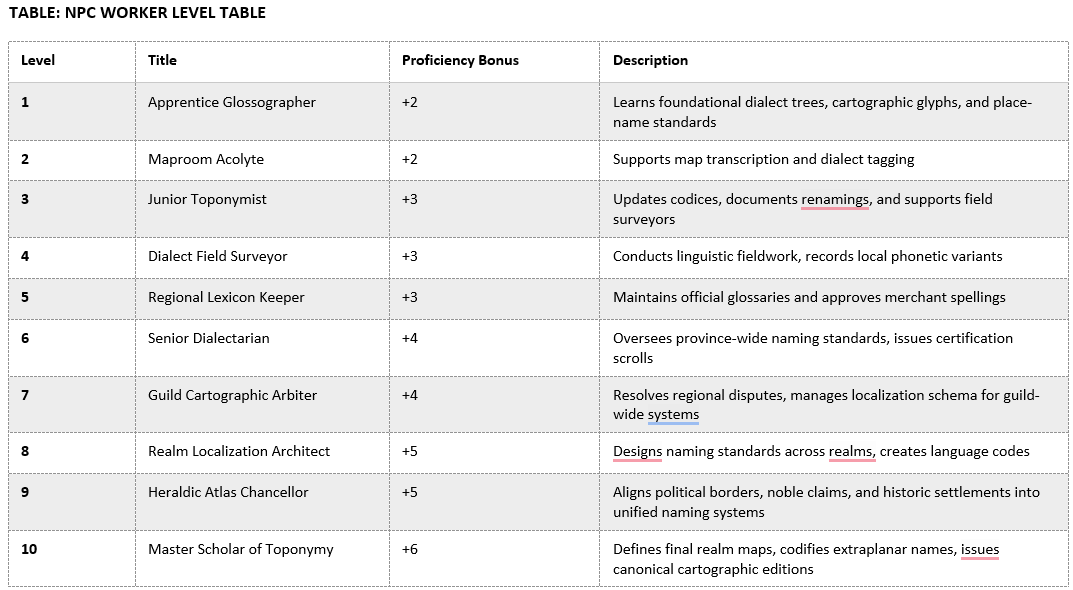
Worker Proficiency

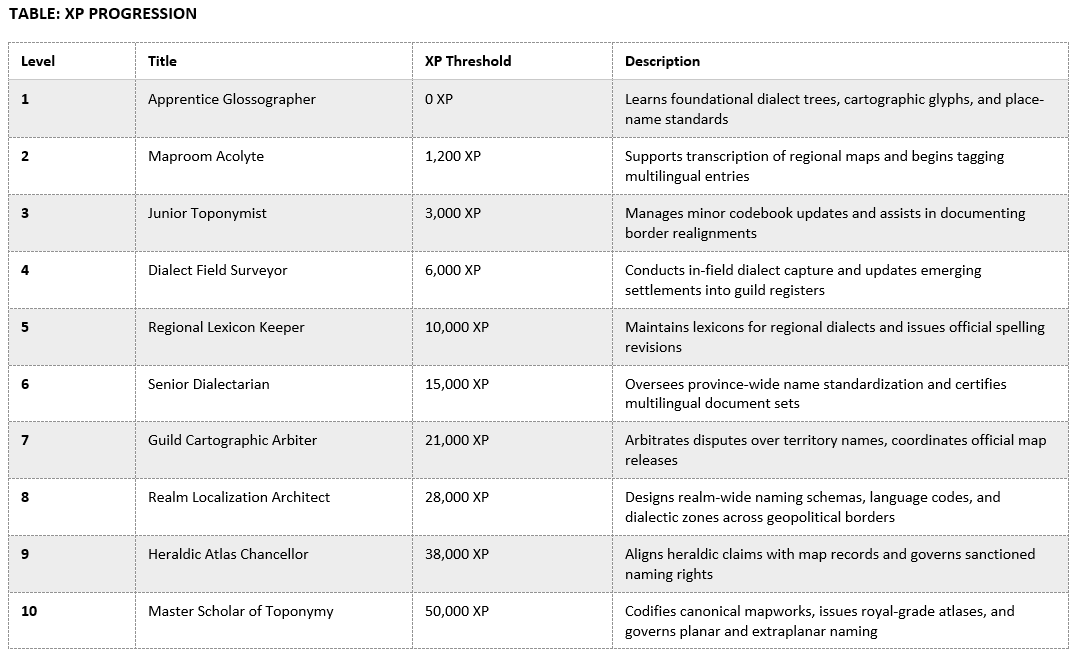
The Lorewright Cartographer follows a structured progression of geographic literacy, dialectal authority, and map governance. From apprentice scribes documenting minor settlements to mythic lexicographers designing planar codification trees, each rank in this class represents a deeper bond with the linguistic fabric of Faerûn.

Proficiency bonuses reflect expertise in toponymic research, cultural cartography, diplomatic translation, and standardized localization. Higher-tier Lorewrights are authorized to enforce naming standards across trade records, guild ledgers, and even royal edicts.

This system is essential to the operations of guilds like the Waterdeep Trading Company, where accurate names, codes, and dialect mappings are tied directly to taxation, delivery accuracy, teleportation scrolls, and cultural compliance.

Skill Set Summary

By the time one rises to the rank of Master Scholar of Toponymy, a map is no longer just a tool of navigation, it is a declaration of truth, authority, and sovereign memory. The skill set of a Lorewright Cartographer transcends inked borders and place names; it is the careful art of codifying identity, resolving territorial claims, and preserving the linguistic soul of Faerûn across centuries and realms.

Each of the following proficiencies reflects decades of guild schooling, regional immersion, and arcane-codex study. Whether transcribing a newly founded hamlet, resolving a border dispute between duchies, or formalizing the planar names of extraplanar colonies, these skills are essential to the cultural infrastructure of the Realms. From dialectal calibration to glyph alignment, the Lorewright’s craft ensures that every map tells a story with precision, purpose, and political weight.

Dialect Tree Mapping: Understands regional linguistic evolution, enabling accurate rendering of names in context.

Province Codex Maintenance: Updates official names, borders, and language data for trade, governance, and travel.

Translation Standardization: Applies approved grammatical structures and naming suffixes across official documents.

Postal Schema Integration: Assigns postal region codes (e.g., 01-WDP) for use in commerce and delivery systems.

Heraldic Coordination: Links place names with noble houses, historical holdings, and title claims.

Glyph Legend Control: Ensures all maps use correct cartographic symbols and sigils per guild standard.

Multiplanar Localization: Creates naming structures for extraplanar settlements and coordinates realm-aligned equivalency.

Map Script Calligraphy: Crafts maps with approved scriptwork, guild insignia, and readable symbols for replication.

Cultural Sensitivity Protocols: Avoids offense or diplomatic incident by applying naming conventions with historical respect.

Scroll Duplication: Produces faithful duplicates of map scrolls with preserved glyph integrity and legend clarity.

Cross-Language Lexeme Resolution: Resolves multiple translations of the same place into a unified codex entry.

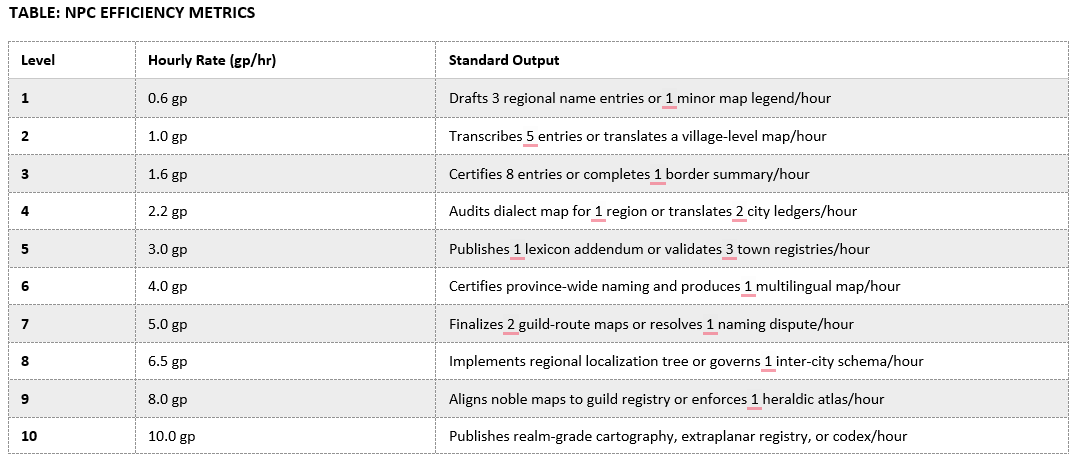
Efficiency Metrics

Lorewright Cartographers are not only guardians of linguistic and geographic fidelity, but also disciplined professionals whose productivity can be measured, evaluated, and optimized. The Efficiency Metrics below provide a structured view of expected output at each level of proficiency, allowing guilds, merchant consortiums, and royal archives to align the right talent to the right localization or cartographic task.

As Lorewrights advance in rank, their responsibilities grow from simple transcription and dialect tagging to the publication of realm-sanctioned atlases and the design of interplanar naming systems. These benchmarks ensure that a Junior Toponymist isn’t assigned a planar naming schema, just as a Master Scholar isn’t burdened with minor settlement updates.

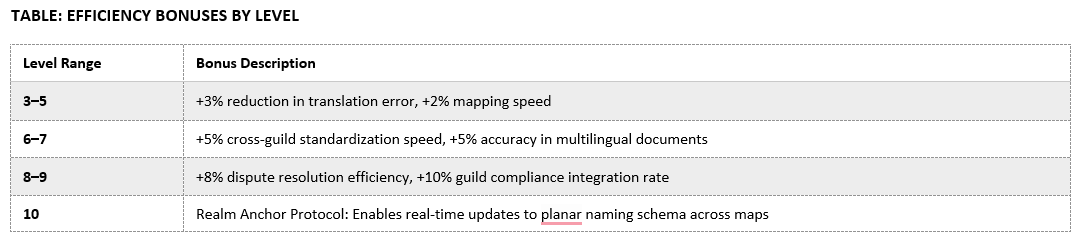
Starting at Level 3, Lorewrights gain cumulative efficiency bonuses, ranging from reduced transcription error to increased speed in dispute resolution and cross-cultural compliance. These gains reflect their mastery of complex dialect webs, glyph-legends, and mapping protocols across cultural boundaries.

By using these metrics, institutions like the Waterdeep Trading Company can make informed decisions on localization staffing, resource allocation, and operational scalability, ensuring every name, border, and legend is crafted with precision and purpose.

Class Role in Guild and Economy

Within systems like Dynamics 365 or guild-led administrative platforms, the Lorewright Cartographer class manages localization master data. This includes:

  • Defining and enforcing regional naming hierarchies
  • Maintaining the province-to-postal-code schema
  • Auditing linguistic consistency across customer records and contracts
  • Managing translation layers in multilingual environments

Their training is tracked in the Cartographer’s Circle Registry, and their certifications determine access to regional lexicons and naming databases. Promotions are tied to successful publication of codified maps, dispute arbitration, and dialectic preservation initiatives.

Image Prompts

Visual representation plays a vital role in bringing the Lorewright Cartographer to life, especially within lore-driven campaigns, simulation modules, or guild-based training guides like those in AD&D365. As the architects of geographic identity and the standard-bearers of linguistic precision, these figures should be portrayed as dignified scholars, respected not for their combat prowess, but for their unwavering authority over borders, names, and cultural memory.

The following image prompt captures the Lorewright Cartographer in full regalia, offering a compelling visual reference suitable for NPC tokens, class handouts, worldbuilding documentation, or character art. Whether illustrated as a traveling dialectarian or a royal codex editor, the prompt reflects the balance between academic mastery, arcane tradition, and bureaucratic power that defines the class.

Use this prompt with your preferred image generation tool to create immersive visuals for campaigns, worldbooks, or training simulations set within Faerûn’s interconnected realms.

General Prompt

A full-body portrait of a Lorewright Cartographer in a candlelit archival chamber surrounded by maps, scrolls, and glowing glyphs. The figure wears indigo and bronze robes embroidered with cartographic lines, runes, and compass roses. They hold a map quill and a floating projection of Faerûn’s regional divisions. Background includes hanging scroll racks, province sigils, and magical map globes.
Style: High-fantasy illustration, rich lighting with arcane blue glow
Mood: Scholarly, precise, diplomatically powerful
No modern elements.

NPC Level Image Prompts

LevelTitleImage Prompt Description
1Apprentice GlossographerA young scribe seated at a shared guild desk, practicing regional script forms by candlelight. Simple tan robes, ink-stained hands, scrolls open to dialect trees. Background: dusty maproom corner. Style: warm, painterly realism.
2Maproom AcolyteA junior cartographer filing region tags and pinning parchment to a large guild map board. Wearing a navy vest over robes, surrounded by measuring tools and labeling glyphs. Style: training-hall interior, medieval fantasy.
3Junior ToponymistA confident figure reviewing a border codex with a quill in hand, tagging a location on a floating map orb. Robes include silver-threaded provincial badges. Style: crisp, scholastic lighting with magical accents.
4Dialect Field SurveyorA robed traveler standing at a village crossroad, interviewing locals while jotting in a language journal. Gear includes a surveyor’s staff, dialect wheel, and map case. Background: rustic settlement with waystones.
5Regional Lexicon KeeperAn experienced scholar cataloging names in a guild lexicon chamber. Dozens of scroll tubes, labeled by dialect, encircle the space. Robe bears the sigil of a regional linguistic order. Style: archival realism with warm glows.
6Senior DialectarianA high-ranking cartographer adjusting a projection map showing shifting borders and multilingual overlays. Complex robes with translation glyphs stitched in gold. Style: arcane academic interior, glowing scrying runes.
7Guild Cartographic ArbiterA stern official presiding over a dispute between guild envoys, displaying a regional map with contested labels. Robes trimmed in red and bronze, wielding a rod of lexicon judgment. Style: courtroom diplomacy scene.
8Realm Localization ArchitectA master planner orchestrating a magical display of Faerûn’s realms, each zone glowing with different dialect overlays. Robes shimmer with realm-wide code rings. Style: mystical strategy chamber with globe-sized map illusion.
9Heraldic Atlas ChancellorA dignified elder presenting a gilded atlas before a royal court, with sigils of noble houses behind them. Golden cartographic robe, heraldic chain across chest. Style: regal, ceremonial atmosphere with high contrast lighting.
10Master Scholar of ToponymyA mythic figure in a floating map observatory, surrounded by constellations of place-names across realms and planes. Robes appear to flow like parchment, embroidered with runes. Style: celestial high-fantasy epic, divine authority.

In the trade halls of Waterdeep and the merchant caravans of the Sword Coast, fate and fortune walk hand in hand. It is only natural that guild administrators, supply masters, and finance scribes would embrace a method long familiar to adventurers: the humble dice roll. Whether settling a vendor dispute, simulating market shifts, or adjudicating magical failures, randomness provides realism and energy to even the most rigid ledgers.

This article explores how randomness—delivered through dice rolls—can be introduced into Dynamics 365 Finance and Operations to simulate the unpredictable world of Faerûn. From approval workflows to risk-based inventory adjustments, these dice-driven scenarios breathe life into business systems, making them immersive, dynamic, and fun to train on.

What It Is

Adding randomness means injecting chance into business processes—typically through d20s, d10s, or percentile dice—to determine outcomes that would otherwise be manually chosen or hard-coded. This can be done with real dice at the desk, random number functions in the system, or automated logic in tools like Power Automate.

This concept is particularly useful in the AD&D365 training environment, where simulation, roleplay, and unpredictability add value to onboarding, demonstrations, and business games.

Why It Matters

Randomization makes Dynamics 365:

  • More engaging: Training sessions become unpredictable and interactive
  • More immersive: Reflects the volatile world of Faerûn, where arcane mishaps and political whim can alter trade flows
  • More realistic: Models uncertainty, risk, and variability—key factors in logistics, finance, and customer behavior
  • More flexible: Dice-based logic can branch workflows and simulate outcomes not covered by standard rules

This approach also encourages creative thinking and decision-making among users, especially when playing out consequences from a bad roll or a stroke of luck.


Support the AD&D365 Project on Patreon. To grow this world, we’ve launched an official Patreon where supporters can gain access to exclusive content, tools, training labs, and even influence the future of the project. Your support fuels more than just development ,  it expands the guildhall, forges new scrolls, and empowers the next generation of configuration wizards.  Begin your journey: https://www.patreon.com/adnd365/

A Grateful Salute to Our Patrons. To all those who stand behind the vision—thank you for helping bring this world to life. Our Benefactor, Andre Breillatt — Your boundless generosity fuels the arcane core of this project. Without your magic, the weave would falter. Our Apprentices — The spell engines turn and the training labs thrive thanks to our current Apprentices: Michael Ramirez and Andreth Bael’Rathyn (Name obfuscated to protect their identity). Special thanks to our past Apprentices, whose contributions helped us get here:  Ralf Weber, Wendy Rijners, Shashi Mahesh, Julia Tejera, Ben Ekokobe, Tiago Xavier, Naveen Boyinapelli, Marcos Tadeu Wolf, Kathryn Greene, Jason Brown, Mark Christy, and Ashish Singh. Our Followers — Your steady presence along the journey is a beacon of encouragement: Sunil Panchal, Sarah D. Morgan, Nick Ramchandani, Daniel Kjærsgaard, and Tomasz Pałys. Our VoyeursHarry Burgh and Abdelrahman Nabil, ever watching from the shadows, clearly intrigued… but not enough to part with a single gold piece. Your silent curiosity is noted—and mildly judged.

Want to design your own manufacturing models in Faerûn? Get your own AD&D365 Environment and guides at adnd365.com/start, and request access to the public view of the current database at https://public.adnd365.com (Login npc@adnd365.com, Password “N0nPl@yC#822!”)


Dice-Driven Scenarios for Dynamics 365

Below are five structured examples where dice-based randomness is used to enhance different modules and processes within Dynamics 365. Each scenario includes a detailed table to show the dice mechanics, outcome descriptions, and suggested system actions.

Requisition Approval Simulation

Used during training or when modeling bureaucratic layers in large guild councils or merchant alliances. Dice can determine the fate of a requisition, from golden favor to outright rejection.

Inventory Loss During Transit

Use this scenario to simulate risk during transport across Faerûn—whether by road, portal, or elemental barge.

Supplier Quality Variance

Inconsistent supplier quality is common in both the mundane and magical economies of Faerûn. This roll simulates that variability.

Magical Infusion Risk Factor

When crafting enchanted goods, spellbound scrolls, or alchemical potions, randomness reflects the instability of arcane infusion.

Customer Response to Offer

From grumpy dwarves to eager guildmasters, not every customer reacts the same to your latest sales pitch.

Final Thoughts

Dice-based randomness in Dynamics 365 introduces fun, realism, and strategic complexity to even the most mundane workflows. For trainers, it’s a powerful engagement tool. For guild administrators and finance controllers, it’s a method of simulating Faerûn’s ever-changing tides of commerce, magic, and mischief.

Whether rolled in the boardroom or coded into automation scripts, the die is not just cast—it is integrated. Now, when a vendor’s delivery fails due to a vortex surge, or a potion turns violet instead of healing red, you have a system that responds in kind.

From the paved merchant roads of Waterdeep to the towering signal spires of Elturel, construction and masonry form the stonebound skeleton of Faerûn’s prosperity. It is more than mere labor—it is a guild-regulated craft that ensures trade moves, cities grow, and arcane infrastructure remains stable.

At the center of this effort stands the Stoneworkers & Builders Federation (STNBLD). Trusted across the continent, this guild enforces structure, standardization, and magical integrity in all major construction projects. Whether it’s a stone bridge over the Dessarin or a teleportation circle keyed to Sigil, STNBLD holds the chisel and the charter.

This article explores how the Waterdeep Trading Company and other enterprise guilds rely on these skilled builders to shape and sustain the Realms.

What It Is

Construction & Masonry in Faerûn includes all phases of building permanent structures—both mundane and magical. It covers roads, towers, keeps, portal hubs, and defensive works. The work is grounded in dwarven tradition, arcane enhancement, and strict oversight by STNBLD-certified project stewards.

Types of builds include:

  • Roadways and caravan routes
  • Strongholds and city walls
  • Magical infrastructure like teleportation rings and leyline signal towers
  • Market districts, bridges, and ports

Why It Matters

Every successful trade guild, including the Waterdeep Trading Company, depends on reliable infrastructure. A collapsed bridge can break a route. A misaligned teleportation circle can strand goods between planes. Masonry isn’t just craft—it’s continuity.

STNBLD’s role is critical to:

  • Standardization: Ensuring all builds follow approved blueprints and magical anchor patterns
  • Safety: Preventing structural collapses or arcane mishaps
  • Compliance: Blocking corruption through certified audits and sealed contracts
  • Scalability: Allowing new builds to integrate with existing road networks and magical systems

Support the AD&D365 Project on Patreon. To grow this world, we’ve launched an official Patreon where supporters can gain access to exclusive content, tools, training labs, and even influence the future of the project. Your support fuels more than just development ,  it expands the guildhall, forges new scrolls, and empowers the next generation of configuration wizards.  Begin your journey: https://www.patreon.com/adnd365/

A Grateful Salute to Our Patrons. To all those who stand behind the vision—thank you for helping bring this world to life. Our Benefactor, Andre Breillatt — Your boundless generosity fuels the arcane core of this project. Without your magic, the weave would falter. Our Apprentices — The spell engines turn and the training labs thrive thanks to our current Apprentices: Michael Ramirez and Andreth Bael’Rathyn (Name obfuscated to protect their identity). Special thanks to our past Apprentices, whose contributions helped us get here:
Ralf Weber, Wendy Rijners, Shashi Mahesh, Julia Tejera, Ben Ekokobe, Tiago Xavier, Naveen Boyinapelli, Marcos Tadeu Wolf, Kathryn Greene, Jason Brown, Mark Christy, and Ashish Singh. Our Followers — Your steady presence along the journey is a beacon of encouragement: Sunil Panchal, Sarah D. Morgan, Nick Ramchandani, Daniel Kjærsgaard, and Tomasz Pałys. Our VoyeursHarry Burgh and Abdelrahman Nabil, ever watching from the shadows, clearly intrigued… but not enough to part with a single gold piece. Your silent curiosity is noted—and mildly judged.

Want to design your own manufacturing models in Faerûn? Get your own AD&D365 Environment and guides at adnd365.com/start, and request access to the public view of the current database at https://public.adnd365.com (Login npc@adnd365.com, Password “N0nPl@yC#822!”)


Components of a Construction Project

Faerûnian projects involve both mundane resources and magical rituals. STNBLD uses a phased approach that blends architecture with arcana.

Project Management in Faerûnian Construction

Guild-certified Project Stewards are assigned to oversee every major construction job. These specialists manage workers, supplies, enchantments, and guild compliance. Every action they take is recorded in enchanted ledgers linked to the STNBLD network.

Their work is governed by the Builder’s Charter of Faerûnian Works, a magical and legal document that outlines process integrity and dispute resolution.

Builder Certification and Guild Ranks

To build within city limits or on behalf of the Waterdeep Trading Company, all workers must be guild-certified. Rank determines what tasks a mason may perform and where they are allowed to build. Promotions come with new responsibilities—and greater magical access.

Certification is renewed every three years and logged in the STNBLD’s Grand Ledger, which is magically duplicated in guild halls across Faerûn.

Worked Example: Signal Tower in Elturel

Elturel commissioned a leyline-linked signal tower to monitor Chionthar River trade. The Waterdeep Trading Company helped fund the effort.

This structure now relays storm warnings and shipment statuses via blinking sigil codes visible from Mirabar to Berdusk.

Realms-Aware Considerations

Different regions of Faerûn impose unique engineering and magical challenges:

  • North: Permafrost and Underdark shifts require deep foundational glyphs
  • Calimport: Planar turbulence requires floating anchors in multi-dimensional builds
  • Chult: High humidity demands fungal-resistant mortars and reinforced enchantments

STNBLD also monitors and mitigates corruption in city contracts through:

  • Funding Transparency Scrolls
  • Inspector Rune Logbooks
  • Tamper Seals on critical keystones

Final Thoughts

Building in Faerûn is an act of permanence in a world of magic, storms, and shifting power. With STNBLD’s stewardship, every stone tells a story of order, every tower channels more than wind, and every portal circle is a promise kept.

For the Waterdeep Trading Company, working with certified builders ensures that every coin invested returns in the form of safe passage, stable roads, and structures that last generations—even across planes.

Want to design your own manufacturing models in Faerûn?

Get your own AD&D365 Environment and guides at adnd365.com/start, and request access to the public view of the current database at https://public.adnd365.com

Login npc@adnd365.com
Password N0nPl@yC#822!

A Grateful Salute to Our Patrons

To all those who stand behind the vision—thank you for helping bring this world to life.

Our Benefactor, Andre Breillatt — Your boundless generosity fuels the arcane core of this project. Without your magic, the weave would falter.

Our Apprentices — The spell engines turn and the training labs thrive thanks to our current Apprentices:
Michael Ramirez and Andreth Bael’Rathyn (Name obfuscated to protect their identity).

Special thanks to our past Apprentices, whose contributions helped us get here:
Ralf Weber, Wendy Rijners, Shashi Mahesh, Julia Tejera, Ben Ekokobe, Tiago Xavier, Naveen Boyinapelli, Marcos Tadeu Wolf, Kathryn Greene, Jason Brown, Mark Christy, and Ashish Singh.

Our Followers — Your steady presence along the journey is a beacon of encouragement:
Sunil Panchal, Sarah D. Morgan, Nick Ramchandani, Daniel Kjærsgaard, and Tomasz Pałys.

Our VoyeursHarry Burgh and Abdelrahman Nabil, ever watching from the shadows, clearly intrigued… but not enough to part with a single gold piece. Your silent curiosity is noted—and mildly judged.

From the spell-stitched cloaks worn by wandering mages to the reinforced satchels slung across merchant shoulders, textiles and storage goods are an essential industry in Faerûn. Within the cities, towns, and trade hubs of the Realms, the art of weaving, cutting, and crafting cloth and leather into functional wares is overseen by one of the most respected guilds in the continent—the Grand Artisans League (GRARTL).

This article explores the foundational role of textile and bag production in Faerûn’s economy, highlighting how artisans contribute to the Waterdeep Trading Company’s supply chain and how localized workshops like Lara’s Fine Fabrics shape quality, customization, and trade readiness.

What It Is

Textile & bag production encompasses the creation of woven and stitched goods used for clothing, adventuring, trade, and logistics. It includes:

  • Loomed fabrics and dyed cloths
  • Leatherwork for utility belts, straps, and coverings
  • Enchanted and mundane cloaks, robes, and capes
  • Bags, satchels, pouches, haversacks, and component pouches
  • Larger storage units like folded chests, bedroll wraps, and enchanted sacks

Production can be entirely manual, arcane-assisted, or fully enchanted depending on region and technology level.

Why It Matters

Storage goods are more than accessories. They are logistical necessities. For adventurers, a reliable bag is as crucial as a sharpened blade. For merchants, sturdy satchels protect coin and contract. For caravans, bulk sacks and fabric-wrapped goods ensure safe passage.

For the Waterdeep Trading Company, textile production is foundational to:

  • Supporting its merchant fleet with durable goods
  • Outfitting field agents with custom cloaks or arcane pouches
  • Supplying clients like the United Caravaners & Teamsters Guild with standardized equipment
  • Generating revenue from high-demand storage solutions in major trade cities

Key Guild: Grand Artisans League (GRARTL)

GRARTL maintains strict standards on stitching methods, thread count minimums, and charm-stabilized seams. With chapters in Waterdeep, Amn, Suzail, Athkatla, and Silverymoon, the League ensures that no fabric bearing its sigil is substandard.

Member shops must:

  • Train apprentices for three winters
  • Use only certified bolts of cloth from registered weavers
  • Price goods within agreed trade margins
  • Submit quarterly samples for enchantment compliance (where applicable)

Components of Production

The creation of a high-quality storage item involves several steps:

Raw Material Acquisition: Bolts of cotton, wool, and silk from inland farms or imported spider-silk from Calimshan

Cutting & Patterning: Designs drawn and cut using hand-blades or arcane shears

Sewing & Assembly: Constructed with stitch-binding spells or reinforced needlework

Finishing & Customization: Additions like clasps, sigils, interior runes, or waterproof linings

Inspection & Approval: Review by a guild-certified foreworker or inspector before sale

Worked Example: Merchant Satchel from Lara’s Fine Fabrics

Lara’s Fine Fabrics, a trusted supplier of the Waterdeep Trading Company, is renowned for durable satchels carried by caravan runners and city-based brokers.

Retail value with markup: 109.00 FSD

Regional Pricing and Demand

Costs shift dramatically based on location and demand. A cloak may cost 40 FSD in Waterdeep, but 75 FSD in Icewind Dale due to material scarcity and insulation enchantment demand.

Realms-Aware Considerations

  • Items may require weather resistance based on region
  • Planar trade pouches need additional sigil-weaving
  • The Baldur’s Gate Blacksmiths Guild often collaborates with GRARTL for buckles and reinforcement materials
  • Export licenses are required when shipping cloaks enchanted for flight or teleport recall

Final Thoughts

Textile and bag production is not just needle and thread—it is infrastructure. It shapes how people travel, trade, and survive. For the Waterdeep Trading Company, ensuring consistent production through vendors like Lara’s Fine Fabrics means fewer delays, higher customer satisfaction, and protection for every contract and coin pouch carried across Faerûn.

Want to design your own manufacturing models in Faerûn?

Get your own AD&D365 Environment and guides at adnd365.com/start, and request access to the public view of the current database at https://public.adnd365.com

Login npc@adnd365.com
Password N0nPl@yC#822!

Support the AD&D365 Project on Patreon

To grow this world, we’ve launched an official Patreon where supporters can gain access to exclusive content, tools, training labs, and even influence the future of the project. Your support fuels more than just development, it expands the guildhall, forges new scrolls, and empowers the next generation of configuration wizards.  Begin your journey: https://www.patreon.com/adnd365/

A Grateful Salute to Our Patrons

To all those who stand behind the vision—thank you for helping bring this world to life.

Our Benefactor, Andre Breillatt — Your boundless generosity fuels the arcane core of this project. Without your magic, the weave would falter.

Our Apprentices — The spell engines turn and the training labs thrive thanks to our current Apprentices:
Michael Ramirez and Andreth Bael’Rathyn (Name obfuscated to protect their identity).

Special thanks to our past Apprentices, whose contributions helped us get here:
Ralf Weber, Wendy Rijners, Shashi Mahesh, Julia Tejera, Ben Ekokobe, Tiago Xavier, Naveen Boyinapelli, Marcos Tadeu Wolf, Kathryn Greene, Jason Brown, Mark Christy, and Ashish Singh.

Our Followers — Your steady presence along the journey is a beacon of encouragement:
Sunil Panchal, Sarah D. Morgan, Nick Ramchandani, Daniel Kjærsgaard, and Tomasz Pałys.

Our VoyeursHarry Burgh and Abdelrahman Nabil, ever watching from the shadows, clearly intrigued… but not enough to part with a single gold piece. Your silent curiosity is noted—and mildly judged.

From the sun-kissed fields of the Western Heartlands to the frost-tinged orchards of Icewind Dale, agriculture in Faerûn is the quiet force behind adventurers’ feasts, brewers’ barrels, and alchemists’ vials. The Waterdeep Trading Company, like many guild-backed merchants, relies heavily on local farms, regional cooperatives, and seasonal harvests to keep goods flowing across the Realms.

Understanding how crops are cultivated, harvested, and transformed into products reveals the deep roots of Faerûn’s economic engine—and how business, biology, and the arcane all intertwine.

What It Is

Agriculture and crop cultivation in Faerûn encompasses the seasonal cycles of farming essential grains, fruits, and herbs used in food production, drink-making, livestock feed, and potion crafting. Unlike monoculture systems of distant empires, Faerûnian agriculture is highly regionalized and often infused with magical or druidic practices. This diversity ensures both survival and specialty.

Primary agricultural guilds include:

  • Local Farming Collectives, responsible for staple crops and rotational fields
  • Herbalist Guilds, overseeing rare flora and alchemical-grade herbs
  • Faerûn Brewers & Distillers Association (FABRDS), partnering with farmers for specialized brewing crops

Why It Matters

For the Waterdeep Trading Company, agriculture is more than background noise—it’s the foundation of supply:

  • Food and Feed: Bread, grain, root vegetables, and forage crops sustain populations and beasts alike
  • Drink and Trade Commodities: Barley, wheat, and fruits drive alcohol and potion production
  • Potion and Magical Ingredient Supply: Rare herbs and magically-reactive fruits are critical for alchemy

Without stable and region-specific farming, everything from Twilight Wheat Ale to frost apple tinctures would vanish from the shelves.

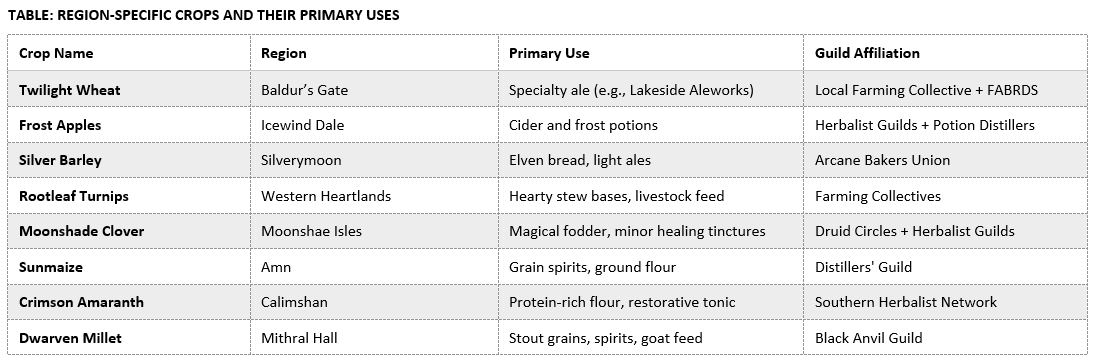
Crop Types and Regional Specialties

Below is a structured view of some of Faerûn’s most significant cultivated crops and their uses.

These crops are cultivated according to lunar calendars, arcane growth spells, and traditional farming cycles—often overlapping where druids, alchemists, and brewers share influence.

Example: Twilight Wheat and the Lakeside Aleworks

One of the most renowned agricultural products in the Western Heartlands is Twilight Wheat, a dusk-golden grain grown exclusively along the Eastbank Lane in Baldur’s Gate. Its distinctive honeyed undertone makes it ideal for light ales and specialty brews. Lakeside Aleworks uses it to create their signature drink—Twilight Wheat Ale.

This crop-to-consumer cycle highlights how agricultural product branding drives economic value when linked to guild-managed quality standards and unique regional terroir.

Realms-Aware Considerations

Agricultural output is affected by more than weather:

  • Planar Interference: Feywild blooms or shadow-blighted soil may alter yield or properties
  • Arcane Pollution: Nearby magical industry may infuse or ruin harvests
  • Seasonal War and Raids: Crops along trade routes or contested regions are vulnerable to loss
  • Guild Tithes and Tariffs: Farmer collectives may owe a portion of rare harvests to cities or guilds

This complex web of conditions means that agricultural planning must balance climate, magic, and politics to maintain consistency.

Final Thoughts

Agriculture in Faerûn is neither simple nor stagnant. It is a blend of ancestral wisdom, elemental influence, and trade-driven necessity. Whether brewing ales in Baldur’s Gate, feeding caravans through the Spine of the World, or crafting drought-resistance potions from frost apples, the crops of the Realms nourish more than bodies—they feed economies, rituals, and reputations.

For the Waterdeep Trading Company, ensuring strong ties with farming guilds and regional crop specialists is not just a strategy—it’s a lifeline.

Want to design your own sustainable manufacturing models in Faerûn?

Get your own AD&D365 Environment and guides at adnd365.com/start, and request access to the public view of the current database at https://public.adnd365.com

Login npc@adnd365.com
Password N0nPl@yC#822!

Support the AD&D365 Project on Patreon

To grow this world, we’ve launched an official Patreon where supporters can gain access to exclusive content, tools, training labs, and even influence the future of the project. Your support fuels more than just development, it expands the guildhall, forges new scrolls, and empowers the next generation of configuration wizards.  Begin your journey: https://www.patreon.com/adnd365/

A Grateful Salute to Our Patrons

To all those who stand behind the vision—thank you for helping bring this world to life.

Our Benefactor, Andre Breillatt — Your boundless generosity fuels the arcane core of this project. Without your magic, the weave would falter.

Our Apprentices — The spell engines turn and the training labs thrive thanks to our current Apprentices:
Michael Ramirez and Andreth Bael’Rathyn (Name obfuscated to protect their identity).

Special thanks to our past Apprentices, whose contributions helped us get here:
Ralf Weber, Wendy Rijners, Shashi Mahesh, Julia Tejera, Ben Ekokobe, Tiago Xavier, Naveen Boyinapelli, Marcos Tadeu Wolf, Kathryn Greene, Jason Brown, Mark Christy, and Ashish Singh.

Our Followers — Your steady presence along the journey is a beacon of encouragement:
Sunil Panchal, Sarah D. Morgan, Nick Ramchandani, Daniel Kjærsgaard, and Tomasz Pałys.

Our VoyeursHarry Burgh and Abdelrahman Nabil, ever watching from the shadows, clearly intrigued… but not enough to part with a single gold piece. Your silent curiosity is noted—and mildly judged.

In a land as magically diverse and ecologically sensitive as Faerûn, the Waterdeep Trading Company faces a growing imperative: to balance production with preservation. From the enchanted groves of the Moonshae Isles to the smoke-filled forges of Ironmaster, sustainability is not a trend, it is a necessity. As regional governors impose stricter resource usage regulations and druids grow vocal about deforestation near key ley lines, sustainable manufacturing has become both a moral stance and a strategic advantage.

This article explores how the Waterdeep Trading Company is embedding sustainable practices across its manufacturing operations, setting a precedent for responsible industrial stewardship across the Realms.

What Is Sustainable Manufacturing?

Sustainable manufacturing in Faerûn refers to the crafting, enchanting, and distribution of goods in ways that minimize harm to the land, the Weave, and its people. It encompasses:

  • Reducing material waste, especially rare or magically reactive components
  • Limiting energy draw from unstable arcane sources
  • Reusing by-products and reclaiming failed castings
  • Respecting local resource thresholds set by druidic councils and settlement pacts
  • Designing for longevity, repair, and regional reusability

In essence, it is about crafting goods that endure, without exhausting what cannot be easily restored.

Why It Matters

Guilds once obsessed with speed and scale now face backlash from both nature and neighbor. Unsustainable production attracts fey ire, arcane instability, and economic penalties. A sustainable operation:

  • Reduces component sourcing costs by enabling circular reuse
  • Avoids fines from the Emerald Enclave and city watch inspectors
  • Enhances brand reputation in markets like Silverymoon and Candlekeep
  • Attracts partnerships with green guilds and eco-conscious mercantile houses

Moreover, sustainable processes often drive innovation, leading to new materials, optimized routings, and adaptive enchantment techniques.

Components of a Sustainable Manufacturing Strategy

The Waterdeep Trading Company segments its sustainability initiatives into five key pillars:

Arcane Energy Optimization

  • Substituting raw leyline draws with enchanted capacitors that recharge during planar flux
  • Leveraging midday solar rituals in place of elemental forges where possible

Resource Lifecycle Management

  • Using Engineering Change Management to track usage, yield, and recyclability of magical inputs
  • Implementing return-for-repair programs on enchanted goods to reduce re-enchantment demand

Ethical Sourcing

  • Aligning vendor contracts with the Emerald Enclave’s Harvesting Accord
  • Prioritizing ingredients gathered under full moonlight rites or from sustainable herb groves

By-product Reclamation

  • Converting slag from golem foundries into paving bricks for Luskan roads
  • Re-infusing minor enchantment remnants into batch potions for field mages

Adaptive Routing

  • Planning production across settlements based on seasonal and regional energy cost forecasts
  • Transporting light components magically and heavy items terrestrially to reduce planar instability

These examples showcase how sustainability efforts can be embedded into regionally relevant practices.

Worked Example: Reclaimed Cloak of Shadows

To illustrate, let us examine a reclaimed Cloak of Shadows product line. Originally enchanted in the halls of Thay, a batch of damaged cloaks was returned to the Waterdeep Trading Company for recycling.

The initiative saved 60 FSD per unit while increasing customer loyalty and regulatory goodwill.

Realms-Aware Considerations

Magical Overuse: Excess enchantment can fray local Weave strands. Sustainable scheduling avoids cumulative arcane drain.

Inter-Guild Compliance: Guilds like the Arcane Artificers & Alchemists Union require certification for “green craft” designations.

Environmental Watchdogs: Emerald Enclave, Harpers, and Circle of the Moon all track industrial activity with an eye toward ecological impact.

Settlement Politics: Calimport prefers planar-efficient imports, while Silverymoon bans unsanctioned rare component harvesting.

Understanding these variances ensures local support and avoids operational bans or planar interdictions.

Final Thoughts

Sustainable manufacturing is not simply a nod to nature—it is a core competency for any serious producer in Faerûn. The Waterdeep Trading Company treats it as an operational philosophy, weaving it into every casting, carving, and caravan. For those who seek enduring prosperity and arcane balance, it is time to consider not just what you produce, but how.

Want to design your own sustainable manufacturing models in Faerûn? Get your own AD&D365 Environment and guides at adnd365.com/start, and request access to the public view of the current database at https://public.adnd365.com (Login npc@adnd365.com, Password “N0nPl@yC#822!“)

Support the AD&D365 Project on Patreon

To grow this world, we’ve launched an official Patreon where supporters can gain access to exclusive content, tools, training labs, and even influence the future of the project. Your support fuels more than just development, it expands the guildhall, forges new scrolls, and empowers the next generation of configuration wizards.  Begin your journey: https://www.patreon.com/adnd365/

Thanks to my supporters for helping make this content possible:

Our Benefactor, Andre Breillatt, whose generosity powers the arcane core of the project.

Our Apprentices, who keep the spell engines humming and the training labs active: Ralf Weber, Wendy Rijners, Shashi Mahesh, Julia Tejera, Ben Ekokobe, Tiago Xavier, Naveen Boyinapelli, Marcos Tadeu Wolf, Kathryn Greene, Jason Brown, Michael Ramirez, Mark Christy, and Ashish Singh.

Our Followers, who lend their steady support and encouragement along every step of the journey: Sunil Panchal, Sarah D. Morgan, Nick Ramchandani, Daniel Kjærsgaard, and Tomasz Pałys.

Across the diverse regions of Faerûn, the Waterdeep Trading Company and its allied guilds face frequent disruptions in supply chains—from avalanches in Icewind Dale to arcane embargoes in Thay. Whether a key herb has been frozen solid for a season or a trade caravan fails to arrive, operations must continue. That is where the Material Substitution Framework comes in: a structured approach to adapting inputs without compromising quality, compliance, or customer expectations.

This guide explores how the Waterdeep Trading Company creates and manages material substitution rules, with a spotlight on cider production—specifically the swap of frost apples with snow pears following a blight in the far north.

What It Is

Material substitution is the practice of predefining or approving alternate raw materials when a primary component becomes unavailable. This can include food ingredients, magical components, textiles, or construction materials. Substitution rules specify:

  • Which material can be replaced
  • Under what conditions substitution is permitted
  • The impact on cost, product potency, or attributes
  • Whether regulatory or guild approvals are required

In Faerûn, these rules are often managed through a mix of Engineering Change Orders (ECOs), alchemist guild protocols, and magical compatibility checks.

Why It Matters

The realms do not operate on predictable schedules. Blizzards, planar interferences, or political tensions often sever critical supply lines. Without a substitution framework, entire production lines may grind to a halt. Implementing material substitution ensures:

  • Continuity in production, even during regional disruptions
  • Minimized loss from spoilage or idled workshops
  • Flexibility in sourcing strategies
  • Quicker responses to crises and market demands

This is especially vital in guild-regulated industries such as brewing, enchantment, and alchemy, where ingredient fidelity impacts both pricing and legality.

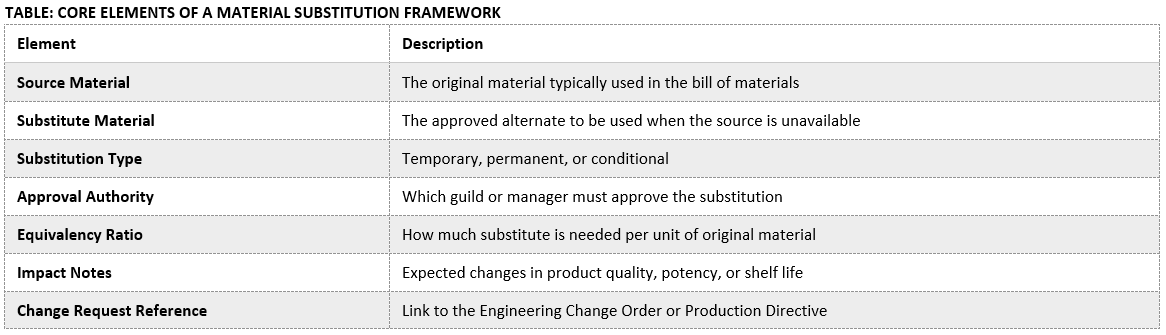
Components of a Material Substitution Framework

These records are managed by procurement leads, supply masters, or arcane compliance officers depending on the trade domain.

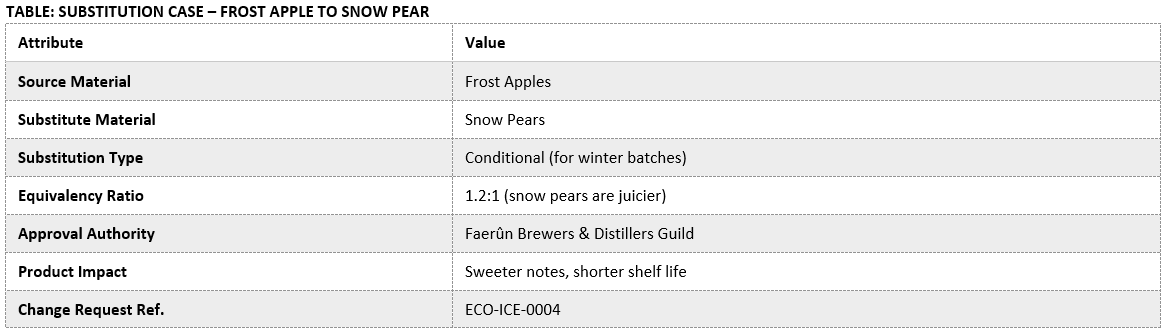
Worked Example: Cider Substitution in Icewind Dale

The Expedition Brewing Co. of Bryn Shander depends on frost apples harvested along the Glacierwash Trail. After a two-month frost rot outbreak, shipments ceased entirely. Faced with tankards to fill and contracts to honor, the distillers invoked their pre-approved substitution framework to switch to snow pears, a similar but softer fruit grown in nearby caves blessed by Auril’s clerics.

Batches produced with snow pears were renamed “Howler’s Bloom Cider” to distinguish them from the original “Mad Howler” batch. This preserved brand integrity while allowing continued sales during a critical season.

Realms-Aware Considerations

When crafting a substitution framework across Faerûn, you must consider:

Magical Compatibility: Substituting a dragon’s scale with basilisk hide may alter enchantment effects. Consult the Arcane Artificers & Alchemists Union.

Guild Approvals: Some substitutions require sign-off from trade associations such as FABRDS or HEAHBG.

Regulatory Compliance: Exported goods to regions like Thay or Calimshan may have substitution restrictions due to mystical purity laws.

Labeling and Lot Tracking: Version control and lot traceability are critical. Each substitution should trigger a new product version for audit purposes.

Final Thoughts

Material substitution is not just a contingency—it is a hallmark of preparedness and operational excellence. By defining flexible yet controlled rules, the Waterdeep Trading Company transforms risk into resilience, ensuring that even when the frost apples fail, the cider still flows.

Whether you are running an apothecary, a distillery, or an enchanted forge, building a substitution framework lets you navigate the uncertain currents of trade with the confidence of a seasoned merchant prince.

Want to design your own manufacturing models in Faerûn?

Get your own AD&D365 Environment and guides at adnd365.com/start, and request access to the public view of the current database at https://public.adnd365.com (Login npc@adnd365.com, Password “N0nPl@yC#822!“)

Support the AD&D365 Project on Patreon

To grow this world, we’ve launched an official Patreon where supporters can gain access to exclusive content, tools, training labs, and even influence the future of the project. Your support fuels more than just development — it expands the guildhall, forges new scrolls, and empowers the next generation of configuration wizards.  Begin your journey: https://www.patreon.com/adnd365/

Thanks to my supporters for helping make this content possible:

Our Benefactor, Andre Breillatt, whose generosity powers the arcane core of the project.

Our Apprentices, who keep the spell engines humming and the training labs active: Ralf Weber, Wendy Rijners, Shashi Mahesh, Julia Tejera, Ben Ekokobe, Tiago Xavier, Naveen Boyinapelli, Marcos Tadeu Wolf, Kathryn Greene, Jason Brown, Michael Ramirez, Mark Christy, and Ashish Singh.

Our Followers, who lend their steady support and encouragement along every step of the journey: Sunil Panchal, Sarah D. Morgan, Nick Ramchandani, Daniel Kjærsgaard, and Tomasz Pałys.

In the magical manufactories, alchemical workshops, and scriptoriums of Faerûn, not every casting lands true and not every gem survives the grind. But within the walls of the Waterdeep Trading Company, waste is not failure—it is opportunity. Production Waste Reclamation is the guild-sanctioned practice of salvaging, reprocessing, and repurposing raw magical and material resources that would otherwise be discarded. It stands apart from by-product processing by focusing on recovery rather than secondary production.

Whether it’s shards of flawed sapphires, vials of unstable elixirs, or scrolls scrawled with jittered glyphs, these remnants are routed through rework stations manned by guild apprentices and supervised by master artisans. The process not only reduces resource loss but strengthens economic resilience and apprenticeship training.

What It Is

Production Waste Reclamation is a formal method of recapturing value from failed, broken, or misused materials in enchanted and mundane manufacturing. Unlike by-products, which are anticipated and often sold or reused, reclamation targets unexpected waste: crushed gemstones from enchantment failures, potion batches rendered inert due to incorrect moon-phase harvesting, and burnt-out scrolls where ink failed to bond with parchment.

Why It Matters

In a realm where raw materials may come from frost giants’ hoards or deep-underground fungal groves, waste is costly. Each salvaged component reduces procurement needs and teaches apprentices how to recognize and work around failure. From a business perspective, reclamation:

  • Lowers material costs through recovery
  • Provides training opportunities without live production risk
  • Creates input streams for experimental or low-tier production lines
  • Reduces guild levies on magical disposal or contamination incidents

Components of a Reclamation System

A properly structured reclamation station includes the following components:

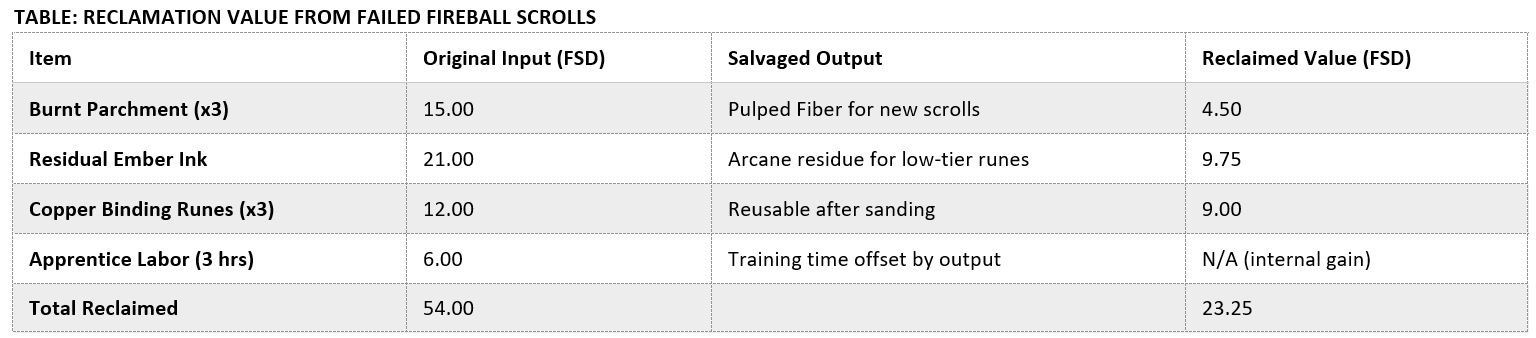
Worked Example: Miscast Scroll Reclamation

Consider a batch of fireball scrolls, three of which were improperly scribed during a rush order for the Crimson Wizards of Thay. Rather than burning them for ash, the damaged scrolls are sent to the Waterdeep Trading Company’s Rework Annex.

This 43% recovery ensures the company absorbs less loss while teaching scribes the dangers of working too fast with volatile ink.

Realms-Aware Considerations

Some cities in Faerûn impose heavy tariffs or disposal fees for magical waste. In Silverymoon, for example, uncontained arcane disposal is subject to crystal excise taxes. Reclaiming material avoids these fees. In Calimport, alchemical waste is monitored by the Desert Glass Chamber—failure to recycle properly can result in trade embargoes.

Guilds such as the Arcane Artificers & Alchemists Union (ARALCH) mandate that all apprentice-led production include a minimum quota of waste reclamation as part of certification. Thus, reclamation is both economic practice and rite of passage.

Final Thoughts

Production Waste Reclamation is more than cleanup—it is a strategic response to failure. It ensures that even when magic fizzles or steel fractures, something can be salvaged. For the Waterdeep Trading Company and allied guilds, it is a pillar of sustainability, education, and economic alchemy.

Want to design your own manufacturing models in Faerûn? Get your own AD&D365 Environment and guides at adnd365.com/start, and request access to the public view of the current database at https://public.adnd365.com

Login npc@adnd365.com
Password N0nPl@yC#822!

Support the AD&D365 Project on Patreon: To grow this world, we’ve launched an official Patreon where supporters can gain access to exclusive content, tools, training labs, and even influence the future of the project. Your support fuels more than just development — it expands the guildhall, forges new scrolls, and empowers the next generation of configuration wizards.  Begin your journey: https://www.patreon.com/adnd365/

Thanks to my supporters for helping make this content possible:

Our Benefactor, Andre Breillatt, whose generosity powers the arcane core of the project.

Our Apprentices, who keep the spell engines humming and the training labs active: Ralf Weber, Wendy Rijners, Shashi Mahesh, Julia Tejera, Ben Ekokobe, Tiago Xavier, Naveen Boyinapelli, Marcos Tadeu Wolf, Kathryn Greene, Jason Brown, Michael Ramirez, Mark Christy, and Ashish Singh.

Our Followers, who lend their steady support and encouragement along every step of the journey: Sunil Panchal, Sarah D. Morgan, Nick Ramchandani, Daniel Kjærsgaard, and Tomasz Pałys.

In the sprawling economies of Faerûn, knowing your enemies is as valuable in trade as it is in war. For the Waterdeep Trading Company, tracking competitors isn’t just a matter of pride—it’s a matter of profit. Whether you’re trying to outmaneuver Royalty Distilleries in spirit shipments or respond to new brewery upstarts from Icewind Dale, a structured system for competitor intelligence can tip the scales in your favor.

Why Monitor Competitors?

Tracking rival trading houses, breweries, distillers, and merchant guilds across Faerûn enables:

  • Price benchmarking for regional goods like Salington wines or Lakeside ciders
  • Forecasting market trends based on seasonal outputs or trade route control
  • Anticipating supply disruptions due to war, embargoes, or monster activity
  • Identifying acquisition or collaboration opportunities

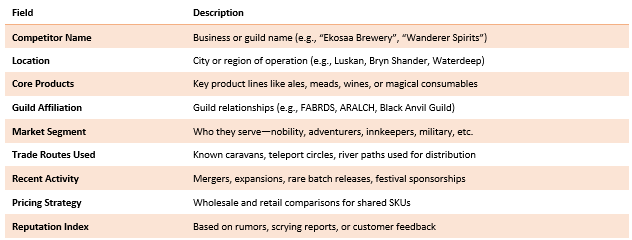
Key Competitor Data to Track

Article content

Tools in Your Arsenal

The Business Administrators Guide outlines several ways to track and leverage this data using the capabilities of Faerûn-enhanced Dynamics 365:

Competitor Profiles in Vendor Table

Use non-trading vendors to create Competitor profiles, assigning them categories like:

  • “Brewery – Northern”
  • “Guild – Independent”
  • “Distillery – Arcane Enhanced”

Custom Fields for Magical Monitoring

Add custom attributes such as:

  • Scrying Viability Score
  • Divination Approval Pending
  • Rumor Spread Rate

These allow you to layer in intelligence from magical informants, Sending Stones, or MirrorNet reports.

Price Journal Comparisons

Import product pricing from scouts or open-market flyers and compare SKUs across regions using the Price Disc Journals or External Trade Tables.

Mirror Communication Logs

Track communications, alliances, and disputes through registered Mirror IDs (e.g., MIR-WD-SAL-002 for Salington Vinyards’ mirror).

Trade Route Mapping

Use the Route Management module to trace known caravans of competitors, identifying stops, vulnerabilities, or shadow market overlaps.

Event Watchlists

Configure Watchlist alerts in your Faerûnian event calendar for:

  • Product Launches
  • Seasonal Brews
  • Interguild Festivals (e.g., Winter Spirits Gala in Baldur’s Gate)
  • Tax code updates from city-states

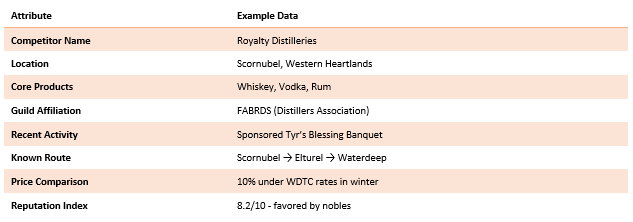
Sample Competitor Intelligence Entry

Article content

Strategic Advantage Through Awareness

From alchemical arms dealers to humble mead brewers, every competitor’s move leaves a footprint. By cataloging those prints in your AD&D365 environment, the Waterdeep Trading Company can stay one teleport step ahead.

Want to automate your competitor watch?

Get your own AD&D365 Environment and guides at adnd365.com/start, and request access to the public view of the current database at https://public.adnd365.com

Login npc@adnd365.com

Password N0nPl@yC#822!

Support the AD&D365 Project on Patreon

To grow this world, we’ve launched an official Patreon where supporters can gain access to exclusive content, tools, training labs, and even influence the future of the project. Your support fuels more than just development — it expands the guildhall, forges new scrolls, and empowers the next generation of configuration wizards. Begin your journey: https://www.patreon.com/adnd365/

Thanks to my supporters for helping make this content possible:

Our Benefactor, Andre Breillatt, whose generosity powers the arcane core of the project.

Our Apprentices, who keep the spell engines humming and the training labs active: Ralf Weber, Wendy Rijners, Shashi Mahesh , Julia Tejera, Ben Ekokobe, Tiago Xavier , Naveen Boyinapelli, Marcos Tadeu Wolf, Kathryn Greene , Jason Brown , Michael Ramirez, PMP , Mark Christy , and Ashish Singh.

Our Followers, who lend their steady support and encouragement along every step of the journey: Sunil Panchal , Sarah D. Morgan , Nick Ramchandani, Daniel Kjærsgaard, and Tomasz Pałys .