Welcoming a new employee or saying farewell to a departing team member is more than just a formality. These are moments that define the culture of your organization. The Waterdeep Trading Company takes these transitions seriously, ensuring that every arrival is smooth and every departure is dignified.
A consistent onboarding and offboarding process strengthens team cohesion, protects company assets, ensures compliance, and builds goodwill that lasts long after someone has left the building.
Here are the standard checklists used throughout the Company to manage those transitions with care and precision.
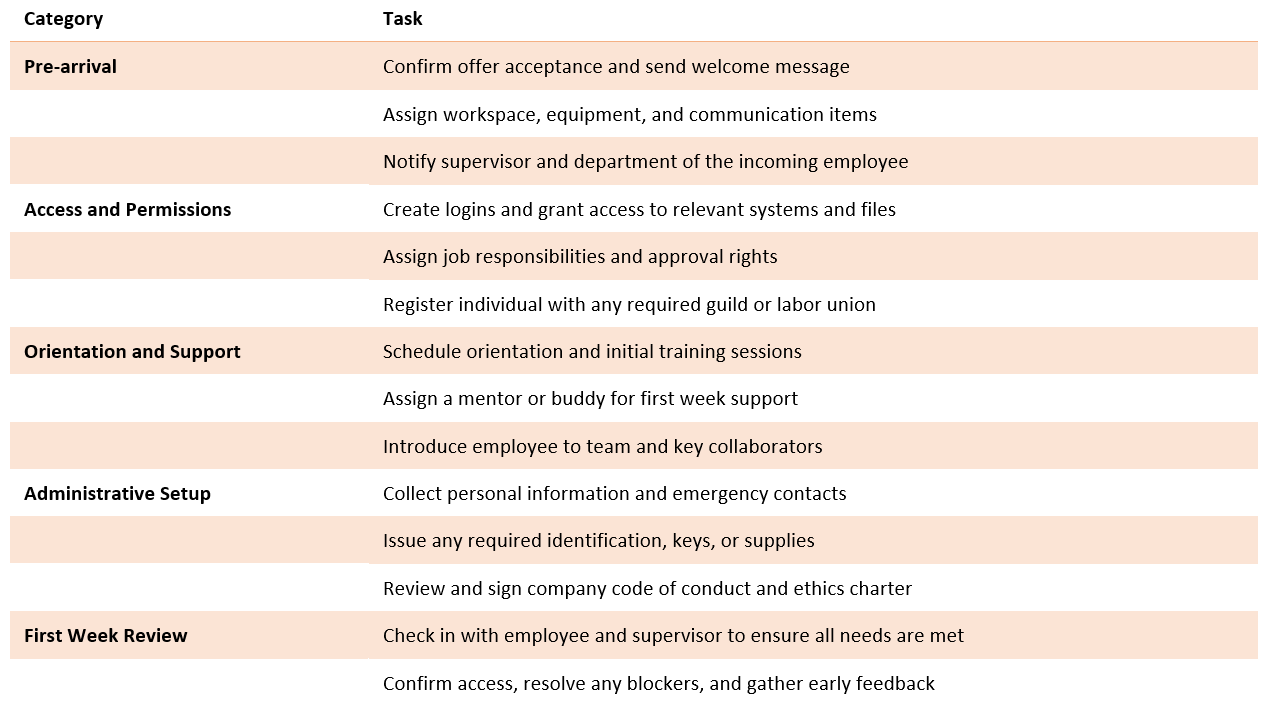
Onboarding Checklist
The onboarding checklist guides teams through every step required to welcome a new employee. It begins before the employee arrives with workspace preparation and system access. It continues with training, orientation, mentorship, and administrative setup. The process ensures new hires feel equipped, included, and empowered from their very first day.
Offboarding Checklist
The offboarding checklist ensures a smooth and compliant transition when an employee leaves. It includes communication, knowledge handover, security and asset recovery, and exit processing. It is designed to protect the company, preserve knowledge, and honor the employee’s contributions while maintaining a positive relationship for the future.
Closing Thought
A checklist is more than a list of tasks. It is a reflection of how much we value each person who passes through our gates. From the newest hire to the longest-serving veteran, every employee deserves a process that respects their contribution and prepares them for what comes next.
These checklists are not only tools for compliance but symbols of commitment to fairness, consistency, and the long-standing traditions of excellence that define the Waterdeep Trading Company.
In the heart of Waterdeep’s bustling workshops, the broom stands as one of the simplest tools we manufacture, until it doesn’t.
What happens when that same broom is imbued with an Arcane Kinetic Core, inscribed with motion glyphs, and certified by the Arcane Artificers & Alchemists Union (ARALCH)? You no longer have a basic product, you have a regulated enchanted good with a completely different production footprint.
This article breaks down the detailed differences in BOM and manufacturing route between the Standard Broom and the Self-Sweeping Broom, revealing how something so familiar can become a case study in magical supply chain transformation.
Detailed Bill of Materials and Route Comparison
Standard Broom – HOME-BROOM-STND
Total Items: 4
Magic Involvement: None
Compliance: Not regulated
Total Operations: 5
Work Centers Required: 3
Production Duration: ~35 minutes
Lot Tracking: Not required
Compliance: Basic QA
Self-Sweeping Broom – HOME-BROOM-SWEEP
Total Items: 7
Magic Involvement: 3 lines (Core, Rune, Glyph)
Compliance: Regulated by ARALCH – must include Rune Certification & Batch Tracking
Product Versions: Use separate BOM/Route versions for HOME-BROOM-STND and HOME-BROOM-SWEEP
Item Types: Use “Service” and “BOM” types for enchanted lines
Tracking Dimensions: Enable batch tracking for magical components
Route Groups: Tag magical operations for inspection required and certified resource
When the Route Becomes the Revolution
What separates a broom from a Self-Sweeping Broom isn’t just a spell—it’s a complete transformation in how we define, track, and execute manufacturing. For teams in product engineering and production control, understanding these differences isn’t optional. It’s operational survival.
The shift from mundane to magical manufacturing starts with mastering the details, your BOMs, your routes, your compliance paths. Whether you’re configuring enchanted inventory, onboarding a new product line, or preparing your team for ARALCH audits, we’ve built the tools to help you do it right.
Want to sweep smarter, not harder? Craft like a carpenter and enchant like an archmage, get the guides at adnd365.com/start and request full access to the public database at https://public.adnd365.com, logging in with
In the thriving trade capital of Waterdeep, gold flows not only between merchants and markets but also into the hands of guilds, those vital engines of craftsmanship, protection, and prosperity. The Waterdeep Trading Company stands at the center of this economic orchestra, ensuring every mason’s hammer, every apothecary’s mortar, and every bard’s lute is backed by fair and structured funding.
The guilds of Faerûn don’t merely operate as trade organizations. They are public institutions, economic engines, and strategic partners in building a stable realm. But even the most revered guild cannot function without clear financial support, transparent oversight, and seasonal adaptability.
Budgeting by Guild and Region
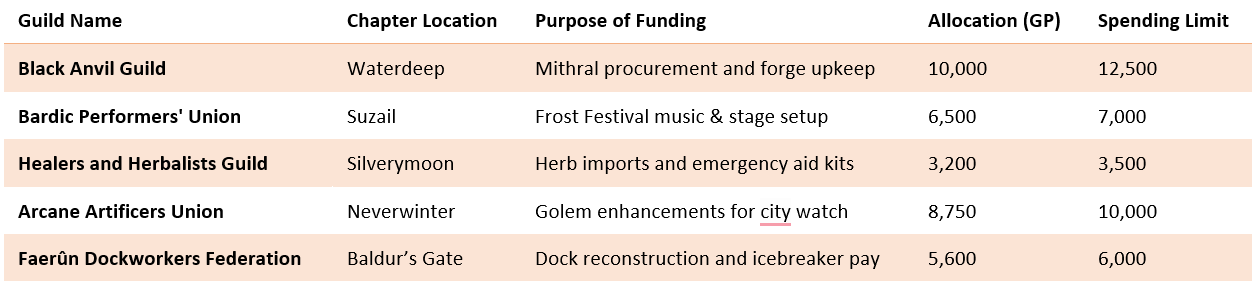
Each guild chapter submits seasonal funding requests, tied to both civic needs and operational objectives. Some seek coin for tools or stockpiles; others require capital for events, apprenticeships, or fortification efforts. The Waterdeep Trading Company maintains a central allocation ledger that organizes these funds by region and purpose.
Winter Allocation Table – 1495 DR
These allocations are not only about coin, but about trust. Higher thresholds are granted to guilds with consistent reporting and successful outcomes. Infractions, mismanagement, or delayed reporting can result in reduced limits for the following quarter.
Submitting and Approving Funding Requests
Guild stewards submit funding requests through formal scrolls, stamped with arcane validation sigils, including:
Description of the project or seasonal need
Proposed cost and required amount
Guild rank and authorization
Historical budget usage summary
Supporting documents such as scribed contracts or crystal scrying validations
A multi-tiered approval process follows, often requiring consent from regional trade councils, merchant alliances, and in some cases, the Lady’s Council itself. Larger requests, particularly those exceeding seasonal baselines, must include performance metrics from the prior year.
Seasonal Adjustments and Emergency Allocations
Faerûn is ever-changing. Wild magic storms, winter floods, and sudden invasions shift priorities. Funding cannot be static. Mid-season reallocations are made during the Highgold Council’s monthly conclave. These decisions reflect both public sentiment and on-the-ground conditions reported by informants and guild marshals.
Spring Revision Example – 1495 DR
Funding is not political, it is logistical. But when emergencies strike, such as the Great Collapse in the Deepstone Ward or the blockade on Moonshae wool, the Company responds swiftly, prioritizing public need over protocol.
Evaluating Guild Performance
Once gold is granted, so too comes accountability. Guild chapters are expected to submit closing ledgers, summarizing their usage, milestones achieved, and any deviations. These are reviewed by both the Chief Trade Auditor and the Office of Resource Alignment.
Sample Performance Ledger Summary – 1495 DR
Performance feeds future funding. Those who show discipline and deliver measurable outcomes earn larger grants and greater autonomy in the following year.
Closing Thoughts
Guild funding in Faerûn is more than coin counted in ledgers. It is the trust between trade and crown, the collaboration between sword and scroll, and the foundation of a thriving realm.
With regional budgeting models, seasonal responsiveness, and reputation-based controls, the Waterdeep Trading Company ensures the right gold flows to the right hands, so that peace, progress, and prosperity continue to echo from the Sea of Swords to the jungles of Chult.
In the arcane halls and subterranean storerooms of the Waterdeep Trading Company, not all inventory sits idly waiting for a sales order. Some cargo pulses with enchantment, fumes with unstable ethers, or begins to lose potency the moment it’s harvested. For potion makers and magical artisans, managing these perishable wares is not just good logistics, it’s a matter of safety, efficacy, and profit.
When it comes to enchanted goods and volatile ingredients, tracking shelf life and magical degradation becomes a critical component of warehouse operations.
The Magical Half-Life of Ingredients
Unlike common flour or salted pork, a crate of wyrmtongue root or a vial of etherfire sap cannot be stockpiled indefinitely. These ingredients possess:
Arcane Half-Life: A reduction in magical potency over time.
Physical Degradation: Mold, crystallization, or alchemical separation.
Environmental Sensitivity: Some require lunar cycles, stasis fields, or freezing glyphs.
Categorizing and Tagging Inventory
Each enchanted item must be logged with specific identifiers:
Inventory Monitoring Intervals
To prevent spoiled or unstable materials from reaching production or sale, ingredient stock is inspected on a regular cadence. These checkpoints are automated by alchemical calendar, crystal scrying, or good old-fashioned parchment logs.
Ingredients may retain varying degrees of power based on when they were harvested, how they were stored, or which planar moon was waxing. To assist potion mixers, each batch can be marked with a Potency Grade.
Disposition Codes for Expired Batches
When materials fall below acceptable thresholds, they must be removed or repurposed. The Waterdeep Trading Company uses standardized codes:
Case Study: Shadowroot Spoilage Prevention
In Springtide 1483, a rare shipment of Shadowroot Bulbs from the Deep Glade was delayed due to wyvern activity near the Sword Mountains. The bulbs, sensitive to moonlight and time, were nearing their 21-day potency cap.
By triggering a 14-day scrying check, the Waterdeep Trading Company identified the decline and rerouted them to their secondary potion facility for conversion into night-vision salves—saving both the product and the profit.
Conclusion
Tracking magical ingredient shelf life is more than a best practice in Faerûn—it’s the difference between a potent healing draught and a fizzling dud. By maintaining precise logs, monitoring intervals, and potency-based disposition, organizations like the Waterdeep Trading Company can ensure their enchanted supply chain flows as reliably as the Evermoor River.
Ready to master your own alchemical logistics? Buy the guides at adnd365.com/start and gain access to the public view of the current database at https://public.adnd365.com, logging in with
The flow of goods through the halls of the Waterdeep Trading Company is relentless—bundles of herbs from the Moonshae Isles, barrels of frost-chilled cider from Silverymoon, crates of ironroot planks from the High Forest. With every shipment inspected, measured, or tested, one truth becomes clear: a measurement is only as good as the tool behind it.
That is why instrument calibration is central to how the Company conducts business across Faerûn.
What Is Instrument Calibration?
Calibration is the process of confirming that a measurement tool produces accurate, reliable results compared to a known standard. Magical interference, wear, environmental exposure, or repeated use can degrade even the most trusted tools. When unchecked, this drift can lead to misgraded shipments, failed inspections, and lost contracts.
Calibration restores confidence. It ensures that a tool’s output aligns with the values it was designed to measure. And at the Waterdeep Trading Company, that process is deeply woven into day-to-day operations.
Instruments That Must Be Calibrated
The Company relies on a wide variety of tools to inspect goods. Many of these are enchanted or alchemically enhanced, each with its own quirks and calibration needs.
Each of these tools plays a vital role in quality verification. If they misread, entire shipments may be mislabeled, mispriced, or rejected outright by guild auditors.
The Calibration Lifecycle
To prevent that, every instrument is placed on a structured calibration cycle. Whether by usage count, time interval, or magical event exposure, calibration schedules ensure no tool drifts too far from truth.
The Waterdeep Trading Company maintains calibration tomes for every location. These documents are reviewed by quality inspectors, regional guild liaisons, and occasionally by visiting regulators from Baldur’s Gate or Neverwinter.
The Cost of Neglect
When an enchanted grain orb underreports moisture levels, the Company could ship spoiled flour to a noble’s kitchen. If a thermo-ring misreads during potion brewing, a whole batch may lose its shelf stability. In some cases, the consequences are minor. In others, reputational damage or trade penalties may follow.
The greatest risk lies in silent failures—the tools that drift just enough to cause problems without drawing attention. That is why proactive calibration is essential.
A Culture of Precision
At the Waterdeep Trading Company, calibration is not a checklist item. It is a reflection of commitment to trade excellence. From the docks of Luskan to the labs of Chult, every clerk, porter, and inspection officer knows their tools are only as trustworthy as the care behind them.
Goods can be delayed. Weather can change. Trade routes may shift. But a calibrated instrument never lies.
Learn more about how the Waterdeep Trading Company maintains quality across Faerûn in our training guides at adnd365.com/start, and request access to the public view of our database at https://public.adnd365.com. Log in using
In the merchant halls of Waterdeep, the potion caves of Baldur’s Gate, and the floating markets of Yartar, supply chains never sleep. To stay competitive, the Waterdeep Trading Company has embraced a model that allows vendors to deliver goods directly into our warehouses while retaining ownership. This practice is called Vendor Consigned Inventory, and it is as much about trust as it is about timing.
What Is Vendor Consigned Inventory
Vendor consigned inventory is a trade agreement in which a supplier delivers goods to the Waterdeep Trading Company, but retains ownership until the items are drawn, used, or sold. We hold the stock in our storerooms, ready to deploy, but do not pay until those goods are consumed.
This is a popular model for high-volume, high-value, or high-risk products. It allows the vendor to establish a strong presence in our distribution chain while WDTC avoids tying up coin in idle inventory.
Key Characteristics
Why It Benefits Vendors and WDTC
Vendor consigned inventory provides shared advantage. It is well suited for dynamic, multi-city operations like those run across Faerûn’s trade routes.
Faster Stock Availability: Stock is already in place. There is no delay due to shipment or customs approval. This is critical when responding to festival surges, urgent orders, or magical emergencies.
Lower Inventory Cost for WDTC: No upfront purchase means less coin locked in non-moving items. This makes room for a wider variety of vendor products to be available.
Improved Vendor Visibility: Vendors see real-time data on their consigned stock in our facilities. They can track drawdowns and plan restocking efforts precisely, even from distant cities like Elturel or Suzail.
Stronger Partnership Bonds: Vendors who consign with us often gain early access to seasonal forecasts, priority placement in our storefronts, and invitations to participate in specialty events.
The Process in Practice
Delivery and Receiving
Upon arrival, vendor inventory is inspected, rune-marked, and entered into the consignment ledger under a Vendor Ownership ID. Items are held in designated consignment zones until drawn.
Draw Events
Inventory is drawn when:
A customer purchases the product from a store or portal
The item is used in a kit, bundle, or manufacturing recipe
The item hits a spoilage or magical expiration threshold
Each draw event triggers a financial journal posting and notifies the vendor.
Settlement and Reporting
The system issues periodic settlement statements that include:
Quantity drawn since last settlement
Agreed-upon pricing and discounts
Payment due for each draw event
Inventory on hand at each warehouse location
Replenishment Triggers
The system monitors thresholds and predicts future demand using our enchanted forecasting model. Vendors are alerted when restocking is needed, and if desired, the replenishment order can be triggered automatically.
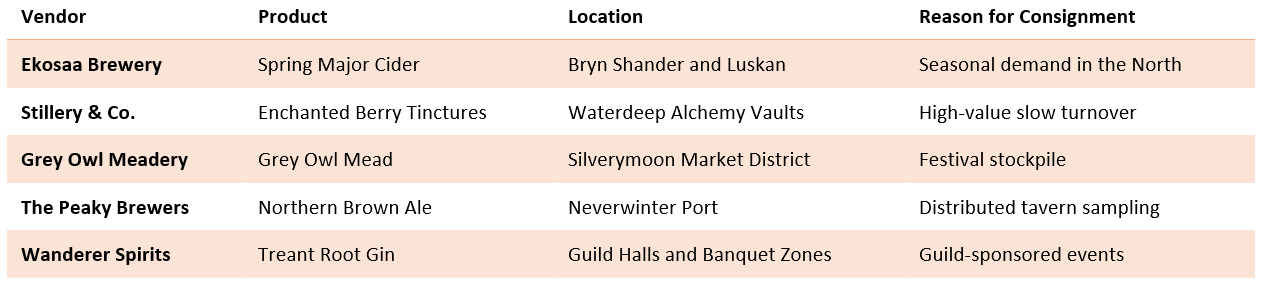
Examples of Vendor Consignment in Faerûn
Best Practices for Managing Vendor Consigned Inventory
Define clear ownership and draw point rules for each product
Use magical seals and ledger mirrors to track inventory status
Review stock levels weekly using the vendor inventory portal
Establish shared replenishment rules to avoid overstocking
Monitor draw event reports for accuracy and audit readiness
Closing Thoughts
Vendor consigned inventory brings power and flexibility to both sides of the supply chain. Vendors gain access to wide Faerûnian markets, and the Waterdeep Trading Company keeps its shelves stocked without overburdening its coffers. With magic-bound ledgers and real-time reporting tools, we make it easy to maintain trust and traceability.
Ready to become a trusted consignment vendor with the Waterdeep Trading Company? Start by visiting adnd365.com/start and request access to our public consignment portal at https://public.adnd365.com
In the crowded storerooms of Waterdeep, the sunlit stalls of Calimport, and the frostbitten depots of Icewind Dale, merchants are turning to a clever inventory strategy rooted in trust and timing. This practice is known as Customer Consigned Inventory, and it offers a way for vendors to reach new markets without giving up ownership or demanding coin upfront.
What is Customer Consigned Inventory
Customer consigned inventory is a trade arrangement where goods are stored by a distributor or marketplace like the Waterdeep Trading Company but remain the legal property of the vendor. Payment is only made once the goods are sold, consumed, or otherwise used.
To put it in Faerûnian terms, imagine a dwarven brewer leaves a cask of Emberfire Stout behind the bar. The tavern keeps it chilled and ready. But the brewer receives no payment until a patron calls for a pour. The brewer retains ownership until the first mug is raised.
Key Characteristics
Why It Works for the Merchants of Faerûn
Faerûn is known for unpredictable roads, magical mishaps, and fast-changing markets. Customer consigned inventory helps both merchants and distributors stay nimble.
Risk Stays with the Vendor
Until a product is sold, the vendor carries the burden. This encourages higher-quality goods and means the Waterdeep Trading Company is not stuck with unsold wares.
Wider Market Access
A potion-maker from Thay can place inventory in Silverymoon or Baldur’s Gate without needing to hire a storefront steward or invest in permanent property.
Seasonal Flexibility
Products can be moved across the continent in advance of local festivals or climate shifts. Fireproof cloaks go north in summer. Woolen wraps go south in winter.
Magical Audit Trail
Mirror-linked ledgers and inventory portals keep everyone informed. Vendors can check stock levels in real time from afar using Sending Stones or Mirror of Communication IDs.
How WDTC Handles the Process
The Waterdeep Trading Company uses a detailed and enchanted workflow to ensure goods are honored and tracked properly.
Receiving the Goods
Upon arrival, goods are examined by Inventory Porters and tagged with a customer ownership status. Enchanted seals are applied to prevent tampering.
Stock Visibility
The item is made visible in the inventory portal to both warehouse staff and the vendor. Alerts are generated if quantity falls below a set threshold or if the item is reaching expiration.
Triggering Settlement
When an item is sold or used, the system records a transfer of ownership and triggers financial settlement. The vendor receives payment based on the agreed terms.
Replenishment
If goods sell quickly, a courier is dispatched or a magical notification is sent to replenish the consigned stock.
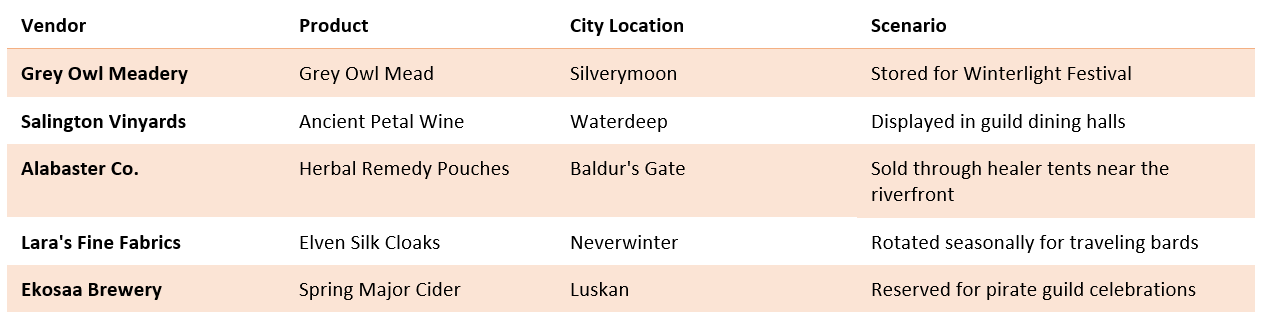
Examples of Consignment in Faerûn
Best Practices for Merchants Using Consignment
Tag each item with a unique Magical Signature
Use enchanted seals to confirm product authenticity and shelf status
Monitor real time inventory using MirrorCommID or Sending Stone alerts
Plan seasonal shipments ahead of festivals and trade fairs
Reconcile consignment reports monthly with WDTC inventory teams
Closing Thoughts
Customer consigned inventory blends flexibility, reach, and shared accountability. For Faerûn’s merchants and guild artisans, it allows products to be seen, sampled, and sold without the burden of upfront coin or the risk of stagnation. The Waterdeep Trading Company ensures that every barrel, bundle, or bottle is treated with care until the moment it changes hands.
In the unpredictable world of Faerûnian commerce, where a snowstorm in Ten-Towns or a goblin raid near the Trade Way can grind trade to a halt, the most successful merchants rely on more than fixed storage. They rely on motion. Enter the Rolling Warehouse. a revolutionary logistics solution blending transportation, storage, and strategic mobility.
More than a wagon and more than a warehouse, a Rolling Warehouse is a self-contained, mobile stockroom on wheels, designed to travel trade routes, supply outposts, and respond to shifting economic winds. They are the unsung heroes of supply chains, silently delivering prosperity from Baldur’s Gate to Bryn Shander.
What Is a Rolling Warehouse?
A Rolling Warehouse is a heavily fortified and often enchanted freight caravan used by trading companies, merchant guilds, and military suppliers. Each is designed to carry both volume and value, everything from winter cloaks and dried meat to enchanted blades and potions of healing. These units serve not only as transport but also as temporary depots, allowing goods to be staged and distributed closer to where they’re needed.
They often travel with their own crew: Loadmasters, Inventory Porters, Beastmasters, and in many cases, a warded security specialist to guard high-value cargo from magical or mundane threats.
Why Faerûn Needs Them
Example: During Deepwinter, Luskan’s frozen port cut it off from southern trade. A pair of Rolling Warehouses diverted from Neverwinter to bring hardtack, salted fish, and oil lamps just in time for the Harbor Festival, saving both the event and the city’s reputation for hospitality.
The Anatomy of a Rolling Warehouse
A Rolling Warehouse is more than a cart with crates. It’s a coordinated, living supply operation that combines enchantment, engineering, and enterprise. Let’s break down each essential component and role in the system:
Stocking and Inventory Assignment
Before departure, inventory is staged and loaded based on a blend of demand forecasts, trade route conditions, and strategic needs. Typical categories include:
Emergency supplies: tents, medical kits, cursed item containment jars
Loadmasters consult with trade coordinators and use encoded scrolls or enchanted manifests to document inventory, with each item sealed in containers labeled by alchemical ink or guild wax.
Route and Dispatch Planning
Rolling Warehouses don’t just go — they’re assigned planned corridors that span guild-supported outposts and waystations. A single trip may involve:
Fallback Paths: Reroute options in case of natural disasters, road collapse, or raids
Mirror Comm Check-ins: Scheduled reports using communication mirrors or relay stones to confirm location, progress, and route condition
Dispatch teams coordinate with local porters’ guilds to ensure paved roads, safe harbors, and posted watch rotations for night travel. Major houses often sponsor a Route Scryer to monitor the caravan via crystal ball or mirror scrying.
Active Storage and Mobile Distribution
Unlike static warehouses, Rolling Warehouses function as live inventory centers, capable of conducting business on the road:
Pop-Up Markets: Crews can open side panels and convert into mobile market stalls for roadside sales
Camp Drops: In wartime or expedition supply chains, inventory can be issued directly to troops or adventuring guilds from the cart
Staggered Deliveries: Deliver only parts of inventory across multiple stops while still in motion
Each Rolling Warehouse carries a Porter Ledger, tracking items moved in or out during the journey. These ledgers are enchanted for heat, water, and tamper resistance, and some sync with merchant guild registries on arrival.
Crew and Roles Aboard the Warehouse
A standard Rolling Warehouse caravan is a self-sufficient crewed operation, including:
Many caravans also employ a Beastmaster, especially if large animals or magical creatures are used for pulling the warehouse or guarding the route.
Security and Defense Enchantments
Given the value of mobile stock, Rolling Warehouses are hardened with both mundane and magical defenses:
Ironwood Plating: Fire-resistant and enchanted to resist blunt force
Ward Glyphs: Trigger alarms, illusions, or stunning shocks when unauthorized access is attempted
Chameleon Cloaks: Optical illusions that make the wagon appear as mundane freight or even a ruined cart
Defensive Traps: Tethered glyphstones that activate spikes, glue traps, or blinding light upon breach
In high-risk areas (such as routes through the Mere of Dead Men or past the Fields of the Dead), caravans may travel with hired guards, mercenary scouts, or even arcane-bound sentries perched atop the wagons.
Inspection and Resupply Stations
Rolling Warehouses depend on access to inspection points, which serve as both safety checks and replenishment hubs. These typically include:
Resupply Docks: Load up new inventory, swap beasts, refill enchanted refrigeration chambers
Magical Checkpoints: Realign route glyphs or stabilize pocket dimension storage
Guild Audits: Ensure taxes, fees, and guild tariffs are settled before passing through toll towns or protected zones
These checkpoints are manned by representatives from the Freight Consortium or United Caravaners, and sometimes host local scribes who issue transit seals and approval glyphs.
Magical Enhancements on the Move
Some Rolling Warehouses are little marvels of logistics enchantment. Features may include:
Guild Oversight and Support
These mobile units are often sanctioned by the United Caravaners & Teamsters Guild, with regulatory support from organizations like the Faerûn Dockworkers Federation and the Faerûnian Freight Consortium. Crews are trained and guild-certified, with rotating assignments, insurance scrolls, and emergency messenger birds for route disruptions.
Case Study: A Midwinter Trade Pivot
Origin: Waterdeep Destination: Fireshear (rerouted from Luskan) Cargo: Wool cloaks, dried fruits, firewood bundles Complication: Ice trolls attacking the western coast trade roads Solution: Diverted inland via Mirabar trade road, secured by mercenaries from the Free Adventurers League Outcome: Delivery made only three days late, saving the village festival and landing the company a lucrative snow-elk jerky contract
Conclusion
Rolling Warehouses are not merely logistical tools. They’re a symbol of adaptability, trust, and foresight in an unpredictable world. Whether supplying adventurers in the Spine of the World or provisioning a merchant gala in Athkatla, these mobile marvels prove that sometimes the best warehouse isn’t a building. it’s a moving target.
For over a century, the Waterdeep Trading Company has been the heartbeat of Faerûn’s trade. From the frost-kissed docks of Icewind Dale to the coastal bazaars of Calimport, the Company moves goods through every season with precision.
Success here is not based on speed alone. It depends on timing.
Seasonal demand planning is the art of predicting what will be needed, when it will be needed, and how to ensure it arrives just in time. It is how the Waterdeep Trading Company avoids stockpiling cloaks in the heat of Flamerule or running out of cider during the first toast of Highharvestide.
The Calendar of Commerce
Faerûn’s calendar tells more than time. It reflects culture, climate, and consumption. Every month carries specific market behaviors and patterns.
Waterdeep Trading Company studies these cycles carefully and layers them into every supply and logistics plan.
How the Company Forecasts Demand
Historical records are the backbone of the Company’s seasonal forecasting. Scribes maintain product movement scrolls dating back several generations.
Here are a few forecasting techniques in practice:
Rolling multi-year averages to compare monthly and festival-based trends across regions
Contracts and standing orders from temples, noble houses, and guilds which repeat annually
Predictive adjustments based on current market activity, such as harbor delays or rising prices from core vendors
Sentinel dispatches from field agents who report signs of early shifts in demand or local disruptions
The result is a structured forecast that balances tradition with the changing tides of trade.
Seasonal Labor and Staffing
The flow of goods depends on the flow of hands. The Waterdeep Trading Company plans its workforce as carefully as it does its inventory.
In Deepwinter, fewer shipments mean a heavier focus on warehouse security and internal audits
In Spring, hiring increases as couriers, carriers, and sorters are deployed to reopen stalled trade routes
In Summer, nearly every department grows. Market tents, brewery lines, and ship crews all need additional labor
In Autumn, specialized workers such as grain assessors and preservation technicians are deployed to lock in inventory before the freeze
Many workers are brought in on rotating seasonal contracts, often earning guild certifications for each successful campaign.
Managing Supplier Constraints
Not every vendor can scale with seasonal demand. Some are limited by harvest cycles, others by labor, and a few by magical interference.
To manage these risks, the Company maintains a supplier tier system:
Primary suppliers are those with strong delivery history and seasonal reliability
Secondary suppliers are used during peak demand or to fill gaps when primary vendors fall short
Specialist vendors are called upon for short seasonal bursts, such as rare spices during feast days or potion ingredients during cold snaps
Every procurement team tracks lead times and past performance to determine who to trust and when to switch.
Special Contracts and Priority Orders
Seasonal shifts also mean more contract-based orders. Some examples include:
Military garrisons requesting rations before planned campaigns
Temples ordering ceremonial garb and incense ahead of holy days
Mercenary companies securing bulk gear and potions in advance of expedition season
Nobles requiring finery and decor ahead of social functions
The Company sets aside protected inventory and often reserves wagon space or teleportation slots for these clients. They are built into seasonal forecasts as immovable pillars.
Transportation Planning by Season
Logistics can be the difference between profit and loss during seasonal transitions. Travel conditions change rapidly, and the Company prepares for these disruptions with dedicated planning ledgers.
Every route has a seasonal modifier and an action plan in place before the first sign of disruption appears.
What Happens After the Season Ends
The Waterdeep Trading Company reviews each season within ten days of its end.
Unused goods are either rotated to other regions or sold at a discount
Performance of forecasts is measured against actual sales
Surprises or anomalies are recorded in the forecasting grimoire for future adjustment
Lessons learned are shared across all Company locations
This cycle of planning, acting, and reviewing has been central to the Company’s growth and resilience.
Closing Thoughts
Seasons affect everything. Weather shifts harvests. Holidays shift demand. Travel restrictions shift logistics. But a business that plans for the seasons instead of reacting to them will always come out ahead.
Waterdeep Trading Company invites others to study how preparation drives prosperity.
To access trade records, planning templates, and regional demand data, visit adnd365.com/start and request access to the public trade network at https://public.adnd365.com.
In Faerûn, no successful merchant operates alone. Behind every cartload of enchanted textiles or barrel of trollwine stands a guild – documenting, inspecting, regulating, and, when necessary, demanding compensation. These are not advisory councils or informal collectives. They are the law in most cities when it comes to tradecraft, labor, pricing, and apprenticeships.
At the Waterdeep Trading Company, guilds form the foundation of our entire supply network. From the warehouses of Silverymoon to the docks of Calimport, our ability to do business depends on how well we manage, track, and respect these institutions.
What Is a Guild in Faerûn?
To an outsider, a guild may look like a club of craftsmen. To a merchant, it is a governing body. Guilds in Faerûn:
Regulate Pricing: They set base prices and forbid undercutting or overpricing.
Enforce Quality Standards: Products bearing the guild seal meet standards of safety, craftsmanship, and purity.
Manage Apprenticeships: Only members of a guild can legally train new workers in a trade.
Control Certification: From spell-tuned brewing to adamantine shaping, guilds determine who is licensed to work in a craft.
Settle Disputes: Guild arbitration often supersedes civil courts in trade matters.
Oversee Regional Chapters: Each major city has a chapter following the central charter while adjusting for local needs.
Organizing Guild Information in Your Company
To manage guilds effectively, companies like ours treat each one like a partner, with structured records and established procedures.
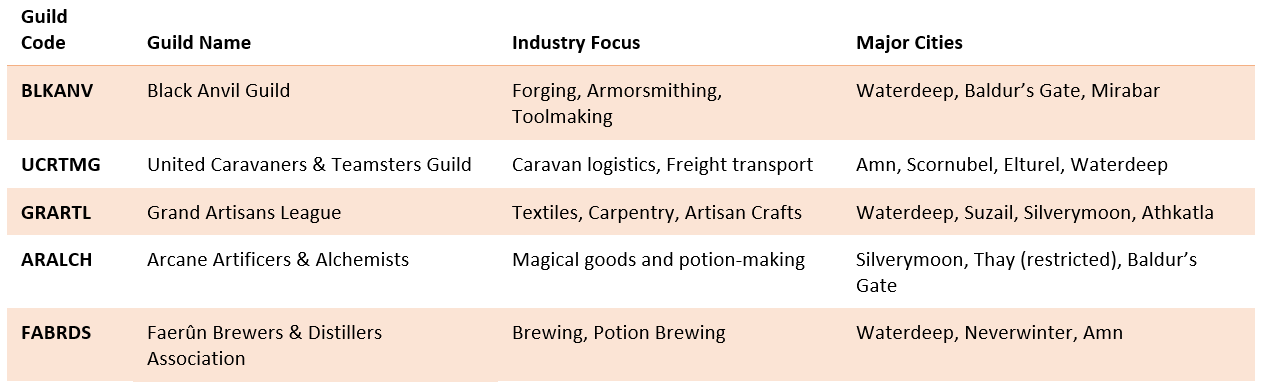
Guild Directory Examples
Here are a few of the more prominent guilds the Waterdeep Trading Company works with:
Guilds govern not just trade but talent. If you want to hire a certified loommaster, a leyline-calibrated enchanter, or a crystal alchemist with reliability, guild records are your best friend.
Merchants should track:
Certification Validity (including expiration and issuing chapter)
Advancement Requests (for promotion to master rank or guild chair)
Guild Exams (success rates and focus areas)
By doing this, you can ensure you’re always working with approved craftsmen and that your wares pass muster when they reach port inspectors.
Managing Guild Contracts
Contracts with guilds are not one-size-fits-all. A shipping agreement with the Teamsters may include:
Volume quotas
Minimum wage requirements
Safety and magical seal inspections
Contingency routes for high-risk regions
A procurement agreement with the Black Anvil Guild might include:
Fixed pricing tiers for steel or mithral goods
Priority supply in wartime
Enchantment inspection clauses
Track these by guild, chapter, and effective date—and always be aware of when a renegotiation period is due.
Dispute Resolution and Compliance
Most cities allow guilds to enforce their own rulings within their domain. When a dispute arises:
Arbitration is often mandatory
Guild fines may be binding on the merchant
Disciplinary actions (such as blacklisting) can affect all affiliated trade
Maintain detailed logs of:
Complaints filed
Guild responses
Resolution terms
Any modifications to contracts or certifications following the ruling
This protects your company and helps build a reputation as a guild-respecting trading house.
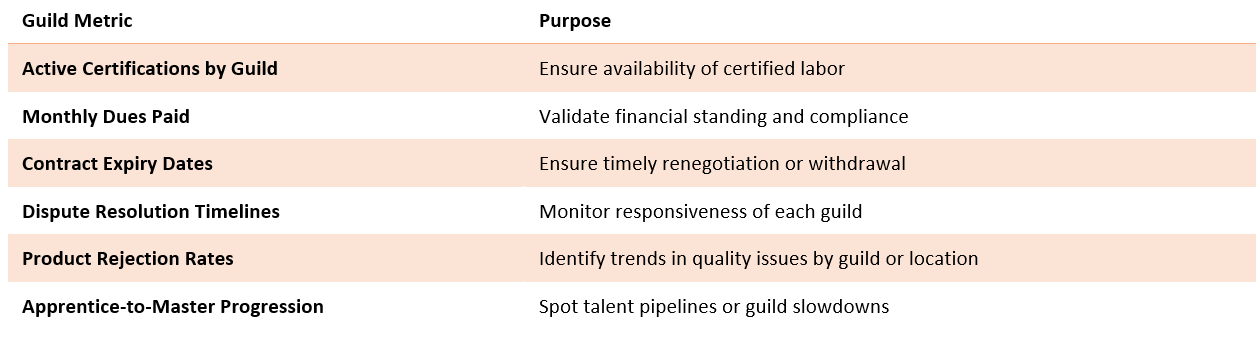
Guild Reporting and Oversight
Larger operations should develop guild reporting practices. Here are a few metrics we track:
Final Thoughts: Why Guilds Deserve Respect
Guilds don’t just protect craftsmen—they protect the economy. They ensure that products move fairly, workers are trained properly, and that bad actors can’t flood the market with cursed tankards and half-finished crossbows.
For a trading company, building strong, respectful, well-documented relationships with every guild you work with isn’t just a best practice—it’s the key to staying in business.
Want to start managing your guild partnerships better? Check out the guides at adnd365.com/start and explore the public demo environment at https://public.adnd365.com, using:









 A Tinkerers Notebook