Every ERP concept in this lab has a CRM twin. The names changed, the forms got wider, and there are more required fields, but the underlying business logic is the same. This lab maps what we already know to where it lives in Finance and Operations.
We are not building anything new yet. We are reading, navigating, and comparing. By the end, the D365 F&O navigation should feel like a dialect of a language we already speak.
Overview
This lab maps six core CRM entities to their ERP equivalents. We will navigate to each F&O form, compare the record structure to what we know from CRM, and identify which fields are new, which are renamed, and which behave differently.
We will complete six activities:
Open a customer record and compare it to a CRM account.
Review customer groups and compare them to CRM account types or segments.
Open a released product and compare it to a CRM product catalog entry.
Navigate the site and warehouse hierarchy and understand physical inventory tracking.
Open a vendor record and understand the purchase side of the same entity model.
Review currency codes and understand multi-currency in ERP.
Each activity is a guided navigation exercise. No records are created or modified.
Objective
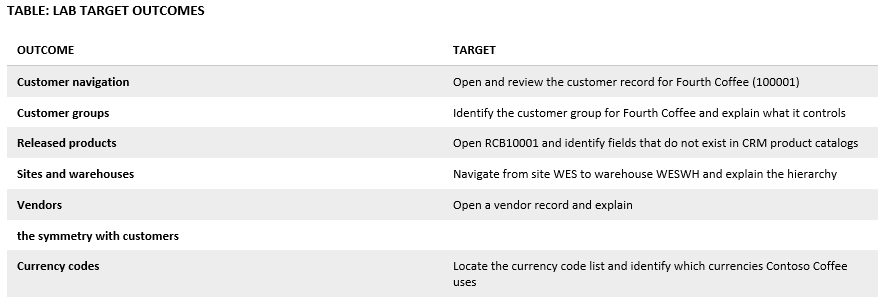
By completing this lab, we will be able to navigate six core F&O entity forms and explain the CRM-to-ERP mapping for each.
The following table defines the target outcomes for each entity mapping exercise.
TABLE: LAB TARGET OUTCOMES
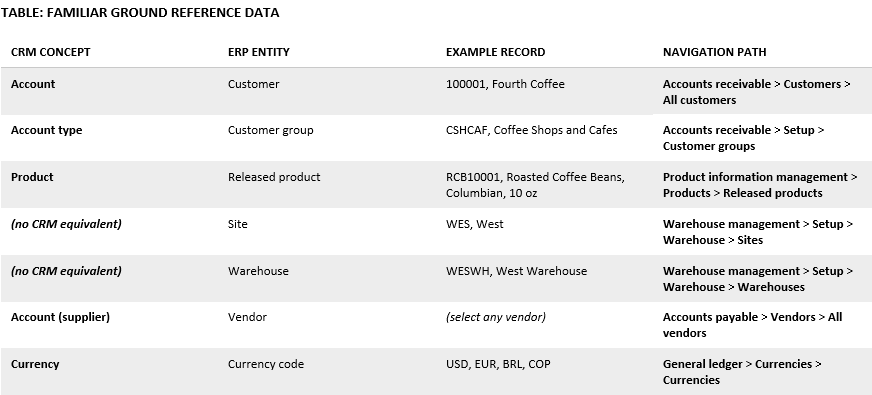
Reference Data
The following reference values support navigation during this lab. All records already exist in the Contoso Coffee database.
In every guild hall across the Sword Coast, from the marble counting houses of Waterdeep to the timber-framed trade posts of Baldur’s Gate, there exists an unspoken question. What separates a thriving merchant house from one that folds after a single bad season?
Adventurers have long been judged by strength, dexterity, constitution, intelligence, wisdom, and charisma. These scores tell the story of what a person can lift, dodge, endure, learn, perceive, and persuade. But guilds and trading companies are not people. They are living systems built on coin, contracts, caravans, and control.
The Waterdeep Trading Company does not measure itself by the arm strength of its porters or the charm of its negotiators. It measures itself by six core business ability scores. Capital Base, Operational Speed, Stability, Planning Acumen, Control Discipline, and Trade Standing. Together, these scores provide a complete picture of how a business performs under pressure, navigates opportunity, and sustains itself across seasons and storms.
This system is used by guild clerks, senior factors, and financial scribes to evaluate performance, compare branches, and make decisions about expansion, investment, and partnerships. The scores are not abstract. They shape daily outcomes, from whether a contract is honored to whether a caravan reaches its destination intact.
This article explains how the Waterdeep Trading Company uses business ability scores to measure organizational health, predict risks, and maintain one of the most respected operations in the Realms.
What Business Ability Scores Are
Business ability scores are numerical ratings that describe the functional capacity of a guild, trading house, or merchant operation. Just as adventurers are rated on a scale of 3 to 18 for physical and mental attributes, businesses are rated on the same scale for operational and financial attributes.
Each score measures a specific dimension of performance. Low scores indicate weakness or vulnerability. High scores indicate strength and resilience. A score of 10 or 11 represents average competence for an established guild. Scores below 8 suggest critical deficiencies. Scores above 15 suggest exceptional capability.
These scores are not static. They shift in response to events, decisions, investments, and market conditions. A guild that loses its warehouse to fire may see its Stability score drop by 3 points. A guild that secures exclusive contracts with the Lords’ Alliance may see its Trade Standing rise by 2 points.
The six core scores are used individually and in combination to calculate derived metrics that describe real operational outcomes.
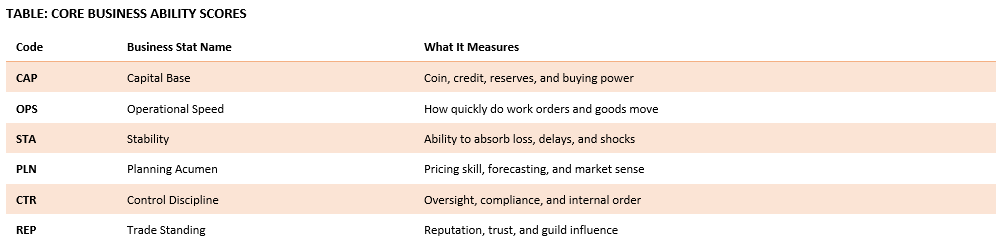
The Six Core Business Stats
This table defines the primary attributes used to assess a business’s strength and health in Faerûn.
Capital Base, CAP
Capital Base measures financial muscle. It represents the total amount of liquid coin, available credit, vaulted reserves, and purchasing power that a business can deploy on short notice.
A guild with a high Capital Base can afford bulk purchases at discount rates, fund emergency repairs without hesitation, and sustain operations through lean months. A guild with a low Capital Base struggles to keep shelves stocked, cannot negotiate favorable terms, and must turn away profitable opportunities due to a lack of funds.
Capital Base is used when a business needs to outbid rivals, secure rare materials, pay unexpected tariffs, or survive a season where revenue drops below expenses. It determines whether a company controls its suppliers or is controlled by them.
A score of 8 or below means the guild operates hand to mouth, always one delay away from insolvency. A score of 15 or above means the guild can absorb shocks, invest in growth, and dictate terms to weaker partners.
Operational Speed, OPS
Operational Speed measures how fast a business acts. It represents the ability to fulfill orders promptly, reroute caravans in response to danger, process customer requests without delay, and handle surges in demand.
A guild with high Operational Speed completes contracts ahead of schedule, adapts to shifting markets, and captures time-sensitive opportunities. A guild with low Operational Speed creates backlogs, misses deadlines, and loses customers to faster competitors.
Operational Speed is used when goods must be delivered by a specific festival date, when a workshop must pivot to produce a different item on short notice, or when emergency repairs are needed to keep a production line running.
A score of 8 or below means the guild is perpetually behind, with frustrated customers and missed opportunities. A score of 15 or more means the guild sets the pace of the market and can react to changes faster than rivals can plan for them.
Stability, STA
Stability measures endurance under pressure. It represents the ability to absorb losses, withstand delays, survive fines or penalties, and continue operating when circumstances turn hostile.
A guild with high Stability can endure a failed caravan, a spoiled shipment, a warehouse fire, or a contract dispute without collapsing. A guild with low Stability teeters on the edge of ruin, where a single bad event can close its doors permanently.
Stability is used when goods spoil in transit, when bandits destroy a shipment, when tariffs double unexpectedly, when a key partner goes bankrupt, or when a plague disrupts supply chains for months.
A score of 8 or below means the guild has no cushion for error and cannot survive adversity. A score of 15 or above means the guild can weather storms that would destroy lesser operations and emerge intact.
Planning Acumen, PLN
Planning Acumen measures foresight and judgment. It represents the ability to forecast demand, anticipate price shifts, choose reliable suppliers, set profitable margins, and avoid costly mistakes.
A guild with high Planning Acumen purchases materials before prices spike, avoids inventory that will not sell, prices goods to maximize profit without losing customers, and identifies emerging markets before competitors do. A guild with low Planning Acumen overbuys goods that sit unsold, underprices valuable items, and makes purchasing decisions based on guesswork.
Planning Acumen is used to determine how much stock to order for the winter season, decide whether to expand into a new region, set prices for a new product line, or evaluate the reliability of a potential supplier.
A score of 8 or below means the guild makes poor decisions that erode margins and waste resources. A score of 15 or above means the guild anticipates market movements and positions itself ahead of the curve.
Control Discipline, CTR
Control Discipline measures internal order and rule-keeping. It represents the ability to enforce procedures, detect fraud, maintain accurate records, ensure contract compliance, and prevent waste or theft.
A guild with high Control Discipline has clean books, reliable audits, trusted employees, and consistent processes. A guild with low Control Discipline suffers from embezzlement, sloppy record keeping, contract violations, and operational leaks that drain profit.
Control Discipline is used when conducting financial audits, investigating discrepancies in inventory counts, enforcing contract terms with suppliers, or ensuring that employees follow established procedures.
A score of 8 or below means the guild is vulnerable to fraud, mistakes, and regulatory penalties. A score of 15 or above means the guild operates with precision and can be trusted by partners, investors, and guilds.
Trade Standing, REP
Trade Standing measures how the market views the business. It represents reputation, trustworthiness, influence with guilds and nobles, access to favorable credit terms, and the ability to negotiate from a position of strength.
A guild with high Trade Standing enjoys preferred supplier relationships, can secure credit on favorable terms, gains access to exclusive contracts, and receives lenient treatment when disputes arise. A guild with low Trade Standing must pay cash up front, is denied opportunities, and struggles to find partners willing to work with them.
Trade Standing is used when negotiating payment terms, seeking membership in a prestigious guild, applying for licenses or permits, or requesting favors from influential contacts.
A score of 8 or below means the guild is viewed as unreliable and unworthy of trust. A score of 15 or above means the guild opens doors that others cannot access and commands respect across the Realms.
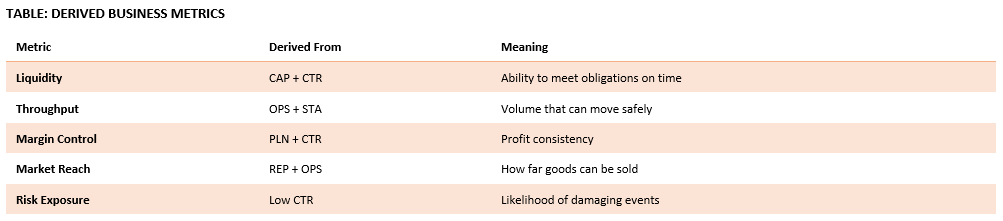
Derived Business Metrics
Core ability scores are useful on their own, but they become even more powerful when combined to calculate derived metrics. These metrics describe specific operational outcomes that matter to daily performance.
This table shows how core stats combine into practical outcomes.
Liquidity
Liquidity is calculated by adding Capital Base and Control Discipline. It measures whether a business can meet its financial obligations when they come due. A guild with high Liquidity has enough coin on hand and disciplined processes to ensure payments are made on time. A guild with low Liquidity may have coin but lose track of when payments are due, or may have excellent record keeping but insufficient funds to cover debts.
Throughput
Throughput is calculated by adding Operational Speed and Stability. It measures the volume of goods that can be moved safely without exceeding the system’s capacity. A guild with high Throughput can handle large orders, seasonal surges, and complex logistics without collapsing under the load. A guild with low Throughput becomes overwhelmed when demand spikes and suffers delays or failures.
Margin Control
Margin Control is calculated by adding Planning Acumen and Control Discipline. It measures how consistently a business generates profit. A guild with high Margin Control prices goods intelligently and enforces cost controls that prevent waste. A guild with low Margin Control makes erratic profits, with some quarters highly profitable and others deeply unprofitable.
Market Reach
Market Reach is calculated by adding Trade Standing and Operational Speed. It measures how far a business can effectively sell its goods. A guild with high Market Reach can deliver products quickly to distant cities and has the reputation to close deals in unfamiliar markets. A guild with low Market Reach is confined to local sales and struggles to expand beyond familiar territory.
Risk Exposure
Risk Exposure is indicated by low Control Discipline. It measures the likelihood of damage from internal failures. A guild with high Risk Exposure is vulnerable to fraud, contract violations, regulatory fines, and operational mistakes that create financial harm.
Reading a Business Profile
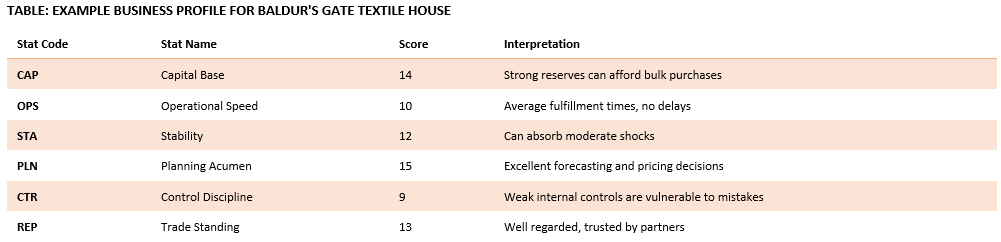
To illustrate how these scores work together, consider a mid-sized merchant house operating out of Baldur’s Gate. The house specializes in importing textiles from Calimport and selling them throughout the Sword Coast.
This table shows the ability scores for a fictional merchant house.
Derived Metrics:
Liquidity: 14 + 9 = 23. Adequate ability to meet obligations, though control weaknesses introduce some risk.
Throughput: 10 + 12 = 22. Moderate capacity can handle standard volumes.
Margin Control: 15 + 9 = 24. Good planning is offset by weak controls; profits are strong but inconsistent.
Market Reach: 13 + 10 = 23. Solid reach can sell across the Sword Coast.
Risk Exposure: Control Discipline of 9 indicates an elevated risk of fraud or operational errors.
Interpretation
This merchant house has strong margins and good market standing, but weak controls. Growth has outpaced discipline. The business is profitable and well-positioned for expansion, but a single fraud incident, contract violation, or sloppy record-keeping error could cause significant damage.
The recommended action would be to invest in improving Control Discipline before pursuing further growth. This might include hiring an experienced auditor, implementing stricter inventory checks, or establishing formal approval processes for major expenditures.
Using Business Ability Scores in Daily Decisions
Guild clerks and senior factors use these scores to guide decisions across a range of scenarios.
When evaluating a potential partnership, they compare Trade Standing and Control Discipline scores. A partner with high Trade Standing but low Control Discipline may bring valuable connections but also introduce operational risk.
When planning for seasonal demand surges, they examine Operational Speed and Stability. If both scores are low, the guild may need to decline large orders or risk collapse under the load.
When deciding whether to extend credit to a customer, they review the customer’s Capital Base and Trade Standing. A customer with a strong reputation but weak capital may need shorter payment terms.
When assessing the viability of a new trade route, they calculate Market Reach and compare it with the route’s distance and complexity. If Market Reach is insufficient, the route may fail due to delivery delays or the inability to negotiate favorable terms in unfamiliar cities.
These scores are not abstract academic measures. They are practical tools used daily to evaluate risk, allocate resources, and make choices that determine whether a business thrives or fails.
Realms Aware Considerations
Business ability scores are influenced by location, market conditions, and external events. A guild operating in Waterdeep may have higher Trade Standing due to proximity to influential nobles and guild councils. A guild operating in a frontier settlement may have lower Operational Speed due to limited infrastructure and unreliable supply chains.
Scores can shift rapidly during crises. A plague that disrupts trade routes may reduce Operational Speed and Stability across an entire region. A successful diplomatic mission that secures favorable trade agreements may increase Trade Standing for all guilds affiliated with the sponsoring faction.
Guilds with diversified operations across multiple cities may have different scores in each location. The Waterdeep Trading Company may have a Capital Base of 16 in its home city but only 11 in its Baldur’s Gate branch, reflecting differences in local reserves and access to credit.
Senior factors track score changes over time to identify trends. A steady decline in Control Discipline may indicate that internal processes are breaking down and require immediate attention. A steady increase in Planning Acumen may indicate that recent hires or training programs are paying off.
Final Thoughts
Business ability scores let a guild feel alive, measured, and fallible, just like any adventuring party. They provide a common language for evaluating performance, comparing operations, and making decisions grounded in evidence rather than intuition.
The Waterdeep Trading Company uses these scores to maintain discipline, anticipate risks, and ensure that every branch operates with the strength needed to survive in the competitive markets of Faerûn. Whether managing a warehouse, negotiating a contract, or planning for the next season, these six scores guide every choice and shape every outcome.
Support the AD&D365 Project on Patreon. To grow this world, we’ve launched an official Patreon page where supporters can access exclusive content, tools, and training labs, and even influence the project’s future. Your support fuels more than just development; it expands the guildhall, forges new scrolls, and empowers the next generation of configuration wizards. Begin your journey: https://www.patreon.com/adnd365/
A Grateful Salute to ourPatrons. To all those who stand behind the vision, thank you for helping bring this world to life. Our Benefactors, Andre Breillatt and Eryndor Fiscairn‡, your boundless generosity fuels the arcane core of this project. Without your magic, the weave would falter. OurApprentices, the spell engines turn, and the training labs thrive thanks to our current Apprentices: Michael Ramirez and Andreth Bael’Rathyn‡. Special thanks to our past Apprentices, whose contributions helped us get here: Ralf Weber, Wendy Rijners, Shashi Mahesh, Julia Tejera, Ben Ekokobe, Tiago Xavier, Naveen Boyinapelli, Marcos Tadeu Wolf, Kathryn Greene, Jason Brown, Mark Christy, and Ashish Singh. Our Initiates, Jeff Stiles,Harry Burgh, Jesper Livbjerg, Peter Lorre, Gregory Brigden, and Martin Grahm, your commitment marks the start of the deeper path, stepping beyond mere observation into the active shaping of this realm.Our Followers, your steady presence along the journey is a beacon of encouragement: Rusty Cavalier,Eric Shuss, Sunil Panchal, Sarah D. Morgan, Nick Ramchandani, Daniel Kjærsgaard, and Tomasz Pałys. And our Voyeurs, ever watching from the shadows, clearly intrigued… but not enough to part with a single gold piece. Your silent curiosity is noted and mildly judged.
Want to design your own economic models in Faerûn? Get your own AD&D365 Environment and guides at adnd365.com/start, and request access to the public view of the current database at https://public.adnd365.com – Login npc@adnd365.com, Password N0nPl@yC#822!
In the workshops, distilleries, and forges across the Sword Coast, production rarely fails because of a single dramatic event like a broken enchantment or collapsed furnace. Instead, loss arises from small pauses, slow runs, spoiled batches, and quiet rework that never clearly reaches the ledger. A half hour here, a failed batch there, and suddenly the quarterly margins tell a different story than the production logs promised.
The Waterdeep Trading Company recognizes this truth. To see what truly happens on the shop floor, rather than what should happen according to plan, the company employs a measurement discipline known as Overall Equipment Effectiveness, or OEE. This metric does not judge the skill of artificers or the dedication of laborers. Instead, it measures how well equipment turns planned time into sellable goods. It captures time, speed, and quality in a single actionable metric that reveals the hidden costs of production.
OEE matters because it connects the reality of the workshop to the expectations of the counting house. It indicates whether delays are attributable to bad luck, poor maintenance, inadequate training, or systemic issues that require investment. For guild masters, production supervisors, and finance scribes alike, OEE transforms vague impressions into clear data.
This article explains OEE in plain terms, shows how it applies to Faerûnian production environments, and walks through worked examples using a heated cauldron line operated by the Waterdeep Trading Company.
What OEE Is
OEE is a single measure built from three distinct components. Each component represents a different approach, which can result in lost planned production time. Together, they answer one essential question: Of all the time we planned to produce, how much became a good product ready for sale?
The three components are Availability, Performance, and Quality. Each is expressed as a percentage, and their product yields the overall OEE score.
The Three Components Explained
Understanding each component separately is essential before combining them into the full OEE calculation.
Availability
Availability measures time lost to stoppages. If a cauldron is scheduled to run but sits idle due to cleaning, repair, missing ingredients, or equipment failure, that time is lost availability. Availability only checks whether the equipment is running. It does not matter how fast the equipment runs or whether the output is good. It simply asks: Was the equipment operating when it should have been?
Common causes of availability loss in Faerûn include arcane instability requiring recalibration, material shortages from delayed caravans, mechanical failures in gears or seals, and unplanned cleaning due to contamination.
Performance
Performance measures lost speed. If a cauldron is running but heating more slowly than expected, pausing briefly between batches, or operating at reduced output due to worn components, the slowdown reduces performance. Performance is measured by comparing the actual output rate to the ideal output rate. Even if the equipment never fully stops, running at 80% of expected speed results in a 20% performance loss.
In Faerûnian workshops, performance loss often comes from aging enchantments, inexperienced operators, inconsistent ingredient quality, or temperature fluctuations in the workshop environment.
Quality
Quality measures lost output. If a batch fails inspection, requires rework, or must be discarded entirely, that loss reduces quality. Quality looks only at usable output. Even if availability and performance are perfect, quality loss means that production time was spent creating goods that cannot be sold at full value.
Typical quality issues include failed enchantments, contamination from improper cleaning, incorrect ingredient ratios, or structural defects in the finished product.
The OEE Formula
The formula for OEE is straightforward. It multiplies the three components together.
OEE equals Availability multiplied by Performance multiplied by Quality.
Each value is expressed as a percentage, and the result is also a percentage. An OEE of 85 percent means that 85 percent of planned production time resulted in good output. The remaining 15 percent was lost due to downtime, slow speed, or defective products.
Worked Example 1: Single Heated Cauldron, One Shift
For example, OEE can be illustrated by a single heated cauldron operated by the Waterdeep Trading Company over an eight-hour shift. The cauldron produces alchemical potions in batches, each requiring a defined heating and cooling cycle.
The shift begins with a plan. The following table shows how the planned shift time is allocated before any actual production begins.
The planned production time of 420 minutes represents the time available for actual manufacturing after subtracting scheduled breaks, shift handovers, and routine inspections. This is the baseline against which OEE will be measured.
During the shift, several events occur that affect production. A seal failure causes a 30-minute stoppage while repairs are made. The cauldron runs slower than expected for part of the shift due to inconsistent heat from a weakening enchantment. One batch fails quality inspection due to improper mixing and must be discarded.
Now we calculate each component of OEE step by step.
Step 1: Calculating Availability
Availability compares the time the equipment operated to the planned production time. The following table breaks down the calculation.
Availability equals operating time divided by planned production time. This gives us 390 ÷ 420, which equals 92.86%. The cauldron was available to produce for just under 93 percent of the planned time.
Step 2: Calculating Performance
Performance compares actual output to the ideal output based on the equipment’s design speed. The cauldron is designed to produce one batch every 20 minutes when running at full capacity.
With 390 minutes of operating time, the ideal output is 390/20, which equals 19.5 batches. However, the actual output before quality checks is 18 batches.
Performance equals actual output divided by ideal output. This gives us 18 ÷ 19.5, which equals 92.31%. The cauldron ran at just over 92 percent of its expected speed.
Step 3: Calculating Quality
Quality compares good output to total output. Out of the 18 batches produced, one fails inspection and must be discarded. This leaves 17 good batches.
Quality equals good batches divided by total batches. This gives us 17/18, which equals 94.44%. Just over 94 percent of production met quality standards.
Step 4: Calculating OEE
We now multiply the three components to compute the overall equipment effectiveness.
OEE equals 92.86% × 92.31% × 94.44%, which gives approximately 80.9%.
This means that just over 80% of the planned production time resulted in sellable output. The remaining nineteen percent was lost due to downtime, reduced speed, and quality failures. Each of these losses represents real cost to the company, whether in wasted materials, wasted labor time, or lost revenue from goods that could not be sold.
Worked Example 2: Comparing Two Cauldrons
The Waterdeep Trading Company operates two heated cauldrons in parallel, both using the same recipe and running for the same shift length. While both produce the same product, their performance characteristics differ significantly. The following table compares their OEE components.
The results reveal an interesting pattern. Cauldron B stops more often, resulting in more downtime and lower availability. However, when it runs, it runs faster and produces cleaner output. Cauldron A runs more consistently with fewer stoppages but loses effectiveness through slower speed and more quality issues.
Despite their different loss patterns, both cauldrons deliver nearly identical overall effectiveness, approximately 80%. This informs the production supervisor and the finance scribe that both lines require attention, but for different reasons. Cauldron A may require improved training or maintenance to enhance speed and quality. Cauldron B may need more reliable components or better preventive maintenance to reduce stoppages. Focusing solely on total output would obscure these differences. OEE reveals where improvement efforts should focus.
Why OEE Matters to the Ledger
OEE connects the shop floor to finance without guesswork or assumptions. Each component of OEE has direct financial implications that are reflected in the cost accounting system.
Low availability increases labor cost per unit because workers are paid for time when the equipment sits idle. It also increases per-unit overhead allocation because fixed costs, such as workshop rent and lighting, are spread across fewer units of output.
Low performance hides capacity loss. A workshop that believes it has space to take on more orders may be running its existing equipment at reduced speed. OEE reveals this hidden constraint before the company overcommits to customers.
Low quality creates scrap, rework, and delayed revenue. Materials are consumed but produce no sellable output. Labor is spent twice on the same batch. Delivery promises are broken because good output arrives later than planned.
By linking OEE trends to cost and margin analysis, the Waterdeep Trading Company avoids the common mistake of blaming weak demand for execution issues. When revenues fall short, OEE data can show whether the problem is market conditions or internal capacity utilization.
Using OEE the Right Way
OEE is a signal, not a weapon. When used properly, it guides continuous improvement and reveals systemic issues. When used improperly, it becomes a tool for blame that drives workers to hide problems rather than solve them.
Good use of OEE focuses on patterns over time rather than on single shifts. A bad day tells you little. A trend of declining performance over weeks indicates that something fundamental requires attention. OEE should be reviewed with operators, not against them. The people closest to the equipment often know exactly what is wrong and simply need permission and resources to fix it.
The goal of tracking OEE is to remove friction from the system, not to punish those working within it. Equipment that consistently exhibits low availability may require investment in improved maintenance or replacement parts. Low performance may indicate the need for improved training, clearer work instructions, or enhanced capabilities. Low quality may indicate issues with ingredient sourcing, inadequate inspection tools, or process design flaws.
OEE works best when it is transparent, regularly discussed, and used to justify investments in improvement rather than to assign blame for shortfalls.
Realms Aware Considerations
Production in Faerûn faces unique challenges that are less common in purely mechanical manufacturing environments. Some losses are specific to the magical and logistical realities of the Sword Coast.
Magical instability affects quality. Enchantments can fade, interfere with each other, or behave unpredictably during storms or planar convergences. Quality losses from arcane sources require different solutions than mechanical defects.
Ingredient variance affects performance. Raw materials sourced from different regions or different seasons may behave differently in the same process. A potion recipe that works perfectly with Cormyrian herbs may run slower or produce inconsistent results with substitutes from Amn.
Enchantment maintenance affects availability. Unlike purely mechanical equipment, magical apparatus requires periodic recalibration, attunement, or recharging. These maintenance activities may be less predictable than oiling gear or replacing worn belts.
Despite these unique factors, the losses are still losses. OEE allows them to be measured, discussed, and planned for, rather than accepted as inevitable. By quantifying the impact of magical instability or ingredient variance, the company can make informed decisions about whether to invest in better enchanters, source more consistent materials, or adjust customer delivery promises.
Final Thoughts
OEE does not promise perfection. No production system will ever achieve 100% effectiveness. Equipment breaks, people make mistakes, and materials vary. OEE clarifies where production time is spent and why planned output differs from actual results.
For the Waterdeep Trading Company, OEE turns the shop floor into a reliable source of truth. Time, speed, and quality cease to be narrative elements in shift reports and become metrics that inform better decisions. Finance scribes can calculate true production costs. Operations supervisors can prioritize improvement projects. Guild masters can set realistic expectations for capacity and delivery times.
In a competitive market where margins are measured in units per copper piece, the difference between 80% and 90% OEE can determine whether a product line thrives or fails. OEE makes that difference visible, measurable, and actionable.
Support the AD&D365 Project on Patreon. To grow this world, we’ve launched an official Patreon page where supporters can access exclusive content, tools, and training labs, and even influence the project’s future. Your support fuels more than just development; it expands the guildhall, forges new scrolls, and empowers the next generation of configuration wizards. Begin your journey: https://www.patreon.com/adnd365/
A Grateful Salute to Our Patrons. To all those who stand behind the vision, thank you for helping bring this world to life. Our Benefactors, Andre Breillatt and Eryndor Fiscairn‡, your boundless generosity fuels the arcane core of this project. Without your magic, the weave would falter. Our Apprentices, the spell engines turn, and the training labs thrive thanks to our current Apprentices: Michael Ramirez and Andreth Bael’Rathyn‡. Special thanks to our past Apprentices, whose contributions helped us get here: Ralf Weber, Wendy Rijners, Shashi Mahesh, Julia Tejera, Ben Ekokobe, Tiago Xavier, Naveen Boyinapelli, Marcos Tadeu Wolf, Kathryn Greene, Jason Brown, Mark Christy, and Ashish Singh.Our Initiates, Jesper Livbjerg, Peter Lorre, Gregory Brigden, and Martin Grahm, your commitment marks the start of the deeper path, stepping beyond mere observation into the active shaping of this realm. Our Followers, your steady presence along the journey is a beacon of encouragement: Rusty Cavalier,Eric Shuss, Sunil Panchal, Sarah D. Morgan, Nick Ramchandani, Daniel Kjærsgaard, and Tomasz Pałys. And our Voyeurs, Harry Burgh, Abdelrahman Nabil, and Basil Quarrell, ever watching from the shadows, clearly intrigued… but not enough to part with a single gold piece. Your silent curiosity is noted and mildly judged.
Want to design your own economic models in Faerûn? Get your own AD&D365 Environment and guides at adnd365.com/start, and request access to the public view of the current database at https://public.adnd365.com – Login npc@adnd365.com, Password N0nPl@yC#822!
Once an organization decides that a code should be fixed-length, the next question is unavoidable.
How long should it be?
Too short, and the code runs out of room or loses clarity. Too long; it becomes slow to read, hard to type, and error-prone.
The Waterdeep Trading Company treats code length as a design decision, not a guess. This article explains how to select the appropriate length for fixed codes using practical customer-group examples.
What Fixed Length Is Solving
Fixed-length codes exist to create predictability.
They allow
Clean sorting
Consistent reports
Easy scanning
Stable training materials
Length determines how much meaning and growth can be packed into that predictability.
Common Fixed Length Options with Examples
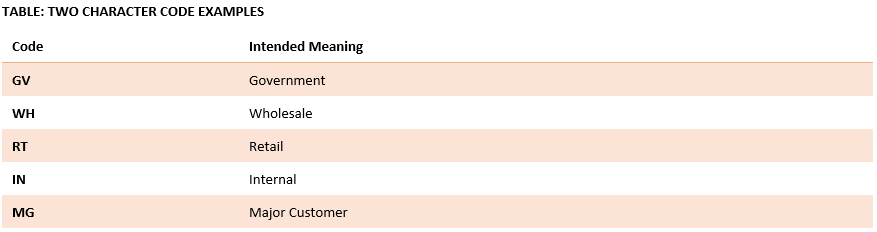
Two Characters
Two character codes are rarely sufficient for business classifications.
They only work when
The list is extremely small
The values will never grow
Meaning is obvious without explanation
For customer groups, this breaks almost immediately.
These become ambiguous as soon as the business needs subcategories.
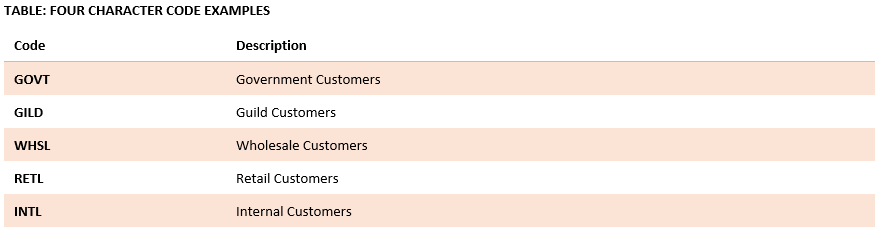
Four Characters
Four-character codes work for small, controlled domains.
They are often used for
Region codes
Short site identifiers
Very limited category lists
Expansion pressure becomes apparent as the list grows.
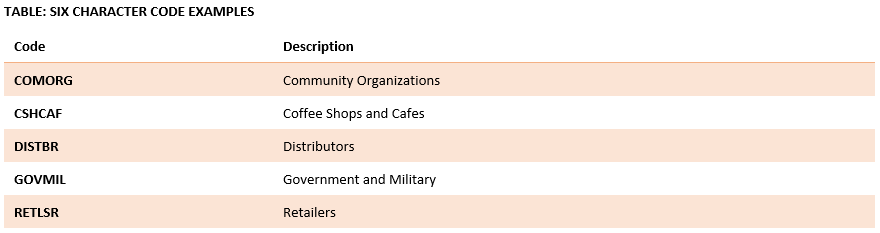
Six Characters
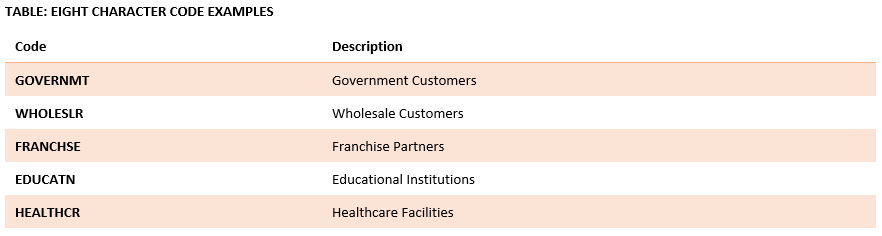
Six characters are the most common reference data balance points.
They allow
Clear abbreviations
Visual consistency
Room for moderate growth
This length supports scalability while remaining readable and easy to train on.
Eight Characters
Eight characters favor longevity over speed.
They work well when
The domain is large
Growth is expected
More clarity is required
This reduces abbreviation pressure at the cost of slightly slower scanning.
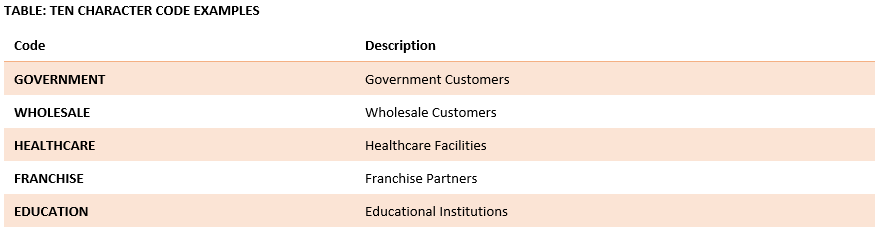
Ten Characters or More
Ten-character fixed codes should be used cautiously.
They only make sense when
The code must be fully readable
Structure is minimal
The list is stable
At this point, variable-length codes often provide better flexibility.
Human Factors Matter
The Waterdeep Trading Company places a heavy weight on how often people interact with a code.
Key questions are always asked
Will this appear in daily work
Will clerks type it manually
Will it be spoken aloud
The more human interaction involved, the shorter and cleaner the code should be.
Growth Pressure Over Time
A fixed-length code must survive future use, not just current needs.
Short codes fail when
New categories appear
The business expands into new markets
Special cases multiply
Longer codes fail when
Users avoid them
Entry errors increase
People invent unofficial shortcuts
The ideal length balances both pressures.
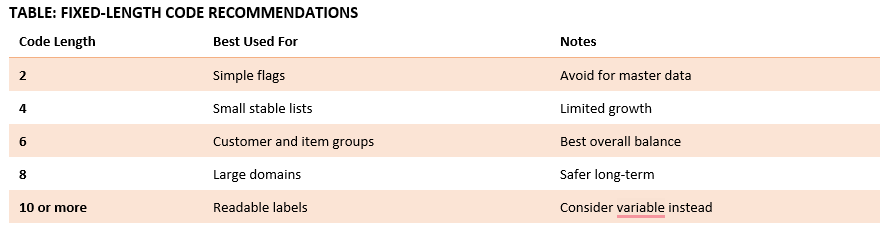
Practical Recommendation
Why Six Characters Often Win
Six characters succeed because they sit in the middle.
They are
Short enough to scan
Long enough to grow
Clear enough to teach
Stable enough to trust
This is why many well-run systems standardize on six for customer groups and posting groups.
Final Thoughts
There is no universal correct length. There is only the correct fit.
Fixed-length codes should be
Long enough to survive growth
Short enough to support people
Consistent enough to train
Choosing the length early and documenting the rationale avoids costly redesign later.
Support the AD&D365 Project on Patreon. To grow this world, we’ve launched an official Patreon page where supporters can access exclusive content, tools, and training labs, and even influence the project’s future. Your support fuels more than just development; it expands the guildhall, forges new scrolls, and empowers the next generation of configuration wizards. Begin your journey: https://www.patreon.com/adnd365/
A Grateful Salute to Our Patrons. To all those who stand behind the vision, thank you for helping bring this world to life. Our Benefactors, Andre Breillatt and Eryndor Fiscairn‡, your boundless generosity fuels the arcane core of this project. Without your magic, the weave would falter. Our Apprentices, the spell engines turn, and the training labs thrive thanks to our current Apprentices: Michael Ramirez and Andreth Bael’Rathyn‡. Special thanks to our past Apprentices, whose contributions helped us get here: Ralf Weber, Wendy Rijners, Shashi Mahesh, Julia Tejera, Ben Ekokobe, Tiago Xavier, Naveen Boyinapelli, Marcos Tadeu Wolf, Kathryn Greene, Jason Brown, Mark Christy, and Ashish Singh.Our Initiates, Jesper Livbjerg, Peter Lorre, Gregory Brigden, and Martin Grahm, your commitment marks the start of the deeper path, stepping beyond mere observation into the active shaping of this realm. Our Followers, your steady presence along the journey is a beacon of encouragement: Rusty Cavalier,Eric Shuss, Sunil Panchal, Sarah D. Morgan, Nick Ramchandani, Daniel Kjærsgaard, and Tomasz Pałys. And our Voyeurs, Harry Burgh, Abdelrahman Nabil, and Basil Quarrell, ever watching from the shadows, clearly intrigued… but not enough to part with a single gold piece. Your silent curiosity is noted and mildly judged.
Want to design your own economic models in Faerûn? Get your own AD&D365 Environment and guides at adnd365.com/start, and request access to the public view of the current database at https://public.adnd365.com – Login npc@adnd365.com, Password N0nPl@yC#822!
Across Faerûn, serious buyers rarely begin with a direct order. Guilds preparing seasonal stock, nobles provisioning estates, and caravan masters planning long routes often ask for terms before committing coin. They send a Request for Quotation (RFQ).
For the Waterdeep Trading Company, receiving RFQs from customers is a controlled sales practice. It protects margins, confirms supply, and prevents promises that cannot be kept. This article explains the full customer RFQ lifecycle, from intake to internal review, pricing, approval, and conversion into a sales order, with a complete worked example using realistic trade data.
What a Customer RFQ Is
A customer RFQ is a formal request to Waterdeep Trading Company to provide pricing, quantities, delivery schedules, and terms for a proposed purchase. It does not reserve stock and does not create a financial obligation.
Customer RFQs are common when
Quantities are large or recurring.
Prices may vary by season or route.
Delivery is split across dates or locations.
Extra handling or markings are required.
RFQs may arrive by courier, guild scribe, sealed letter, or arcane message and are always logged before any pricing work begins.
Why Receiving RFQs Matters
Poor RFQ handling creates risk. A rushed response can underprice goods or overcommit inventory. A slow response can lose the deal.
A structured RFQ process allows the Waterdeep Trading Company to:
Confirm inventory and production capacity.
Apply correct pricing and margin rules.
Review customer credit standing.
Align sales, finance, and logistics before making promises.
The RFQ stage is where sales discipline begins.
How Customer RFQs Are Received and Logged
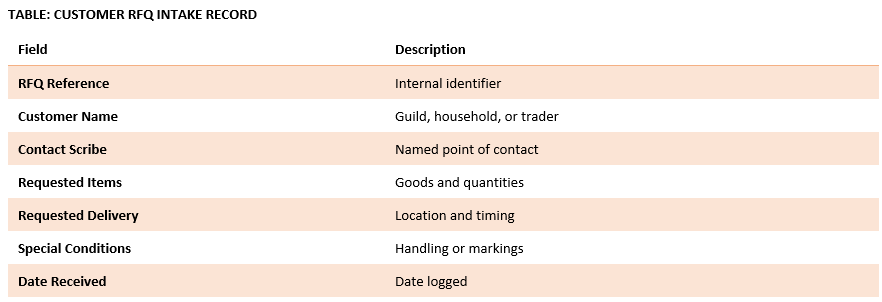
All incoming RFQs are recorded by the Sage Archivists in the Records Office. Each request is assigned an internal reference for tracking and auditing.
No RFQ moves forward without a complete intake record.
Internal Review and Validation
After logging, the RFQ is reviewed across inventory, finance, and logistics.
Internal checks include:
Available stock and production lead time.
Standard cost and current selling price.
Customer credit rating and limits.
Route capacity and seasonal risk.
If any check fails, the RFQ may be declined or returned with adjusted terms.
Pricing a Customer RFQ
RFQ pricing reflects more than the shelf price. It accounts for scale, effort, and risk.
An Arcane Treasurer reviews pricing before approval.
Approval and Customer Response
Large or high-value RFQs require approval before a quote is sent. Approval ensures margins and capacity remain within company rules.
Once approved, the RFQ response becomes a formal quote with:
Confirmed prices.
Delivery terms.
Payment conditions.
A validity period.
At this stage, no ledger posting occurs.
Worked Example
Customer RFQ Received by the Waterdeep Trading Company
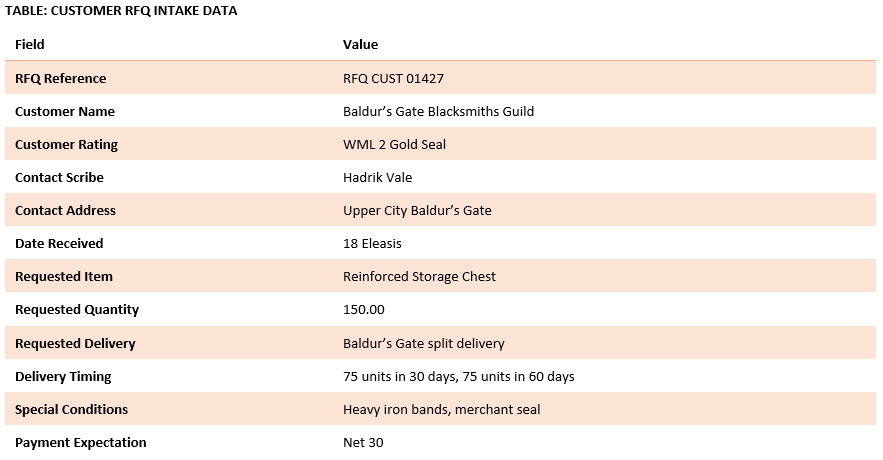
Scenario Overview: The Baldur’s Gate Blacksmiths Guild plans a seasonal expansion serving caravan operators. They submit an RFQ for reinforced storage chests before committing funds.
RFQ as Received: This table shows the RFQ exactly as logged on receipt.
No stock is reserved at this point.
Internal Feasibility Review: The RFQ is reviewed by the planning, finance, and logistics teams.
Pricing Construction: Pricing is based on volume, handling, and transport.
Margins remain within policy.
Approval Record: Because of the deal size, approval is required.
Quote Sent to Customer: The approved RFQ response becomes a formal quote.
No ledger entries are created until acceptance.
Conversion to Order
If the customer accepts:
The quote converts to a sales order.
Inventory reservations are created.
Production is scheduled.
Revenue is posted only after delivery and invoicing.
If declined or expired, the RFQ is closed with no financial impact.
Final Thoughts
Customer RFQs protect both seller and buyer. They slow the process just enough to replace guesswork with proof. For the Waterdeep Trading Company, RFQs ensure every large sale begins with confirmed supply, fair pricing, and clear terms.
Handled correctly, an RFQ is not delayed. It is control.
Support the AD&D365 Project on Patreon. To grow this world, we’ve launched an official Patreon page where supporters can access exclusive content, tools, and training labs, and even influence the project’s future. Your support fuels more than just development; it expands the guildhall, forges new scrolls, and empowers the next generation of configuration wizards. Begin your journey: https://www.patreon.com/adnd365/
A Grateful Salute to Our Patrons. To all those who stand behind the vision, thank you for helping bring this world to life. Our Benefactors, Andre Breillatt and Eryndor Fiscairn‡, your boundless generosity fuels the arcane core of this project. Without your magic, the weave would falter. Our Apprentices, the spell engines turn, and the training labs thrive thanks to our current Apprentices: Michael Ramirez and Andreth Bael’Rathyn‡. Special thanks to our past Apprentices, whose contributions helped us get here: Ralf Weber, Wendy Rijners, Shashi Mahesh, Julia Tejera, Ben Ekokobe, Tiago Xavier, Naveen Boyinapelli, Marcos Tadeu Wolf, Kathryn Greene, Jason Brown, Mark Christy, and Ashish Singh.Our Initiates, Jesper Livbjerg, Peter Lorre, Gregory Brigden, and Martin Grahm, your commitment marks the start of the deeper path, stepping beyond mere observation into the active shaping of this realm. Our Followers, your steady presence along the journey is a beacon of encouragement: Rusty Cavalier,Eric Shuss, Sunil Panchal, Sarah D. Morgan, Nick Ramchandani, Daniel Kjærsgaard, and Tomasz Pałys. And our Voyeurs, Harry Burgh, Abdelrahman Nabil, and Basil Quarrell, ever watching from the shadows, clearly intrigued… but not enough to part with a single gold piece. Your silent curiosity is noted and mildly judged.
Want to design your own economic models in Faerûn? Get your own AD&D365 Environment and guides at adnd365.com/start, and request access to the public view of the current database at https://public.adnd365.com – Login npc@adnd365.com, Password N0nPl@yC#822!
Across Faerûn, trade does not happen from behind a desk alone. Clerks travel between guild halls, cartographers ride with caravans, and procurement officers cross regions to secure goods. The Waterdeep Trading Company acknowledges that its employees will spend company funds. The risk is not the spending itself, but the loss of control over how it is recorded, reviewed, and repaid.
Employee expense processing exists to solve that problem. It gives the company a straightforward way to let workers spend when needed, while keeping the ledger accurate and auditable. This article explains how employee expenses are handled, how they are coded using expense categories, and how those costs move from receipt to reimbursement within the Waterdeep Trading Company.
What Employee Expense Processing Is
Employee expense processing is the controlled process by which employees submit costs they paid personally for company-related duties. These costs are reviewed, approved, posted to the ledger, and then reimbursed from company funds.
Unlike vendor invoices, these expenses typically begin with a worker and end with a payment to the same worker. Because of this, strict rules and clear coding are required to prevent misuse and to keep costs tied to the correct purpose.
Why It Matters to the Waterdeep Trading Company
The Waterdeep Trading Company operates across cities, regions, and trade routes. Without proper expense processing:
Travel costs blend into overhead with no clarity
Small purchases disappear from cost tracking
Audits become guesswork instead of review
Workers lose trust if repayments are late or disputed
A defined expense process protects both the company and its people. It also ensures that travel, trade missions, and field work can continue without delay.
Core Expense Categories and Ledger Coding
Each employee expense must be coded to an expense category. The category controls posting behavior, allowed limits, and review rules.
The following table shows common expense categories used by the Waterdeep Trading Company, with Faerûn-specific flavor and clear accounting intent.
Each category ensures that costs are posted to the correct part of the ledger and can be reviewed by purpose rather than by person.
Expense Submission Flow
The standard flow for employee expenses follows a predictable pattern.
A worker incurs an expense while on an approved company activity.
The worker submits an expense report with dates, amounts, and category codes.
Receipts are attached when required.
A supervisor reviews the expense for the purpose and reason.
Approved expenses are posted to the ledger.
Reimbursement is paid to the worker.
This flow separates responsibility. Workers submit. Managers approve. Treasurer’s post and pay.
Worked Example One: Trade Route Travel
Elira Moonshadow, Special Courier, travels from Waterdeep to Daggerford on company business.
She pays for:
Horse hire for two days
One night at a roadside inn
Meals during travel
After approval, the posting is straightforward:
Debit travel, meals, and lodging expense accounts
Credit employee reimbursement liability
Payment clears the liability
Worked Example Two: Arcane Procurement Expense
Selene Duskbloom, Magical Trade Officer, purchases arcane inks while negotiating a Mage Guild supply contract.
Because arcane components affect regulated costs, this expense requires an additional approval by the Magical Trade Officer role before posting.
Policy Controls and Common Rules
To keep expenses fair and controlled, the Waterdeep Trading Company applies standard rules:
Meal costs have daily limits by region
Lodging must match approved inns where possible
Arcane purchases require role-based approval
Missing receipts require a written explanation
Personal and company expenses may not mix
These rules protect the ledger and simplify review.
How Expenses Appear in the Ledger
Once approved, expenses no longer belong to the worker. They belong to the company.
From a ledger view:
Each category posts to a defined expense account
The worker’s balance is cleared upon payment
Reports can be run by worker, category, route, or period
This allows the Arcane Treasurers to answer vital yet straightforward questions, such as which routes incur the highest support costs or which roles carry the highest field-expense burden.
Realms Aware Considerations
Faerûn adds its own challenges:
Some regions prefer barter equivalents
Guild fees vary by city
Travel risks change seasonal costs
Arcane supplies fluctuate in price due to demand
Expense categories allow these variations to be tracked without breaking structure.
Final Thoughts
Employee expense processing is not about limiting trust. It is about recording truth. The Waterdeep Trading Company succeeds because it allows workers to act quickly while keeping records clean, fair, and clear.
By using defined categories, consistent approvals, and proper posting, expenses support trade rather than obscure it.
Support the AD&D365 Project on Patreon. To grow this world, we’ve launched an official Patreon page where supporters can access exclusive content, tools, and training labs, and even influence the project’s future. Your support fuels more than just development; it expands the guildhall, forges new scrolls, and empowers the next generation of configuration wizards. Begin your journey: https://www.patreon.com/adnd365/
A Grateful Salute to Our Patrons. To all those who stand behind the vision, thank you for helping bring this world to life. Our Benefactors, Andre Breillatt and Eryndor Fiscairn‡, your boundless generosity fuels the arcane core of this project. Without your magic, the weave would falter. Our Apprentices, the spell engines turn, and the training labs thrive thanks to our current Apprentices: Michael Ramirez and Andreth Bael’Rathyn‡. Special thanks to our past Apprentices, whose contributions helped us get here: Ralf Weber, Wendy Rijners, Shashi Mahesh, Julia Tejera, Ben Ekokobe, Tiago Xavier, Naveen Boyinapelli, Marcos Tadeu Wolf, Kathryn Greene, Jason Brown, Mark Christy, and Ashish Singh.Our Initiates, Jesper Livbjerg, Peter Lorre, Gregory Brigden, and Martin Grahm, your commitment marks the start of the deeper path, stepping beyond mere observation into the active shaping of this realm. Our Followers, your steady presence along the journey is a beacon of encouragement: Rusty Cavalier,Eric Shuss, Sunil Panchal, Sarah D. Morgan, Nick Ramchandani, Daniel Kjærsgaard, and Tomasz Pałys. And our Voyeurs, Harry Burgh, Abdelrahman Nabil, and Basil Quarrell, ever watching from the shadows, clearly intrigued… but not enough to part with a single gold piece. Your silent curiosity is noted and mildly judged.
Want to design your own economic models in Faerûn? Get your own AD&D365 Environment and guides at adnd365.com/start, and request access to the public view of the current database at https://public.adnd365.com – Login npc@adnd365.com, Password N0nPl@yC#822!
The Waterdeep Trading Company oversees forges, breweries, tanneries, butcher halls, and alchemical works from the Sword Coast to the Moonsea. Each site produces goods needed by guilds, caravans, and settlements. To control these flows, the company relies on two core production models: input-driven manufacturing and output-driven manufacturing.
Choosing the correct method shapes cost, supply, and worker activity across the company. It is a key skill for any planner or foreman in Faerûn.
What Is Input-Driven Manufacturing
Input-driven manufacturing begins when materials arrive. The trigger is the availability of raw goods, not a customer request. Production cycles are set by supply rhythm, which may depend on weather, caravans, or seasonal harvests.
This method suits operations that must consume materials before spoilage or where bulk goods are expected to flow in steady waves.
Examples include:
Breweries working with incoming grain.
Tanneries receiving hides after large hunts.
Butcher halls where livestock arrives from nearby farms.
What Is Output-Driven Manufacturing
Output-driven manufacturing begins when a customer asks for something. A work order is created only when demand is confirmed. Goods are produced with accuracy, often following custom instructions or strict material controls.
This method suits operations where materials are rare or high cost, or where final goods require specialized work by artificers or master smiths.
Examples include:
Enchanted gear production.
Noble house commissions.
Custom alchemical batches.
Why These Approaches Matter
Both approaches determine how goods and coins move across the company.
They influence:
Inventory levels.
Cash flow.
Labor planning.
Resource allocation.
Selecting the right method ensures smooth trade across regions such as Waterdeep, Baldur’s Gate, and Calimport.
Worked Example One: Input Driven Example: Frostroot Ale in Silverymoon
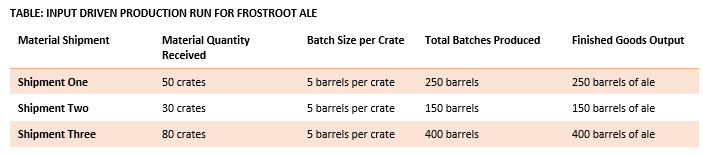
When Frostroot Barley arrives from Icewind Dale, the Copperleaf Brewery begins a new brewing cycle. Barley cannot remain in storage for long, so production is triggered by shipments.
The table below shows how incoming material drives production volume.
This method keeps taverns supplied but increases storage during heavy harvest seasons.
Worked Example Two: Output Driven Example: Enchanted Shields in Waterdeep
The Arcane Smiths Hall starts production only when a signed order arrives. Mithral Dust and Phoenix Plume are tracked tightly by the Artificers Union, which makes this method ideal.
The table shows how materials are allocated only after orders are logged.
This approach protects rare resources and ensures predictable delivery.
Worked Example Three: Input Driven Example with Variable Outputs: Whole Animal Disassembly in Daggerford
When local farmers bring cattle to the Daggerford Butcher Hall, production begins immediately. This is input-driven because the animal itself is the trigger. One animal, however, can be broken into multiple cut profiles, each requested by nearby markets.
The final output varies because cutters choose different profiles based on condition, size, and planned sales.
The table below shows how three animals can produce different cut mixes. Each cut type has a standard yield range, but the actual yield depends on the animal’s size and the chosen breakdown pattern.
How This Works in Practice
The Butcher Hall begins work as soon as animals arrive. The cutters select the breakdown style based on:
Market demand in Waterdeep or Baldur’s Gate
Condition and age of the animal
Local festival needs
Storage space and salt levels
Order patterns from nearby taverns
This produces variable outputs and makes production unpredictable. It is a classic input-driven scenario because cutters respond to the arrival of livestock rather than to a fixed customer order.
This method is standard across Faerûn, where livestock flows depend on weather, harvesting, grazing conditions, and the health of nearby herds.
Realms Aware Considerations
Faerûn’s regions shape the choice of method.
Livestock production in Daggerford follows input cycles tied to farm supply.
Wandering herds in Amn cause irregular arrivals for local butcher halls.
Enchanted workshops in Waterdeep use output cycles to protect rare essence materials.
Coastal trade houses in Calimport favor output cycles for high-value seafood that must be allocated by order.
Final Thoughts
Input-driven manufacturing converts available goods into stock as soon as materials arrive. Output-driven manufacturing produces only when the market demands it. The Waterdeep Trading Company uses both across Faerûn to keep trade stable, predictable, and profitable.
Animal disassembly adds an extra layer of complexity, since a single input can yield many different outputs. This makes the method valuable for regions with active livestock markets and diverse customer needs.
Support the AD&D365 Project on Patreon. To grow this world, we’ve launched an official Patreon where supporters can gain access to exclusive content, tools, training labs, and even influence the future of the project. Your support fuels more than just development , it expands the guildhall, forges new scrolls, and empowers the next generation of configuration wizards. Begin your journey: https://www.patreon.com/adnd365/
A Grateful Salute to Our Patrons. To all those who stand behind the vision, thank you for helping bring this world to life. Our Benefactors, Andre Breillatt, and Eryndor Fiscairn‡, your boundless generosity fuels the arcane core of this project. Without your magic, the weave would falter. Our Apprentices, the spell engines turn and the training labs thrive thanks to our current Apprentices: Michael Ramirez and Andreth Bael’Rathyn‡. Special thanks to our past Apprentices, whose contributions helped us get here: Ralf Weber, Wendy Rijners, Shashi Mahesh, Julia Tejera, Ben Ekokobe, Tiago Xavier, Naveen Boyinapelli, Marcos Tadeu Wolf, Kathryn Greene, Jason Brown, Mark Christy, and Ashish Singh.Our Initiates, Gregory Brigden, and Martin Grahm, your commitment marks the start of the deeper path, stepping beyond mere observation into the active shaping of this realm. Our Followers, your steady presence along the journey is a beacon of encouragement: Eric Shuss, Sunil Panchal, Sarah D. Morgan, Nick Ramchandani, Daniel Kjærsgaard, and Tomasz Pałys. And our Voyeurs, Harry Burgh, Abdelrahman Nabil, and Basil Quarrell, ever watching from the shadows, clearly intrigued… but not enough to part with a single gold piece. Your silent curiosity is noted, and mildly judged.
Want to design your own economic models in Faerûn? Get your own AD&D365 Environment and guides at adnd365.com/start, and request access to the public view of the current database at https://public.adnd365.com – Login npc@adnd365.com, Password N0nPl@yC#822!
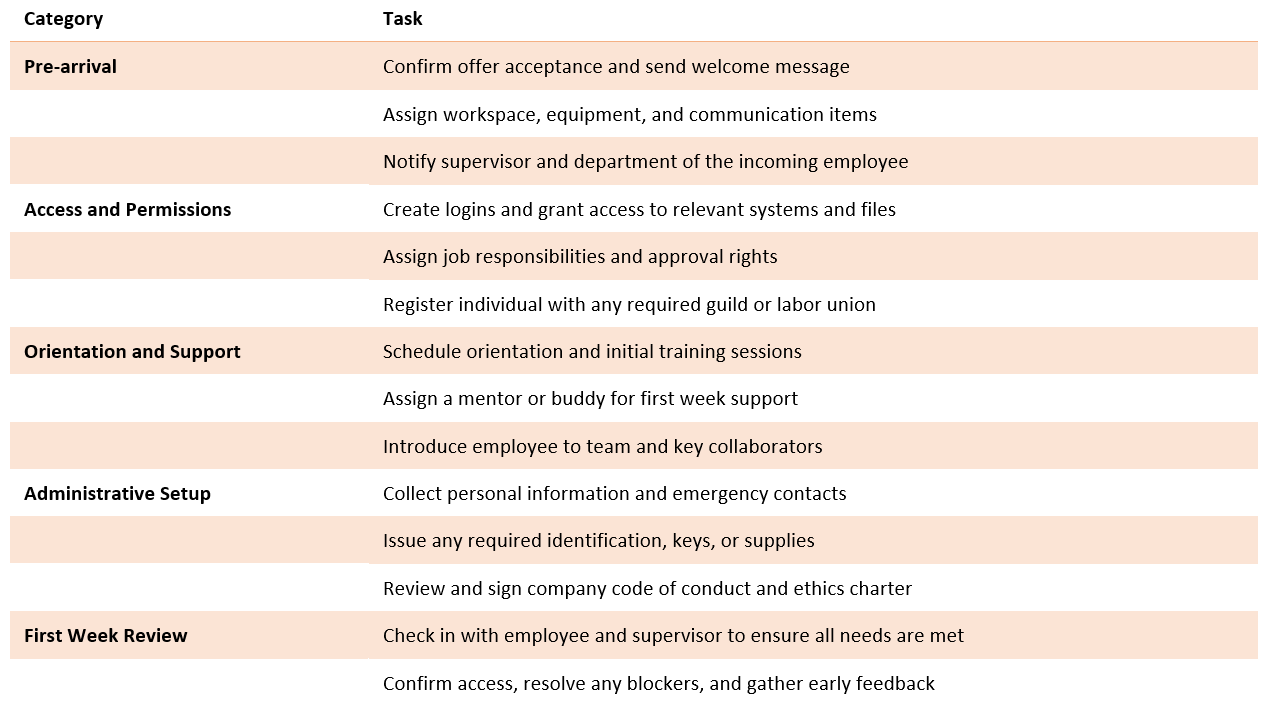
Welcoming a new employee or saying farewell to a departing team member is more than just a formality. These are moments that define the culture of your organization. The Waterdeep Trading Company takes these transitions seriously, ensuring that every arrival is smooth and every departure is dignified.
A consistent onboarding and offboarding process strengthens team cohesion, protects company assets, ensures compliance, and builds goodwill that lasts long after someone has left the building.
Here are the standard checklists used throughout the Company to manage those transitions with care and precision.
Onboarding Checklist
The onboarding checklist guides teams through every step required to welcome a new employee. It begins before the employee arrives with workspace preparation and system access. It continues with training, orientation, mentorship, and administrative setup. The process ensures new hires feel equipped, included, and empowered from their very first day.
Offboarding Checklist
The offboarding checklist ensures a smooth and compliant transition when an employee leaves. It includes communication, knowledge handover, security and asset recovery, and exit processing. It is designed to protect the company, preserve knowledge, and honor the employee’s contributions while maintaining a positive relationship for the future.
Closing Thought
A checklist is more than a list of tasks. It is a reflection of how much we value each person who passes through our gates. From the newest hire to the longest-serving veteran, every employee deserves a process that respects their contribution and prepares them for what comes next.
These checklists are not only tools for compliance but symbols of commitment to fairness, consistency, and the long-standing traditions of excellence that define the Waterdeep Trading Company.
For over a century, the Waterdeep Trading Company has been the heartbeat of Faerûn’s trade. From the frost-kissed docks of Icewind Dale to the coastal bazaars of Calimport, the Company moves goods through every season with precision.
Success here is not based on speed alone. It depends on timing.
Seasonal demand planning is the art of predicting what will be needed, when it will be needed, and how to ensure it arrives just in time. It is how the Waterdeep Trading Company avoids stockpiling cloaks in the heat of Flamerule or running out of cider during the first toast of Highharvestide.
The Calendar of Commerce
Faerûn’s calendar tells more than time. It reflects culture, climate, and consumption. Every month carries specific market behaviors and patterns.
Waterdeep Trading Company studies these cycles carefully and layers them into every supply and logistics plan.
How the Company Forecasts Demand
Historical records are the backbone of the Company’s seasonal forecasting. Scribes maintain product movement scrolls dating back several generations.
Here are a few forecasting techniques in practice:
Rolling multi-year averages to compare monthly and festival-based trends across regions
Contracts and standing orders from temples, noble houses, and guilds which repeat annually
Predictive adjustments based on current market activity, such as harbor delays or rising prices from core vendors
Sentinel dispatches from field agents who report signs of early shifts in demand or local disruptions
The result is a structured forecast that balances tradition with the changing tides of trade.
Seasonal Labor and Staffing
The flow of goods depends on the flow of hands. The Waterdeep Trading Company plans its workforce as carefully as it does its inventory.
In Deepwinter, fewer shipments mean a heavier focus on warehouse security and internal audits
In Spring, hiring increases as couriers, carriers, and sorters are deployed to reopen stalled trade routes
In Summer, nearly every department grows. Market tents, brewery lines, and ship crews all need additional labor
In Autumn, specialized workers such as grain assessors and preservation technicians are deployed to lock in inventory before the freeze
Many workers are brought in on rotating seasonal contracts, often earning guild certifications for each successful campaign.
Managing Supplier Constraints
Not every vendor can scale with seasonal demand. Some are limited by harvest cycles, others by labor, and a few by magical interference.
To manage these risks, the Company maintains a supplier tier system:
Primary suppliers are those with strong delivery history and seasonal reliability
Secondary suppliers are used during peak demand or to fill gaps when primary vendors fall short
Specialist vendors are called upon for short seasonal bursts, such as rare spices during feast days or potion ingredients during cold snaps
Every procurement team tracks lead times and past performance to determine who to trust and when to switch.
Special Contracts and Priority Orders
Seasonal shifts also mean more contract-based orders. Some examples include:
Military garrisons requesting rations before planned campaigns
Temples ordering ceremonial garb and incense ahead of holy days
Mercenary companies securing bulk gear and potions in advance of expedition season
Nobles requiring finery and decor ahead of social functions
The Company sets aside protected inventory and often reserves wagon space or teleportation slots for these clients. They are built into seasonal forecasts as immovable pillars.
Transportation Planning by Season
Logistics can be the difference between profit and loss during seasonal transitions. Travel conditions change rapidly, and the Company prepares for these disruptions with dedicated planning ledgers.
Every route has a seasonal modifier and an action plan in place before the first sign of disruption appears.
What Happens After the Season Ends
The Waterdeep Trading Company reviews each season within ten days of its end.
Unused goods are either rotated to other regions or sold at a discount
Performance of forecasts is measured against actual sales
Surprises or anomalies are recorded in the forecasting grimoire for future adjustment
Lessons learned are shared across all Company locations
This cycle of planning, acting, and reviewing has been central to the Company’s growth and resilience.
Closing Thoughts
Seasons affect everything. Weather shifts harvests. Holidays shift demand. Travel restrictions shift logistics. But a business that plans for the seasons instead of reacting to them will always come out ahead.
Waterdeep Trading Company invites others to study how preparation drives prosperity.
To access trade records, planning templates, and regional demand data, visit adnd365.com/start and request access to the public trade network at https://public.adnd365.com.
At the Waterdeep Trading Company, production efficiency is more than just a number on a ledger. It is the difference between an on-time delivery of potions to Silverymoon or a chaotic recall because a batch of fire resistance potions fizzled out mid-adventure. Whether we are bottling enchanted tonics or stitching high-grade leather satchels, the core of our operational success lies in the structure of our manufacturing routes.
And yes, routes are not just maps or travel paths. In manufacturing, a route is the formal recipe for how a product gets built, who does the work, in what order, using which tools, and for how long.
What Happens When Efficiency Drops?
Let us say you are running the Potionworks team, and you notice that the standard time to produce a batch of Potion of Giant Strength has slowly crept up by fifteen percent over the last quarter. It does not mean your alchemists are lazy. More likely, something in the route no longer reflects reality.
You might see results like this:
Where Route Adjustments Make the Difference
Adjusting a manufacturing route is not just about changing a number. It is about recognizing the evolving nature of work and making sure your systems reflect reality.
Update Task Durations
Add Alternate Operations
Reassign Resource Groups
Efficiency Tracking With Employee Profiles
Each worker has their own rhythm. Instead of a one-size-fits-all metric, track efficiency by skill, task type, and improvement over time.
Breaking Out Composite Steps
Some operations hide their inefficiencies inside multi-part steps. Separating them helps pinpoint exactly where slowdowns occur.
Quality Inspections Add Predictability
A well-placed inspection prevents rework, improves customer satisfaction, and gives employees more confidence in their work.
The Bigger Picture
Every route is a living system. Ingredients change. Regulations shift. Staff learn and grow. If the Waterdeep Trading Company kept its manufacturing routes static, we would be unable to handle product innovation, seasonal demand spikes, or guild audits.
By updating task durations, reassigning talent, building flexible alternatives, and embedding inspections, we create a production system that adapts with us. We do not just run a business, we run a guild-backed, customer-loved, efficiency-honed enterprise that runs like a dwarven clockwork engine.
Want to boost your own manufacturing efficiency and avoid magical misfires? Download the full Advanced Dungeons and Dynamics 365 guide at adnd365.com/start, and see it live in the public database at https://public.adnd365.com using:

















 A Tinkerers Notebook