Archive

Tag Archives: dark-fantasy

In the mystic halls of the Waterdeep Trading Company’s Department of Arcane Inscription, a new craft has emerged that bridges art, magic, and structured design: GlyphForge.
GlyphForge serves as both a philosophy and a system, a structured language of symbols that can describe, evoke, and empower. Much like accountants use ledgers and artificers use schematics, glyphwrights use glyphs to bind meaning and magic into form.

This guide provides the full codified structure of the Glyphic Arcanum, a system that standardizes the creation, fusion, and interpretation of glyphs across the known realms.

What Is GlyphForge

GlyphForge is a structured design system for creating, explaining, and visualizing ancient magical symbols. It defines every glyph as a fusion of runic logic, elemental association, and symbolic intent. Each glyph, whether carved into sandstone or inscribed upon parchment, represents a self-contained enchantment.

These symbols are carved into the ledgers of the Arcane Treasury, drawn by cartographers upon planar maps, and even etched upon cooking stones by culinary mages who seek to perfect their art.

The Structure of a Glyph

Every glyph follows a three-layered hierarchy, balancing core meaning with elemental and directional intent.

When multiple meanings overlap, glyphs are nested within a Containment Ring (⚲), ensuring magical stability.

The Logic of Symbolism

Each element follows a specific visual motif, grounded in the ancient design languages of the Arcane Guilds.

Design Standards

Glyphs must be centered in perfect geometry. They glow faintly when active and often appear etched upon stone, metal, or parchment. Each element determines the hue of its glow.

Constructing Glyphs

To create a glyph, select one symbol from each layer:

  1. Core Rune: What action is being performed?
  2. Aspect Mark: What element or essence powers it?
  3. Focus Stroke:  Who or what is affected?

Then fuse them together in sequence.
Example: ⌘ + 🔺 + ∩ = Flame Ward, a shield of protective fire surrounding an area.

For complex symbols, enclose the fusion in ⚲ to stabilize it.

Example Glyphs

Below are the most recognized glyphs of the Glyphic Arcanum.

Ingredient Glyphs

The Guild of Culinary Mages frequently inscribes ingredient glyphs into cauldrons, allowing meals to sustain magical potency.

Glyph Syntax Rules

Just as merchants rely on standardized ledgers to ensure their accounts align, so too must glyphwrights follow precise structure when combining symbols. The Glyph Syntax Rules serve as the grammatical foundation of the Glyphic Arcanum, ensuring that each rune, aspect, and focus interacts correctly within an inscription.

Without proper syntax, a glyph’s meaning can shift, unravel, or even invert, turning a ward into a snare or a blessing into a curse. These rules govern how layers are ordered, nested, or stabilized, defining whether energy flows harmoniously or collapses upon itself.

By following these conventions, artisans can craft complex and stable glyphs that remain consistent across spellbooks, scrolls, and arcane seals. This syntax is the unspoken language of magic itself, the logic that binds artistry to precision.

Every glyph name carries more than identity, it conveys purpose. The naming suffixes of the Glyphic Arcanum act as linguistic markers that reveal a glyph’s function or nature. Whether denoting creation, protection, transformation, or containment, these endings help scholars and artisans understand a symbol’s intent at a glance.

Worked Examples

Healing Flame
Fusion: ⚚ + 🔺 + ∧
Meaning: Healing fire directed toward a living being.
Visual: Central flame motif wrapped in soft, circular lines of light.

Stone Memory
Fusion: ⚷ + ⬛ + ,
Meaning: Knowledge engraved in earth, remembrance through matter.
Visual: Rectangular foundation with an inward spiral of awareness.

Bread Sigil (Moltar)
Fusion: ⚲(⚒ + ⚚ + ⌖ + ☉)
Meaning: Creation of life through craft, nurture, and fire.
Visual: A ring of grain and droplet motifs surrounding a central rising flame.

Image Prompt Guidelines

When rendering glyphs as images:

  • Use centered, circular designs.
  • Show glowing etchings on aged material.
  • Maintain symmetry and reverence.
  • Avoid modern or religious symbols.

Why GlyphForge Matters

For the Waterdeep Trading Company, GlyphForge is more than artistry, it is a business tool. Recipes, enchantments, and protection seals are all standardized using this system, ensuring that magical formulas can be transferred between workshops without misinterpretation or fraud.
Each symbol’s precise layering deters tampering, as even the smallest alteration changes its meaning or nullifies its magic entirely. Thus, the placement of a single rune safeguards both art and commerce across Faerûn.

Final Thoughts

GlyphForge unites the visual and the arcane into one structured discipline. Whether used for potion design, artifact sealing, or enchanted trade documentation, it brings clarity and consistency to the mystical craft of inscription.

As the scribes of Waterdeep often say: “A word may lie, but a glyph remembers truth.”


Support the AD&D365 Project on Patreon.  To grow this world, we’ve launched an official Patreon where supporters can gain access to exclusive content, tools, training labs, and even influence the future of the project. Your support fuels more than just development ,  it expands the guildhall, forges new scrolls, and empowers the next generation of configuration wizards.  Begin your journey: https://www.patreon.com/adnd365/

A Grateful Salute to Our Patrons.  To all those who stand behind the vision, thank you for helping bring this world to life. Our Benefactors, Andre Breillatt, and Eryndor Fiscairn, your boundless generosity fuels the arcane core of this project. Without your magic, the weave would falter. Our Apprentices, the spell engines turn and the training labs thrive thanks to our current Apprentices: Michael Ramirez and Andreth Bael’Rathyn. Special thanks to our past Apprentices, whose contributions helped us get here:  Ralf Weber, Wendy Rijners, Shashi Mahesh, Julia Tejera, Ben Ekokobe, Tiago Xavier, Naveen Boyinapelli, Marcos Tadeu Wolf, Kathryn Greene, Jason Brown, Mark Christy, and Ashish Singh. Our Initiates, Gregory Brigden, and Martin Grahm, your commitment marks the start of the deeper path, stepping beyond mere observation into the active shaping of this realm. Our Followers, your steady presence along the journey is a beacon of encouragement:  Eric Shuss, Sunil Panchal, Sarah D. Morgan, Nick Ramchandani, Daniel Kjærsgaard, and Tomasz Pałys. And our Voyeurs, Harry Burgh, Abdelrahman Nabil, and Basil Quarrell, ever watching from the shadows, clearly intrigued… but not enough to part with a single gold piece. Your silent curiosity is noted, and mildly judged.Want to design your own economic models in Faerûn?  Get your own AD&D365 Environment and guides at adnd365.com/start, and request access to the public view of the current database at https://public.adnd365.com – Login npc@adnd365.com, Password N0nPl@yC#822!

In Faerûn, where caravans cross nations and portals link planes, trade is a living, breathing force. Yet even the best-run merchants of Waterdeep, Baldur’s Gate, and Calimport know that not every deal goes as planned. A cracked wand, a spoiled crate of moonwine, or an amulet that misfires its enchantment, all must be handled with discipline.

The Waterdeep Trading Company has built a structured framework for such cases known as Returns and Dispositions. This process ensures that every returned good, mundane or magical, is properly inspected, valued, and resolved, preserving both customer trust and the Company’s ledgers.

What It Is

A Return records the reversal of a completed sale or shipment. A Disposition defines the next step in that item’s story: whether it is resold, repaired, scrapped, or replaced.

When a customer or partner initiates a return, clerks record the reason, identify the source of issue, and assign a disposition code. Returned items are routed through specialized review zones, warehouses, vaults, or workshops, based on product type and region.

Why It Matters

Returns and dispositions maintain the Company’s reputation and prevent financial distortion. Without them, inventory counts could drift, profit margins would blur, and customers could lose confidence in trade fairness.

They also allow analysts to study trade patterns: identifying failing suppliers, error-prone regions, or recurring mishaps in teleportation routes. This is vital in Faerûn, where magical instability, regional tariffs, or planar interference can turn a simple exchange into a costly problem.

Standard Disposition Actions

The Waterdeep Trading Company uses a set of standardized Disposition Codes across its trade houses in Faerûn. Each determines how a returned good is handled once it re-enters inventory or quarantine.

Each disposition is logged against both physical and arcane inventories. When magic is involved, treasurers consult with the Mage Guild Arcane Mark Office to verify containment before processing.

Faerûn-Specific Disposition Codes

Because Faerûn is a realm of enchantment, divine law, and shifting trade alliances, standard merchant practices alone cannot manage its complexities. The Waterdeep Trading Company therefore maintains a second, deeper layer of Faerûn-Specific Disposition Codes, adapted for magical instability, divine purification, barter settlements, and regional compliance.

Return Reason Codes

To understand the causes behind returns, the Company employs a library of standardized Reason Codes. These codes are reviewed quarterly by the Sage Archivists and shared with the Scriveners’, Scribes’, & Clerks’ Guild for industry benchmarking.

These records allow the Company to trace whether returns arise from supplier error, warehouse mishandling, or arcane instability, critical insight for improving both craftsmanship and trade routes.

Worked Example: Return from the Sword Coast

A trader from Baldur’s Gate (01-BDG-LWC) returns an enchanted cooking pot that failed to sustain its warming spell. The return is classified as:

  • Reason Code: DEFECTIVE
  • Disposition Code: CREDREP (Credit, Repair, and Return)
  • Value: 𝔉285.00 FSD

Upon arrival, the pot is routed to the Arcane Containment Ward in the Waterdeep warehouse for rune re-inscription. After a successful enchantment check by the Lorewright Cartographers, it is returned to sellable stock and a credit is issued to the trader’s ledger.

Example: Arcane Containment Return

A Moonshae Isles customer returns a scrying mirror that shows inverted images of alternate timelines, a clear case of magical corruption.

  • Reason Code: DEFECTIVE
  • Disposition: CREDARC (Credit and Arcane Rework)
  • Route: Teleported to Waterdeep Arcane Vault under Mage Guild seal
  • Resolution: Mirror cleansed using distilled moonlight and re-enchanted before resale

Example: Divine Disposal

A Suzail temple sends back a relic that began emanating necrotic whispers after consecration.

  • Reason Code: CURSED
  • Disposition: SCRPDIS (Scrap under Divine Supervision)
  • Action: Disassembled by clerics of Lathander, base silver repurposed into purified chalices

Regional and Arcane Considerations

Faerûn’s vast geography requires local handling rules.

These localized differences ensure that returns comply with trade law and arcane safety ordinances while maintaining consistent internal records.

Realms-Aware Examples of Quarantine Dispositions

These examples highlight how physical, magical, and bureaucratic layers intertwine in Faerûn’s approach to reverse logistics.

Realms-Aware Benefits

Faerûn-specific disposition codes achieve far more than simple inventory control. They:

  • Protect clerks from exposure to cursed materials.
  • Comply with temple and guild purification mandates.
  • Prevent cross-contamination of planar energies.
  • Maintain detailed provenance for both mundane and enchanted goods.

Final Thoughts

In the Waterdeep Trading Company, every return tells a story. Whether it is a defective blade from Suzail, a spoiled elixir from Rashemen, or a misfired charm from Silverymoon, each item follows a trail of accountability.

The Returns and Dispositions system transforms what could be loss into learning, protecting profit, preserving reputation, and strengthening trust across the Realms. Through Faerûn-specific disposition codes, the Company honors every return with care suited to its nature, be it forged, brewed, or bound by ancient spell. This approach turns even failure into order, sustaining trust between guild, merchant, and the magic that binds Faerûn’s economy together.


Support the AD&D365 Project on Patreon.  To grow this world, we’ve launched an official Patreon where supporters can gain access to exclusive content, tools, training labs, and even influence the future of the project. Your support fuels more than just development ,  it expands the guildhall, forges new scrolls, and empowers the next generation of configuration wizards.  Begin your journey: https://www.patreon.com/adnd365/

A Grateful Salute to Our Patrons.  To all those who stand behind the vision, thank you for helping bring this world to life. Our Benefactors, Andre Breillatt, and Eryndor Fiscairn, your boundless generosity fuels the arcane core of this project. Without your magic, the weave would falter. Our Apprentices, the spell engines turn and the training labs thrive thanks to our current Apprentices: Michael Ramirez and Andreth Bael’Rathyn. Special thanks to our past Apprentices, whose contributions helped us get here:  Ralf Weber, Wendy Rijners, Shashi Mahesh, Julia Tejera, Ben Ekokobe, Tiago Xavier, Naveen Boyinapelli, Marcos Tadeu Wolf, Kathryn Greene, Jason Brown, Mark Christy, and Ashish Singh. Our Initiates, Gregory Brigden, and Martin Grahm, your commitment marks the start of the deeper path, stepping beyond mere observation into the active shaping of this realm. Our Followers, your steady presence along the journey is a beacon of encouragement:  Eric Shuss, Sunil Panchal, Sarah D. Morgan, Nick Ramchandani, Daniel Kjærsgaard, and Tomasz Pałys. And our Voyeurs, Harry Burgh, Abdelrahman Nabil, and Basil Quarrell, ever watching from the shadows, clearly intrigued… but not enough to part with a single gold piece. Your silent curiosity is noted, and mildly judged.

Want to design your own economic models in Faerûn?  Get your own AD&D365 Environment and guides at adnd365.com/start, and request access to the public view of the current database at https://public.adnd365.com – Login npc@adnd365.com, Password N0nPl@yC#822!

In Faerûn, no successful merchant operates alone. Behind every cartload of enchanted textiles or barrel of trollwine stands a guild – documenting, inspecting, regulating, and, when necessary, demanding compensation. These are not advisory councils or informal collectives. They are the law in most cities when it comes to tradecraft, labor, pricing, and apprenticeships.

At the Waterdeep Trading Company, guilds form the foundation of our entire supply network. From the warehouses of Silverymoon to the docks of Calimport, our ability to do business depends on how well we manage, track, and respect these institutions.

What Is a Guild in Faerûn?

To an outsider, a guild may look like a club of craftsmen. To a merchant, it is a governing body. Guilds in Faerûn:

  • Regulate Pricing: They set base prices and forbid undercutting or overpricing.
  • Enforce Quality Standards: Products bearing the guild seal meet standards of safety, craftsmanship, and purity.
  • Manage Apprenticeships: Only members of a guild can legally train new workers in a trade.
  • Control Certification: From spell-tuned brewing to adamantine shaping, guilds determine who is licensed to work in a craft.
  • Settle Disputes: Guild arbitration often supersedes civil courts in trade matters.
  • Oversee Regional Chapters: Each major city has a chapter following the central charter while adjusting for local needs.

Organizing Guild Information in Your Company

To manage guilds effectively, companies like ours treat each one like a partner, with structured records and established procedures.

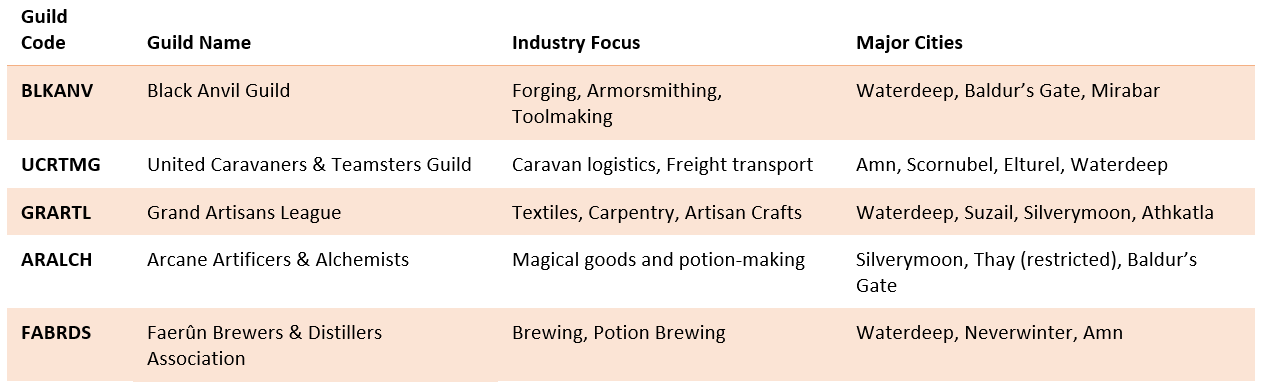
Guild Directory Examples

Here are a few of the more prominent guilds the Waterdeep Trading Company works with:

Guilds govern not just trade but talent. If you want to hire a certified loommaster, a leyline-calibrated enchanter, or a crystal alchemist with reliability, guild records are your best friend.

Merchants should track:

  • Certification Validity (including expiration and issuing chapter)
  • Completed Apprenticeship Logs (trainer, craft, rating)
  • Advancement Requests (for promotion to master rank or guild chair)
  • Guild Exams (success rates and focus areas)

By doing this, you can ensure you’re always working with approved craftsmen and that your wares pass muster when they reach port inspectors.

Managing Guild Contracts

Contracts with guilds are not one-size-fits-all. A shipping agreement with the Teamsters may include:

  • Volume quotas
  • Minimum wage requirements
  • Safety and magical seal inspections
  • Contingency routes for high-risk regions
  • A procurement agreement with the Black Anvil Guild might include:
  • Fixed pricing tiers for steel or mithral goods
  • Priority supply in wartime
  • Enchantment inspection clauses

Track these by guild, chapter, and effective date—and always be aware of when a renegotiation period is due.

Dispute Resolution and Compliance

Most cities allow guilds to enforce their own rulings within their domain. When a dispute arises:

  • Arbitration is often mandatory
  • Guild fines may be binding on the merchant
  • Disciplinary actions (such as blacklisting) can affect all affiliated trade

Maintain detailed logs of:

  • Complaints filed
  • Guild responses
  • Resolution terms
  • Any modifications to contracts or certifications following the ruling

This protects your company and helps build a reputation as a guild-respecting trading house.

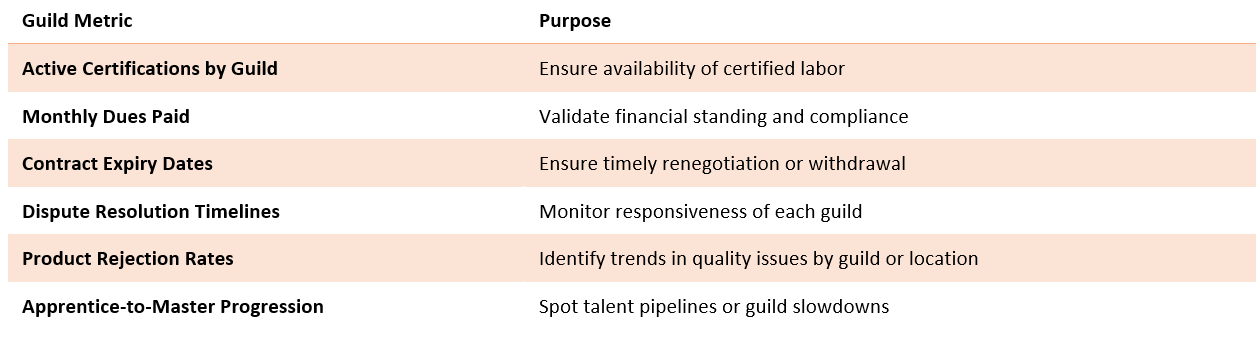
Guild Reporting and Oversight

Larger operations should develop guild reporting practices. Here are a few metrics we track:

Final Thoughts: Why Guilds Deserve Respect

Guilds don’t just protect craftsmen—they protect the economy. They ensure that products move fairly, workers are trained properly, and that bad actors can’t flood the market with cursed tankards and half-finished crossbows.

For a trading company, building strong, respectful, well-documented relationships with every guild you work with isn’t just a best practice—it’s the key to staying in business.

Want to start managing your guild partnerships better? Check out the guides at adnd365.com/start and explore the public demo environment at https://public.adnd365.com, using:

Login: npc@adnd365.com

Password: N0nPl@yC#822!