Archive

Tag Archives: dd

In the bustling arcane districts of Faerûn—where scrolls are scribed by moonlight and potions bubble through the night—magical workshops are the beating heart of innovation. From the runeforges of Silverymoon to the cauldron yards of Baldur’s Gate, spellcasters labor tirelessly to meet the demands of nobles, adventurers, and merchant guilds alike. Yet even magic has its limits.

At the Waterdeep Trading Company, understanding workshop overload and capacity planning is essential to avoiding catastrophic failures—from potion evaporation to leyline destabilization. This article explores how magical production capacity is tracked, the factors that cause overload, and how workshop managers across the Realms plan their way out of arcane bottlenecks.

What It Is

Capacity planning in Faerûnian workshops refers to the systematic measurement and management of a magical site’s ability to produce enchanted goods, alchemical concoctions, or spell-infused items. Overload occurs when the demands placed upon the workshop exceed its magical, physical, or labor-based thresholds.

Why It Matters

Unlike mundane smithies, arcane workshops face risks beyond smoke and heat. Mismanaged capacity can lead to:

  • Leyline interference, disrupting the flow of planar energies and corrupting spell matrices.
  • Spellcaster fatigue, a hazardous state that reduces precision and increases the odds of failure or injury.
  • Resource spoilage, such as potion evaporation or unstable reagents igniting during overproduction cycles.

When capacity is exceeded without proper planning, entire batches may fail, enchanted tools may become cursed, and planar regulators may impose fines or shut down production facilities.

Components of Magical Capacity

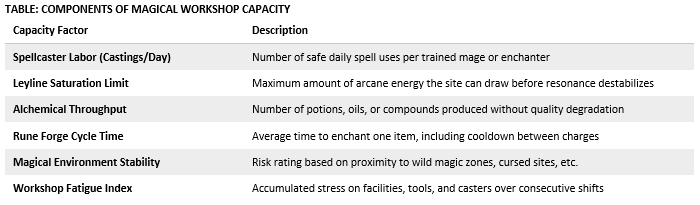
To effectively manage workload across workshops, the Waterdeep Trading Company tracks the following capacity components:
Common Sources of Overload

Seasonal demand spikes, such as mass orders of fire-resistant cloaks during dragon migration season

Guild pressure, when orders from the Arcane Artificers Union demand unrealistic lead times

Planar anomalies, which may cause sudden surges or dropouts in leyline energy availability

Inexperienced apprentices, whose miscasts may jam infusion chambers or destabilize reagents

Worked Example: Potion Workshop at Capacity

Imagine the Alchemical Infusion Wing in Waterdeep is rated for:

  • 12 castings/day per spellcaster (3 casters on staff)
  • 60 potion vials infused per day
  • Leyline draw of 300 ArcUnits

One urgent guild contract demands:

  • 90 Healing Potions in 2 days
  • Each potion requires 1 casting and draws 5 ArcUnits

Assessment:

  • Total Castings Needed: 90
  • Castings Capacity: 3 casters × 12/day × 2 days = 72 → Overload by 18 castings
  • Leyline Draw: 90 × 5 = 450 ArcUnits → Overload by 150 ArcUnits

Mitigation strategies would include shifting work to a secondary site, staggering production over four days, or hiring freelance mages on hazard pay.

Realms-Aware Considerations

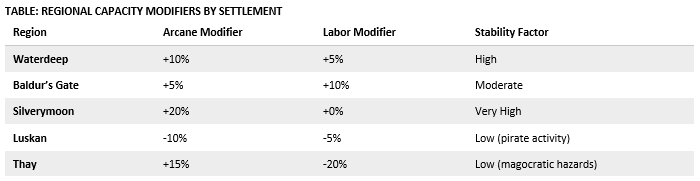
Capacity planning cannot ignore local conditions. Cities near leyline convergence zones, like Myth Drannor, may support higher arcane throughput. Conversely, areas like Thay or the Underdark may suffer from planar contamination, reducing safe operational thresholds.
Final Thoughts

In Faerûn, even the most skilled spellwright or potion master must respect the limits of magic and labor. Workshop overload is more than a logistical inconvenience—it is a threat to safety, reputation, and the very fabric of the Realms.

By tracking spellcasting loads, leyline usage, environmental factors, and fatigue, the Waterdeep Trading Company ensures that its enchanted goods meet the highest standards—without melting the floor or summoning a hungry elemental.


Support the AD&D365 Project on Patreon.

To grow this world, we’ve launched an official Patreon where supporters can gain access to exclusive content, tools, training labs, and even influence the future of the project. Your support fuels more than just development ,  it expands the guildhall, forges new scrolls, and empowers the next generation of configuration wizards.  Begin your journey: https://www.patreon.com/adnd365/

A Grateful Salute to Our Patrons

To all those who stand behind the vision, thank you for helping bring this world to life. Our Benefactor, Andre Breillatt, your boundless generosity fuels the arcane core of this project. Without your magic, the weave would falter. Our Apprentices, the spell engines turn and the training labs thrive thanks to our current Apprentices: Michael Ramirez and Andreth Bael’Rathyn (Name obfuscated to protect their identity). Special thanks to our past Apprentices, whose contributions helped us get here:  Ralf Weber, Wendy Rijners, Shashi Mahesh, Julia Tejera, Ben Ekokobe, Tiago Xavier, Naveen Boyinapelli, Marcos Tadeu Wolf, Kathryn Greene, Jason Brown, Mark Christy, and Ashish Singh. Our Initiates, Peter Lorre, your commitment marks the start of the deeper path, stepping beyond mere observation into the active shaping of this realm. Our Followers, your steady presence along the journey is a beacon of

Want to design your own economic models in Faerûn?

Get your own AD&D365 Environment and guides at adnd365.com/start, and request access to the public view of the current database at https://public.adnd365.com – Login npc@adnd365.com, Password N0nPl@yC#822!

The trade winds of Faerûn are shifting, and they carry more than rumors and spices. From the alchemical terraces of Silverymoon to the enchanted farmlands of the Western Heartlands, a new breed of commodity is emerging: Magical Genetic Organisms (MGOs). Alongside them, a growing demand for certified organic goods has taken hold, driven by noble courts, druids’ circles, and increasingly conscious adventurers.

For the Waterdeep Trading Company (WDTC), this dual trend represents both opportunity and complexity. Here’s what it means for their operations.

What Are MGOs?

MGOs are living products (plants, animals, or alchemical cultures) that have been enhanced or fundamentally altered using enchantments, bloodline infusions, or genetic transmogrification spells. Examples include:

  • Cattle bred to resist cold through white dragon bloodlines
  • Corn enchanted to glow in the dark for night-harvests
  • Grapevines grown with elemental earth grafts to improve drought resistance

These are not simple potions or scrolls. MGOs are living, evolving, and heavily regulated by the Arcane Artificers & Alchemists Union (ARALCH).

Organic Goods in Faerûn

“Organic” in Faerûn typically means:

  • Grown or raised without magical augmentation
  • Untouched by necromantic residue or planar corruption
  • Certified by the Healers & Herbalists Guild (HEAHBG)

Common organic trade goods include:

  • Apples from Daggerford orchards, certified druidically grown
  • Wool from sheep unaltered by elemental feeding programs
  • Wine aged in natural, unruned oak

Operational Impact on the Waterdeep Trading Company

Example Product Comparison Table

Market Implications

Both MGOs and Organics tap into growing trends in Faerûnian commerce:

  • MGOs cater to efficiency-focused trading houses, military buyers, and arcane guilds
  • Organics are prized by elven enclaves, noble estates, druidic settlements, and “clean living” adventurers

WDTC stands poised to capitalize on both, if its operations are equipped to trace, verify, and adapt quickly.

Ready to manage your enchanted cows and organic mead with confidence? Buy the guides at adnd365.com/start, and request access to the public view of the current database at https://public.adnd365.com

Login: npc@adnd365.com

Password: N0nPl@yC#822!

In the cities and strongholds of Faerûn, coin doesn’t just flow through markets and mead halls, it flows through payroll ledgers. Whether you’re an apprentice scribe in Candlekeep or a battle-hardened inventory porter in Waterdeep’s lower docks, your pay is determined by a system that’s as structured as a dwarven fortress: step-based compensation.

This isn’t just a civilized form of gold distribution. It’s how guilds and trading companies standardize pay, encourage career growth, and keep labor disputes from devolving into fireball-flinging protests.

What Is Step-Based Compensation?

Step-based compensation is a tiered wage system where workers earn more as they progress through defined roles. Most guilds structure this into five steps, with each level tied to experience, certifications, or sometimes just surviving long enough to tell the tale.

These ranges aren’t static. In cities like Luskan, where danger clings to every crate, hazard pay bonuses may boost compensation by up to 50%. Some occupations also carry premiums depending on magical risk, rarity of skill, or guild scarcity.

Why the Steps Matter

In a continent bound together by trade routes and teleportation circles, consistency in compensation helps prevent chaos. Guilds enforce minimums, reward growth, and create expectations across the Sword Coast and beyond.

Step-based models also:

  • Support career progression that’s visible and motivating.
  • Enable structured training programs and certifications.
  • Allow for easy workforce budgeting in tools like Dynamics 365.
  • Prevent the “random NPC wage” effect from breaking immersion.

Common Faerûnian Pay Ranges

Here’s a sample from across guilds and corker classes:

These roles often reflect local conditions. A Potion Sampler in Amn may fetch higher rates due to alchemical guild demand, while an Inventory Porter in Mirabar might earn less thanks to automation by enchanted pulley systems.

Moving Up the Ranks

Progressing through compensation steps usually involves:

  • Time served in a guild or under contract
  • Performance evaluations from senior corkers
  • Certifications and formal skill tests
  • Survival, especially in hazardous roles like wild magic waste disposal

Guilds like the Grand Artisans League and the Arcane Artificers Union publish detailed advancement criteria, while others—like the Free Mercenaries League—prefer the “prove it or perish” method.

Standardizing Pay in Dynamics 365

For trading companies like the Waterdeep Trading Company, these steps are modeled directly in Dynamics 365 Human Resources:

  • Job levels and skill requirements mapped to compensation bands
  • Automated progression workflows tied to review periods
  • Reports and dashboards showing wage distribution across sites
  • Integration with guild dues and hazard premiums

This ensures your compensation structure reflects both fantasy logic and enterprise accountability.

Final Thoughts

Whether you’re enchanting potion bottles in Baldur’s Gate or hauling siege ballistae in Scornubel, step-based pay ensures that work in Faerûn is as structured as it is storied. It builds morale, supports retention, and ensures that even the lowliest apprentice has a path forward—ideally, one with fewer explosions.

Looking to implement your step-based compensation strategy (with or without beholder hazard pay)? Start your journey at adnd365.com/start and request access to the public demo of our Faerûn Dynamics 365 setup at https://public.adnd365.com, logging in with

Username: npc@adnd365.com

Password: N0nPl@yC#822!

The realm pays well—if you level up right.

When adventurers in Faerûn tally their loot, when merchants count their wares in the bustling streets of Waterdeep, or when a dwarven stillmaster measures out moonshine in the Underdark—there’s one thing they all rely on: units of measure. But unlike our modern world of liters, kilograms, and miles per hour, Faerûn’s systems are delightfully inconsistent, hyper-regional, and infused with centuries of tradition, trade, and even magic.

Let’s take a tour through the wonderfully eclectic system of measurement in the Forgotten Realms.

Quantity Units: From Pieces to Pallets

Faerûnian traders deal in discrete units when counting physical goods—especially when it comes to adventuring gear, weapons, fabric, or food.

Weight Units: Medieval Heft with Mystical Variance

Faerûn may lack precision scales in every village, but weight still matters—especially to caravan masters and tax collectors.

Different regions may also use local names (like “kiv” in Rashemen or “zenk” in Thay), each reflecting unique cultural needs.

Volume Units: Casks, Jars, and Magical Bottles

Alchemists, distillers, and apothecaries are fastidious about their liquids—whether it’s healing potion or dwarven ale.

Magical volumes may defy expectations—a decanter of endless water, for example, does not comply with any rational standard.

Length and Fabric: From Elves to Ells

Clothiers and mapmakers in Faerûn often measure in units both familiar and fantastical.

Some elven cultures use units like the “moonstep” (about 3.3 feet) or the “petal’s fall” (a subjective unit of time/distance).

Area and Agriculture: For Land, Fields, and Armies

Land grants, farming plots, and battlegrounds are measured in larger units.

Magic and Alchemical Units

The arcane arts introduced unique measurements for magical substances and energies:

  • “Casting” (cst): One complete spell effect, used in crafting and alchemy.
  • “Soul-shard”: A necromantic unit for capturing essence (not legally recognized in Waterdeep).
  • “Pinch,” “Smidgen,” “Dash”: Extremely small units often used in potion brewing and cooking—especially halfling kitchens.

Standardization… Or Not

Faerûn doesn’t have a single standards board—each city, guild, or kingdom may have their own versions of the same unit. Thankfully, major trade cities like Waterdeep, Baldur’s Gate, and Calimport have codified equivalents for inter-regional commerce. Some larger organizations—like the Lords’ Alliance—even issue measurement tokens to help travelers convert between standards.

Final Thoughts

Units of measure may seem mundane, but in a world of dragons, liches, and flying ships, they’re a grounding force. Whether you’re an adventurer dividing loot, a merchant measuring goods, or a mage crafting potions, understanding these units means operating safely and fairly in a realm where even the size of a spoonful could mean life or death.

And in case you’re setting up inventory in Dynamics 365 for the Waterdeep Trading Company—yes, we’ve mapped all these units into the Item Master for you in The Advanced Dungeons & Dynamics 365 book series takes you deeper into magical business systems with step-by-step setups, fantasy examples, and real ERP strategy.

Grab your copy today and contract with confidence at adnd365.com/start

In the world of Advanced Dungeons & Dynamics 365, the real heroes of commerce aren’t always wielding swords—they’re wielding spreadsheets.

Whether you’re a potions distributor in Amn or a magical cookware wholesaler in Waterdeep, running trade promotions is one of the best ways to boost volume, clear seasonal inventory, and gain favor with merchant guilds. But managing those promotions across city-states, planes of existence, and fluctuating economic zones? That’s where Dynamics 365 Trade Promotion Management becomes your best magical artifact.

Let’s unpack how it works, with a few scrolls from our campaign log.

What Are Trade Promotions?

Think of trade promotions as targeted campaigns that offer discounts, incentives, or bundled offers to specific customers—usually retailers, guilds, or channel partners.

Here’s what they look like in Faerûn:

  • “Buy 3 Healing Potions, Get 1 Free” in Baldur’s Gate
  • 10% discount on Moonshines for the Brewers’ Guild during Brewfest
  • Extra 2% off all scrolls shipped via teleportation (because logistics costs are lower!)
  • Flat rate rebates on armor bundles during wartime (high demand = high reward)

In Dynamics 365, these promotions are configured as Trade Agreements, Discounts, and Rebate Programs, tracked across customers, products, and timelines.

Setting Up a Promotion in Dynamics 365

Let’s say you’re the Trade Master for Waterdeep Trading Company, and you want to launch a “Potion Palooza” campaign. Here’s how you’d do it:

  1. Define the Offer
  2. Configure the Trade Agreement
  3. Add a Rebate Program (optional)
  4. Link to Promotions Calendar
  5. Monitor Effectiveness with Power BI

Why It Matters in a Fantasy World (or Real One)

Trade promotions allow you to:

  • Move inventory before seasonal demand drops (hello, summer furs…)
  • Strengthen partner relationships by offering exclusive deals
  • Drive competitive advantage in crowded marketplaces (especially in cities like Calimshan)
  • Track ROI on every promotion (you don’t want to offer discounts that eat your margin like a gelatinous cube)

And with D365, it’s not just about setting up the discount—it’s about controlling it, automating it, and analyzing the results across your financial and supply chain modules.

Ready to Power Up Your Promotions?

Trade promotions are just one of the many magical tools in your ERP grimoire. Want to learn how to blend economic models, regional pricing, product variants, and guild contracts into a single unified system?

The Advanced Dungeons & Dynamics 365 books are your spellbook. Whether you’re a merchant prince or a humble configuration wizard, these guides will show you how to run your kingdom (or company) like a pro.

Grab your copy now and charm your way into trade success: Buy the AD&D365 Books

