Archive

Tag Archives: diet

The Waterdeep Trading Company relies on steady labor across docks, warehouses, counting rooms, and guard posts. Feeding that workforce is a daily operational task, not courtesy. A hungry crew slows work, causes friction, and creates avoidable risk. For this reason, the company operates a centralized food hall that delivers consistent meals at scale while maintaining precise cost control and minimal waste.

The food hall plans meals the same way the company plans freight and inventory, using fixed volumes, predictable demand, and clear rules that can be repeated every day.

Why Centralized Food Planning Matters

When meals are left to individual departments or ad hoc kitchens, costs rise, and service becomes uneven. A central food hall allows the company to buy in bulk, standardize portions, and control preparation timing. It also ensures that every worker, regardless of role or shift, receives the same reliable meal.

Central planning turns food into a managed resource rather than an ongoing problem.

Establishing the Workforce Baseline

Daily planning begins with a known headcount. The food hall does not plan by role, rank, or department. It plans by total mouths served across all shifts. Dockhands, clerks, guards, supervisors, and night watch are counted together to avoid gaps or double-counting.

The core planning unit is one hundred workers. This unit reflects proven banquet scale quantities that assume physical labor and full meals.

The One Hundred Worker Meal Set

The food hall uses a standard one-hundred-worker meal set as its baseline. One complete set feeds one hundred workers for a single main meal. Half a set feeds fifty workers, and a quarter set feeds twenty-five. Most days fall between one and two complete sets.

By scaling meals in these fixed blocks, purchasing, prep, and storage remain predictable.

Protein Planning for Sustained Labor

Protein is the most expensive and most closely tracked part of the meal. Portions are generous but controlled.
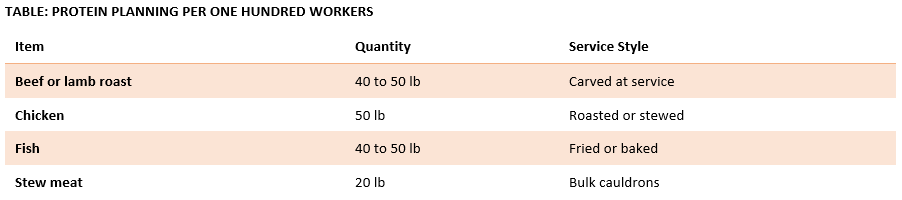
Only two protein options are served at any meal. One is treated as the primary dish, while the second supports variety without increasing waste.

Soup as the Daily Anchor

Soup is served at every meal. It fills bowls, stretches inventory, and absorbs attendance fluctuations without complaint.

One gallon serves about twenty workers, making soup the most efficient volume control tool in the hall.

Sides and Cold Dishes

Side dishes are chosen for stability and early preparation. Many are prepared before midday to smooth labor demand and reduce pressure during peak service.
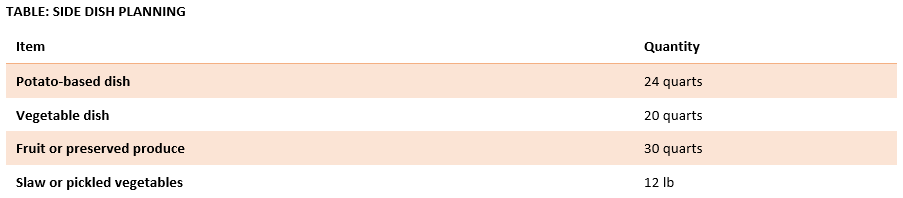
Cold dishes are favored because they store well and reduce reliance on open fires during service.

Bread and Dairy as Calorie Insurance

Bread is always available. It ensures no worker leaves hungry, even on days when attendance exceeds estimates.

Bread consumption is tracked daily, as sharp increases often signal that protein portions need adjustment.

Beverage Planning

Water is unlimited. Hot drinks are planned by volume and issued in controlled batches.

Ale and spirits are not part of the food hall ration and are handled separately through licensed taverns.

Daily Planning in Practice

On a typical workday, the food hall may require approximately 1.5 meal sets to meet demand. In practice, the kitchen prepares two complete sets to protect against shortages and late arrivals. Any unused portions are intentionally folded into the following day’s soups or stews, where they can be safely and efficiently reused. Leftover proteins are never held beyond the day of service unless they are immediately repurposed in accordance with controlled preparation rules. This approach prevents spoilage, reduces waste, and minimizes the risk of illness while keeping service predictable.

Ledger Control and Oversight

Each day, the food hall reports the number of workers fed, the total food cost, the average cost per worker, and any recorded waste. These figures are reviewed weekly by the Arcane Treasurer to ensure the food hall supports operations without unnecessary spending.

Food is treated as an operational input, tracked with the same discipline as tools, wagons, or warehouse space.

Final Thoughts

Feeding a large workforce is a logistics problem solved through structure and repetition. By planning meals in fixed sets and enforcing clear reuse rules, the Waterdeep Trading Company keeps its workers fed, its kitchens orderly, and its ledgers clean. A full stomach keeps the company moving, and a planned kitchen keeps the company profitable.


Support the AD&D365 Project on Patreon.  To grow this world, we’ve launched an official Patreon page where supporters can access exclusive content, tools, and training labs, and even influence the project’s future. Your support fuels more than just development; it expands the guildhall, forges new scrolls, and empowers the next generation of configuration wizards.  Begin your journey: https://www.patreon.com/adnd365/

A Grateful Salute to Our Patrons.  To all those who stand behind the vision, thank you for helping bring this world to life. Our Benefactors, Andre Breillatt and Eryndor Fiscairn, your boundless generosity fuels the arcane core of this project. Without your magic, the weave would falter. Our Apprentices, the spell engines turn, and the training labs thrive thanks to our current Apprentices: Michael Ramirez and Andreth Bael’Rathyn. Special thanks to our past Apprentices, whose contributions helped us get here: Ralf Weber, Wendy Rijners, Shashi Mahesh, Julia Tejera, Ben Ekokobe, Tiago Xavier, Naveen Boyinapelli, Marcos Tadeu Wolf, Kathryn Greene, Jason Brown, Mark Christy, and Ashish Singh. Our Initiates, Jesper Livbjerg, Peter Lorre, Gregory Brigden, and Martin Grahm, your commitment marks the start of the deeper path, stepping beyond mere observation into the active shaping of this realm. Our Followers, your steady presence along the journey is a beacon of encouragement: Rusty Cavalier, Eric Shuss, Sunil Panchal, Sarah D. Morgan, Nick Ramchandani, Daniel Kjærsgaard, and Tomasz Pałys. And our Voyeurs, Harry Burgh, Abdelrahman Nabil, and Basil Quarrell, ever watching from the shadows, clearly intrigued… but not enough to part with a single gold piece. Your silent curiosity is noted and mildly judged.

Want to design your own economic models in Faerûn?  Get your own AD&D365 Environment and guides at adnd365.com/start, and request access to the public view of the current database at https://public.adnd365.com – Login npc@adnd365.com, Password N0nPl@yC#822!

In the sprawling markets of Faerûn, sweetness is never just sugar, it is craft, alchemy, and trade. The Waterdeep Trading Company stands at the forefront of this art, transforming raw ingredients from across the Realms into syrups that enrich daily life. From the common taverns of Baldur’s Gate to the noble estates of Silverymoon and the enchanted courts of the Moonshae Isles, our syrups find their way into mugs, goblets, and ritual chalices.

Sweeteners carry not only taste but also identity. They bring forward the land they hail from, the guilds who refine them, and the merchants who carry them along caravan and sea routes. Some are familiar, like cane sugar or honey, while others are rare luxuries, moonflower nectar harvested under enchanted blossoms, or celestial dew condensed from the very light of the heavens.

This article reveals how the Waterdeep Trading Company manufactures, refines, and distributes syrups. It explores both traditional and exotic sweeteners, provides tables for conversion and usage, and presents worked examples to show the difference between common goods and rare luxuries.


Support the AD&D365 Project on Patreon.

To grow this world, we’ve launched an official Patreon where supporters can gain access to exclusive content, tools, training labs, and even influence the future of the project. Your support fuels more than just development ,  it expands the guildhall, forges new scrolls, and empowers the next generation of configuration wizards.  Begin your journey: https://www.patreon.com/adnd365/

A Grateful Salute to Our Patrons

To all those who stand behind the vision, thank you for helping bring this world to life. Our Benefactor, Andre Breillatt, your boundless generosity fuels the arcane core of this project. Without your magic, the weave would falter. Our Apprentices, the spell engines turn and the training labs thrive thanks to our current Apprentices: Michael Ramirez and Andreth Bael’Rathyn (Name obfuscated to protect their identity). Special thanks to our past Apprentices, whose contributions helped us get here:  Ralf Weber, Wendy Rijners, Shashi Mahesh, Julia Tejera, Ben Ekokobe, Tiago Xavier, Naveen Boyinapelli, Marcos Tadeu Wolf, Kathryn Greene, Jason Brown, Mark Christy, and Ashish Singh. Our Initiates, Peter Lorre, your commitment marks the start of the deeper path, stepping beyond mere observation into the active shaping of this realm. Our Followers, your steady presence along the journey is a beacon of

Want to design your own economic models in Faerûn?

Get your own AD&D365 Environment and guides at adnd365.com/start, and request access to the public view of the current database at https://public.adnd365.com – Login npc@adnd365.com, Password N0nPl@yC#822!


Classic Sugars: The Foundation of Syrupcraft

The backbone of most syrups rests upon tried-and-true sugars. These provide stability and consistency, easily dissolved into both hot and cold beverages.

  • Cane Sugar – Imported from the cane fields of Amn, pressed and crystallized, then dissolved into syrup. Clean, sweet, and versatile.
  • Brown Sugar – A Waterdeep specialty created by adding molasses back into refined sugar, giving depth and a toasted warmth.
  • Honey – Harvested by Rashemi druids and apiarists, honey carries floral notes and golden sweetness, a luxury long beloved in Faerûn.
  • Maple Syrup – Drawn from enchanted northern groves, reduced by fire and filtered to retain its earthy, woodsy caramel tones.

Manufacturing Process: Raw sugar or honey is delivered to Waterdeep workshops. Syrup-makers dissolve it in large copper cauldrons, strain it through linen cloth, add stabilizing herbs, and bottle it for trade.

Alternative Natural Sweeteners: Syrups with Character

Adventurers and nobles often seek tastes that go beyond tradition. These syrups bring distinctive flavors tied to their regions of origin.

  • Agave Syrup – Extracted from the cactus heart in Calimshan, light, smooth, and excellent for cold drinks.
  • Coconut Sugar Syrup – From Chultan coconuts, boiled down into a caramel-rich syrup.
  • Date Syrup – A Thayan enclave specialty, dark, fruity, and reminiscent of toffee and dried fruit.

Manufacturing Process: These sweeteners are boiled in sealed kettles at low heat to preserve flavor, then aged briefly in oak casks for consistency.

Plant-Based Zero-Calorie Sweeteners: Nature Refined by Alchemy

These extracts appeal to health-conscious customers without sacrificing sweetness.

  • Stevia – Leaves harvested from eastern plantations are dried, powdered, and magically steeped to yield sweetness 200× stronger than sugar.
  • Monk Fruit Extract – Rare fruits imported from Kara-Tur, carefully processed to create concentrated sweetness.

Manufacturing Process: Extracts are stabilized with herbs and cooled by enchanted stones, preventing bitterness and ensuring clarity.

Sugar Alcohols: Sweet with a Cool Finish

These lie between natural and refined, offering milder sweetness and a refreshing aftertaste.

  • Erythritol – Created from fermented fruits in Icewind Dale, nearly calorie-free, with a cooling effect.
  • Xylitol – Extracted from northern birchwood, equal in sweetness to sugar, providing body to syrups.

Manufacturing Process: Fermentation and crystallization cycles ensure purity before blending into syrups.

Artificial Sweeteners: The Arcane Alternatives

Though some prefer natural sources, the Company also crafts syrups from wizard-forged ingredients.

  • Aspartame – Alchemically bound proteins, strong but heat-sensitive, suited to cold syrups.
  • Acesulfame K – A stable, arcane creation that can withstand boiling and large-scale brewing.

Manufacturing Process: Arcane treasurers oversee the sigil-sealed laboratories where these sweeteners are made, ensuring purity.

Faerûn-Exclusive Sweeteners

Beyond the known Realms, exotic ingredients provide syrups unique to Waterdeep’s trade networks.

  • Moonflower Nectar – Blossoms from the Moonshae Isles, glowing under starlight, yielding intense sweetness.
  • Evermead Sap – A floral nectar from Evereskan vines, prized for noble teas and vintages.
  • Shadowroot Molasses – Thick syrup drawn from Underdark fungal roots, bitter-sweet and favored by dwarves.
  • Celestial Dew – Distilled from condensed starlight, requiring mage-sealed containers, nearly priceless.

Conversion Rates for Sweeteners

To assist guilds and taverns, we provide guidance on how each sweetener compares to standard cane sugar.

Usage Guidance for Sweeteners

To guide merchants and artisans, here are suggested applications for each syrup type.

Worked Example: Syrup Production

To illustrate how manufacturing differs between a common and a luxury syrup, here are two complete costing sheets.

Final Thoughts

Sweeteners in Faerûn are more than just ingredients. They are a symbol of connection between regions, guilds, and cultures. Cane sugar syrup sustains the daily trade of inns and taverns, while moonflower nectar syrup binds noble courts and elven feasts to the Waterdeep Trading Company’s reputation.

By maintaining both steady common production and rare luxury offerings, the Company ensures that no cup, mug, or chalice goes without the right touch of sweetness.