Every ERP concept in this lab has a CRM twin. The names changed, the forms got wider, and there are more required fields, but the underlying business logic is the same. This lab maps what we already know to where it lives in Finance and Operations.
We are not building anything new yet. We are reading, navigating, and comparing. By the end, the D365 F&O navigation should feel like a dialect of a language we already speak.
Overview
This lab maps six core CRM entities to their ERP equivalents. We will navigate to each F&O form, compare the record structure to what we know from CRM, and identify which fields are new, which are renamed, and which behave differently.
We will complete six activities:
Open a customer record and compare it to a CRM account.
Review customer groups and compare them to CRM account types or segments.
Open a released product and compare it to a CRM product catalog entry.
Navigate the site and warehouse hierarchy and understand physical inventory tracking.
Open a vendor record and understand the purchase side of the same entity model.
Review currency codes and understand multi-currency in ERP.
Each activity is a guided navigation exercise. No records are created or modified.
Objective
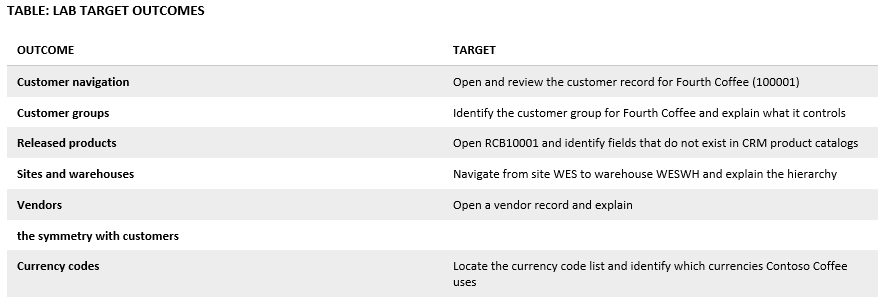
By completing this lab, we will be able to navigate six core F&O entity forms and explain the CRM-to-ERP mapping for each.
The following table defines the target outcomes for each entity mapping exercise.
TABLE: LAB TARGET OUTCOMES
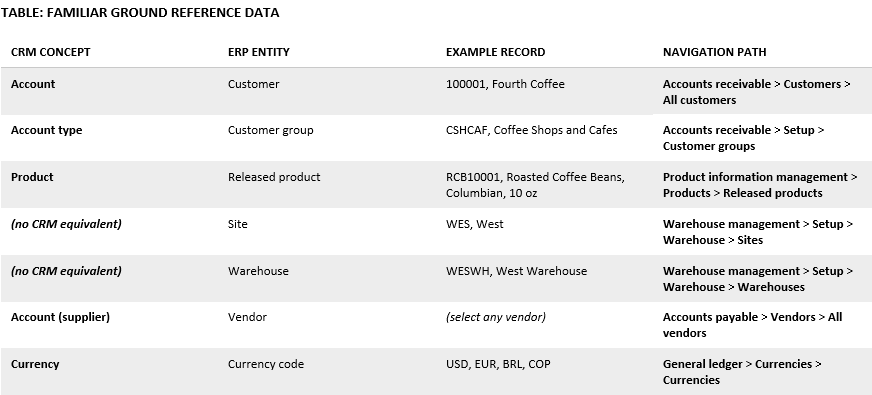
Reference Data
The following reference values support navigation during this lab. All records already exist in the Contoso Coffee database.
Across Faerûn, serious buyers rarely begin with a direct order. Guilds preparing seasonal stock, nobles provisioning estates, and caravan masters planning long routes often ask for terms before committing coin. They send a Request for Quotation (RFQ).
For the Waterdeep Trading Company, receiving RFQs from customers is a controlled sales practice. It protects margins, confirms supply, and prevents promises that cannot be kept. This article explains the full customer RFQ lifecycle, from intake to internal review, pricing, approval, and conversion into a sales order, with a complete worked example using realistic trade data.
What a Customer RFQ Is
A customer RFQ is a formal request to Waterdeep Trading Company to provide pricing, quantities, delivery schedules, and terms for a proposed purchase. It does not reserve stock and does not create a financial obligation.
Customer RFQs are common when
Quantities are large or recurring.
Prices may vary by season or route.
Delivery is split across dates or locations.
Extra handling or markings are required.
RFQs may arrive by courier, guild scribe, sealed letter, or arcane message and are always logged before any pricing work begins.
Why Receiving RFQs Matters
Poor RFQ handling creates risk. A rushed response can underprice goods or overcommit inventory. A slow response can lose the deal.
A structured RFQ process allows the Waterdeep Trading Company to:
Confirm inventory and production capacity.
Apply correct pricing and margin rules.
Review customer credit standing.
Align sales, finance, and logistics before making promises.
The RFQ stage is where sales discipline begins.
How Customer RFQs Are Received and Logged
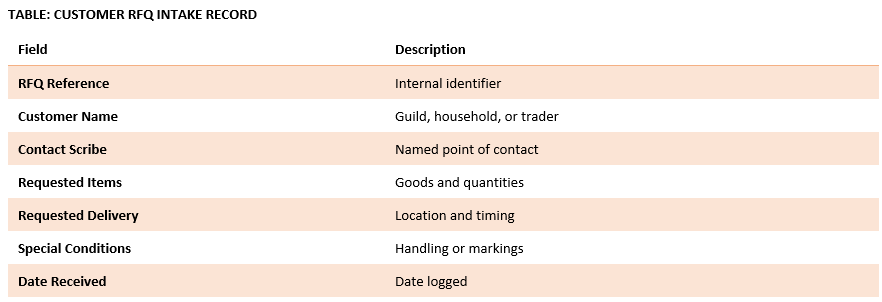
All incoming RFQs are recorded by the Sage Archivists in the Records Office. Each request is assigned an internal reference for tracking and auditing.
No RFQ moves forward without a complete intake record.
Internal Review and Validation
After logging, the RFQ is reviewed across inventory, finance, and logistics.
Internal checks include:
Available stock and production lead time.
Standard cost and current selling price.
Customer credit rating and limits.
Route capacity and seasonal risk.
If any check fails, the RFQ may be declined or returned with adjusted terms.
Pricing a Customer RFQ
RFQ pricing reflects more than the shelf price. It accounts for scale, effort, and risk.
An Arcane Treasurer reviews pricing before approval.
Approval and Customer Response
Large or high-value RFQs require approval before a quote is sent. Approval ensures margins and capacity remain within company rules.
Once approved, the RFQ response becomes a formal quote with:
Confirmed prices.
Delivery terms.
Payment conditions.
A validity period.
At this stage, no ledger posting occurs.
Worked Example
Customer RFQ Received by the Waterdeep Trading Company
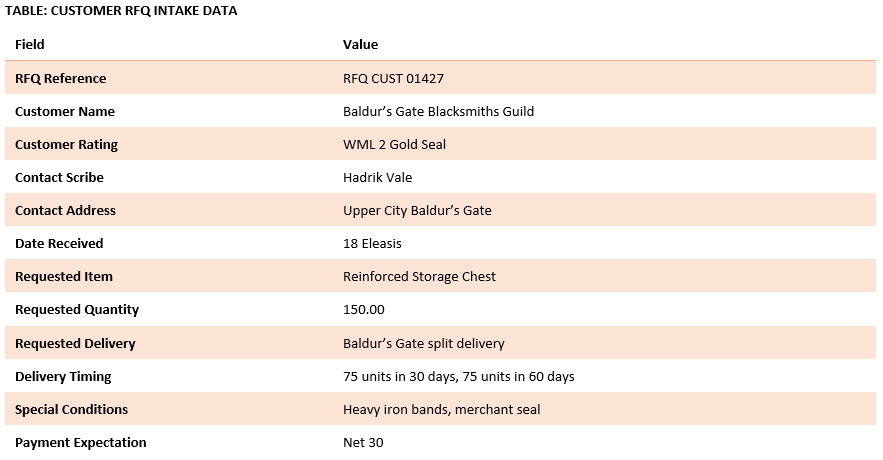
Scenario Overview: The Baldur’s Gate Blacksmiths Guild plans a seasonal expansion serving caravan operators. They submit an RFQ for reinforced storage chests before committing funds.
RFQ as Received: This table shows the RFQ exactly as logged on receipt.
No stock is reserved at this point.
Internal Feasibility Review: The RFQ is reviewed by the planning, finance, and logistics teams.
Pricing Construction: Pricing is based on volume, handling, and transport.
Margins remain within policy.
Approval Record: Because of the deal size, approval is required.
Quote Sent to Customer: The approved RFQ response becomes a formal quote.
No ledger entries are created until acceptance.
Conversion to Order
If the customer accepts:
The quote converts to a sales order.
Inventory reservations are created.
Production is scheduled.
Revenue is posted only after delivery and invoicing.
If declined or expired, the RFQ is closed with no financial impact.
Final Thoughts
Customer RFQs protect both seller and buyer. They slow the process just enough to replace guesswork with proof. For the Waterdeep Trading Company, RFQs ensure every large sale begins with confirmed supply, fair pricing, and clear terms.
Handled correctly, an RFQ is not delayed. It is control.
Support the AD&D365 Project on Patreon. To grow this world, we’ve launched an official Patreon page where supporters can access exclusive content, tools, and training labs, and even influence the project’s future. Your support fuels more than just development; it expands the guildhall, forges new scrolls, and empowers the next generation of configuration wizards. Begin your journey: https://www.patreon.com/adnd365/
A Grateful Salute to Our Patrons. To all those who stand behind the vision, thank you for helping bring this world to life. Our Benefactors, Andre Breillatt and Eryndor Fiscairn‡, your boundless generosity fuels the arcane core of this project. Without your magic, the weave would falter. Our Apprentices, the spell engines turn, and the training labs thrive thanks to our current Apprentices: Michael Ramirez and Andreth Bael’Rathyn‡. Special thanks to our past Apprentices, whose contributions helped us get here: Ralf Weber, Wendy Rijners, Shashi Mahesh, Julia Tejera, Ben Ekokobe, Tiago Xavier, Naveen Boyinapelli, Marcos Tadeu Wolf, Kathryn Greene, Jason Brown, Mark Christy, and Ashish Singh.Our Initiates, Jesper Livbjerg, Peter Lorre, Gregory Brigden, and Martin Grahm, your commitment marks the start of the deeper path, stepping beyond mere observation into the active shaping of this realm. Our Followers, your steady presence along the journey is a beacon of encouragement: Rusty Cavalier,Eric Shuss, Sunil Panchal, Sarah D. Morgan, Nick Ramchandani, Daniel Kjærsgaard, and Tomasz Pałys. And our Voyeurs, Harry Burgh, Abdelrahman Nabil, and Basil Quarrell, ever watching from the shadows, clearly intrigued… but not enough to part with a single gold piece. Your silent curiosity is noted and mildly judged.
Want to design your own economic models in Faerûn? Get your own AD&D365 Environment and guides at adnd365.com/start, and request access to the public view of the current database at https://public.adnd365.com – Login npc@adnd365.com, Password N0nPl@yC#822!
The Morning of the Three Bottles The bells of the Waterdeep Trading Company’s counting house chimed the eighth hour as Greta Ironfist strode into the pricing hall. Ledger-keepers were already at their desks, quills scratching in neat columns while the scent of parchment, ink, and faintly sweet syrup filled the air. On the great oak table in the center of the room sat three glass bottles, each gleaming under the morning light—one plain but sturdy, one etched with seasonal motifs, and one crowned with gold filigree. Greta stopped beside them, resting her calloused hand on the S3 bottle as though it were a treasured relic. “These,” she said to the gathered clerks, “are more than syrup. They are the proof of our craft, the measure of our discipline, and the promise we make to every customer who walks through our doors. Whether you sell to a dockside inn or the High Lord’s feast, the price must be right, fair to them, fair to us.” She nodded to the head scribe, who unrolled a parchment marked with the familiar S1–S3 tiers. Numbers and attributes danced across the page like runes of commerce, each line telling the story of a product’s value: its flavor, its rarity, its place in the market. This was the Company’s way, turning traits into tariffs, attributes into coin, and it had kept their coffers full for decades.
In the labyrinthine alleys of Waterdeep’s Trade Ward, merchants haggle over crates of goods while scribes tally weights and measures in ink-stained ledgers. For the Waterdeep Trading Company (WDTC), pricing is not left to the chaos of the marketplace. Instead, it is governed by a structured system that transforms a product’s attributes into precise, repeatable pricing rules.
By defining product attributes, rarity tier, size, seasonal status, and enhancement type, the Company ensures every sale is consistent, fair, and profitable. The foundation of this method is the tier system, known internally as S1–S3, which assigns products into structured pricing categories.
What It Is
Before we can apply structured pricing, we must understand the foundation of the approach. This section introduces the concept of product attribute–based pricing, how characteristics like flavor type, rarity, and size become the framework for determining base prices and modifiers. By replacing guesswork with defined attributes, WDTC ensures consistency across its entire product catalog.
Product attribute–based pricing is a strategy that uses the characteristics of an item to determine its base price and any modifiers. Attributes may be purely physical (size, weight), tied to rarity (common vs seasonal), or value-enhancing (arcane infusion, sugar-free variants).
In WDTC’s syrup trade, this approach avoids setting prices individually for each SKU. Instead, a tiered pricing table and attribute multipliers generate the correct price for every product variation automatically.
Why It Matters
The value of an attribute-based pricing system lies in its ability to serve both operational efficiency and commercial advantage. Here we explain why WDTC invests in this method, covering the benefits of consistency, scalability, and speed, as well as how the approach safeguards margins while encouraging customer loyalty.
Consistency: All merchants pay prices grounded in defined rules, not guesswork.
Scalability: New products can be slotted into existing tiers without rewriting the entire price list.
Speed: Price updates are applied instantly across all products sharing the same attribute set.
Margin Protection: Rare and high-cost items maintain premium pricing even during seasonal promotions.
Support the AD&D365 Project on Patreon.
To grow this world, we’ve launched an official Patreon where supporters can gain access to exclusive content, tools, training labs, and even influence the future of the project. Your support fuels more than just development , it expands the guildhall, forges new scrolls, and empowers the next generation of configuration wizards. Begin your journey: https://www.patreon.com/adnd365/
A Grateful Salute to Our Patrons
To all those who stand behind the vision, thank you for helping bring this world to life. Our Benefactor, Andre Breillatt, your boundless generosity fuels the arcane core of this project. Without your magic, the weave would falter. Our Apprentices, the spell engines turn and the training labs thrive thanks to our current Apprentices: Michael Ramirez and Andreth Bael’Rathyn (Name obfuscated to protect their identity). Special thanks to our past Apprentices, whose contributions helped us get here: Ralf Weber, Wendy Rijners, Shashi Mahesh, Julia Tejera, Ben Ekokobe, Tiago Xavier, Naveen Boyinapelli, Marcos Tadeu Wolf, Kathryn Greene, Jason Brown, Mark Christy, and Ashish Singh.Our Initiates, Peter Lorre, your commitment marks the start of the deeper path, stepping beyond mere observation into the active shaping of this realm. Our Followers, your steady presence along the journey is a beacon of
Want to design your own economic models in Faerûn?
To make attribute-based pricing work in practice, WDTC needed a simple, universal classification. This section presents the S1–S3 tier framework, showing how products are grouped into Common, Seasonal, and Specialty categories. Each tier reflects availability, production cost, and buyer segment, forming the base layer for all pricing calculations.
Attribute Modifiers
The tier sets the foundation, but the real power comes from fine-tuning. This section details the modifiers that adjust base prices within a tier: size multipliers, sweetener premiums, seasonal adjustments, and packaging upgrades. By layering these rules, WDTC tailors each product’s price to its exact combination of attributes.
Once a tier is set, additional attributes adjust the base price:
Size: Larger bottles (24oz) use a multiplier (e.g., 1.75× S1 base price).
Packaging Prestige: Ornate or magical packaging can double retail value for noble clients.
Worked Example: Pumpkin Spice Syrup (S2 Seasonal)
Theory is valuable, but nothing drives home a process like a real example. In this section, we walk through the pricing calculation for a seasonal favorite, Pumpkin Spice Syrup. Each step shows how attributes, modifiers, and customer discounts flow into a final price per bottle, demonstrating how repeatable and transparent the process can be.
Attributes:
Tier: S2 (Seasonal)
Size: 12oz
Sweetener: Classic sugar
Season: In-Season (Fall)
Pricing Calculation Flow:
Base Price (Tier S2, 12oz): 6.85 FSD
Seasonal Modifier: None (In-Season)
Customer Group Discount: Preferred customer → –15% = 5.82 FSD
Volume Discount: Order of 24 bottles → –10% = 5.25 FSD
Final Price per Bottle: 5.25 FSD
This structured calculation ensures that whether the syrup is sold in Dock Ward’s guildhouses or shipped to a noble estate in Silverymoon, the pricing is consistent and predictable.
Realms-Aware Considerations
Pricing in Faerûn is never just about numbers, it’s about context. This section addresses the factors outside the core calculation that WDTC must account for: guild tariffs, regional availability, magical enhancements, and festival demand spikes. These realities influence how attribute-based pricing is applied in practice across the Realms.
Guild Tariffs: The Confectioners’ Guild levies additional fees on S3 products to maintain exclusivity.
Regional Availability: Certain flavors are only viable in specific climates (e.g., Frostsap from Icewind Dale).
Magical Enhancements: Arcane infusion extends shelf life but adds to cost.
Festivals: Flavors linked to major holidays (Shieldmeet, Midwinter) may shift from S1 to S2 during high demand.
Final Thoughts
An attribute-based pricing system is not simply a mechanical exercise in number-crunching—it is a discipline that shapes the way the Waterdeep Trading Company engages with every facet of its trade. By using the S1–S3 tier framework as a foundation, the Company ensures that each product is valued not by whim, but by the tangible qualities and market realities that define it.
This approach allows the Company to navigate the diverse economies of Faerûn with confidence. In the same week, a merchant caravan may carry S1 common syrups to rural taverns along the Trade Way, S2 seasonal syrups to bustling city markets, and S3 specialty syrups to the banquet halls of noble estates. Each sale, whether modest or grand, follows the same transparent structure—reinforcing fairness and predictability for customers while protecting margins.
Beyond immediate profit, this method strengthens WDTC’s long-term position. Consistency builds trust, and trust becomes loyalty. Preferred customers can rely on their tier-based advantages without the uncertainty of shifting prices, while non-preferred customers are presented with clear incentives to deepen their relationship with the Company. Seasonal surges and rare ingredient shortages may influence pricing, but they do so within a framework that is understood by all parties.
In a realm where the price of goods can be swayed by guild politics, sudden resource scarcity, or even the whims of magic, WDTC’s attribute-driven pricing system serves as both a shield and a sword. It shields the Company from market instability by applying calculated safeguards, and it acts as a sword by giving WDTC a competitive edge over less disciplined rivals.
Ultimately, the practice transforms pricing from a reactive task into a proactive strategy—one that aligns perfectly with the Company’s broader mission: to conduct trade across Faerûn with precision, foresight, and an unyielding commitment to fair dealing. The sweet profits of the syrup trade are merely one example of how this philosophy plays out in the everyday business of the Waterdeep Trading Company.
As the Dynamics Master, you control more than just the dice, you oversee the very economic systems that power the Waterdeep Trading Company’s operations in AD&D365. Greta Ironfist has tasked you with crafting a rebate structure that not only rewards customer loyalty but also strategically boosts profit margins, clears surplus stock, and strengthens alliances across Faerûn.
Your players aren’t adventurers with swords, they’re trade agents, procurement specialists, and sales negotiators working inside the system you run. Their battlefield is the Rebate Management workspace.
From the WDTC Headquarters in Waterdeep, trade flows across caravans, airships, and planar portals. The competition is fierce, Baldur’s Gate’s spice consortium, Calimport’s jewel traders, Neverwinter’s timber merchants, all offering tempting prices.
Your mission as Dynamics Master is to create a rebate program in AD&D365 that makes your customers think twice before taking their coin elsewhere.
Support the AD&D365 Project on Patreon.
To grow this world, we’ve launched an official Patreon where supporters can gain access to exclusive content, tools, training labs, and even influence the future of the project. Your support fuels more than just development , it expands the guildhall, forges new scrolls, and empowers the next generation of configuration wizards. Begin your journey: https://www.patreon.com/adnd365/
A Grateful Salute to Our Patrons
To all those who stand behind the vision, thank you for helping bring this world to life. Our Benefactor, Andre Breillatt, your boundless generosity fuels the arcane core of this project. Without your magic, the weave would falter. Our Apprentices, the spell engines turn and the training labs thrive thanks to our current Apprentices: Michael Ramirez and Andreth Bael’Rathyn (Name obfuscated to protect their identity). Special thanks to our past Apprentices, whose contributions helped us get here: Ralf Weber, Wendy Rijners, Shashi Mahesh, Julia Tejera, Ben Ekokobe, Tiago Xavier, Naveen Boyinapelli, Marcos Tadeu Wolf, Kathryn Greene, Jason Brown, Mark Christy, and Ashish Singh.Our Initiates, Peter Lorre, your commitment marks the start of the deeper path, stepping beyond mere observation into the active shaping of this realm. Our Followers, your steady presence along the journey is a beacon of
Want to design your own economic models in Faerûn?
In the arsenal of a skilled Dynamics Master, few tools are as versatile as tiered and hybrid agreements. These configurations allow the Waterdeep Trading Company to move beyond one-size-fits-all offers, tailoring incentives that adapt to customer behavior and seasonal rhythms. By layering spend or volume thresholds, combining different rebate triggers, and aligning offers with festivals or market events, you can guide purchasing patterns with precision. The result is a rebate program that not only rewards loyalty but also shapes the very flow of trade across Faerûn.
Tiered: Set multiple spend/volume bands in the agreement to encourage progressive purchasing
Hybrid: Combine volume thresholds with targeted product incentives
Seasonal: Apply rebate lines with effective dates matching festivals or market events
Use at the start of a rebate period to determine external influences on sales:
(For 2–19, use the full “Rebate Trigger Events” table from the core guide.)
Use at rebate cycle close to determine payout style in AD&D365:
In the realm of the Dynamics Master, success is not won with swords, but with spreadsheets and strategic foresight. Each rebate cycle is a campaign in its own right, with profit margins as your battlefield, customer satisfaction as your supply lines, and market share as your captured territory. To claim victory, you must balance generosity with discipline, rewarding loyalty while keeping the Waterdeep Trading Company’s coffers secure. The following conditions define what triumph looks like when the final ledger is closed and the cycle’s story is told.
Maintain profitability while funding rebate payouts
Increase customer retention rate by at least 15%
Build exclusive rebate-linked supply contracts with guilds
Failure Conditions
Even the most seasoned Dynamics Master knows that a misjudged rebate program can unravel faster than a frayed caravan rope. Overcommit to payouts, misread the market, or let rivals turn your own tactics against you, and the Waterdeep Trading Company’s advantage can vanish overnight. Failure in this campaign is not simply a loss of coin, it is a loss of influence, trust, and strategic standing in the bustling trade halls of Faerûn. The following conditions mark the signs that the rebate accord has tipped from asset to liability.
As the Dynamics Master, you hold the quill that writes the fate of every rebate cycle. Your role is equal parts strategist, storyteller, and system architect. Just as a dungeon master weaves encounters to challenge and reward adventurers, you must design rebate programs that entice customers, withstand market turbulence, and align with the Waterdeep Trading Company’s grand strategy. The tips below are your toolkit, practical levers and narrative devices to keep the campaign balanced, profitable, and engaging from the first signed agreement to the final coin counted.
Tie game events to AD&D365 automation – let the system track progress toward thresholds in real time
Leverage trade agreements for flexibility – seasonal clauses, product-specific terms, and dynamic start/end dates
Use analytics to adjust mid-cycle – prevent loss by revising thresholds before end-of-period settlements
If your rebate program thrives, the Waterdeep Trading Company solidifies its position as the trade power of the Sword Coast, with Greta Ironfist granting you a seat on the Merchant Council and a share of quarterly profits. Fail, and your name will be whispered in the halls of rival traders as the one who tried to buy loyalty but paid too dear a price.
In the thriving trade cities of Waterdeep, Baldur’s Gate, and beyond, merchants often find themselves at a loss not from theft or misadventure but from failing to account for the true cost of their imports. That’s where understanding landed cost comes in.
Whether you’re bringing in saffron from Calimshan, dwarven steel from Mithral Hall, or elven wine from the Salington Vinyards, knowing your full landed cost is the difference between profit and peril.
What Is Landed Cost
Landed cost is the total expense incurred to bring a product from its source to its final destination not just the vendor’s price. It includes:
Base purchase cost
Transport fees (caravan, barge, airship, or teleportation)
Import duties and tariffs
Handling, inspection, and insurance
Security (escorts, guards, bribes if necessary)
Currency exchange losses or fees
Magical sealing, warding, or scrying
These additional costs accumulate through every step of the product’s journey and they must be calculated if a merchant is to determine the real price of their inventory.
Sample Landed Cost Breakdown: A Faerûnian Case Study
Let’s say the Waterdeep Trading Company imports Sake Rage from Salington Vinyards in Neverwinter.
A merchant who sells the sake based solely on the 260 FSD supplier price may think they’re earning 20 percent margin. In truth they may barely break even or worse.
Why Landed Cost Matters
Proper Pricing Without it prices are based on illusion not reality
Trade Route Evaluation Understanding which routes magical or mundane offer better margins
Profitability Forecasting A true picture of earnings requires full cost awareness
Product Comparison Knowing full cost helps compare multiple suppliers not just their invoice price
Common Faerûnian Costs to Consider
Best Practices for Faerûnian Merchants
Track each cost layer no matter how small Even a 5 FSD handling fee can add up across shipments
Use standard units like FSD per crate or bottle for consistency
Build buffer margins into your pricing to account for lost goods taxes or delays
Plan seasonally Snow in the Spine of the World Expect freight delays and added guard fees
Maintain supplier scorecards with both base and landed cost to spot hidden costs
Final Thoughts
In the end savvy trade in Faerûn isn’t about knowing the lowest price it’s about understanding the total price. Whether your goods travel by foot hoof keelboat or leyline calculating landed cost is your secret weapon in staying competitive and profitable.
Want to simulate shipping strategies in Faerûn or model transportation operations in Dynamics 365?
To grow this world, we’ve launched an official Patreon where supporters can gain access to exclusive content, tools, training labs, and even influence the future of the project. Your support fuels more than just development — it expands the guildhall, forges new scrolls, and empowers the next generation of configuration wizards. Begin your journey: https://www.patreon.com/adnd365/
Thanks to my supporters for helping make this content possible:
Our Benefactor, Andre Breillatt, whose generosity powers the arcane core of the project.
Our Apprentices, who keep the spell engines humming and the training labs active: Ralf Weber, Wendy Rijners, Shashi Mahesh, Julia Tejera, Ben Ekokobe, Tiago Xavier, Naveen Boyinapelli, Marcos Tadeu Wolf, Kathryn Greene, Jason Brown, Michael Ramirez, Mark Christy, and Ashish Singh.
Our Followers, who lend their steady support and encouragement along every step of the journey: Sunil Panchal, Sarah D. Morgan, Nick Ramchandani, Daniel Kjærsgaard, and Tomasz Pałys.
At the Waterdeep Trading Company, efficiency is the difference between a satisfied customer and a fireball in the storeroom. One of the simplest but most powerful tools we’ve implemented in Dynamics 365 to streamline inventory lookup is the Search name field — and we’re not just typing in product names. We’ve turned it into a structured hierarchy system that lets us search smarter, not harder.
What Is the “Search Name”?
In Dynamics 365, the Search name is a simplified identifier that helps users quickly find products without needing to remember the exact item number or full description. It’s used in lookups across sales orders, purchase orders, inventory journals, and more. But by default, it’s just text.
We decided to turn that text into a strategy.
Hierarchy-Based Naming Convention
Instead of entering plain names, we use uppercase, hyphenated codes that follow a logical structure. Each segment represents a tier of product classification — from category to product type to material and variant.
Format
[CATEGORY]-[PRODUCT]-[MATERIAL]-[VARIANT]
This makes every search name:
Readable
Standardized
Filterable by segment
Segment Breakdown
Example Table
With this structure, a warehouse user typing STRG- can immediately filter to everything in the storage category. Type WPN-SWRD- and you’re only seeing swords. It’s as if your product list is pre-sorted by magic.
Why Uppercase?
We use uppercase exclusively for visual cleanliness and consistency. Mixed-case names slow down scanning and increase the chance of typos during data entry. When everyone follows the same uppercase-hyphenated structure, there’s less room for error — and a lot less shouting across the warehouse.
Benefits
Faster product lookups in order entry and warehouse activities
Simpler training for new users who only need to learn the hierarchy
Improved filtering during Excel exports, reports, and analytics
Consistency across environments, especially when syncing with e-commerce or external systems
Getting Started with Search Name Hierarchies
If you’re implementing or cleaning up your item master, now’s the time to adopt a structured search name strategy. Start by building a controlled vocabulary of category, product, material, and variant codes. Then roll it out in mass updates or via Excel templates.
Want to master more hidden inventory tricks like this? Grab the guides at adnd365.com/start and explore the public instance of our database at public.adnd365.com using
The Waterdeep Trading Company, headquartered in the bustling Sword Coast metropolis of Waterdeep, offers everything an adventurer might need—from enchanted aprons to armor blessed by clerics of Lathander. But as their product lines expanded across Faerûn, their quill-and-scroll inventory system simply couldn’t keep up. That’s when they turned to Microsoft Dynamics 365—and specifically, product category hierarchies—to bring order to their magical chaos.
Why Category Hierarchies Matter
In Dynamics 365, category hierarchies are like the enchanted blueprints of your product catalog. They give structure, meaning, and power to how products are organized, priced, reported on, and sold.
Instead of listing all products in a single long scroll, Waterdeep Trading Company now classifies them into structured Sales Category Hierarchies that mirror their physical shelves and trading logic.
The Anatomy of Waterdeep’s Product Categories
Here’s a peek at their current Sales Category Hierarchy:
Each node isn’t just a label—it’s a functional container that drives how products behave in the system.
Magic Behind the Structure
Here’s why Waterdeep’s team, led by Greta Ironfist, built such a comprehensive structure:
Relevant Attributes Per Category: Different products need different data. A chainmail vest needs a defense rating, while a cook’s apron requires a heat resistance level. By assigning attribute groups to each category, they ensure each product has the right fields—no more, no less.
Faster Sales and Smarter Filtering: Sales agents no longer scroll endlessly through product lists. Using Released Products by Category, they can filter by Clothing > Aprons or Weapons > Daggers instantly—whether they’re taking an order in-store or via speaking stone.
Discount and Pricing Control: During the annual “Goblin Week” sale, the system automatically applies discounts to all Armor category items. There’s no need to tag each item—just one discount rule tied to the category node.
Clean Procurement Workflows: Vendor relationships are tied to procurement categories. This ensures the Baldur’s Gate Blacksmiths Guild doesn’t get accidental orders for bathrobes. Procurement policies guide buying by category, preventing mistakes and keeping supplier alignment sharp.
Crystal-Clear Reporting: Need to know which product family brought in the most gold last quarter? Category-based reports break down performance by line: Armor vs. Weapons vs. Clothing.
Real Example: Bells & Aprons
Using product codes like 10002-BELL and 10001-APRN, products are linked to the Bells and Aprons nodes under Clothing. This categorization powers everything from pricing to trade agreement journals to magical inventory counts.
A System Built for Growth
As new products are added—say Clothing > Cloaks or Weapons > Polearms—they simply extend the existing hierarchy. Each addition inherits the right behaviors, pricing rules, and attributes without manual duplication.
This system ensures that the Waterdeep Trading Company is prepared not just for tomorrow’s adventures, but for a full-scale expansion across the Western Heartlands and beyond.
Ready to organize your own product catalog with spellbinding efficiency? Grab the Advanced Dungeons & Dynamics 365 guides at adnd365.com/start.
Want to explore Waterdeep’s real system? Request access to the live demo environment at https://public.adnd365.com using:
The Waterdeep Trading Company isn’t just a general store, it’s the central nerve of a supply empire that keeps adventurers, merchants, and mystics stocked from Luskan to Calimport. With customers as diverse as noble houses, guild outposts, and lone rangers, the company needed a way to structure its rapidly growing operations while maintaining financial precision and strategic agility.
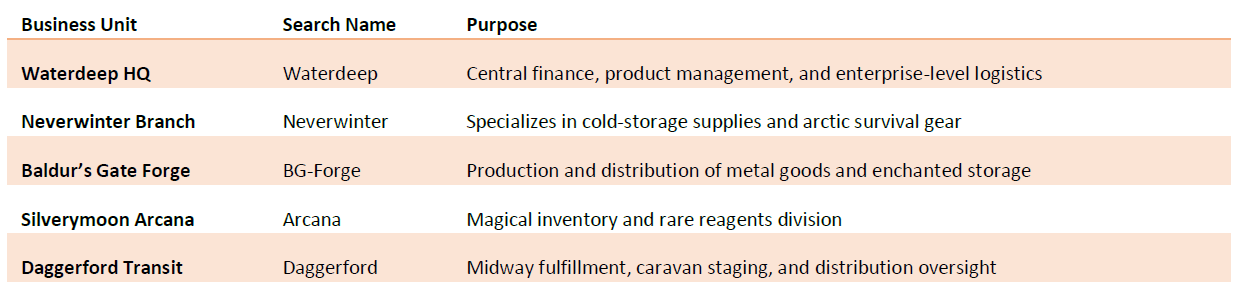
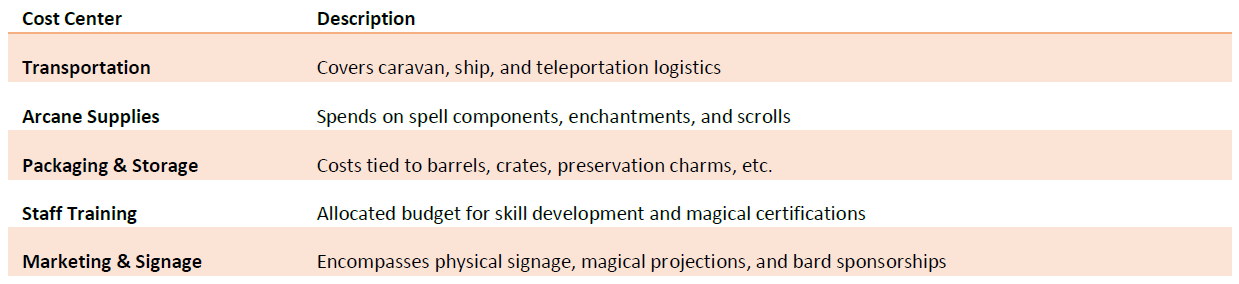
Enter Business Units, Departments, Sales Channels, and Cost Centers, the quartet of operational clarity in Microsoft Dynamics 365 Finance.
Business Units: Territory and Purpose
The company organizes its operations by Business Unit to reflect both geographic footprint and strategic focus. Each Business Unit represents a distinct operational hub, responsible for local inventory, staffing, and margin targets.
Each Business Unit tracks its own revenue and costs, enabling financial reporting at both unit and consolidated levels.
Departments: Role and Function
Where Business Units define where things happen, Departments define who does the work. These are the roles and internal teams that perform the operations of the business, often cutting across units.
Departments help structure responsibilities for budgeting and workforce management within each Business Unit.
Sales Channels: Who They Serve
Sales Channels represent the customer-facing paths through which the Waterdeep Trading Company moves its goods. These span traditional commerce and some… less conventional routes.
Using sales channels allows for segmented revenue reporting, discounting strategies, and tailored marketing campaigns.
Cost Centers: Where Money Is Spent
To control expenses and improve budgeting accuracy, the company uses Cost Centers to group similar operational expenditures. These are typically aligned with departments but offer finer granularity, especially in joint projects or field operations.
This structure supports top-down and bottom-up budgeting, with financial dimensions tracking expenses per cost center across all Business Units.
Why It All Matters
By organizing the Waterdeep Trading Company with Business Units, Departments, Sales Channels, and Cost Centers, Greta Ironfist and her team achieve:
Granular reporting: See profit margins by branch, track department-level performance, or monitor sales channel velocity.
Smarter budgeting: Allocate funds where they’re needed and track actuals against plans with visibility by dimension.
Accountability: Department heads and business unit managers can be held responsible for outcomes.
Scalability: As the company expands (hello, Chult!), new units, departments, or sales paths can be added without disrupting the existing structure.
A Realm in Balance
The Waterdeep Trading Company didn’t become Faerûn’s top outfitter by accident. Through clever use of Dynamics 365’s organizational structures, it tames the chaos of commerce—even in a world of dragons, demons, and duty-bound auditors.
So whether you’re running potions to a necromancer or hempen rope to a ranger, remember: structure is the silent partner in every successful adventure.
Start your own implementation journey today. Buy the full configuration guide at adnd365.com/start
🔍 Want to explore the live Faerûn demo environment? Log in to the public read-only view at https://public.adnd365.com
In the bustling cities of the Sword Coast—from Waterdeep’s merchant squares to the shady alleys of Luskan—one thing is clear: magic sells. Whether you’re a potion purveyor, an arcane gear supplier, or an enchanted scroll distributor, knowing which magical products bring the highest margins is critical for growth.
In this post, we’re using Dynamics 365’s Product Profitability Reports, Item Sales Margins, and Sales by Product Category to reveal the top 10 most profitable magical items currently moving through the Faerûnian economy.
How We Calculated Profitability
We pulled data from the Waterdeep Trading Company’s Dynamics 365 environment, combining:
Sales revenue from the Order to Cash module
Cost of Goods Sold (COGS) via Inventory Valuation
Gross Margin % based on item group (Magical Items, Potions, Scrolls, etc.)
Profit = (Sales – COGS) × Volume Sold
Top 10 Magical Products by Profit
Key Insights for Inventory & Trade Managers
Healing Potions dominate—they’re cheap to produce, high in volume, and in constant demand. Set reorder thresholds in your Item Coverage settings.
Arcane Saddles are low-volume, high-margin—ideal candidates for Trade Agreements with aerial suppliers and custom production runs.
Scrolls offer recurring revenue—track parchment, ink, and scribing labor as bundled production cost drivers.
Teleportation services represent a unique product-as-a-service model—handled as a non-stock item but linked to high-value invoicing and permit records.
Dynamics 365 Tips to Track Magical Profitability
Use Item Groups and Product Categories to segment magical vs. mundane goods.
Enable Standard Costing or FIFO for better margin clarity on alchemical and enchanted items.
Run the “Gross Margin by Product” report in Cost Management > Inquiries and Reports.
Tag products with attributes like Arcane Level, Guild Certification, or Spell School to enable dimensional profitability analysis.
What’s Next?
If you’re a trading company operating across Faerûn, your profit isn’t just about what you sell—it’s about knowing what sells best, to whom, and how consistently. With Dynamics 365, you have the tools to track product-level performance across every district, ward, and plane.
Curious what the margins are on a Flask of Faerie Fire or a Golem Core? Start building your magical profitability matrix today with our Bare Bones Templates and Fantasy Item Master demo packs at adnd365.com/start.