Archive

Tag Archives: dnd

The economy of Faerûn is not defined by coin alone. Its true strength lies in the industries that sustain livelihoods, uphold guild traditions, and bridge the gap between the mundane and the magical. From the vast wheat fields of Goldenfields to the enchanted workshops of Silverymoon, industries act as the pulse of the Realms, feeding cities, outfitting adventurers, empowering temples, and ensuring that trade routes remain alive with goods both practical and arcane.

For merchants and adventurers alike, industries are more than suppliers of goods, they are the engines of culture, politics, and survival. Guilds wield enormous influence, dictating not only quality and pricing but also shaping the destinies of apprentices, artisans, and even kingdoms. Magical integration further sets Faerûn apart from other economies: brewers enchant their mead for longevity, smiths forge blades with runes of protection, and scribes craft parchments immune to rot. Each craft carries with it centuries of tradition, technical mastery, and at times, divine blessing.

The Waterdeep Trading Company views industries not as abstract markets but as living ecosystems. Understanding how each vertical operates is essential for anticipating shortages, negotiating contracts, and leveraging guild alliances. A failure in one industry, a poor harvest, a guild strike, a broken leyline, can ripple outward, threatening supply chains, destabilizing tariffs, or sparking political unrest. Conversely, mastery of industry knowledge can unlock opportunities: positioning goods where scarcity drives demand, investing in verticals aligned with magical trends, and safeguarding contracts through compliance with guild regulations.

Industries of Faerûn also mirror the unique geography and cultures of the continent. Luskan’s shipwrights thrive because of their harsh northern seas. Amn’s merchants dominate coffee and tea through coastal access and southern trade routes. Thay’s arcane workshops flourish under Red Wizard oversight, while Goldenfields ensures that the breadbasket of the Sword Coast never runs dry. Each region specializes, adapts, and innovates, creating a patchwork economy where survival depends on both local resilience and continental trade flows.

By exploring these industries in detail, we uncover not only their typical products and craft requirements but also the business capabilities needed to manage them effectively within a system like Dynamics 365. From batch traceability in brewing to serialized artifact registries for enchanted items, each vertical demands specialized processes that reflect its magical and cultural realities.

The following sections will examine the major industries of Faerûn, their guild structures, and their operational needs. Together, they form a blueprint for understanding the engines of commerce and craft, industries that do not simply sustain the Realms but define them.

Why Faerûnian Industries Matter

Industries in Faerûn are more than lines of trade, they are the pillars that uphold the Realms’ prosperity and stability. Each vertical binds together tradition, innovation, and survival, ensuring that both great cities and rural hamlets remain supplied and sustained. Their significance rests on four interwoven principles:

  • Guild Regulation: Powerful guilds safeguard every craft, enforcing standards of quality, setting fair wages, and guiding apprenticeships. Their oversight prevents chaos in the marketplace and ensures continuity of skill across generations.
  • Regional Specialization: Geography shapes mastery. Goldenfields thrives as the breadbasket of the North, while Luskan’s icy docks produce ships that endure the harshest seas. Each region’s strengths define its contribution to the greater economy.
  • Magical Integration: Arcane practice and mundane craft are inseparable. Brewers weave enchantments into mead for longevity, smiths etch protective runes into armor, and scribes enchant parchment against decay. Magic amplifies what craftsmanship alone could not achieve.
  • Economic Stability: Industries are the lifeblood of tariffs, taxes, and trade flows. They generate wealth for cities, sustenance for villages, and resilience for kingdoms, anchoring both everyday survival and grand commerce.

Together, these principles explain why industries are not merely sectors of labor, they are the engines that drive Faerûn’s culture, politics, and prosperity.

Key Industries of Faerûn and Their Unique Requirements

From the bustling dockyards of Luskan to the fertile fields of Goldenfields and the enchanted workshops of Silverymoon, each industry in Faerûn has its own rhythms, strengths, and challenges. These verticals not only supply goods but also shape the character of their regions, reflecting centuries of guild tradition and magical practice. For the Waterdeep Trading Company, understanding the unique requirements of each industry is vital to managing supply chains, negotiating contracts, and forecasting demand. What follows is a closer look at the industries that power the Realms and the specialized capabilities that make them thrive.

Brewing & Distillation: Ale, cider, and spirits flow across taverns and courts alike. Brewers require fermentation mastery, magical infusions for aging, and scrying spells for quality control. Their guild, FABRDS, ensures authenticity and fair pricing.

Agriculture & Crop Cultivation: Goldenfields and Amn dominate grain and produce, feeding cities and supplying potion ingredients. Farmers must master seasonal planning, irrigation, and pest-warding rituals, while balancing both mundane crop yields and druidic blessings.

Cattle & Livestock Trade: From Daggerford pastures to Calimport markets, livestock fuels diets and barter economies. Herdsmen must focus on breeding management, disease prevention, and caravan protection, especially in regions where a cow may be worth 30 gold or more.

Potion & Alchemy Manufacturing: Alchemists and artificers in Waterdeep, Baldur’s Gate, and Thay rely on Engineering Change Management to regulate volatile recipes. Requirements include safe distillation, version tracking, and strict guild compliance to avoid catastrophic failures.

Textile & Storage Crafting: The Grand Artisans League oversees fabrics, satchels, and planar bags. Craftsfolk require loom mastery, dye enchantment, and planar weave sealing, ensuring robes resist flames and bags hold more than their size would suggest.

Weapon & Armor Smithing: The Black Anvil Guild unites smiths from Waterdeep and Neverwinter. Beyond metallurgy, rune-forging and rigorous apprenticeship systems are essential. Every blade and breastplate is tested both by hammer and enchantment.

Enchanted Item Production: Concentrated in Silverymoon and Thay, enchanted item production requires leyline attunement, artifact registries, and enchantment safety practices. Wands, rings, and arcane tools must be carefully catalogued to prevent misuse.

Construction & Masonry: The Stoneworkers & Builders Federation oversees towers, fortresses, and arcane gates. Requirements include rune binding, corruption-free contracting, and structural engineering fit for both mundane strongholds and planar gateways.

Herbalism & Botanical Goods: Herbalists in Candlekeep and Silverymoon must balance cultivation, drying techniques, and ritual knowledge. Their trade supplies both healers and alchemists, with guilds ensuring rare herbs are protected from exploitation.

Bardic & Instrument Crafting: The Bardic Performers’ Union protects the crafters of lutes, flutes, and illusion boxes. Their work requires tonal enchantments, illusion weaving, and performer sponsorship to keep bardic schools supplied.

Shipbuilding & Outfitting: Luskan’s dockyards and Mintarn’s drydocks specialize in galleons and spelljammer-ready hulls. Dockwrights require hull reinforcement expertise, planar navigation glyphs, and logistical control of drydock resources.

Glassblowing & Crystalworks: Glasswrights shape vials, mirrors, and scrying lenses in Amn and Silverymoon. Precision crystal alignment and enchantment compatibility are paramount to prevent flaws in alchemical or divinatory tools.

Parchment & Book Production: Papermakers and scribes produce ledgers and spell scrolls. They require vellum crafting, ink enchantments, and anti-decay spells to safeguard libraries such as Candlekeep.

Gemcutting & Stonebinding: The Gemcutters’ Consortium ensures stability in jewelry and soul stones. Skills include faceting, soul-binding rituals, and gemstone stabilization, work that often balances commerce with spiritual trust.

Leatherworking & Saddlery: Tanners in Daggerford and Baldur’s Gate craft boots, saddles, and monster-hide goods. Requirements include toxin neutralization, hide curing, and sigil carving, particularly for exotic mounts.

Candle, Oil & Incense Making: Temples rely heavily on WIXCOL guild-certified products. Craftsfolk refine wax, infuse scents, and maintain ritual purity, ensuring candles and incense meet religious standards.

Jewelry & Amulet Forging: Artificers of Ornament specialize in protective amulets and noble house sigils. They must blend heraldic design with enchantment bonding, ensuring both prestige and function.

Ceramics & Clayworking: Potters in Amn and Waterdeep produce urns, cauldrons, and rune-etched vessels. Their requirements include kiln mastery, rune embedding, and fracture resistance for ritual reliability.

Furniture & Fixtures: Carpenters craft chests, beds, and warded doors. Joinery, planar anchoring, and compartment warding are required to create fixtures that protect against scrying or intrusion.

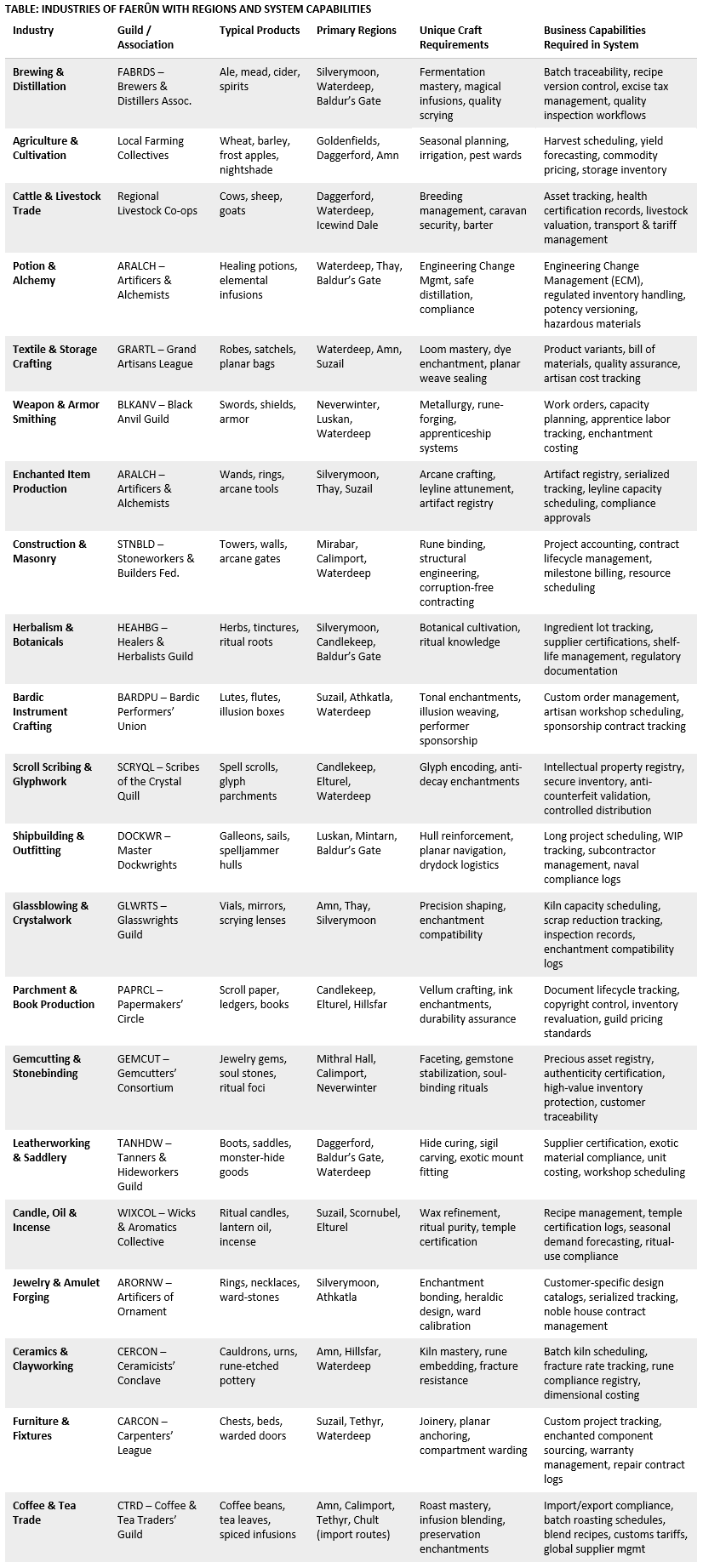
The following table highlights all the industries of Faerûn, their guilds, typical goods, craft requirements, business system needs, and the regions where they are most active. A new row has been added for the Coffee & Tea trade, a growing vertical in southern Faerûn.
Realms-Aware Considerations

Industries in Faerûn do not exist in isolation, they are shaped by forces as varied as guild politics, magical tides, geography, and the turning of the seasons. A process that runs flawlessly in Waterdeep may falter in Luskan’s harsher climate, while Goldenfields’ abundant harvests may wither under Calimport’s arid skies. For the Waterdeep Trading Company, true mastery comes not only from understanding the craft of each industry but also from recognizing the wider forces that influence production, trade, and demand across the continent.

  • Seasonality – Many trades, particularly agriculture, brewing, and candle-making, are bound to ritual calendars and harvest cycles, creating periods of abundance and scarcity that drive pricing and supply.
  • Magic vs. Mundane Balance – Some industries, such as alchemy and potion-making, operate under strict arcane regulation, while others, like blacksmithing, face shifting pressures from tariffs, wartime requisitions, or local politics.
  • Guild Oversight – Apprenticeships, certifications, and price controls are enforced through powerful guild networks, ensuring consistency but also limiting flexibility for independent traders.
  • Regional Scarcity – Goods plentiful in one region may be rare luxuries in another. Cattle may roam freely in Goldenfields, yet in Icewind Dale they command extraordinary value, shaping trade routes and bargaining power.

Taken together, these considerations remind us that Faerûn’s industries are never static. They are living systems, influenced by culture, magic, and environment. For traders and guilds alike, success lies in adapting to these shifting currents while maintaining trust, quality, and resilience.

Final Thoughts

The industries of Faerûn create more than goods, they weave the very fabric of the Realms. Where tradition meets magic, each vertical carries its own disciplines, safeguards, and cultural significance, shaping not only commerce but also identity and survival. Brewing, smithing, enchanting, and cultivation are not isolated trades; together they sustain cities, empower adventurers, and anchor the flow of wealth across kingdoms.

For the Waterdeep Trading Company, understanding these industries is not simply a matter of market awareness, it is a strategic imperative. Success depends on anticipating the rhythms of harvests, respecting guild governance, leveraging magical innovation, and adapting to shifting regional demands. By mastering the unique requirements of each vertical, the Company secures its place at the heart of Faerûn’s economy, ensuring resilience, influence, and prosperity in an ever-changing world.


Support the AD&D365 Project on Patreon.

To grow this world, we’ve launched an official Patreon where supporters can gain access to exclusive content, tools, training labs, and even influence the future of the project. Your support fuels more than just development ,  it expands the guildhall, forges new scrolls, and empowers the next generation of configuration wizards.  Begin your journey: https://www.patreon.com/adnd365/

A Grateful Salute to Our Patrons

To all those who stand behind the vision, thank you for helping bring this world to life. Our Benefactors, Andre Breillatt, and Eryndor Fiscairn,, your boundless generosity fuels the arcane core of this project. Without your magic, the weave would falter. Our Apprentices, the spell engines turn and the training labs thrive thanks to our current Apprentices: Michael Ramirez and Andreth Bael’Rathyn. Special thanks to our past Apprentices, whose contributions helped us get here:  Ralf Weber, Wendy Rijners, Shashi Mahesh, Julia Tejera, Ben Ekokobe, Tiago Xavier, Naveen Boyinapelli, Marcos Tadeu Wolf, Kathryn Greene, Jason Brown, Mark Christy, and Ashish Singh. Our Initiates, Peter Lorre, your commitment marks the start of the deeper path, stepping beyond mere observation into the active shaping of this realm. Our Followers, your steady presence along the journey is a beacon of encouragement:  Eric Shuss, Sunil Panchal, Sarah D. Morgan, Nick Ramchandani, Daniel Kjærsgaard, and Tomasz Pałys. And our Voyeurs, Harry Burgh, Abdelrahman Nabil, and Basil Quarrell, ever watching from the shadows, clearly intrigued… but not enough to part with a single gold piece. Your silent curiosity is noted, and mildly judged.

Want to design your own economic models in Faerûn?

Get your own AD&D365 Environment and guides at adnd365.com/start, and request access to the public view of the current database at https://public.adnd365.com – Login npc@adnd365.com, Password N0nPl@yC#822!

In the trade halls of Waterdeep and the merchant caravans of the Sword Coast, fate and fortune walk hand in hand. It is only natural that guild administrators, supply masters, and finance scribes would embrace a method long familiar to adventurers: the humble dice roll. Whether settling a vendor dispute, simulating market shifts, or adjudicating magical failures, randomness provides realism and energy to even the most rigid ledgers.

This article explores how randomness—delivered through dice rolls—can be introduced into Dynamics 365 Finance and Operations to simulate the unpredictable world of Faerûn. From approval workflows to risk-based inventory adjustments, these dice-driven scenarios breathe life into business systems, making them immersive, dynamic, and fun to train on.

What It Is

Adding randomness means injecting chance into business processes—typically through d20s, d10s, or percentile dice—to determine outcomes that would otherwise be manually chosen or hard-coded. This can be done with real dice at the desk, random number functions in the system, or automated logic in tools like Power Automate.

This concept is particularly useful in the AD&D365 training environment, where simulation, roleplay, and unpredictability add value to onboarding, demonstrations, and business games.

Why It Matters

Randomization makes Dynamics 365:

  • More engaging: Training sessions become unpredictable and interactive
  • More immersive: Reflects the volatile world of Faerûn, where arcane mishaps and political whim can alter trade flows
  • More realistic: Models uncertainty, risk, and variability—key factors in logistics, finance, and customer behavior
  • More flexible: Dice-based logic can branch workflows and simulate outcomes not covered by standard rules

This approach also encourages creative thinking and decision-making among users, especially when playing out consequences from a bad roll or a stroke of luck.


Support the AD&D365 Project on Patreon. To grow this world, we’ve launched an official Patreon where supporters can gain access to exclusive content, tools, training labs, and even influence the future of the project. Your support fuels more than just development ,  it expands the guildhall, forges new scrolls, and empowers the next generation of configuration wizards.  Begin your journey: https://www.patreon.com/adnd365/

A Grateful Salute to Our Patrons. To all those who stand behind the vision—thank you for helping bring this world to life. Our Benefactor, Andre Breillatt — Your boundless generosity fuels the arcane core of this project. Without your magic, the weave would falter. Our Apprentices — The spell engines turn and the training labs thrive thanks to our current Apprentices: Michael Ramirez and Andreth Bael’Rathyn (Name obfuscated to protect their identity). Special thanks to our past Apprentices, whose contributions helped us get here:  Ralf Weber, Wendy Rijners, Shashi Mahesh, Julia Tejera, Ben Ekokobe, Tiago Xavier, Naveen Boyinapelli, Marcos Tadeu Wolf, Kathryn Greene, Jason Brown, Mark Christy, and Ashish Singh. Our Followers — Your steady presence along the journey is a beacon of encouragement: Sunil Panchal, Sarah D. Morgan, Nick Ramchandani, Daniel Kjærsgaard, and Tomasz Pałys. Our VoyeursHarry Burgh and Abdelrahman Nabil, ever watching from the shadows, clearly intrigued… but not enough to part with a single gold piece. Your silent curiosity is noted—and mildly judged.

Want to design your own manufacturing models in Faerûn? Get your own AD&D365 Environment and guides at adnd365.com/start, and request access to the public view of the current database at https://public.adnd365.com (Login npc@adnd365.com, Password “N0nPl@yC#822!”)


Dice-Driven Scenarios for Dynamics 365

Below are five structured examples where dice-based randomness is used to enhance different modules and processes within Dynamics 365. Each scenario includes a detailed table to show the dice mechanics, outcome descriptions, and suggested system actions.

Requisition Approval Simulation

Used during training or when modeling bureaucratic layers in large guild councils or merchant alliances. Dice can determine the fate of a requisition, from golden favor to outright rejection.

Inventory Loss During Transit

Use this scenario to simulate risk during transport across Faerûn—whether by road, portal, or elemental barge.

Supplier Quality Variance

Inconsistent supplier quality is common in both the mundane and magical economies of Faerûn. This roll simulates that variability.

Magical Infusion Risk Factor

When crafting enchanted goods, spellbound scrolls, or alchemical potions, randomness reflects the instability of arcane infusion.

Customer Response to Offer

From grumpy dwarves to eager guildmasters, not every customer reacts the same to your latest sales pitch.

Final Thoughts

Dice-based randomness in Dynamics 365 introduces fun, realism, and strategic complexity to even the most mundane workflows. For trainers, it’s a powerful engagement tool. For guild administrators and finance controllers, it’s a method of simulating Faerûn’s ever-changing tides of commerce, magic, and mischief.

Whether rolled in the boardroom or coded into automation scripts, the die is not just cast—it is integrated. Now, when a vendor’s delivery fails due to a vortex surge, or a potion turns violet instead of healing red, you have a system that responds in kind.

When Faerûnians hear “batch control,” their thoughts often drift to the rich scent of mead barrels aging beneath Baldur’s Gate, or to the tightly tracked crates of vintage wine headed for noble feasts in Waterdeep. But there’s another trade where batch control has become essential, not for taste, but for trust.

The Herbalists Guild of Faerûn (HRBL) has quietly adopted one of the most advanced forms of traceability across the continent. No longer just guardians of ancient remedies and hedge-grown wisdom, the herbalists are becoming stewards of supply chain integrity in a world where reputation can wilt faster than a summer thistle.

The Trouble With Loose Leaves

A few years ago, no one questioned where their feverfew sprigs came from. You bought them from a guild-certified apothecary, assumed they were properly harvested, dried, and dosed, and hoped for the best. But as Faerûn’s trade expanded and demand for rare potions exploded, the risks multiplied:

  • Spoiled wild yarrow from the Chondalwood weakened recovery potions across multiple outposts.
  • A black-market ring in Tethyr swapped skybloom petals with painted leaves from roadside weeds.
  • A corrupted batch of bitter nettle led to hallucinatory side effects in Luskan’s mercenary district.

Without traceability, the blame scattered like dandelion fluff in the wind. With traceability, the HRBL could trace the problem right back to the glade, the gatherer, and the moment of misharvest.

What Does Batch Control Look Like for Herbalists?

Under HRBL regulation, all registered ingredients now include the following details:

Every finished salve, tincture, or potion includes encoded batch marks readable by guild auditors and arcane inspection devices.

From Grove to Vial: How the Guild Tracks Flow

A simplified example:

  1. Frostroot is harvested outside Daggerford by a certified gatherer. It is assigned a batch code, bagged, tagged, and sealed with a guild rune.
  2. It enters a local guild node, where potency is tested and quality is validated. If the results fall below standard, it’s discarded or redirected to minor uses.
  3. A potion brewer in Elturel uses the frostroot batch to craft a batch of Resilience Draught. The potion is labeled with its own production code and linked back to every ingredient used.
  4. A recall alert is issued two weeks later due to a contamination issue upstream. The HRBL issues an order: all Resilience Draughts linked to that frostroot batch must be removed from shelves and adventuring packs by the next full moon.
  5. Compensation and sanctions are processed based on documentation. The brewer is cleared. The gatherer is retrained. The forest site is closed for inspection.

Why the Guild Cares Deeply About This

The HRBL isn’t driven by bureaucracy—they’re driven by the weight of responsibility. Herbalists aren’t just craftspeople; they’re caretakers of health, memory, and survival. When something goes wrong in a potion, people get hurt.

With batch tracking:

  • Safety becomes provable, not just promised.
  • Fraud becomes traceable.
  • Reputation becomes protectable.

And for guild members, it ensures that their skills are never devalued by counterfeiters or careless hands.

Looking Ahead

The Herbalists Guild of Faerûn is now experimenting with layered seals and arcane batch runes that react to climate, time, or tampering. Some regions are piloting seasonal certification marks, allowing rare spring blossoms to be certified separately from late bloomers.

In an age of magical volatility and global trade, traceability isn’t optional, it’s an ingredient in the potion itself.

If you work with ingredients, sell potions, or run an apothecary, now is the time to ask: Do you know where your herbs came from—and where they’ll go next?

To learn more about how the HRBL operates across Faerûn, grab the free public guild records at https://public.adnd365.com

Login: npc@adnd365.com

Password: “N0nPl@yC#822!”

Or start your own trade simulation with the full guides at adnd365.com/start.

The trade winds of Faerûn are shifting, and they carry more than rumors and spices. From the alchemical terraces of Silverymoon to the enchanted farmlands of the Western Heartlands, a new breed of commodity is emerging: Magical Genetic Organisms (MGOs). Alongside them, a growing demand for certified organic goods has taken hold, driven by noble courts, druids’ circles, and increasingly conscious adventurers.

For the Waterdeep Trading Company (WDTC), this dual trend represents both opportunity and complexity. Here’s what it means for their operations.

What Are MGOs?

MGOs are living products (plants, animals, or alchemical cultures) that have been enhanced or fundamentally altered using enchantments, bloodline infusions, or genetic transmogrification spells. Examples include:

  • Cattle bred to resist cold through white dragon bloodlines
  • Corn enchanted to glow in the dark for night-harvests
  • Grapevines grown with elemental earth grafts to improve drought resistance

These are not simple potions or scrolls. MGOs are living, evolving, and heavily regulated by the Arcane Artificers & Alchemists Union (ARALCH).

Organic Goods in Faerûn

“Organic” in Faerûn typically means:

  • Grown or raised without magical augmentation
  • Untouched by necromantic residue or planar corruption
  • Certified by the Healers & Herbalists Guild (HEAHBG)

Common organic trade goods include:

  • Apples from Daggerford orchards, certified druidically grown
  • Wool from sheep unaltered by elemental feeding programs
  • Wine aged in natural, unruned oak

Operational Impact on the Waterdeep Trading Company

Example Product Comparison Table

Market Implications

Both MGOs and Organics tap into growing trends in Faerûnian commerce:

  • MGOs cater to efficiency-focused trading houses, military buyers, and arcane guilds
  • Organics are prized by elven enclaves, noble estates, druidic settlements, and “clean living” adventurers

WDTC stands poised to capitalize on both, if its operations are equipped to trace, verify, and adapt quickly.

Ready to manage your enchanted cows and organic mead with confidence? Buy the guides at adnd365.com/start, and request access to the public view of the current database at https://public.adnd365.com

Login: npc@adnd365.com

Password: N0nPl@yC#822!

In the cities and strongholds of Faerûn, coin doesn’t just flow through markets and mead halls, it flows through payroll ledgers. Whether you’re an apprentice scribe in Candlekeep or a battle-hardened inventory porter in Waterdeep’s lower docks, your pay is determined by a system that’s as structured as a dwarven fortress: step-based compensation.

This isn’t just a civilized form of gold distribution. It’s how guilds and trading companies standardize pay, encourage career growth, and keep labor disputes from devolving into fireball-flinging protests.

What Is Step-Based Compensation?

Step-based compensation is a tiered wage system where workers earn more as they progress through defined roles. Most guilds structure this into five steps, with each level tied to experience, certifications, or sometimes just surviving long enough to tell the tale.

These ranges aren’t static. In cities like Luskan, where danger clings to every crate, hazard pay bonuses may boost compensation by up to 50%. Some occupations also carry premiums depending on magical risk, rarity of skill, or guild scarcity.

Why the Steps Matter

In a continent bound together by trade routes and teleportation circles, consistency in compensation helps prevent chaos. Guilds enforce minimums, reward growth, and create expectations across the Sword Coast and beyond.

Step-based models also:

  • Support career progression that’s visible and motivating.
  • Enable structured training programs and certifications.
  • Allow for easy workforce budgeting in tools like Dynamics 365.
  • Prevent the “random NPC wage” effect from breaking immersion.

Common Faerûnian Pay Ranges

Here’s a sample from across guilds and corker classes:

These roles often reflect local conditions. A Potion Sampler in Amn may fetch higher rates due to alchemical guild demand, while an Inventory Porter in Mirabar might earn less thanks to automation by enchanted pulley systems.

Moving Up the Ranks

Progressing through compensation steps usually involves:

  • Time served in a guild or under contract
  • Performance evaluations from senior corkers
  • Certifications and formal skill tests
  • Survival, especially in hazardous roles like wild magic waste disposal

Guilds like the Grand Artisans League and the Arcane Artificers Union publish detailed advancement criteria, while others—like the Free Mercenaries League—prefer the “prove it or perish” method.

Standardizing Pay in Dynamics 365

For trading companies like the Waterdeep Trading Company, these steps are modeled directly in Dynamics 365 Human Resources:

  • Job levels and skill requirements mapped to compensation bands
  • Automated progression workflows tied to review periods
  • Reports and dashboards showing wage distribution across sites
  • Integration with guild dues and hazard premiums

This ensures your compensation structure reflects both fantasy logic and enterprise accountability.

Final Thoughts

Whether you’re enchanting potion bottles in Baldur’s Gate or hauling siege ballistae in Scornubel, step-based pay ensures that work in Faerûn is as structured as it is storied. It builds morale, supports retention, and ensures that even the lowliest apprentice has a path forward—ideally, one with fewer explosions.

Looking to implement your step-based compensation strategy (with or without beholder hazard pay)? Start your journey at adnd365.com/start and request access to the public demo of our Faerûn Dynamics 365 setup at https://public.adnd365.com, logging in with

Username: npc@adnd365.com

Password: N0nPl@yC#822!

The realm pays well—if you level up right.

In the complex and often perilous world of Faerûn, overland trade remains one of the lifelines of regional commerce. Understanding the costs, risks, and logistics of transporting goods between cities is crucial for trading companies, merchant guilds, and caravan operators alike. This article examines the full cost breakdown of transporting goods via horse-drawn caravan from Waterdeep to Dagger Falls, following the more direct and strategic route through Secomber, Loudwater, Llorkh, and the Black Road through the Empire of Shadows.

Overview: Route Summary

The total journey from Waterdeep to Dagger Falls covers 155 leagues, approximately 465 miles, and takes about 15.5 days under average conditions. The route chosen offers a faster but riskier alternative to the northern passage through Silverymoon.

Route Segments

Daily Operational Costs

To estimate full journey expenses, we begin by calculating the daily baseline costs for one standard merchant wagon. These include wages, lodging, maintenance, and overhead.

Basic Daily Costs per Wagon

Hazard Pay and Risk Premiums

Traveling through the Empire of Shadows and the Black Road requires additional security and preparation. Shadowspawn, undead, and political hostilities can add risk-based costs.

Additional Risk-Based Costs

Total Transportation Cost Estimate

With both daily operational costs and risk premiums calculated, we can summarize the full cost for one wagon making the 15.5-day journey.

Final Journey Cost Summary (Per Wagon)

This cost is for one standard wagon. Larger caravans, or those transporting magical goods, should expect higher totals due to increased security needs.

Considerations for Merchants and Caravaneers

  • Insurance: Some merchant guilds offer limited insurance or replacement value for losses due to attack or theft.
  • Teleportation Circles: Licensed teleportation may be available from Silverymoon or Hillsfar, but costs begin at 500 gp one-way, plus registration fees.
  • Cargo Valuation: Goods like dwarven steel, moonshae wine, or spell components may justify the cost and risk of direct overland shipment.

Conclusion

Whether you are a small-scale trader or a major trading company like the Waterdeep Trading Company, understanding the cost structures of overland routes is vital for planning logistics and maximizing profit margins. The Waterdeep to Dagger Falls route via Secomber and the Black Road offers speed, but also risk—and cost. Proper planning, appropriate guard contingents, and clear expectations on tolls and bribes are essential.

To explore how you can set up full logistics operations, merchant trade networks, or configure route-based cost tracking inside Dynamics 365, get the Advanced Dungeons & Dynamics 365 Bare Bones Configuration Guides at:

adnd365.com/start

These guides provide the foundation for modeling travel, trade, inventory, and cost management within your fantasy economy—whether for business or adventuring campaigns.

In the world of Advanced Dungeons & Dynamics 365, the real heroes of commerce aren’t always wielding swords—they’re wielding spreadsheets.

Whether you’re a potions distributor in Amn or a magical cookware wholesaler in Waterdeep, running trade promotions is one of the best ways to boost volume, clear seasonal inventory, and gain favor with merchant guilds. But managing those promotions across city-states, planes of existence, and fluctuating economic zones? That’s where Dynamics 365 Trade Promotion Management becomes your best magical artifact.

Let’s unpack how it works, with a few scrolls from our campaign log.

What Are Trade Promotions?

Think of trade promotions as targeted campaigns that offer discounts, incentives, or bundled offers to specific customers—usually retailers, guilds, or channel partners.

Here’s what they look like in Faerûn:

  • “Buy 3 Healing Potions, Get 1 Free” in Baldur’s Gate
  • 10% discount on Moonshines for the Brewers’ Guild during Brewfest
  • Extra 2% off all scrolls shipped via teleportation (because logistics costs are lower!)
  • Flat rate rebates on armor bundles during wartime (high demand = high reward)

In Dynamics 365, these promotions are configured as Trade Agreements, Discounts, and Rebate Programs, tracked across customers, products, and timelines.

Setting Up a Promotion in Dynamics 365

Let’s say you’re the Trade Master for Waterdeep Trading Company, and you want to launch a “Potion Palooza” campaign. Here’s how you’d do it:

  1. Define the Offer
  2. Configure the Trade Agreement
  3. Add a Rebate Program (optional)
  4. Link to Promotions Calendar
  5. Monitor Effectiveness with Power BI

Why It Matters in a Fantasy World (or Real One)

Trade promotions allow you to:

  • Move inventory before seasonal demand drops (hello, summer furs…)
  • Strengthen partner relationships by offering exclusive deals
  • Drive competitive advantage in crowded marketplaces (especially in cities like Calimshan)
  • Track ROI on every promotion (you don’t want to offer discounts that eat your margin like a gelatinous cube)

And with D365, it’s not just about setting up the discount—it’s about controlling it, automating it, and analyzing the results across your financial and supply chain modules.

Ready to Power Up Your Promotions?

Trade promotions are just one of the many magical tools in your ERP grimoire. Want to learn how to blend economic models, regional pricing, product variants, and guild contracts into a single unified system?

The Advanced Dungeons & Dynamics 365 books are your spellbook. Whether you’re a merchant prince or a humble configuration wizard, these guides will show you how to run your kingdom (or company) like a pro.

Grab your copy now and charm your way into trade success: Buy the AD&D365 Books


