Archive

Tag Archives: economy

In Faerûn, guilds rise and fall on the strength of their name. Some have deep histories, while others seek a broader presence across the Sword Coast markets. Many do not own the workshops or caravans needed to support steady trade. This gap is filled by the Waterdeep Trading Company, which offers both white label and private-label production.

These services allow guilds, noble houses, and merchant companies to place their own seal upon goods crafted by the company. Through these partnerships, Waterdeep Trading Company becomes the quiet force behind many brands without ever setting foot in their halls.

What White Label and Private Label Mean in Faerûn

White label items are standard goods produced in bulk. Any client may purchase them and apply their own seal. The goods themselves do not change across buyers.
Private label items are exclusive commissions. The client directs the product design, and the company produces it exclusively for that client.

White label favors scale. Private label favors identity.

Why These Practices Matter in the Sword Coast

Commerce moves quickly along the coast. Caravans pass through Waterdeep every day, bringing requests from far-off cities like Silverymoon and Calimport. Many organizations cannot afford to manage supply chains or maintain staff of enchanters and skilled workers. White label and private-label production turn these gaps into opportunities.

Clients gain:

  • Reliable supply of goods
  • Stable cost structure
  • Access to the company’s procurement network
  • Protection against market shifts or magical shortages
  • Fast entry into new regions without building local workshops

Waterdeep Trading Company gains:

  • Steady volume across seasons
  • Long-term agreements with influential houses
  • Exclusive contracts for rare material sourcing
  • Increased reach without changing its own brand

The arrangement strengthens the guild and the region.

How the Waterdeep Trading Company Manages White Label Trade

White label goods must remain consistent. They are produced with the same recipe, materials, and routing for all clients. The customer applies branding after delivery.

The Waterdeep Trading Company controls:

  • Material quality
  • Production routing
  • Arcane safety
  • Bulk transport

This keeps costs low and efficiency high.

White label items often include:

  • Common healing potions
  • Basic satchels
  • Travel pouches
  • Unmarked alchemical supplies
  • Simple foods and dried rations
  • Unenchanted scroll cases

How Private Label Production Works

Private label goods require a deeper partnership. Buyers may specify materials, freshness windows, embellishments, or even the workers permitted to handle the product. These items are tied to a single client and cannot be sold to others without permission.
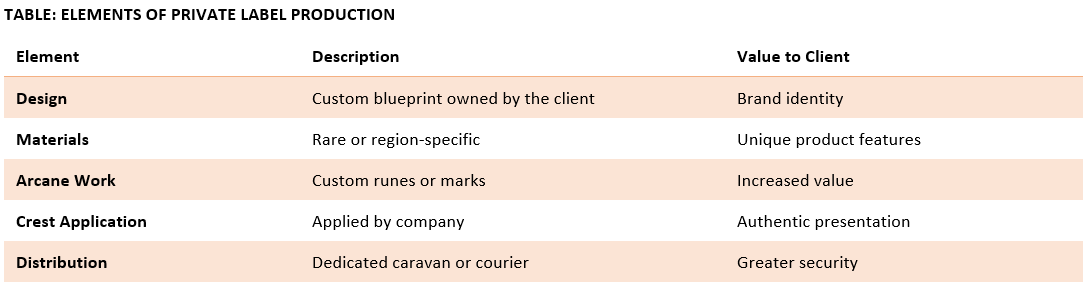
Private label goods often include:

  • Noble house satchels with protective runes
  • Exclusive alchemical brews
  • Magical inks with secret compositions
  • House banners made with custom dyes
  • Luxury trade goods for high-end markets

Expanded Worked Example

A noble house in Silverymoon requests an enchanted satchel for its officers. The item must hold more than its size suggests. The crest must appear on the clasp in silver thread and must glow faintly when exposed to moonlight.

The Waterdeep Trading Company prepares the costing sheet shown below.

The noble house pays a private-label margin of 25%, bringing the final contract price to 255.00 FSD.

Contract Models in Faerûn

White label and private-label agreements follow distinct patterns.

Regional and Material Considerations

Faerûn is large and diverse. Production quality must adjust to regional realities.

Sword Coast: Strong supply lines and fast arcane courier routes

The North: Cold weather slows caravans so that insulation materials may be needed

Amn: Strict tax checks on imported goods

Calimshan: High interest in luxury items with rare scents or spices

Thay: Arcane compliance is strict and requires extensive proof of origin

Rare material sourcing also affects agreements. Items such as rainbow quills, moonlight dyes, and stormglass shards require planning, as they can only be harvested during specific sky turns.

Branding and Secrecy

Brand identity is vital in Faerûn. For private-label goods, Waterdeep Trading Company maintains strict confidentiality. Workrooms that produce exclusive items are closed to general staff.

Seals and crests are applied in a controlled room overseen by the Sage Archivists and the Mage Guild liaison.
Arcane Treasurers record each production batch to prevent counterfeit goods.

Expanding Distribution Through Cooperative Labeling

Some guilds choose a cooperative model in which several allied houses commission white label goods but agree to share a unified brand for a season. Waterdeep Trading Company manages the production and ensures every shipment matches the shared mark.

This approach is common during:

  • Merchant festivals
  • Trade fairs
  • Regional harvest weeks
  • Diplomatic gatherings

It strengthens alliances and creates temporary product lines that build interest across provinces.

Final Thoughts

White label and private-label production turn craftsmanship into a shared advantage across Faerûn. Through these agreements, the Waterdeep Trading Company becomes a steady hand behind many banners while clients gain access to scale, skill, and arcane safety that few could maintain alone.

These partnerships strengthen trade routes, stabilize supply, and deepen the ties between guilds and houses across the realms.


Support the AD&D365 Project on Patreon.  To grow this world, we’ve launched an official Patreon where supporters can gain access to exclusive content, tools, training labs, and even influence the future of the project. Your support fuels more than just development ,  it expands the guildhall, forges new scrolls, and empowers the next generation of configuration wizards.  Begin your journey: https://www.patreon.com/adnd365/

A Grateful Salute to Our Patrons.  To all those who stand behind the vision, thank you for helping bring this world to life. Our Benefactors, Andre Breillatt, and Eryndor Fiscairn, your boundless generosity fuels the arcane core of this project. Without your magic, the weave would falter. Our Apprentices, the spell engines turn, and the training labs thrive thanks to our current Apprentices: Michael Ramirez and Andreth Bael’Rathyn. Special thanks to our past Apprentices, whose contributions helped us get here: Ralf Weber, Wendy Rijners, Shashi Mahesh, Julia Tejera, Ben Ekokobe, Tiago Xavier, Naveen Boyinapelli, Marcos Tadeu Wolf, Kathryn Greene, Jason Brown, Mark Christy, and Ashish Singh. Our Initiates, Jesper Livbjerg, Peter Lorre, Gregory Brigden, and Martin Grahm, your commitment marks the start of the deeper path, stepping beyond mere observation into the active shaping of this realm. Our Followers, your steady presence along the journey is a beacon of encouragement:  Eric Shuss, Sunil Panchal, Sarah D. Morgan, Nick Ramchandani, Daniel Kjærsgaard, and Tomasz Pałys. And our Voyeurs, Harry Burgh, Abdelrahman Nabil, and Basil Quarrell, ever watching from the shadows, clearly intrigued… but not enough to part with a single gold piece. Your silent curiosity is noted, and mildly judged.

Want to design your own economic models in Faerûn?  Get your own AD&D365 Environment and guides at adnd365.com/start, and request access to the public view of the current database at https://public.adnd365.com – Login npc@adnd365.com, Password N0nPl@yC#822!

Commerce in Faerûn is shaped by shifting seasons, magical markets, and the endless flow of raw goods that move between provinces. From ores pulled from the deep halls of the North to the spice caravans of Calimshan and the enchanted herbs gathered in Rashemen, every region carries its own strengths. The Waterdeep Trading Company relies on these differences to operate a steady and profitable commodity network. This trade network links ports, roads, and arcane corridors to balance supply and demand across the Sword Coast and beyond.

The goal of commodity trading at the Waterdeep Trading Company is simple. Buy where goods are plentiful and priced low, transport them with care, and deliver them into markets hungry for those same goods. This article looks at how those trades work, how region based supply patterns shape prices, and how the company chooses the best routes to move goods safely.

What Commodity Trading Is

Commodity trading is the movement of raw or lightly processed materials from one region to another in response to changes in supply, climate, harvest cycles, or magical conditions. Within Faerûn, this includes materials such as iron ore, timber, grain, herbs, spell components, hides, salt, incense, and planar infused substances. Each province offers something unique because of terrain, culture, or magical tradition.

For the Waterdeep Trading Company, commodity trading supports three key aims. First, meeting the needs of Waterdeep’s dense urban markets. Second, maintaining trade influence across border cities. Third, strengthening relations with guilds, harvest clans, and miners’ lodges in distant lands.

Why This Matters to the Waterdeep Trading Company

The company’s influence depends on steady deliveries. Inns need grain, smiths need ore, and apothecaries need herbs. When the company can buy in regions with surplus and sell in cities with active demand, profits rise and relationships strengthen. Knowing when to send caravans, when to hold stock in bonded warehouses, and when to shift to sea routes is what keeps the trade ledgers in balance.

Regional differences also shape margins. Some provinces offer low cost extraction, while others impose tariffs, guild dues, or arcane proofing fees. These variables must be understood before any caravan or ship leaves Waterdeep’s gates.

Commodity Patterns Across the Provinces

Each region of Faerûn produces its own set of traded resources. The following section outlines the typical goods that flow from province to province.

Here is an introduction to the first summary grid. This grid lists the major commodities produced in each province and why these regions matter to the company.

How the Waterdeep Trading Company Trades These Goods

The approach is based on buying in bulk at the source, forming contracts with regional guilds, and assigning caravans or ships based on route risk. When goods require enchantment, such as planar dust or spirit soaked herbs, the company uses mage sealed containers prepared in Waterdeep before departure.

Route planning accounts for weather, borders, bandit risk, guild rules, and tolls. The company uses coastal ships for dense cargo and slow caravans for fragile stock. Magical couriers move small high value items. All routes feed into depots in Baldur’s Gate, Daggerford, and Waterdeep.

Below is an introduction to the trade pattern grid. This grid shows how the company typically moves goods between provinces, the chosen transport method, and the pricing strategy.

Worked Example: Trading a Load of Iron Ore

Here is an introduction to the first example. This example shows how the company buys ore in the North, moves it to Waterdeep, and posts the expected profit once sold to the smiths.

Worked Example: Southern Salt Route from Calimshan

Here is an introduction to a second example that shows how exotic goods travel north and how margins rise as distance grows.

Route Considerations Across Faerûn

Trading depends on safe and predictable movement. The Waterdeep Trading Company uses known waypoints, seasonal shifts, and guild agreements to reduce risk. Sea routes are chosen when storms recede. Arcane shortcuts are used for urgent items. Desert crossings require extra water barrels and hired outriders. Winter freezes open river routes but close mountain passes.

The company keeps merchant scribes in each province to track regional changes. If Rashemen produces less herb than normal, buying shifts toward Dalelands grain until the herb cycle returns.

Final Thoughts

Commodity trading gives shape to the company’s finances. Stable routes bring stable coin. Knowing when to expand, when to pause shipments, and when to store goods for later is the mark of a true trader. This system of regional buying, careful transport, and managed selling is what keeps the Waterdeep Trading Company ahead across the Realms.


Support the AD&D365 Project on Patreon.  To grow this world, we’ve launched an official Patreon where supporters can gain access to exclusive content, tools, training labs, and even influence the future of the project. Your support fuels more than just development ,  it expands the guildhall, forges new scrolls, and empowers the next generation of configuration wizards.  Begin your journey: https://www.patreon.com/adnd365/

A Grateful Salute to Our Patrons.  To all those who stand behind the vision, thank you for helping bring this world to life. Our Benefactors, Andre Breillatt, and Eryndor Fiscairn, your boundless generosity fuels the arcane core of this project. Without your magic, the weave would falter. Our Apprentices, the spell engines turn, and the training labs thrive thanks to our current Apprentices: Michael Ramirez and Andreth Bael’Rathyn. Special thanks to our past Apprentices, whose contributions helped us get here: Ralf Weber, Wendy Rijners, Shashi Mahesh, Julia Tejera, Ben Ekokobe, Tiago Xavier, Naveen Boyinapelli, Marcos Tadeu Wolf, Kathryn Greene, Jason Brown, Mark Christy, and Ashish Singh. Our Initiates, Jesper Livbjerg, Peter Lorre, Gregory Brigden, and Martin Grahm, your commitment marks the start of the deeper path, stepping beyond mere observation into the active shaping of this realm. Our Followers, your steady presence along the journey is a beacon of encouragement:  Eric Shuss, Sunil Panchal, Sarah D. Morgan, Nick Ramchandani, Daniel Kjærsgaard, and Tomasz Pałys. And our Voyeurs, Harry Burgh, Abdelrahman Nabil, and Basil Quarrell, ever watching from the shadows, clearly intrigued… but not enough to part with a single gold piece. Your silent curiosity is noted, and mildly judged.

Want to design your own economic models in Faerûn?  Get your own AD&D365 Environment and guides at adnd365.com/start, and request access to the public view of the current database at https://public.adnd365.com – Login npc@adnd365.com, Password N0nPl@yC#822!

In the diverse and often fractious realms of Faerûn, trade flows not only through rivers and roadways, but also through the tangled webs of regulation spun by each city-state, province, and guild-dominated territory. These authorities often impose tariffs—whether to protect local industries, fund defensive walls, or simply fill coffers—which impact the final cost of goods traded across borders.

For the Waterdeep Trading Company and its peers, applying these surcharges manually is a recipe for inefficiency and inconsistency. Instead, the company relies on the pricing engine to automatically apply margin-based pricing adjustments. These adjustments ensure that tariff costs are accounted for transparently and fairly at the time of sale or quotation.

This article explains how margin pricing works, how to configure it, and why it is essential for maintaining profitability when tariffs are involved.

What Are Margin-Based Pricing Adjustments?

Margin pricing adjusts the final sales price of a product by applying a target profit margin over a known cost. In the case of tariffs, these adjustments often include:

  • A fixed markup to cover expected border fees or import duties
  • A percentage-based increase over the base cost of the product
  • Location-specific surcharges tied to trade routes, zones, or cities

Tariff-aware pricing is especially critical in cities like Zhentil Keep, Calimport, or Amn, where merchant councils or rulers impose steep levies on foreign goods.

Why Margin Pricing Matters in a Tariffed Economy

Using the pricing engine for tariff-aware adjustments provides several benefits:

  • Automation: Prices adjust automatically based on the destination, customer group, or delivery warehouse.
  • Compliance: Ensures that tariffs are passed on to customers rather than absorbed as margin erosion.
  • Transparency: Sales agents and customers alike can see that pricing varies by region due to legal and logistical reasons.
  • Competitiveness: Adjusting margins dynamically enables the company to remain profitable while still offering competitive prices in less regulated markets.

Support the AD&D365 Project on Patreon.

To grow this world, we’ve launched an official Patreon where supporters can gain access to exclusive content, tools, training labs, and even influence the future of the project. Your support fuels more than just development ,  it expands the guildhall, forges new scrolls, and empowers the next generation of configuration wizards.  Begin your journey: https://www.patreon.com/adnd365/

A Grateful Salute to Our Patrons

To all those who stand behind the vision, thank you for helping bring this world to life. Our Benefactor, Andre Breillatt, your boundless generosity fuels the arcane core of this project. Without your magic, the weave would falter. Our Apprentices, the spell engines turn and the training labs thrive thanks to our current Apprentices: Michael Ramirez and Andreth Bael’Rathyn (Name obfuscated to protect their identity). Special thanks to our past Apprentices, whose contributions helped us get here:  Ralf Weber, Wendy Rijners, Shashi Mahesh, Julia Tejera, Ben Ekokobe, Tiago Xavier, Naveen Boyinapelli, Marcos Tadeu Wolf, Kathryn Greene, Jason Brown, Mark Christy, and Ashish Singh. Our Followers, your steady presence along the journey is a beacon of encouragement:  Sunil Panchal, Sarah D. Morgan, Nick Ramchandani, Daniel Kjærsgaard, and Tomasz Pałys. Our Voyeurs, Harry Burgh, Abdelrahman Nabil, and Basil Quarrell, ever watching from the shadows, clearly intrigued… but not enough to part with a single gold piece. Your silent curiosity is noted, and mildly judged.


Components of a Tariff-Aware Pricing Setup

To implement tariff-based margin pricing, the Waterdeep Trading Company configures the following:

Cost Price Setup

  • This includes the landed cost of goods, including freight, handling, and vendor cost.
  • For imports from Baldur’s Gate into Calimshan, this may also include bribes and “unofficial entry fees.”

Margin Pricing Rules

  • Set at the item, item group, or category level.
  • Vary based on the customer’s location, tariff group, or shipping method.

Tariff Groups

  • Created to group cities or provinces with similar duties.
  • Assigned to delivery locations or sales territories.

Sales Price Adjustments

  • Configured in the pricing engine using trade agreements or price simulations.
  • Include tiered pricing based on cost plus margin.

Worked Example: Selling Cloaks into Calimport

Let’s assume the Waterdeep Trading Company is selling enchanted cloaks from its Silverymoon workshop. The base cost per cloak is 45.00 FSD. The company aims to maintain a 25% margin in normal cities, but must apply an additional 15% to account for Calimport’s magical goods import tariff.

Tariff groups in this case are applied to determine the final price through the margin pricing policy tied to destination city-states.

Realms-Aware Considerations

Different regions in Faerûn may use tariffs for wildly different purposes. In some cities, tariffs fund sanitation and roads. In others, they line the pockets of merchant princes or enforce protectionism.

Notable Examples:

  • Amn uses tariffs to fund their merchant navy.
  • Thay applies tariffs based on magical aura ratings of enchanted goods.
  • Luskan offers tariff waivers in exchange for smuggling contracts.

Using the pricing engine allows you to adapt your pricing strategy to the political and economic landscape of each territory.

Navigating the Unpredictable World of Tariff Pricing

Even the most finely-tuned pricing engine cannot account for the whims of Faerûn’s merchant lords, border guards, or arcane auditors. Tariffs are living creatures—shifting with the seasons, manipulated by guild politics, or waived on a noble’s drunken promise. To bring this unpredictability into your simulations, the Waterdeep Trading Company employs random roll tables.

These tables introduce chaos, challenge, and realism to trade scenarios by simulating tariff fluctuations, bribe opportunities, and pricing engine anomalies. Whether used during training exercises, economic simulations, or tabletop commerce campaigns, these rolls provide rich variability to any margin pricing strategy.

This table adds dynamic fluctuation to tariffs based on the current mood of the city-state, economic need, or political climate.

If the trader attempts to negotiate or bypass tariffs through “other means.”

When using automation, mishaps can occur. Use this to simulate pricing miscalculations due to magical interference or bureaucratic error.

Adding dice tables to tariff-aware pricing creates an immersive and unpredictable element for trade campaigns or test scenarios. Whether used in a Faerûnian pricing simulation or during a tabletop logistics challenge, these random events challenge even the most seasoned merchant clerks and pricing wizards.

Final Thoughts

In a realm where trade is taxed as much by swords as by scrolls, margin-based pricing adjustments ensure that your business remains profitable and adaptable. With the pricing engine configured to account for tariffs, the Waterdeep Trading Company not only meets local compliance but maintains a strategic edge in every market.


Want to design your own economic models in Faerûn?

Get your own AD&D365 Environment and guides at adnd365.com/start, and request access to the public view of the current database at https://public.adnd365.com

Login npc@adnd365.com
Password N0nPl@yC#822!

When most adventurers think of critical gear, their minds turn to enchanted weapons, shimmering cloaks, or potent healing draughts. But there’s one unsung hero in every rucksack, every military crate, and every ship’s galley: the Hardtack Loaf.

Built for Survival, Not for Taste

The hardtack loaf is a dense, triple-baked, long-lasting bread—flavorless, tough, and enduring. It’s not trying to win any culinary contests. Its purpose is singular: sustain life. With a shelf life measured in decades (or longer), it resists mold, insects, and even the occasional siege.

Breakable only with a pommel or boot heel, it’s more weapon than snack. But softened in stew or ale, and paired with a chunk of salted pork or cheese, it becomes a nostalgic reminder of hearths far from the battlefield.

Cost to Produce

Let’s break down the economics behind this survival essential. Here’s what it costs to produce 100 loaves:

That’s right—less than half a Faerûnian Silver Dragon per loaf. And with a retail markup of 0.69 FSD and wholesale options starting at 0.60 FSD, hardtack brings in profit margins that even a Zhentarim quartermaster would respect.

Regional Price Variation

Not all economies treat hardtack equally. By applying regional Economy Type Modifiers, you get price realism across Faerûn:

Imagine the profit potential when buying low in Daggerford and selling high in Port Nyanzaru.

Crate-Level Supply & Demand

Crates of hardtack (100 loaves each) are shipped across the continent to organizations like:

That’s over 13,000 loaves monthly to named buyers alone, with more forecasted based on regional campaign seasons and winter stockpiling.

Capital Investment & Workforce

To get a hardtack operation running, you’ll need:

And a team of six cross-trained workers producing up to 100 loaves per batch/day, including an ovenmaster, bakers, and haulers.

Planning for the Future

A monthly demand forecast shows strategic consumption spikes:

Using this data, supply chain managers at the Waterdeep Trading Company can optimize procurement, scale batches, and even model profitability across trade routes using margin-based forecasting.

Final Thoughts

The hardtack loaf may be simple, but it sits at the center of some of the most complex logistical webs in Faerûn. It powers armies, fuels adventurers, and ensures caravans survive long hauls. If you’re not selling hardtack, you’re leaving money on the table—and possibly your crew hungry in the field.

Start modeling your Faerûnian business today. Get the full Advanced Dungeons & Dynamics 365 guides at adnd365.com/start, and see the public view of the current database by logging in at https://public.adnd365.com using:

Login: npc@adnd365.com

Password: N0nPl@yC#822!

Waterdeep, the City of Splendors, is the crown jewel of trade along the Sword Coast. Its robust infrastructure, bustling markets, and magical commerce attract merchants from every corner of Faerûn. However, these opportunities come with significant responsibilities. Trade within the city is tightly regulated, and businesses must comply with a comprehensive and often complex system of taxes, tariffs, and guild fees.

For the Waterdeep Trading Company (WDTC), compliance with these financial obligations is not just about avoiding penalties. It is a fundamental part of how the company operates and thrives.

Understanding the Tax Landscape in Waterdeep

The economy of Waterdeep is shaped by policies enacted by the Lords of Waterdeep, enforced by trade guilds, and influenced by arcane regulators. Taxes cover everything from standard sales to magical services and imported goods. Below are the key types of taxes and fees businesses face:

How WDTC Manages Tax Compliance

The Waterdeep Trading Company uses Microsoft Dynamics 365 Finance to integrate tax compliance into every aspect of its financial operations. This ensures that taxes are accurately applied, transparently recorded, and automatically posted at the point of transaction.

Automated Tax Application

Each tax type is configured as a distinct code or group within the system. These are applied to sales orders, purchase orders, and inventory transactions based on product classification and trade channel. This reduces manual entry and improves audit readiness.

Smart Product Classification

WDTC assigns all items to tax groups that reflect their economic category. For example:

  • Enchanted items fall under the magic group
  • Jewelry and fine fabrics are categorized under luxury
  • General goods are classified under standard groups

This categorization ensures that the correct tax rates are applied automatically during sales and purchasing processes.

Landed Cost Tracking for Imports

Imported goods are subject to various tariffs and duties. WDTC utilizes the Landed Cost module in Dynamics 365 to accurately track and allocate these costs across the items being received. This ensures the company always has a clear picture of true inventory value and profitability.

Budgeting for Unofficial Overhead

While not recognized in formal tax records, certain transactions require what are diplomatically referred to as “negotiation fees.” These are handled with discretion and tracked within internal budgets to maintain operational agility in bureaucratic environments.

Tax Strategy as a Growth Enabler

Rather than treating tax as a burden, the Waterdeep Trading Company approaches it as a source of control and insight. Their tax configuration supports accurate reporting, supports pricing strategies, and ensures compliance across all trade activity.

This level of discipline allows the company to operate confidently within Waterdeep’s competitive and heavily regulated marketplace. It also lays the groundwork for expansion into other city-states with similarly complex trade policies.

If you are ready to elevate your Faerûnian business operations or want to model similar structures in your Dynamics 365 environment:

Visit adnd365.com/start for the full set of configuration guides.

Access the public demo environment at https://public.adnd365.com

Login: npc@adnd365.com

Password: N0nPl@yC#822!