Archive

Tag Archives: entrepreneurship

Equity shares explain how ownership is recorded in the Waterdeep Trading Company. Stock-based compensation extends this structure by granting workers who guide the company each season a future claim to ownership. Greta Ironfist uses these awards to reward commitment, attract skilled treasurers, and maintain stable long-term plans.

This follow-up article explains how these awards work, how they connect to the existing equity accounts, and how the ledger captures the cost of service through clear accruals.

What Stock-Based Compensation Represents

A stock-based award grants a worker the right to receive shares at a later date. Some vest with time. Some require completing a trade route or a season of substantial surplus. All create an obligation for the company. As the worker provides service, a portion of that award becomes earned. This earned portion is recognized as an expense.

Because these awards settle in shares rather than coins, the accounting flows through equity. The Waterdeep Mercantile League provides fair value scrolls to help treasurers measure each grant at the moment it is offered.

Why These Awards Matter

Workers who hold a chance at future ownership feel a stronger bond to the company. They take care of the ledgers, caravans, and contracts as if they already have a place in the long history of the guild. Stock-based compensation supports worker retention and encourages a stable culture across the company.

For the ledger, these awards must be handled with precision. The service cost must be recognized each season. The equity obligation must be increased over the vesting period. When the award vests, the reserve converts into the appropriate share class.

Equity Accounts Used for Stock-Based Awards

Stock-based compensation builds on the existing share accounts. Two new reserve accounts are added to track the accrual during the vesting period.

This table shows the core accounts used when awards are granted, accrued, and vested.

These accounts integrate fully with the chart of accounts used in the prior article.

How the Company Measures Fair Value

At the grant date, the arcane treasurers rely on Waterdeep Mercantile League valuation scrolls. These scrolls consider guild reputation, seasonal surplus, trade route strength, supply conditions, and historical demand for company shares. This value becomes fixed for accounting purposes and does not change with later events.

The fair value is then spread evenly across the vesting period, unless service terms require a different pattern.

Worked Example: Four-Year Vesting Award

A senior archivist is awarded a fair value of 2,400.00 FSD. The award lasts for over four years.

Annual expense equals 2,400.00 divided by 4. This is 600.00 FSD per year.

Below is the progression of expense and reserve growth.

Journal Entries During the Vesting Period

The following entries repeat each year until vesting is complete.

This records the cost of service and increases the equity obligation.

Journal Entry Upon Vesting

When the award vests, the reserve is transferred to the appropriate equity account.

If the award settles into common shares:

If the nominal share value is less than the award value, a portion may be posted to Share Premium instead.

Special Faerûn Notes

Some provinces classify stock-based awards as guild benefits and require scroll filings before vesting. The Scriveners’, Scribes’, and Clerks’ Guild must seal the grant scroll for the award to be recognized. Magical contracts tied to planar trade may require performance conditions rather than time-based vesting.

The Waterdeep Trading Company stores all award terms in the Arcane Ledger to ensure that each accrual aligns with the service provided.

Final Thoughts

Stock-based compensation links the strength of the Waterdeep Trading Company to the dedication of its workers. These awards are both a reward and a responsibility. When recorded with care, they present a clear story of service, growth, and shared ownership. The seasonal expense and the growing reserve keep the ledger accurate. The final conversion into shares marks the worker’s lasting place in the company.


Support the AD&D365 Project on Patreon.  To grow this world, we’ve launched an official Patreon page where supporters can access exclusive content, tools, and training labs, and even influence the project’s future. Your support fuels more than just development; it expands the guildhall, forges new scrolls, and empowers the next generation of configuration wizards.  Begin your journey: https://www.patreon.com/adnd365/

A Grateful Salute to Our Patrons.  To all those who stand behind the vision, thank you for helping bring this world to life. Our Benefactors, Andre Breillatt and Eryndor Fiscairn, your boundless generosity fuels the arcane core of this project. Without your magic, the weave would falter. Our Apprentices, the spell engines turn, and the training labs thrive thanks to our current Apprentices: Michael Ramirez and Andreth Bael’Rathyn. Special thanks to our past Apprentices, whose contributions helped us get here: Ralf Weber, Wendy Rijners, Shashi Mahesh, Julia Tejera, Ben Ekokobe, Tiago Xavier, Naveen Boyinapelli, Marcos Tadeu Wolf, Kathryn Greene, Jason Brown, Mark Christy, and Ashish Singh. Our Initiates, Jesper Livbjerg, Peter Lorre, Gregory Brigden, and Martin Grahm, your commitment marks the start of the deeper path, stepping beyond mere observation into the active shaping of this realm. Our Followers, your steady presence along the journey is a beacon of encouragement: Rusty Cavalier, Eric Shuss, Sunil Panchal, Sarah D. Morgan, Nick Ramchandani, Daniel Kjærsgaard, and Tomasz Pałys. And our Voyeurs, Harry Burgh, Abdelrahman Nabil, and Basil Quarrell, ever watching from the shadows, clearly intrigued… but not enough to part with a single gold piece. Your silent curiosity is noted and mildly judged.

Want to design your own economic models in Faerûn?  Get your own AD&D365 Environment and guides at adnd365.com/start, and request access to the public view of the current database at https://public.adnd365.com – Login npc@adnd365.com, Password N0nPl@yC#822!

In Faerûn, some of the most valuable work done by the Waterdeep Trading Company is not tied to stocked goods or caravan shipments. Instead, it comes from clients who need unique work planned, tracked, and completed on their behalf. These are customer-funded projects, a standard part of trade across the Sword Coast, where noble houses, guilds, and adventuring parties require crafted items, research, or services beyond a regular order.

For the Waterdeep Trading Company, these projects allow the guild to grow coin reserves without taking on risk from unsold stock. Each project is financed by the customer who requests it, and Dynamics 365 helps track cost, time, revenue, and progress through structured project accounting, ledger controls, and milestone billing.

This article explores how customer-funded projects function in Faerûn, why they matter, and how they are managed through the company’s accounting practices.

What Customer Funded Projects Are

A customer-funded project is work that is paid for by the customer either in advance or throughout the life of the activity. The Waterdeep Trading Company treats these as formal undertakings, usually tied to a contract scroll signed and sealed by the Scriveners Guild. Common examples include commissions for enchanted goods, production runs for noble households, research tasks for arcanists, or repairs for merchant fleets.

Unlike internal projects, these efforts do not draw on the company’s own coin at the outset. Instead, funds provided by the customer become the resource pool used to carry out the work. This requires precise accounting to separate the client’s coin from internal budgets.

Why These Projects Matter

Customer-funded projects support the company’s financial stability in several ways.

  • They remove inventory risk, since the client covers all costs.
  • They allow the company to expand its capabilities, since rare materials or specialist labor can be procured with client funds.
  • They offer steady and predictable revenue, since contracts lay out how milestones and progress payments are invoiced.

In a land where supply lines stretch across wild terrain and arcane markets shift day by day, having stable client-backed work ensures dependable profit for Greta Ironfist and her planners.

Core Components of a Customer Funded Project

Below are the significant elements the Waterdeep Trading Company tracks within Dynamics 365.

First, Contract Setup. Every project begins with a customer record linked to a project contract. The contract defines funding rules, billing type, currency, and expected milestones. The base setup for customers and billing models follows the same ledger framework taught in the Bare Bones Configuration Guides.

Second, Funding Allocation. Funds supplied by the customer are mapped to the project so that labor, materials, and overhead settle against the customer’s balance rather than internal accounts.

Third, Work Breakdown. Tasks, phases, and activities are created to organize the work effort. This may include forging stages, enchantment sessions, transport planning, or research steps.

Fourth, Cost Accumulation. All project expenses are routed through dedicated ledger accounts. This includes raw material purchases, hourly craft labor, magical services, and overhead charges.

Fifth, Revenue Recognition. Invoicing may be based on milestones, time-and-materials, or fixed-price agreements. Milestone billing is most common, with seals applied at major completion points.

Sixth, Project Closure. The ledger is settled, any unused customer funds are returned or credited, and Seraphina Quillspire and Maelor the Quill archive all documentation.

Worked Example: Commissioned Arcane Beacon for the Lords of Everlund

To show how customer-funded projects operate, here is a complete example of a commission.

Scenario: The Lords of Everlund request a defensive arcane beacon built by the Waterdeep Trading Company. They provide full funding up front.

Below is a table that captures the planned cost structure.

Before the table, here is an explanation. This table lists the major cost items required to produce the arcane beacon and shows how each cost is drawn from the customer’s funded pool. It helps planners keep spending aligned with the contract.

Because the customer funds the entire amount at contract signing, the ledger holds their deposit as a liability until revenue is recognized through milestone completion.

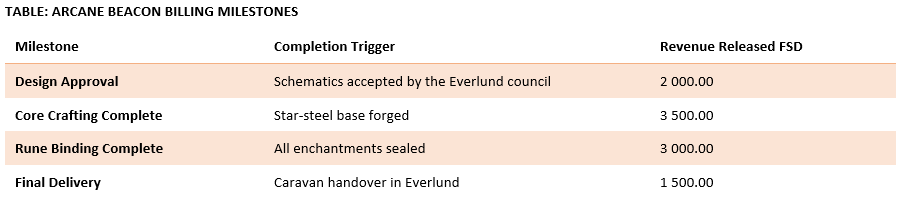
A second table shows how revenue is released.

This table outlines the billing milestones and explains when the customer’s deposit converts to earned revenue. This helps the Accounts Receivable clerks track progress and apply the proper postings.

Once the final milestone is posted, the deposit liability is cleared and converted into project revenue, and the project is closed.

Realms-Aware Considerations

Faerûn introduces unique factors that must be considered with customer-funded projects.

  • Arcane inputs may require permits from mage guilds, adding additional lead times.
  • Regions outside the Sword Coast may impose trade tariffs or require special papers.
  • Some clients provide materials directly, such as gemstones or ancient relics, which must be handled as non-monetary contributions.
  • Guild labor unions control rates for smiths, engravers, and arcane specialists.
  • Projects involving planar materials may require Essence Credit tracking for sustainability purposes.

These factors make structured project accounting vital for the Waterdeep Trading Company.

Final Thoughts

Customer-funded projects allow the Waterdeep Trading Company to serve nobles, adventurers, and trade houses with custom work while keeping internal risk low. When managed well, they offer steady coin, predictable workloads, and precise financial control.

For teams using Dynamics 365, the structure provided in the Bare Bones Configuration Guides supports proper ledger setup, customer controls, and project workflows that keep each commission profitable and compliant.


Support the AD&D365 Project on Patreon.  To grow this world, we’ve launched an official Patreon where supporters can gain access to exclusive content, tools, training labs, and even influence the future of the project. Your support fuels more than just development ,  it expands the guildhall, forges new scrolls, and empowers the next generation of configuration wizards.  Begin your journey: https://www.patreon.com/adnd365/

A Grateful Salute to Our Patrons.  To all those who stand behind the vision, thank you for helping bring this world to life. Our Benefactors, Andre Breillatt, and Eryndor Fiscairn, your boundless generosity fuels the arcane core of this project. Without your magic, the weave would falter. Our Apprentices, the spell engines turn, and the training labs thrive thanks to our current Apprentices: Michael Ramirez and Andreth Bael’Rathyn. Special thanks to our past Apprentices, whose contributions helped us get here: Ralf Weber, Wendy Rijners, Shashi Mahesh, Julia Tejera, Ben Ekokobe, Tiago Xavier, Naveen Boyinapelli, Marcos Tadeu Wolf, Kathryn Greene, Jason Brown, Mark Christy, and Ashish Singh. Our Initiates, Jesper Livbjerg, Peter Lorre, Gregory Brigden, and Martin Grahm, your commitment marks the start of the deeper path, stepping beyond mere observation into the active shaping of this realm. Our Followers, your steady presence along the journey is a beacon of encouragement:  Eric Shuss, Sunil Panchal, Sarah D. Morgan, Nick Ramchandani, Daniel Kjærsgaard, and Tomasz Pałys. And our Voyeurs, Harry Burgh, Abdelrahman Nabil, and Basil Quarrell, ever watching from the shadows, clearly intrigued… but not enough to part with a single gold piece. Your silent curiosity is noted, and mildly judged.

Want to design your own economic models in Faerûn?  Get your own AD&D365 Environment and guides at adnd365.com/start, and request access to the public view of the current database at https://public.adnd365.com – Login npc@adnd365.com, Password N0nPl@yC#822!

In the thriving trade cities of Waterdeep, Baldur’s Gate, and beyond, merchants often find themselves at a loss not from theft or misadventure but from failing to account for the true cost of their imports. That’s where understanding landed cost comes in.

Whether you’re bringing in saffron from Calimshan, dwarven steel from Mithral Hall, or elven wine from the Salington Vinyards, knowing your full landed cost is the difference between profit and peril.

What Is Landed Cost

Landed cost is the total expense incurred to bring a product from its source to its final destination not just the vendor’s price. It includes:

  • Base purchase cost
  • Transport fees (caravan, barge, airship, or teleportation)
  • Import duties and tariffs
  • Handling, inspection, and insurance
  • Security (escorts, guards, bribes if necessary)
  • Currency exchange losses or fees
  • Magical sealing, warding, or scrying

These additional costs accumulate through every step of the product’s journey and they must be calculated if a merchant is to determine the real price of their inventory.

Sample Landed Cost Breakdown: A Faerûnian Case Study

Let’s say the Waterdeep Trading Company imports Sake Rage from Salington Vinyards in Neverwinter.

A merchant who sells the sake based solely on the 260 FSD supplier price may think they’re earning 20 percent margin. In truth they may barely break even or worse.

Why Landed Cost Matters

  • Proper Pricing Without it prices are based on illusion not reality
  • Trade Route Evaluation Understanding which routes magical or mundane offer better margins
  • Profitability Forecasting A true picture of earnings requires full cost awareness
  • Product Comparison Knowing full cost helps compare multiple suppliers not just their invoice price

Common Faerûnian Costs to Consider

Best Practices for Faerûnian Merchants

  • Track each cost layer no matter how small Even a 5 FSD handling fee can add up across shipments
  • Use standard units like FSD per crate or bottle for consistency
  • Build buffer margins into your pricing to account for lost goods taxes or delays
  • Plan seasonally Snow in the Spine of the World Expect freight delays and added guard fees
  • Maintain supplier scorecards with both base and landed cost to spot hidden costs

Final Thoughts

In the end savvy trade in Faerûn isn’t about knowing the lowest price it’s about understanding the total price. Whether your goods travel by foot hoof keelboat or leyline calculating landed cost is your secret weapon in staying competitive and profitable.

Want to simulate shipping strategies in Faerûn or model transportation operations in Dynamics 365?

Get your own AD&D365 Environment and guides at adnd365.com/start, and request access to the public view of the current database at https://public.adnd365.com

Login npc@adnd365.com Password N0nPl@yC#822!

Support the AD&D365 Project on Patreon

To grow this world, we’ve launched an official Patreon where supporters can gain access to exclusive content, tools, training labs, and even influence the future of the project. Your support fuels more than just development — it expands the guildhall, forges new scrolls, and empowers the next generation of configuration wizards. Begin your journey: https://www.patreon.com/adnd365/

Thanks to my supporters for helping make this content possible:

Our Benefactor, Andre Breillatt, whose generosity powers the arcane core of the project.

Our Apprentices, who keep the spell engines humming and the training labs active: Ralf Weber, Wendy Rijners, Shashi Mahesh, Julia Tejera, Ben Ekokobe, Tiago Xavier, Naveen Boyinapelli, Marcos Tadeu Wolf, Kathryn Greene, Jason Brown, Michael Ramirez, Mark Christy, and Ashish Singh.

Our Followers, who lend their steady support and encouragement along every step of the journey: Sunil Panchal, Sarah D. Morgan, Nick Ramchandani, Daniel Kjærsgaard, and Tomasz Pałys.

In the merchant halls of Waterdeep, the potion caves of Baldur’s Gate, and the floating markets of Yartar, supply chains never sleep. To stay competitive, the Waterdeep Trading Company has embraced a model that allows vendors to deliver goods directly into our warehouses while retaining ownership. This practice is called Vendor Consigned Inventory, and it is as much about trust as it is about timing.

What Is Vendor Consigned Inventory

Vendor consigned inventory is a trade agreement in which a supplier delivers goods to the Waterdeep Trading Company, but retains ownership until the items are drawn, used, or sold. We hold the stock in our storerooms, ready to deploy, but do not pay until those goods are consumed.

This is a popular model for high-volume, high-value, or high-risk products. It allows the vendor to establish a strong presence in our distribution chain while WDTC avoids tying up coin in idle inventory.

Key Characteristics

Why It Benefits Vendors and WDTC

Vendor consigned inventory provides shared advantage. It is well suited for dynamic, multi-city operations like those run across Faerûn’s trade routes.

Faster Stock Availability: Stock is already in place. There is no delay due to shipment or customs approval. This is critical when responding to festival surges, urgent orders, or magical emergencies.

Lower Inventory Cost for WDTC: No upfront purchase means less coin locked in non-moving items. This makes room for a wider variety of vendor products to be available.

Improved Vendor Visibility: Vendors see real-time data on their consigned stock in our facilities. They can track drawdowns and plan restocking efforts precisely, even from distant cities like Elturel or Suzail.

Stronger Partnership Bonds: Vendors who consign with us often gain early access to seasonal forecasts, priority placement in our storefronts, and invitations to participate in specialty events.

The Process in Practice

Delivery and Receiving

Upon arrival, vendor inventory is inspected, rune-marked, and entered into the consignment ledger under a Vendor Ownership ID. Items are held in designated consignment zones until drawn.

Draw Events

Inventory is drawn when:

  • A customer purchases the product from a store or portal
  • The item is used in a kit, bundle, or manufacturing recipe
  • The item hits a spoilage or magical expiration threshold

Each draw event triggers a financial journal posting and notifies the vendor.

Settlement and Reporting

The system issues periodic settlement statements that include:

  • Quantity drawn since last settlement
  • Agreed-upon pricing and discounts
  • Payment due for each draw event
  • Inventory on hand at each warehouse location

Replenishment Triggers

The system monitors thresholds and predicts future demand using our enchanted forecasting model. Vendors are alerted when restocking is needed, and if desired, the replenishment order can be triggered automatically.

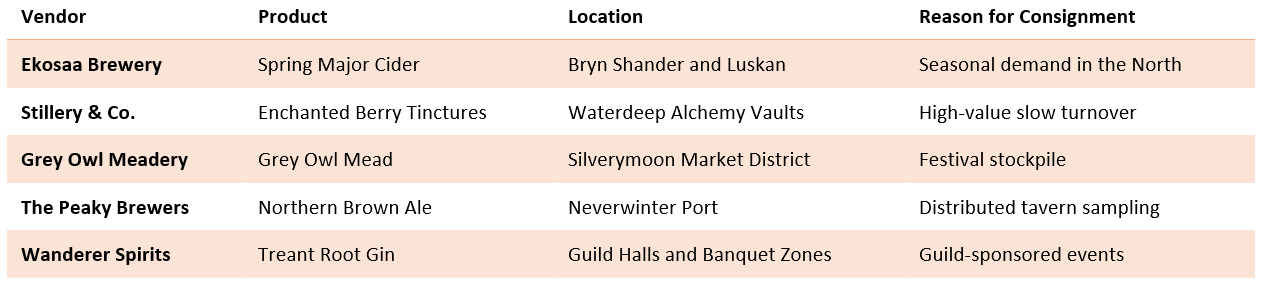
Examples of Vendor Consignment in Faerûn

Best Practices for Managing Vendor Consigned Inventory

  • Define clear ownership and draw point rules for each product
  • Use magical seals and ledger mirrors to track inventory status
  • Review stock levels weekly using the vendor inventory portal
  • Establish shared replenishment rules to avoid overstocking
  • Monitor draw event reports for accuracy and audit readiness

Closing Thoughts

Vendor consigned inventory brings power and flexibility to both sides of the supply chain. Vendors gain access to wide Faerûnian markets, and the Waterdeep Trading Company keeps its shelves stocked without overburdening its coffers. With magic-bound ledgers and real-time reporting tools, we make it easy to maintain trust and traceability.

Ready to become a trusted consignment vendor with the Waterdeep Trading Company? Start by visiting adnd365.com/start and request access to our public consignment portal at https://public.adnd365.com

Username: npc@adnd365.com

Password: N0nPl@yC#822!