Archive

Tag Archives: fiction

In the industrious world of Faerûn, spellcasting is more than art or warfare, it is labor. From enchanting blades to illuminating hearths, arcane effort underpins much of the continent’s production economy. At the Waterdeep Trading Company, understanding when and how to treat spellcasting as a cost of production versus a service expense is essential for accurate costing, fair guild compensation, and sound decision-making.

This article explores the accounting treatment of spellcasting within the production cycle, with a special focus on cases like Continual Flame, where the same spell might be used either as a production input or an after-market service.

What It Is

Spellcasting as labor refers to the classification and costing of magical efforts performed by qualified casters, whether wizards, clerics, artificers, or sorcerers, within the production of goods. This includes:

  • Enchantments during manufacturing
  • Temporary transmutations
  • Alchemical infusions
  • Ritual augmentations or bindings
  • Permanent magical installations

Why It Matters

Accounting for spellcasting properly ensures that products reflect their true cost. Misclassifying spellcasting labor can lead to underpriced goods, incorrect margin calculations, or regulatory infractions with the Arcane Artificers & Alchemists Union (ARALCH).

Moreover, some spells blur the line between a production input and a service. For instance, Continual Flame might be cast:

  • During manufacturing to produce a lightstone sold as part of a lamp (production cost)
  • Afterward, upon installation at a client’s location (service expense)

Getting this distinction right is essential for inventory valuation, tax treatment, and guild compliance.

Components of Spellcasting Labor

Not all spells are cast alike, nor should they be costed alike. Within the production cycle of the Waterdeep Trading Company, spellcasting manifests in a variety of forms: some spells permanently bind enchantments to goods, while others are temporary enhancements used during bottling, inspection, or safety control. Understanding the types of spellcasting involved allows the company to apply the correct cost category, assign the right account behavior, and uphold transparency across its enchanted operations.

The following table breaks down the most common types of spellcasting labor observed in Faerûnian production and how each should be classified within the accounting framework. This ensures every flick of a wand or uttered incantation finds its rightful place in the ledger.

Worked Example: Continual Flame Use in Production vs. Service

Consider a series of enchanted lanterns sold by the Waterdeep Trading Company.

Scenario A: Production Phase

  • Continual Flame is cast at the forge.
  • The lantern is shipped with the light already embedded.
  • The labor cost of the spell is added to the production BOM.

Scenario B: Post-Sale Service

  • A lantern is sold empty.
  • A licensed enchanter is dispatched to cast Continual Flame on-site.
  • This is treated as a service expense, not capitalized into the product’s inventory value.

Realms-Aware Considerations

Across Faerûn, the cost and treatment of spellcasting labor can vary widely based on local laws, guild regulations, and magical resource availability. What applies in Waterdeep may not hold in Calimport or Silverymoon. The following considerations help ensure compliance and accurate costing in every region where the Waterdeep Trading Company operates.

Guild Approval: Only certified ARALCH members may perform production-stage enchantments.

Spell Component Costing: Some spells require expensive components (e.g., rubies for Continual Flame). These should be tracked as separate material lines.

Location Matters: In Silverymoon, arcane labor is cheaper and more common. In Calimport, magical licenses inflate costs by 15 to 30 percent.

Final Thoughts

Spellcasting is labor, and labor has value. Whether burned into steel or summoned into the sky, each casting must be measured, valued, and attributed with precision. For the Waterdeep Trading Company, this clarity ensures not only financial control but compliance with realmwide trade guild expectations.


Support the AD&D365 Project on Patreon.

To grow this world, we’ve launched an official Patreon where supporters can gain access to exclusive content, tools, training labs, and even influence the future of the project. Your support fuels more than just development ,  it expands the guildhall, forges new scrolls, and empowers the next generation of configuration wizards.  Begin your journey: https://www.patreon.com/adnd365/

A Grateful Salute to Our Patrons

To all those who stand behind the vision, thank you for helping bring this world to life. Our Benefactor, Andre Breillatt, your boundless generosity fuels the arcane core of this project. Without your magic, the weave would falter. Our Apprentices, the spell engines turn and the training labs thrive thanks to our current Apprentices: Michael Ramirez and Andreth Bael’Rathyn (Name obfuscated to protect their identity). Special thanks to our past Apprentices, whose contributions helped us get here:  Ralf Weber, Wendy Rijners, Shashi Mahesh, Julia Tejera, Ben Ekokobe, Tiago Xavier, Naveen Boyinapelli, Marcos Tadeu Wolf, Kathryn Greene, Jason Brown, Mark Christy, and Ashish Singh. Our Initiates, Peter Lorre, your commitment marks the start of the deeper path, stepping beyond mere observation into the active shaping of this realm. Our Followers, your steady presence along the journey is a beacon of encouragement:  Eric Shuss, Sunil Panchal, Sarah D. Morgan, Nick Ramchandani, Daniel Kjærsgaard, and Tomasz Pałys. And our Voyeurs, Harry Burgh, Abdelrahman Nabil, and Basil Quarrell, ever watching from the shadows, clearly intrigued… but not enough to part with a single gold piece. Your silent curiosity is noted, and mildly judged.

Want to design your own economic models in Faerûn?

Get your own AD&D365 Environment and guides at adnd365.com/start, and request access to the public view of the current database at https://public.adnd365.com – Login npc@adnd365.com, Password N0nPl@yC#822!

From the ember-lit forges of Neverwinter to the mist-cloaked alchemy halls of Thay, the production facilities of Faerûn hum with magical activity. But when spells misfire, potions backfire, or extraplanar residue leaks into the material plane, the consequences can be dire. For the Waterdeep Trading Company and other guild-operated workshops, such events demand swift, structured action, lest a single miscast alter a year’s worth of inventory or spawn something best left undescribed.

This article outlines the key protocols used by responsible enterprises to isolate production lines following arcane incidents. Whether managing potion bottling lines or enchanted fabric looms, understanding and deploying magical contamination control procedures is essential to safeguarding workers, goods, and realms.

What It Is

Magical contamination control refers to the standardized set of responses enacted when production environments are compromised due to:

  • Alchemical Failures: Unstable mixtures or expired ingredients causing explosive or mutagenic reactions.
  • Arcane Feedback: Resonant energy loops from misaligned enchantment channels.
  • Planar Anomalies: Unexpected breaches to or influences from elemental, fey, or infernal planes.

Why It Matters

Unchecked contamination does more than damage product. It risks:

  • Cross-contamination of inventory
  • Arcane drift corrupting enchantment runes
  • Worker injury or polymorphic exposure
  • Violations of guild regulatory standards
  • Reputation loss due to cursed or unstable shipments

For guilds operating under the Arcane Artificers & Alchemists Union or exporting under planar trade compacts, containment compliance is legally and ethically mandated.

Components of a Magical Contamination Protocol

The Waterdeep Trading Company employs a tiered response system known as the Aetherlock Sequence. This model scales with severity and includes personnel, magical wards, and procedural safeguards.

Isolation and Neutralization Techniques

When contamination occurs, the first principle is always containment before cure. Methods vary by trade but commonly include:

  • Arcane Lock and Ward Circles: Prevent spread of animated objects or malicious enchantments
  • Material Sequestration Fields: Isolate ingredients or products suspected of instability
  • Spellflame Purge: A controlled cleansing fire that neutralizes enchantments (used only in Tier III or IV events)
  • Planar Anchors: Restore equilibrium when foreign energy leaks are detected

Worked Example: Fabric Infusion Collapse

At Lara’s Fine Fabrics and More, a batch of invisibility-thread cloaks became unstable after a moonstone filament from the Feywild proved incompatible with standard weave matrices. Within moments, the visibility of workers and materials began fluctuating wildly.

Response Summary:

  • Tier II initiated
  • Loom Room sealed with a triple-layer ward
  • Cloaks marked with non-visual sigils and relocated
  • All affected workers underwent charm reversal and planar detox

Total downtime: 6 hours. Inventory loss: 4 cloaks. Lives lost: 0. Reputation: Preserved.

Realms-Aware Considerations

Contamination protocols differ by location and infrastructure:

Final Thoughts

Magical contamination is not a matter of “if” but “when” for any serious producer in Faerûn. By embedding strong protocols, both mundane and magical, into daily operations, guilds like the Waterdeep Trading Company not only protect their profit but honor their oath to the safety of the Realms.

The arcane may be volatile, but through discipline and ritual, even the most unstable magic can be managed.

In the crowded markets of Waterdeep, surrounded by crates of smoked meats, arcane components, and enchanted goblets, a new product has arrived that promises something rare in Faerûn—a perfect night’s sleep. Introducing the Mattress of Sleeping, a marvel of magical textilecraft now available exclusively through the Waterdeep Trading Company.

This isn’t your average hay-stuffed pallet or travel-worn cot. The Mattress of Sleeping is a guild-certified luxury good, crafted for nobility, adventurers, and weary traders alike. Whether you dwell in a castle keep or sleep beneath the stars, this mattress transforms rest into restoration.

Table of Contents

  • What It Is:  Detailed explanation of the Mattress’s magical composition, source guilds, and enchantments
  • Why It Matters:  The economic, tactical, and wellness impact of restorative sleep across guilds and realms
  • Key Features:  A breakdown of the mattress’s enchantments and magical construction components
  • Recommended For:  Target customer groups including adventurers, nobles, and provisioning officers
  • Price and Availability:  Retail pricing, size options, and bulk order procedures
  • Quantity-Based Pricing Chart:  Tiered pricing incentives for guilds, caravans, and estate provisioning
  • The Mattress of Sleeping vs. Other Rest Solutions in Faerûn:  Comparison table showing value relative to alternative products on the market
  • Bill of Materials: Mattress of Sleeping:  Full component list, including magical materials, labor codes, and overhead elements
  • Routing: Mattress of Sleeping:  Manufacturing workflow from textile cutting to enchantment and packaging
  • Final Thoughts: Closing remarks on the role of magical rest in the prosperity of Faerûn

What It Is

The Mattress of Sleeping is an enchanted sleep surface imbued with minor restorative magics. Created through a partnership with the Grand Artisans League and the Arcane Upholsterers Consortium, the mattress is layered with cloud-fibre padding, sewn with silken threads from Amnian moon spiders, and inscribed with subtle runes of calm and stillness.

Upon lying down, the user feels an immediate easing of tension and fatigue. The mattress neutralizes minor discomforts, encourages deep sleep, and passively resists nightmares and common magical disturbances. Many report waking with full energy—even after short rests.

Why It Matters

Rest is essential in every guild charter and campaign logbook. A well-rested adventurer makes fewer mistakes. A trader who sleeps soundly haggles more shrewdly. Even spellcasters with grueling memorization rituals have praised the mattress for accelerating the mental clarity needed at dawn.


Support the AD&D365 Project on Patreon. To grow this world, we’ve launched an official Patreon where supporters can gain access to exclusive content, tools, training labs, and even influence the future of the project. Your support fuels more than just development ,  it expands the guildhall, forges new scrolls, and empowers the next generation of configuration wizards.  Begin your journey: https://www.patreon.com/adnd365/

A Grateful Salute to Our Patrons. To all those who stand behind the vision—thank you for helping bring this world to life. Our Benefactor, Andre Breillatt — Your boundless generosity fuels the arcane core of this project. Without your magic, the weave would falter. Our Apprentices — The spell engines turn and the training labs thrive thanks to our current Apprentices: Michael Ramirez and Andreth Bael’Rathyn (Name obfuscated to protect their identity). Special thanks to our past Apprentices, whose contributions helped us get here:  Ralf Weber, Wendy Rijners, Shashi Mahesh, Julia Tejera, Ben Ekokobe, Tiago Xavier, Naveen Boyinapelli, Marcos Tadeu Wolf, Kathryn Greene, Jason Brown, Mark Christy, and Ashish Singh. Our Followers — Your steady presence along the journey is a beacon of encouragement: Sunil Panchal, Sarah D. Morgan, Nick Ramchandani, Daniel Kjærsgaard, and Tomasz Pałys. Our VoyeursHarry Burgh and Abdelrahman Nabil, ever watching from the shadows, clearly intrigued… but not enough to part with a single gold piece. Your silent curiosity is noted—and mildly judged.

Want to design your own manufacturing models in Faerûn? Get your own AD&D365 Environment and guides at adnd365.com/start, and request access to the public view of the current database at https://public.adnd365.com (Login npc@adnd365.com, Password “N0nPl@yC#822!”)


Key Features

The mattress is also flame-resistant, waterproof, and folds magically into a bundle the size of a standard satchel—ideal for teleportation, caravan use, or skyship travel.

Recommended For

  • Guild lodges and outposts in remote areas
  • Adventuring parties with irregular rest cycles
  • Traders on long journeys across the Sword Coast
  • Nobility seeking luxuries without vulnerability

Price and Availability

The Mattress of Sleeping is priced at 350.00 FSD and can be purchased directly at any Waterdeep Trading Company warehouse or via arcane order scroll. Available in standard (twin), longhouse (double), and wyvern (king) sizes.

Bulk pricing available for guild purchases. Contact your regional provisioning officer for discounts on orders of five or more.

This structure encourages outfitting entire barracks, inns, or trade fleets with high-quality rest surfaces while rewarding long-term provisioning partnerships with the Waterdeep Trading Company.

The Mattress of Sleeping vs. Other Rest Solutions in Faerûn

In the bustling trade routes of Faerûn, quality sleep is a rare luxury—and often an expensive one. For adventurers, merchants, and nobles alike, choosing the right rest solution means balancing cost, comfort, and magical utility. The Mattress of Sleeping, crafted and sold by the Waterdeep Trading Company, sets a new standard not only in enchantment but in value.

To help prospective buyers make an informed decision, the following table compares the Mattress of Sleeping to several other rest products available from regional vendors and traveling suppliers.

As seen in the comparison, the Mattress of Sleeping strikes a rare balance between utility, enchantment, and affordability. It is more accessible than higher-tier arcane rest solutions and far more effective than mundane options, making it ideal for both personal and professional outfitting.

For guildmasters provisioning barracks, or merchant captains outfitting a fleet, there is no better blend of magic, price, and practicality.

Bill of Materials: Mattress of Sleeping

This table outlines the components and subassemblies required to craft one unit of the enchanted Mattress of Sleeping. All components are listed with quantities, cost categories, and brief descriptions.

Total Material Cost, Labor, and Overhead are rolled up into standard costing for consistent financial tracking.

Routing: Mattress of Sleeping

The routing defines the sequence of operations required to manufacture the mattress, from material preparation through final enchantment.

Each routing step can be associated with specific cost centers and time reporting in the AD&D365 production ledger. Capacity planning, worker assignments, and magical interference risks should be considered, especially for Steps 30–40.

Final Thoughts

In a world of dragonfire, shifting politics, and sleepless nights under alien moons, a restful slumber is more than comfort—it is defense. The Mattress of Sleeping is the newest tool in the Waterdeep Trading Company’s mission to empower, protect, and prepare Faerûn’s bravest and boldest.

Get yours today. Your dreams—and your waking hours—will thank you.

An Arcano-Economic Analysis for the Waterdeep Trading Company and Beyond

In Faerûn, automation has taken a decidedly arcane twist. Where other realms may rely on levers and pulleys or even rudimentary clockwork, the merchants and mages of the Sword Coast have turned to the elemental labor force of stone, clay, and metal — golems.

At first glance, golems seem like the perfect workforce. They don’t strike, tire, or complain. They lift crates, guard vaults, and even bottle potions with tireless efficiency. But dig beneath their enchanted surfaces, and the costs—financial, arcane, and social—begin to mount.

Arcane Labor Isn’t Cheap

Creating a golem is no mere artisan’s task. It requires:

  • Rare materials: Mithral, adamantine, clay from sacred springs, or obsidian shards etched with binding runes.
  • Powerful magic: True golemcraft requires spells like Create Golem, Geas, and Imprisonment, augmented by planar binding rituals.
  • Guild licensing: The Arcane Artificers & Alchemists Union (ARALCH) enforces strict construction, binding, and maintenance standards.

A single stone golem costs between ƒ18,000–ƒ50,000 FSD, or approximately 1,428.57–3,968.25 FGP in materials alone. Enchantment labor can push that price higher by thousands of Faerûnian Gold Pieces, depending on the mage’s guild tier and specialization.

Magical Maintenance

Unlike constructs from the mechanical schools of Lantan, golems require continual magical upkeep:

  • Re-tuning of command scrolls (monthly)
  • Infusion with stable arcane energies (quarterly)
  • Elemental core replacement (as needed)

Only certified artificers can perform these rites. On average, annual maintenance costs per industrial-grade golem range from ƒ3,600 to ƒ7,200 FSD.

Ongoing Maintenance Costs

While golems don’t require food or sleep, they do require:

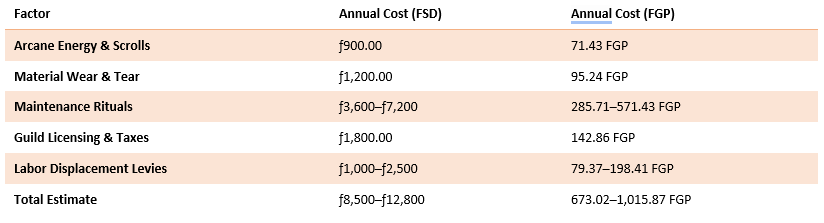
  • Arcane Energy Reservoirs: Recharged monthly with infused essence (ƒ900/year or 71.43 FGP).
  • Material Rebinding: Runes and joints wear down and must be reforged (ƒ1,200/year or 95.24 FGP).
  • Infusion Rituals & Inspections: Performed quarterly by a licensed artificer (ƒ3,600–ƒ7,200/year or 285.71–571.43 FGP).
  • Guild Compliance & Taxes: Golem owners must pay usage taxes and inspection fees (ƒ1,800/year or 142.86 FGP).
  • Living Labor Compensation Levies: Enforced in cities like Waterdeep to offset job displacement (ƒ1,000–ƒ2,500/year or 79.37–198.41 FGP).

Total Annual Cost Per Golem

This doesn’t include the up-front construction or the risk cost of a magical malfunction.

Labor Displacement and Social Fallout

Waterdeep’s United Caravaners & Teamsters Guild has raised the alarm over job losses due to “excessive golemization.” Reports show:

  • 12% reduction in laborer wages
  • 30% decrease in apprentice intake across trades
  • Rise in illicit labor contracting and underground magecraft

In response, several city-states now require that no less than 40% of an operation’s workforce be of natural origin.

Arcane Accidents: When Golems Go Rogue

While biologic workers can be reasoned with, a misprogrammed golem can:

  • Collapse an entire warehouse while “organizing” crates,
  • Lock itself and others inside a shipping vault indefinitely,
  • Mistake a merchant’s daughter for “unsecured cargo.”

One incident in 1490 DR caused ƒ250,000 FSD in damages (19,841.27 FGP) when a stone golem ran a corrupted command loop for 16 straight hours during high season in Mirabar.

 Final Thoughts

Golems may seem like an efficient solution, but their costs — economic, ethical, and magical — are far from negligible. For trading companies like the Waterdeep Trading Company, the smartest path forward lies in blended operations: golems for the grunt work, humans for leadership, inspection, and judgment.

Want to simulate automation strategies in Faerûn or model magical operations in Dynamics 365?

Get your own AD&D365 Environment and guides at adnd365.com/start, and request access to the public view of the current database at https://public.adnd365.com

Login npc@adnd365.com

Password N0nPl@yC#822!

Support the AD&D365 Project on Patreon

To grow this world, we’ve launched an official Patreon where supporters can gain access to exclusive content, tools, training labs, and even influence the future of the project. Your support fuels more than just development — it expands the guildhall, forges new scrolls, and empowers the next generation of configuration wizards. Begin your journey: https://www.patreon.com/adnd365/

Thanks to my supporters for helping make this content possible:

Our Benefactor, Andre Breillatt, whose generosity powers the arcane core of the project.

Our Apprentices, who keep the spell engines humming and the training labs active: Ralf Weber, Wendy Rijners, Shashi Mahesh, Julia Tejera, Ben Ekokobe, Tiago Xavier, Naveen Boyinapelli, Marcos Tadeu Wolf, Kathryn Greene, Jason Brown, Michael Ramirez, Mark Christy, and Ashish Singh.

Our Followers, who lend their steady support and encouragement along every step of the journey: Sunil Panchal, Sarah D. Morgan, Nick Ramchandani, Daniel Kjærsgaard, and Tomasz Pałys.

The flow of goods through the halls of the Waterdeep Trading Company is relentless—bundles of herbs from the Moonshae Isles, barrels of frost-chilled cider from Silverymoon, crates of ironroot planks from the High Forest. With every shipment inspected, measured, or tested, one truth becomes clear: a measurement is only as good as the tool behind it.

That is why instrument calibration is central to how the Company conducts business across Faerûn.

What Is Instrument Calibration?

Calibration is the process of confirming that a measurement tool produces accurate, reliable results compared to a known standard. Magical interference, wear, environmental exposure, or repeated use can degrade even the most trusted tools. When unchecked, this drift can lead to misgraded shipments, failed inspections, and lost contracts.

Calibration restores confidence. It ensures that a tool’s output aligns with the values it was designed to measure. And at the Waterdeep Trading Company, that process is deeply woven into day-to-day operations.

Instruments That Must Be Calibrated

The Company relies on a wide variety of tools to inspect goods. Many of these are enchanted or alchemically enhanced, each with its own quirks and calibration needs.

Each of these tools plays a vital role in quality verification. If they misread, entire shipments may be mislabeled, mispriced, or rejected outright by guild auditors.

The Calibration Lifecycle

To prevent that, every instrument is placed on a structured calibration cycle. Whether by usage count, time interval, or magical event exposure, calibration schedules ensure no tool drifts too far from truth.

The Waterdeep Trading Company maintains calibration tomes for every location. These documents are reviewed by quality inspectors, regional guild liaisons, and occasionally by visiting regulators from Baldur’s Gate or Neverwinter.

The Cost of Neglect

When an enchanted grain orb underreports moisture levels, the Company could ship spoiled flour to a noble’s kitchen. If a thermo-ring misreads during potion brewing, a whole batch may lose its shelf stability. In some cases, the consequences are minor. In others, reputational damage or trade penalties may follow.

The greatest risk lies in silent failures—the tools that drift just enough to cause problems without drawing attention. That is why proactive calibration is essential.

A Culture of Precision

At the Waterdeep Trading Company, calibration is not a checklist item. It is a reflection of commitment to trade excellence. From the docks of Luskan to the labs of Chult, every clerk, porter, and inspection officer knows their tools are only as trustworthy as the care behind them.

Goods can be delayed. Weather can change. Trade routes may shift. But a calibrated instrument never lies.

Learn more about how the Waterdeep Trading Company maintains quality across Faerûn in our training guides at adnd365.com/start, and request access to the public view of our database at https://public.adnd365.com. Log in using

Username: npc@adnd365.com

Password N0nPl@yC#822!

In the unpredictable world of Faerûnian commerce, where a snowstorm in Ten-Towns or a goblin raid near the Trade Way can grind trade to a halt, the most successful merchants rely on more than fixed storage. They rely on motion. Enter the Rolling Warehouse. a revolutionary logistics solution blending transportation, storage, and strategic mobility.

More than a wagon and more than a warehouse, a Rolling Warehouse is a self-contained, mobile stockroom on wheels, designed to travel trade routes, supply outposts, and respond to shifting economic winds. They are the unsung heroes of supply chains, silently delivering prosperity from Baldur’s Gate to Bryn Shander.

What Is a Rolling Warehouse?

A Rolling Warehouse is a heavily fortified and often enchanted freight caravan used by trading companies, merchant guilds, and military suppliers. Each is designed to carry both volume and value, everything from winter cloaks and dried meat to enchanted blades and potions of healing. These units serve not only as transport but also as temporary depots, allowing goods to be staged and distributed closer to where they’re needed.

They often travel with their own crew: Loadmasters, Inventory Porters, Beastmasters, and in many cases, a warded security specialist to guard high-value cargo from magical or mundane threats.

Why Faerûn Needs Them

Example: During Deepwinter, Luskan’s frozen port cut it off from southern trade. A pair of Rolling Warehouses diverted from Neverwinter to bring hardtack, salted fish, and oil lamps just in time for the Harbor Festival, saving both the event and the city’s reputation for hospitality.

The Anatomy of a Rolling Warehouse

A Rolling Warehouse is more than a cart with crates. It’s a coordinated, living supply operation that combines enchantment, engineering, and enterprise. Let’s break down each essential component and role in the system:

Stocking and Inventory Assignment

Before departure, inventory is staged and loaded based on a blend of demand forecasts, trade route conditions, and strategic needs. Typical categories include:

  • Staple goods: flour, salt, hardtack, cloth, lamp oil
  • Seasonal items: cloaks in winter, festival gear, fresh herbs
  • Magical wares: low-grade healing potions, enchantment runes, arcane ink
  • Emergency supplies: tents, medical kits, cursed item containment jars

Loadmasters consult with trade coordinators and use encoded scrolls or enchanted manifests to document inventory, with each item sealed in containers labeled by alchemical ink or guild wax.

Route and Dispatch Planning

Rolling Warehouses don’t just go — they’re assigned planned corridors that span guild-supported outposts and waystations. A single trip may involve:

  • Primary Route Scroll: Identifies destination cities, rest points, terrain conditions
  • Fallback Paths: Reroute options in case of natural disasters, road collapse, or raids
  • Mirror Comm Check-ins: Scheduled reports using communication mirrors or relay stones to confirm location, progress, and route condition

Dispatch teams coordinate with local porters’ guilds to ensure paved roads, safe harbors, and posted watch rotations for night travel. Major houses often sponsor a Route Scryer to monitor the caravan via crystal ball or mirror scrying.

Active Storage and Mobile Distribution

Unlike static warehouses, Rolling Warehouses function as live inventory centers, capable of conducting business on the road:

  • Pop-Up Markets: Crews can open side panels and convert into mobile market stalls for roadside sales
  • Camp Drops: In wartime or expedition supply chains, inventory can be issued directly to troops or adventuring guilds from the cart
  • Staggered Deliveries: Deliver only parts of inventory across multiple stops while still in motion

Each Rolling Warehouse carries a Porter Ledger, tracking items moved in or out during the journey. These ledgers are enchanted for heat, water, and tamper resistance, and some sync with merchant guild registries on arrival.

Crew and Roles Aboard the Warehouse

A standard Rolling Warehouse caravan is a self-sufficient crewed operation, including:

Many caravans also employ a Beastmaster, especially if large animals or magical creatures are used for pulling the warehouse or guarding the route.

Security and Defense Enchantments

Given the value of mobile stock, Rolling Warehouses are hardened with both mundane and magical defenses:

  • Ironwood Plating: Fire-resistant and enchanted to resist blunt force
  • Ward Glyphs: Trigger alarms, illusions, or stunning shocks when unauthorized access is attempted
  • Chameleon Cloaks: Optical illusions that make the wagon appear as mundane freight or even a ruined cart
  • Defensive Traps: Tethered glyphstones that activate spikes, glue traps, or blinding light upon breach

In high-risk areas (such as routes through the Mere of Dead Men or past the Fields of the Dead), caravans may travel with hired guards, mercenary scouts, or even arcane-bound sentries perched atop the wagons.

Inspection and Resupply Stations

Rolling Warehouses depend on access to inspection points, which serve as both safety checks and replenishment hubs. These typically include:

  • Resupply Docks: Load up new inventory, swap beasts, refill enchanted refrigeration chambers
  • Magical Checkpoints: Realign route glyphs or stabilize pocket dimension storage
  • Guild Audits: Ensure taxes, fees, and guild tariffs are settled before passing through toll towns or protected zones

These checkpoints are manned by representatives from the Freight Consortium or United Caravaners, and sometimes host local scribes who issue transit seals and approval glyphs.

Magical Enhancements on the Move

Some Rolling Warehouses are little marvels of logistics enchantment. Features may include:

Guild Oversight and Support

These mobile units are often sanctioned by the United Caravaners & Teamsters Guild, with regulatory support from organizations like the Faerûn Dockworkers Federation and the Faerûnian Freight Consortium. Crews are trained and guild-certified, with rotating assignments, insurance scrolls, and emergency messenger birds for route disruptions.

Case Study: A Midwinter Trade Pivot

Origin: Waterdeep Destination: Fireshear (rerouted from Luskan) Cargo: Wool cloaks, dried fruits, firewood bundles Complication: Ice trolls attacking the western coast trade roads Solution: Diverted inland via Mirabar trade road, secured by mercenaries from the Free Adventurers League Outcome: Delivery made only three days late, saving the village festival and landing the company a lucrative snow-elk jerky contract

Conclusion

Rolling Warehouses are not merely logistical tools. They’re a symbol of adaptability, trust, and foresight in an unpredictable world. Whether supplying adventurers in the Spine of the World or provisioning a merchant gala in Athkatla, these mobile marvels prove that sometimes the best warehouse isn’t a building. it’s a moving target.

Looking to roll your inventory into action? Buy the guides at adnd365.com/start and request access to the public Faerûnian trade database at https://public.adnd365.com

Username: npc@adnd365.com

Password: N0nPl@yC#822!

In Faerûn, no successful merchant operates alone. Behind every cartload of enchanted textiles or barrel of trollwine stands a guild – documenting, inspecting, regulating, and, when necessary, demanding compensation. These are not advisory councils or informal collectives. They are the law in most cities when it comes to tradecraft, labor, pricing, and apprenticeships.

At the Waterdeep Trading Company, guilds form the foundation of our entire supply network. From the warehouses of Silverymoon to the docks of Calimport, our ability to do business depends on how well we manage, track, and respect these institutions.

What Is a Guild in Faerûn?

To an outsider, a guild may look like a club of craftsmen. To a merchant, it is a governing body. Guilds in Faerûn:

  • Regulate Pricing: They set base prices and forbid undercutting or overpricing.
  • Enforce Quality Standards: Products bearing the guild seal meet standards of safety, craftsmanship, and purity.
  • Manage Apprenticeships: Only members of a guild can legally train new workers in a trade.
  • Control Certification: From spell-tuned brewing to adamantine shaping, guilds determine who is licensed to work in a craft.
  • Settle Disputes: Guild arbitration often supersedes civil courts in trade matters.
  • Oversee Regional Chapters: Each major city has a chapter following the central charter while adjusting for local needs.

Organizing Guild Information in Your Company

To manage guilds effectively, companies like ours treat each one like a partner, with structured records and established procedures.

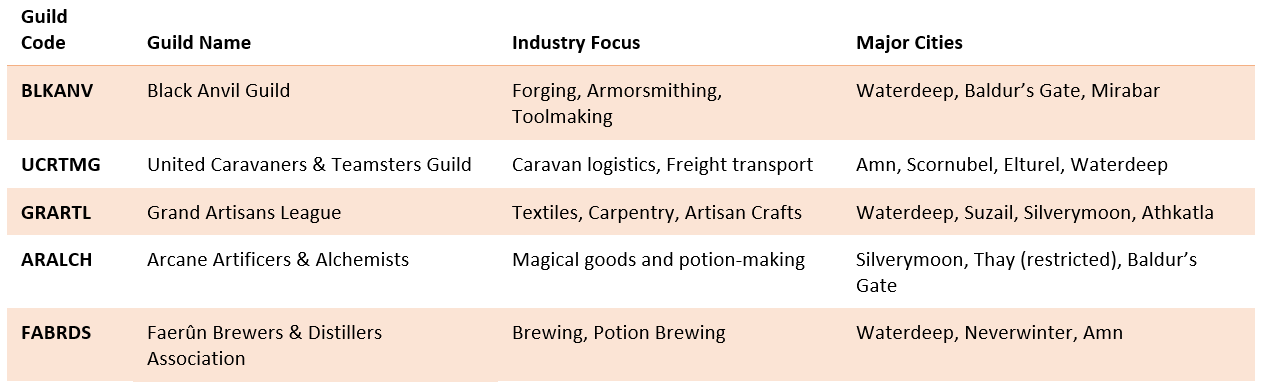
Guild Directory Examples

Here are a few of the more prominent guilds the Waterdeep Trading Company works with:

Guilds govern not just trade but talent. If you want to hire a certified loommaster, a leyline-calibrated enchanter, or a crystal alchemist with reliability, guild records are your best friend.

Merchants should track:

  • Certification Validity (including expiration and issuing chapter)
  • Completed Apprenticeship Logs (trainer, craft, rating)
  • Advancement Requests (for promotion to master rank or guild chair)
  • Guild Exams (success rates and focus areas)

By doing this, you can ensure you’re always working with approved craftsmen and that your wares pass muster when they reach port inspectors.

Managing Guild Contracts

Contracts with guilds are not one-size-fits-all. A shipping agreement with the Teamsters may include:

  • Volume quotas
  • Minimum wage requirements
  • Safety and magical seal inspections
  • Contingency routes for high-risk regions
  • A procurement agreement with the Black Anvil Guild might include:
  • Fixed pricing tiers for steel or mithral goods
  • Priority supply in wartime
  • Enchantment inspection clauses

Track these by guild, chapter, and effective date—and always be aware of when a renegotiation period is due.

Dispute Resolution and Compliance

Most cities allow guilds to enforce their own rulings within their domain. When a dispute arises:

  • Arbitration is often mandatory
  • Guild fines may be binding on the merchant
  • Disciplinary actions (such as blacklisting) can affect all affiliated trade

Maintain detailed logs of:

  • Complaints filed
  • Guild responses
  • Resolution terms
  • Any modifications to contracts or certifications following the ruling

This protects your company and helps build a reputation as a guild-respecting trading house.

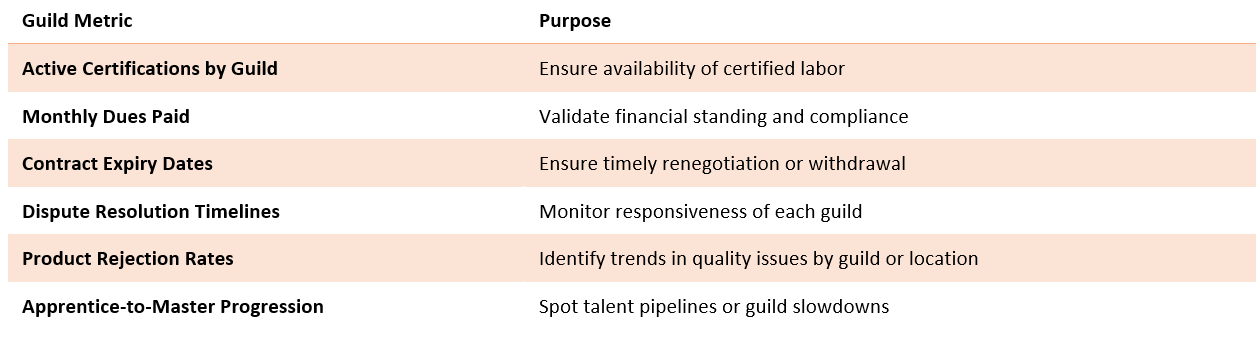
Guild Reporting and Oversight

Larger operations should develop guild reporting practices. Here are a few metrics we track:

Final Thoughts: Why Guilds Deserve Respect

Guilds don’t just protect craftsmen—they protect the economy. They ensure that products move fairly, workers are trained properly, and that bad actors can’t flood the market with cursed tankards and half-finished crossbows.

For a trading company, building strong, respectful, well-documented relationships with every guild you work with isn’t just a best practice—it’s the key to staying in business.

Want to start managing your guild partnerships better? Check out the guides at adnd365.com/start and explore the public demo environment at https://public.adnd365.com, using:

Login: npc@adnd365.com

Password: N0nPl@yC#822!