Archive

Tag Archives: finance

The Waterdeep Trading Company (WDTC) doesn’t just traffic in grain sacks and crossbow bolts. From spell-scrolls to silks, it handles a sprawling catalog of goods that straddle two very different economic planes: the mundane and the magical. And if there’s one thing Greta Ironfist has learned over the years, it’s this: you cannot value a crate of pickles the same way you value a Potion of Invisibility.

In this post, we explore how WDTC uses multi-ledger inventory valuation in Microsoft Dynamics 365 to accurately represent the true cost and value of its wildly diverse product lines.

The Problem: Two Economies, One Ledger?

Most trading companies operate within a single economic model. Standard costing methods like FIFO or Weighted Average are enough when you’re just shipping barrels of oil or bundles of lumber.

But for WDTC, the reality is more complex:

  • Mundane goods like iron nails or flour operate on predictable market logic.
  • Magical goods fluctuate based on arcane scarcity, planar trade politics, or adventuring trends.

Using a single valuation method across both types would either overstate the value of cheap goods or understate the risk in magical inventory.

The Solution: Valuation by Product Class in Dynamics 365

Using item model groups and inventory valuation methods, WDTC configured Dynamics 365 to assign different costing logic based on product category:

Example: Cloak vs Crate

Let’s break down two sales scenarios:

Cloak of the Emberward (Magical Item)

  • Purchase Cost (initial): 250 gp
  • Market spike after a regional fire elemental outbreak
  • Revaluation: 300 gp
  • Selling Price: 450 gp
  • Costing Method: Moving Average
  • Margin: 150 gp

Crate of Iron Nails (Mundane Item)

  • Purchase Cost: 10 gp
  • Stable demand across regions
  • Selling Price: 15 gp
  • Costing Method: FIFO
  • Margin: 5 gp

This separation ensures that magical price volatility does not distort the margin reports of common products, and vice versa.

Why It Matters to WDTC

  • Accurate financial reporting by product class
  • Better guild compliance when reporting to trade unions and arcane oversight bodies
  • Risk visibility for magical goods with erratic supply chains
  • Profit segmentation that separates stable trade income from speculative arcane revenue

Regional Valuation Adjustments

Faerûn isn’t one economy. It’s dozens. Prices vary by city, faction, and even by time of year.

For instance, Elixir of Haste sells at:

  • 200 gp in Waterdeep
  • 300 gp in Icewind Dale
  • 150 gp in Calimport

WDTC uses financial dimensions tied to region to track where margins are highest. This allows Greta to reroute magical inventory dynamically and ensure magical surplus in saturated markets is reallocated before losses hit the books.

Final Thoughts

Managing two economies under one roof is no easy task. But with the right inventory valuation configuration in Dynamics 365, the Waterdeep Trading Company turns complexity into clarity.

So next time you’re weighing whether to ship a box of rope or a case of scrolls, ask yourself: do you know what it’s really worth, and how it affects your ledger?


For more Faerûn-based business wisdom, get your copy of the guides at adnd365.com/start. You can also request access to our current demo database and see how it’s all set up. Just log in to https://public.adnd365.com using:

Email: npc@adnd365.com

Password: N0nPl@yC#822!

Waterdeep, the City of Splendors, is the crown jewel of trade along the Sword Coast. Its robust infrastructure, bustling markets, and magical commerce attract merchants from every corner of Faerûn. However, these opportunities come with significant responsibilities. Trade within the city is tightly regulated, and businesses must comply with a comprehensive and often complex system of taxes, tariffs, and guild fees.

For the Waterdeep Trading Company (WDTC), compliance with these financial obligations is not just about avoiding penalties. It is a fundamental part of how the company operates and thrives.

Understanding the Tax Landscape in Waterdeep

The economy of Waterdeep is shaped by policies enacted by the Lords of Waterdeep, enforced by trade guilds, and influenced by arcane regulators. Taxes cover everything from standard sales to magical services and imported goods. Below are the key types of taxes and fees businesses face:

How WDTC Manages Tax Compliance

The Waterdeep Trading Company uses Microsoft Dynamics 365 Finance to integrate tax compliance into every aspect of its financial operations. This ensures that taxes are accurately applied, transparently recorded, and automatically posted at the point of transaction.

Automated Tax Application

Each tax type is configured as a distinct code or group within the system. These are applied to sales orders, purchase orders, and inventory transactions based on product classification and trade channel. This reduces manual entry and improves audit readiness.

Smart Product Classification

WDTC assigns all items to tax groups that reflect their economic category. For example:

  • Enchanted items fall under the magic group
  • Jewelry and fine fabrics are categorized under luxury
  • General goods are classified under standard groups

This categorization ensures that the correct tax rates are applied automatically during sales and purchasing processes.

Landed Cost Tracking for Imports

Imported goods are subject to various tariffs and duties. WDTC utilizes the Landed Cost module in Dynamics 365 to accurately track and allocate these costs across the items being received. This ensures the company always has a clear picture of true inventory value and profitability.

Budgeting for Unofficial Overhead

While not recognized in formal tax records, certain transactions require what are diplomatically referred to as “negotiation fees.” These are handled with discretion and tracked within internal budgets to maintain operational agility in bureaucratic environments.

Tax Strategy as a Growth Enabler

Rather than treating tax as a burden, the Waterdeep Trading Company approaches it as a source of control and insight. Their tax configuration supports accurate reporting, supports pricing strategies, and ensures compliance across all trade activity.

This level of discipline allows the company to operate confidently within Waterdeep’s competitive and heavily regulated marketplace. It also lays the groundwork for expansion into other city-states with similarly complex trade policies.

If you are ready to elevate your Faerûnian business operations or want to model similar structures in your Dynamics 365 environment:

Visit adnd365.com/start for the full set of configuration guides.

Access the public demo environment at https://public.adnd365.com

Login: npc@adnd365.com

Password: N0nPl@yC#822!

Budgeting doesn’t get the same attention as dragon-slaying or spell-slinging, but if you ask Greta Ironfist, it’s what keeps the doors open and the swords sharp. At the Waterdeep Trading Company, budgeting is how we make sure every gold piece has a job to do.

Let’s walk through how you can set up and use budgeting in Dynamics 365 Finance, with a few examples from our favorite trade hub on the Sword Coast.

Why Budgeting Is More Than Just Ledger Scrolls

Running a growing trading company means managing costs across different wards, cities, and sometimes even planes. Whether you’re buying spell ink in Waterdeep or renting a wagon in Elturel, you need a plan.

With Dynamics 365, budgeting helps you:

  • Forecast future expenses
  • Prevent overspending
  • Align your spend with goals like expansion or inventory restocking

Creating a Budget Register Entry

A budget register entry is where you define how much money you’re allocating and where it’s going. This can be done by department, cost center, or project.

Here’s what Greta’s FY25 budget register might look like:

You can create these manually or import from Excel. It’s especially helpful when you’re dealing with dozens of departments and hundreds of accounts.

Setting Up Budget Control Rules

Budget control lets you apply rules that prevent spending over budget. You can set this up to stop transactions or just warn the user.

Here’s how we’ve configured ours:

This makes sure field teams don’t accidentally order 10 crates of holy water when they only need two.

Allocating Budgets Over Time

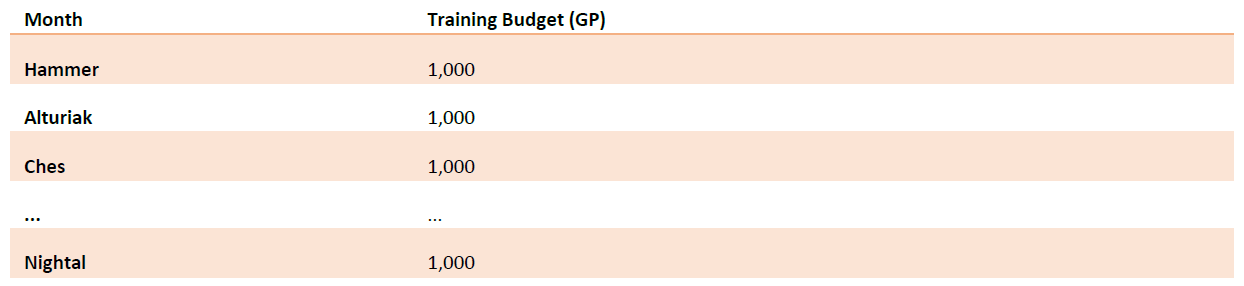
Not all costs hit at once. Some budgets, like the one for magical research or training, might be spread across the year.

Equal Monthly Allocation Example

You can also do weighted allocations if you expect spikes during busy seasons, like Greengrass or the Day of Wonders.

Reporting and Variance Tracking

Now that your budget is in the system, it’s easy to track how you’re doing. With the help of Power BI or built-in reports, you can compare budget to actuals.

Sample Variance Report

This kind of visibility lets Greta make smarter decisions and redirect funds when needed.

Final Thoughts

Budgeting in Faerûn is not just about counting coins. It’s about making sure your resources are lined up with your ambitions. Whether you’re building a new warehouse in Baldur’s Gate or launching a supply run to Icewind Dale, having your budgets set in Dynamics 365 means you can move with confidence.

Want to do this yourself? Download the Advanced Dungeons & Dynamics 365 guides at adnd365.com/start. For hands-on access, explore the live demo environment at https://public.adnd365.com, logging in with npc@adnd365.com and password N0nPl@yC#822!.

Let me know if you want to create a follow-up post on budgeting approvals, forecast comparisons, or project-based budgeting.

In the bustling cities of the Sword Coast—from Waterdeep’s merchant squares to the shady alleys of Luskan—one thing is clear: magic sells. Whether you’re a potion purveyor, an arcane gear supplier, or an enchanted scroll distributor, knowing which magical products bring the highest margins is critical for growth.

In this post, we’re using Dynamics 365’s Product Profitability Reports, Item Sales Margins, and Sales by Product Category to reveal the top 10 most profitable magical items currently moving through the Faerûnian economy.

How We Calculated Profitability

We pulled data from the Waterdeep Trading Company’s Dynamics 365 environment, combining:

  • Sales revenue from the Order to Cash module
  • Cost of Goods Sold (COGS) via Inventory Valuation
  • Gross Margin % based on item group (Magical Items, Potions, Scrolls, etc.)

Profit = (Sales – COGS) × Volume Sold

Top 10 Magical Products by Profit

Key Insights for Inventory & Trade Managers

  1. Healing Potions dominate—they’re cheap to produce, high in volume, and in constant demand. Set reorder thresholds in your Item Coverage settings.
  2. Arcane Saddles are low-volume, high-margin—ideal candidates for Trade Agreements with aerial suppliers and custom production runs.
  3. Scrolls offer recurring revenue—track parchment, ink, and scribing labor as bundled production cost drivers.
  4. Teleportation services represent a unique product-as-a-service model—handled as a non-stock item but linked to high-value invoicing and permit records.

Dynamics 365 Tips to Track Magical Profitability

  • Use Item Groups and Product Categories to segment magical vs. mundane goods.
  • Enable Standard Costing or FIFO for better margin clarity on alchemical and enchanted items.
  • Run the “Gross Margin by Product” report in Cost Management > Inquiries and Reports.
  • Tag products with attributes like Arcane Level, Guild Certification, or Spell School to enable dimensional profitability analysis.

What’s Next?

If you’re a trading company operating across Faerûn, your profit isn’t just about what you sell—it’s about knowing what sells best, to whom, and how consistently. With Dynamics 365, you have the tools to track product-level performance across every district, ward, and plane.

Curious what the margins are on a Flask of Faerie Fire or a Golem Core? Start building your magical profitability matrix today with our Bare Bones Templates and Fantasy Item Master demo packs at adnd365.com/start.

In the cities and farmlands of Faerûn, trade flows like water through the continent—vital, ever-changing, and affected by forces both natural and magical. To help traders, governments, and guilds make sense of this dynamic economy, the Faerûnian Commodities Exchange (FCEX) and its regional partners maintain a set of Faerûn Price Indexes (FPIs)—standardized benchmarks that track the value of common goods across the continent.

Whether you’re a merchant prince in Calimport or a dwarven brewer in Citadel Adbar, understanding price indexes can help you make better decisions, hedge against regional volatility, and forecast your next profitable move.

What Is a Price Index?

A price index is a numerical value representing the average price level of a selected group of goods over time. In Faerûn, each index is tied to a commodity category and adjusts based on:

  • Supply and demand
  • Regional scarcity or abundance
  • Seasonal factors
  • Political or magical disruptions

Price indexes allow merchants and record-keepers in Dynamics 365 Finance to automate price adjustments, simulate market events, and guide inventory valuation.

The Core Faerûn Price Indexes

These indexes are recalculated monthly and regionally, using weighted average pricing from participating exchanges.

Here are the primary FPIs maintained by FCEX:

Example: Price Calculation Using FPI

Let’s say you’re trading wheat in Baldur’s Gate. The FPI-GRNS is currently at 108.0. The base price per bushel is 1.00 gp, and the current regional modifier is +5% (due to local demand).

Final Price = Base Price × (FPI / 100) × (1 + Regional Modifier)

Calculation:

1.00 × (108 / 100) × (1 + 0.05) = 1.134 gp per bushel

Thus, the trader should price wheat at 1.13 gp per bushel in current market conditions.

Magical & Seasonal Adjustments

Faerûnian indexes are also responsive to magical anomalies and seasonal trends. For example:

  • Winter: +10% to grain and livestock indexes
  • Festival Month (Mirtul): +15% to Moonshine Index
  • Arcane Drought in Thay: +20% to Alchemical Index

These modifiers can be simulated in Dynamics 365 using Price Adjustment Journals linked to market events or custom financial dimensions.

Dynamics 365 Integration Example

In Dynamics 365 Finance, FPIs can be integrated using:

  • Trade Agreements for commodity contracts
  • Inventory Revaluation Journals for cost layer updates
  • Price Simulation Models using seasonal and regional modifiers
  • Procurement Policies to enforce index-based pricing

You can even create a custom Price Index table to adjust costs across product hierarchies automatically.

Sample Commodity Index Table

Building a Resilient Economy with FPIs

Using Faerûn Price Indexes provides:

  • Transparency in trade
  • Fair valuation across regions
  • Simulation of economic events
  • Seamless integration into ERP systems

Whether you’re a guild accountant or a caravan master, understanding the FPIs is essential for navigating the financial landscape of the realms.

Want to Use FPIs in Your Game or Business?

Download the official Faerûnian Trader’s Handbook and FCEX Pricing Templates at: adnd365.com/start

You’ll gain access to:

  • Pre-built Excel pricing sheets
  • Trade agreement configuration files
  • Market simulation tools for Dynamics 365

In Faerûn, wealth isn’t just held in coin—it bleats, moos, and occasionally tries to escape from the back of a cart. While cities like Waterdeep rely heavily on minted currency, rural economies and frontier settlements often prefer bartering with livestock, especially sheep and cows, as their primary medium of exchange. In these markets, currency management goes far beyond decimal places and exchange rates—it’s measured in hooves and wool.

Trading Livestock: The Art of the Barter Deal

Sheep and cows are among the most commonly traded animals across Faerûn. Instead of fixed coin prices, their value is often expressed in livestock equivalents or agreed-upon barter deals. For example, a farmer in Daggerford might offer 3 sheep for 1 milk cow, while a merchant in Silverymoon agrees to trade 2 cows for a refurbished wagon and a barrel of smoked fish.

Barter agreements like these introduce valuation risks—a form of unrealized gain or loss if the agreed deal differs from market value at settlement.

Example:

If Greta Ironfist agrees to trade 1 cow (normally valued at 12 gp) for 10 sheep (normally valued at 1 gp each), she’s made a paper gain of 2 gp—but only if she manages to offload those sheep at market value. If the market crashes and sheep drop to 0.8 gp each, she’s suddenly facing a realized loss of 4 gp.

Tracking Unrealized Gains & Losses in Dynamics 365

Using Dynamics 365 Finance, organizations can manage livestock like any asset class, and track fluctuations through barter transactions:

 Configure posting profits to book gains/losses into:

  • 8150 – Unrealized Currency Gains
  • 8200 – Realized Currency Gains
  • 1400 – Livestock Inventory (customized by type)

 Sheep Equivalency Table

To help standardize barter pricing, many trading companies and farming cooperatives use equivalency tables. These values adjust seasonally, but the table below offers a standard baseline used by the Waterdeep Trading Company:

These equivalencies are often posted on chalkboards in guild halls and auction houses, with exchange rates adjusted based on region, season, and demand.

Livestock Valuation Strategy in Faerûn

Using barter pricing as the standard means the value of livestock acts like floating currency, influenced by:

  • War or Famine: Raises cow values, lowers sheep (if feed is short)
  • Seasonal Demand: High wool prices in winter increase sheep value
  • Regional Trade Routes: Supply constraints affect prices dramatically

In D365, livestock can be managed with inventory journals that reflect changes in expected barter value. These changes trigger unrealized gains or losses until settlement occurs—when those numbers become very real on the books.

Final Thoughts: Counting Sheep in the Ledger

Managing currency in Faerûn isn’t just a matter of coins—it’s about contracts and creatures. By treating livestock as movable wealth, Faerûnian traders and companies like the Waterdeep Trading Company bring agility and realism to their accounting.

When you track sheep like silver and cows like coin, the only limit is how fast your ledgers—and your livestock—can move.

Ready to track your herd and harvest your profits? Download the Advanced Dungeons & Dynamics 365 Bare Bones Configuration Guides at adnd365.com/start and bring order to your beasts.