Archive

Tag Archives: food

The Waterdeep Trading Company relies on steady labor across docks, warehouses, counting rooms, and guard posts. Feeding that workforce is a daily operational task, not courtesy. A hungry crew slows work, causes friction, and creates avoidable risk. For this reason, the company operates a centralized food hall that delivers consistent meals at scale while maintaining precise cost control and minimal waste.

The food hall plans meals the same way the company plans freight and inventory, using fixed volumes, predictable demand, and clear rules that can be repeated every day.

Why Centralized Food Planning Matters

When meals are left to individual departments or ad hoc kitchens, costs rise, and service becomes uneven. A central food hall allows the company to buy in bulk, standardize portions, and control preparation timing. It also ensures that every worker, regardless of role or shift, receives the same reliable meal.

Central planning turns food into a managed resource rather than an ongoing problem.

Establishing the Workforce Baseline

Daily planning begins with a known headcount. The food hall does not plan by role, rank, or department. It plans by total mouths served across all shifts. Dockhands, clerks, guards, supervisors, and night watch are counted together to avoid gaps or double-counting.

The core planning unit is one hundred workers. This unit reflects proven banquet scale quantities that assume physical labor and full meals.

The One Hundred Worker Meal Set

The food hall uses a standard one-hundred-worker meal set as its baseline. One complete set feeds one hundred workers for a single main meal. Half a set feeds fifty workers, and a quarter set feeds twenty-five. Most days fall between one and two complete sets.

By scaling meals in these fixed blocks, purchasing, prep, and storage remain predictable.

Protein Planning for Sustained Labor

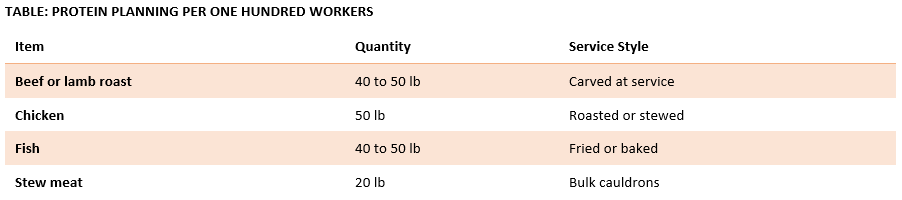
Protein is the most expensive and most closely tracked part of the meal. Portions are generous but controlled.

Only two protein options are served at any meal. One is treated as the primary dish, while the second supports variety without increasing waste.

Soup as the Daily Anchor

Soup is served at every meal. It fills bowls, stretches inventory, and absorbs attendance fluctuations without complaint.

One gallon serves about twenty workers, making soup the most efficient volume control tool in the hall.

Sides and Cold Dishes

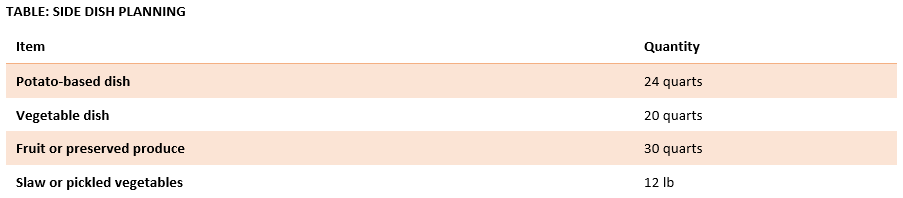
Side dishes are chosen for stability and early preparation. Many are prepared before midday to smooth labor demand and reduce pressure during peak service.

Cold dishes are favored because they store well and reduce reliance on open fires during service.

Bread and Dairy as Calorie Insurance

Bread is always available. It ensures no worker leaves hungry, even on days when attendance exceeds estimates.

Bread consumption is tracked daily, as sharp increases often signal that protein portions need adjustment.

Beverage Planning

Water is unlimited. Hot drinks are planned by volume and issued in controlled batches.

Ale and spirits are not part of the food hall ration and are handled separately through licensed taverns.

Daily Planning in Practice

On a typical workday, the food hall may require approximately 1.5 meal sets to meet demand. In practice, the kitchen prepares two complete sets to protect against shortages and late arrivals. Any unused portions are intentionally folded into the following day’s soups or stews, where they can be safely and efficiently reused. Leftover proteins are never held beyond the day of service unless they are immediately repurposed in accordance with controlled preparation rules. This approach prevents spoilage, reduces waste, and minimizes the risk of illness while keeping service predictable.

Ledger Control and Oversight

Each day, the food hall reports the number of workers fed, the total food cost, the average cost per worker, and any recorded waste. These figures are reviewed weekly by the Arcane Treasurer to ensure the food hall supports operations without unnecessary spending.

Food is treated as an operational input, tracked with the same discipline as tools, wagons, or warehouse space.

Final Thoughts

Feeding a large workforce is a logistics problem solved through structure and repetition. By planning meals in fixed sets and enforcing clear reuse rules, the Waterdeep Trading Company keeps its workers fed, its kitchens orderly, and its ledgers clean. A full stomach keeps the company moving, and a planned kitchen keeps the company profitable.


Support the AD&D365 Project on Patreon.  To grow this world, we’ve launched an official Patreon page where supporters can access exclusive content, tools, and training labs, and even influence the project’s future. Your support fuels more than just development; it expands the guildhall, forges new scrolls, and empowers the next generation of configuration wizards.  Begin your journey: https://www.patreon.com/adnd365/

A Grateful Salute to Our Patrons.  To all those who stand behind the vision, thank you for helping bring this world to life. Our Benefactors, Andre Breillatt and Eryndor Fiscairn, your boundless generosity fuels the arcane core of this project. Without your magic, the weave would falter. Our Apprentices, the spell engines turn, and the training labs thrive thanks to our current Apprentices: Michael Ramirez and Andreth Bael’Rathyn. Special thanks to our past Apprentices, whose contributions helped us get here: Ralf Weber, Wendy Rijners, Shashi Mahesh, Julia Tejera, Ben Ekokobe, Tiago Xavier, Naveen Boyinapelli, Marcos Tadeu Wolf, Kathryn Greene, Jason Brown, Mark Christy, and Ashish Singh. Our Initiates, Jesper Livbjerg, Peter Lorre, Gregory Brigden, and Martin Grahm, your commitment marks the start of the deeper path, stepping beyond mere observation into the active shaping of this realm. Our Followers, your steady presence along the journey is a beacon of encouragement: Rusty Cavalier, Eric Shuss, Sunil Panchal, Sarah D. Morgan, Nick Ramchandani, Daniel Kjærsgaard, and Tomasz Pałys. And our Voyeurs, Harry Burgh, Abdelrahman Nabil, and Basil Quarrell, ever watching from the shadows, clearly intrigued… but not enough to part with a single gold piece. Your silent curiosity is noted and mildly judged.

Want to design your own economic models in Faerûn?  Get your own AD&D365 Environment and guides at adnd365.com/start, and request access to the public view of the current database at https://public.adnd365.com – Login npc@adnd365.com, Password N0nPl@yC#822!

Within Faerûn, waste is rarely loud. It slips away in thin shavings of wood, in excess trim from a carcass, or in ribbon lengths that never quite fit an order. For the Waterdeep Trading Company, cut optimization is the discipline that prevents this loss. It is the practice of deciding how raw material is divided before the blade ever touches it. When done well, yield is predictable, costs stay stable, and pricing remains fair across guild contracts and city markets.

This article explains cut optimization as it is practiced by the Waterdeep Trading Company, using meat, timber, and ribbon as working examples. Each section shows how planned cuts outperform improvised ones, and why this matters to cost, inventory, and trust.

What Cut Optimization Is

Cut optimization is the planning of cut orders, dimensions, and allocations to maximize the share of raw material that becomes sellable goods. It applies wherever material cannot be restored once cut. In Faerûn trade, this includes butcher work, sawmills, cloth halls, and packaging workshops.

The purpose is not speed. The purpose is to achieve yield, consistency, and unit-cost control.

Why It Matters to Trade

Markets pay for finished goods, not for raw weight. A carcass, a log, or a ribbon spool all carry a fixed purchase cost. The only way to improve margin after purchase is to increase the portion of that material that becomes saleable stock.

Poor cutting raises the cost per unit without increasing the price. That loss manifests later as thin margins, stock shortages, or measurement disputes.

Meat Cut Optimization

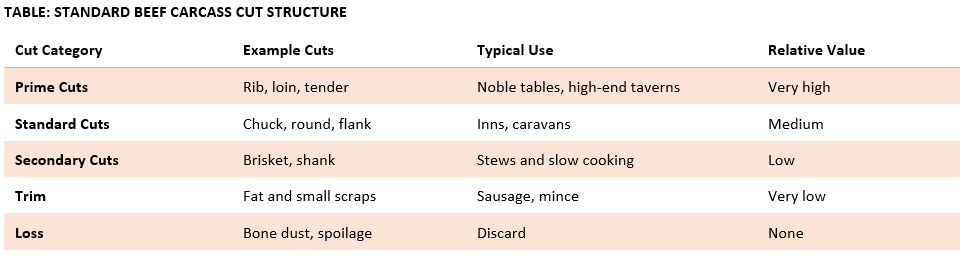
Meat cutting shows cut optimization at its clearest. A carcass has a fixed weight. Every cut choice shifts value between premium cuts, standard cuts, trim, and loss.

The following table shows how a standard beef carcass is divided for trade use. It is helpful for planners and butchers to share a standard structure.

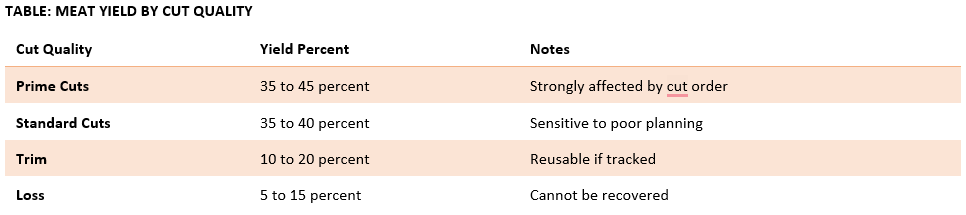
The following table shows how yield varies with cutting quality. It highlights where discipline matters most.

Cost impact follows directly from yield. This table explains why planners care about cutting standards.

Wood Cut Optimization

Timber behaves much like meat in economic terms. A log has a fixed volume. Waste hides in kerf loss, poor board layout, and random sizing.

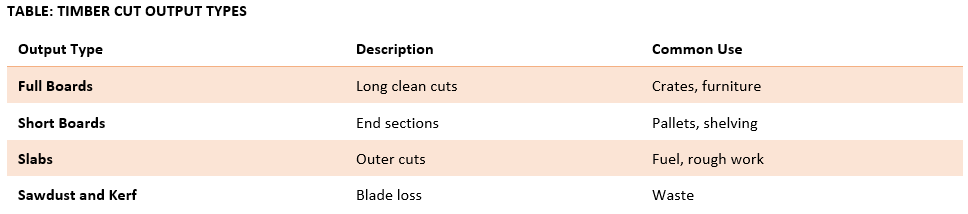
The table below defines the main outputs from a log. It helps align sawyers, crate makers, and cost scribes.

Yield depends on planning. This comparison shows the difference.

Board size discipline also matters. The following table explains why standard lengths are favored.

Ribbon Cut Optimization

Ribbon and cloth are thin materials, but the same rules apply. Length planning determines whether value is realized or stranded.

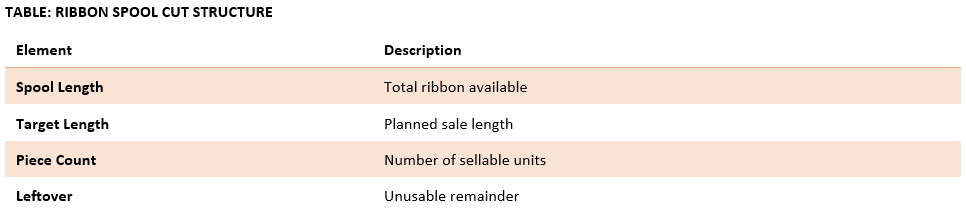
This structure table defines how a spool is evaluated before cutting.

Cut outcomes vary sharply by planning discipline.

Cost follows the same pattern seen in meat and wood.

How the Company Applies These Rules

The Waterdeep Trading Company enforces cut plans before work begins. Primary cuts are reserved for known buyers. Secondary outputs are assigned to reuse streams. Trim is tracked rather than ignored. Actual yield is recorded and compared with the expected yield after each batch.

This turns cutting from a craft risk into a managed process.

Final Thoughts

Cut optimization is quite a lot of work, but it decides profit more often than price negotiation. Whether the blade meets meat, wood, or ribbon, the rule remains the same. Plan the cut, protect the yield, and never let waste hide inside the ledger.


Support the AD&D365 Project on Patreon.  To grow this world, we’ve launched an official Patreon page where supporters can access exclusive content, tools, and training labs, and even influence the project’s future. Your support fuels more than just development; it expands the guildhall, forges new scrolls, and empowers the next generation of configuration wizards.  Begin your journey: https://www.patreon.com/adnd365/

A Grateful Salute to Our Patrons.  To all those who stand behind the vision, thank you for helping bring this world to life. Our Benefactors, Andre Breillatt and Eryndor Fiscairn, your boundless generosity fuels the arcane core of this project. Without your magic, the weave would falter. Our Apprentices, the spell engines turn, and the training labs thrive thanks to our current Apprentices: Michael Ramirez and Andreth Bael’Rathyn. Special thanks to our past Apprentices, whose contributions helped us get here: Ralf Weber, Wendy Rijners, Shashi Mahesh, Julia Tejera, Ben Ekokobe, Tiago Xavier, Naveen Boyinapelli, Marcos Tadeu Wolf, Kathryn Greene, Jason Brown, Mark Christy, and Ashish Singh. Our Initiates, Jesper Livbjerg, Peter Lorre, Gregory Brigden, and Martin Grahm, your commitment marks the start of the deeper path, stepping beyond mere observation into the active shaping of this realm. Our Followers, your steady presence along the journey is a beacon of encouragement: Rusty Cavalier, Eric Shuss, Sunil Panchal, Sarah D. Morgan, Nick Ramchandani, Daniel Kjærsgaard, and Tomasz Pałys. And our Voyeurs, Harry Burgh, Abdelrahman Nabil, and Basil Quarrell, ever watching from the shadows, clearly intrigued… but not enough to part with a single gold piece. Your silent curiosity is noted and mildly judged.

Want to design your own economic models in Faerûn?  Get your own AD&D365 Environment and guides at adnd365.com/start, and request access to the public view of the current database at https://public.adnd365.com – Login npc@adnd365.com, Password N0nPl@yC#822!


Across the bakehouses, inns, and contract kitchens supplied by the Waterdeep Trading Company, biscuits are treated as a controlled food product with a defined structure. They are not managed as separate recipes invented each morning. Instead, they are produced from a single base batch that anchors cost, supply planning, and pricing discipline. From that base, flavor and service variations are added in a controlled way.

This article presents the full details of the base biscuit batch and then carefully expands on each approved variation. The focus is not on novelty, but on control. Every ingredient, quantity, and cost exists for a reason. When butter prices change or dairy becomes scarce, the impact is known immediately across all biscuit products.

Standard Ingredient Assumptions

All costs shown use Waterdeep wholesale averages and standard batch sizes suitable for taverns and inns. Labor and fuel are excluded here to keep the focus strictly on material cost. This allows a clean comparison between variants without mixing production efficiency into the numbers.

Each variant discussed here is calculated for a single base batch.

Why a Base Batch Matters

In Faerûn, kitchens that rely on memory and habit lose coin. Kitchens that rely on structure survive lean seasons.

By defining a single base batch, the Waterdeep Trading Company ensures consistency across locations. The Dock Ward kitchens, caravan field ovens, and guild hall bake rooms all start from the same foundation. Variations are layered on top, never hidden inside vague instructions.

This approach allows costs to roll up cleanly, simplifies training, and prevents silent margin loss when ingredients drift.

The Base Biscuit Batch

The base batch is a savory quick bread dough suitable for cutting or dropping. It is not sold individually. It exists only as a production reference.

Base Batch Recipe Description

Dry ingredients are combined first. Butter is worked in until coarse. Liquid dairy is added last. Mixing stops as soon as the dough comes together. Rest is brief. From this point, the dough is shaped, dropped, or otherwise modified, depending on the variant.

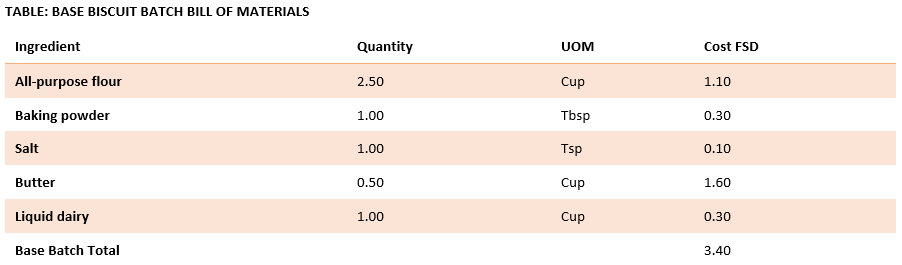
Base Batch Bill of Materials

This table defines the anchor cost. Every biscuit variant inherits from this batch.

This total of 3.40 FSD serves as the cost reference for pricing, budgeting, and contract negotiations.

How Variations Are Defined

A variation does one of two things.

It either replaces part of the base batch, such as swapping the dairy, or it adds ingredients on top of the base. No variant alters flour or butter quantities without formal review. That rule protects the cost anchor.

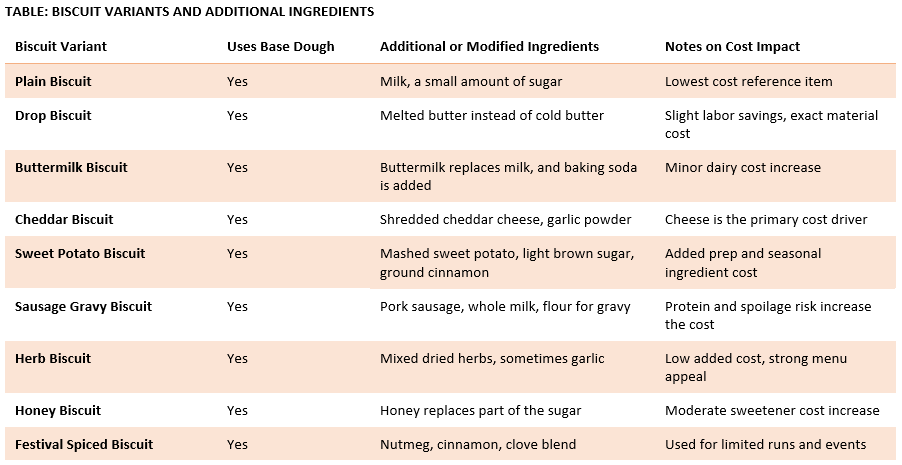
The table below lists each biscuit variant discussed, its base, and the additional or modified ingredients that create it. This is the table planners use when reviewing BOM impact and pricing changes.

How the Table Is Used

This structure allows the Waterdeep Trading Company to do three things quickly.

First, price changes for butter, flour, or dairy automatically affect all biscuit variants without requiring recipe changes.

Second, premium ingredients such as cheese, pork, or honey are clearly isolated, making margin risk more visible.

Third, seasonal or limited biscuits can be approved or retired by adjusting only the add-on line, not the base product.

Ledger and Product Coding Practice

In WDTC records, the base dough is treated as an internal reference rather than a sellable item. Only the finished variants appear in inventory and sales, each pointing back to the exact base definition.

This keeps kitchens flexible and ledgers clean, even when menus change weekly.

If you’d like, the next step is to convert this table into a full product hierarchy and item numbering scheme that shows how these variants roll up in reporting.

Variant Recipes and BOM Expansions

Each variation below is defined for one base batch.

Plain Biscuit Variation

The plain biscuit is the reference sellable product. It stays close to the base batch, with only a small amount of sweetener added for balance.

This variant is used for bulk supply, breakfast boards, and as the foundation for plated dishes.

Drop Biscuit Variation

The drop biscuit changes process, not material. Butter is melted rather than cut in. The dough is spooned instead of rolled.

This variant exists to reduce labor and waste during peak service.

Buttermilk Biscuit Variation

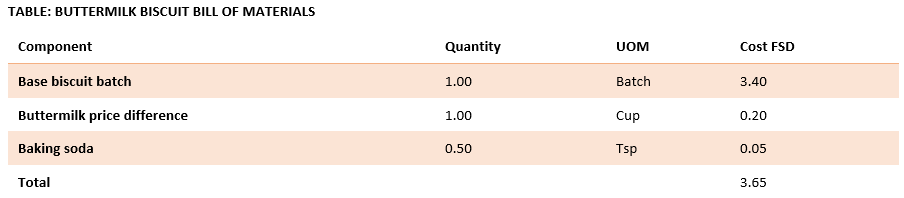
This variation replaces the liquid dairy and adjusts the leavening chemistry. The structure remains the same.

This biscuit commands steady demand and moderate pricing.

Cheddar Biscuit Variation

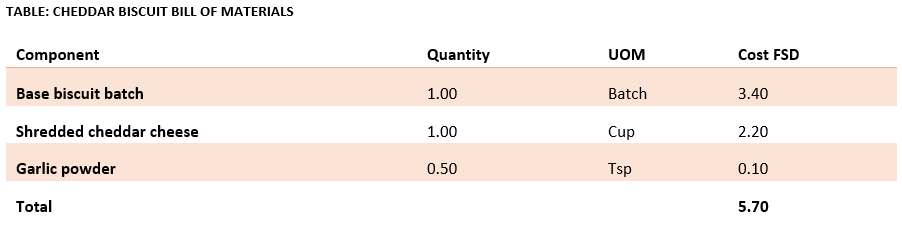
Cheddar biscuits introduce a high-value ingredient that must be visible and justified at the point of sale.

Volatility in cheese costs makes this variant sensitive to supply conditions.

Sweet Potato Biscuit Variation

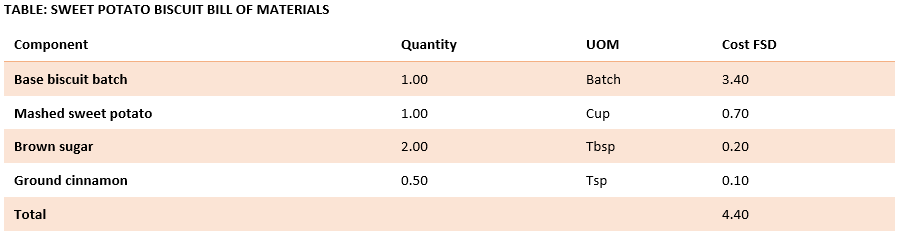
This is a seasonal biscuit tied to harvest cycles and regional supply.

This variant is approved for festivals, autumn menus, and limited runs.

Sausage Gravy Biscuit (Bundled Service Product)

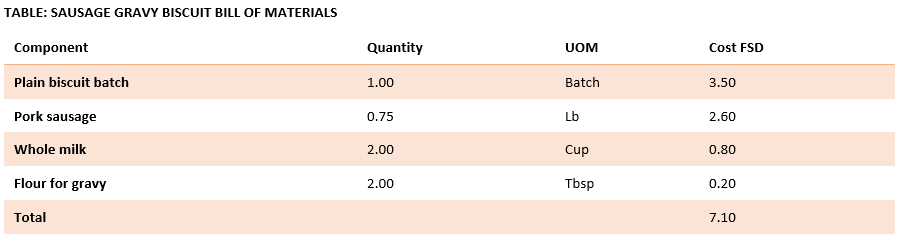
This is not just a biscuit. It is a plated product built on the plain biscuit batch.

Protein, holding time, and spoilage risk place this firmly in the high cost tier.

Interpreting the Cost Differences

Three tiers appear immediately. Plain, drop, and buttermilk biscuits sit in the low-cost tier and are suitable for volume contracts and daily service. Sweet potato biscuits are in the middle tier, and any added preparation or ingredients must be matched to seasonal pricing. Cheddar and sausage gravy biscuits sit firmly in the high-cost tier and rely on premium positioning to remain profitable.

How This Structure Is Used in Practice

By holding all biscuits to one base batch, the Waterdeep Trading Company gains clear control.

When butter prices rise, every biscuit reflects it instantly. When cheese supply tightens, only cheddar biscuits are affected. Seasonal ingredients stay visible and optional, never hidden.

Kitchens gain flexibility without losing discipline. Accountants gain traceable cost logic. Buyers gain leverage in negotiations.

Final Thoughts

Biscuits in Faerûn may look humble, but they tell the whole story of kitchen economics. One clearly defined base batch supports many variations without confusion. Flavor is added with intent. Cost is never a surprise.

This is how the Waterdeep Trading Company feeds cities, caravans, and guild halls without losing coin along the way.


Support the AD&D365 Project on Patreon.  To grow this world, we’ve launched an official Patreon page where supporters can access exclusive content, tools, and training labs, and even influence the project’s future. Your support fuels more than just development; it expands the guildhall, forges new scrolls, and empowers the next generation of configuration wizards.  Begin your journey: https://www.patreon.com/adnd365/

A Grateful Salute to Our Patrons.  To all those who stand behind the vision, thank you for helping bring this world to life. Our Benefactors, Andre Breillatt and Eryndor Fiscairn, your boundless generosity fuels the arcane core of this project. Without your magic, the weave would falter. Our Apprentices, the spell engines turn, and the training labs thrive thanks to our current Apprentices: Michael Ramirez and Andreth Bael’Rathyn. Special thanks to our past Apprentices, whose contributions helped us get here: Ralf Weber, Wendy Rijners, Shashi Mahesh, Julia Tejera, Ben Ekokobe, Tiago Xavier, Naveen Boyinapelli, Marcos Tadeu Wolf, Kathryn Greene, Jason Brown, Mark Christy, and Ashish Singh. Our Initiates, Jesper Livbjerg, Peter Lorre, Gregory Brigden, and Martin Grahm, your commitment marks the start of the deeper path, stepping beyond mere observation into the active shaping of this realm. Our Followers, your steady presence along the journey is a beacon of encouragement: Rusty Cavalier, Eric Shuss, Sunil Panchal, Sarah D. Morgan, Nick Ramchandani, Daniel Kjærsgaard, and Tomasz Pałys. And our Voyeurs, Harry Burgh, Abdelrahman Nabil, and Basil Quarrell, ever watching from the shadows, clearly intrigued… but not enough to part with a single gold piece. Your silent curiosity is noted and mildly judged.

Want to design your own economic models in Faerûn?  Get your own AD&D365 Environment and guides at adnd365.com/start, and request access to the public view of the current database at https://public.adnd365.com – Login npc@adnd365.com, Password N0nPl@yC#822!

Facility maintenance across Faerûn is a constant effort. Weather from the Sea of Swords wears down roofs and stonework. Workshops hum with arcane devices that need careful inspection. Storehouses carry goods from every coast, and their upkeep protects both inventory and reputation. The Waterdeep Trading Company depends on steady maintenance to keep its halls safe, its warehouses efficient, and its trading operations uninterrupted.

This article explains how facility maintenance works within the company, why it matters to both accounting and logistics teams, and how the company structures its routine and long-term upkeep across the Sword Coast.

What Facility Maintenance Is

Facility maintenance covers all tasks that keep property, structures, and equipment in proper condition. In Waterdeep, that means stone repairs, timber replacement, arcane ward checks, chimney sweeps, roof inspection after storms, and routine upkeep of forges and loading areas.

These tasks fall into three main groups.

  • Planned maintenance occurs on a schedule.
  • Reactive maintenance corrects failures or damage.
  • Capital improvements enhance the property’s long-term value.

The Waterdeep Trading Company treats each group differently through its ledgers, work orders, and supply planning.

Why Facility Maintenance Matters

Strong buildings keep workers safe and goods protected.

Predictable upkeep prevents costly failures during peak trade seasons.

Precise financial tracking allows the company to separate expenses, investments, and losses.

Accurate records help the guild justify labor costs for city inspections.

Maintenance also supports merchants’ trust in secure storage facilities.

Location and Asset Hierarchy

The Waterdeep Trading Company maintains a structured hierarchy to manage every facility, room, and piece of equipment. This hierarchy helps clerks assign work orders, track maintenance history, and record costs at the correct property level.

The hierarchy is built in four levels.

  • The Site represents the city location, such as Waterdeep or Baldur’s Gate.
  • The Facility represents each central operational building.
  • The Area groups rooms or working spaces.
  • The Asset represents the specific item requiring upkeep.

Below is a view of the hierarchy used across the Sword Coast.

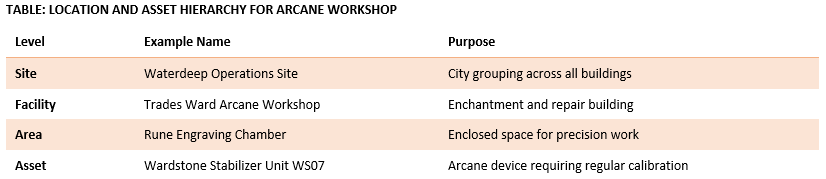
This table shows an example hierarchy for the Waterdeep primary operations area.

A second example of arcane equipment follows.

This table shows how magical assets are grouped within the Trades Ward workshop.

These structures ensure maintenance orders are always posted against the correct area and asset. They also enable the company to generate reports that show where failures recur or where investment is needed.

Components of Facility Maintenance

The company organizes upkeep into four areas.

  • Structural upkeep includes walls, floors, beams, doors, and roofs.
  • Utility systems include lantern lines, water pumps, heating runes, and ventilation.
  • Operational equipment includes hoists, lifts, carts, loading arches, and warded vault doors.
  • Grounds upkeep includes yard areas, stable maintenance, and perimeter inspection.

This table lists common cost types used in planning and reviewing maintenance.

Maintenance Types and Their Use

This table helps overseers select the proper work classification for each job.

Worked Example

Below is a sample roof repair at the Dock Ward storehouse.

Realms Aware Considerations

Faerûn presents special conditions that influence upkeep.

  • Salt air from the Sea of Swords causes fast corrosion.
  • Arcane flux near magical districts requires routine stabilizer checks.
  • Forest settlements face creature interference.
  • Seasonal storms strain roofs and drainage.

These conditions guide the company’s maintenance calendar and supply plans.

Final Thoughts

Facility maintenance keeps the Waterdeep Trading Company steady through every trade season. Strong buildings support safe storage, stable operations, and predictable financial results. A clear hierarchy, proper classification, and careful planning help the company control costs while protecting the value of its assets.


Support the AD&D365 Project on Patreon.  To grow this world, we’ve launched an official Patreon page where supporters can access exclusive content, tools, and training labs, and even influence the project’s future. Your support fuels more than just development; it expands the guildhall, forges new scrolls, and empowers the next generation of configuration wizards.  Begin your journey: https://www.patreon.com/adnd365/

A Grateful Salute to Our Patrons.  To all those who stand behind the vision, thank you for helping bring this world to life. Our Benefactors, Andre Breillatt and Eryndor Fiscairn, your boundless generosity fuels the arcane core of this project. Without your magic, the weave would falter. Our Apprentices, the spell engines turn, and the training labs thrive thanks to our current Apprentices: Michael Ramirez and Andreth Bael’Rathyn. Special thanks to our past Apprentices, whose contributions helped us get here: Ralf Weber, Wendy Rijners, Shashi Mahesh, Julia Tejera, Ben Ekokobe, Tiago Xavier, Naveen Boyinapelli, Marcos Tadeu Wolf, Kathryn Greene, Jason Brown, Mark Christy, and Ashish Singh. Our Initiates, Jesper Livbjerg, Peter Lorre, Gregory Brigden, and Martin Grahm, your commitment marks the start of the deeper path, stepping beyond mere observation into the active shaping of this realm. Our Followers, your steady presence along the journey is a beacon of encouragement: Rusty Cavalier, Eric Shuss, Sunil Panchal, Sarah D. Morgan, Nick Ramchandani, Daniel Kjærsgaard, and Tomasz Pałys. And our Voyeurs, Harry Burgh, Abdelrahman Nabil, and Basil Quarrell, ever watching from the shadows, clearly intrigued… but not enough to part with a single gold piece. Your silent curiosity is noted and mildly judged.

Want to design your own economic models in Faerûn?  Get your own AD&D365 Environment and guides at adnd365.com/start, and request access to the public view of the current database at https://public.adnd365.com – Login npc@adnd365.com, Password N0nPl@yC#822!

In the sprawling markets of Faerûn, sweetness is never just sugar, it is craft, alchemy, and trade. The Waterdeep Trading Company stands at the forefront of this art, transforming raw ingredients from across the Realms into syrups that enrich daily life. From the common taverns of Baldur’s Gate to the noble estates of Silverymoon and the enchanted courts of the Moonshae Isles, our syrups find their way into mugs, goblets, and ritual chalices.

Sweeteners carry not only taste but also identity. They bring forward the land they hail from, the guilds who refine them, and the merchants who carry them along caravan and sea routes. Some are familiar, like cane sugar or honey, while others are rare luxuries, moonflower nectar harvested under enchanted blossoms, or celestial dew condensed from the very light of the heavens.

This article reveals how the Waterdeep Trading Company manufactures, refines, and distributes syrups. It explores both traditional and exotic sweeteners, provides tables for conversion and usage, and presents worked examples to show the difference between common goods and rare luxuries.


Support the AD&D365 Project on Patreon.

To grow this world, we’ve launched an official Patreon where supporters can gain access to exclusive content, tools, training labs, and even influence the future of the project. Your support fuels more than just development ,  it expands the guildhall, forges new scrolls, and empowers the next generation of configuration wizards.  Begin your journey: https://www.patreon.com/adnd365/

A Grateful Salute to Our Patrons

To all those who stand behind the vision, thank you for helping bring this world to life. Our Benefactor, Andre Breillatt, your boundless generosity fuels the arcane core of this project. Without your magic, the weave would falter. Our Apprentices, the spell engines turn and the training labs thrive thanks to our current Apprentices: Michael Ramirez and Andreth Bael’Rathyn (Name obfuscated to protect their identity). Special thanks to our past Apprentices, whose contributions helped us get here:  Ralf Weber, Wendy Rijners, Shashi Mahesh, Julia Tejera, Ben Ekokobe, Tiago Xavier, Naveen Boyinapelli, Marcos Tadeu Wolf, Kathryn Greene, Jason Brown, Mark Christy, and Ashish Singh. Our Initiates, Peter Lorre, your commitment marks the start of the deeper path, stepping beyond mere observation into the active shaping of this realm. Our Followers, your steady presence along the journey is a beacon of

Want to design your own economic models in Faerûn?

Get your own AD&D365 Environment and guides at adnd365.com/start, and request access to the public view of the current database at https://public.adnd365.com – Login npc@adnd365.com, Password N0nPl@yC#822!

Classic Sugars: The Foundation of Syrupcraft

The backbone of most syrups rests upon tried-and-true sugars. These provide stability and consistency, easily dissolved into both hot and cold beverages.

  • Cane Sugar – Imported from the cane fields of Amn, pressed and crystallized, then dissolved into syrup. Clean, sweet, and versatile.
  • Brown Sugar – A Waterdeep specialty created by adding molasses back into refined sugar, giving depth and a toasted warmth.
  • Honey – Harvested by Rashemi druids and apiarists, honey carries floral notes and golden sweetness, a luxury long beloved in Faerûn.
  • Maple Syrup – Drawn from enchanted northern groves, reduced by fire and filtered to retain its earthy, woodsy caramel tones.

Manufacturing Process: Raw sugar or honey is delivered to Waterdeep workshops. Syrup-makers dissolve it in large copper cauldrons, strain it through linen cloth, add stabilizing herbs, and bottle it for trade.

Alternative Natural Sweeteners: Syrups with Character

Adventurers and nobles often seek tastes that go beyond tradition. These syrups bring distinctive flavors tied to their regions of origin.

  • Agave Syrup – Extracted from the cactus heart in Calimshan, light, smooth, and excellent for cold drinks.
  • Coconut Sugar Syrup – From Chultan coconuts, boiled down into a caramel-rich syrup.
  • Date Syrup – A Thayan enclave specialty, dark, fruity, and reminiscent of toffee and dried fruit.

Manufacturing Process: These sweeteners are boiled in sealed kettles at low heat to preserve flavor, then aged briefly in oak casks for consistency.

Plant-Based Zero-Calorie Sweeteners: Nature Refined by Alchemy

These extracts appeal to health-conscious customers without sacrificing sweetness.

  • Stevia – Leaves harvested from eastern plantations are dried, powdered, and magically steeped to yield sweetness 200× stronger than sugar.
  • Monk Fruit Extract – Rare fruits imported from Kara-Tur, carefully processed to create concentrated sweetness.

Manufacturing Process: Extracts are stabilized with herbs and cooled by enchanted stones, preventing bitterness and ensuring clarity.

Sugar Alcohols: Sweet with a Cool Finish

These lie between natural and refined, offering milder sweetness and a refreshing aftertaste.

  • Erythritol – Created from fermented fruits in Icewind Dale, nearly calorie-free, with a cooling effect.
  • Xylitol – Extracted from northern birchwood, equal in sweetness to sugar, providing body to syrups.

Manufacturing Process: Fermentation and crystallization cycles ensure purity before blending into syrups.

Artificial Sweeteners: The Arcane Alternatives

Though some prefer natural sources, the Company also crafts syrups from wizard-forged ingredients.

  • Aspartame – Alchemically bound proteins, strong but heat-sensitive, suited to cold syrups.
  • Acesulfame K – A stable, arcane creation that can withstand boiling and large-scale brewing.

Manufacturing Process: Arcane treasurers oversee the sigil-sealed laboratories where these sweeteners are made, ensuring purity.

Faerûn-Exclusive Sweeteners

Beyond the known Realms, exotic ingredients provide syrups unique to Waterdeep’s trade networks.

  • Moonflower Nectar – Blossoms from the Moonshae Isles, glowing under starlight, yielding intense sweetness.
  • Evermead Sap – A floral nectar from Evereskan vines, prized for noble teas and vintages.
  • Shadowroot Molasses – Thick syrup drawn from Underdark fungal roots, bitter-sweet and favored by dwarves.
  • Celestial Dew – Distilled from condensed starlight, requiring mage-sealed containers, nearly priceless.

Conversion Rates for Sweeteners

To assist guilds and taverns, we provide guidance on how each sweetener compares to standard cane sugar.

Usage Guidance for Sweeteners

To guide merchants and artisans, here are suggested applications for each syrup type.

Worked Example: Syrup Production

To illustrate how manufacturing differs between a common and a luxury syrup, here are two complete costing sheets.

Final Thoughts

Sweeteners in Faerûn are more than just ingredients. They are a symbol of connection between regions, guilds, and cultures. Cane sugar syrup sustains the daily trade of inns and taverns, while moonflower nectar syrup binds noble courts and elven feasts to the Waterdeep Trading Company’s reputation.

By maintaining both steady common production and rare luxury offerings, the Company ensures that no cup, mug, or chalice goes without the right touch of sweetness.