Across the bakehouses, inns, and contract kitchens supplied by the Waterdeep Trading Company, biscuits are treated as a controlled food product with a defined structure. They are not managed as separate recipes invented each morning. Instead, they are produced from a single base batch that anchors cost, supply planning, and pricing discipline. From that base, flavor and service variations are added in a controlled way.
This article presents the full details of the base biscuit batch and then carefully expands on each approved variation. The focus is not on novelty, but on control. Every ingredient, quantity, and cost exists for a reason. When butter prices change or dairy becomes scarce, the impact is known immediately across all biscuit products.
Standard Ingredient Assumptions
All costs shown use Waterdeep wholesale averages and standard batch sizes suitable for taverns and inns. Labor and fuel are excluded here to keep the focus strictly on material cost. This allows a clean comparison between variants without mixing production efficiency into the numbers.
Each variant discussed here is calculated for a single base batch.
Why a Base Batch Matters
In Faerûn, kitchens that rely on memory and habit lose coin. Kitchens that rely on structure survive lean seasons.
By defining a single base batch, the Waterdeep Trading Company ensures consistency across locations. The Dock Ward kitchens, caravan field ovens, and guild hall bake rooms all start from the same foundation. Variations are layered on top, never hidden inside vague instructions.
This approach allows costs to roll up cleanly, simplifies training, and prevents silent margin loss when ingredients drift.
The Base Biscuit Batch
The base batch is a savory quick bread dough suitable for cutting or dropping. It is not sold individually. It exists only as a production reference.
Base Batch Recipe Description
Dry ingredients are combined first. Butter is worked in until coarse. Liquid dairy is added last. Mixing stops as soon as the dough comes together. Rest is brief. From this point, the dough is shaped, dropped, or otherwise modified, depending on the variant.
Base Batch Bill of Materials
This table defines the anchor cost. Every biscuit variant inherits from this batch.
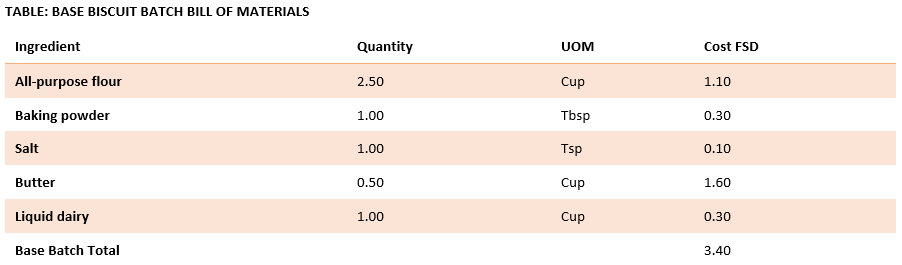
This total of 3.40 FSD serves as the cost reference for pricing, budgeting, and contract negotiations.
How Variations Are Defined
A variation does one of two things.
It either replaces part of the base batch, such as swapping the dairy, or it adds ingredients on top of the base. No variant alters flour or butter quantities without formal review. That rule protects the cost anchor.
The table below lists each biscuit variant discussed, its base, and the additional or modified ingredients that create it. This is the table planners use when reviewing BOM impact and pricing changes.
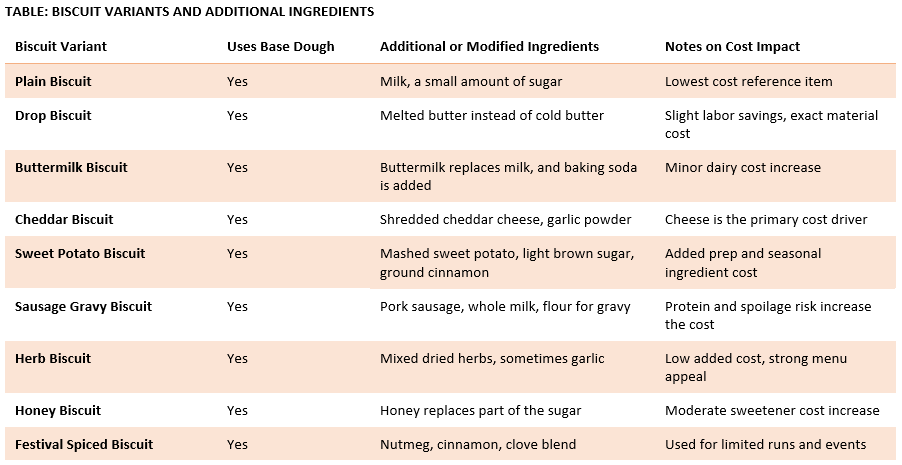
How the Table Is Used
This structure allows the Waterdeep Trading Company to do three things quickly.
First, price changes for butter, flour, or dairy automatically affect all biscuit variants without requiring recipe changes.
Second, premium ingredients such as cheese, pork, or honey are clearly isolated, making margin risk more visible.
Third, seasonal or limited biscuits can be approved or retired by adjusting only the add-on line, not the base product.
Ledger and Product Coding Practice
In WDTC records, the base dough is treated as an internal reference rather than a sellable item. Only the finished variants appear in inventory and sales, each pointing back to the exact base definition.
This keeps kitchens flexible and ledgers clean, even when menus change weekly.
If you’d like, the next step is to convert this table into a full product hierarchy and item numbering scheme that shows how these variants roll up in reporting.
Variant Recipes and BOM Expansions
Each variation below is defined for one base batch.
Plain Biscuit Variation
The plain biscuit is the reference sellable product. It stays close to the base batch, with only a small amount of sweetener added for balance.

This variant is used for bulk supply, breakfast boards, and as the foundation for plated dishes.
Drop Biscuit Variation
The drop biscuit changes process, not material. Butter is melted rather than cut in. The dough is spooned instead of rolled.

This variant exists to reduce labor and waste during peak service.
Buttermilk Biscuit Variation
This variation replaces the liquid dairy and adjusts the leavening chemistry. The structure remains the same.
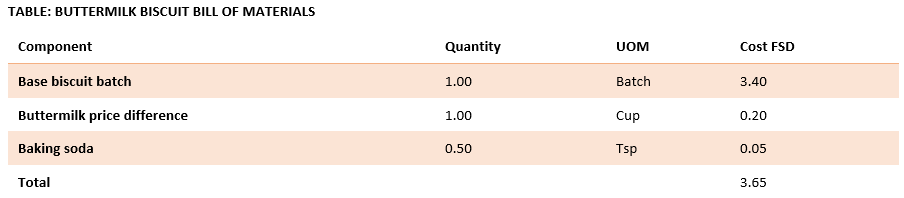
This biscuit commands steady demand and moderate pricing.
Cheddar Biscuit Variation
Cheddar biscuits introduce a high-value ingredient that must be visible and justified at the point of sale.
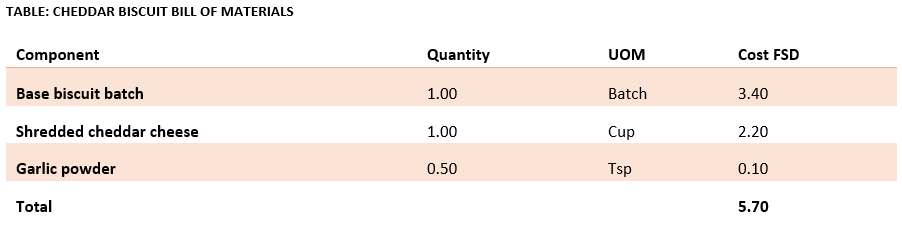
Volatility in cheese costs makes this variant sensitive to supply conditions.
Sweet Potato Biscuit Variation
This is a seasonal biscuit tied to harvest cycles and regional supply.
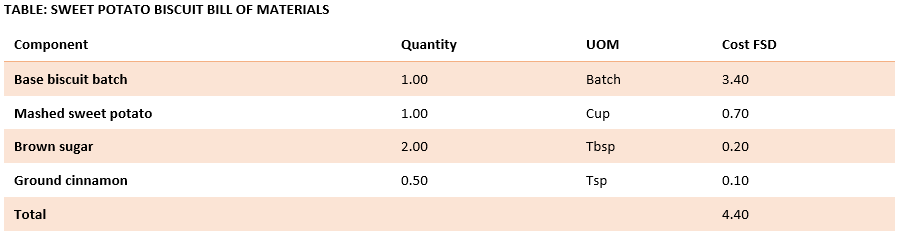
This variant is approved for festivals, autumn menus, and limited runs.
Sausage Gravy Biscuit (Bundled Service Product)
This is not just a biscuit. It is a plated product built on the plain biscuit batch.
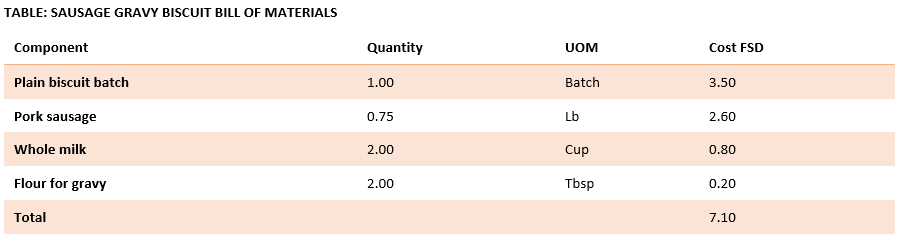
Protein, holding time, and spoilage risk place this firmly in the high cost tier.
Interpreting the Cost Differences
Three tiers appear immediately. Plain, drop, and buttermilk biscuits sit in the low-cost tier and are suitable for volume contracts and daily service. Sweet potato biscuits are in the middle tier, and any added preparation or ingredients must be matched to seasonal pricing. Cheddar and sausage gravy biscuits sit firmly in the high-cost tier and rely on premium positioning to remain profitable.
How This Structure Is Used in Practice
By holding all biscuits to one base batch, the Waterdeep Trading Company gains clear control.
When butter prices rise, every biscuit reflects it instantly. When cheese supply tightens, only cheddar biscuits are affected. Seasonal ingredients stay visible and optional, never hidden.
Kitchens gain flexibility without losing discipline. Accountants gain traceable cost logic. Buyers gain leverage in negotiations.
Final Thoughts
Biscuits in Faerûn may look humble, but they tell the whole story of kitchen economics. One clearly defined base batch supports many variations without confusion. Flavor is added with intent. Cost is never a surprise.
This is how the Waterdeep Trading Company feeds cities, caravans, and guild halls without losing coin along the way.
Support the AD&D365 Project on Patreon. To grow this world, we’ve launched an official Patreon page where supporters can access exclusive content, tools, and training labs, and even influence the project’s future. Your support fuels more than just development; it expands the guildhall, forges new scrolls, and empowers the next generation of configuration wizards. Begin your journey: https://www.patreon.com/adnd365/
A Grateful Salute to Our Patrons. To all those who stand behind the vision, thank you for helping bring this world to life. Our Benefactors, Andre Breillatt and Eryndor Fiscairn‡, your boundless generosity fuels the arcane core of this project. Without your magic, the weave would falter. Our Apprentices, the spell engines turn, and the training labs thrive thanks to our current Apprentices: Michael Ramirez and Andreth Bael’Rathyn‡. Special thanks to our past Apprentices, whose contributions helped us get here: Ralf Weber, Wendy Rijners, Shashi Mahesh, Julia Tejera, Ben Ekokobe, Tiago Xavier, Naveen Boyinapelli, Marcos Tadeu Wolf, Kathryn Greene, Jason Brown, Mark Christy, and Ashish Singh. Our Initiates, Jesper Livbjerg, Peter Lorre, Gregory Brigden, and Martin Grahm, your commitment marks the start of the deeper path, stepping beyond mere observation into the active shaping of this realm. Our Followers, your steady presence along the journey is a beacon of encouragement: Rusty Cavalier, Eric Shuss, Sunil Panchal, Sarah D. Morgan, Nick Ramchandani, Daniel Kjærsgaard, and Tomasz Pałys. And our Voyeurs, Harry Burgh, Abdelrahman Nabil, and Basil Quarrell, ever watching from the shadows, clearly intrigued… but not enough to part with a single gold piece. Your silent curiosity is noted and mildly judged.
Want to design your own economic models in Faerûn? Get your own AD&D365 Environment and guides at adnd365.com/start, and request access to the public view of the current database at https://public.adnd365.com – Login npc@adnd365.com, Password N0nPl@yC#822!








 A Tinkerers Notebook