The world of trade does not belong to Faerûn alone. Commerce has always found its way to the edges of known charts, into harbors where no guild charter holds authority and no lord’s tax collector dares to venture. It is in those contested waters that the Black Tide Trading Company has made its name, and it is through that company’s operations that a new chapter in the Advanced Dungeons and Dynamics 365 series now opens.
This article introduces the Black Tide Trading Company, the pirate-genre companion to the Waterdeep Trading Company. It is a different world, a different currency, and a different set of trade pressures, but the underlying disciplines of accounts receivable, inventory management, procurement, and payroll apply just as surely on the deck of a Caribbean trader as they do in the vaults of Waterdeep’s merchant lords.
A Different Stage, The Same Discipline
The base Advanced Dungeons and Dynamics 365 guides use the Waterdeep Trading Company as the example organization. Every legal entity, every customer account, every vendor relationship, and every fiscal period is configured around that company and its operations across Faerûn.
The Black Tide Trading Company supplement works differently. It is a genre overlay, a companion document that sits alongside each base guide and provides alternative configuration values for readers who want to work through the same ERP concepts in a maritime trading environment. Where the base guide says Waterdeep, the supplement says Tortuga. Where the base guide specifies Waterdeep Gold, the supplement specifies the Piece of Eight.
The concepts taught are identical. The setting is entirely its own.
The Setting: The Caribbean, 1718
The year is 1718. The Caribbean is divided among the competing ambitions of four colonial powers. Spain controls Havana and the silver trade routes running north and east. Britain holds Port Royal and commands the Atlantic passage. The Dutch East India Company operates out of Batavia with a near-total monopoly on Asian spices. The French maintain interests in the Windward Islands, with sugar and colonial supply contracts moving through their own networks.
Into this contested maritime world sails the Black Tide Trading Company. It is not a pirate outfit in the theatrical sense. It flies no Jolly Roger and raids no merchant vessels. Instead, it occupies the profitable grey zone between licensed privateer and licensed trading house, moving cargo across jurisdictional lines that more cautious merchants refuse to cross. Its competitors are not other pirates. They are over-regulated colonial trading houses that cannot react quickly when a pepper crop fails or a Dutch spice convoy arrives six weeks ahead of schedule.
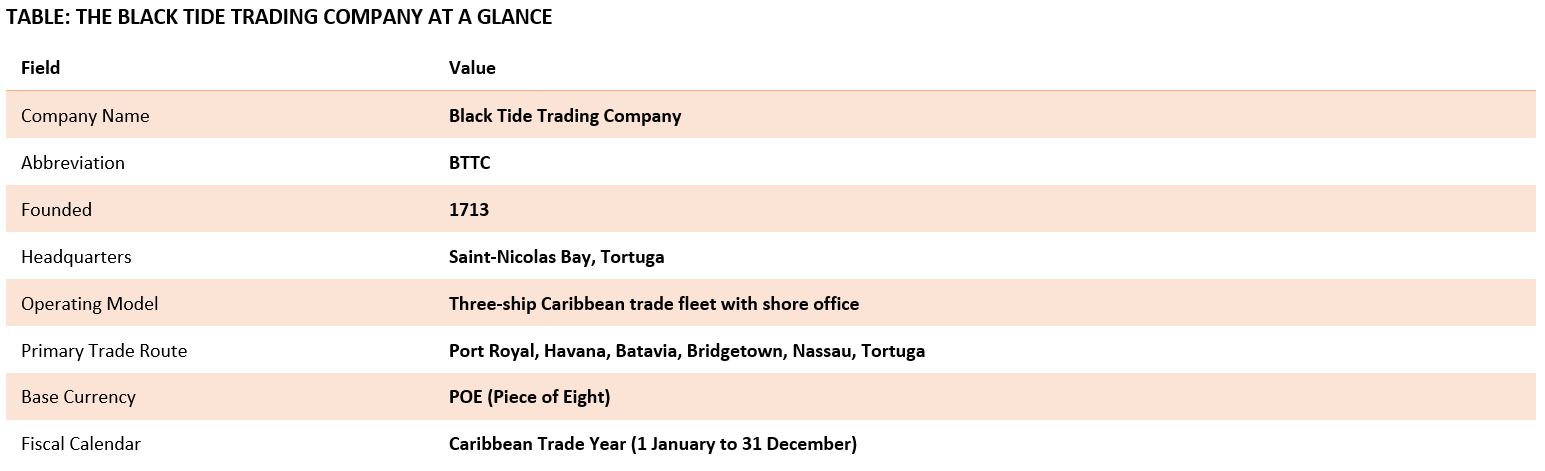
The company operates out of Tortuga, headquartered at the Black Tide Counting House on Saint-Nicolas Bay, and maintains agents and accounts across six ports.
The Fleet: Three Ships, Six Ports
Every voyage the BTTC undertakes is a logistics puzzle. Cargo must be procured months in advance in Batavia, transported across two oceans, and sold into Caribbean markets where prices shift with colonial politics, weather, and supply disruptions. The company’s three ships are its primary inventory-holding units, functioning in the ERP configuration as mobile warehouses.
The following table describes the three vessels that form the backbone of BTTC operations.

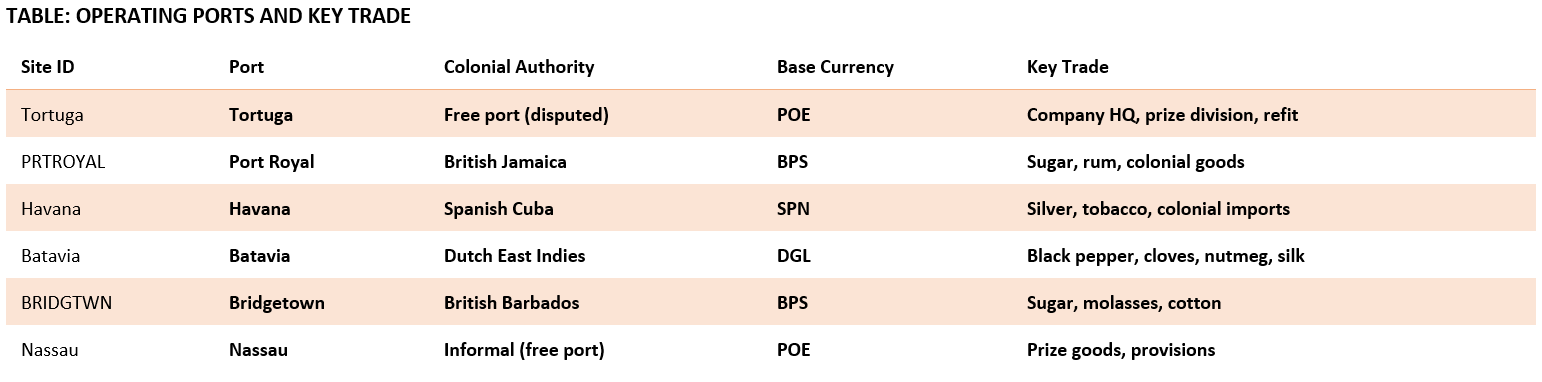
Cargo is loaded at one port and unloaded at another, with each port configured as a separate site in the ERP structure. The six operating ports below represent the geographic scope of BTTC trade.
The People: Who Runs the Black Tide
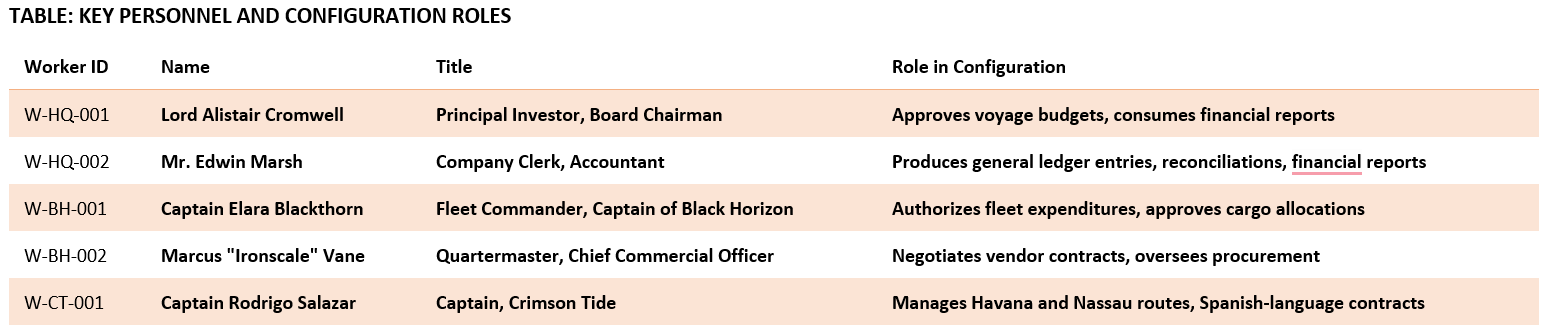
Five individuals make most of the financial decisions that the BTTC configuration guides ask learners to work through. Understanding who they are and what they are responsible for helps place the configuration tasks in their proper operational context.
The following table summarizes the key personnel and their roles within the company.
The company employs sixty workers in total, organized across three ship crews, a Tortuga shore team, and a network of five port agents stationed at each operating location.
The Currency: Trading Across Jurisdictions
One of the most distinctive aspects of BTTC operations is the multi-currency environment. Where the Waterdeep Trading Company operates primarily in Waterdeep Gold, the BTTC moves goods across four colonial currency zones and maintains six additional internal and specialty currencies for crew wages, prize cargo, and luxury trade.
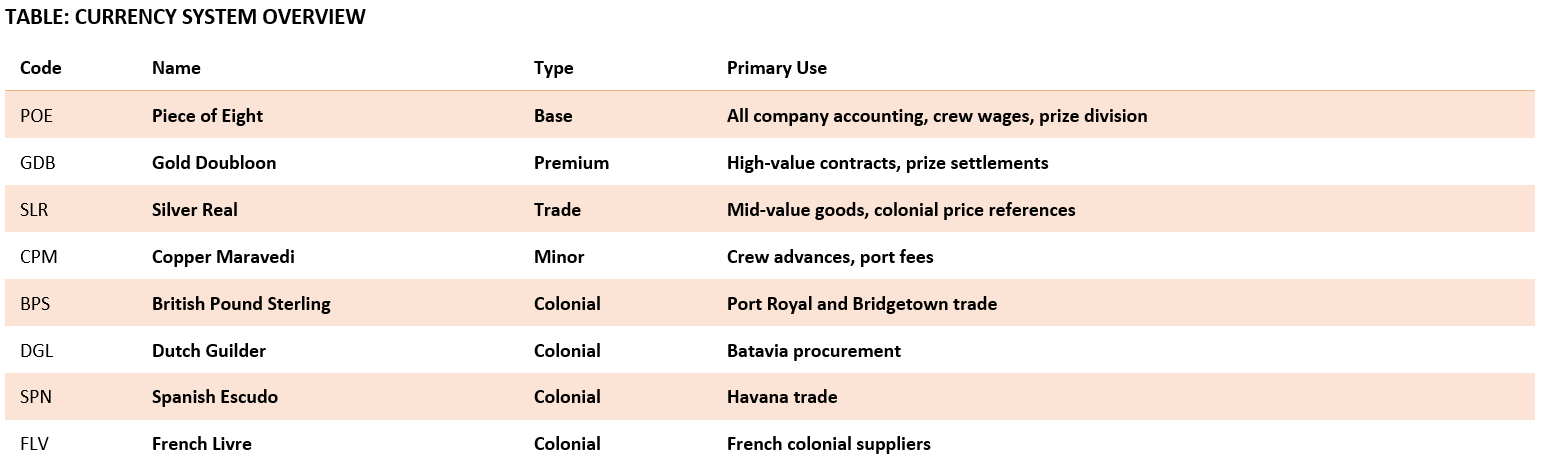
The Piece of Eight is the company’s base currency and serves as the interoperability unit across all accounts. Exchange rates are expressed as POE cross-rates.
The following table shows the core and colonial currencies configured for BTTC operations.
The Products: What the BTTC Trades
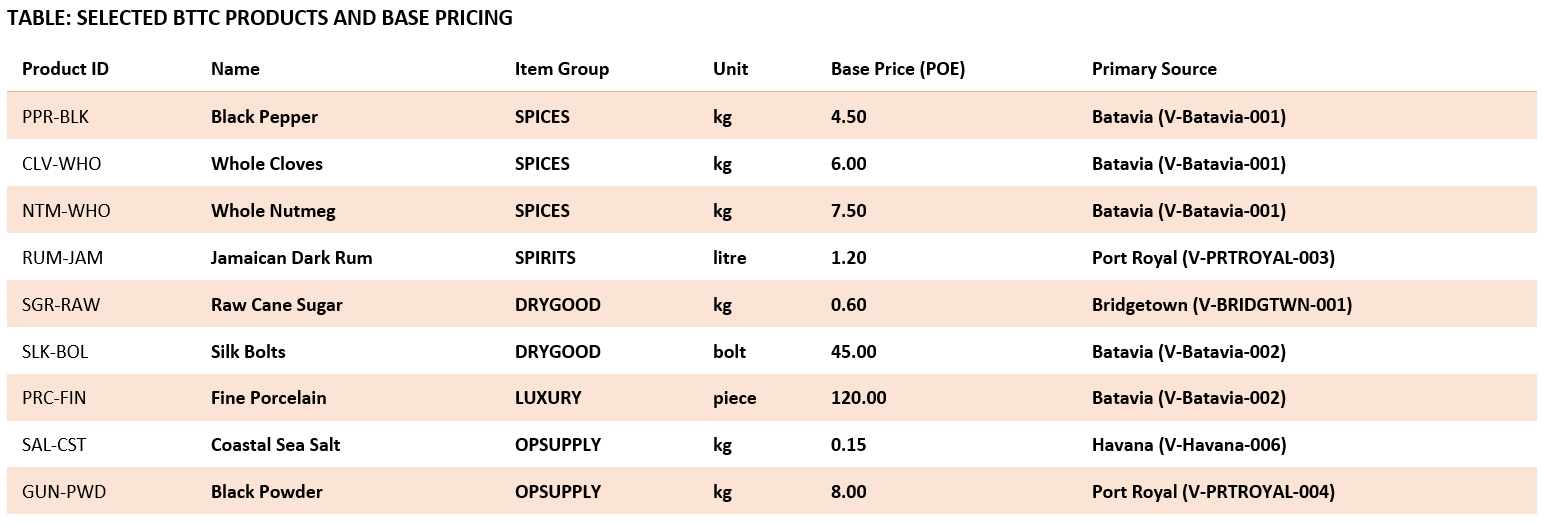
The company carries twenty commodity products spanning Asian spices sourced in Batavia, Caribbean spirits and agricultural goods from Port Royal, Bridgetown, and Havana, and operational supplies that keep the fleet moving. Products are grouped by trade route logic rather than product type, with spices, spirits, dry goods, raw materials, and operational supplies each managed as distinct item groups.
Black pepper is the company’s highest-volume product and the commodity at the center of the primary adventure scenario. It drives the best margins when markets are stable, and it represents the company’s most significant financial exposure when supply and demand fall out of alignment.
The following table shows a selection of key products and their base pricing.
The Adventure: A Planning Failure at Sea
The primary adventure scenario built around the BTTC configuration data is the Spice Route Commodity Run of 1718. The Black Horizon departs Tortuga in March, sails to Batavia, loads a full hold of black pepper and mixed spices, and returns to the Caribbean by September.
The scenario is designed around a demand planning failure. The BTTC loaded more pepper than the market could absorb at the expected sale price. A Dutch spice convoy arrived ahead of schedule, flooding Port Royal and Bridgetown with cheaper pepper, and the company’s revenue projections collapsed below the approved voyage budget.
The sample voyage budget below shows what Lord Cromwell approved before departure, and what Clerk Marsh was left to reconcile upon return.
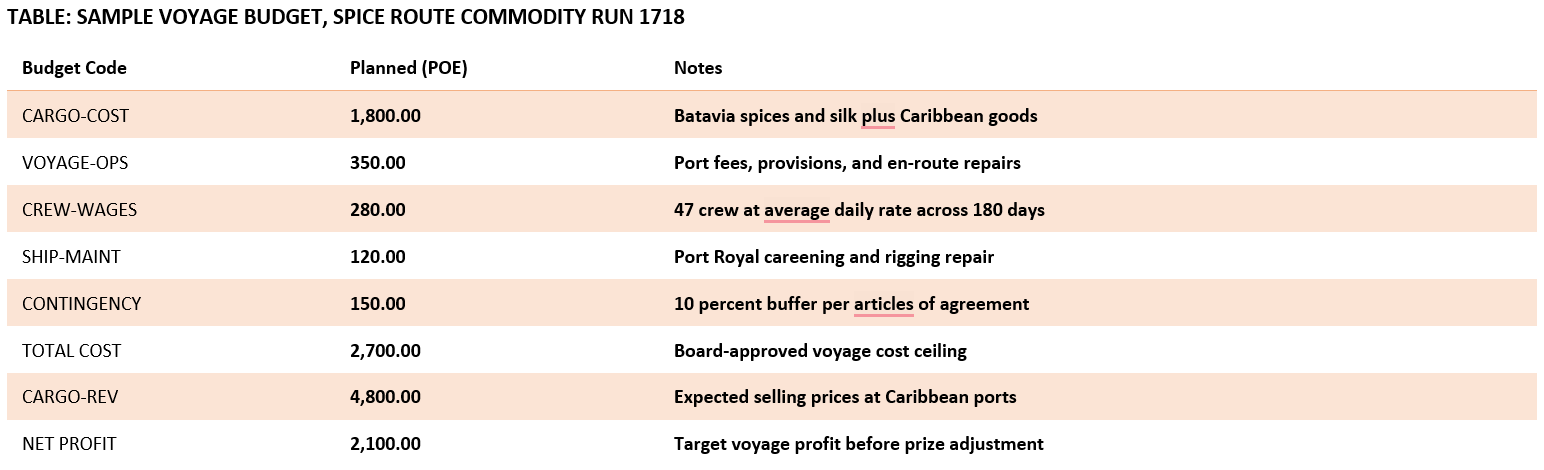
This is the configuration that learners analyze when they complete the adventure. The variance between planned and actual, and the systems that should have flagged the risk earlier, are the practical lessons that the BTTC scenario is built to teach.
How to Use the Supplement
The Black Tide Trading Company supplement is structured to work alongside the base AD&D365 configuration guides, not to replace them. Each guide in the supplement mirrors its corresponding base guide and provides BTTC-specific values for every field that learners are asked to configure.
The approach is straightforward. Open the base guide in one window and the supplement in another. When the base guide asks for a company name, currency code, fiscal calendar, or customer record, find the matching BTTC value in the supplement and enter that instead. The same configuration steps apply. Only the data changes.
This design means that readers who work through the base guides using the Waterdeep Trading Company can return to the same guides and complete a second pass with the BTTC, reinforcing every concept in a different operational context.
Final Thoughts
The Black Tide Trading Company is a different kind of organization from the Waterdeep Trading Company. It operates in a harder world with fewer protections, more currency exposure, a crew that expects a share of every profit, and a voyage budget that can unravel when the Dutch arrive early. But the disciplines it relies on, well-configured accounts, accurate inventory tracking, defensible procurement records, and a payroll system that can calculate voyage shares to the last Piece of Eight, are the same disciplines that any well-run trading operation depends on.
Whether the ledger is kept in Waterdeep Gold or Pieces of Eight, good accounting keeps the ship afloat.
Support the AD&D365 Project on Patreon. To grow this world, we’ve launched an official Patreon page where supporters can access exclusive content, tools, and training labs, and even influence the project’s future. Your support fuels more than just development; it expands the guildhall, forges new scrolls, and empowers the next generation of configuration wizards. Begin your journey: https://www.patreon.com/adnd365/
A Grateful Salute to Our Patrons. To all those who stand behind the vision, thank you for helping bring this world to life. Our Benefactors, Andre Breillatt and Eryndor Fiscairn‡, your boundless generosity fuels the arcane core of this project. Without your magic, the weave would falter. Our Apprentices, the spell engines turn, and the training labs thrive thanks to our current Apprentices: Michael Ramirez and Andreth Bael’Rathyn‡. Special thanks to our past Apprentices, whose contributions helped us get here: Ralf Weber, Wendy Rijners, Shashi Mahesh, Julia Tejera, Ben Ekokobe, Tiago Xavier, Naveen Boyinapelli, Marcos Tadeu Wolf, Kathryn Greene, Jason Brown, Mark Christy, and Ashish Singh. Our Initiates, Jesper Livbjerg, Peter Lorre, Gregory Brigden, and Martin Grahm, your commitment marks the start of the deeper path, stepping beyond mere observation into the active shaping of this realm. Our Followers, your steady presence along the journey is a beacon of encouragement: Rusty Cavalier, Eric Shuss, Sunil Panchal, Sarah D. Morgan, Nick Ramchandani, Daniel Kjærsgaard, and Tomasz Pałys. And our Voyeurs, Harry Burgh, Abdelrahman Nabil, and Basil Quarrell, ever watching from the shadows, clearly intrigued… but not enough to part with a single gold piece. Your silent curiosity is noted and mildly judged.
Want to design your own economic models in Faerûn? Get your own AD&D365 Environment and guides at adnd365.com/start, and request access to the public view of the current database at https://public.adnd365.com – Login npc@adnd365.com, Password N0nPl@yC#822!
 A Tinkerers Notebook