Archive

Tag Archives: inventory-management

Abstract

Rolling cart inventory management is the practice of treating mobile material carts as formal, governed sub-locations within a warehouse structure. This article explains how the Waterdeep Trading Company assigns items to carts, sets par levels to prevent stockouts, and follows a disciplined restocking cycle across its forge halls, enchanting workshops, and dispatch stations. Operations managers, materials planners, and guild inventory stewards will find this guide useful for establishing or improving cart-level controls at any site across Faerûn.

Introduction

Across the markets of Waterdeep, within the forge halls of Baldur’s Gate, and along the trade routes stretching toward Silverymoon, the Waterdeep Trading Company relies not only on grand warehouses and guarded vaults, but on something far humbler: the rolling cart.

Whether stationed beside an enchanter’s bench, a blacksmith’s anvil, or a packing table in the dispatch hall, rolling carts act as mobile inventory nodes. When managed well, they reduce wasted motion, prevent stockouts, and protect margins. When neglected, they become silent drains on coin and productivity.

In a formal inventory structure, a rolling cart is treated as a sub-location within a warehouse. Each cart carries its own assigned site, warehouse code, location identifier, storage dimension group, and default replenishment policy. Rather than forcing artisans to retrieve materials from a distant rack or vault, carts position high-usage items within arm’s reach. This increases throughput and reduces idle labor, and, from a materials management standpoint, the cart serves as a controlled buffer between bulk storage and production consumption.

What Is Rolling Cart Inventory Management?

Rolling cart inventory management is the structured control of materials stored in mobile carts that support production, repair, enchantment, or packing operations. It includes defining which items belong on each cart, setting minimum and maximum quantities, tracking consumption against production orders, replenishing from central warehouse stock, and counting inventory on a scheduled basis.

Unlike primary warehouse inventory, cart inventory turns quickly and is at a higher risk of shrinkage, misplacement, or undocumented use. For that reason, governance must be tighter, not looser.

Why It Matters

Poorly managed carts lead to hidden shrinkage, duplicate purchases, production delays, and the need for emergency procurement at premium prices. Across multiple sites and product lines, these losses compound quickly and erode the margins that keep a trading company competitive.

Well-managed carts produce measurable gains: reduced idle labor time, lower overall warehouse movement, predictable consumption trends, and improved gross margin control. Rolling carts may seem modest in isolation, but across the full network of Waterdeep Trading Company operations, their collective financial impact is anything but minor.

Materials Management at the Cart Level

Rolling carts typically hold fast-moving raw materials, small components and fittings, consumables such as oil, flux, ink, or arcane dust, and frequently used enchanted parts. The Waterdeep Trading Company assigns each cart to a functional area aligned with production routing.

The table below lists the standard cart types used across Waterdeep Trading Company operations, along with their assigned areas and typical contents.
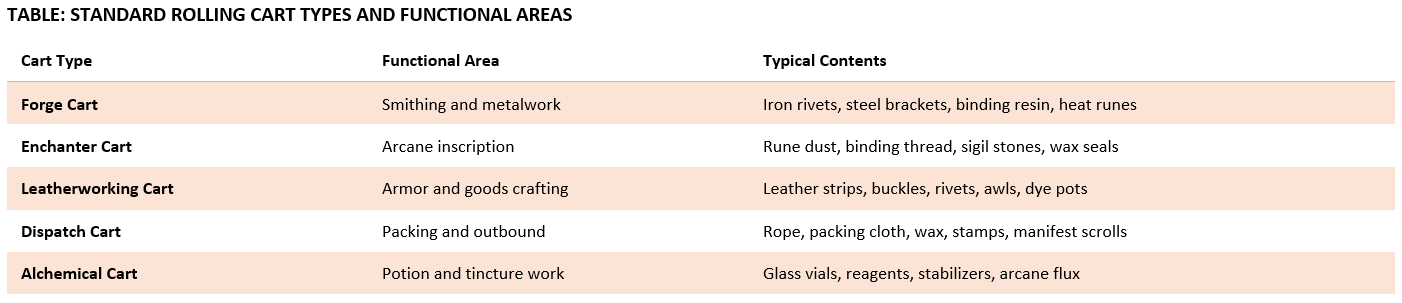
Each cart has a predefined item list that aligns with its production routing. Only approved items may be stocked; no bulk reserve inventory is held on carts. Every withdrawal must be posted to a production or service order, and each cart is assigned to a named, responsible guild member. This transforms the cart from a loose supply tray into a managed micro-warehouse.

Establishing Par Levels

Par levels define how much of each item must remain on the cart to support uninterrupted operations. The Waterdeep Trading Company uses a straightforward but disciplined formula:

Daily Usage multiplied by Lead Time, plus Safety Buffer, equals Par Level.

The safety buffer accounts for demand spikes, delivery delays, and seasonal variation. Without it, even a single missed replenishment can halt production run and trigger costly emergency procurement.

The table below shows a sample par configuration for a Forge Cart, including the maximum working quantity, the replenishment trigger point, and the required buffer to prevent disruption.

Par levels are reviewed quarterly or whenever demand patterns shift significantly. Sites operating in remote or high-risk locations should increase safety buffers to account for longer, less predictable lead times.

The table below shows how par level adjustments might apply across different regions of Faerûn for the same item.

This comparison illustrates why a single company-wide par level is insufficient. Each site must be assessed on its own supply conditions.

Restocking Process and Governance

Restocking is not a casual refill. It follows a defined workflow that ensures every movement of materials is recorded and verified. The five steps below represent the standard restocking cycle used by the Waterdeep Trading Company.

Step 1. Consumption Posting. Materials issued from the cart must be tied to a production order, sales order, or internal job before they leave the cart location. Unposted withdrawals are a primary source of inventory shrinkage and must be treated as a control failure.

Step 2. Reorder Trigger. When the on-hand quantity reaches the reorder point, a replenishment request is generated automatically or flagged to the cart steward. The trigger should be monitored daily in high-volume environments.

Step 3. Internal Transfer. Warehouse staff transfer the required materials from bulk storage to the cart location using a formal transfer journal. No materials should move without a corresponding document, even for internal movements.

Step 4. Verification Count. The cart steward confirms that quantities match the transfer journal before providing sign-off. Discrepancies must be investigated before the transfer is closed.

Step 5. Audit Cycle Count. Due to high turnover, carts are counted weekly as part of the standard inventory audit cycle. Surprise counts should also be performed at least monthly to identify unrecorded withdrawals and assess compliance.

Replenishment Models

The Waterdeep Trading Company applies three replenishment models depending on material type, volume, and supply conditions. Selecting the wrong model for a given item can result in either chronic shortages or wasteful overstocking.

Fixed Par Replenishment refills the cart back to its full par level each time a reorder is triggered. This model works best for high-volume standard components consumed consistently across production runs. It is simple to manage and easy for cart stewards to verify at a glance.

Minimum Trigger Replenishment initiates a restock only when the reorder point is reached. This suits mid-volume materials where demand is predictable but not constant. It reduces unnecessary material movement and keeps warehouse labor costs lower than with a fixed-par approach.

Demand-Based Replenishment ties restocking to scheduled production orders rather than fixed thresholds. This model is best for rare arcane components or controlled substances where over-ordering carries risk, whether due to cost, storage restrictions, or guild regulations. Restocking quantities are calculated from confirmed order requirements rather than standing par targets.

The table below summarizes when each model is most appropriate.

Risk Areas and Control Measures

Rolling carts introduce risk due to their mobility and accessibility. Unlike fixed rack locations, carts can be moved, shared between work areas, or accessed by personnel outside their assigned team. The table below identifies the most common risk categories and the controls the Waterdeep Trading Company applies to address them.
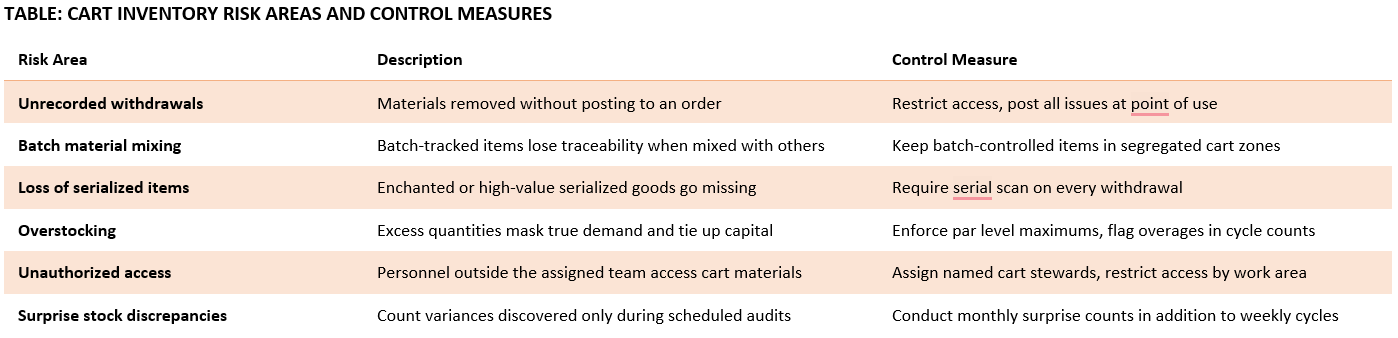
Proper tracking dimensions prevent traceability failures and protect the integrity of production records. Any control gap at the cart level can propagate through costing, batch tracking, and financial reporting, making what appears to be a minor operational issue into a significant audit concern.

Realms-Aware Considerations

The geography and infrastructure of Faerûn introduce variables that a simple par formula cannot always capture. In cities like Waterdeep, lead times are short, and replenishment can occur daily. In frontier settlements near the High Forest or along extended caravan routes, restocking delays may span several tendays, requiring par levels to be increased accordingly.

Arcane materials also require special storage conditions, which can restrict which carts are permitted to carry them. Guild regulations may further define handling protocols, particularly for enchanted or alchemical components. Operations managers should review cart configurations whenever a new site is established or when trade route conditions change significantly.

Final Thoughts

Rolling carts are not minor conveniences. They are controlled inventory nodes that support production efficiency across Faerûn. When governed through disciplined materials management, defined par levels, and structured restocking, they strengthen operational reliability and protect the coin of the Waterdeep Trading Company. Even the smallest mobile shelf, when managed with care, contributes to stable margins and uninterrupted trade.


Support the AD&D365 Project on Patreon.

To grow this world, we’ve launched an official Patreon page where supporters can access exclusive content, tools, and training labs, and even influence the project’s future. Your support fuels more than just development; it expands the guildhall, forges new scrolls, and empowers the next generation of configuration wizards.  Begin your journey: https://www.patreon.com/adnd365/

A Grateful Salute to Our Patrons

To everyone who supports this world, thank you for helping keep it alive and growing.

Our Benefactor: Andre Breillatt. Your generosity powers the heart of this project. Because of you, everything continues to grow and move forward.

Our Apprentices: Michael Ramirez and Andreth Bael’Rathyn‡. The engines keep turning, and the training halls stay alive because of you.

With special thanks to our past Apprentices, whose early support built the foundation:  Ralf Weber, Wendy Rijners, Shashi Mahesh, Julia Tejera, Ben Ekokobe, Tiago Xavier, Naveen Boyinapelli, Marcos Tadeu Wolf, Kathryn Greene, Jason Brown, Mark Christy, and Ashish Singh.

Our Initiates: Sarah D. Morgan, Jesper Livbjerg, Harry Burgh, Martin Frahm, Gregory Brigden, and Peter Lorre. You’ve stepped beyond watching and into shaping what this becomes.

Our Followers: Rusty Cavalier, Eric Shuss, and Michael Ramirez. Your steady backing keeps progress steady.

Our Voyeurs (Free Members): Deborah, Zarana, Daniel Tchakounte, Will Morrison, Danuelle Geldenhuys, Stuart, JoeNorthMan, Kshitiz Sinha, Michael A., Danijel Vucic, Damio, Zamir Gori, LK, Reza Al, Amith Prasanna, Suprit Naregal, Monika Duplessis, Brianna Otto, PW, Laura J, Alan Megahy, Carsten, Carri, Marcel Barrow, Greg, Ahmet, Franky, Abdullah, Basil Quarrell, Abdelrahman Nabil, NPC, Manimaran Shanmugam, and Shoaib Rafi. Ever watching from the shadows, curious but not yet parting with a single gold piece. Your quiet interest is noticed and lightly judged.

Want to design your own economic models in Faerûn? Get your own AD&D365 Environment and guides at adnd365.com/start, and request access to the public view of the current database at https://public.adnd365.com – Login npc@adnd365.com, Password N0nPl@yC#822!
Across Faerûn, goods arrive by wagon, barge, and caravan. Some come from trusted partners. Others arrive with false seals, watered contents, short counts, or missing permits. The Waterdeep Trading Company treats receiving as a line of defense, not a courtesy. Before any crate becomes sellable stock, it must pass controlled checks that protect coin, customers, and reputation.

This article explains how receiving controls work, why they matter, and how they are applied in daily trade. It includes a fully expanded worked example that shows how minor warning signs, when taken together, lead to a clear stop decision before bad goods ever reach the ledger.

What Receiving Controls Are

Receiving controls are the checks performed when goods first arrive at a warehouse, dock, or yard. These checks occur before inventory is posted, invoices are approved, and payments are released.

Every delivery must answer four questions.

  • Is the good correct?
  • Is the quantity correct?
  • Is the quality and origin correct?
  • Is it reasonable to accept and sell?

If any answer fails, the process stops.

Why Receiving Controls Matter

Bad goods cause damage long before a sale occurs. Counterfeit items erode trust. Smuggled goods expose the company to fines and seizure. Short shipments distort inventory counts. Poor quality alcohol or unstable potions can injure customers and trigger guild action.

Strong receiving controls stop loss early. They also create records that support vendor disputes, insurance claims, and guild reporting. Rejecting a shipment at the gate costs far less than recalling it from customers or correcting posted inventory.

Core Receiving Checks

Each delivery passes through the same structured sequence. Some checks are visual. Others are measured or documented. All outcomes are recorded.

Visual Inspection

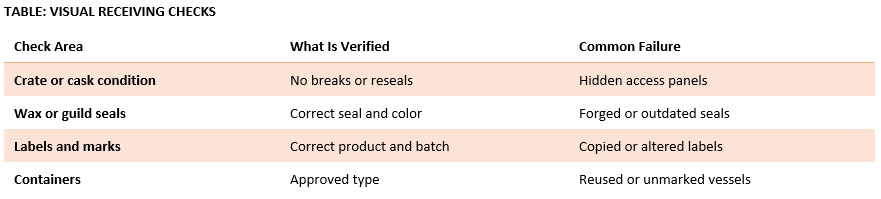
Visual inspection is the earliest and least costly control. It requires no tools, no opening of goods, and no ledger activity. It exists to catch deception before responsibility can be shifted. Once a crate is opened or a seal is broken, disputes become harder to resolve.

In Faerûn, counterfeiters often succeed by forging trust rather than goods. Outdated seals, reused casks, and copied markings are meant to pass a glance. Visual inspection slows the process just enough to expose mistakes. Anything rushed, mismatched, or slightly wrong stops the shipment.

Clerks compare what they see against expectations for the vendor, the season, and the route.

Many counterfeit shipments fail at this first step.

Quantity Verification

Quantity checks protect against silent loss. A shipment that is short by a few units may not raise an alarm at sale time, but it will distort inventory, margins, and trust. Counterfeit and smuggling operations often rely on small shortages spread across many deliveries to stay unnoticed.

By verifying quantities at receipt, the Waterdeep Trading Company assigns responsibility at the correct time. If counts do not match the delivery record, the discrepancy belongs to the shipment, not the warehouse. This prevents later disputes in which loss is attributed to storage or handling.

Repeated short counts across containers indicate planning rather than an accident and trigger deeper review.

Any variance places the shipment on hold.

Quality and Authenticity Checks

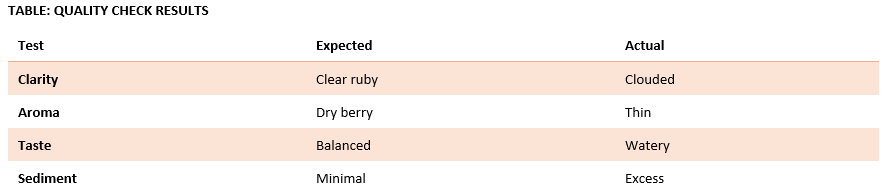
A shipment can be complete and still be wrong. Quality checks exist to protect customers and reputation, not just coin. In Faerûn, watered wine, unstable potions, and low-grade materials cause real harm.

Authenticity checks confirm that goods match known profiles on record. Established producers leave consistent signatures in taste, clarity, weight, weave, balance, or aura. Counterfeiters often copy appearance but fail to replicate substance.

This step ensures the company sells what it claims to sell and creates defensible evidence when a vendor disputes rejection.

Alcohol and potion goods are tested using methods approved by the Faerûn Brewers & Distillers Association. Weapons, armor, and tools follow Black Anvil Guild standards.

Failed goods are never added to available stock.

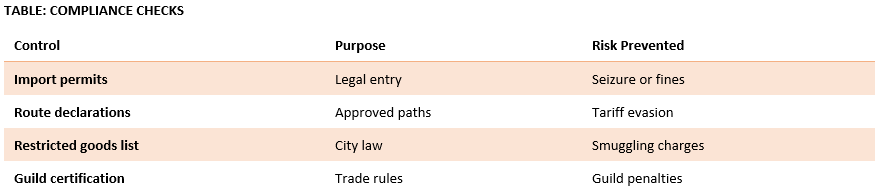
Compliance and Permit Review

Not all risk comes from bad goods. Some risk comes from illegal goods. Compliance checks ensure the company does not become the point at which laws are broken, tariffs are avoided, or restricted items are traded.

Permits tie goods to routes, cities, and guild authority. Smugglers often rely on missing paperwork, reused certifications, or outdated registry numbers to slip through busy gates.

By verifying permits before acceptance, the company avoids fines, seizures, and guild penalties that often exceed the shipment’s value.

Missing or altered documents stop the process immediately.

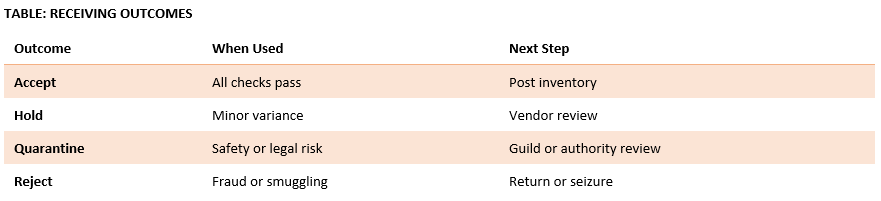
Holds, Quarantine, and Rejection

Receiving is not binary. Not every issue means fraud, and not every failure implies rejection. This step exists to apply a proportional response.

A hold allows clarification without escalation. Quarantine isolates risk while preserving evidence. Rejection removes known threats from the operation entirely.

Clear outcomes prevent informal decisions at the dock or gate.

Quarantined goods are locked, labeled, and excluded from counts.

Expanded Worked Example: Intercepting Counterfeit Wine at Receiving

This example follows a single shipment from arrival to final disposition. It shows how receiving controls work together as a layered system where minor inconsistencies accumulate into a decisive stop.

Scenario Overview

A river barge docks at Waterdeep just after dawn. The cargo includes wine consigned to the Waterdeep Trading Company, marked for resale to noble households ahead of a seasonal feast. The vendor claims the shipment originates from Salington Vinyards, a respected producer with strong demand.

The delivery appears routine. That is precisely why the controls matter.

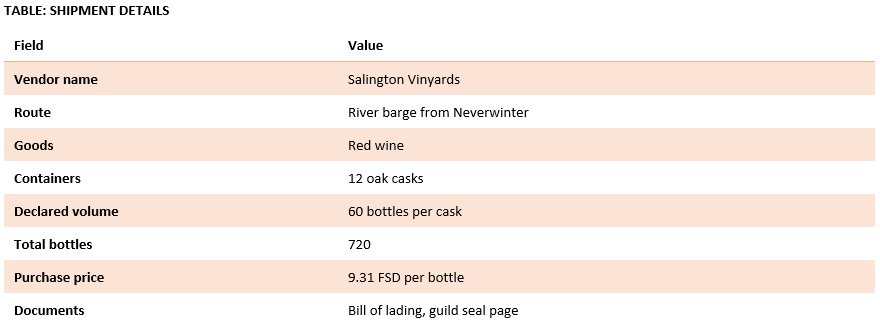
Shipment as Declared

The receiving clerk reviews the declared details before any physical action is taken. This establishes the expectation against which every later check is measured.

No inventory is posted at this stage.

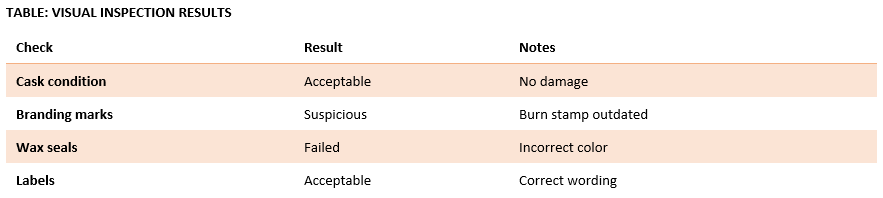
Step 1. Visual Inspection: Setting the first line of defense

Before seals are broken or casks moved, the receiving clerks walk the shipment. This moment fixes responsibility. If something is wrong, it must be found while the goods are still untouched.

Clerks know how Salington shipments typically appear. They see the stamp style used this year and the wax color adopted after the last guild update.

The failed seal breaks trust and triggers a temporary hold.

Step 2. Quantity Verification: Testing whether the paperwork reflects reality

Once visual issues appear, quantity checks become more than routine. Short shipments are a common way to extract value without drawing attention.

Two casks are opened under supervision.

The repeated short fill suggests intent.

Step 3. Quality and Authenticity: Confirming whether the goods are what they claim to be

The question now shifts from how much wine arrived to what wine it actually is.

The wine does not match known profiles on file.

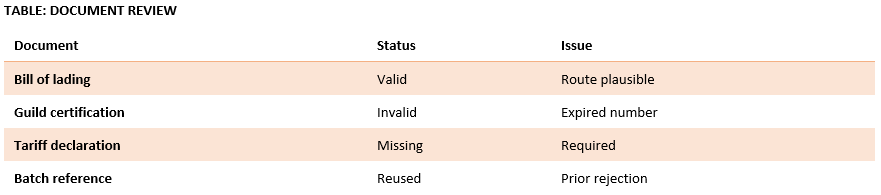
Step 4. Documentation Review: Determining whether the shipment is legal to accept

Paperwork is examined line by line.

Risk escalates from quality concern to legal exposure.

Step 5. Receiving Decision: Applying control without negotiation

The combined failures trigger quarantine.

Casks are sealed and moved to a secure holding area.

Step 6. Ledger and Operational Impact: Protecting the books by doing nothing

Because the shipment was never accepted, there is nothing to reverse.

No write-off is required later.

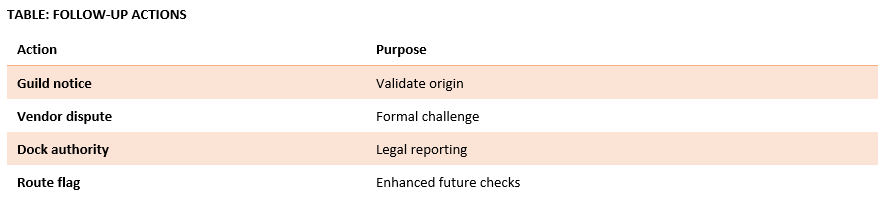
Step 7. Follow Up and Risk Management: Turning one interception into lasting protection

The goal is not only to stop this shipment, but to prevent the next one.

The guild confirms the wine is counterfeit. City authorities seize the casks. Loss is limited to the inspection effort.

Realms Aware Considerations

Controls vary by city and route. Major ports apply stricter inspection. Smaller towns rely more on paperwork and trust, increasing risk. High-value or regulated goods undergo more thorough checks, while staples move faster.

The Waterdeep Trading Company adjusts controls by vendor history, route risk, and product type.

Final Thoughts

Receiving is not unloading. It is protection. Strong receiving controls prevent counterfeit and smuggled goods from reaching the ledger, the shelf, or the customer. Once inventory is posted, every correction incurs additional costs.

The cheapest loss is the one that stops at the gate.


Support the AD&D365 Project on Patreon.  To grow this world, we’ve launched an official Patreon page where supporters can access exclusive content, tools, and training labs, and even influence the project’s future. Your support fuels more than just development; it expands the guildhall, forges new scrolls, and empowers the next generation of configuration wizards.  Begin your journey: https://www.patreon.com/adnd365/

A Grateful Salute to Our Patrons.  To all those who stand behind the vision, thank you for helping bring this world to life. Our Benefactors, Andre Breillatt and Eryndor Fiscairn, your boundless generosity fuels the arcane core of this project. Without your magic, the weave would falter. Our Apprentices, the spell engines turn, and the training labs thrive thanks to our current Apprentices: Michael Ramirez and Andreth Bael’Rathyn. Special thanks to our past Apprentices, whose contributions helped us get here: Ralf Weber, Wendy Rijners, Shashi Mahesh, Julia Tejera, Ben Ekokobe, Tiago Xavier, Naveen Boyinapelli, Marcos Tadeu Wolf, Kathryn Greene, Jason Brown, Mark Christy, and Ashish Singh. Our Initiates, Jesper Livbjerg, Peter Lorre, Gregory Brigden, and Martin Grahm, your commitment marks the start of the deeper path, stepping beyond mere observation into the active shaping of this realm. Our Followers, your steady presence along the journey is a beacon of encouragement: Rusty Cavalier, Eric Shuss, Sunil Panchal, Sarah D. Morgan, Nick Ramchandani, Daniel Kjærsgaard, and Tomasz Pałys. And our Voyeurs, Harry Burgh, Abdelrahman Nabil, and Basil Quarrell, ever watching from the shadows, clearly intrigued… but not enough to part with a single gold piece. Your silent curiosity is noted and mildly judged.

Want to design your own economic models in Faerûn?  Get your own AD&D365 Environment and guides at adnd365.com/start, and request access to the public view of the current database at https://public.adnd365.com – Login npc@adnd365.com, Password N0nPl@yC#822!

In the merchant halls of Waterdeep, the potion caves of Baldur’s Gate, and the floating markets of Yartar, supply chains never sleep. To stay competitive, the Waterdeep Trading Company has embraced a model that allows vendors to deliver goods directly into our warehouses while retaining ownership. This practice is called Vendor Consigned Inventory, and it is as much about trust as it is about timing.

What Is Vendor Consigned Inventory

Vendor consigned inventory is a trade agreement in which a supplier delivers goods to the Waterdeep Trading Company, but retains ownership until the items are drawn, used, or sold. We hold the stock in our storerooms, ready to deploy, but do not pay until those goods are consumed.

This is a popular model for high-volume, high-value, or high-risk products. It allows the vendor to establish a strong presence in our distribution chain while WDTC avoids tying up coin in idle inventory.

Key Characteristics

Why It Benefits Vendors and WDTC

Vendor consigned inventory provides shared advantage. It is well suited for dynamic, multi-city operations like those run across Faerûn’s trade routes.

Faster Stock Availability: Stock is already in place. There is no delay due to shipment or customs approval. This is critical when responding to festival surges, urgent orders, or magical emergencies.

Lower Inventory Cost for WDTC: No upfront purchase means less coin locked in non-moving items. This makes room for a wider variety of vendor products to be available.

Improved Vendor Visibility: Vendors see real-time data on their consigned stock in our facilities. They can track drawdowns and plan restocking efforts precisely, even from distant cities like Elturel or Suzail.

Stronger Partnership Bonds: Vendors who consign with us often gain early access to seasonal forecasts, priority placement in our storefronts, and invitations to participate in specialty events.

The Process in Practice

Delivery and Receiving

Upon arrival, vendor inventory is inspected, rune-marked, and entered into the consignment ledger under a Vendor Ownership ID. Items are held in designated consignment zones until drawn.

Draw Events

Inventory is drawn when:

  • A customer purchases the product from a store or portal
  • The item is used in a kit, bundle, or manufacturing recipe
  • The item hits a spoilage or magical expiration threshold

Each draw event triggers a financial journal posting and notifies the vendor.

Settlement and Reporting

The system issues periodic settlement statements that include:

  • Quantity drawn since last settlement
  • Agreed-upon pricing and discounts
  • Payment due for each draw event
  • Inventory on hand at each warehouse location

Replenishment Triggers

The system monitors thresholds and predicts future demand using our enchanted forecasting model. Vendors are alerted when restocking is needed, and if desired, the replenishment order can be triggered automatically.

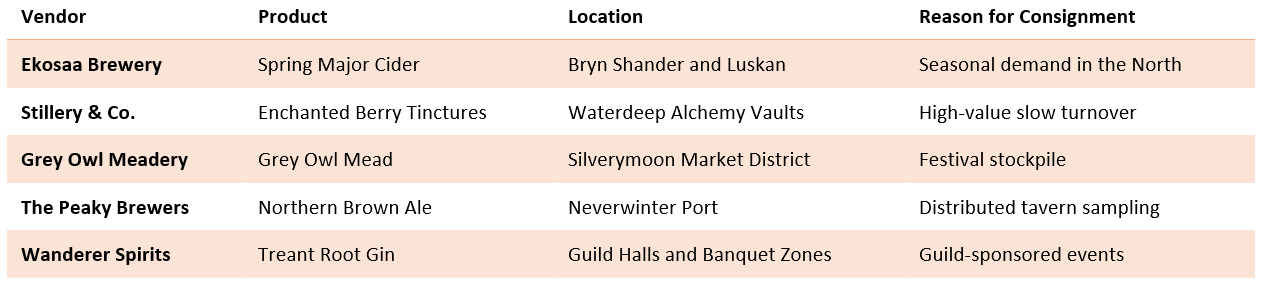
Examples of Vendor Consignment in Faerûn

Best Practices for Managing Vendor Consigned Inventory

  • Define clear ownership and draw point rules for each product
  • Use magical seals and ledger mirrors to track inventory status
  • Review stock levels weekly using the vendor inventory portal
  • Establish shared replenishment rules to avoid overstocking
  • Monitor draw event reports for accuracy and audit readiness

Closing Thoughts

Vendor consigned inventory brings power and flexibility to both sides of the supply chain. Vendors gain access to wide Faerûnian markets, and the Waterdeep Trading Company keeps its shelves stocked without overburdening its coffers. With magic-bound ledgers and real-time reporting tools, we make it easy to maintain trust and traceability.

Ready to become a trusted consignment vendor with the Waterdeep Trading Company? Start by visiting adnd365.com/start and request access to our public consignment portal at https://public.adnd365.com

Username: npc@adnd365.com

Password: N0nPl@yC#822!