Abstract
Physical assets across Faerûn differ by how they exist in space. Some occupy a single location, some stretch between points, and some cover entire areas. Each type behaves, fails, and incurs different costs. The Waterdeep Trading Company classifies its holdings into point-based assets (warehouses, towers), linear assets (roads, walls), and polygon-based assets (districts, mining claims). This classification determines inspection schedules, maintenance strategies, accounting treatment, and risk management. Understanding these distinctions prevents waste, protects coin, and keeps trade flowing even when disaster strikes.
Introduction
In the bustling realm of Faerûn, the Waterdeep Trading Company controls more than goods and coin. From the stone docks of Baldur’s Gate to the winding Trade Way and the fortified warehouses of the Dock Ward, the company manages a vast network of physical holdings. Roads, warehouses, docks, districts, mines, caravan routes, and fortified towers all fall under its stewardship.
But not all assets are the same. A warehouse is not a road. A road is not a mining claim. Each behaves differently, creates different costs, and carries different risks. Treating them all as simple ledger entries leads to poor records, weak cost control, and disputes with guilds and city rulers.
To avoid this, the Waterdeep Trading Company classifies its physical assets into three distinct types: point-based, linear, and polygon-based. This classification is not an academic exercise. It reflects how assets actually exist in space, how they fail, and how they must be maintained.
What These Asset Types Are
Physical assets differ in how they exist in space. Some exist at a single location. Some stretch from one place to another. Some cover an entire area. Each type needs its own rules for value, upkeep, and control.
Point-based assets exist at a single fixed location, with a clear position and defined footprint. Warehouses, dock cranes, watchtowers, city gates, and market stalls all qualify. You can mark them on a map with one dot.
Linear assets run from one location to another with length and direction. Trade roads, caravan routes, city walls, aqueducts, and tunnels all function this way. They have multiple points of failure along their length.
Polygon-based assets cover an area with boundaries and internal variation. Mining claims, market districts, warehouse compounds, port zones, and agricultural estates all represent this type. They cannot be reduced to a single point or line.
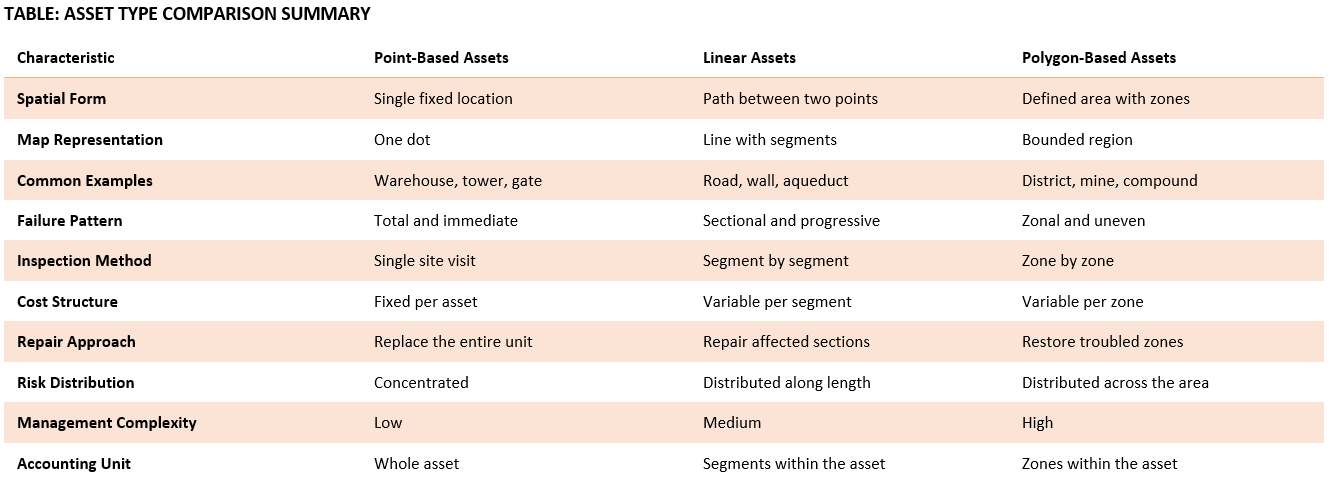
The following table summarizes the key characteristics of each asset type, showing how they differ in spatial existence, failure patterns, management complexity, and accounting treatment. This comparison provides a foundation for understanding why classification matters.
Why the Classification Matters
Treating all assets the same causes errors. Point assets fail suddenly. Linear assets fail locally. Polygon assets fail unevenly. Each type needs different inspection cycles, cost posting rules, risk planning, and control methods.
The Waterdeep Trading Company avoids disputes, losses, and surprise costs by keeping these distinctions clear. When a guild challenges ownership, the company knows exactly what is claimed. When a disaster strikes, the company knows exactly what is lost. When costs rise, the company knows exactly where to cut.
This is not abstract theory. This is practical survival in a world where roads collapse, warehouses burn, and mining claims flood. The company that correctly classifies its assets is the one that stays profitable.
Point-Based Assets: Single Location Holdings
A point-based asset exists at one fixed location. It has a clear position, a defined footprint, and a single set of ownership records. You can mark it on a map with one dot and know exactly what you control.
Common Examples in Faerûn
Warehouses in Waterdeep, dock cranes at a harbor, watchtowers along the Trade Way, city gates, arcane relay towers, and market stalls owned outright all qualify as point-based assets. Each has a single address, a single deed, and a single point of failure.
Why It Matters
Point assets are easy to value and audit. They have clear ownership, direct maintenance costs, and can be secured or lost as a whole. When a warehouse burns, the entire asset is affected at once. When a watchtower falls to raiders, the loss is complete and immediate.
This makes point assets straightforward to insure, defend, and replace. The costs are predictable. The risks are visible. The control is absolute.
Operational Management
Point assets require single-point inspections. The entire asset can be assessed in one visit. Guards can be posted at one location. Repairs affect the whole structure at once. Insurance premiums are calculated on total replacement value.
The company maintains detailed records for each point asset, including construction date, original cost, accumulated depreciation, current condition rating, and estimated remaining useful life. Annual inspections determine whether the asset remains serviceable or requires major intervention.
Accounting Treatment
Point assets are treated as capital holdings. They are capitalized at purchase or construction cost, depreciated over time, and repaired or replaced as single units. When the company buys a warehouse, the full purchase price is recorded as an asset. When it burns, the full value is written off.
Depreciation is calculated using the straight-line method based on the expected useful life. A stone warehouse might depreciate over 50 years. A wooden market stall might depreciate over 15 years. Major improvements extend useful life and increase book value. Minor repairs are expensed in the current period.
The following table shows typical point assets and the main costs the Waterdeep Trading Company tracks for each type. These cost drivers determine how much the company spends annually to keep each asset operational and protected.

Risk Assessment
Point assets face concentrated risk. A single fire, flood, or raid can destroy the entire holding. This makes location selection critical. Warehouses near water sources are at risk of flooding. Watchtowers in contested territory face the risk of raids. Market stalls in high-traffic areas face a higher risk of theft.
The company mitigates risk through strategic placement, redundant holdings, and comprehensive insurance. No single point asset carries more than 10 percent of the company’s total property value. This prevents catastrophic loss from a single incident.
Linear Assets: Path and Boundary Holdings
A linear asset runs between two locations. It has length, direction, and multiple points of failure. Unlike a point asset, a linear asset cannot fail all at once. Damage in one section affects the whole, but the asset continues to exist in parts.
Common Examples in Faerûn
Trade roads, caravan routes, city walls, aqueducts, underground tunnels, and river shipping lanes under charter all function as linear assets. A road from Waterdeep to Daggerford is one asset, but damage at any mile affects the whole. A city wall protects an entire perimeter, but a breach in one section compromises the entire defense.
Why It Matters
Linear assets fail in sections, not all at once. Costs vary by segment. Risk changes by location. A bridge collapse impacts trade even if the rest of the road is intact. A wall breach in one quarter does not mean the entire fortification must be rebuilt.
This makes linear assets more complex to manage. Inspection must be continuous. Repairs must be targeted. Risk assessment must be granular. The company that treats a road as a single unit will waste coin repairing strong sections while ignoring weak ones.
Operational Control
The company tracks linear assets by segments. Each segment has length, condition, upkeep cost, and risk rating. This allows partial closures and targeted repairs. When a bridge on the Trade Way collapses, the company closes only the affected segment. Trade is rerouted. Repairs are budgeted for one section, not the entire road.
Segment length is determined by natural divisions. Bridges, gates, and terrain changes all mark segment boundaries. A road through flat farmland might be segmented every 10 miles. A road through mountains might be segmented at every pass, bridge, and switchback.
Condition ratings follow a standard scale: Excellent, Good, Fair, Poor, Critical. Excellent segments require minimal maintenance. Critical segments require immediate intervention. The company prioritizes repairs based on condition rating and strategic importance.
Accounting Treatment
Linear assets are capitalized as a whole but maintained in parts. Repairs are often expensed per segment. Major rebuilds increase asset value. A complete road repaving increases the asset’s capitalized value. A minor pothole repair is expensed in the current period.
The total asset value is divided proportionally by segment length and quality. A stone-paved segment in good condition carries a higher book value than a dirt segment in poor condition. This allows precise loss calculation when a segment fails.
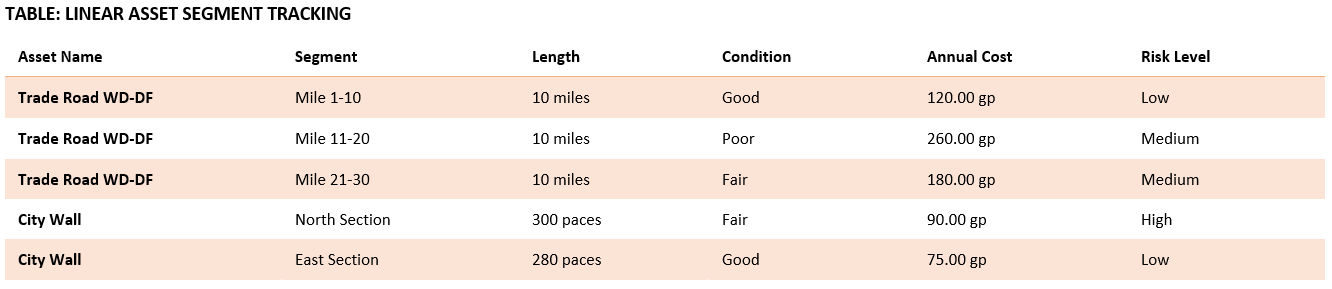
The following table demonstrates how the Waterdeep Trading Company divides linear assets into manageable sections for tracking condition and maintenance costs. Each segment is monitored separately, allowing precise cost control and targeted intervention.
Risk Assessment
Linear assets face distributed risk. Damage to one segment degrades the entire asset but does not destroy it. This creates complex risk scenarios. A road with one weak bridge is only as reliable as that bridge. A wall with one breached section is only as secure as that breach.
The company conducts rolling inspections, reviewing each segment on a scheduled cycle. High-risk segments are inspected quarterly. Low-risk segments are inspected annually. This prevents surprise failures and allows proactive maintenance.
Weather patterns, bandit activity, monster migration routes, and political instability all affect segment risk ratings. A road through peaceful farmland has a low risk. A road through contested borderlands has a high risk. The company adjusts maintenance budgets and insurance premiums accordingly.
Segment Optimization
The company continuously evaluates whether to maintain, reroute, or abandon segments. A road segment that costs more to maintain than it generates in toll revenue is a candidate for abandonment. A wall segment that protects nothing of value is a candidate for decommissioning.
This optimization prevents wasted resources. The company does not maintain roads that no one travels or walls that protect empty fields. Resources are concentrated on segments that generate value and protect critical holdings.
Polygon-Based Assets: Area and Territory Holdings
A polygon-based asset covers an area. It has boundaries, internal variation, and shared control. Unlike point assets, which exist at a single location, or linear assets, which stretch between two points, polygon assets occupy space. They have zones, districts, and territories within their boundaries.
Common Examples in Faerûn
Mining claims, forested timber rights, market districts, warehouse compounds, port zones, agricultural estates, and city wards under charter all represent polygon-based assets. These assets cannot be reduced to a single point or line. They have internal complexity, varied terrain, and multiple sources of value.
Why It Matters
Polygon assets generate value across space. Different sections may earn different revenue, face different risks, or require different upkeep. A mine produces more in one vein than another. A district has streets that profit and streets that drain coin. A warehouse compound has yards that earn rent and yards that sit empty.
This makes polygon assets the most complex to manage. Value is distributed unevenly. Costs are hard to predict. Risk varies by zone. The company that treats a market district as a single asset will miss the profitable streets and overpay for the failing ones.
Operational Control
Polygon assets are divided into zones for management and accounting. Each zone has defined boundaries, assigned use, revenue potential, and cost structure. The company tracks performance by zone, identifying which areas generate profit and which areas drain resources.
Zone boundaries follow natural divisions. In a market district, zones might align with streets or blocks. In a mining claim, zones might align with veins or shafts. In a warehouse compound, zones might align with yards or buildings.
Zone use determines value. A loading zone generates more revenue than a storage zone. An active mining zone generates more revenue than a flooded zone. A high-traffic market zone generates more revenue than a back-alley zone.
Accounting Treatment
Polygon assets are often treated as controlled territories. Value comes from output, rent, taxation rights, and access control. Costs are tracked by zone within the area. When the company controls a mining claim, it does not record one asset. It records multiple zones, each with its own cost structure and revenue potential.
Total asset value is allocated by zone based on productive capacity and revenue history. A zone that generates 40 percent of total revenue carries 40 percent of total asset value. This allows precise profitability analysis and investment decisions.
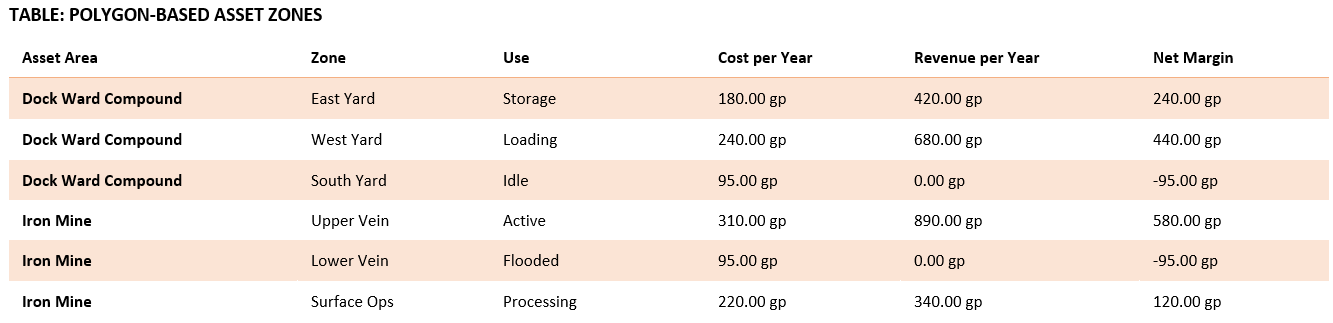
The following table illustrates how area-based assets are divided into zones, each with its own use classification and annual cost allocation. This zoning approach allows the company to identify which areas generate profit and which areas drain resources.
Risk Assessment
Polygon assets face zoned risk. Damage to one zone degrades that zone but may not affect others. A fire in one warehouse yard does not burn the entire compound. A collapse in one mine shaft does not close the entire mine. A riot in one market street does not shut down the entire district.
This creates risk management opportunities. The company can isolate high-risk zones with barriers, separate operations, and independent access. A flooded mine shaft is sealed off while other shafts continue production. A riot-prone market street is fenced while other streets continue to trade.
However, polygon assets also face systemic risk. A plague in one district zone can spread to others. A fire in one compound yard can jump to others. Contamination in one mine vein can poison others. The company must balance zone isolation with systemic monitoring.
Zone Optimization
The company continuously evaluates zone performance and allocation. Underperforming zones are candidates for reallocation, subleasing, or abandonment. The South Yard in the table above generates no revenue but costs 95 gold pieces annually. The company has three options: find a tenant, repurpose the space, or abandon it.
High-performing zones receive additional investment. The West Yard generates the highest margin in the compound. The company might expand loading capacity, add equipment, or improve access to capture more business. This optimization maximizes return on territory holdings.
Worked Example: Trade Access Between Waterdeep and Daggerford
The company controls trade access between Waterdeep and Daggerford through three distinct asset types. Each serves a different purpose, fails in different ways, and costs differently. Understanding how they interact demonstrates the practical value of asset classification.
The Point Asset: Toll House
The toll house at Waterdeep city gate is a classic point asset. This structure collects fees from all travelers entering the city. It has a single location, a single function, and a single point of failure.
The toll house is valued at 2,400 gold pieces with annual maintenance costs of 180 gold pieces. It generates 3,200 gold pieces in annual toll revenue. If the toll burns, the tolls stop instantly. The entire asset is lost at once. Trade can continue, but revenue collection stops until the structure is rebuilt.
The company maintains fire insurance on the toll house with a replacement value policy. In the event of total loss, insurance covers rebuilding costs minus a 10 percent deductible. This protects the company from catastrophic loss while incentivizing fire prevention.
The Linear Asset: The Road
The road itself stretches 30 miles from Waterdeep to Daggerford. This linear asset has three segments, each with its own condition and cost structure, as shown in the earlier table.
Total road value is 18,000 gold pieces with annual maintenance costs of 560 gold pieces across all segments. The road generates indirect revenue by enabling trade, but its value is measured in trade volume enabled rather than direct tolls.
If the road washes out at one bridge in segment two, trade slows but does not stop everywhere. Caravans reroute through segments one and three at reduced speed. Repairs are budgeted at 1,200 gold pieces for the affected segment only. The asset continues to function at reduced capacity while repairs proceed.
The company prioritizes segment two for major investment because its poor condition creates the highest risk of trade disruption. A 2,000-gold-piece upgrade would improve conditions from Poor to Good, reduce annual maintenance from 260 to 140 gold pieces, and eliminate high-risk closures.
The Polygon Asset: Market District
The bonded market district at the Daggerford end covers 12 acres, divided into six zones. Each zone has different characteristics, costs, and revenue potential. The company holds exclusive trade rights to the district under a charter from the Daggerford City Council.
The total district value is 45,000 gold pieces, with annual costs of 1,850 gold pieces and annual revenue of 6,400 gold pieces. Net margin is 4,550 gold pieces, making this the most profitable component of the trade access system.
If the market district experiences unrest in one zone, revenue drops only in that zone. Some merchants close. Some stay open. The asset degrades in parts, not all at once. The company can isolate troubled zones, increase security, negotiate with local guilds, and restore order incrementally.
Zone three, the central market square, generates 35 percent of total district revenue on only 15 percent of total space. This makes it the most valuable zone per acre. The company invests heavily in maintaining square conditions, strong guild relationships, and a strong security presence to protect this revenue stream.
Integrated Risk Management
Each asset type in this system requires different risk management. The toll house needs fire insurance and security guards. The road needs weather monitoring and segment inspection. The market district needs guild relationships and zone security.
A catastrophic event affects each asset differently. A military invasion might destroy the toll house, block the road, and shutter the market district. But recovery follows different paths. The toll house is being rebuilt as a unit. The road is cleared segment by segment. The market district reopens zone by zone.
Understanding these differences allows the company to prioritize recovery, allocate resources efficiently, and restore trade quickly. The company that treats all three as simple assets will waste time, coin, and opportunity in crisis response.
The Strategic Value of Asset Classification
Point, linear, and polygon-based assets are not abstract ideas. They reflect how land, roads, and holdings actually behave across Faerûn. A warehouse is not a road. A road is not a mining claim. Each has its own rules, risks, and costs.
By classifying assets correctly, the Waterdeep Trading Company protects its coin, plans repairs properly, argues contracts clearly, and keeps trade flowing even when trouble strikes. This classification shapes everything from insurance premiums to maintenance schedules to legal disputes.
Realms Aware Considerations
Faerûn adds extra pressure to asset control. Magic damage is often localized. A fireball strikes one warehouse, not the entire compound. Monsters target roads more than buildings. Bandits attack caravans on open stretches, not fortified gates. City charters define area rights tightly. A market district may belong to the company, but the streets belong to the city.
Guild claims often overlap zones. The Blacksmiths Guild may claim rights to one quarter of a mining district. The Merchants Guild may claim exclusive access to one street in a market. The company that ignores asset type will find itself in legal fights, guild fines, or lost trade privileges.
By correctly classifying assets, the company knows exactly what it owns, what it controls, and what it must defend. This clarity prevents disputes before they start and protects the company’s reputation across Faerûn.
Final Thoughts
Whether you oversee a single warehouse or a network of caravan routes, this classification system will serve you well. The principles are universal. The benefits are immediate. The company that masters asset classification is the company that survives and prospers across Faerûn.
Start with a simple inventory. List every physical asset you control. Mark each as a point, a line, or a polygon. Adjust your ledgers, your inspections, and your risk planning accordingly. The investment is small. The protection is substantial. Your coin, your reputation, and your trade depend on it.
Support the AD&D365 Project on Patreon.
To grow this world, we’ve launched an official Patreon page where supporters can access exclusive content, tools, and training labs, and even influence the project’s future. Your support fuels more than just development; it expands the guildhall, forges new scrolls, and empowers the next generation of configuration wizards. Begin your journey: https://www.patreon.com/adnd365/
A Grateful Salute to Our Patrons
To everyone who supports this world, thank you for helping keep it alive and growing.
Our Benefactors: Rovado and Andre Breillatt. Your generosity powers the heart of this project. Because of you, everything continues to grow and move forward.
Our Apprentices: Michael Ramirez and Andreth Bael’Rathyn‡. The engines keep turning, and the training halls stay alive because of you.
With special thanks to our past Apprentices, whose early support built the foundation: Ralf Weber, Wendy Rijners, Shashi Mahesh, Julia Tejera, Ben Ekokobe, Tiago Xavier, Naveen Boyinapelli, Marcos Tadeu Wolf, Kathryn Greene, Jason Brown, Mark Christy, and Ashish Singh.
Our Initiates: Sarah D. Morgan, Jesper Livbjerg, Harry Burgh, Martin Frahm, Gregory Brigden, and Peter Lorre. You’ve stepped beyond watching and into shaping what this becomes.
Our Followers: Rusty Cavalier, Eric Shuss, Jeff Berberich, and Michael Ramirez. Your steady backing keeps progress steady.
Our Voyeurs (Free Members): Deborah, Zarana, Daniel Tchakounte, Will Morrison, Danuelle Geldenhuys, Stuart, JoeNorthMan, Kshitiz Sinha, Michael A., Danijel Vucic, Damio, Zamir Gori, LK, Reza Al, Amith Prasanna, Suprit Naregal, Monika Duplessis, Brianna Otto, PW, Laura J, Alan Megahy, Carsten, Carri, Marcel Barrow, Greg, Ahmet, Franky, Abdullah, Basil Quarrell, Abdelrahman Nabil, NPC, Manimaran Shanmugam, and Shoaib Rafi. Ever watching from the shadows, curious but not yet parting with a single gold piece. Your quiet interest is noticed and lightly judged.
Want to design your own economic models in Faerûn? Get your own AD&D365 Environment and guides at adnd365.com/start, and request access to the public view of the current database at https://public.adnd365.com – Login npc@adnd365.com, Password N0nPl@yC#822!





 A Tinkerers Notebook