Archive

Tag Archives: poetry

The Waterdeep Trading Company knows that profit is not only what is carried, but how, when, and in what quantity it is delivered. Perishable goods demand speed, luxury goods reward distance, and transportation—whether caravan, ship, or portal—carries its own costs. Scale, the merchant’s hidden lever, can turn a marginal route into a fortune.

Perishables: Fighting Spoilage

Perishable goods—food, drink, herbs, potions, and livestock—lose value with time. Every week of travel cuts into margin unless preserved by salt, ice, or enchantment.

  • Caravans: slow, cheaper per unit, but high spoilage.
  • Ships: faster, large loads, but weather-sensitive.
  • Portals: instantaneous, preserve freshness, but costs scale poorly.

Luxuries: Gaining with Distance

Luxury goods—spices, silks, jewelry, perfumes, planar reagents—gain value with distance. Buyers pay for scarcity, prestige, and the risks endured to bring them.

  • Caravans: increase value with each league, but invite theft.
  • Ships: move bulk luxuries at moderate cost, maximizing margin.
  • Portals: flatten distance premiums, but allow nobles to secure rare goods instantly.

The Role of Transportation & Scale

Transportation cost is not fixed. Moving one crate by teleportation circle may equal the cost of an entire caravan. Merchants calculate economy of scale before deciding the method.

Caravan Freight

  • Cost: Low per unit when wagons are full.
  • Scale Advantage: Larger caravans reduce per-unit guard and wagon costs.
  • Limitation: Spoilage eats margin for perishables.

Maritime Shipping

  • Cost: Moderate per unit, with large holds reducing cost further.
  • Scale Advantage: Best for bulk grain, silks, and ore.
  • Limitation: Risk of storms and piracy.

Arcane Portals

  • Cost: Extremely high base (e.g., 500 FSD per casting).
  • Scale Advantage: Costs spread across more goods if the portal is fully loaded.
  • Limitation: Not suited to bulk, but invaluable for high-value perishables and urgent luxuries.

Comparative Economics Table

To bring these principles together, it is helpful to compare how different goods behave under varying methods of transport and scale. The following table illustrates the practical economics of moving both perishables and luxuries by caravan, ship, or portal, showing not only the base cost of each method but also how per-unit expenses shift when moving small loads versus bulk consignments. By examining both spoilage and appreciation alongside transportation cost, merchants can see where profit is gained, where coin is lost, and why the Waterdeep Trading Company selects routes with such care.

Realms-Aware Considerations

While ledgers and tables reveal the numbers, true trade in Faerûn is shaped by the lands, climates, and powers that goods must cross. A caravan moving through the frozen North faces different challenges than a ship sailing to Calimshan, just as planar imports demand rules unlike any mortal route. These local and magical conditions shape spoilage, scarcity, and demand in ways no simple calculation can capture. The following considerations highlight the realities that every Waterdeep Trading Company factor must weigh before sending a wagon, ship, or spell across the Realms.

  • Bulk vs. Urgency: Grain caravans thrive on scale; healing potions justify portal expense.
  • Climate: Hot regions make portal transport more attractive for perishables.
  • Noble Demands: Aristocrats often pay for instant luxury, ignoring efficiency.
  • Planar Imports: Exotic reagents justify high costs because no local substitute exists.

Final Thoughts

Economy of scale separates thriving merchants from failed ones. Perishables belong to wagons and ships unless urgency demands portals. Luxuries grow more valuable with distance, but risk premiums and transport costs must be measured carefully. The Waterdeep Trading Company prospers by balancing spoilage, scarcity, transportation, and scale to turn every journey into profit.


Support the AD&D365 Project on Patreon.

To grow this world, we’ve launched an official Patreon where supporters can gain access to exclusive content, tools, training labs, and even influence the future of the project. Your support fuels more than just development ,  it expands the guildhall, forges new scrolls, and empowers the next generation of configuration wizards.  Begin your journey: https://www.patreon.com/adnd365/

A Grateful Salute to Our Patrons

To all those who stand behind the vision, thank you for helping bring this world to life. Our Benefactors, Andre Breillatt, and Eryndor Fiscairn, your boundless generosity fuels the arcane core of this project. Without your magic, the weave would falter. Our Apprentices, the spell engines turn and the training labs thrive thanks to our current Apprentices: Michael Ramirez and Andreth Bael’Rathyn. Special thanks to our past Apprentices, whose contributions helped us get here:  Ralf Weber, Wendy Rijners, Shashi Mahesh, Julia Tejera, Ben Ekokobe, Tiago Xavier, Naveen Boyinapelli, Marcos Tadeu Wolf, Kathryn Greene, Jason Brown, Mark Christy, and Ashish Singh. Our Initiates, Gregory Brigden, and Martin Grahm, your commitment marks the start of the deeperFpath, stepping beyond mere observation into the active shaping of this realm. Our Followers, your steady presence along the journey is a beacon of encouragement:  Eric Shuss, Sunil Panchal, Sarah D. Morgan, Nick Ramchandani, Daniel Kjærsgaard, and Tomasz Pałys. And our Voyeurs, Harry Burgh, Abdelrahman Nabil, and Basil Quarrell, ever watching from the shadows, clearly intrigued… but not enough to part with a single gold piece. Your silent curiosity is noted, and mildly judged.

Want to design your own economic models in Faerûn?

Get your own AD&D365 Environment and guides at adnd365.com/start, and request access to the public view of the current database at https://public.adnd365.com – Login npc@adnd365.com, Password N0nPl@yC#822!

In the bustling workshops and enchanted forges of Faerûn, the reputation of the Waterdeep Trading Company rests on the quality of its goods. From rune-etched cauldrons to barrels of ale, consistency is key. To maintain that standard, the company employs structured methods of inline and continuous item sampling during production. These practices ensure that defects are caught early, magical anomalies are corrected, and customers across the Sword Coast receive only the finest merchandise.

What It Is

Production is not simply the act of crafting an item—it is the weaving together of material, labor, and enchantment into something worthy of trade. At every step, flaws may appear: impurities in ore, unstable runes, mismeasured herbs, or even disruption from ambient magic. Inline sampling and continuous sampling are the two chief practices for safeguarding against such failures. Inline sampling takes precise snapshots of quality at chosen points in the line, while continuous sampling acts as an ever-vigilant sentinel, monitoring the flow without pause. Together, they form a shield against defects and unreliability in the production halls of Faerûn.

Inline sampling refers to taking quality samples at defined checkpoints within the production line. This could be after the shaping of a steel blade, midway through a potion distillation, or upon the weaving of an enchanted fabric.

Continuous sampling involves monitoring product quality throughout the entire production flow. Instead of relying on static checkpoints, it constantly draws information—through inspection, testing, or even arcane sensors—to flag issues as soon as they arise.

Both methods are integral parts of a quality control system within Faerûn’s manufacturing houses and are supported by enchanted ledgers that track results automatically.

Why It Matters

Every caravan that departs Waterdeep bears the reputation of the Company with it. A cracked cauldron in Baldur’s Gate or a spoiled potion in Calimport can tarnish not just a shipment but the very trust of an entire guild or city. By embedding sampling practices into production, the Company ensures that goods arriving in far-off markets meet the highest standards. More than a technical necessity, these practices fulfill guild contracts, appease inspectors, and honor the confidence of customers who expect perfection from every crate, cask, and casting.

Inline and continuous sampling matter because they:

  • Reduce waste by catching defects before they reach final assembly
  • Protect brand reputation by ensuring goods are consistent
  • Meet guild regulations, such as those set by the Brewers & Distillers or Arcane Artificers’ Union
  • Provide traceability for compliance with magical safety standards
  • Support continuous improvement of both mundane and arcane production processes

Components of Inline Sampling

Inline sampling is deliberate and structured, demanding that checkpoints be chosen wisely. A single overlooked step can allow imperfections to slip downstream. By establishing these checkpoints—whether at the forge, the loom, or the distillery—workers carve moments of certainty out of an otherwise complex flow. Each checkpoint becomes a watchtower along the supply route, guarding the line against creeping errors. The Company records not just results, but the very methods of inspection, so that apprentices learn, guilds are reassured, and auditors find confidence in the paper and rune trails alike.

Inline sampling typically includes:

  • Checkpoint Definition: Identifying critical stages in the production route where a sample must be taken.
  • Sample Size: Deciding how many items to test from each batch or flow.
  • Inspection Method: Visual, mechanical, or magical checks depending on the item.
  • Documentation: Recording results in production journals, often supported by enchanted runes or Dynamics 365 ledgers.

Components of Continuous Sampling

Continuous sampling carries this watchfulness further, embedding quality vigilance into the very heartbeat of production. Instead of stopping to examine at intervals, it uses enchanted crystals, mechanical gauges, or even bound elementals to watch every item as it moves. No forge can produce endlessly flawless goods, but continuous monitoring ensures that the moment cracks form, or magical energy fluctuates, the line is alerted. This constant oversight is akin to a cleric’s ward, shielding not through occasional ritual but through ceaseless guardianship.

Continuous sampling builds on these by:

  • Using real-time detection tools, such as crystal sensors for potion stability or weight-runes for milling consistency.
  • Applying statistical or arcane process control to spot trends.
  • Ensuring ongoing compliance, with alerts that automatically halt a production line if thresholds are breached.

Worked Example: Enchanted Steel Cauldron

The enchanted steel cauldron is one of the Waterdeep Trading Company’s most popular items, sold to merchants, alchemists, and inns across the Sword Coast. Its strength lies not only in its steel but in the delicate balance of enchantments that allow it to withstand flame, frost, and magical reactions. To maintain this reputation, both inline and continuous sampling are employed throughout its production cycle.

Step 1: Smelting and Pouring

As dwarven smelters pour molten steel into molds, inline sampling occurs every twentieth ladle. A portion of the steel is cooled, tested for purity, and checked for proper alloy balance. If traces of brittle slag are found, the entire melt is flagged for rework. At the same stage, continuous sampling is achieved by placing rune-marked weights at the base of the molds. These weights glow red if the density shifts outside acceptable limits, alerting workers instantly.

Step 2: Shaping and Hammering

When the cauldron halves are hammered into form, inline sampling involves removing one cauldron per shift and testing rim thickness with enchanted calipers. Results are logged into the quality ledger for guild review. Continuous sampling here is subtler: rune-etched anvils hum and glow whenever force distribution strays, catching uneven strikes that could cause long-term weakness.

Step 3: Enchanting

Perhaps the most critical stage, enchantments must bind evenly across the steel. Inline sampling includes channeling a simple flame spell into every fiftieth cauldron, verifying that the enchantment disperses heat without distortion. Meanwhile, continuous sampling is carried out by crystals embedded above the enchanting circle. These crystals pulse whenever magical resonance falters, allowing enchanters to halt the ritual before an unstable cauldron is finalized.

Step 4: Cooling and Finishing

During cooling, inline sampling involves pulling random cauldrons and filling them with boiling water to test for sudden cracks. The tests are witnessed by both smiths and guild auditors. Continuous sampling comes through rune-bands laid along the cooling racks, which hum in harmony when the cauldrons contract evenly. A discordant note warns of hidden fractures invisible to the naked eye.

Step 5: Packing and Dispatch

Before the cauldrons are crated and sealed for caravan, the sampling process continues. Inline checks inspect branding marks and serial runes on selected cauldrons to ensure traceability. Continuous oversight comes from arcane sigils painted on the storage pallets that glow if any item deviates from the recorded sample standard.

By employing both sampling methods, the Waterdeep Trading Company ensures that not a single enchanted cauldron leaves the forge untested. Customers in Calimport can set them over dragon-fire stoves, alchemists in Baldur’s Gate can brew volatile mixtures within them, and nobles in Silverymoon can serve feasts with pride—all without fear of failure.

Realms-Aware Considerations

Unlike purely mundane factories, Faerûn’s production halls contend with shifting magical fields, guild regulations, and planar oddities. Inline and continuous sampling must be adapted for each region and product. A brewer in Silverymoon might emphasize sensory sampling to detect subtleties of taste enchanted by moonlight, while a smith in Luskan must focus on structural checks to prevent flaws in steel. When trade stretches across planes, additional layers of stability and safety are imposed, ensuring that what survives a planar forge remains safe once carried back to Waterdeep. In the Realms, quality control is as much an art of adaptation as it is of procedure.

In Faerûn, these methods must adapt to local conditions:

  • Arcane Influence: Magical surges may distort results; continuous wards are often required.
  • Regional Guild Standards: Brewers in Silverymoon use stricter taste tests than smiths in Baldur’s Gate.
  • Planar Supply Chains: Items crafted in cross-planar forges demand additional stabilization tests.

Final Thoughts

Inline and continuous item sampling are more than mundane quality tools—they are safeguards of trust in a realm where goods may carry both physical and magical consequences. For the Waterdeep Trading Company, they ensure that every cauldron, potion, and enchanted saddle leaving its gates strengthens its reputation as the Sword Coast’s most reliable trading house.


Support the AD&D365 Project on Patreon.

To grow this world, we’ve launched an official Patreon where supporters can gain access to exclusive content, tools, training labs, and even influence the future of the project. Your support fuels more than just development ,  it expands the guildhall, forges new scrolls, and empowers the next generation of configuration wizards.  Begin your journey: https://www.patreon.com/adnd365/

A Grateful Salute to Our Patrons

To all those who stand behind the vision, thank you for helping bring this world to life. Our Benefactors, Andre Breillatt, and Eryndor Fiscairn, your boundless generosity fuels the arcane core of this project. Without your magic, the weave would falter. Our Apprentices, the spell engines turn and the training labs thrive thanks to our current Apprentices: Michael Ramirez and Andreth Bael’Rathyn. Special thanks to our past Apprentices, whose contributions helped us get here:  Ralf Weber, Wendy Rijners, Shashi Mahesh, Julia Tejera, Ben Ekokobe, Tiago Xavier, Naveen Boyinapelli, Marcos Tadeu Wolf, Kathryn Greene, Jason Brown, Mark Christy, and Ashish Singh. Our Initiates, Gregory Brigden, and Martin Grahm, your commitment marks the start of the deeperFpath, stepping beyond mere observation into the active shaping of this realm. Our Followers, your steady presence along the journey is a beacon of encouragement:  Eric Shuss, Sunil Panchal, Sarah D. Morgan, Nick Ramchandani, Daniel Kjærsgaard, and Tomasz Pałys. And our Voyeurs, Harry Burgh, Abdelrahman Nabil, and Basil Quarrell, ever watching from the shadows, clearly intrigued… but not enough to part with a single gold piece. Your silent curiosity is noted, and mildly judged.

Want to design your own economic models in Faerûn?

Get your own AD&D365 Environment and guides at adnd365.com/start, and request access to the public view of the current database at https://public.adnd365.com – Login npc@adnd365.com, Password N0nPl@yC#822!

In the wards of Waterdeep, work begins before dawn and ends when the last cart clears the gate. Foremen count crates, baristas tune grindstones, and clerks balance ledgers by lantern light. The Waterdeep Trading Company thrives when each role is measured with clarity and coached with purpose. This article gathers the company rating models, anchors, and prompts into one reusable guide. It turns scattered checklists into a single practice that is fair, fast, and ready for audit in every city of the Sword Coast.

What It Is

This is a complete evaluation framework for crews and stewards across shops, warehouses, caravans, and labs. It defines rating scales with pass rules, gives behavior anchors for everyday tasks, and packages a clean question set for reviews. It also includes targeted follow-ups for training exceptions and a worked example that shows the scoring pattern.

Why It Matters

Consistent ratings reduce disputes and speed coaching. Anchors cut guesswork between shifts and locations. Pass rules support auditors and guild inspectors. Together, these practices improve service, limit rework, and raise throughput without risking safety or compliance.

Rating Models at a Glance

This section introduces the scales used across the company. Each model has a factor used in scoring, a pass rule, and a plain description. Use this overview to pick the right model before you rate a task.

The following table summarizes every model the Waterdeep Trading Company uses for performance and compliance. Keep this close at hand when preparing reviews or building dashboards. It doubles as a quick reference so stewards can choose the correct scale without searching through scrolls.

BARS5, Behavior Anchors for Common Roles

This section explains the behavior scale with concrete anchors for three common duties. Use these anchors to keep ratings consistent between wards and shifts, especially when crews rotate between lanes.

The next table turns the BARS5 scale into specific, observable behaviors across three role families. These anchors reduce rater drift, help new stewards calibrate quickly, and give employees clear targets for advancement.

Training Status and Follow Through

This section covers training completion states and the actions that keep the roster compliant. Use the status table for scoring and the follow up table to close gaps without delay.

The next table shows every completion state along with factor and pass rule. It is the single source of truth for auditors and guild inspectors. Pair it with the follow up table that follows to convert exceptions into dated action.

Use the next table whenever a training item is failed or exempt. These prompts create a corrective path with ownership and due dates. This prevents repeat exceptions and keeps the ledger of learning clean.

Skill Proficiency

This section records how strong a skill is in daily work. Use the five level table for detailed roles, and the three level table for quick snapshots during ladder reviews.

The table below defines five proficiency levels with factors and pass rules. Use it for hands on roles like brewing, picking, and station work. It is also helpful when proposing cross training or merit increases.

Use the next table when a quick snapshot is needed for role mapping. It supports talent reviews, crew assignments, and leadership identification with minimal overhead.

Compliance and Observation

This section captures policy status and live task checks. Use it to certify safe practice on the floor and to keep inspection scrolls in order.

The following compliance table aligns policy status to clear outcomes. It is designed for quick sign off during monthly reviews and for guild inspections. It ensures that remediation steps are tracked when gaps appear.

Use the observation table that follows to document what was seen at the station. It is the evidence trail for sign off and prevents disputes about readiness.

Frequency, Security, License, and Audit

This section covers measures that guide training plans and risk posture, including frequency of use, security drills, credentials, and audits.

The next table is informational. It captures how often a skill is used. This helps planners time refreshers and rotate crews to maintain muscle memory without wasting tuition.

Security incidents in Faerûn include trapped parchments and false sending stones. The table below records the latest outcome for drills or real events. It pairs well with refresher coaching notes.

Credentials keep dangerous work safe, from forklifts to alchemical vessels. Use the next table to track standing, schedule renewals, and satisfy inspectors.

Audits keep shops and warehouses honest. The next table provides a simple four level record for findings. Use it with CAPA logs to close issues before the next inspection.

Attendance matters for classroom and on the job sessions. Use the table below to record presence and to trigger make up training when needed.

Short UI Tooltips

This section gives single line hints for forms and dashboards. Use them as hover text or small print under field labels when building review scrolls or crystals.

The table below condenses each model into a one line helper. It improves speed during entry and reduces confusion for new stewards.

The Question Set, Ready to Use

This section presents the evaluation prompts in a single checklist. Use the right model beside each prompt, and add notes when the prompt calls for narrative detail.

The next table maps every prompt to the correct model. Take it onto the floor for mid-period checks, and keep a copy in the steward’s office for end-of-period reviews. It allows one pass from behavior through growth planning.

When a completion exception appears, use the prompts below without delay. This keeps the training ledger current and prevents repeat findings at the next inspection.

Worked Example, Mid-Period Snapshot

This section shows a filled example for a picker barista in the Dock Ward. Use it as a model for scoring and notes during mid period coaching.

The next table presents a complete snapshot with selections, factors, pass results, and short notes. It demonstrates how to convert observations into clear scores and actions that carry into the next moon.

Quick Capture Sheet for Field Use

This section gives a one-page capture layout for clipboards and tablets in loud stations. Copy it into a form and keep it near the time board so stewards can complete reviews between rushes.

The next table lists the capture fields in the order a steward will encounter them during a review. It keeps the process fast, traceable, and consistent with the scales above.

Realms Aware Considerations

Travel time varies by ward and season, so judge behaviors first and adjust expectations only when evidence shows outside forces at play. Arcane devices require extra care, so apply compliance with attention to sanitation charms and containment runes. Security awareness includes trapped parchments and false sending stones, treat them like suspicious links, report, isolate, purge. For roaming caravans, pin observations to the city and day to keep context clear for audits.

Final Thoughts

Post the scales in steward stations, add the tooltips to forms, and keep the capture sheet close at hand. Rate the behavior you see most, write brief notes, and close every exception with an owner and a date. End each review with two strengths, one development area, and two or three goals that can be verified on the floor. In this way the Waterdeep Trading Company keeps its promise to crews and clients across Faerûn.


Support the AD&D365 Project on Patreon.

To grow this world, we’ve launched an official Patreon where supporters can gain access to exclusive content, tools, training labs, and even influence the future of the project. Your support fuels more than just development, it expands the guildhall, forges new scrolls, and empowers the next generation of configuration wizards.  Begin your journey: https://www.patreon.com/adnd365/

A Grateful Salute to Our Patrons

To all those who stand behind the vision, thank you for helping bring this world to life. Our Benefactors, Andre Breillatt, and Eryndor Fiscairn, your boundless generosity fuels the arcane core of this project. Without your magic, the weave would falter. Our Apprentices, the spell engines turn and the training labs thrive thanks to our current Apprentices: Michael Ramirez and Andreth Bael’Rathyn. Special thanks to our past Apprentices, whose contributions helped us get here:  Ralf Weber, Wendy Rijners, Shashi Mahesh, Julia Tejera, Ben Ekokobe, Tiago Xavier, Naveen Boyinapelli, Marcos Tadeu Wolf, Kathryn Greene, Jason Brown, Mark Christy, and Ashish Singh. Our Initiates, Gregory Brigden, and Martin Grahm, your commitment marks the start of the deeper path, stepping beyond mere observation into the active shaping of this realm. Our Followers, your steady presence along the journey is a beacon of encouragement:  Eric Shuss, Sunil Panchal, Sarah D. Morgan, Nick Ramchandani, Daniel Kjærsgaard, and Tomasz Pałys. And our Voyeurs, Harry Burgh, Abdelrahman Nabil, and Basil Quarrell, ever watching from the shadows, clearly intrigued… but not enough to part with a single gold piece. Your silent curiosity is noted, and mildly judged.

Want to design your own economic models in Faerûn?

Get your own AD&D365 Environment and guides at adnd365.com/start, and request access to the public view of the current database at https://public.adnd365.com – Login npc@adnd365.com, Password N0nPl@yC#822!

From the anvil halls of the Black Anvil Guild to the silk-threaded studios of the Grand Artisans League, apprenticeships are the lifeblood of skilled labor across Faerûn. For the Waterdeep Trading Company and affiliated guilds, integrating apprentices into active production environments ensures not only continuity of craft but also operational resilience. However, such integration requires careful structuring, balancing training, certification, and workplace safety.

This article outlines how Faerûnian guilds manage apprentice participation on the production floor, detailing learning outcomes, certification paths, and the governance necessary to mitigate risk and uphold standards.

What It Is

Apprenticeship Integration is the structured onboarding of novice guild members into real-world production activities. Unlike classroom instruction or simulation-based learning, this model places apprentices directly on workshop floors, caravan logistics teams, or alchemical lines, under the guidance of journeymen and masters.

Why It Matters

For the Waterdeep Trading Company and its guild partners, apprentices are not mere students, they are future masters, capable of carrying on the art and trade. Integration allows:

  • Accelerated skill acquisition through practical experience
  • Early detection of talent and specialization pathways
  • Reduced training costs through in-situ instruction
  • Strengthening of guild labor pipelines during peak demand

Components of the Integration Framework

The successful inclusion of apprentices on live workstations or production environments requires structure. The table below outlines the key components:

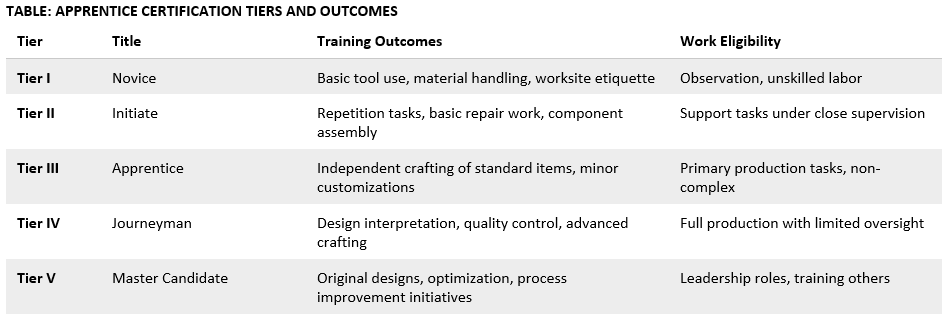
Training Outcomes by Certification Tier

Each certification level within a guild defines the scope of permissible work and the expected outcomes. Below is a model used by the Grand Artisans League:

Risk Mitigation When Working with Apprentices

Letting apprentices on the shop floor is not without risk. The Waterdeep Trading Company applies the following strategies to minimize disruptions and dangers:

  • Magical Safeguards: Enchanted aprons, emergency dispel zones, and auto-warded tools reduce arcane mishaps
  • Task Gating: Each task is linked to a minimum certification tier, preventing unqualified access
  • Shadow Assignments: New apprentices must shadow a senior member for a defined period before solo work
  • Rotational Learning: Apprentices rotate across stations to prevent overuse injuries and broaden exposure
  • Incident Review Panels: Any apprentice-caused incident triggers a panel review and learning cycle

Worked Example: Integration at the Elturel Leatherworks Guild

At the Elturel chapter of the Grand Artisans League, apprentices from Tier II onward are placed on the production floor during peak order seasons. A sample schedule might look like:

  • Morning: Tool sharpening, leather cutting under journeyman review
  • Midday: Stitching standard satchels on the apprentice line
  • Afternoon: Supervisory feedback, skill assessments, and lore studies

Every completed product is logged against the apprentice’s guild ledger. Errors beyond tolerance lead to either rework drills or temporary reassignment to basic tasks.

Realms-Aware Considerations

Different cities and guilds apply unique filters:

  • Baldur’s Gate Blacksmiths Guild mandates all apprentices pass a Magical Resistance Fitness check due to high enchanted forge use
  • Arcane Artificers Union forbids planar material handling until Tier IV due to safety and containment risks
  • Faerûn Dockworkers Federation trains apprentices on dummy loads before allowing real cargo interaction

Final Thoughts

Apprenticeship integration in Faerûn is more than filling labor gaps, it is an investment in continuity, quality, and craft preservation. For the Waterdeep Trading Company, ensuring apprentices are nurtured, certified, and safeguarded is key to a sustainable workforce and to the legacies each guild seeks to build.


Support the AD&D365 Project on Patreon.

To grow this world, we’ve launched an official Patreon where supporters can gain access to exclusive content, tools, training labs, and even influence the future of the project. Your support fuels more than just development ,  it expands the guildhall, forges new scrolls, and empowers the next generation of configuration wizards.  Begin your journey: https://www.patreon.com/adnd365/

A Grateful Salute to Our Patrons

To all those who stand behind the vision, thank you for helping bring this world to life. Our Benefactors, Andre Breillatt, and Eryndor Fiscairn,, your boundless generosity fuels the arcane core of this project. Without your magic, the weave would falter. Our Apprentices, the spell engines turn and the training labs thrive thanks to our current Apprentices: Michael Ramirez and Andreth Bael’Rathyn. Special thanks to our past Apprentices, whose contributions helped us get here:  Ralf Weber, Wendy Rijners, Shashi Mahesh, Julia Tejera, Ben Ekokobe, Tiago Xavier, Naveen Boyinapelli, Marcos Tadeu Wolf, Kathryn Greene, Jason Brown, Mark Christy, and Ashish Singh. Our Initiates, Peter Lorre, your commitment marks the start of the deeper path, stepping beyond mere observation into the active shaping of this realm. Our Followers, your steady presence along the journey is a beacon of encouragement:  Eric Shuss, Sunil Panchal, Sarah D. Morgan, Nick Ramchandani, Daniel Kjærsgaard, and Tomasz Pałys. And our Voyeurs, Harry Burgh, Abdelrahman Nabil, and Basil Quarrell, ever watching from the shadows, clearly intrigued… but not enough to part with a single gold piece. Your silent curiosity is noted, and mildly judged.

Want to design your own economic models in Faerûn?

Get your own AD&D365 Environment and guides at adnd365.com/start, and request access to the public view of the current database at https://public.adnd365.com – Login npc@adnd365.com, Password N0nPl@yC#822!

In the bustling trade heart of Faerûn, the Waterdeep Trading Company has built its reputation on reliability. From enchanted cauldrons sold in Candlekeep to barrels of Twilight Wheat Ale bound for Baldur’s Gate, adventurers and nobles alike trust the Company to deliver safe, dependable, and high-quality goods. Yet, not every shipment is flawless. Potions may destabilize, enchantments may fade, or items may cause unintended magical surges. When these issues occur, the guild cannot rely on coin refunds alone, it must ensure that the problem never happens again.

This is where Corrective and Preventive Actions (CAPA) take root. CAPA is the discipline that ensures magical and mundane products alike meet standards of safety, quality, and trust. In a land where a faulty potion can mean life or death in a dungeon, CAPA is more than process, it is survival.

What Is CAPA?

Corrective and Preventive Actions (CAPA) is a structured process used to resolve product defects, investigate causes, and prevent recurrence. In the context of magical commerce, CAPA is not only about repairing goods but also about safeguarding reputation, protecting customers, and complying with guild regulations.

In Faerûn, a single failed batch of healing potions could tarnish the reputation of a trading company for seasons. CAPA provides the framework to identify the issue, correct the defect, and design safeguards against future failure. It is an arcane-tempered system of accountability that ensures consistency, safety, and trust across the entire supply chain.

Why CAPA Matters for Magical Products

Magical items are far more volatile than their mundane counterparts. Where a cracked leather satchel may inconvenience an adventurer, a mis-brewed potion can burn flesh, explode in transit, or cause unintended enchantments. A sword with a fading rune might break mid-battle. An amulet mis-scribed with unstable sigils might corrupt its wearer.

For the Waterdeep Trading Company, the risks of such failures include:

  • Loss of trust among adventurers, nobles, and guilds.
  • Financial penalties from regulatory guilds such as the Arcane Artificers & Alchemists Union.
  • Legal repercussions from nobles, merchants, or mercenaries harmed by defective items.
  • Operational disruption, as caravans must be recalled and goods remade.

CAPA ensures that these risks are mitigated. It is a defensive shield protecting both the Company’s coin and its honor.

The CAPA Components in Faerûn

Every CAPA process in the Waterdeep Trading Company follows four main stages.

Detection:  Issues are identified through customer complaints, guild inspections, or magical monitoring runes embedded in goods.

Root Cause Analysis:  Investigations determine the cause. Methods may include mundane inspection or divination spells to retrace the enchantment sequence.

Corrective Action:  Immediate steps taken to address defective stock, such as recalls, refunds, or re-enchantments.

Preventive Action:  Long-term measures to ensure the issue does not recur, such as changing suppliers, adjusting workshop wards, or updating process instructions.

CAPA Workflow in Dynamics 365 for Magical Goods

The Waterdeep Trading Company manages CAPA cases directly in its enchanted ledgers, structured within Dynamics 365. A CAPA case links directly to returns, inventory adjustments, or quality incidents, ensuring traceability.

  1. Initiate CAPA Case:  A clerk opens a CAPA case when a non-conformance is reported.
  2. Assign Responsibilities:  Arcane Treasurers manage cost analysis, Sage Archivists record root cause findings, and Lorewright Cartographers adjust routing and storage data.
  3. Investigate and Document:  Records include customer accounts, supplier contracts, magical readings, and inspection reports.
  4. Implement Actions:  Corrective steps (replacements, recalls) and preventive measures (new suppliers, modified enchantments) are executed.
  5. Close and Archive:  The case is closed only once the Guild Council confirms resolution and preventive safeguards are embedded.

Worked Example: Faulty Potion Batch CAPA

In 1382 DR, the Waterdeep Trading Company faced a crisis. A full caravan of Elixirs of Flame Resistance was returned after adventurers in Calimport reported that the potions had evaporated before use.

Step 1: Detection

The issue was reported by the Faerûn Brewers & Distillers Association after several adventuring parties returned the faulty potions. Enchanted tracking runes confirmed product evaporation during transit.

Step 2: Root Cause Analysis

  • Investigation revealed that the potion vials had been sourced from a Rashemi supplier.
  • The glass was mundane and lacked the arcane reinforcement required to contain volatile essences.
  • Divination spells confirmed leyline interference during distillation had further weakened vial integrity.

Step 3: Corrective Action

  • All distributed vials were recalled from Calimshan and the Sword Coast.
  • Customers were refunded in Faerûn Standard Dollars (FSD).
  • A new batch was brewed, this time infused into reinforced glass vials supplied by the Baldur’s Gate Blacksmiths Guild.

Step 4: Preventive Action

  • The Rashemi supplier was blacklisted.
  • Procurement contracts were updated to specify “arcane-reinforced containment required.”
  • New QA wards were installed in the Alchemical Distillery to monitor vial resilience before shipment.

The case was closed only after the preventive measures were verified across three new production runs.

Realms-Aware Considerations

While the principles of CAPA are universal, applying them across Faerûn requires sensitivity to the unique conditions of the Realms. Each city, guild, and arcane market brings its own challenges, from strict regulations in Waterdeep to the unpredictable flows of leyline magic in Rashemen. A potion brewed under one moon may behave differently under another, and a sword enchanted in Baldur’s Gate may be subject to entirely different guild standards in Calimport.

For the Waterdeep Trading Company, this means that CAPA cannot exist as a static system—it must flex and adapt to regional, magical, and political realities. Regulatory compliance, ingredient variability, guild collaboration, and the protection of reputation are all crucial considerations when designing preventive safeguards for magical products.

  • Regulatory Compliance: Cities like Waterdeep impose stricter guild regulations, while Luskan offers more leniency. CAPA must adapt accordingly.
  • Magical Variability: Ingredients fluctuate with moon cycles and leyline strength, demanding flexible but reliable safeguards.
  • Multi-Guild Oversight: Alchemists, Artificers, and Brewers all influence CAPA, requiring careful coordination.
  • Reputation Management: A single defective magical batch can ripple across markets, doubling the importance of preventive measures.

Final Thoughts

Corrective and Preventive Actions in Faerûn are more than clerical processes, they are protective wards for commerce. For the Waterdeep Trading Company, CAPA ensures that a single failure does not cascade into systemic collapse. By blending arcane oversight with disciplined process, the Company safeguards both adventurers’ lives and its own long-standing reputation across Faerûn.


Support the AD&D365 Project on Patreon.

To grow this world, we’ve launched an official Patreon where supporters can gain access to exclusive content, tools, training labs, and even influence the future of the project. Your support fuels more than just development ,  it expands the guildhall, forges new scrolls, and empowers the next generation of configuration wizards.  Begin your journey: https://www.patreon.com/adnd365/

A Grateful Salute to Our Patrons

To all those who stand behind the vision, thank you for helping bring this world to life. Our Benefactor, Andre Breillatt, your boundless generosity fuels the arcane core of this project. Without your magic, the weave would falter. Our Apprentices, the spell engines turn and the training labs thrive thanks to our current Apprentices: Michael Ramirez and Andreth Bael’Rathyn (Name obfuscated to protect their identity). Special thanks to our past Apprentices, whose contributions helped us get here:  Ralf Weber, Wendy Rijners, Shashi Mahesh, Julia Tejera, Ben Ekokobe, Tiago Xavier, Naveen Boyinapelli, Marcos Tadeu Wolf, Kathryn Greene, Jason Brown, Mark Christy, and Ashish Singh. Our Initiates, Peter Lorre, your commitment marks the start of the deeper path, stepping beyond mere observation into the active shaping of this realm. Our Followers, your steady presence along the journey is a beacon of

Want to design your own economic models in Faerûn?

Get your own AD&D365 Environment and guides at adnd365.com/start, and request access to the public view of the current database at https://public.adnd365.com – Login npc@adnd365.com, Password N0nPl@yC#822!

In Faerûn, where trade routes are protected by arcane glyphs and castles glow with perpetual wards, it’s easy to overlook that even magic has limits. While a +1 sword might stay sharp indefinitely, enchantments placed on buildings, gates, infrastructure, and tools often degrade, expire, or require periodic recharging. For the wise merchant or quartermaster, these enhancements aren’t one-time costs—they’re capital assets with lifespans and diminishing value.

This article explores how to financially track and depreciate long-term magical enhancements as part of responsible accounting and resource planning.

What Qualifies as a Long-Term Magical Enhancement?

These enhancements share common traits:

  • They improve the utility, protection, or efficiency of a structure, facility, or system.
  • They last for more than a year but eventually degrade.
  • They require significant upfront investment in labor, materials, or guild services.

Examples of Enhancements:

Depreciation Methods for Magical Assets

Straight-Line Depreciation (Most Common)

  • Equal value lost each year.
  • Works well for enchantments with stable energy decay or maintained potency.

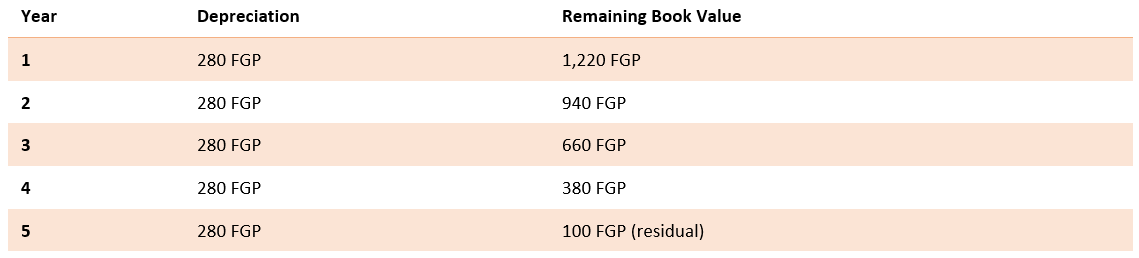
Example: A Sending Circle costing 1,500 FGP with a 100 FGP residual rune value after 5 years:

Annual Depreciation = (1,500 – 100) / 5 = 280 FGP per year

Magical Half-Life Depreciation

  • Ideal for enchantments that fade with time, like illusions, camouflage fields, or aura-based effects.
  • Value decreases by half each year or by magical potency intervals.

Example: Illusory Ward (600 FGP)

Ritual-Driven Declining Balance

  • Some magical investments lose value faster early on (e.g., temporary blessings or planar-tuned wards).
  • Use a declining balance method with a fixed percentage (e.g., 40% per year).

Accounting for Residual Magic

When enchantments fade, residual components (e.g., carved runestones, infused crystals, or blessed architecture) may retain scrap value:

  • Residual Value: Kept for repurposing or sale.
  • Re-enchantment Credit: Used to offset future enhancement costs.
  • Magical Salvage: Claimed by guilds like ARALCH if the enchantment was subsidized.

Triggering Revaluations

Some enchantments require mid-life reassessment, such as:

  • Leyline shifts that reduce potency.
  • Guild policy changes affecting regulatory compliance.
  • Damage or misfires reducing duration or effectiveness.

In such cases, a revaluation or impairment adjustment may be applied to reflect the true market or magical value of the asset.

When to Expense Instead of Depreciate

Not all enchantments qualify for depreciation. Short-duration effects, consumable spell contracts, or one-time arcane services (e.g., teleportation, weather summoning) are typically expensed immediately.

Expensed Examples:

  • Alarm spell cast on a single delivery (15 FGP, one day)
  • Sending scroll rental for a merchant’s urgent message (50 FGP, one use)
  • Hallowing a tent before a diplomatic negotiation (100 FGP, single event)

Conclusion

Even in a world saturated with wonder, magic must bow to the ledger. By tracking long-term magical enhancements as depreciable assets, organizations ensure more accurate valuations, realistic budgeting, and better forecasting for re-enchantment cycles.

Whether you’re protecting your warehouse with dragon wards or tuning a lighthouse to repel banshees, accounting for the slow fade of magic is a critical part of surviving in a realm where commerce is every bit as arcane as the spells that fuel it.

Get your own AD&D365 Environment

For more enchanted finance, get your guide at adnd365.com/start, and explore the public accounting samples at https://public.adnd365.com

Login npc@adnd365.com

Password N0nPl@yC#822!

Support the AD&D365 Project on Patreon

To grow this world, we’ve launched an official Patreon where supporters can gain access to exclusive content, tools, training labs, and even influence the future of the project. Your support fuels more than just development, it expands the guildhall, forges new scrolls, and empowers the next generation of configuration wizards.

Begin your journey: https://www.patreon.com/adnd365/

Thanks to my supporters (past and present) for helping make this content possible:

Sunil Panchal , Michael Ramirez, PMP , Sarah D. Morgan , Nick Ramchandani , Daniel Kjærsgaard and Tomasz Pałys.

In the heart of Faerûn’s bustling Sword Coast, the Waterdeep Trading Company continues to lead the way in magical manufacturing and logistical innovation. Whether it’s potions distilled in our alchemical towers or enchanted gear forged in subterranean workshops, one of the invisible engines of our operations is a powerful, often misunderstood tool: the Phantom Bill of Materials, or Phantom BOM.

What Is a Phantom BOM?

A Phantom BOM is a logical grouping of components used during production that doesn’t exist as a physical, stored item. These assemblies are consumed immediately during the crafting process, streamlining production without complicating inventory management.

Rather than being crafted, stored, and later consumed, Phantom BOMs are exploded into their individual components as part of a larger recipe. It’s like a stage in cooking where you mix spices before they hit the stew — you never bottle that spice blend, but you always prepare it.

When We Use Phantom BOMs

The Waterdeep Trading Company uses Phantom BOMs extensively across a variety of processes:

Case Example: Potion of Silent Stride

To illustrate, let’s look at one of our popular stealth products: the Potion of Silent Stride.

Rather than list all ingredients directly every time, we use a Phantom BOM called Essence Shadowkit, a reusable alchemical base that appears in multiple recipes.

Phantom BOM – Essence Shadowkit

This bundle is never stocked. Instead, it’s immediately broken down into its parts when crafting the parent potion. It ensures consistent quality and reduces duplication across our recipes.

Why We Use Phantom BOMs

Avoiding Common Mistakes

Like any powerful tool, Phantom BOMs come with a few caveats:

1.        Don’t Treat Them Like Stock Phantom BOMs aren’t items you store or move. They only exist within the crafting plan.

2.        Include Route Details Where Needed If the phantom process has specific steps (e.g., chilling vapors or combining extracts), those must be folded into the overall plan.

3.        Track Cost Impacts Carefully Phantoms don’t carry costs themselves. Costs should always roll up to the final crafted product.

The Invisible Backbone of Production

Phantom BOMs are like ghostly assistants on the production floor — they never clock in, but they always get the job done. Whether you’re enchanting a blade, bottling a potion, or preparing scrolls for export to Thay, using these invisible bundles brings consistency, clarity, and speed.

At the Waterdeep Trading Company, we trust our phantoms — and not just the ones haunting the lower warehouses.

To learn more trade secrets and optimize your own manufacturing guild:

Buy the official guides at adnd365.com/start Request access to the public demo database at public.adnd365.com

Login: npc@adnd365.com Password: N0nPl@yC#822!

When most adventurers think of critical gear, their minds turn to enchanted weapons, shimmering cloaks, or potent healing draughts. But there’s one unsung hero in every rucksack, every military crate, and every ship’s galley: the Hardtack Loaf.

Built for Survival, Not for Taste

The hardtack loaf is a dense, triple-baked, long-lasting bread—flavorless, tough, and enduring. It’s not trying to win any culinary contests. Its purpose is singular: sustain life. With a shelf life measured in decades (or longer), it resists mold, insects, and even the occasional siege.

Breakable only with a pommel or boot heel, it’s more weapon than snack. But softened in stew or ale, and paired with a chunk of salted pork or cheese, it becomes a nostalgic reminder of hearths far from the battlefield.

Cost to Produce

Let’s break down the economics behind this survival essential. Here’s what it costs to produce 100 loaves:

That’s right—less than half a Faerûnian Silver Dragon per loaf. And with a retail markup of 0.69 FSD and wholesale options starting at 0.60 FSD, hardtack brings in profit margins that even a Zhentarim quartermaster would respect.

Regional Price Variation

Not all economies treat hardtack equally. By applying regional Economy Type Modifiers, you get price realism across Faerûn:

Imagine the profit potential when buying low in Daggerford and selling high in Port Nyanzaru.

Crate-Level Supply & Demand

Crates of hardtack (100 loaves each) are shipped across the continent to organizations like:

That’s over 13,000 loaves monthly to named buyers alone, with more forecasted based on regional campaign seasons and winter stockpiling.

Capital Investment & Workforce

To get a hardtack operation running, you’ll need:

And a team of six cross-trained workers producing up to 100 loaves per batch/day, including an ovenmaster, bakers, and haulers.

Planning for the Future

A monthly demand forecast shows strategic consumption spikes:

Using this data, supply chain managers at the Waterdeep Trading Company can optimize procurement, scale batches, and even model profitability across trade routes using margin-based forecasting.

Final Thoughts

The hardtack loaf may be simple, but it sits at the center of some of the most complex logistical webs in Faerûn. It powers armies, fuels adventurers, and ensures caravans survive long hauls. If you’re not selling hardtack, you’re leaving money on the table—and possibly your crew hungry in the field.

Start modeling your Faerûnian business today. Get the full Advanced Dungeons & Dynamics 365 guides at adnd365.com/start, and see the public view of the current database by logging in at https://public.adnd365.com using:

Login: npc@adnd365.com

Password: N0nPl@yC#822!

The Waterdeep Trading Company employs a wide range of talent—from guild-trained accountants in Baldur’s Gate to teleportation-circle custodians in Elturel. With such a diverse and magically-inclined workforce, offering the right benefits isn’t just important—it’s essential for survival, morale, and long-term productivity (especially in a realm where “occupational hazard” may include basilisk encounters).

But how do we track benefits, manage eligibility periods, and enable self-enrollment in a setting where both arcane scrolls and labor contracts exist side-by-side?

The answer lies in our adoption of Advanced Dungeons & Dynamics 365.

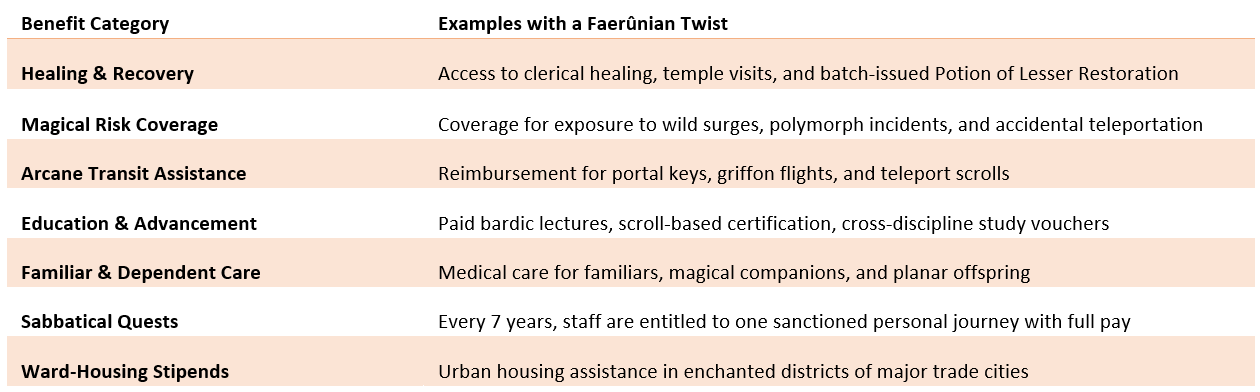
What Counts as a Benefit in Faerûn?

Employee benefits in Faerûn go well beyond the mundane. Here’s a breakdown of what we manage at WDTC:

Let the Adventurers Choose: Self-Service Enrollment

In the spirit of decentralization (and to avoid overworking our HR scribes), employee self-enrollment is a cornerstone of our benefit tracking system. Whether you’re a dwarven accountant working nights in Mithral Hall or a half-elf procurement officer stationed in Thay, you can manage your own benefits via the Employee Self-Service Portal in Dynamics 365 Human Resources.

Here’s how it works:

  1. Eligibility Flags: When a new employee is added, their race, class, guild affiliation, and role type automatically configure their base eligibility.
  2. Enrollment Periods: Two major periods are open annually — Greengrass (early spring) and Highharvestide (autumn harvest). A third “emergency re-enrollment” is available during Time of Troubles declarations.
  3. Benefit Elections: Employees can opt into available plans through an intuitive, portal-based interface. Each option includes a description, value in GP, duration, and special magical considerations.
  4. Familiar Enrollment: Employees with bonded companions can select add-on options for Familiar Healthcare, Companion Shadow Training, or Planar Travel Liability Coverage.

“I signed up for the Arcane Accidents Protection plan just in time—our wizard sneezed during inventory and turned me into a stool. That’s at least a Tier 2 incident,” — Nharra Feldspar, Junior Enchanter, Skullport Branch

Controlling Enrollment with Periods and Rules

Just like any good system of laws in Waterdeep, benefits come with timelines and compliance windows. Dynamics 365 allows us to define benefit periods, event-based eligibility, and waiting periods for risk-heavy roles.

Standard Enrollment Periods

Eligibility Conditions

  • Waiting Periods: Employees classified as “Adventurer Class II or higher” must wait 30 days before Magical Risk plans are active.
  • Guild Membership Dependencies: Benefits for potion-makers, for instance, require active status in the Healers & Herbalists Guild.
  • Location-Based Restrictions: Some plans (like “Underdark Relocation Stipends”) are only available to employees based in subterranean postings.

Automation with a Magical Touch

Here’s what makes the WDTC system so efficient:

  • Automated Alerts for enrollment deadlines sent via Sending Stones or enchanted scrollmail
  • Approval Workflows using customizable rules (e.g., benefits for a druid require Druid Circle co-signature)
  • Reporting and Audit Trails to track who enrolled, when, and how the benefits align with compensation benchmarks
  • Benefit Forecasting with Power BI to estimate potions consumed per department, scroll usage by guild, and familiars vaccinated

Final Thoughts

Managing benefits across Faerûn isn’t just about compliance—it’s about culture. By empowering our employees to enroll themselves, timing those decisions with meaningful in-world events, and tracking magical and mundane needs alike, the Waterdeep Trading Company sets a new standard in workforce support.

Whether you run a guild, a keep, or a kraken-hunting charter, there’s a lesson here: Magic might make anything possible—but good HR practices make it sustainable.

 Want to build your own portal for Faerûnian benefits management? Download the full implementation guides at adnd365.com/start and explore our working demo at https://public.adnd365.com

Login: npc@adnd365.com

Password: N0nPl@yC#822!

Your next sabbatical quest awaits—track it properly.