Archive

Tag Archives: supply-chain

For the Waterdeep Trading Company, order quantity is not a clerical detail. It is a product strategy choice that shapes cash, risk, and service.

MOQ and EOQ only make sense when viewed through the lens of what a product is meant to do for the business. Some goods are built for volume. Others exist to deliver value, margin, or capability. When teams align product strategy with ordering behavior, decisions become more precise, and silent balance-sheet damage is avoided.

This article integrates the product strategy view, the MOQ-EOQ trade-off, and a worked example that makes the trade-off visible.

Two Product Strategies, Two Ordering Behaviors

Most products fall into one of two broad strategies. Bulk flow goods are designed to move. Value-sensitive goods are designed to protect margin and cash.

This classification should happen before any discussion of order size.

Bulk Flow Products

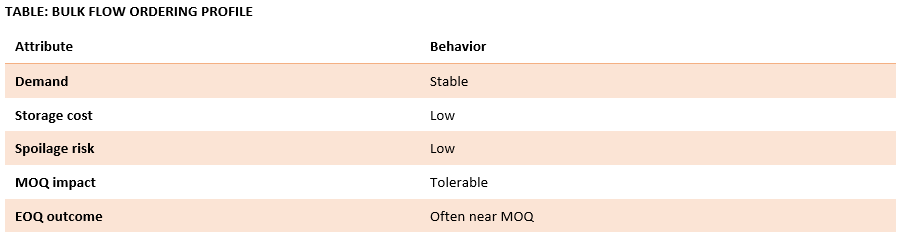
Bulk-flow products sell steadily, store cheaply, and rarely lose value over time.

For these goods, MOQ pressure is often acceptable. Excess stock turns quickly, and the business recovers its coin through normal sales.

EOQ still matters, but it often aligns closely with MOQ when holding costs and demand are well-balanced.

This is why buyers feel comfortable ordering by the crate or wagon.

Value Sensitive Products

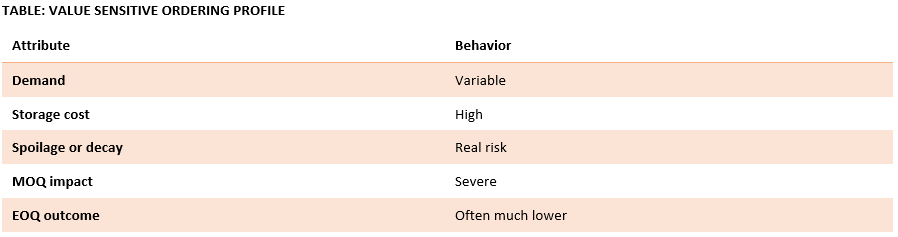
Value-sensitive products behave very differently.

Demand is uneven. Storage is costly. Risk rises the longer goods sit idle. These products punish excess.

Here, EOQ is usually far lower than the supplier’s MOQ. Every unit above EOQ increases tied-up cash and write-off exposure.

Accepting MOQ without challenge becomes a structural risk, not a short-term inconvenience.

These products are where ordering discipline matters most.

MOQ and EOQ Within Product Strategy

MOQ and EOQ serve different masters.

The supplier sets the MOQ and reflects their cost structure. It is a constraint.

The business sets the EOQ and aligns it with total cost and working capital goals. It is a decision target.

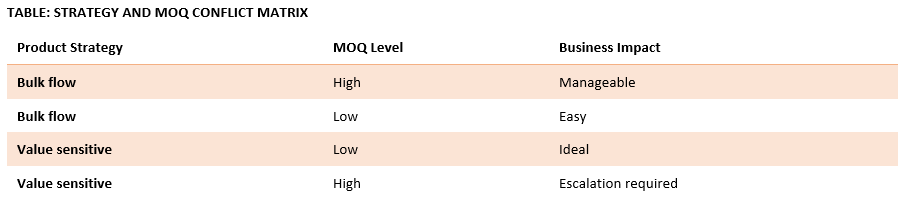
The conflict arises when the MOQ exceeds the EOQ.

This matrix alone often explains why an order feels wrong before numbers are even reviewed.

Worked Example

Consider the case of a specialty alchemical ink, favored by scribes and guild clerks. Annual demand remains modest but consistent, while the supplier insists on large batch distillations. This setup creates a classic tension between what the business wants to order and what the supplier requires.

When MOQ Sits Above EOQ

Consider the case of a specialty alchemical ink, favored by scribes and guild clerks. Annual demand remains modest but consistent, while the supplier insists on large batch distillations. This setup creates a classic tension between what the business wants to order and what the supplier requires.

Scenario Setup: The company sells a specialty alchemical ink used by scribes and guild clerks.  Annual demand is low but steady. The supplier only runs large batch distillations.

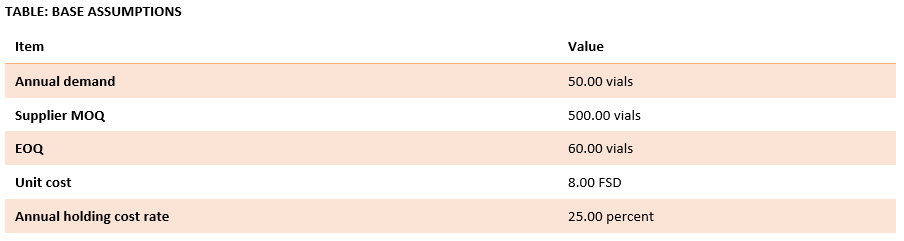
The following table summarizes the key assumptions for this scenario: annual demand is 50 vials, the supplier’s minimum order quantity (MOQ) is 500 vials, and the business’s calculated economic order quantity (EOQ) is 60 vials. Each vial costs 8 FSD, and the annual holding cost rate is 25%. By strategy, this ink is a value-sensitive product, making excess inventory a costly risk.

This is a value-sensitive product by strategy.

EOQ View: What the business would choose

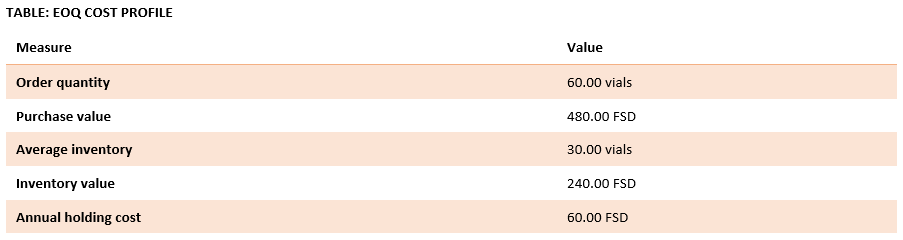
If the business could order at its preferred EOQ, the numbers reflect a lean approach: 60 vials per order, a purchase value of 480 FSD, and an average inventory of 30 vials. Inventory value stays at 240 FSD, with an annual holding cost of just 60 FSD. Cash exposure is limited, and inventory turns efficiently.

Cash exposure is limited, and inventory turns cleanly.

MOQ View: What the supplier requires

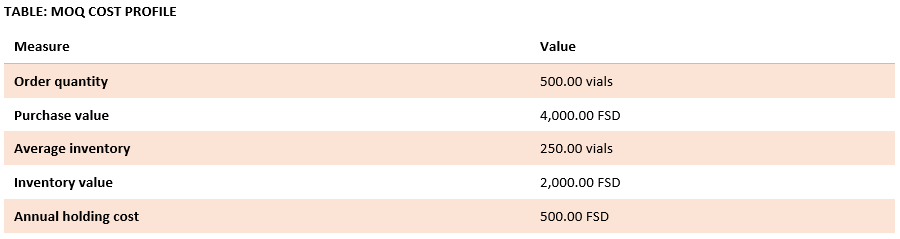
When the supplier’s MOQ dictates the order size, the impact is dramatic. The business must purchase 500 vials at once, tying up 4,000 FSD. Average inventory jumps to 250 vials, with a value of 2,000 FSD, and annual holding costs soar to 500 FSD. This approach locks up far more cash and increases the risk of unsold stock.

What Changed

Demand did not change. Unit cost did not change. Only the order quantity changed.

Cash tied up increased by 3,520.00 FSD. Annual holding cost increased by 440.00 FSD.

That difference lives entirely on the buyer’s balance sheet.

Making the Trade Off Visible: Buyer and Planner Checklist

Before placing an order that exceeds EOQ, teams should pause and answer the following.

Multiple No answers indicate that the order carries structural risk.

When This Becomes a Leadership Issue

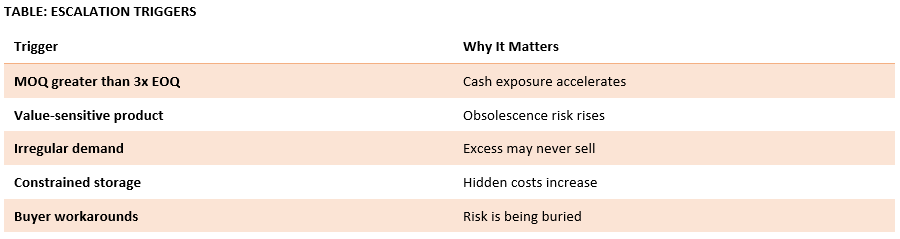
High MOQ on value-sensitive products should never be handled quietly.

These cases belong in sales and operations planning or integrated planning discussions, where demand, supplier strategy, and cash are reviewed together.

Negotiating With Strategy in Mind

Suppliers often defend MOQs on the grounds of unit price. That view ignores total cost.

Better discussions focus on shared value. Stable commitments, longer contracts, coordinated transport, or phased deliveries can lower MOQ pressure without harming supplier economics.

Strategy provides the leverage. Quantity follows.

Other Ordering Strategies to Consider Beyond MOQ and EOQ

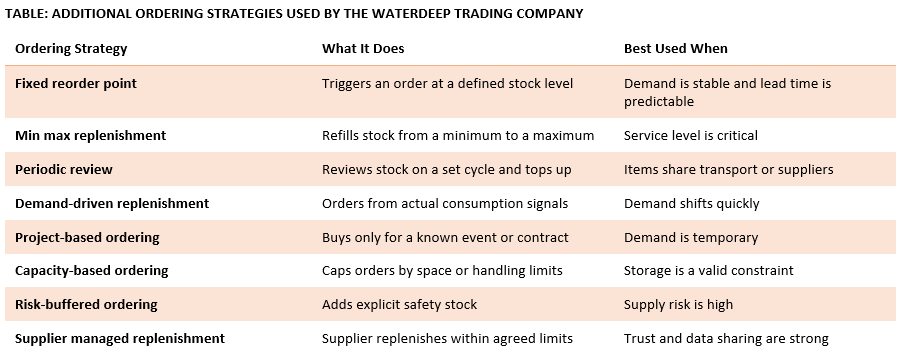
MOQ and EOQ frame the core tension between supplier constraints and internal cost control. The company also uses additional ordering strategies to fit product behavior, demand visibility, and risk tolerance. These approaches complement MOQ and EOQ rather than replace them.

These strategies let planners express product intent clearly. A healing potion may use min-max replenishment to protect service, while festival banners use project-based ordering to avoid leftovers.

Final Thoughts

Order quantity is not neutral. It reflects how a product creates value.

Bulk flow goods reward scale. Value-sensitive goods punish excess. MOQ is a constraint imposed from outside. EOQ is a choice made within the business.

When teams connect product strategy to ordering behavior, trade-offs become visible, intentional, and easier to lead.


Support the AD&D365 Project on Patreon.  To grow this world, we’ve launched an official Patreon page where supporters can access exclusive content, tools, and training labs, and even influence the project’s future. Your support fuels more than just development; it expands the guildhall, forges new scrolls, and empowers the next generation of configuration wizards.  Begin your journey: https://www.patreon.com/adnd365/

A Grateful Salute to Our Patrons.  To all those who stand behind the vision, thank you for helping bring this world to life. Our Benefactors, Andre Breillatt and Eryndor Fiscairn, your boundless generosity fuels the arcane core of this project. Without your magic, the weave would falter. Our Apprentices, the spell engines turn, and the training labs thrive thanks to our current Apprentices: Michael Ramirez and Andreth Bael’Rathyn. Special thanks to our past Apprentices, whose contributions helped us get here: Ralf Weber, Wendy Rijners, Shashi Mahesh, Julia Tejera, Ben Ekokobe, Tiago Xavier, Naveen Boyinapelli, Marcos Tadeu Wolf, Kathryn Greene, Jason Brown, Mark Christy, and Ashish Singh. Our Initiates, Jesper Livbjerg, Peter Lorre, Gregory Brigden, and Martin Grahm, your commitment marks the start of the deeper path, stepping beyond mere observation into the active shaping of this realm. Our Followers, your steady presence along the journey is a beacon of encouragement: Rusty Cavalier, Eric Shuss, Sunil Panchal, Sarah D. Morgan, Nick Ramchandani, Daniel Kjærsgaard, and Tomasz Pałys. And our Voyeurs, Harry Burgh, Abdelrahman Nabil, and Basil Quarrell, ever watching from the shadows, clearly intrigued… but not enough to part with a single gold piece. Your silent curiosity is noted and mildly judged.

Want to design your own economic models in Faerûn?  Get your own AD&D365 Environment and guides at adnd365.com/start, and request access to the public view of the current database at https://public.adnd365.com – Login npc@adnd365.com, Password N0nPl@yC#822!

In the merchant halls of Waterdeep, the potion caves of Baldur’s Gate, and the floating markets of Yartar, supply chains never sleep. To stay competitive, the Waterdeep Trading Company has embraced a model that allows vendors to deliver goods directly into our warehouses while retaining ownership. This practice is called Vendor Consigned Inventory, and it is as much about trust as it is about timing.

What Is Vendor Consigned Inventory

Vendor consigned inventory is a trade agreement in which a supplier delivers goods to the Waterdeep Trading Company, but retains ownership until the items are drawn, used, or sold. We hold the stock in our storerooms, ready to deploy, but do not pay until those goods are consumed.

This is a popular model for high-volume, high-value, or high-risk products. It allows the vendor to establish a strong presence in our distribution chain while WDTC avoids tying up coin in idle inventory.

Key Characteristics

Why It Benefits Vendors and WDTC

Vendor consigned inventory provides shared advantage. It is well suited for dynamic, multi-city operations like those run across Faerûn’s trade routes.

Faster Stock Availability: Stock is already in place. There is no delay due to shipment or customs approval. This is critical when responding to festival surges, urgent orders, or magical emergencies.

Lower Inventory Cost for WDTC: No upfront purchase means less coin locked in non-moving items. This makes room for a wider variety of vendor products to be available.

Improved Vendor Visibility: Vendors see real-time data on their consigned stock in our facilities. They can track drawdowns and plan restocking efforts precisely, even from distant cities like Elturel or Suzail.

Stronger Partnership Bonds: Vendors who consign with us often gain early access to seasonal forecasts, priority placement in our storefronts, and invitations to participate in specialty events.

The Process in Practice

Delivery and Receiving

Upon arrival, vendor inventory is inspected, rune-marked, and entered into the consignment ledger under a Vendor Ownership ID. Items are held in designated consignment zones until drawn.

Draw Events

Inventory is drawn when:

  • A customer purchases the product from a store or portal
  • The item is used in a kit, bundle, or manufacturing recipe
  • The item hits a spoilage or magical expiration threshold

Each draw event triggers a financial journal posting and notifies the vendor.

Settlement and Reporting

The system issues periodic settlement statements that include:

  • Quantity drawn since last settlement
  • Agreed-upon pricing and discounts
  • Payment due for each draw event
  • Inventory on hand at each warehouse location

Replenishment Triggers

The system monitors thresholds and predicts future demand using our enchanted forecasting model. Vendors are alerted when restocking is needed, and if desired, the replenishment order can be triggered automatically.

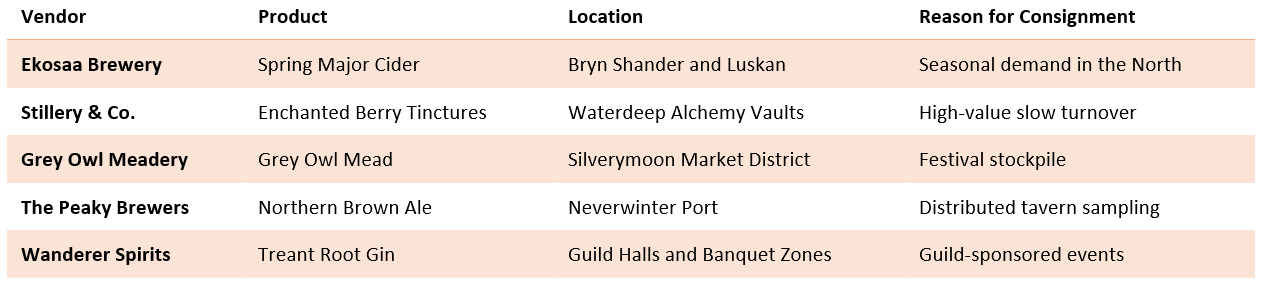
Examples of Vendor Consignment in Faerûn

Best Practices for Managing Vendor Consigned Inventory

  • Define clear ownership and draw point rules for each product
  • Use magical seals and ledger mirrors to track inventory status
  • Review stock levels weekly using the vendor inventory portal
  • Establish shared replenishment rules to avoid overstocking
  • Monitor draw event reports for accuracy and audit readiness

Closing Thoughts

Vendor consigned inventory brings power and flexibility to both sides of the supply chain. Vendors gain access to wide Faerûnian markets, and the Waterdeep Trading Company keeps its shelves stocked without overburdening its coffers. With magic-bound ledgers and real-time reporting tools, we make it easy to maintain trust and traceability.

Ready to become a trusted consignment vendor with the Waterdeep Trading Company? Start by visiting adnd365.com/start and request access to our public consignment portal at https://public.adnd365.com

Username: npc@adnd365.com

Password: N0nPl@yC#822!

For over a century, the Waterdeep Trading Company has been the heartbeat of Faerûn’s trade. From the frost-kissed docks of Icewind Dale to the coastal bazaars of Calimport, the Company moves goods through every season with precision.

Success here is not based on speed alone. It depends on timing.

Seasonal demand planning is the art of predicting what will be needed, when it will be needed, and how to ensure it arrives just in time. It is how the Waterdeep Trading Company avoids stockpiling cloaks in the heat of Flamerule or running out of cider during the first toast of Highharvestide.

The Calendar of Commerce

Faerûn’s calendar tells more than time. It reflects culture, climate, and consumption. Every month carries specific market behaviors and patterns.

Waterdeep Trading Company studies these cycles carefully and layers them into every supply and logistics plan.

How the Company Forecasts Demand

Historical records are the backbone of the Company’s seasonal forecasting. Scribes maintain product movement scrolls dating back several generations.

Here are a few forecasting techniques in practice:

  1. Rolling multi-year averages to compare monthly and festival-based trends across regions
  2. Contracts and standing orders from temples, noble houses, and guilds which repeat annually
  3. Predictive adjustments based on current market activity, such as harbor delays or rising prices from core vendors
  4. Sentinel dispatches from field agents who report signs of early shifts in demand or local disruptions

The result is a structured forecast that balances tradition with the changing tides of trade.

Seasonal Labor and Staffing

The flow of goods depends on the flow of hands. The Waterdeep Trading Company plans its workforce as carefully as it does its inventory.

  • In Deepwinter, fewer shipments mean a heavier focus on warehouse security and internal audits
  • In Spring, hiring increases as couriers, carriers, and sorters are deployed to reopen stalled trade routes
  • In Summer, nearly every department grows. Market tents, brewery lines, and ship crews all need additional labor
  • In Autumn, specialized workers such as grain assessors and preservation technicians are deployed to lock in inventory before the freeze

Many workers are brought in on rotating seasonal contracts, often earning guild certifications for each successful campaign.

Managing Supplier Constraints

Not every vendor can scale with seasonal demand. Some are limited by harvest cycles, others by labor, and a few by magical interference.

To manage these risks, the Company maintains a supplier tier system:

  • Primary suppliers are those with strong delivery history and seasonal reliability
  • Secondary suppliers are used during peak demand or to fill gaps when primary vendors fall short
  • Specialist vendors are called upon for short seasonal bursts, such as rare spices during feast days or potion ingredients during cold snaps

Every procurement team tracks lead times and past performance to determine who to trust and when to switch.

Special Contracts and Priority Orders

Seasonal shifts also mean more contract-based orders. Some examples include:

  • Military garrisons requesting rations before planned campaigns
  • Temples ordering ceremonial garb and incense ahead of holy days
  • Mercenary companies securing bulk gear and potions in advance of expedition season
  • Nobles requiring finery and decor ahead of social functions

The Company sets aside protected inventory and often reserves wagon space or teleportation slots for these clients. They are built into seasonal forecasts as immovable pillars.

Transportation Planning by Season

Logistics can be the difference between profit and loss during seasonal transitions. Travel conditions change rapidly, and the Company prepares for these disruptions with dedicated planning ledgers.

Every route has a seasonal modifier and an action plan in place before the first sign of disruption appears.

What Happens After the Season Ends

The Waterdeep Trading Company reviews each season within ten days of its end.

  • Unused goods are either rotated to other regions or sold at a discount
  • Performance of forecasts is measured against actual sales
  • Surprises or anomalies are recorded in the forecasting grimoire for future adjustment
  • Lessons learned are shared across all Company locations

This cycle of planning, acting, and reviewing has been central to the Company’s growth and resilience.

Closing Thoughts

Seasons affect everything. Weather shifts harvests. Holidays shift demand. Travel restrictions shift logistics. But a business that plans for the seasons instead of reacting to them will always come out ahead.

Waterdeep Trading Company invites others to study how preparation drives prosperity.

To access trade records, planning templates, and regional demand data, visit adnd365.com/start and request access to the public trade network at https://public.adnd365.com.

Login: npc@adnd365.com

Password: N0nPl@yC#822!

Prepare before the winds change. Trade like the season depends on it.

At the Waterdeep Trading Company, production efficiency is more than just a number on a ledger. It is the difference between an on-time delivery of potions to Silverymoon or a chaotic recall because a batch of fire resistance potions fizzled out mid-adventure. Whether we are bottling enchanted tonics or stitching high-grade leather satchels, the core of our operational success lies in the structure of our manufacturing routes.

And yes, routes are not just maps or travel paths. In manufacturing, a route is the formal recipe for how a product gets built, who does the work, in what order, using which tools, and for how long.

What Happens When Efficiency Drops?

Let us say you are running the Potionworks team, and you notice that the standard time to produce a batch of Potion of Giant Strength has slowly crept up by fifteen percent over the last quarter. It does not mean your alchemists are lazy. More likely, something in the route no longer reflects reality.

You might see results like this:

Where Route Adjustments Make the Difference

Adjusting a manufacturing route is not just about changing a number. It is about recognizing the evolving nature of work and making sure your systems reflect reality.

Update Task Durations

Add Alternate Operations

Reassign Resource Groups

Efficiency Tracking With Employee Profiles

Each worker has their own rhythm. Instead of a one-size-fits-all metric, track efficiency by skill, task type, and improvement over time.

Breaking Out Composite Steps

Some operations hide their inefficiencies inside multi-part steps. Separating them helps pinpoint exactly where slowdowns occur.

Quality Inspections Add Predictability

A well-placed inspection prevents rework, improves customer satisfaction, and gives employees more confidence in their work.

The Bigger Picture

Every route is a living system. Ingredients change. Regulations shift. Staff learn and grow. If the Waterdeep Trading Company kept its manufacturing routes static, we would be unable to handle product innovation, seasonal demand spikes, or guild audits.

By updating task durations, reassigning talent, building flexible alternatives, and embedding inspections, we create a production system that adapts with us. We do not just run a business, we run a guild-backed, customer-loved, efficiency-honed enterprise that runs like a dwarven clockwork engine.

Want to boost your own manufacturing efficiency and avoid magical misfires? Download the full Advanced Dungeons and Dynamics 365 guide at adnd365.com/start, and see it live in the public database at https://public.adnd365.com using:

Login: npc@adnd365.com

Password N0nPl@yC#822!

In Faerûn, having inventory on hand when the next caravan arrives is the difference between a profitable month and a letter of apology written in infernal ink. At the Waterdeep Trading Company, we don’t rely on wishful thinking or divination spells to keep our shelves stocked. We use Forecasting and Demand Planning in Dynamics 365 to stay ahead of the curve.

Let’s break down what that looks like when you’re supplying everything from iron spikes to cursed mirror cases.

What Is Forecasting?

Forecasting is the process of predicting future demand based on historical data, market trends, upcoming events, and customer behavior. In Dynamics 365, this can be driven by:

  • Historical sales
  • Purchase trends
  • Manual adjustments
  • External factors (festivals, raids, wars, winter wolf migration patterns)

Forecasts can be entered manually or generated using built-in models, which project expected demand over a defined horizon. These forecasts can be set at various levels:

  • By item
  • By item group
  • By customer or sales channel
  • By warehouse or region

Example: Forecast for Health Potions

What Is Demand Planning?

Demand planning takes that forecast and aligns it with inventory, procurement, and production. It helps answer:

  • Do we have enough raw materials?
  • Should we increase safety stock?
  • Should we initiate new purchase orders or production runs?

In Dynamics 365, this process feeds into Master Planning, where forecasted demand is treated like confirmed orders, generating planned supply suggestions. These can include:

  • Planned purchase orders
  • Planned transfer orders
  • Planned production orders

Why It Matters for the Waterdeep Trading Company

Greta Ironfist, our fearless founder, once said:

“If you can predict the next spike in rope demand during troll season, you don’t need luck. You need a forecast.”

In the past, too many decisions were based on guesswork. Now, by using historical trends and adjusting for regional events (like the Annual Adventurers’ Expo in Silverymoon), we’re better prepared for demand fluctuations.

Best Practices in Dynamics 365 for Forecasting

Start with historical data: Use the Forecast planning workspace or Excel templates to analyze patterns.

Segment your products: Forecast high-volume items differently from rare or seasonal goods.

Involve stakeholders: Sales, warehouse managers, and even suppliers may have insights that raw numbers miss.

Adjust forecasts regularly: Update based on shifting trends, marketing events, or monster incursions.

Use forecast reduction: Let actual sales orders reduce the forecast so you don’t double-count demand.

Putting It Into Action

Let’s say you forecast a rise in demand for Frost Resistance Gear due to early winter reports from Icewind Dale. Dynamics 365 will recommend boosting production of frost cloaks and earmuffs, generating supply plans to meet the projected demand before it becomes a problem.

These forecasts then flow into:

  • Master Planning for automated supply suggestions
  • Warehouse stocking plans
  • Cash flow planning based on expected procurement

Final Thoughts

Forecasting and demand planning in Dynamics 365 give you something better than magical foresight — real-time, data-driven decisions that protect margins and customer satisfaction.

You no longer need to pray to Mystra for inventory clarity. With the right setup, you can plan your way to profitability and avoid the scroll of backorders altogether.

Ready to build your own forecasting models and master plans?

Start your journey today with the Advanced Dungeons & Dynamics 365 guides at adnd365.com/start

You can also test it yourself in a live environment at https://public.adnd365.com

Login: npc@adnd365.com

Password: N0nPl@yC#822!